

Table of Contents
The Script That Changed Everything (And the One That Almost Ended a Channel)
David had 8,000 subscribers. He posted every week without fail. His thumbnail game was strong. His topics were relevant.
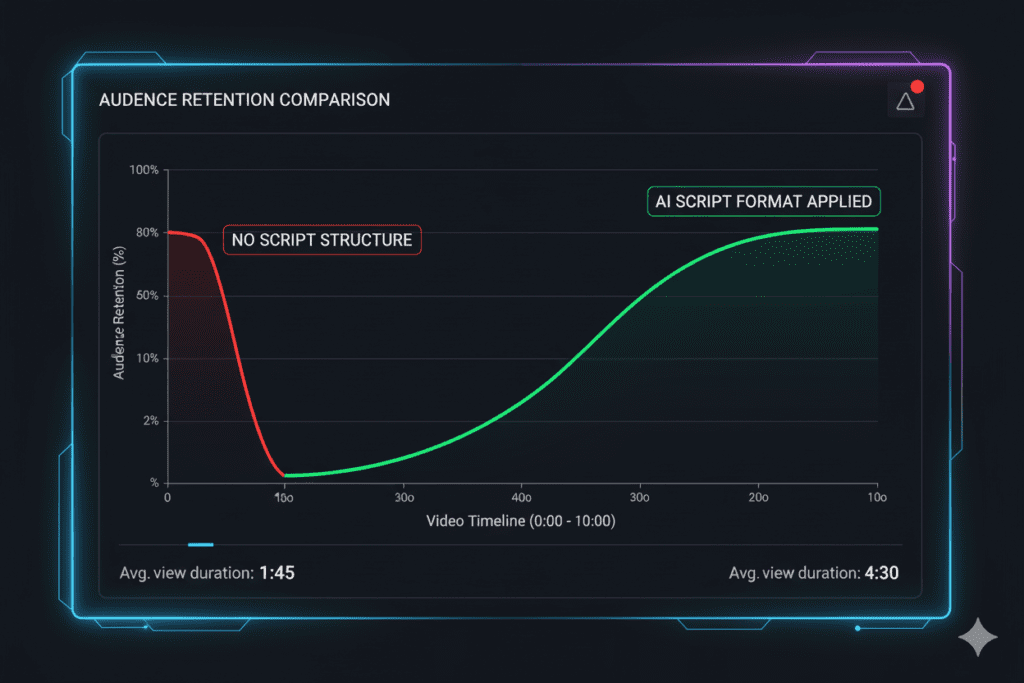
But his average view duration was stuck at 28%. For every 10-minute video, most viewers were gone by the three-minute mark.
One afternoon, he finally did what he’d been avoiding — he rewatched his own videos like a stranger would. And what he found was brutal.
His intros rambled for 90 seconds before getting to the point. His segments had no connective tension. His midpoints dragged. And his endings? He’d been ending videos with “anyway, that’s all for today” — essentially telling the algorithm to stop recommending his content.
His content was good. His YouTube script format was broken.
He rewrote his next video using a structured YouTube script format AI tool. Tight hook in the first 10 seconds. A clear value promise up front. Pattern interrupts every 90 seconds. A mid-point retention hook. A strong closing CTA.
The video hit 67% average retention. The algorithm pushed it to 40,000 views in two weeks. His channel grew by 1,200 subscribers that month alone — more than the previous six months combined.
That’s the power of the right YouTube script format AI system. And in this guide, you’re going to learn exactly how to build one for yourself.
Why Your YouTube Script Format AI Is the #1 Driver of Watch Time
Before we dive into formats and frameworks, let’s talk about why this matters so much — because the data is eye-opening.
The 2026 average retention across all YouTube videos is just 23.7%, with over 55% of viewers leaving within the first 60 seconds. Think about that. More than half your audience is gone before your video even gets going — unless your script gives them a reason to stay.
And it gets more direct than that. YouTube’s algorithm in 2026 primarily rewards watch time and retention rate. A 10-minute video with 80% retention beats a 20-minute video with 30% retention every single time. The algorithm prioritizes viewer satisfaction over raw length or view count. When retention drops below 40%, YouTube actively deprioritizes the video regardless of how good its CTR is.
Your script is the cheapest lever you control — and the most powerful one. A tight, viewer-focused YouTube script front-loads value so the first 15 seconds flatten instead of free-fall, shaves hours off editing because you already know which takes and B-roll to keep, and bakes in SEO because every keyword you speak gets auto-captioned and indexed.
Your camera, your lighting, your editing software — none of it matters if the words aren’t structured to keep people watching. Here’s what poor script format costs you in real terms:
- Algorithm suppression — Low retention flags your video as low-quality, and YouTube stops recommending it to new viewers.
- Wasted production time — Hours of filming and editing, undone by a weak hook and a wandering structure.
- Subscriber loss — Viewers who click away early rarely return. They don’t subscribe to channels that waste their time.
- Monetization impact — Low watch time means fewer mid-roll ad plays, which directly reduces your ad revenue per video.
The good news? YouTube script format AI tools have made it faster and easier than ever to write scripts that retain viewers from the first second to the last. You don’t have to figure it out through trial and error anymore.
The 3 Core YouTube Script Formats Every Creator Needs to Know
Not all videos need the same format. The format that works for a 10-minute tutorial is completely different from one that works for a 90-second YouTube Short. Understanding the right format for each video type is the foundation of effective YouTube script format AI usage.
Here are the three core script formats — and when to use each one.
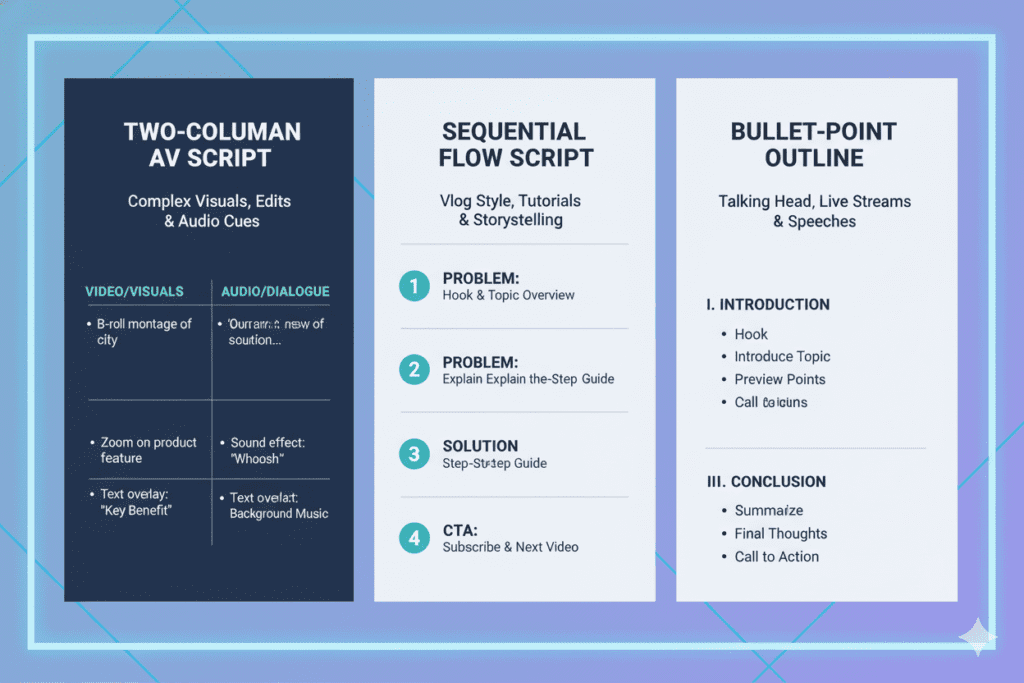
Format 1: The Audio/Visual (AV) Two-Column Script
This is the most professional and production-ready YouTube script format. A YouTube script template uses a two-column format to separate audio elements like voice-over, sound effects, and music from visual elements.
Left column: Spoken dialogue, narration, and audio cues. Right column: Visual directions — b-roll descriptions, camera angles, graphics, and on-screen text.
Best for: Tutorial videos, explainers, product reviews, faceless voiceover channels, and any video where the visual and audio tracks need precise synchronization.
Why it works: A script with visual cues is more than just a transcript — it’s a production blueprint. By planning where a graphic will pop up or a new camera angle will appear, you’re scripting viewer retention right into the DNA of your video.
Format 2: The Sequential Flow Script
This is a single-column, chronological script — the format most similar to how a film script or article reads. No columns. No visual cues. Just the complete spoken script written in the order it will be delivered.
Best for: Talking-head commentary channels, personal story videos, opinion content, and any creator who films solo without complex production elements.
Why it works: It’s fast to write and easy to read on camera. It keeps your delivery natural and conversational, which is critical since videos perceived as heavily AI-generated or “low-effort AI slop” show an average 70% lower audience retention compared to human-fronted or high-effort original content. A sequential script helps you sound human, not robotic.
Format 3: The Bullet-Point Outline Script (Level 2 Scripting)
This sits between a fully written script and pure improvisation. At this level, you use bullet points with more detail, breaking each segment down into three key elements: Setup (explain why the segment is important), Tension (gradually add information and build towards the reveal), and Payoff (reveal the exciting or important information).
Best for: Experienced creators who are comfortable on camera, conversational vlogs, and podcast-style content where a natural flow matters more than precision.
Why it works: It keeps you flexible and authentic while still ensuring you hit every key point in the right order. The setup-tension-payoff structure baked into each bullet point naturally builds viewer retention without a word-for-word script.
The Anatomy of a High-Retention YouTube Script Format
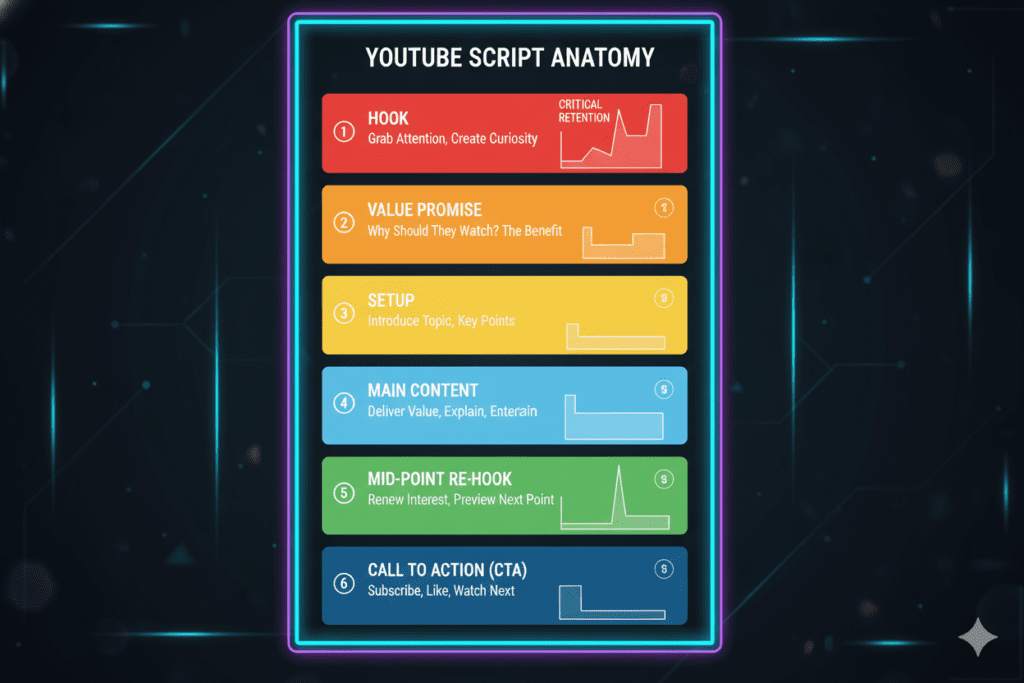
Regardless of which format you use, every high-performing YouTube script shares the same core anatomy. Miss any one of these sections and your retention will suffer.
Here’s the exact structure that top creators — and the best YouTube script format AI tools — build every video around.
1. The Hook (0:00 – 0:10)
This is the single most critical section of your entire video. 20–40% of viewers drop off in the first 10 seconds. They clicked your video based on title and thumbnail, but if the opening doesn’t immediately confirm they’ll get what they came for, they’re gone.
A strong hook does one of three things: makes a bold, specific promise (“I spent $10,000 testing 50 AI tools — here are the only 3 worth your time”), reveals a surprising fact that demands an explanation, or opens an irresistible curiosity gap that the viewer has to resolve.
Your hook should never start with “Hey guys, welcome back to my channel.” That’s not a hook. That’s a fast-forward button.
2. The Value Promise (0:10 – 0:30)
Immediately after your hook, tell viewers exactly what they’re going to learn or experience by watching. Be specific. Be fast. Make them feel like watching this video is the best decision they’ve made all day.
Example: “By the end of this video, you’ll have a complete YouTube script format AI system you can use for every video you make — starting today.”
This section is what converts a curious viewer into a committed one.
3. The Setup and Context (0:30 – 1:30)
This is where you briefly establish the stakes. Why does this topic matter? What problem does the viewer have that your video is going to solve? This is where structured storytelling or teaching begins — and your script should align with your overall content strategy.
Keep it tight. Viewers don’t watch YouTube for long preambles. They watch for solutions.
4. The Main Content Sections (With Pattern Interrupts)
This is the body of your video — the substance your viewer came for. The key to holding retention through this section is pattern interrupts: small, intentional changes in pace, tone, or visual format that reset the viewer’s attention every 90 seconds or so.
In a 15-second section, you can have 4 pattern interrupts (screen cut, zoom, return to camera, expression) maintaining visual interest. Think of each segment as its own mini-story with a setup, a tension point, and a payoff.
5. The Mid-Point Re-Hook (For Videos Over 8 Minutes)
Longer videos (over 10 minutes) risk a 15% secondary viewer exodus around the 55–65% mark without re-engagement tactics. This is the “danger zone” for long-form content — right around the halfway mark.
Script in a deliberate re-hook here: a new revelation, a surprising turn in the narrative, or a teaser of what’s coming in the second half. Something that makes walking away feel like a mistake.
6. The Conclusion and CTA
Your conclusion should deliver on every promise your hook and value statement made. Recap the key takeaways. Then give a clear, specific call to action — subscribe, watch the next video, download a resource, leave a comment.
Note: only 16% of viewers, on average, reach the final 10 seconds of a video. That’s why your CTA shouldn’t wait until the very end — place a soft CTA at the 50–60% mark as well, while more viewers are still watching.
5 Proven YouTube Script Format Frameworks That Beat the Algorithm
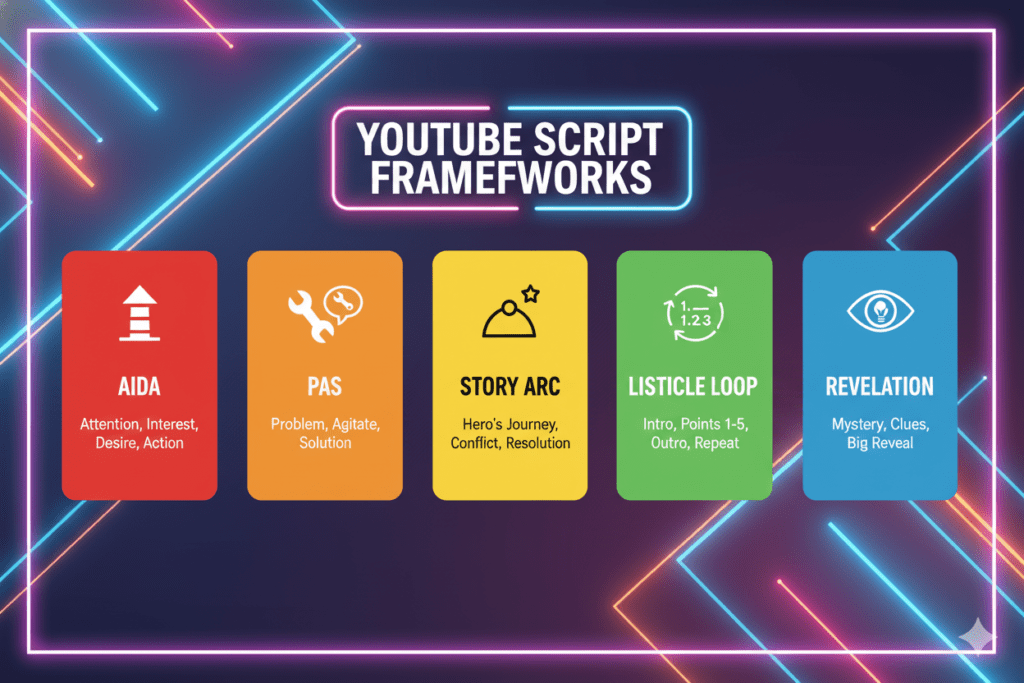
The best YouTube script format AI tools are built around tested psychological frameworks — not random writing patterns. Here are the five frameworks you’ll encounter most in high-performing YouTube content.
Framework 1: AIDA (Attention → Interest → Desire → Action)
The oldest marketing framework in the book — and still one of the most effective for YouTube scripting.
- Attention: Hook them in the first 10 seconds.
- Interest: Build curiosity and context in the setup.
- Desire: Show them what their life looks like after they apply this information.
- Action: Give a clear, compelling CTA at the end.
Best for: How-to tutorials, product reviews, skill-building content.
Framework 2: PAS (Problem → Agitate → Solution)
This is the go-to framework for any video addressing a pain point — which is most high-performing YouTube content.
- Problem: Name the specific issue your viewer is experiencing right now.
- Agitate: Make them feel the weight of that problem. Add emotional stakes.
- Solution: Present your video’s content as the clear, actionable answer.
Example opening: “Your videos aren’t growing. It’s frustrating watching others succeed and you not. Here’s the script structure that fixes it in 5 easy steps.”
Best for: Growth advice, health and fitness content, finance and side hustle videos.
Framework 3: The Story Arc (Hook → Rising Tension → Resolution)
Narrative scripting that treats your video like a short story.
The viewer is the main character. The problem is the conflict. Your content is the resolution — a structure often guided by YouTube script format AI to keep the story clear and engaging.
This framework works exceptionally well for personal story videos, case studies, and transformation content — where the emotional journey is as important as the information.
Best for: Personal development, “I tried this for 30 days” videos, creator journey content.
Framework 4: The Listicle Loop
Structure your video around a numbered list — and tease the entire list at the beginning. A good way to structure your content section is to use lists. People will want to stick around until you deliver the final item because that’s the complete loop. If you stop at number four and don’t close the loop by delivering five, your audience will feel ripped off.
Each list item acts as its own mini-hook, pulling the viewer forward to the next one.
This structure works especially well when planned with YouTube script format AI, helping organize each segment clearly and keep the viewer moving to the next point.This framework has some of the highest average retention rates of any YouTube format because viewers are psychologically driven to complete what they started.
Best for: Rankings, tips lists, gear roundups, top-10 style videos.
Framework 5: The Revelation Structure
Build your script around a surprising insight, counterintuitive finding, or little-known fact — and tease it from the very first line.
“The YouTube advice you’ve been following for years is actually killing your channel. Here’s what nobody tells beginners.”
Everything from the hook to the midpoint builds anticipation for the revelation. When it finally lands, it delivers an emotional payoff that makes viewers share the video.
Best for: Opinion content, “things I wish I knew” videos, niche-specific insider knowledge.
YouTube Script Format AI: How AI Transforms the Way You Write Scripts
Let’s be honest about what writing a great YouTube script actually takes when you do it manually.
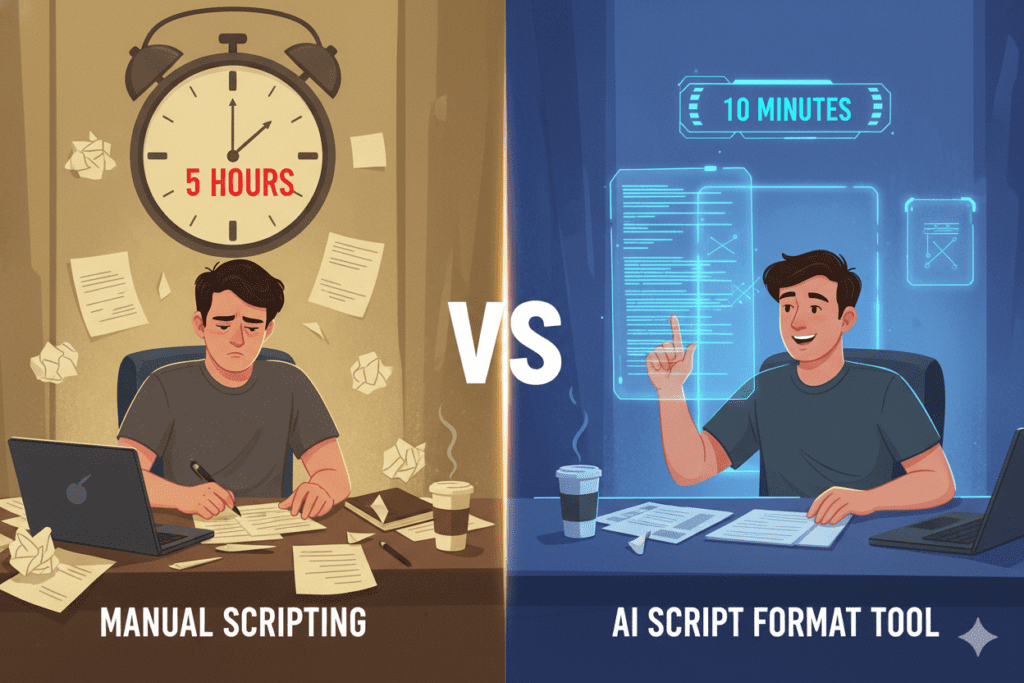
You need to research your topic. Build an outline. Write a compelling hook — then rewrite it three times. Draft the full script. Read it aloud. Edit for pacing. Add in visual cues. Check the word count against your target run time. Then review the whole thing again to make sure it doesn’t sound robotic.
For a 10-minute video, that process typically takes four to six hours. For a creator posting three times a week, that’s up to 18 hours of script writing alone — before you’ve filmed a single frame.
YouTube script format AI changes this math completely.
Over 64% of marketers are already using AI tools to speed up content production. AI script writing tools can analyze what’s trending, generate compelling hooks, structure your content logically, and even match your personal tone and style. What used to take half a day now takes minutes.
But there’s an important distinction the best creators understand. Channels that let AI draft outlines, then added human jokes and anecdotes, lifted average view duration by 14% compared to fully manual or fully automated scripts. The winning approach is the hybrid: AI handles the structure, research, and formatting; you add the personality, the stories, and the voice.
Here’s what YouTube script format AI does exceptionally well:
- Generates your hook instantly — instead of staring at a blank page, you have five strong hook options in seconds.
- Applies proven retention frameworks automatically — AIDA, PAS, Listicle Loop — the AI knows which one fits your video type.
- Paces your script for the right run time — automatically calculating word count against your target video length.
- Builds in pattern interrupt cues — flagging where to cut, zoom, or shift delivery to maintain viewer attention.
- Integrates keywords naturally — so your spoken words contribute to YouTube SEO through auto-captions, without sounding forced.
- Generates your title, description, and tags alongside the script — so everything is optimized as one cohesive package.
Without YouTube script format AI, manual scripting is the single biggest time sink in a creator’s workflow. With it, that time sink becomes a 10-minute asset-building session that produces better results than hours of manual work ever could.
How ytZolo’s YouTube Script Format AI Creates Retention-Optimized Scripts Instantly
Here’s the problem with most AI writing tools when it comes to YouTube scripting: they’re built for readers, not viewers.
A generic AI tool like a standalone chatbot doesn’t understand the difference between a hook that works on a blog post and a hook that grabs a YouTube viewer in three seconds. It doesn’t account for retention drops, pattern interrupts, the psychological pull of a listicle loop, or the mid-point re-hook that prevents the 55–65% drop-off danger zone.
That’s precisely what ytZolo is built to solve.
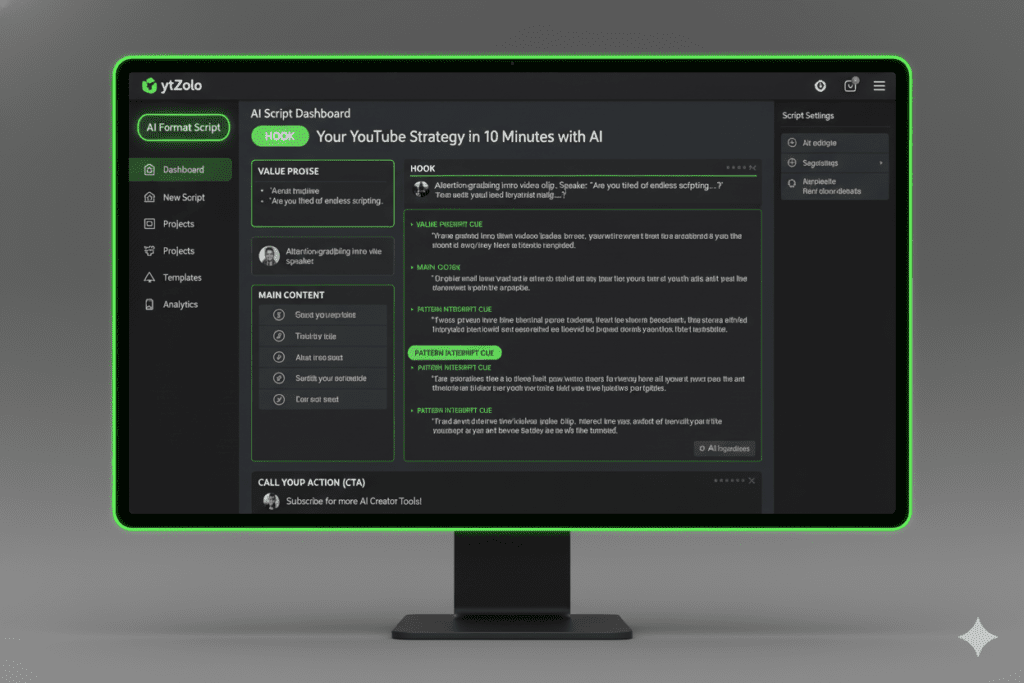
ytZolo is an all-in-one AI YouTube growth tool designed from the ground up by people who understand the YouTube algorithm, creator psychology, and what actually drives channel growth. Its YouTube script format AI doesn’t just generate text — it creates video-native scripts that are structured for retention, optimized for search, and formatted for the way real viewers watch.
Here’s exactly what ytZolo’s YouTube script format AI does that other tools can’t match:
- Retention-Optimized Script Structure — Every ytZolo script is built around proven formats: tight hook, clear value promise, segmented main content with pattern interrupt cues, mid-point re-hook, and a strategic CTA. The same structure that top creators spend years learning manually is built into every output.
- Hook Variations on Demand — ytZolo generates multiple hook options for your video topic so you can pick the one that aligns best with your audience’s current pain point. No more agonizing over the first 10 seconds.
- Tone Adaptation by Niche — Whether your channel is fast-paced and energetic, calm and educational, or entertaining and story-driven, ytZolo adapts the script tone to match. Generic AI doesn’t do this. ytZolo does.
- Keyword-Integrated Dialogue — Your target keywords are woven naturally into the script so every word you speak contributes to YouTube’s auto-caption indexing and improves your video’s search ranking.
- Complete Content Package in One Click — When ytZolo writes your script, it simultaneously generates your optimized title, SEO description, tag set, and thumbnail concept direction. One input. A full pre-upload content brief ready to go.
With ytZolo, a full, structured YouTube script is generated in under 60 seconds. From there, light customization adds another 2–5 minutes. Compare that to 2–4 hours of manual research and writing per script.
That’s not a marginal time saving. That’s a transformation in how you create. And it’s why thousands of creators have already made ytZolo their YouTube script format AI tool of choice.
Explore everything ytZolo can do at ytzolo.com — and check out deeper script strategy guides on the ytZolo blog.
Why ytZolo Is Better Than Other YouTube Script Format AI Tools
The market for YouTube script format AI tools has grown fast. You have options. But options aren’t equal — and for YouTube specifically, the differences matter in ways that show up directly in your retention graphs.
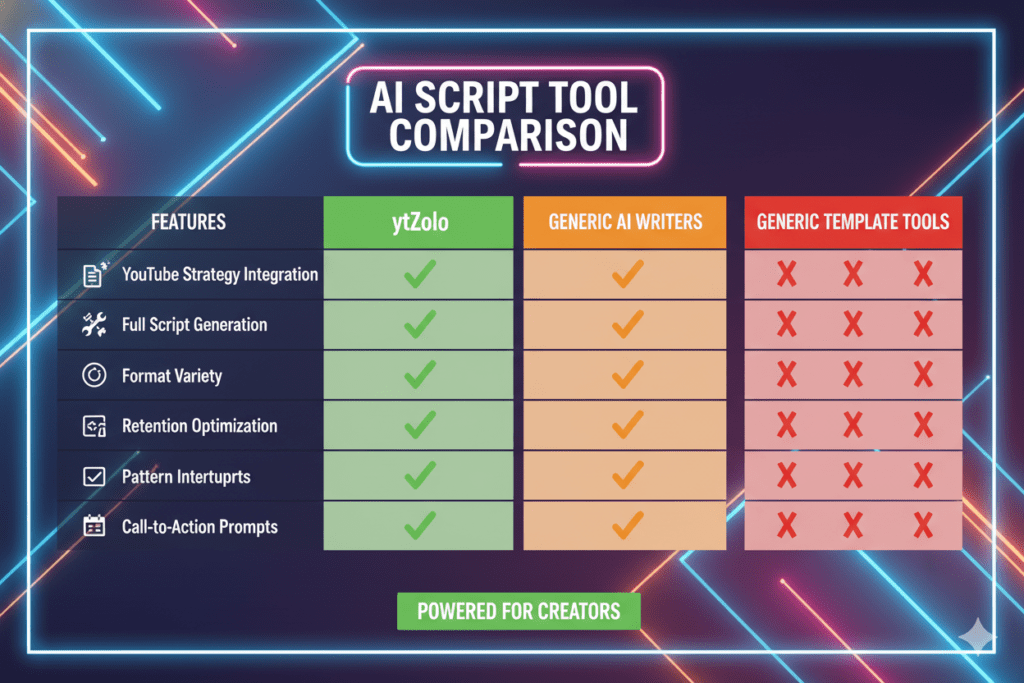
Here’s how ytZolo compares to the alternatives:
| Capability | ChatGPT / Claude (Standalone) | Jasper / Copy.ai | VidIQ Script Generator | ytZolo |
|---|---|---|---|---|
| YouTube-native script structure | ❌ (generic) | ❌ (marketing-focused) | Partial | ✅ Fully YouTube-optimized |
| Built-in retention frameworks | ❌ | ❌ | ❌ | ✅ AIDA, PAS, Listicle, Story Arc |
| Pattern interrupt cues in script | ❌ | ❌ | ❌ | ✅ Built-in |
| Hook variation generator | ❌ | Partial | ❌ | ✅ Multiple options |
| Keyword-integrated dialogue | ❌ | Partial | ❌ | ✅ Automatic |
| Title + description + tags with script | ❌ | ❌ | Partial | ✅ Complete package |
| Thumbnail concept alongside script | ❌ | ❌ | ❌ | ✅ |
| Script generation time | 10–20 min (prompt engineering needed) | 15–30 min | 10–15 min | Under 60 seconds |
The pattern is clear. Every alternative requires you to either prompt-engineer your way to a structured output (slow and inconsistent), or use a marketing-writing tool that doesn’t understand YouTube retention mechanics (ineffective for the platform).
A generic AI writing tool doesn’t understand watch time, YouTube SEO, algorithm signals, or what makes a script watchable vs. just readable. That’s why having a tool built specifically for YouTube creators makes all the difference.
ytZolo was purpose-built for creators who care about growing their channel — not just generating content. It’s the only YouTube script format AI tool that delivers a complete, retention-optimized script alongside every other piece of your video’s pre-upload package.
One tool. One session. Everything you need to film and upload — ready to go.
Head to ytzolo.com to see it in action.
Step-by-Step: Building Your YouTube Script Using AI in Under 10 Minutes
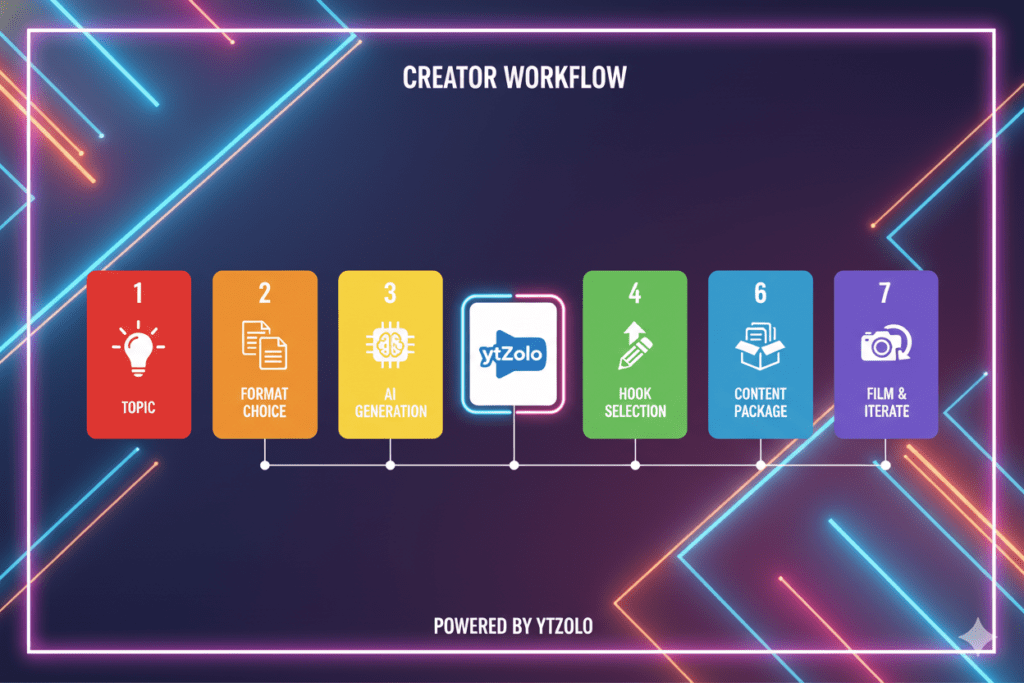
Ready to try this yourself? Here’s the exact process for using YouTube script format AI to go from blank page to upload-ready script brief in under 10 minutes.
Step 1: Define Your Video Topic and Target Keyword (1 minute)
Be specific. “YouTube tips” is too broad. “How to increase YouTube retention rate for beginners” is a video topic. The more specific your input, the more targeted and useful your YouTube script format AI output will be.
Step 2: Choose Your Script Format (30 seconds)
Based on your content type, decide which format fits:
- Tutorial or explainer → AV two-column script
- Talking-head commentary → Sequential flow script
- Conversational or vlog-style → Bullet-point outline script
Step 3: Input Your Topic Into ytZolo and Generate (60 seconds)
Go to ytzolo.com and enter your topic, target keyword, and desired video length. Select your tone — educational, entertaining, motivational — and let the YouTube script format AI generate your full script framework with hook, main sections, and CTA.
Step 4: Review and Select Your Hook (2 minutes)
ytZolo generates multiple hook variations. Read each one aloud. Pick the one that sounds most like you — and most likely to stop a viewer from scrolling past in the first three seconds.
Step 5: Add Your Personal Voice (3–4 minutes)
This is the most important step. Take the AI-generated structure and inject your personality. Add a personal anecdote. Include a specific data point. Punch up a joke. Change any phrase that doesn’t sound like how you actually talk. This is what separates a 72% retention video from a forgettable one.
Step 6: Grab Your Full Content Package (30 seconds)
Copy your ytZolo-generated title, SEO description, and tag set. You now have everything you need to film and upload — script, metadata, and thumbnail direction — all from one 10-minute session.
Step 7: Film, Upload, and Iterate
After your video goes live, check your retention graph in YouTube Studio after 48 hours. Look for drop-off points — those are your script’s weak spots. Use that data to improve your next script. Repeat the cycle.
Over time, this process gets faster and better. Your YouTube script format AI outputs get more refined as your prompts improve.Your personal voice layer gets sharper as you develop your style. The whole system compounds.
YouTube Script Format AI: Word Count, Pacing, and Timing Guidelines
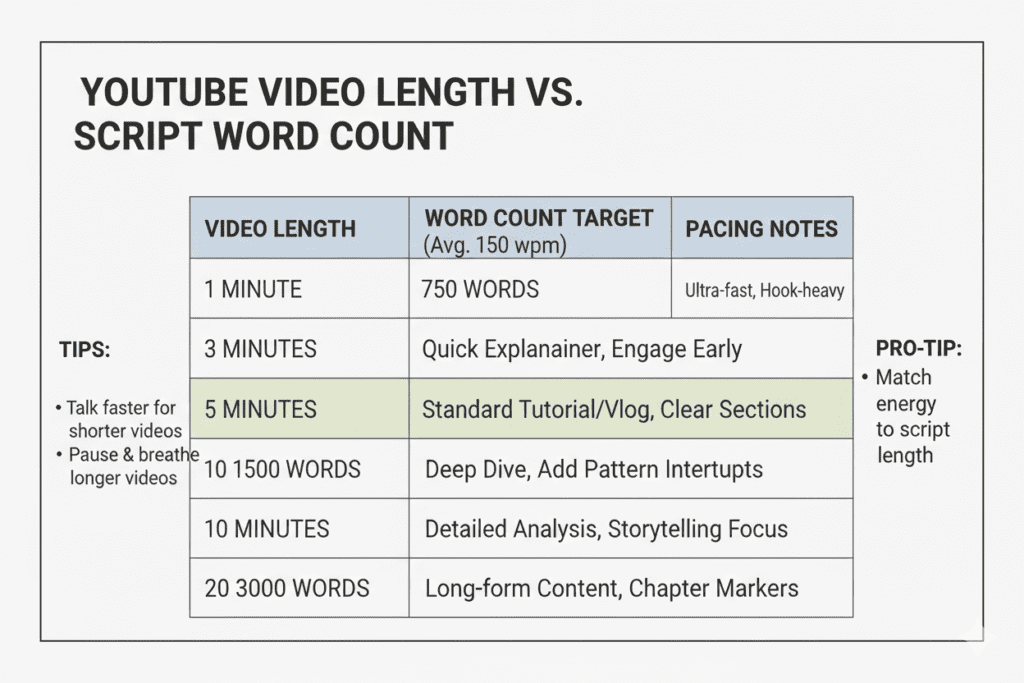
One of the most practical benefits of YouTube script format AI is its ability to automatically calibrate your word count for your target video length. Here are the numbers every creator needs to know.
As a rule of thumb, one minute of video is around 160 to 180 words. Natural human speech clocks in at an average of 130 words per minute, but that’s without a script to back you up.
Here’s the quick reference guide for scripted delivery:
| Video Length | Target Word Count | Key Structure Notes |
|---|---|---|
| 60-second Short | 130–160 words | Hook in first 3 sec, one core point, hard CTA |
| 5-minute video | 750–900 words | Hook + 2–3 main points + CTA |
| 10-minute video | 1,400–1,600 words | Hook + 4–5 segments + mid-hook + CTA |
| 15-minute video | 2,100–2,400 words | Hook + 6–8 segments + 2 re-hooks + CTA |
| 20-minute video | 2,800–3,200 words | Full chapter structure + multiple re-hooks |
A few pacing principles to keep in mind:
- Short sentences hold attention. Long, complex sentences cause viewers to mentally “check out.” Write for the ear, not the eye.
- Front-load your value. Top creators start with the “result” in the first 10 seconds, then explain the process. Don’t save your best insight for the end.
- Plan your pattern interrupts. For every 90 seconds of scripted content, include a visual or delivery shift — a cut, a zoom, a new on-screen graphic, or a change in delivery tempo. YouTube script format AI helps plan these pattern interrupts naturally within your script structure.
- Your spoken keywords matter. YouTube’s auto-captioning indexes every word you say. Speaking your target keyword naturally 3–5 times throughout the script improves search rankings without any extra metadata work.
Common Script Format Mistakes That Kill Retention (And How to Fix Them)
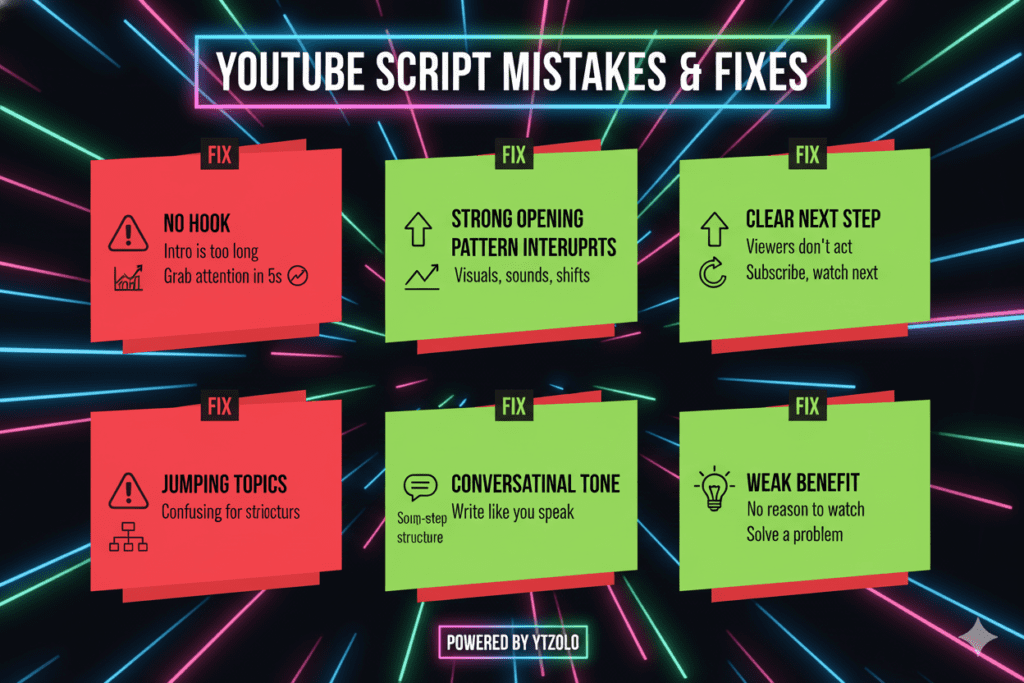
Even with the best YouTube script format AI tool at your disposal, certain scripting habits will undermine your retention every time. Here are the most common — and how to eliminate them immediately.
Mistake #1: Starting with “Hey guys, welcome back to my channel.” This is the single most damaging opener on YouTube in 2026. It signals to the viewer that the valuable content hasn’t started yet — and they leave. Your first word should be the beginning of your hook, not a formality. Fix: Start mid-story or mid-statement. Jump straight into the value.
Mistake #2: Telling viewers what you’re not going to cover. Saying “before we get into it, I just want to mention that this video isn’t about X” is another fast-forward trigger. Every word in your first 30 seconds should reinforce why staying is worth it — not catalogue your exclusions. Fix: Cut every sentence that isn’t building the case for watching.
Mistake #3: Writing to be read, not to be heard. AI script tools that aren’t built for YouTube often produce text that reads beautifully but sounds stiff and formal when spoken aloud. Write in a punchy, relatable style — short sentences and natural rhythm. If it sounds robotic, rewrite it. Fix: Read every line of your script aloud before filming. If you wouldn’t say it naturally in conversation, rewrite it.
Mistake #4: No mid-point re-hook. Most creators write a strong opening and a solid conclusion — but forget that the hardest part is the middle. That 55–65% danger zone is where viewers decide whether to stay or switch to something else. Fix: At the midpoint of every video over 8 minutes, script a deliberate re-hook that teases what’s coming next and reminds the viewer why they clicked.
Mistake #5: Vague or delayed CTAs. Asking viewers to “like and subscribe” as your final line — when only 16% of your audience is still watching — is wasted breath. Fix: Place a soft CTA at the 50–60% mark. Make it specific: “If you want the follow-up video on this, subscribe now so you don’t miss it.” Give them a reason, not just a request.
Mistake #6: Ignoring the loop-close mechanic. If you open a numbered list and promise five items, you must deliver all five. So it’s really important that if you open a loop, you always close it.It’s not about dragging things out unnecessarily — it’s about respecting your audience’s psychology.Open loops create commitment. Closed loops create satisfaction. Satisfied viewers subscribe.
FAQ: YouTube Script Format AI
Q1: What is a YouTube script format and why does it matter for growth?
A YouTube script format is the structural template that organizes your spoken content — including the hook, value promise, main sections, pattern interrupts, mid-point re-hooks, and CTA — into a sequence designed to maximize viewer retention.
It matters for growth because YouTube’s 2026 algorithm heavily rewards retention rate and watch time above almost every other metric. A video with 70% retention will outperform a video with 30% retention every time, regardless of views or subscriber count.
The script format is the single biggest variable you control that determines whether viewers stay or leave.
Q2: How does YouTube script format AI actually work?
YouTube script format AI tools — like ytZolo — take your video topic, target keyword, niche, and desired length as inputs. The AI then generates a fully structured script using proven retention frameworks like AIDA, PAS, or the Listicle Loop, with pattern interrupt cues, hook variations, and keyword-integrated dialogue built in.
The best tools simultaneously generate your video’s title, SEO description, and tags as part of the same workflow. The process takes under 60 seconds for the initial output, with 2–5 minutes of personalization on top.
Q3: Is AI-generated YouTube script format content allowed by YouTube in 2026?
Yes. YouTube’s 2026 policies explicitly allow AI-assisted and AI-generated content, provided it delivers genuine value to viewers and doesn’t constitute repetitive spam. According to YouTube’s content policies, AI-assisted content is permitted as long as it provides genuine value to viewers and isn’t repetitive spam.
Using AI to enhance your creativity — not replace it — is completely within YouTube’s guidelines. The key is always to add your personal voice, accuracy review, and creative perspective on top of any AI-generated framework.
Q4: How long should a YouTube script be for a 10-minute video?
For a 10-minute video, your script should be approximately 1,400 to 1,600 words, assuming a natural scripted delivery pace of 140 to 160 words per minute.
The script should include a 10-second hook, a 20-second value promise, and a brief setup lasting 30–90 seconds.
Add four to five main content segments with pattern-interrupt cues, a mid-point re-hook around the 5-minute mark, and a closing CTA.
YouTube script format AI tools like ytZolo automatically calibrate word count to your target video length, so you never have to do this math manually.
Q5: What is the best YouTube script format AI tool for creators in 2026?
ytZolo is the leading YouTube script format AI tool for creators in 2026. Unlike generic writing AI tools, ytZolo is purpose-built for YouTube — generating retention-optimized scripts with built-in hooks, framework selection (AIDA, PAS, Listicle Loop), pattern interrupt cues, keyword-integrated dialogue, and a complete content package (title, description, tags, thumbnail direction) in a single workflow.
A full script is generated in under 60 seconds, and light personalization takes another 2–5 minutes.
The result is a video-native script designed to keep viewers watching and trigger the algorithm signals that grow your channel.
Conclusion: Your Script Is Either Growing Your Channel or Killing It
Here’s the truth that David discovered when he rewatched his own videos: a great idea with a broken YouTube script format is a lost opportunity. The algorithm never gives you a second chance with viewers who clicked away at the 90-second mark.
But a tight, retention-optimized script? That’s a channel that compounds. Every video builds watch time. Every view signals quality. Every point of retention growth pushes your content into more feeds, more suggested sidebars, and more new viewers who’ve never heard of you.
YouTube script format AI has made it possible for any creator — regardless of writing experience, time, or budget — to script every video with the same structural precision that top creators have spent years developing manually.
You now have the core formats, the proven frameworks, the anatomy of a high-retention script, the word count guidelines, the mistakes to avoid, and the step-by-step system to execute. Everything you need to transform your script process starts here.
And when you’re ready for a YouTube script format AI tool that doesn’t just write a script but builds your complete content package — optimized title, SEO description, tags, thumbnail concept, and a fully structured, retention-engineered script — all in under 10 minutes from a single input, ytZolo is exactly that tool.
The algorithm rewards watch time. Watch time rewards great scripts. Great scripts come from great structure. And great structure, in 2026, comes from YouTube script format AI done right.
Start creating smarter, faster, and more viral YouTube content with ytZolo today.
→ Visit ytzolo.com to get started — and explore the ytZolo blog for weekly deep dives on scripting, SEO, thumbnails, and every other growth lever that serious creators are using right now.
External Resources:

