
Introduction: The Video That Changed Everything
Priya had been uploading consistently for eight months.
Her content was genuinely good. She knew her niche. Her editing was clean, her audio was crisp, and her topics were relevant.
But her videos were invisible.
Average views per video? About 700. Subscriber growth? A slow crawl of 30–40 per month. She was doing everything right — except one thing.
Her titles were terrible. Not offensive or misleading. Just… forgettable. Generic. Zero SEO strategy behind them.
Then a fellow creator walked her through the SEO strategies for YouTube titles that were quietly powering the top channels in her niche. She rewrote three old video titles in an afternoon using ytZolo‘s AI title generator.
Within two weeks, one of those videos climbed from 900 views to over 14,000. A second one hit 8,000. Her channel jumped 200 subscribers in a single week.
Nothing changed except the titles.
If you’ve been grinding without the results you deserve, this post is your turning point. You’re going to learn the most powerful SEO strategies for YouTube titles in 2026, how to apply them step by step, and how tools like ytZolo make the entire process faster and smarter.
Let’s get into it.
Table of Contents
1. Why YouTube Titles Are Your Single Biggest Growth Lever
Here’s a truth that will reshape how you think about your channel.
You can have the best video in your niche — the best editing, the best information, the best hook. But if your title doesn’t get clicked, none of that matters.
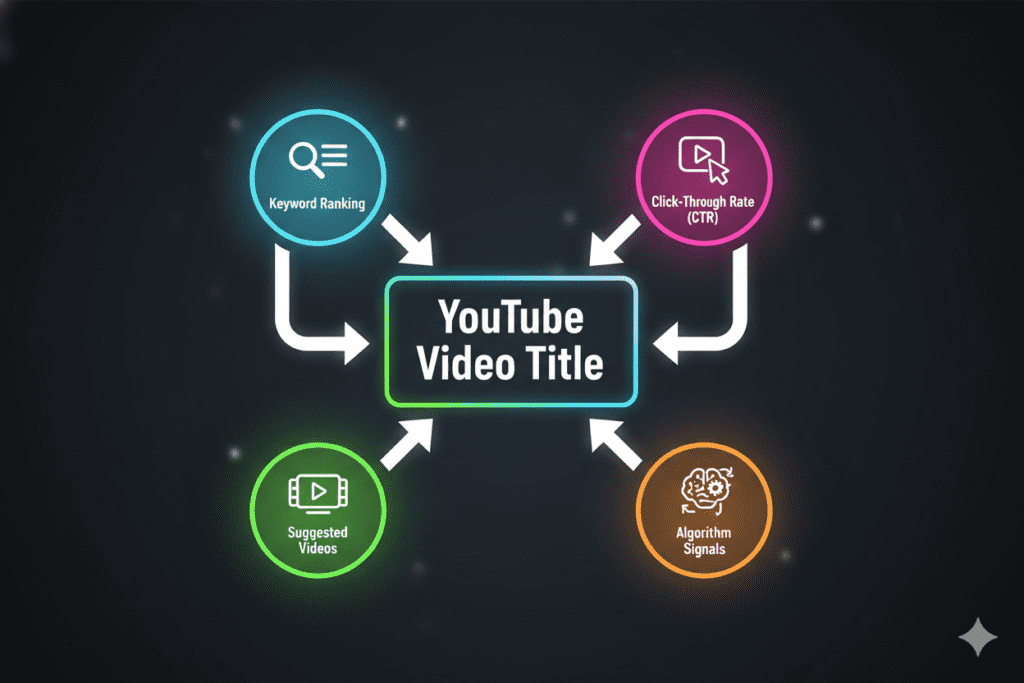
Your title does two jobs simultaneously: it signals relevance to the YouTube algorithm, and it sells the click to the human viewer. Miss either one and your video disappears into the void.
Think about it from the platform’s perspective. YouTube processes 500 hours of video uploaded every single minute. The algorithm uses your title as one of its primary signals to understand what your content is about and who should see it.
Channels that consistently apply modern YouTube SEO practices see 2x to 3x higher organic view growth compared to channels that don’t. And titles are the front door to all of that growth.
Here’s why SEO strategies for YouTube titles matter more in 2026 than ever before:
- Click-Through Rate (CTR) is a direct ranking signal. A better title = more clicks = better rankings.
- Keyword relevance in your title tells the algorithm which searches to surface your video for.
- Titles influence suggested video placement — the right wording pairs you alongside top videos in your niche.
- 70% of views now come from recommendations, not search — and recommendation placement starts with strong title signals.
If there’s one thing to optimize first, it’s always the title.
2. How YouTube’s Algorithm Reads Your Title
Understanding the algorithm’s perspective helps you write smarter titles — not just catchier ones.
YouTube’s algorithm in 2026 is powered by AI. It doesn’t just match keywords the way a search engine did in 2010. It understands context, intent, and viewer satisfaction patterns.
The platform needs to quickly understand what a video covers, who it’s for, and whether viewers actually engage with it once they click. A strong title should clearly state what the video delivers while sounding natural. The goal is relevance first, not keyword repetition.
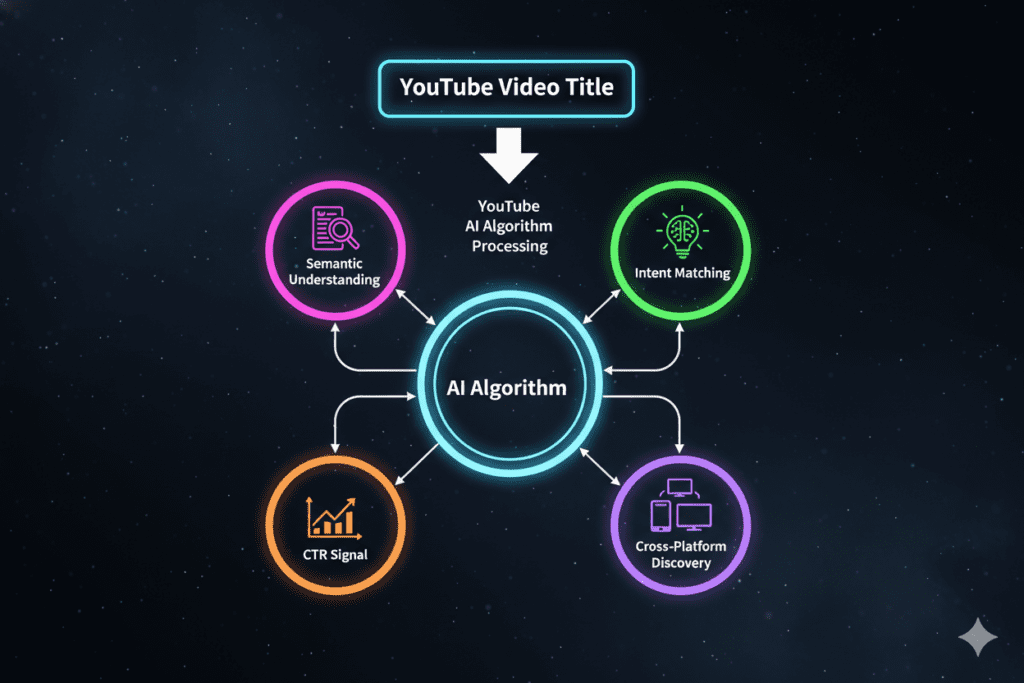
Here’s what YouTube’s algorithm actually does with your title:
Semantic Understanding
The algorithm reads your title semantically — meaning it understands concepts, not just keywords. “How to lose belly fat fast” and “fastest way to burn abdominal fat” register as similar topics. This is why keyword stuffing is dead.
Intent Matching
YouTube matches your title to the intent behind a viewer’s search query. Informational intent, comparison intent, how-to intent — your title’s phrasing signals which category you belong to.
CTR Signal Weighting
Your title performs two jobs: ranking in search and driving clicks from impressions. A keyword-optimized title might rank well but get fewer clicks than an emotionally compelling one. The best SEO strategies for YouTube titles balance both goals.
Cross-Platform Discovery
More than 25% of Google search results now include a video snippet, and AI-powered search tools are starting to summarize and reference videos directly in their answers. Your YouTube title is now a Google SEO asset too.
This is why the best SEO strategies for YouTube titles aren’t just about keywords — they’re about crafting titles that satisfy both the machine and the human.
3. The Core SEO Strategies for YouTube Titles in 2026
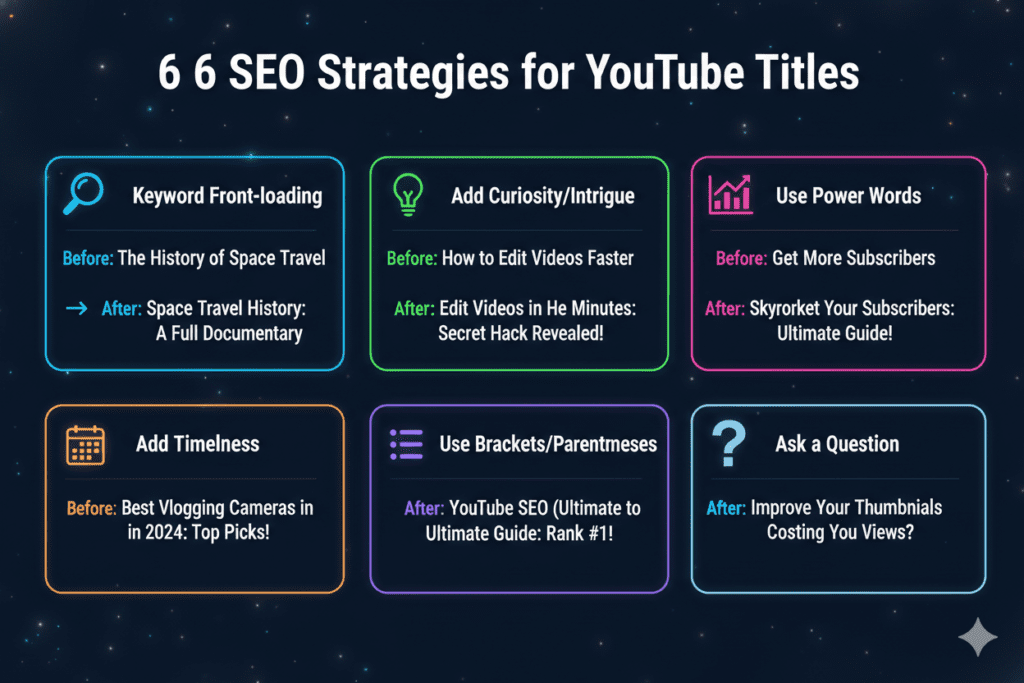
Let’s get practical. These are the most effective SEO strategies for YouTube titles that are working right now.
Strategy 1: Front-Load Your Primary Keyword
Place your primary keyword within the first 40 characters of your title — before truncation happens on mobile screens.
Mobile is where most YouTube viewing happens. If your keyword is buried at the end, viewers and the algorithm may never register it.
❌ “In This Video I Explain the Best Ways to Lose Belly Fat Fast” ✅ “Lose Belly Fat Fast: 5 Proven Methods That Actually Work”
Strategy 2: Keep It Under 60 Characters
Keep titles under 60 characters when possible, and always under 100. This ensures you’re not cut off on mobile, and it forces you to be concise.
Shorter titles also process faster in a viewer’s brain. Less friction = more clicks.
Strategy 3: One Primary Keyword Per Title
One primary keyword per title is ideal—two maximum in long titles. When applying SEO strategies for YouTube titles, keyword density matters less than keyword relevance and natural placement. Stuff keywords, and your title becomes unclickable.
Pick the one search phrase your ideal viewer would type. Optimize the rest through your description, tags, and transcript.
Strategy 4: Use Numbers and Specificity
Specific titles consistently outperform vague ones. Numbers trigger cognitive pattern recognition — our brains love lists.
- “5 YouTube Title SEO Mistakes Killing Your Views” > “YouTube Title SEO Mistakes”
- “Grow From 0 to 10K Subscribers in 90 Days” > “How to Get More Subscribers”
Strategy 5: Match Search Intent Perfectly
Ask yourself: What is the viewer actually trying to accomplish? Is it learning something? Solving a problem? Making a decision?
Your title’s phrasing should signal the exact type of answer your video provides. Intent-matched titles earn higher CTR and better watch time — both of which compound your ranking over time.
Strategy 6: Test and Iterate
YouTube Studio now offers an A/B testing feature for titles. Test different title variations for the best CTR and update regularly based on performance data.
The best creators treat titles like hypotheses, not final answers. Test, measure, and improve.
4. The Anatomy of a Perfect YouTube Title
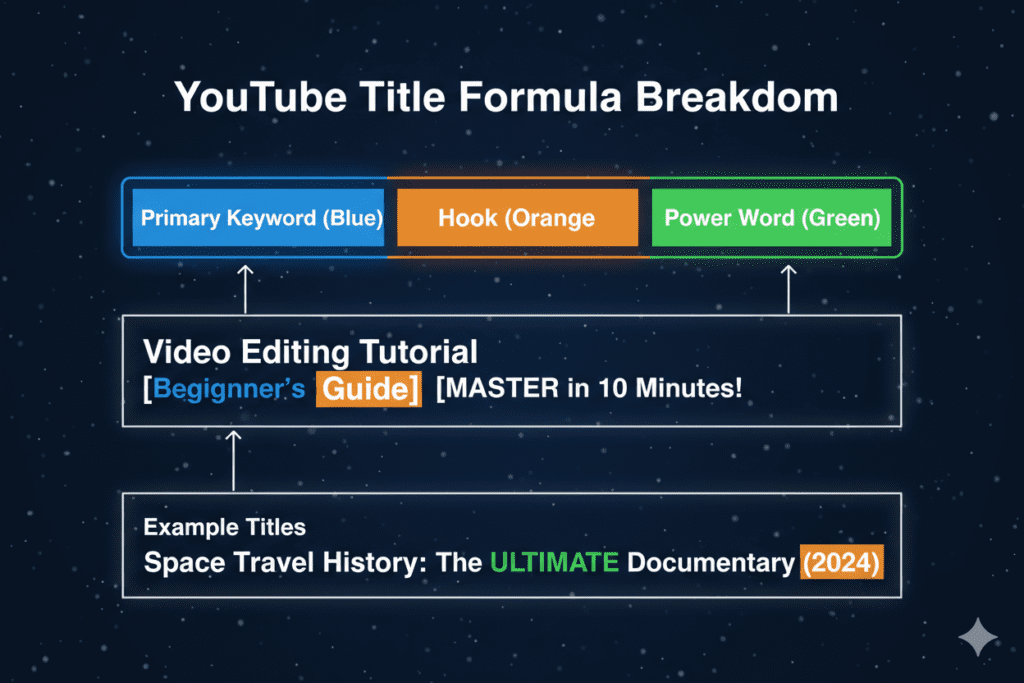
The best YouTube titles follow a formula. Once you know it, you’ll see it everywhere — and you’ll never write a weak title again.
The Winning Formula:
[Primary Keyword] + [Hook/Curiosity Trigger] + [Value Proof/Power Word]
Let’s break each component down.
Component 1: Primary Keyword
This is the search term your target viewer types into YouTube. It should appear naturally at or near the beginning of the title when using SEO strategies for YouTube titles.
Example: “YouTube SEO strategies,” “home workout for beginners,” “meal prep for weight loss”
Component 2: Hook or Curiosity Trigger
This is what makes a human want to click. It creates a curiosity gap — the brain feels compelled to close it.
Examples: “you didn’t know,” “that actually works,” “before it’s too late,” “the truth about,” “that nobody talks about”
Component 3: Value Proof or Power Word
This tells the viewer what they’ll get. It confirms the promise and builds trust.
Power words like “ultimate,” “complete,” “surprising,” and “proven” increase engagement. Data shows that video titles with power words receive 8.3% higher click-through rates.
Real Title Examples Using This Formula:
| Keyword | + Hook | + Power Word | Final Title |
|---|---|---|---|
| YouTube SEO | secrets nobody shares | proven | “YouTube SEO Secrets Nobody Shares (Proven to Work)” |
| Weight loss | works without the gym | ultimate | “Ultimate Weight Loss Plan That Works Without the Gym” |
| Passive income | starting from $0 | complete | “Complete Guide to Passive Income Starting From $0” |
According to best practices research from Influencer Marketing Hub, the most effective YouTube titles are 8–15 words long, hitting a sweet spot between descriptiveness and scannability.
5. Power Words and Emotional Triggers That Drive Clicks
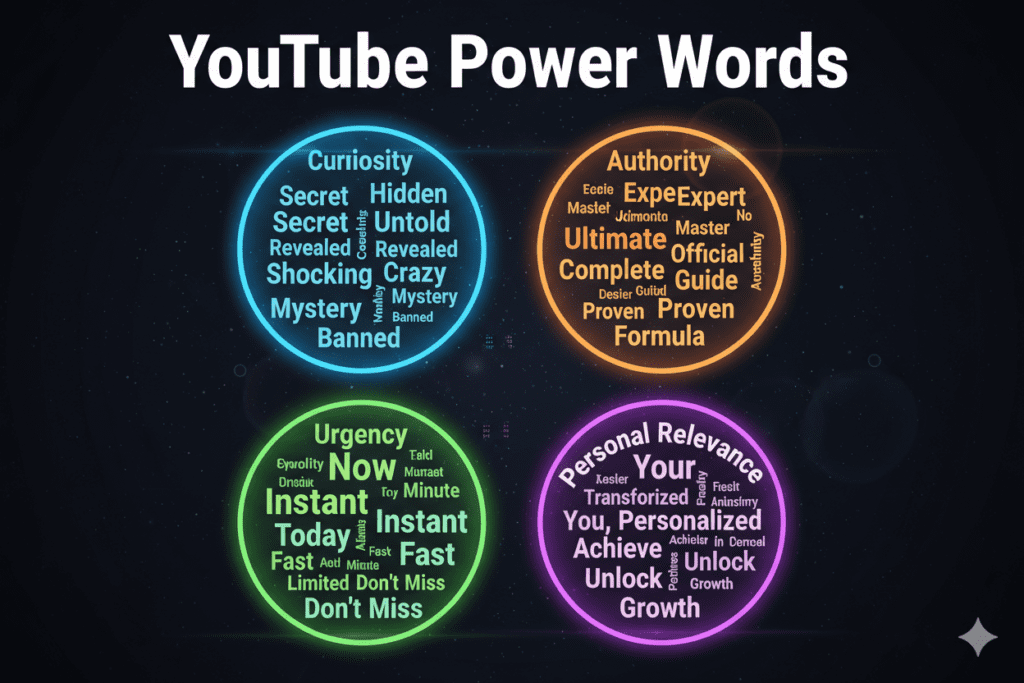
Power words are the secret weapon behind the highest-CTR YouTube titles. They tap into emotion, urgency, and desire—the three forces that make humans click, especially when combined with SEO strategies for YouTube titles.
Here’s a curated power word toolkit organized by emotional trigger:
Curiosity Triggers
- Secret, Hidden, Revealed, Truth About, You Don’t Know, Unknown
Authority Boosters
- Proven, Expert, Ultimate, Best, Complete, #1, Definitive
Urgency & FOMO
- Before It’s Too Late, Right Now, Stop Doing This, Last Chance, Don’t Miss
Personal Relevance
- For Beginners, If You’re Struggling, Why You’re Failing, That Changed My Life
Result-Oriented
- That Actually Works, In 7 Days, That Got Me 100K, Without [Common Obstacle]
Numbers and Lists
- 5 Ways, Top 10, 3 Mistakes, 7 Secrets, The #1 Reason
The magic happens when you combine a power word with a strong keyword and a clear promise. That combination is what the best SEO strategies for YouTube titles are built on.
One quick warning: power words only work when your content delivers on the promise. YouTube is one of the few platforms where compelling, curiosity-driven titles are encouraged — as long as you can deliver on the promises in your video. Clickbait without substance destroys retention and tanks your rankings.
6. Long-Tail Keywords: The Hidden Traffic Goldmine
Most creators fight over the same high-competition keywords. They write titles like “How to Lose Weight” and wonder why they can’t rank against channels with millions of subscribers.
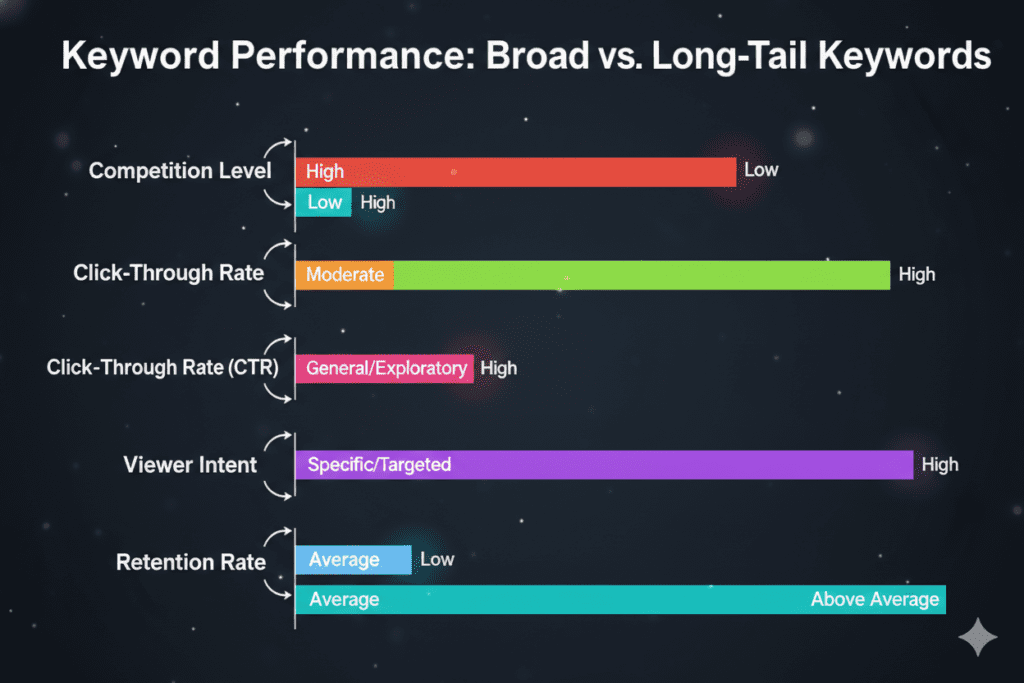
The smarter play is long-tail keywords — specific, 4–7 word phrases that real viewers search with high intent.
Longer, more specific phrases like “best live streaming tools for online courses” instead of just “live streaming” not only have less competition but also attract more qualified viewers who know what they’re looking for.
Here’s what makes long-tail SEO strategies for YouTube titles so powerful:
- Lower competition — fewer videos targeting the exact phrase
- Higher intent — viewers searching specific terms want a specific answer
- Better retention — they clicked for exactly what your video delivers, so they stay longer
- Compound growth — rank for 10 long-tail titles and your total search traffic dwarfs one broad keyword
How to Find Long-Tail Keywords for Your Titles:
- YouTube Search Autocomplete — Type your broad keyword and note the suggestions that appear. These are real queries from real users.
- Google Trends (YouTube filter) — See trending searches specific to YouTube in your niche.
- Competitor title analysis — Study the titles of top-performing videos in your niche. What specific phrasing do they use?
- Comment sections — Your audience literally tells you what they’re searching for. Mine those comments for exact phrasing.
- AI tools like ytZolo — The fastest and most data-driven method, covered in the next section.
Long-tail keyword strategy is one of the most underused SEO strategies for YouTube titles. Embrace it and your channel will find traffic pockets your competitors have completely ignored.
7. How ytZolo Makes SEO Strategies for YouTube Titles Effortless
Here’s the honest truth about applying SEO strategies for YouTube titles manually.
It works. But it takes hours. Keyword research, competitor analysis, power word selection, character counting, intent matching — done properly, crafting one great title can take 30–60 minutes of focused work.
Now multiply that by every video you publish. It becomes unsustainable.
This is exactly the problem ytZolo was built to solve.
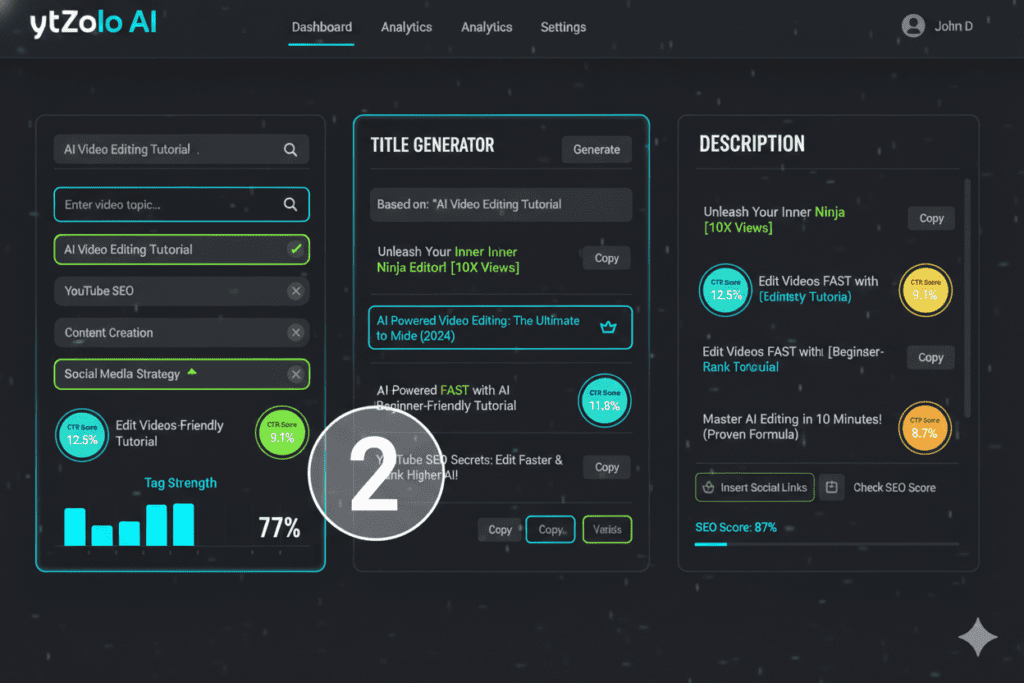
ytZolo is an all-in-one AI YouTube growth platform. Its AI title generator is specifically designed around the SEO strategies for YouTube titles that are proven to drive clicks, rankings, and views.
Here’s what ytZolo’s AI title engine does in seconds:
- Keyword extraction — Identifies the primary keyword and semantic variations from your topic input
- Competitor intelligence — Analyzes top-performing video titles in your niche to extract winning patterns
- CTR optimization — Generates titles with built-in power words and emotional triggers that drive clicks
- Character count optimization — Every title is crafted to display perfectly on mobile and desktop
- Intent matching — Ensures the title matches what your target viewer is actually searching for
- Long-tail variations — Produces multiple title options targeting different keyword angles
The old way? Hours of research, guesswork, and second-guessing. The ytZolo way? A complete, data-backed, SEO strategies for YouTube titles-driven, SEO-optimized title set in under 60 seconds.
When creators struggle without AI, it’s because the data behind great titles — competitor patterns, trend signals, keyword search volumes — is simply too vast to process manually at scale. ytZolo closes that gap instantly.
Visit ytzolo.com to see it in action. You can also explore deeper guides on title strategy and YouTube growth at the ytZolo blog.
8. Why ytZolo Is Better Than Other Title Optimization Tools
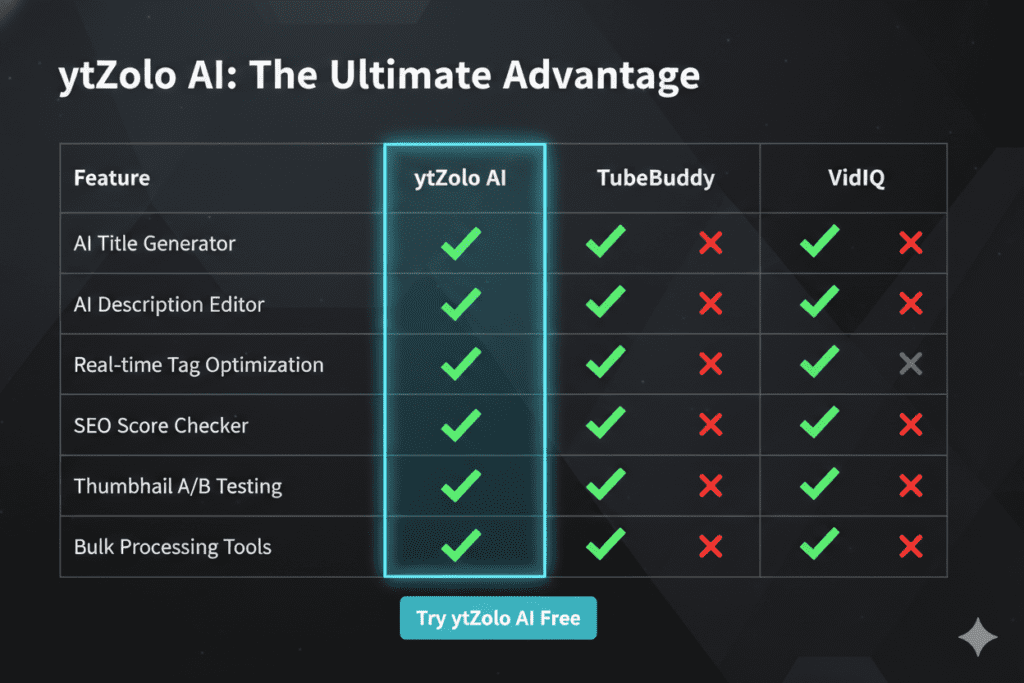
There are other tools in this space. Here’s how ytZolo stacks up against the most popular alternatives:
| Feature | TubeBuddy | VidIQ | Morningfame | ytZolo |
|---|---|---|---|---|
| AI title generator | Partial | Partial | ❌ | ✅ Full AI |
| Long-tail keyword discovery | ✅ | ✅ | ✅ | ✅ Advanced |
| Competitor title analysis | ✅ | ✅ | Partial | ✅ Full |
| Power word optimization | ❌ | ❌ | ❌ | ✅ Built-in |
| Intent-based title suggestions | ❌ | Partial | ❌ | ✅ Full |
| CTR prediction score | ❌ | Partial | ❌ | ✅ Yes |
| AI description writer | ❌ | Partial | ❌ | ✅ Full |
| AI script generator | ❌ | ❌ | ❌ | ✅ Full |
| AI thumbnail suggestions | ❌ | ❌ | ❌ | ✅ Full |
| AI tag optimizer | Partial | Partial | Partial | ✅ Full AI |
| All-in-one growth platform | ❌ | ❌ | ❌ | ✅ Yes |
The fundamental difference is philosophy.
TubeBuddy and VidIQ are analytics-first tools. They give you data and leave the creative decision-making to you. That’s valuable—but when applying SEO strategies for YouTube titles, it still requires significant time and expertise to act on.
ytZolo is an AI-first growth platform. It doesn’t just show you data. It turns that data into action — generating the actual title, description, script, tags, and thumbnail direction for you.
You still make the final call. But ytZolo does the heavy lifting.
For more comparisons, deep dives, and creator success stories, check out the ytZolo blog — it’s packed with actionable guides updated regularly.
External resources worth bookmarking: Ahrefs’ YouTube SEO guide and the YouTube Creator Academy are excellent for building foundational strategy knowledge.
9. Step-by-Step: Crafting Winning YouTube Titles with ytZolo
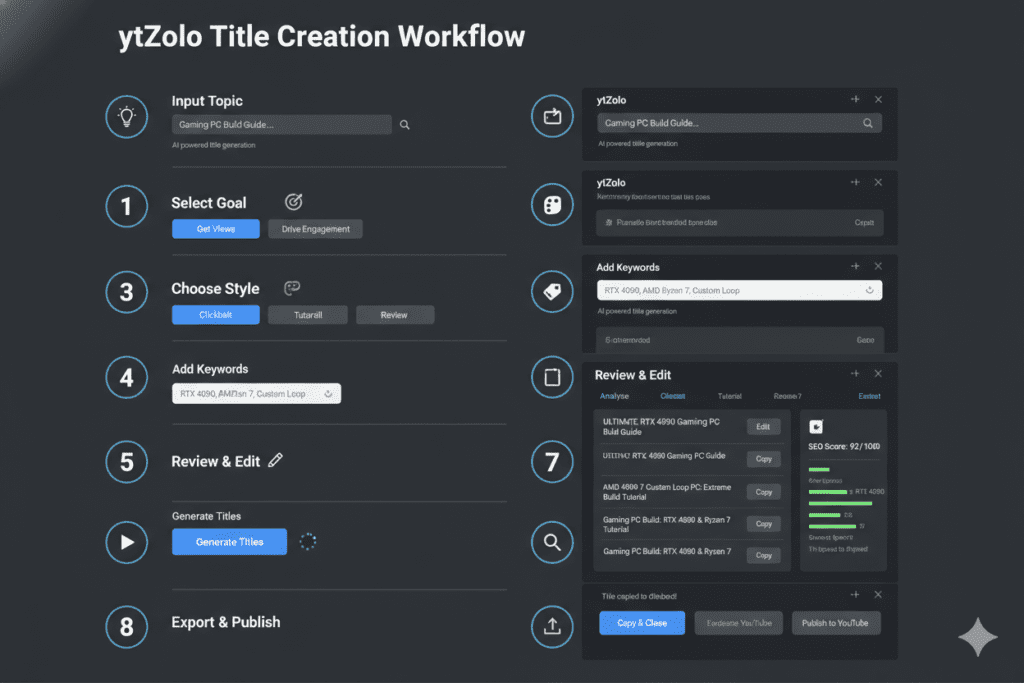
Ready to put this all together? Here’s your complete action plan for using ytZolo to execute the best SEO strategies for YouTube titles every single time you upload.
Step 1: Define Your Video Topic Clearly
Before you touch any tool, get crystal clear on what your video is actually about. Write one sentence: “This video teaches [audience] how to [outcome] using [method/angle].”
This clarity feeds everything else.
Step 2: Open ytZolo and Enter Your Topic
Head to ytzolo.com and navigate to the AI Title Generator. Enter your video topic or your rough working title.
Be specific. “How to lose belly fat” will generate different results than “how to lose belly fat without cardio in 30 days.” The more specific you are—especially when applying SEO strategies for YouTube titles—the better the output.
Step 3: Review Your AI-Generated Title Options
ytZolo will generate multiple title variations, each optimized differently:
- Search-first titles — prioritize keyword placement for discoverability
- CTR-first titles — prioritize emotional triggers and curiosity gaps for click-through rate
- Hybrid titles — balance both goals for maximum all-around performance
Review each option. Notice how the keyword placement shifts. Notice which power words are used and why.
Step 4: Apply the Front-Loading Check
Whatever title you choose, make sure the primary keyword appears within the first 40 characters. If it doesn’t, ytZolo flags it — but always double-check manually before you publish.
Step 5: Run the Mobile Preview Test
In YouTube Studio, preview how your title displays on mobile. If it truncates in an awkward place, adjust the wording. The title should communicate core value even in its truncated form.
Step 6: Cross-Reference with Your Thumbnail
Your title and thumbnail work together. The thumbnail shows emotion or visual hook; the title provides context and keyword. They should complement each other, not repeat each other.
ytZolo’s AI thumbnail suggestions help you align these two elements for maximum click-through impact.
Step 7: Publish, Monitor, and Iterate
After publishing, check your CTR in YouTube Analytics after 48–72 hours. If it’s below 4%, consider A/B testing a title variation. ytZolo makes it easy to generate new options without starting from scratch.
Step 8: Revisit Underperforming Videos
Don’t just apply SEO strategies for YouTube titles to new uploads. Old videos are often your biggest hidden opportunity — a topic covered in detail in the next section.
10. Common YouTube Title Mistakes That Kill Your Rankings
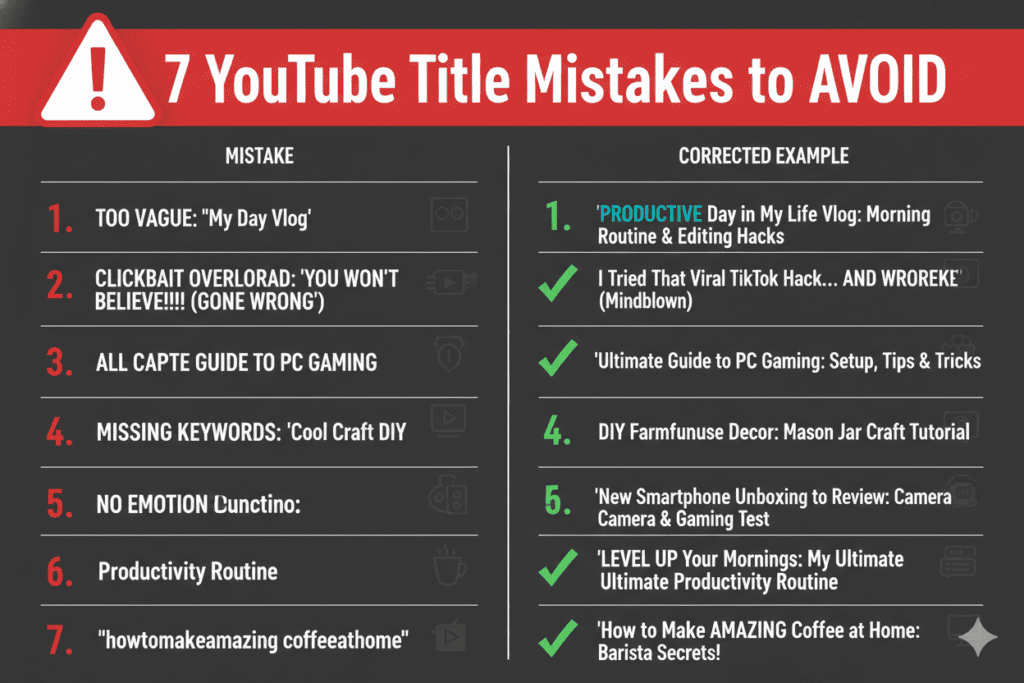
Even experienced creators make these title mistakes. Check your existing videos against this list right now.
Mistake 1: Burying the Keyword at the End “My Complete Guide to Everything You Need to Know About YouTube SEO” puts the keyword at position 14. Rewrite to front-load: “YouTube SEO: The Complete Creator Guide for 2026.”
Mistake 2: Writing for Search Only, Not for Humans A title like “YouTube Title SEO Optimization Keyword Strategy 2026” might signal relevance to the algorithm but no human wants to click that. Balance searchability with human appeal.
Mistake 3: Being Too Vague “My Fitness Journey Update” tells the viewer nothing. What changed? What did you learn? What will they get? Vague titles get ignored. Specific titles get clicked.
Mistake 4: Ignoring Mobile Truncation On mobile, YouTube truncates titles after roughly 55–60 characters. If your key promise or keyword—especially when using SEO strategies for YouTube titles—lives past that cutoff, most viewers never see it.
Mistake 5: Keyword Stuffing Trying to force SEO keywords into your title won’t help in 2026 — that strategy became obsolete after 2017. One well-placed keyword outperforms three awkwardly forced ones.
Mistake 6: Clickbait Without Delivery Using a shocking title to drive clicks then failing to deliver on the promise destroys your audience retention. Low retention kills your rankings faster than any bad title.
Mistake 7: Never Testing or Updating Titles Your title isn’t a permanent decision. Search trends shift. Viewer behavior evolves. The best creators revisit and refresh titles on a quarterly basis — especially for older videos showing signs of recovery potential.
11. How to Refresh Old Titles and Recover Dead Videos
Here’s a growth hack most creators completely ignore.
Your back catalog is full of sleeping giants — videos with solid content that never reached their potential because of weak titles. Refreshing those titles with smart SEO strategies for YouTube titles is often the fastest way to generate new growth without filming a single new video.
Use YouTube Analytics to spot new search queries bringing traffic and add them to your title or description. Refreshing timestamps, links, and thumbnails can help older content maintain high rankings and adapt to YouTube algorithm updates.
How to Find and Revive Underperforming Videos:
- Open YouTube Studio → Analytics → Content
- Sort by impressions and filter for videos with decent impressions but low CTR (under 4%)
- These are your title recovery opportunities — the algorithm is showing the video, but the title isn’t converting
- Use ytZolo’s AI title generator to create fresh, optimized alternatives
- Update the title and monitor CTR over the next 7–14 days
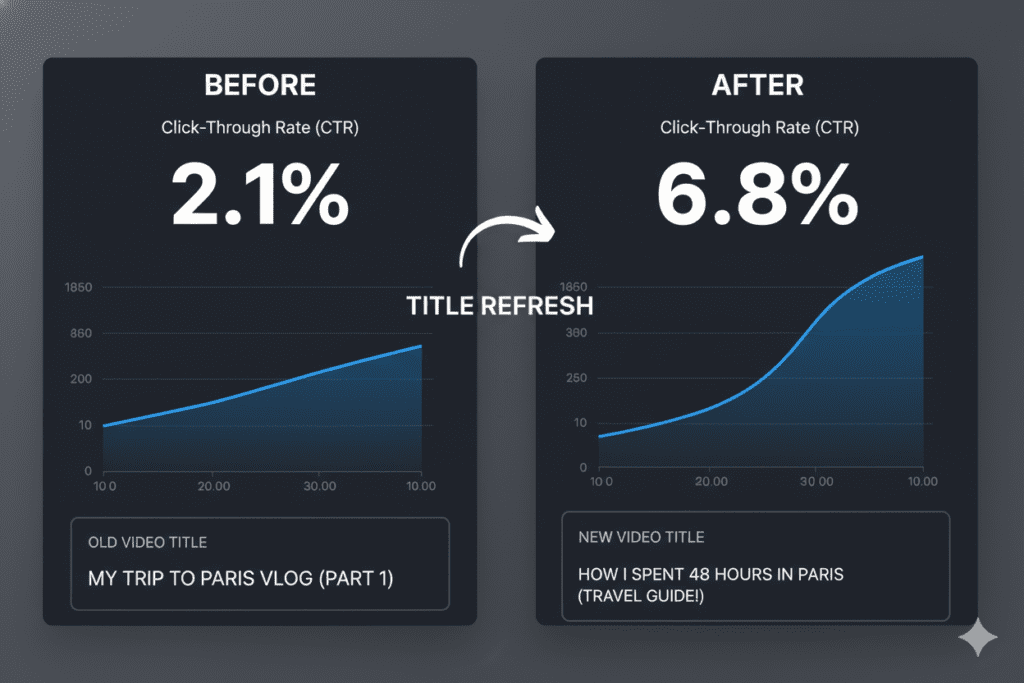
Signs a Title Refresh Is Working:
- CTR increases from 2–3% to 5–7%
- Watch time per view increases
- The video begins appearing in new suggested video placements
- Comments and engagement pick up again
One successful title refresh can turn a 500-view video into a 5,000-view video — without any new filming, editing, or promotion.
This is one of the most underrated SEO strategies for YouTube titles available to any creator. The content is already done. The audience is already there. You just need the title to do its job.
12. FAQ
What are the most effective SEO strategies for YouTube titles in 2026?
The most effective SEO strategies for YouTube titles in 2026 include front-loading your primary keyword within the first 40 characters, keeping titles under 60 characters for mobile optimization, using power words to boost CTR, targeting long-tail keywords with specific audience intent, and matching your title to the exact search intent behind your viewer’s query.
AI tools like ytZolo automate the research and generation process, making all of these strategies faster and more data-driven than manual methods.
How important is keyword placement in a YouTube title?
Keyword placement in a YouTube title is critical. YouTube’s algorithm gives more weight to keywords that appear early in the title. Placing your primary keyword in the first 40 characters signals relevance clearly to both the algorithm and mobile viewers. However, the keyword should always read naturally — forced placement that makes the title awkward will hurt your CTR and ultimately your rankings.
How long should a YouTube video title be for the best SEO results?
The ideal YouTube title length for SEO is 50–60 characters. Titles in this range are short enough to display fully on mobile without truncation, while long enough to include a keyword, hook, and value signal. Titles can extend to 100 characters for longer-form content, but the most critical information — especially the primary keyword — must appear within the first 55 characters.
Can changing an old YouTube title improve rankings?
Yes — updating an old YouTube title is one of the fastest ways to recover underperforming videos. If YouTube Analytics shows your video is receiving impressions but has a low click-through rate (under 4%), a new SEO-optimized title can significantly improve CTR, which signals better content relevance to the algorithm and can trigger a ranking boost. Using ytZolo’s AI title generator to create refreshed alternatives makes this process quick and data-driven.
Why should I use ytZolo for YouTube title optimization instead of doing it manually?
Manual title optimization requires hours of keyword research, competitor analysis, and creative testing — every single time you upload. ytZolo’s AI title generator, built on advanced SEO strategies for YouTube titles, compresses that entire process into under 60 seconds, generating keyword-optimized, CTR-focused, intent-matched titles based on real data.
As an all-in-one AI YouTube growth platform, ytZolo also synchronizes your title strategy with your descriptions, tags, scripts, and thumbnails — giving your entire video metadata the best possible foundation for algorithmic performance.
13. Conclusion: Your Title Is Your Most Powerful SEO Tool
Everything else can be perfect — the content, the edit, the thumbnail, the upload schedule. But if your title doesn’t do its job, none of it matters.
The SEO strategies for YouTube titles in this guide aren’t theoretical. They’re the exact tactics driving real channel growth in 2026. Front-loaded keywords. Intent-matched phrasing. Power words. Long-tail precision. Mobile-first character counts. Data-driven testing.
Apply even three of these consistently and you’ll see your CTR climb, your rankings improve, and your growth accelerate.
But here’s the truth about sustained growth: doing this manually for every video is exhausting and time-consuming. The creators who stay ahead aren’t working harder — they’re working smarter. They use AI to do the heavy lifting on research and optimization so they can focus on what they love: creating.
That’s exactly what ytZolo delivers.
From AI title generation to scripts, descriptions, tags, and thumbnail direction — ytZolo is the all-in-one YouTube growth platform built for creators who are serious about results.
Your next viral video is one great title away. Stop leaving that to chance.
Start creating smarter, faster, and more viral YouTube content with ytZolo today. 👉 Try ytZolo Free at ytzolo.com
Related resources:
- Ahrefs’ YouTube SEO Guide — In-depth ranking factor analysis
- YouTube Creator Academy — Official YouTube education platform
- HubSpot’s Video Marketing Guide — Video strategy and content planning
- More YouTube growth guides on the ytZolo blog
© 2026 ytZolo. All rights reserved.

