
Introduction: The 3-Second Decision That Makes or Breaks Your Channel
You spend 6 hours filming. 4 hours editing. Another hour on the thumbnail.
Then you type a title in 30 seconds — and wonder why no one clicks.
Here’s the cold truth: your YouTube title is the single most important piece of text on your entire channel. If you’re still figuring out how titles and visuals work together, this guide on AI-generated YouTube thumbnails breaks down how thumbnails directly impact clicks alongside your title.
And in 2026, the rules around YouTube title best practices length have changed. Dramatically.
What worked in 2022 — short, punchy, keyword-stuffed — is now actively hurting creators in youtube title best practices length 2026. The algorithm is smarter. Viewers are more selective. And the competition? It’s fiercer than ever.
This guide will walk you through everything: the optimal title length for YouTube in 2026, the psychology behind high-CTR titles, proven formulas that work right now, and how the smartest creators are using AI tools like ytZolo to consistently write titles that rank and convert.
Let’s get into it.
Table of Contents
1. Why Your YouTube Title Length Matters More Than Ever in 2026
Think of your YouTube title like a storefront sign.
If the sign is blank or boring, no one walks in. If it’s clear, compelling, and well-placed, people stop and look. Your title does the same thing — it tells YouTube’s algorithm what your video is about and convinces real humans to click in youtube title best practices length 2026.
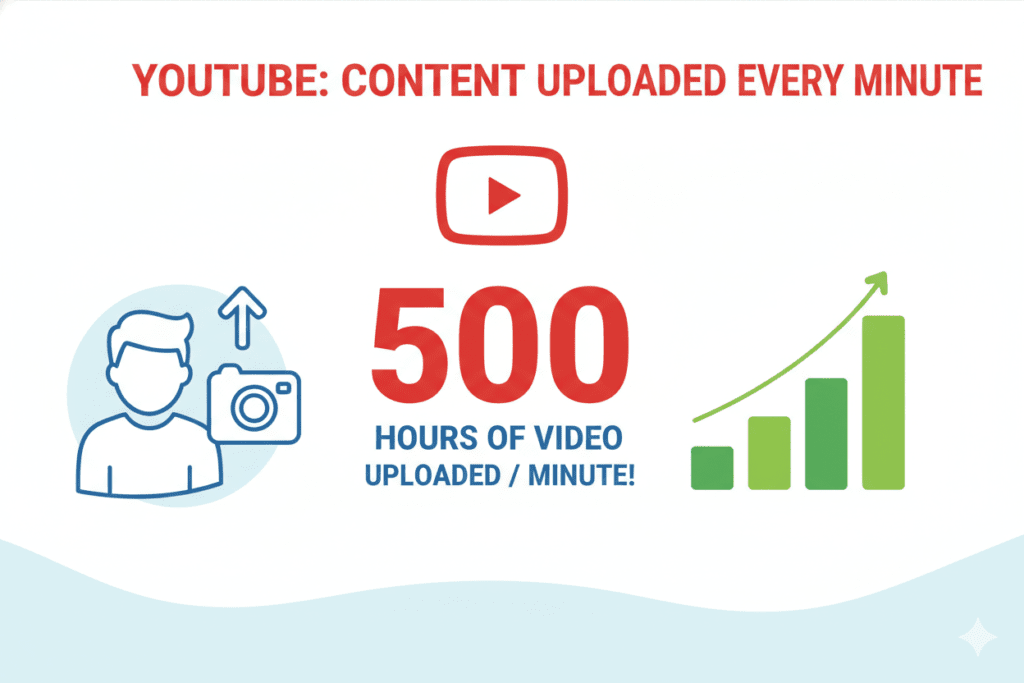
In 2026, YouTube processes over 500 hours of video every single minute. The platform uses AI to scan your metadata — including your title — and match it to the right viewers. A weak title means YouTube doesn’t know who to show your video to.
A strong title? That’s your ticket to organic reach, recommended feeds, and compounding views over time.
The good news: most creators are still writing weak titles. That’s your opportunity.
2. The Official YouTube Title Character Limit (And What It Actually Means)
Let’s start with the basics.
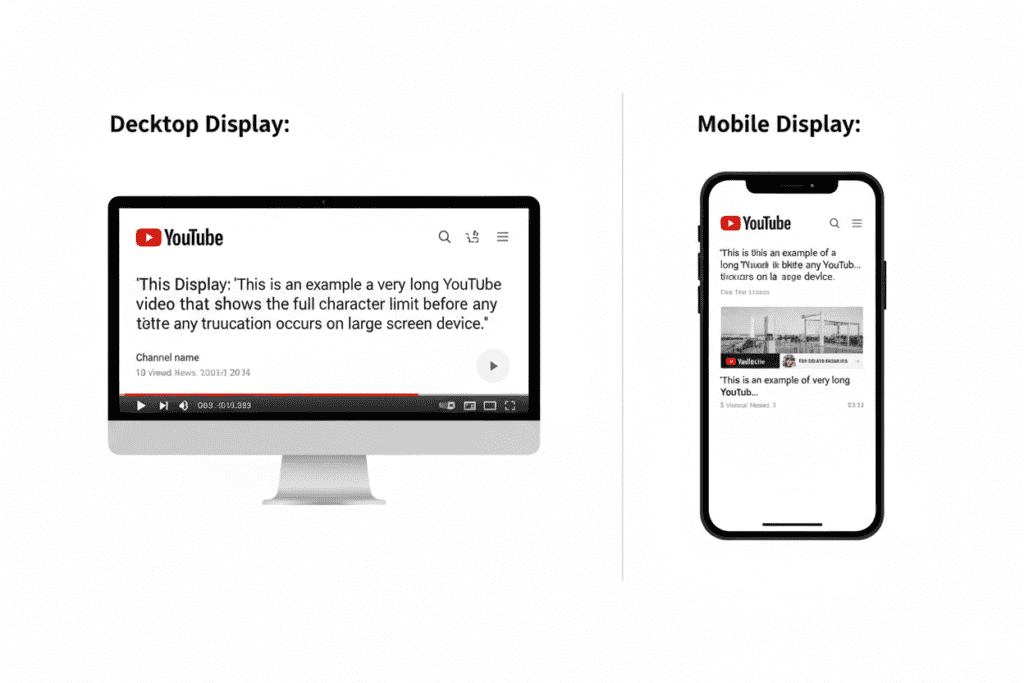
YouTube allows a maximum of 100 characters in any video title. Go beyond that and your title gets cut off entirely — which hurts your SEO and confuses viewers.
But here’s where most creators get confused: the maximum is not the optimal.
Here’s how titles display across platforms in 2026:
- Desktop search results: 60–70 characters visible
- Mobile home feed: 35–50 characters visible before truncation
- YouTube search on mobile: 50–60 characters shown
- Suggested videos sidebar: First 50–60 characters displayed
So yes — most of your title gets cut off for most viewers, most of the time.
Does that mean you should write shorter titles? No. And the data proves it.
3. YouTube Title Best Practices Length 2026: What the Data Actually Says
Here’s where things get interesting — and counterintuitive.
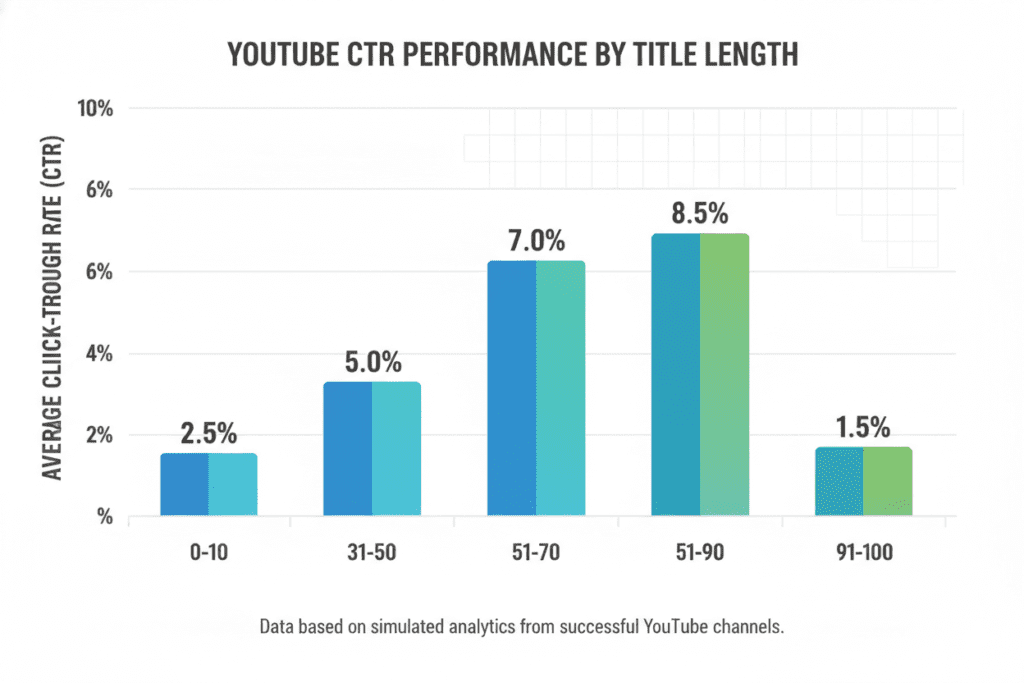
A study analyzing over 3 million YouTube videos found that titles in the 70–100 character range outperform shorter titles by 10–14% on average. Videos with 90–100 character titles outperform ultra-short titles (under 10 characters) by more than 2x.
Let that sink in. Longer titles win — even when they get truncated on mobile.
Why? Three reasons:
- Front-loading works. Put your hook in the first 50 characters. The truncated part supports it.
- Truncation creates curiosity. A title ending in “…” can actually increase clicks.
- Search shows more. When people search on YouTube, they often see the full title. Longer titles rank better for more keyword variations.
Now, there’s nuance here. Some industry experts recommend keeping titles between 50–70 characters for full mobile visibility. Others point to the 70–100 range for peak SEO performance in youtube title best practices length 2026.
The honest answer? It depends on your content type:
| Content Type | Recommended Length |
|---|---|
| Trending / reaction videos | 40–60 characters |
| Tutorial / how-to videos | 70–100 characters |
| Evergreen educational content | 70–90 characters |
| News / timely content | 50–70 characters |
| Entertainment / personality-driven | 40–65 characters |
The key principle: use as many characters as your title genuinely needs — not one more, not one less.
Don’t pad. Don’t cut. Write the most compelling version of your title and let the character count follow naturally.
4. How YouTube’s AI Changed Title Optimization in 2026
If you’re still treating YouTube like a 2019 search engine, you’re already behind.
In early 2026, YouTube rolled out a deeper Gemini AI integration that changed how the platform reads your content in youtube title best practices length 2026. YouTube’s algorithm now understands videos at a semantic level — it reads transcripts, analyzes visuals, and builds a complete profile of your video’s intent.
This has two major implications for your titles:
First: keyword stuffing is dead. Cramming your keyword five times into a title no longer tricks the algorithm. It just makes your title unreadable and tanks your CTR. YouTube understands synonyms, context, and related terms.
Second: natural language wins. Titles written for humans first now outperform titles written for bots. Your primary keyword should appear naturally — ideally in the first 4–5 words — but the rest of the title should flow like real speech.
This is exactly why so many creators are turning to AI tools like ytZolo to write YouTube titles. Not because they’re lazy — but because AI understands the new rules better than manual guesswork ever could.
5. The Anatomy of a Perfect YouTube Title
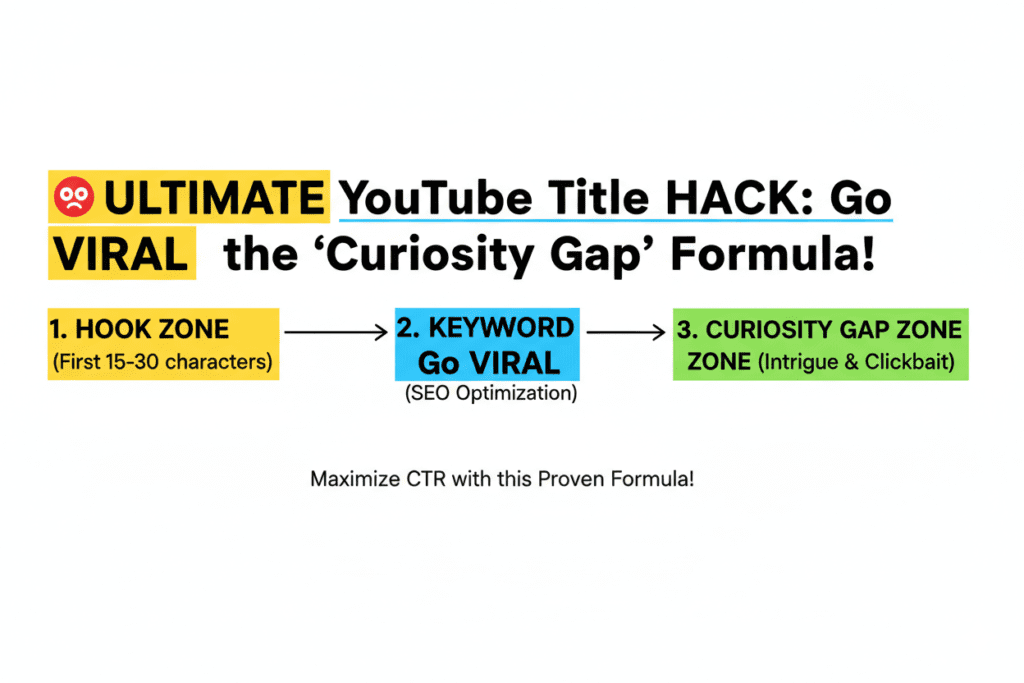
Every great YouTube title in 2026 has the same core DNA. Here’s what it looks like:
[HOOK] + [KEYWORD] + [SPECIFICITY/CURIOSITY GAP]
Let’s break each element down:
The Hook (First 40 characters) This is what people see before truncation in youtube title best practices length 2026. It needs to grab attention instantly. Use numbers, bold claims, emotions, or direct questions. Example: “I Made $10K in 30 Days Using…”
The Keyword (Naturally placed) Your target search term needs to appear early. Not forced, not repeated — just present and natural. Example: “YouTube title best practices” placed in the first half of the title.
The Specificity or Curiosity Gap (The rest) This is what makes people need to click. Give them a specific outcome, a surprising twist, or an incomplete thought that can only be resolved by watching. Example: “…and it only took one change.”
Put it together: “I Doubled My CTR Using These YouTube Title Best Practices (1 Simple Trick)”
That’s 72 characters. Hook-driven. Keyword-present. Curiosity-inducing. Perfect.
6. 7 Proven YouTube Title Formulas That Crush CTR
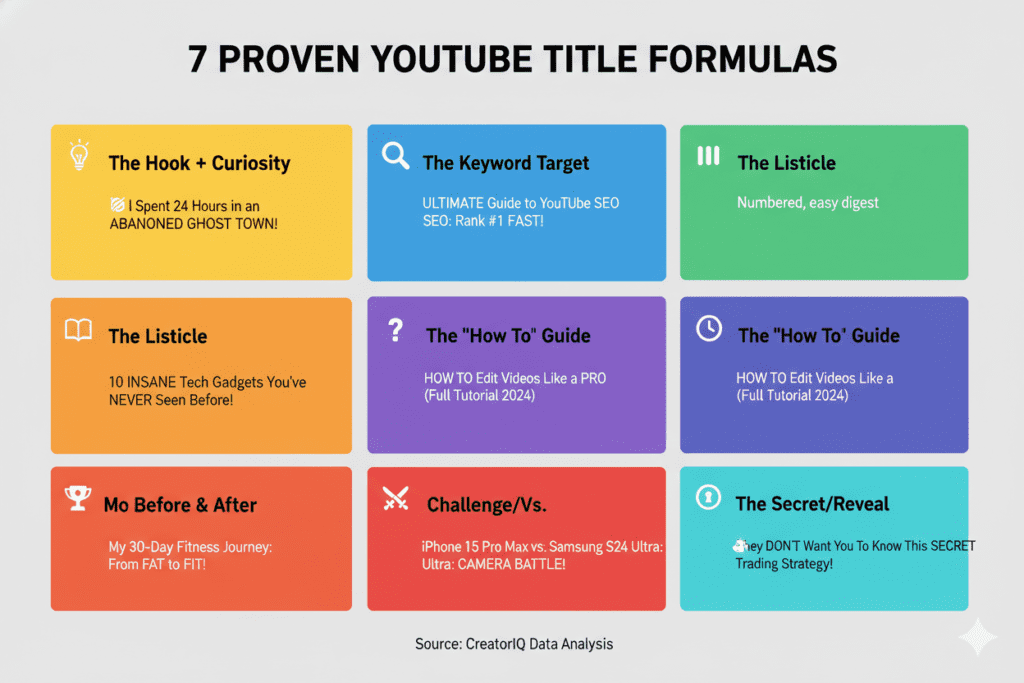
You don’t have to reinvent the wheel every time you upload. These title formulas have been tested across thousands of channels and they work — right now, in youtube title best practices length 2026.
Formula 1: The Number + Outcome “7 YouTube Title Best Practices That Doubled My Views in 2026”
Numbers set expectations and signal value. Specificity matters — “7” beats “Several” every time.
Formula 2: The Curiosity Gap “I Changed One Word in My Title — My CTR Went Up 47%”
Leave them needing to know the resolution. The incomplete story is irresistible.
Formula 3: The Transformation Promise “How to Go from 0 to 100K Subscribers Using YouTube Title Best Practices”
Before → After. Pain → Solution. This formula sells the journey.
Formula 4: The Warning Pattern “Stop Writing YouTube Titles Like This (It’s Killing Your Channel)”
Negative framing triggers loss aversion. People will click to avoid a mistake.
Formula 5: The Year + Action “The Best YouTube Title Strategy for 2026 (Updated Guide)”
Adding the year signals freshness and relevance. Especially powerful for search-driven content.
Formula 6: The Versus Frame “Short vs. Long YouTube Titles: Which Gets More Clicks in 2026?”
Debate and comparison create instant curiosity and cover two keyword intents at once.
Formula 7: The Achievement Story “How I Grew to 50K Subs by Fixing My YouTube Title Best Practices”
First-person results are extremely compelling. People trust evidence over advice.
7. Power Words That Make Viewers Click Instantly
The right word in the right place in youtube title best practices length 2026 can be the difference between a 2% CTR and an 8% CTR.
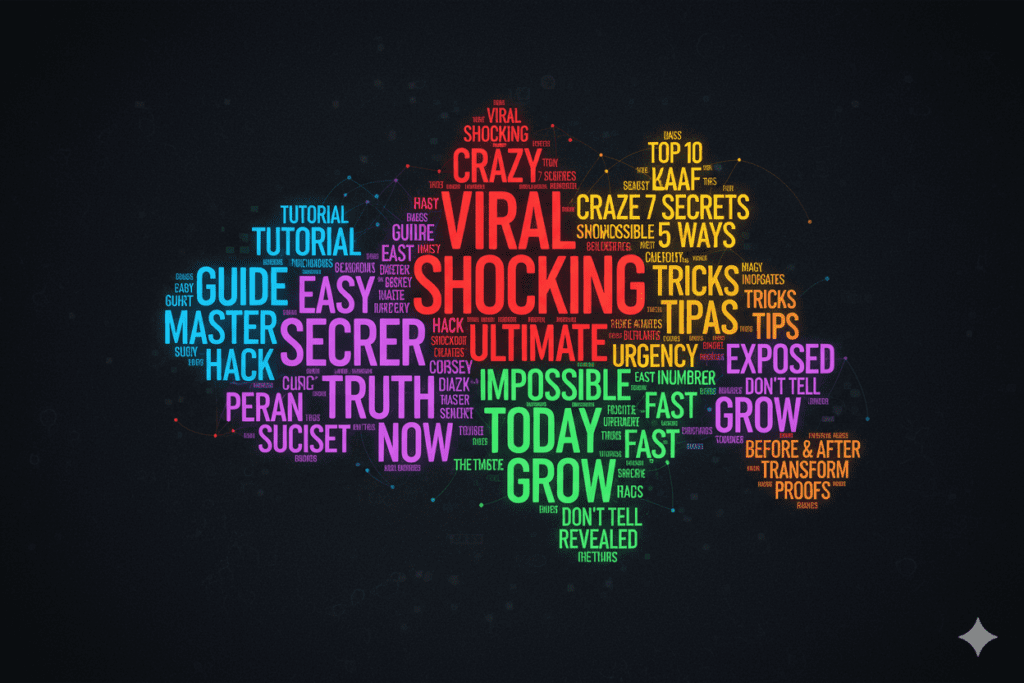
Here are the power word categories that work best in YouTube titles right now:
Curiosity Triggers: Secret, Hidden, Untold, Nobody Talks About, What They Don’t Tell You
Authority Boosters: Proven, Expert, Ultimate, Complete, Official
Urgency & Scarcity: Before It’s Too Late, Right Now, Stop, Never Again, Finally
Numbers & Specificity: 3x, 47%, $10K, In 30 Days, Under 5 Minutes
Emotion Triggers: Shocked, Embarrassed, Terrified, Life-Changing, Honest
Transformation Words: From Scratch, Step by Step, Blueprint, System, Formula
The goal is to use one or two power words per title — not pile them all in. Overloading your title with hype words makes it look like clickbait and destroys trust.
Tools like ytZolo are trained on what power words perform best in specific niches, so you’re not guessing — you’re getting data-backed suggestions every time.
You can also combine these power words with proven hooks from this YouTube script writing guide to create stronger storytelling across your videos.
8. How to Front-Load Your Titles for Maximum Impact
Front-loading is the single most underused title tactic in 2026.
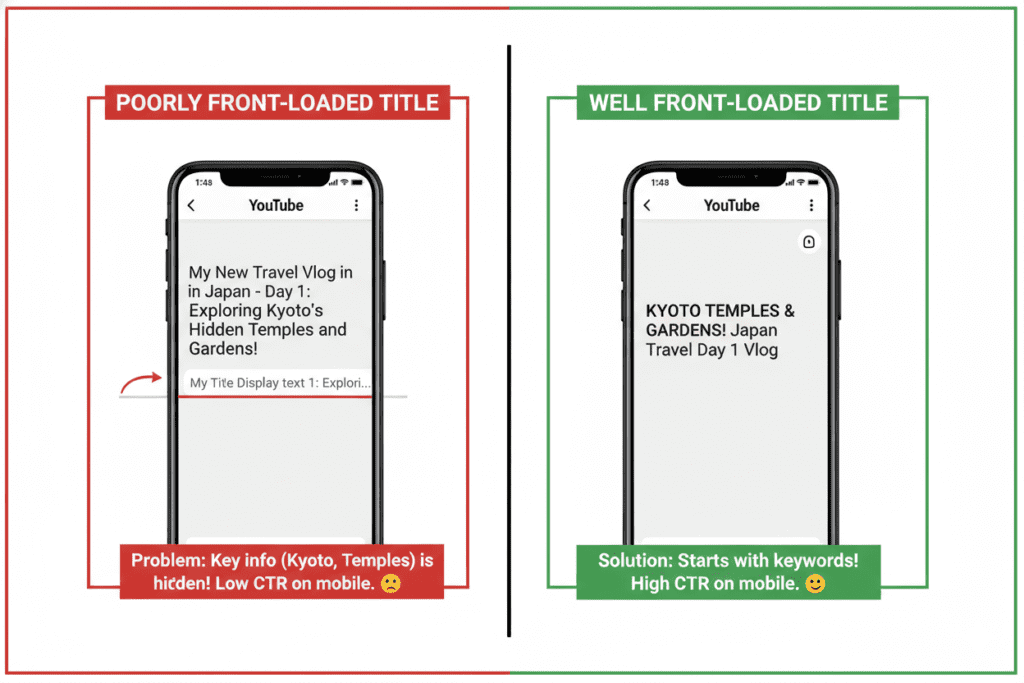
The idea is simple: put your most valuable, attention-grabbing words at the very beginning of your title in youtube title best practices length 2026. YouTube weighs early-title keywords more heavily for SEO. And since mobile truncates titles after 35–50 characters, the front is the only part most viewers see.
Bad front-loading: “In This Video, I’m Going to Show You the Best YouTube Title Practices for 2026”
Good front-loading: “YouTube Title Best Practices 2026: What’s Actually Working Right Now”
See the difference? The second version leads with the exact search query. It’s immediately clear what the video is about. And it survives mobile truncation beautifully.
Here’s a simple front-loading checklist:
- Does your keyword appear in the first 5 words?
- Does the first half of the title make sense on its own?
- Would a viewer know the topic if they only saw 45 characters?
- Is there a compelling reason to keep reading in the second half?
If you can check all four boxes, your front-loading is solid.
9. YouTube Title Best Practices Length 2026: Mobile vs. Desktop
Here’s a stat that should change how you think about every title you write:
Over 70% of YouTube watch time now happens on mobile devices.
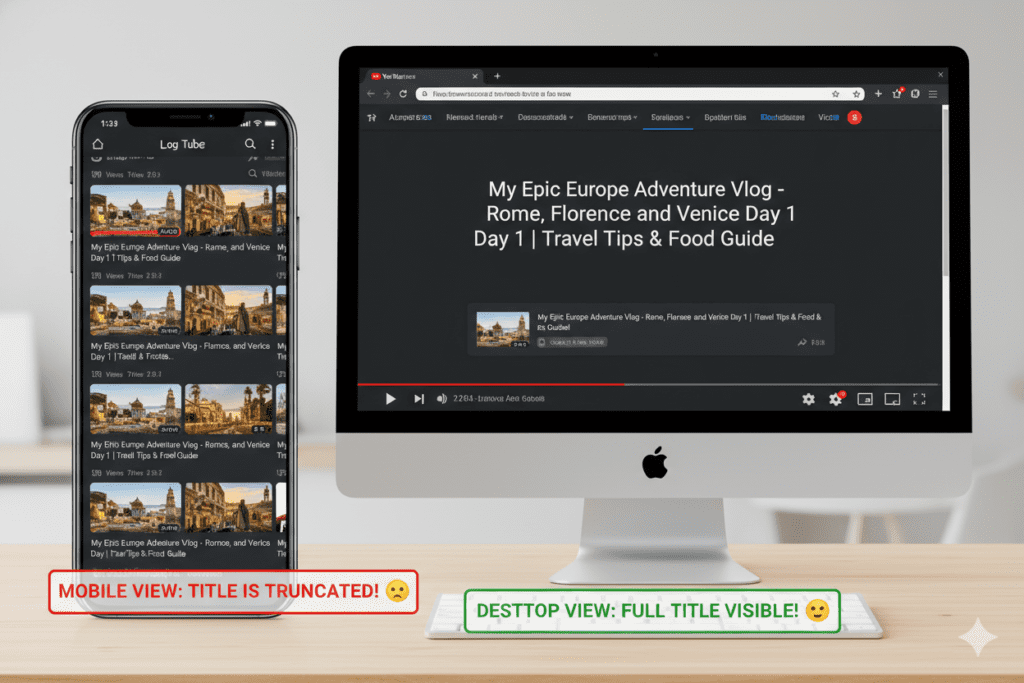
That means the majority of people discovering your videos are seeing a truncated title on a small screen. On mobile, only about 35–50 characters are visible in the feed before the title cuts off.
But — and this is critical — that doesn’t mean you should write 40-character titles.
Here’s the mobile-first strategy that actually works:
Characters 1–40: Your hook + keyword. Make this stand alone. This is all most people see.
Characters 41–70: Add context, specificity, or urgency. This helps search and appeals to desktop viewers.
Characters 71–100: Optional. Use this space for secondary keywords or a curiosity-building tail. This is mostly for SEO.
Think of it as writing two titles in one: a short one for mobile viewers, and a longer one for search ranking and desktop discovery. The best youtube title best practices length 2026 honor both audiences at once.
10. Why Manual Title Writing Is Killing Your Growth
Let’s be honest about something.
Most creators write their titles in the last 5 minutes before uploading. They’re tired. They’ve been editing for hours. They type the first thing that comes to mind, maybe tweak it once, and hit publish.
Creators who automate this process are also using tools like AI YouTube script generators to speed up content production end-to-end.
That approach worked when YouTube was simpler. In 2026, it’s a growth killer.
Here’s why manual title writing fails:
It’s inconsistent. You might write a great title on a good day and a terrible one on a bad day. One weak title can break a momentum streak that took months to build.
It’s not data-driven. Your instincts about what’s “catchy” don’t account for keyword search volume, current trends, or what’s already performing in your niche.
It ignores the competition. Top creators in your space are A/B testing titles, using analytics, and optimizing based on real CTR data. Writing by gut feel puts you at a permanent disadvantage.
It’s slow. Coming up with 5–10 title variations, checking keyword volume, tweaking for the right length and hook in youtube title best practices length 2026 — that’s an hour of work. Every. Single. Upload.
The creators who are winning in 2026 have automated the title-writing process. They use AI. They test faster, rank higher, and free up time for what actually matters: making great content.
That’s exactly where ytZolo changes everything.

11. Why ytZolo Is Better Than Other Tools for Writing YouTube Titles
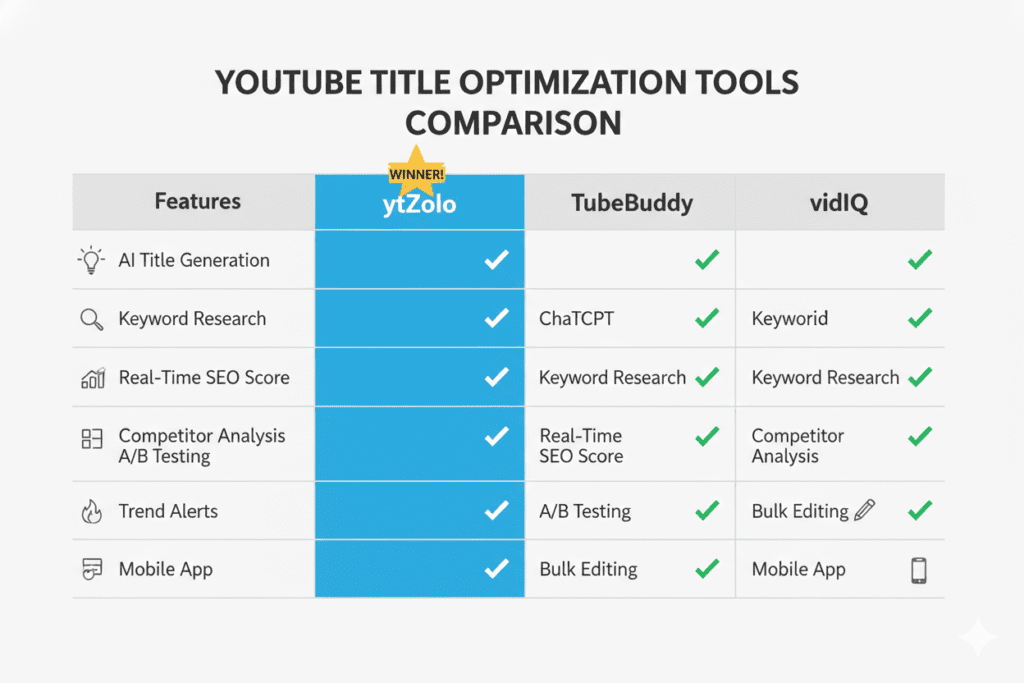
There are a lot of tools out there. ChatGPT, vidIQ, TubeBuddy, Jasper — you’ve probably tried a few. So why is ytZolo the best AI tool for YouTube title optimization in 2026?
Here’s the honest breakdown:
ytZolo vs. ChatGPT
ChatGPT is a brilliant general-purpose AI. But it wasn’t built for YouTube in youtube title best practices length 2026. It doesn’t know your niche’s CTR benchmarks, trending title formats, or what kinds of hooks convert in your specific category. You have to guide it manually — which takes just as much time as writing titles yourself.
ytZolo is YouTube-native. It’s trained specifically on what makes YouTube titles rank and get clicked. You type your topic, and it generates optimized, SEO-ready title options in seconds.
ytZolo vs. TubeBuddy & vidIQ
TubeBuddy and vidIQ are solid analytics tools. They’re great for keyword research and tag optimization. But they’re primarily data dashboards, not content creation tools. They’ll tell you what keywords to target — but they won’t write your titles for you.
ytZolo does both in youtube title best practices length 2026. It combines keyword intelligence with AI-powered title generation, so you get SEO-optimized titles that are also written to convert.
ytZolo vs. Generic AI Writers
Tools like Jasper or Copy.ai write general marketing copy. They don’t understand the specific psychology of YouTube titles, the importance of front-loading, or how to balance CTR optimization with search intent on a video platform.
ytZolo is built exclusively for YouTube creators. Every feature — from title generation to thumbnail creation, script writing, descriptions, and SEO tags — is designed around how YouTube’s algorithm actually works.
The ytZolo Advantage
- All-in-one platform: Titles, scripts, thumbnails, descriptions, and tags — all in one place
- YouTube-specific AI: Trained on viral content patterns and high-CTR title structures
- Time-saving: What takes an hour manually takes under 2 minutes with ytZolo
- Consistent quality: No more off-days ruining your upload schedule
- Built for growth: Every output is optimized to improve CTR, watch time, and discoverability
Creators using ytZolo report CTR improvements of 20–40% just from switching to AI-generated, data-backed titles in youtube title best practices length 2026. That’s not a small edge — that’s the difference between a video that goes viral and one that disappears.
Check out more on the ytZolo blog for creator success stories and platform updates.
12. How to Use ytZolo to Write Viral Titles in Under 2 Minutes
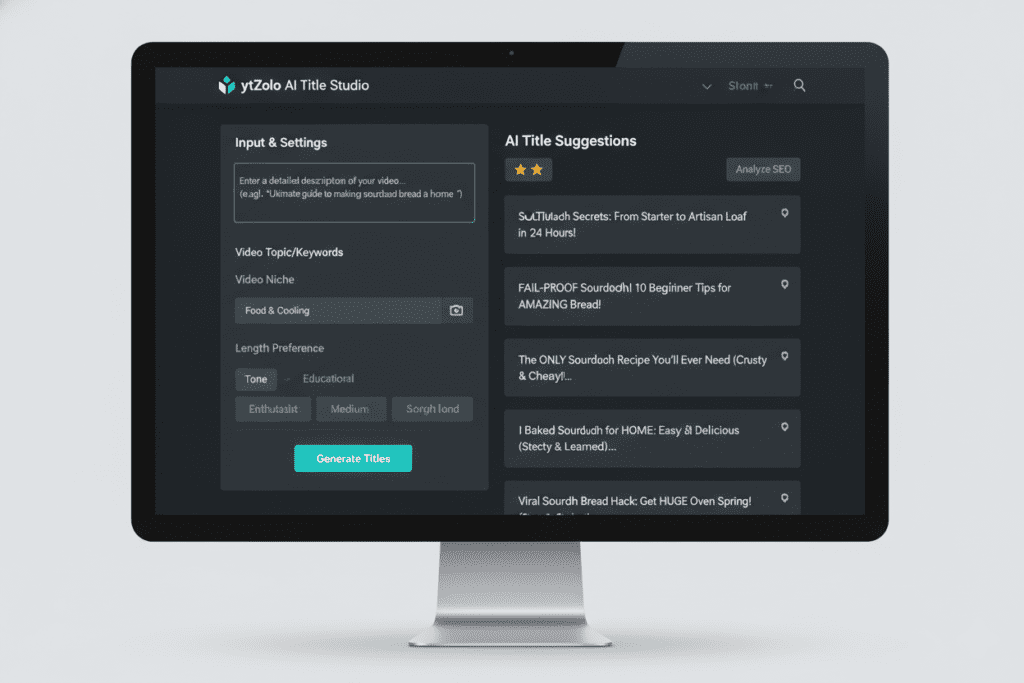
Using ytZolo to write YouTube titles is about as simple as it gets. Here’s the step-by-step:
Step 1: Enter Your Video Topic Type in what your video is about. Be as specific as possible — “how to grow on YouTube with AI tools in 2026” gives ytZolo more to work with than just “YouTube growth.”
Step 2: Select Your Niche ytZolo tailors its title suggestions based on your content category. Gaming titles follow different psychological patterns than finance or beauty content. Niche-matching makes every suggestion more relevant.
Step 3: Review the AI-Generated Title Options ytZolo will generate multiple title variations using different proven formulas — curiosity gaps, number-driven titles, transformation promises, and more. Each one is optimized for length, keyword placement, and CTR.
Step 4: Pick Your Favorite (or Blend Two) Choose the title that feels most aligned with your content. You can also blend elements from two different suggestions to create something uniquely compelling.
Step 5: Use the Other ytZolo Features While you’re in the platform, generate your description, tags, thumbnail, and even your video script — all optimized for the same keyword and audience. That’s a full upload package in minutes, not hours.
That’s the power of working smarter. Start creating with ytZolo today.
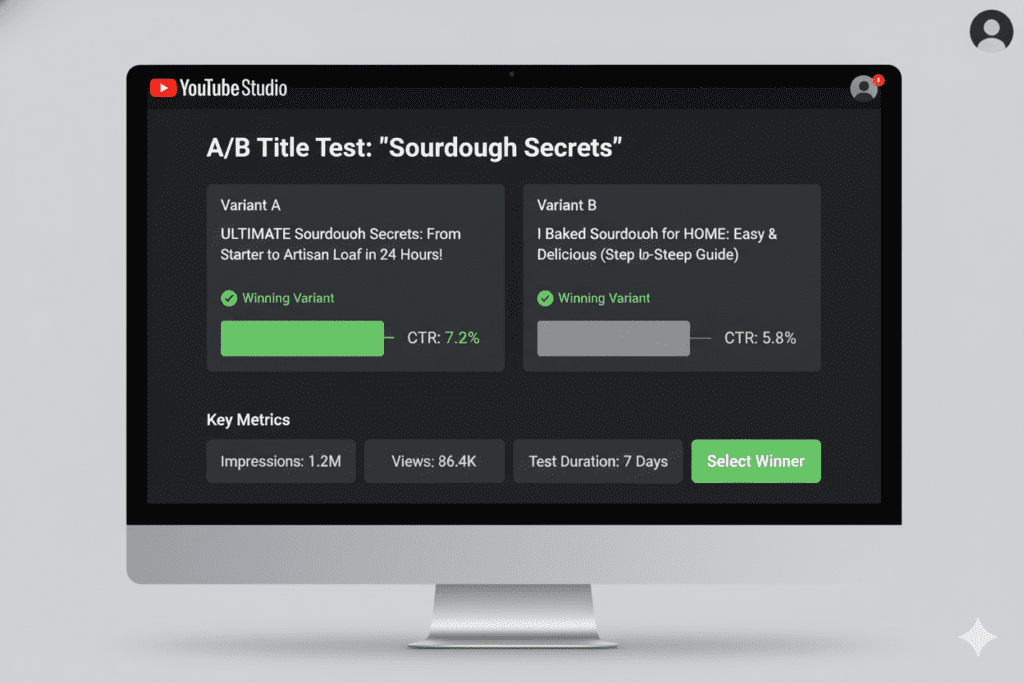
13. How to A/B Test Your YouTube Titles
Even the best title writers test their work. Here’s how to do it right.
YouTube Studio now offers native A/B title testing for channels with 1,000+ subscribers in youtube title best practices length 2026. You can test two title variations against the same video and let YouTube measure which generates a higher CTR over a statistically meaningful period.
Best practices for title A/B testing:
- Run tests on videos that already receive steady traffic (not brand-new uploads)
- Let each test run for at least 1–2 weeks and gather a minimum of 100–200 impressions per variation before drawing conclusions
- Test one variable at a time — don’t change both the hook and the keyword in the same test
- Look at CTR and average view duration together — a title that gets more clicks but kills retention is a net loss
- Apply the winning patterns to future titles, not just the current video
The creators compounding their growth fastest right now are those who systematically test, learn, and iterate. AI tools like ytZolo accelerate this process by generating multiple testable title variations instantly.
You can also explore data-backed title testing strategies on the ytZolo blog.
14. Common YouTube Title Mistakes to Avoid
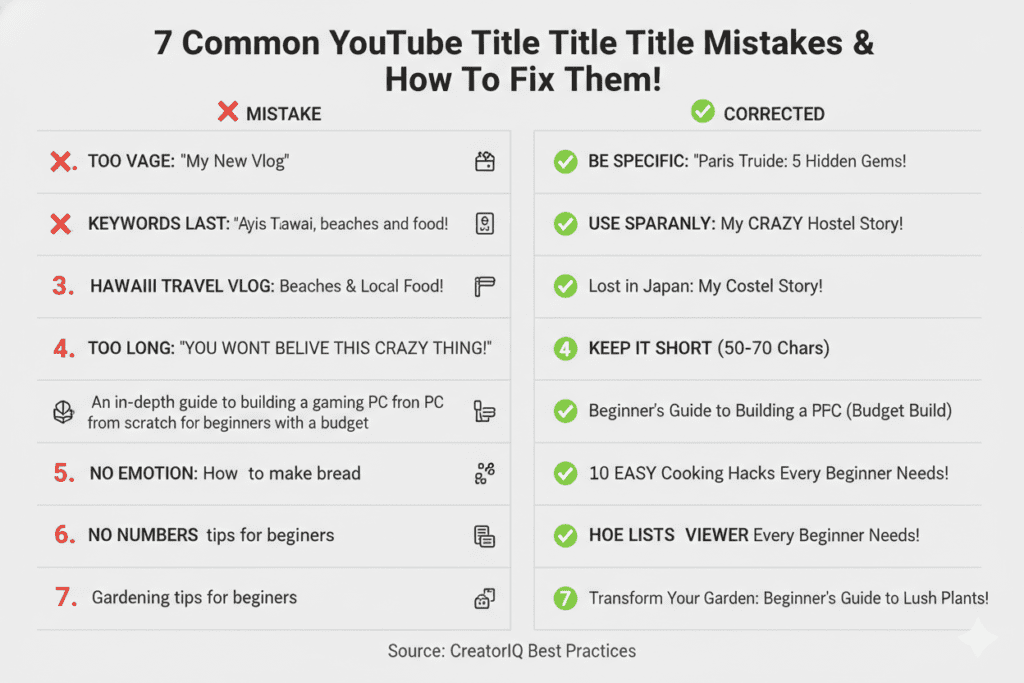
Even experienced creators fall into these traps. Check your recent titles against this list:
Mistake 1: Burying your keyword at the end “Everything You Need to Know About Growing on YouTube: Title Best Practices 2026” — the keyword is too late. Move it to the front.
Mistake 2: Writing for bots, not humans “YouTube Title Best Practices Length 2026 YouTube SEO YouTube Title” — this is keyword stuffing. It reads like spam and tanks your CTR.
Mistake 3: Being too vague “My YouTube Tips for This Year” — what tips? For whom? About what? Specificity drives clicks.
Mistake 4: Misleading clickbait Titles that over-promise and under-deliver destroy trust and increase your bounce rate. Keep it honest. Keep it compelling.
Mistake 5: Ignoring title refresh opportunities An underperforming video from 6 months ago might just need a new title. Updating titles on old videos is one of the highest-leverage, lowest-effort growth tactics available to you.
Mistake 6: Writing just one title option Professional creators generate 5–10 title variations before choosing. If you’re only writing one, you’re leaving your best option on the table.
Mistake 7: Forgetting the thumbnail connection Your title and thumbnail should tell a story together — not repeat the exact same information. If your thumbnail says “I went broke,” your title shouldn’t. Create a conversation between the two.
15. FAQ: YouTube Title Best Practices Length 2026
Q: What is the ideal YouTube title length in 2026?
The ideal YouTube title length in 2026 is 70–100 characters for maximum SEO performance. However, the first 40–50 characters should contain your core hook and keyword, as mobile devices truncate titles after approximately 35–50 characters. A study of over 3 million videos confirmed that 70–100 character titles outperform shorter titles by 10–14% on average.
Q: Does YouTube title length affect SEO?
Yes, YouTube title length directly impacts SEO in youtube title best practices length 2026. Longer titles (70–100 characters) give you more room to include primary and secondary keywords naturally, which improves your video’s chances of ranking in search results. Front-loading your primary keyword in the first 4–5 words gives it additional weight in YouTube’s algorithm.
Q: How many keywords should I include in a YouTube title?
Focus on one primary keyword placed naturally near the beginning of your title. You can include one secondary or related keyword in the latter half if it fits naturally. Avoid keyword stuffing — YouTube’s Gemini AI integration in 2026 now understands semantic context and penalizes unnatural keyword repetition in titles.
Q: Should I include the year (2026) in my YouTube title?
Include the year only when the content is genuinely time-sensitive — annual roundups, algorithm updates, trend analyses, or tutorial content where freshness is a key value in youtube title best practices length 2026. For evergreen content, skip the year. A title without a year will attract views for 3–5 years, while a dated title has a 12-month shelf life before it starts repelling clicks.
Q: Can I change my YouTube title after publishing?
Yes, you can update your YouTube title at any time through YouTube Studio, and it won’t harm your existing rankings. In fact, refreshing the title on an underperforming video is one of the fastest ways to improve its CTR. Many creators use tools like ytZolo to generate new title options for older videos and test whether a title change revives performance.
16. Conclusion: Your Titles Are Your Growth Engine
Here’s the bottom line about YouTube title best practices length 2026:
The length debate is real, but it’s secondary. What matters most is quality — a title that grabs attention in the first 40 characters, includes your keyword naturally, and makes it psychologically impossible not to click.
Whether you land at 55 characters or 90 characters, the principles are the same: front-load your hook, use specific language, speak to a curiosity or a pain point, and make your title and thumbnail work as a team.
But here’s what most guides won’t tell you: the creators growing the fastest in 2026 aren’t writing titles by hand in youtube title best practices length 2026. They’re using data-backed AI tools to generate, test, and optimize their titles at scale.
That’s exactly what ytZolo is built for. It’s not just a title generator — it’s a complete YouTube growth platform that handles titles, scripts, thumbnails, descriptions, and tags in one seamless workflow. It’s the unfair advantage that consistent, growing channels are quietly using right now.
If you’re serious about your channel, the question isn’t whether you should optimize your titles. It’s whether you’re going to keep doing it manually — slowly, inconsistently, and based on gut feel — or whether you’re ready to work smarter.
The algorithm isn’t getting easier. The competition isn’t slowing down. And manual methods are officially outdated.
Start creating smarter, faster, and more viral YouTube content with ytZolo today.
Related reading: Check out more YouTube growth strategies and creator resources on the ytZolo blog.
External resources:

