

Introduction: Your Video Deserves to Be Found
You filmed it. You edited it. You poured hours into making it good.
Then you hit publish — and the views never came.
Sound familiar? You’re not alone. Thousands of talented creators upload videos every single day that never get discovered. Not because the content is bad. But because the metadata is letting them down.
Here’s what most creators don’t realize: YouTube can’t watch your video the way a human does. It reads your metadata — your title, description, tags, and thumbnails — to decide who sees your content. Get the metadata right, and the algorithm rewards you with impressions, recommendations, and views. Get it wrong, and your video disappears into the void.
That’s exactly why a YouTube metadata generator has become one of the most powerful tools in a creator’s arsenal. And when that generator is powered by AI? The results are on another level entirely.
In this guide, we’re going to break down everything you need to know about YouTube metadata, how a metadata generator works, and why ytZolo is the smartest, most complete solution creators are using in 2026 to grow their channels faster than ever.
Let’s get into it.
Table of Contents
What Is YouTube Metadata — And Why Does It Matter So Much?
Before we talk about generators, let’s get crystal clear on what YouTube metadata actually is.
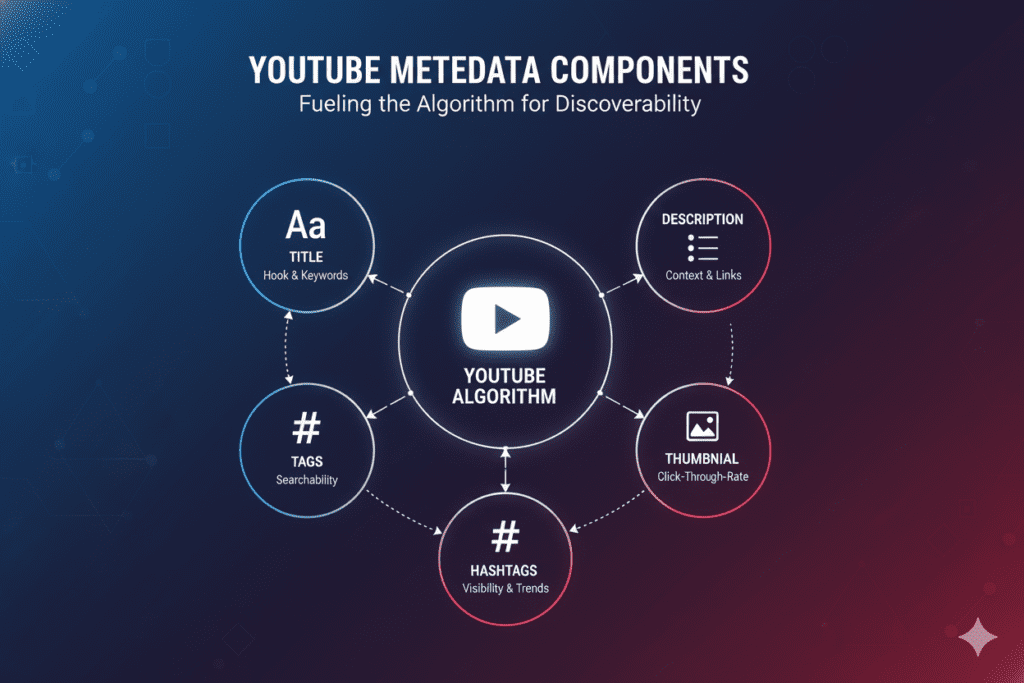
In simple terms, YouTube metadata is all the text-based information attached to your video. It’s the data layer that sits beneath your content — invisible to casual viewers, but absolutely critical to the algorithm.
Your metadata tells YouTube’s system what your video is about, who should see it, and how to categorize it across the platform.
The core components of YouTube metadata include:
- Title — Your video’s headline; the most important metadata element
- Description — Context, keywords, links, and calls to action
- Tags — Keywords that help the algorithm categorize your content
- Thumbnail — The visual metadata that drives click-through rate
- Category — The broad subject area your video belongs to
- Hashtags — Discoverability signals that link your video to trending topics
- Closed Captions / Subtitles — Text YouTube indexes alongside your video
YouTube’s algorithm uses all of this metadata to match your content with search queries and viewer interests. According to the YouTube Creator Blog, the platform processes billions of searches every month — and metadata is the primary signal the system uses to serve the right videos to the right people.
That means your metadata isn’t just labeling. It’s the engine driving your discoverability. And that’s why having the right YouTube metadata generator in your corner isn’t optional — it’s essential.
Why Most Creators Struggle with Metadata (And Pay the Price)
Ask any creator what they find most frustrating about YouTube, and metadata optimization is almost always on the list.
Here’s why it’s so hard to get right on your own.
It requires multiple skill sets simultaneously. Great metadata means combining SEO knowledge, copywriting, keyword research, and an understanding of the algorithm — all at once. Most creators are experts in their content, not in YouTube’s discovery mechanics.
The algorithm is always evolving. What worked for metadata two years ago might not work today. YouTube’s ranking signals shift constantly, and staying on top of those changes is practically a full-time job.
Manual research is brutally slow. Doing proper keyword research, studying competitors, writing a compelling description, and building a strategic tag set for every single video can eat 2–4 hours per upload. That time adds up fast.
Guesswork leads to inconsistency. Without data driving your decisions, your metadata quality varies wildly from video to video. The algorithm rewards consistency. Inconsistent metadata means inconsistent results.
The creators who are winning on YouTube in 2026 aren’t grinding through this manually. They’re using a YouTube metadata generator powered by AI — so every upload is backed by real data, semantic keyword intelligence, and algorithm-aligned optimization.
Manual methods aren’t just slow. They’re outdated. And every video you upload without proper metadata is a missed opportunity you can never get back.

What Is a YouTube Metadata Generator?
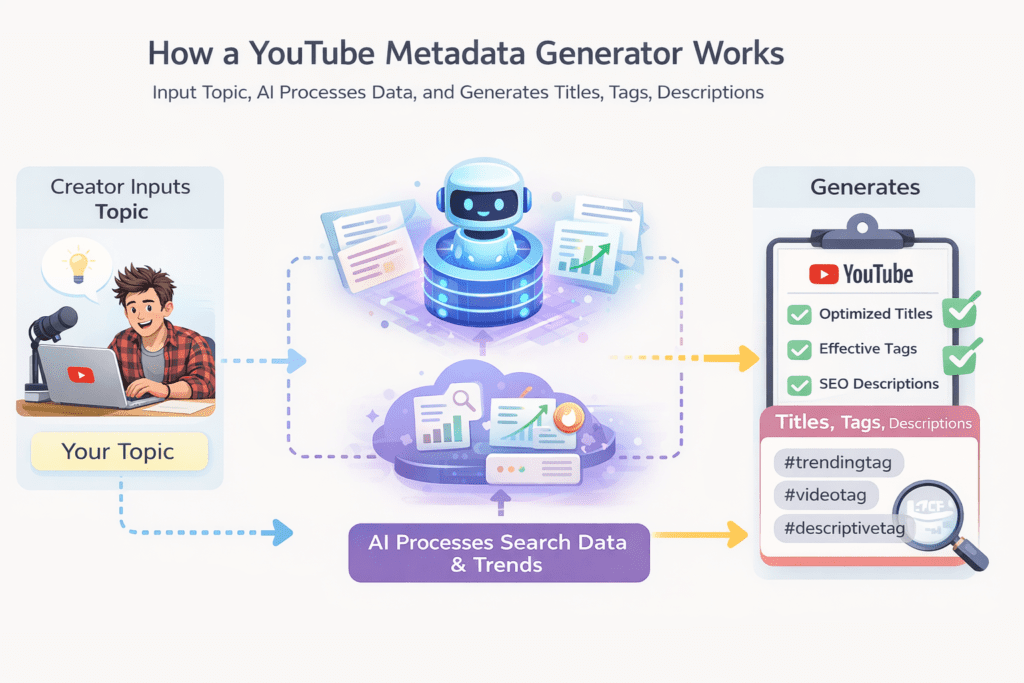
A YouTube metadata generator is a tool — often AI-powered — that automatically creates optimized metadata for your YouTube videos.
Instead of spending hours researching and writing, you input your video topic or a brief description, and the generator produces ready-to-use titles, descriptions, tags, and more — all built to improve discoverability and click-through rate.
The best YouTube metadata generators don’t just spit out generic text. They analyze real-time search trends, study competitor performance, and apply semantic keyword mapping to build a metadata package that speaks directly to YouTube’s algorithm.
Here’s what a quality YouTube metadata generator does for you:
- Generates multiple keyword-optimized title options instantly
- Builds comprehensive tag sets with primary, secondary, and long-tail keywords
- Writes full video descriptions naturally woven with semantic keywords
- Suggests hashtags aligned with trending topics in your niche
- Analyzes competitor metadata to identify ranking opportunities
- Saves hours of manual research and writing per video
Think of it as a shortcut that doesn’t sacrifice quality. A great YouTube metadata generator produces better output than most creators could achieve manually — because it’s backed by data, not guesswork.
And when you multiply that advantage across every video you publish? The compounding effect on your channel growth is enormous.
The 5 Critical Elements of YouTube Metadata You Must Optimize
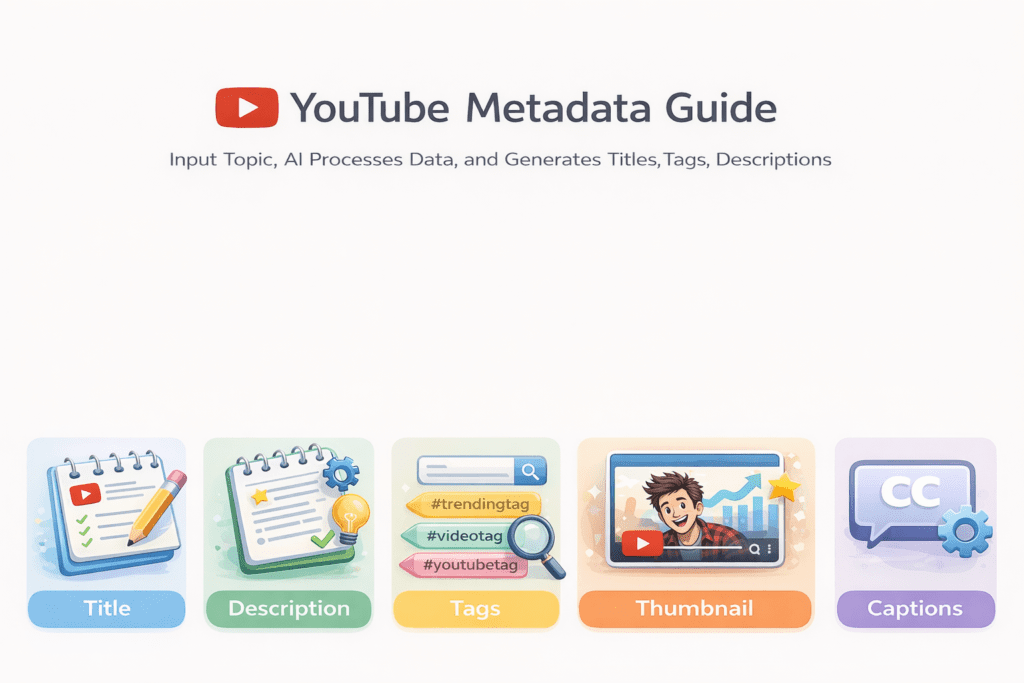
A YouTube metadata generator is only as good as your understanding of what to generate. Let’s break down the five metadata elements that matter most — and why.
1. Video Title
Your title is the single most important piece of YouTube metadata. It’s the first thing viewers see and the primary signal YouTube uses to match your video with search queries.
A great title has three jobs: include your target keyword, trigger emotional curiosity, and be clear about the value the viewer gets. Miss any one of those and your CTR takes a hit.
Best practices for titles:
- Place your primary keyword in the first 3–5 words
- Keep titles under 60 characters to avoid truncation in search
- Use power words: “ultimate,” “proven,” “secret,” “fast,” “complete”
- Combine clarity with curiosity — tell them what it’s about and make them want to click
2. Video Description
Your description is prime real estate that most creators massively underuse. It’s where the algorithm gets deeper context about your content, and it’s also where viewers decide whether to trust you.
A well-written description starts with your primary keyword in the first sentence, includes semantic keywords naturally throughout, and provides genuine value — links, context, timestamps, and a call to action.
Best practices for descriptions:
- Write at least 200–300 words for each video
- Place your most important keyword in the first 1–2 lines
- Include related keywords and subtopics naturally
- Add timestamps to improve viewer experience and generate chapter previews
- End with a clear CTA (subscribe, comment, visit your site)
3. Tags and Hashtags
Tags help YouTube categorize your content, especially for newer channels still building authority. While their direct ranking impact has evolved, they still contribute to the algorithm’s understanding of your video’s topical context.
The key is building a strategic tag set — not just stuffing in every keyword you can think of.
Best practices for tags:
- Lead with your exact primary keyword
- Add long-tail variations (e.g., “YouTube SEO 2026” alongside “YouTube SEO”)
- Include 3–5 broad category tags for wider reach
- Add 2–3 competitor channel/video tags in your niche
- Avoid irrelevant tags — YouTube’s policies penalize misleading metadata
4. Thumbnails (Visual Metadata)
Your thumbnail is metadata in visual form. It’s the image that drives your click-through rate — and CTR is one of YouTube’s most powerful ranking signals.
Research consistently shows that a well-optimized thumbnail can increase video views dramatically. Every visual element — colors, faces, expressions, text overlays, contrast — is a data point that the algorithm uses to predict your video’s performance.
5. Closed Captions and Transcripts
This one surprises a lot of creators. Your video’s captions are indexed by YouTube as text metadata. That means every keyword you say in your video becomes part of your metadata footprint.
Accurate captions also improve accessibility, extend watch time, and signal quality to the algorithm. A YouTube metadata generator that helps you align your spoken keywords with your written metadata creates a powerful consistency that the algorithm rewards.
How a YouTube Metadata Generator Creates a Competitive Edge
Here’s something most creators never think about: when you upload a video, you’re not just competing against content. You’re competing against optimized content.
The top videos in any niche aren’t just well-produced. They’re precisely optimized — with metadata that the algorithm trusts, titles that trigger clicks, and descriptions that reinforce relevance across hundreds of related searches.
Using a YouTube metadata generator gives you that same precision — without the expertise or the hours.
Here’s the compounding advantage a metadata generator creates:
- Faster start. AI-generated metadata is ready before your video even finishes uploading. You’re optimized from the first second the algorithm indexes your content.
- Consistent quality. Every video gets the same level of metadata depth, regardless of how tired or rushed you are. Consistency is what the algorithm builds on.
- Trend awareness. The best AI metadata generators analyze what’s currently trending in your niche — so your metadata captures rising search volume before it peaks.
- Semantic depth. YouTube’s algorithm understands context, not just keywords. A metadata generator that applies semantic keyword mapping gives your video a richer, more comprehensive relevance signal.
- Time reclaimed. Every hour you’re not spending on manual metadata is an hour you can put into creating better content. That’s a direct investment in your channel’s long-term growth.
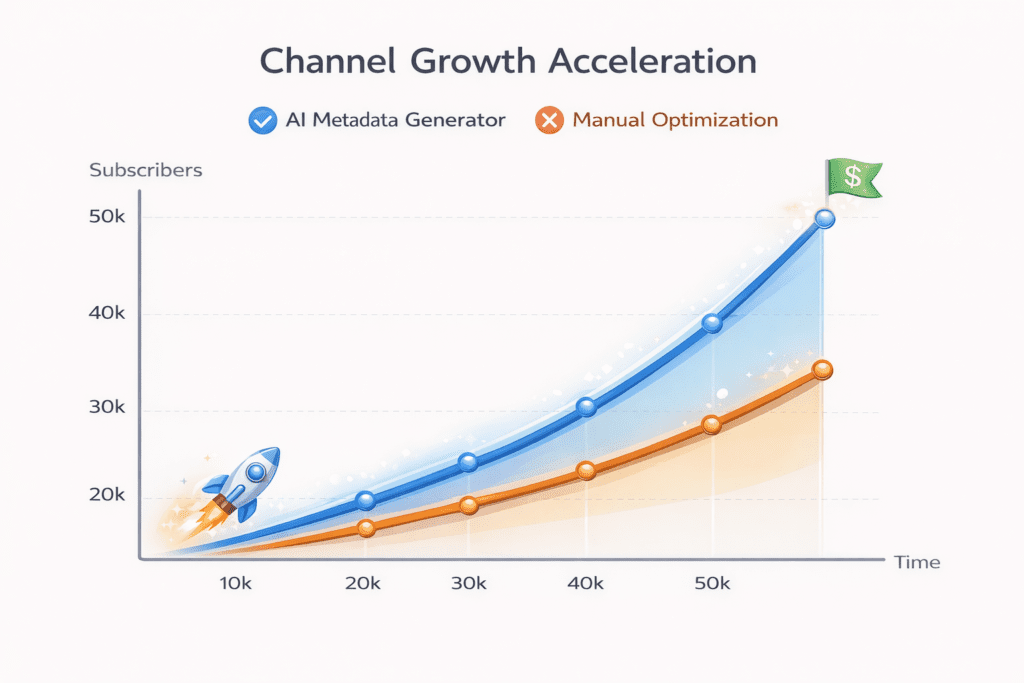
The creators using AI-powered YouTube metadata generators aren’t just working smarter. They’re building a systematic advantage that compounds with every single upload.
Meet ytZolo: The Best AI YouTube Metadata Generator for Growth
There are plenty of AI tools that can generate some YouTube metadata. But there’s only one platform built from the ground up to handle your entire YouTube optimization workflow — and that’s ytZolo.
ytZolo isn’t a generic AI writing tool with a YouTube template bolted on. It’s a purpose-built YouTube metadata generator and all-in-one growth platform designed specifically for the way YouTube’s algorithm actually works.
Here’s what makes ytZolo the definitive choice for creators who are serious about growth:
AI-Powered Title Generation That Drives Real Clicks
ytZolo’s title generator doesn’t just find keywords and string them together. It applies CTR psychology — power words, emotional hooks, curiosity gaps, and proven structural patterns — to create titles that stop people from scrolling.
You get multiple title variations per video, ranked by their predicted click-through performance. Pick the one that fits your style, or use the highest-ranked option and watch your impressions convert at a higher rate.
Smart Metadata Package — All at Once
This is where ytZolo truly separates itself. Most tools generate one element at a time. ytZolo generates your complete YouTube metadata package in a single workflow — title, description, tags, and hashtags — all semantically connected and working together.
When all your metadata elements reinforce the same keywords and topical signals, the algorithm builds a clearer, stronger understanding of your content. That clarity translates directly into better distribution.
Semantic Tag Builder with Long-Tail Intelligence
ytZolo’s tag generator goes beyond surface-level keywords. It builds a full semantic tag ecosystem — primary terms, long-tail variations, related topics, trending hashtags — structured in order of relevance to maximize your algorithmic footprint.
This isn’t a list of random keywords. It’s a strategic metadata architecture designed to help YouTube understand, categorize, and recommend your content to the right audience.
AI Description Writer That Sounds Human
One of the biggest problems with generic AI tools is that their output sounds like it was written by a robot. ytZolo’s description generator produces natural, readable copy that seamlessly incorporates keywords without sacrificing voice or value.
Your descriptions rank better and convert better — because they’re written for both the algorithm and the viewer, simultaneously.
Beyond Metadata: The Full YouTube Growth Stack
ytZolo doesn’t stop at metadata. As a complete YouTube growth platform, it also handles:
- AI Script Writing — Full video scripts with powerful opening hooks designed to maximize watch time from the first second
- Thumbnail Generation — Visual AI trained on millions of high-performing thumbnails across every major YouTube niche
- Trend Analysis — Real-time identification of rising topics in your niche before they peak
- Competitor Intelligence — Detailed analysis of what’s working for top creators in your space
No other tool combines all of these capabilities in one seamless platform. ytZolo doesn’t just generate your YouTube metadata — it powers your entire channel growth strategy.
Explore the full breakdown of ytZolo’s features on the ytZolo blog.
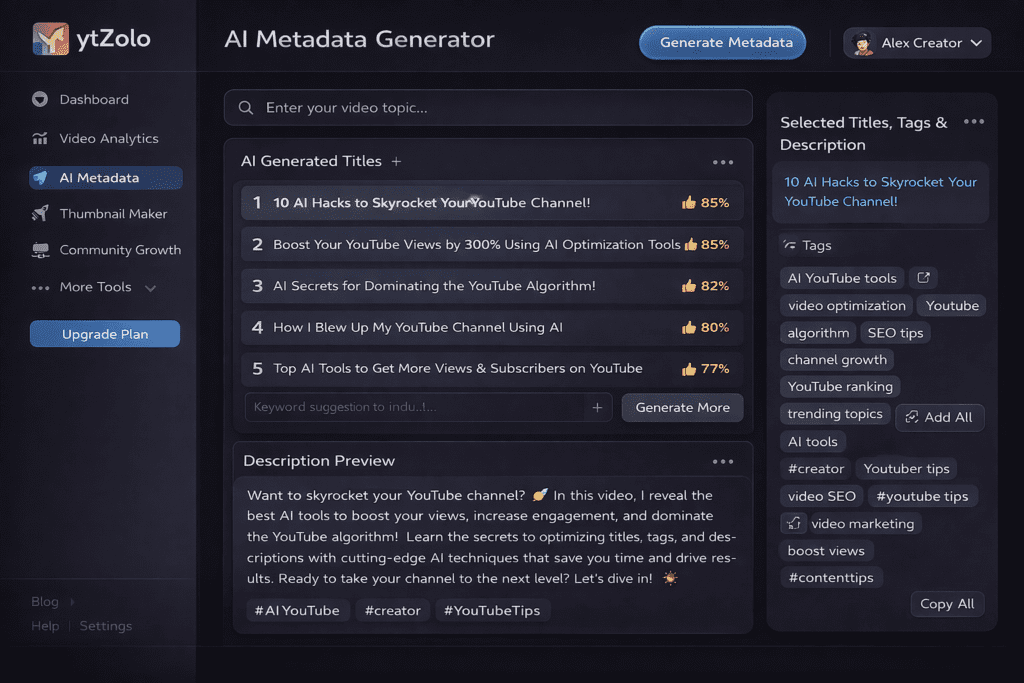
Why ytZolo Is Better Than Other Metadata Tools
Let’s be direct. TubeBuddy, VidIQ, and other platforms have their place. But when it comes to pure YouTube metadata generator capability, ytZolo delivers on a different level.
ytZolo vs. TubeBuddy
TubeBuddy is a browser extension built around analytics and A/B testing. It’s a useful data companion — but it doesn’t generate your metadata for you. You still have to write your titles, tags, and descriptions yourself, using TubeBuddy’s data as a guide.
ytZolo takes that data intelligence and acts on it. The AI writes your complete metadata package — not just shows you the data and leaves you to do the work.
ytZolo vs. VidIQ
VidIQ has improved its AI features significantly, including an AI Coach that gives channel-specific recommendations. It’s genuinely helpful for content ideation and trend spotting.
But VidIQ is still fundamentally an analytics-first tool. ytZolo is a generation-first platform — meaning the primary output is ready-to-use, fully optimized content and metadata, not just insights.
ytZolo vs. Free AI Writing Tools
Free tools like ChatGPT can generate metadata if you write detailed prompts. But they have no real-time YouTube trend awareness, no competitor intelligence, no CTR optimization layer, and no understanding of YouTube’s algorithm-specific requirements.
Using a generic AI for YouTube metadata is like using a hammer to do a surgeon’s work. ytZolo is precision-built for exactly this job.
ytZolo vs. Standalone Metadata Generators
There are several standalone YouTube metadata generators available — free tools that generate basic titles and tags from a keyword input. They’re fast, but shallow.
They don’t consider semantic depth, competitor context, niche-specific patterns, or CTR psychology. They produce functional metadata, not optimized metadata. For creators serious about growth, that difference matters enormously.
Feature Comparison:
| Feature | ytZolo | TubeBuddy | VidIQ | Free Generators |
|---|---|---|---|---|
| AI Title Generation | ✅ Advanced CTR-optimized | ✅ Suggestions only | ✅ Basic | ⚠️ Generic |
| Full Description Writer | ✅ Semantic & human-sounding | ❌ Manual | ❌ Manual | ⚠️ Basic |
| Strategic Tag Builder | ✅ Semantic ecosystem | ✅ Data guidance | ✅ Data guidance | ⚠️ Keyword-only |
| Hashtag Generation | ✅ Trending + relevant | ✅ Basic | ✅ Basic | ❌ No |
| Competitor Intelligence | ✅ Yes | ✅ Yes | ✅ Yes | ❌ No |
| Script + Hook Writing | ✅ Yes | ❌ No | ❌ No | ❌ No |
| Thumbnail Generation | ✅ Yes | ❌ Analysis only | ❌ Analysis only | ❌ No |
| All-in-One Workflow | ✅ Yes | ❌ No | ❌ No | ❌ No |
The conclusion is clear: for creators who want a complete, AI-powered YouTube metadata generator that handles the full optimization stack, ytZolo is in a league of its own.
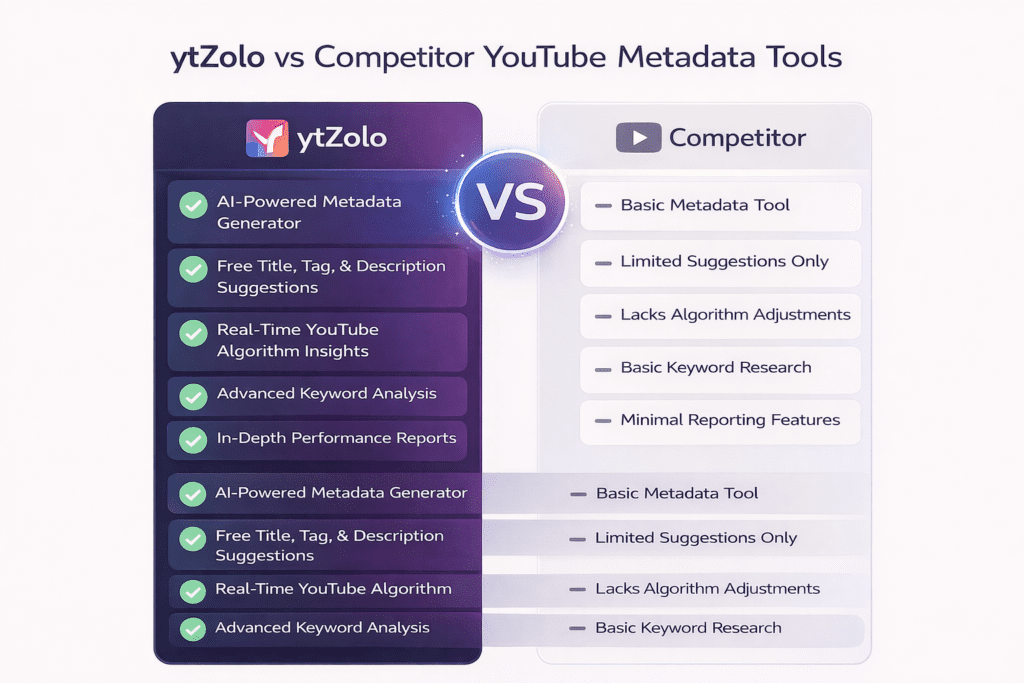
How to Use ytZolo as Your YouTube Metadata Generator (Step-by-Step)
Getting started with ytZolo takes minutes. Here’s exactly how to use it as your go-to YouTube metadata generator for every upload.
Step 1 — Sign Up for Free at ytZolo Go to ytzolo.com and create your account. No credit card is required to start. The platform is clean, fast, and designed for creators — not developers.
Step 2 — Enter Your Video Topic Type in your video topic, a working title, or a short description of your video’s content. The more specific you are, the more targeted and effective your generated metadata will be.
For example, instead of “cooking video,” try “easy weeknight dinner recipes under 30 minutes.” Specificity gives the AI richer context to work with.
Step 3 — Generate Your Full Metadata Package Hit generate. ytZolo’s AI analyzes your topic against:
- Current YouTube search trends
- Competitor video performance in your niche
- Semantic keyword data and long-tail variations
- CTR benchmarks for titles and thumbnails in your category
Within seconds, you receive a complete, ready-to-use metadata package.
Step 4 — Review Your Generated Metadata Your package includes:
- 3–5 AI-generated title options ranked by CTR prediction
- A full 200–300 word keyword-rich video description
- A complete tag set (primary, secondary, long-tail, and trending)
- Relevant hashtag suggestions for discoverability
- Thumbnail concepts and optimization notes
Step 5 — Customize and Apply Review everything, add your personal voice where needed, and plug the metadata directly into your YouTube upload. The whole process takes under 10 minutes per video.
Step 6 — Monitor Performance and Iterate Track your video’s impressions, CTR, and average view duration in YouTube Studio. Over time, you’ll spot which metadata patterns perform best for your specific audience — and ytZolo lets you refine your approach with every video.
This is the system. Video by video, the advantage compounds.
Check out the ytZolo blog for advanced tutorials on squeezing every bit of performance out of your metadata strategy.
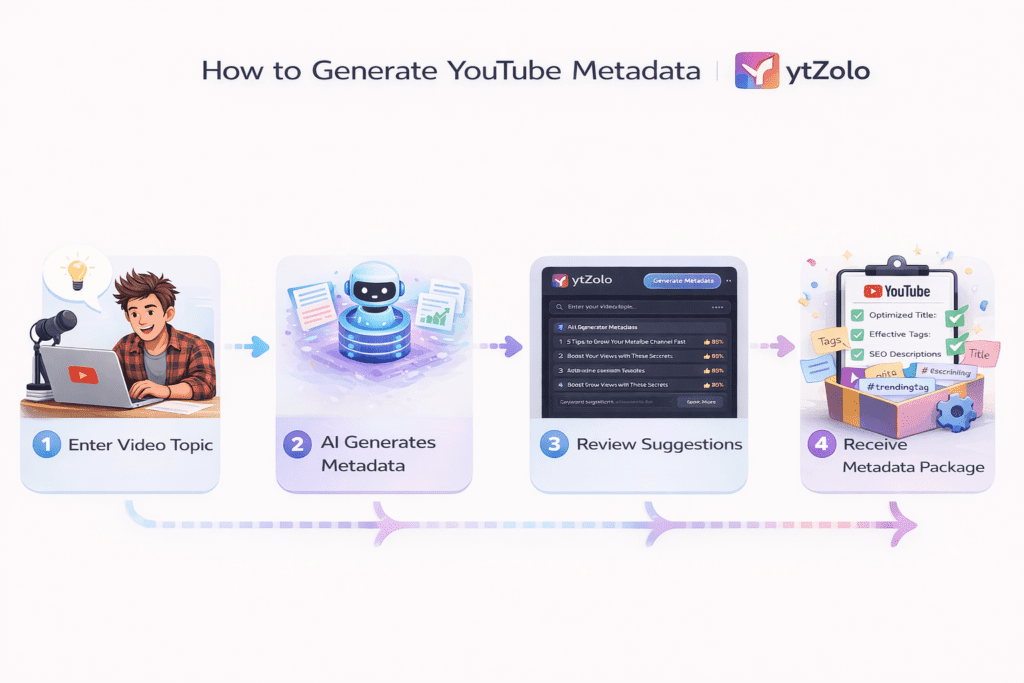
YouTube Metadata Mistakes That Are Killing Your Growth
Even experienced creators make these metadata errors. A good YouTube metadata generator eliminates most of them — but knowing what to avoid makes you sharper.
Mistake #1: Ignoring the Description Entirely Many creators write one or two lines in their description and call it done. This is a massive missed opportunity. YouTube indexes your description for search. A well-written, keyword-rich description adds significant discovery surface area to every video you upload.
Mistake #2: Keyword Stuffing Your Title Packing your title with three or four keywords makes it unreadable — and YouTube’s algorithm is smart enough to recognize it. Titles need to feel natural while strategically including your primary keyword. AI-generated titles strike this balance automatically.
Mistake #3: Using Identical Tag Sets Across Multiple Videos Copy-pasting the same tags from video to video tells the algorithm nothing new about each individual piece of content. Every video needs a unique, tailored metadata package. A YouTube metadata generator creates this automatically.
Mistake #4: Neglecting Hashtags Entirely Hashtags improve discoverability and connect your video to trending topic feeds. YouTube recommends 2–3 hashtags per video in your description. According to YouTube’s support documentation, hashtags placed in the description appear above your video title in search — making them prime discoverability real estate.
Mistake #5: Not Aligning Your Title and Thumbnail Your title and thumbnail should tell the same story. Mismatched visual and text metadata confuses viewers and hurts CTR. High CTR tells YouTube your video is compelling — which triggers more distribution.
Mistake #6: Writing Metadata After Editing Instead of Before The best creators plan their metadata during content development — not after the fact. Knowing your target keywords before filming means you can naturally say those keywords in your video, which YouTube’s captioning system picks up and indexes as additional metadata.
Mistake #7: Never Updating Old Video Metadata Your older videos can still be goldmines. Refreshing the metadata on high-impression, low-CTR videos with AI-generated optimization can revive content that was never properly discovered. This is one of the fastest wins available to any creator.
FAQ: YouTube Metadata Generator
What is a YouTube metadata generator and how does it work?
A YouTube metadata generator is an AI-powered tool that automatically creates optimized titles, descriptions, tags, and hashtags for your YouTube videos. You input your video topic or a brief description, and the generator uses real-time trend data, keyword analysis, and CTR optimization algorithms to produce ready-to-use metadata.
The best generators, like ytZolo, go further — applying semantic keyword mapping and competitor intelligence to ensure your metadata gives the algorithm maximum context for discovery.
How does YouTube metadata affect video rankings?
YouTube’s algorithm scans your title, description, tags, and captions to understand what your video is about and which searches it should match. Strong metadata helps YouTube categorize your content, surface it in relevant searches, and recommend it to viewers with matching interests.
According to YouTube SEO research, keyword relevance in metadata is one of the primary factors the algorithm uses alongside watch time, CTR, and engagement to determine ranking and recommendation frequency.
Is a YouTube metadata generator worth it for small channels?
Absolutely — and arguably even more so for small channels. New and growing channels have less authority with the algorithm, which means every metadata signal matters more. A well-optimized YouTube metadata generator gives small channels a fighting chance against established creators by ensuring every video is fully optimized from day one.
ytZolo is specifically valuable here because it levels the playing field, giving emerging creators the same data-backed metadata quality as channels with full SEO teams.
What should I include in a YouTube video description for SEO?
An SEO-optimized YouTube description should include your primary keyword in the first 1–2 sentences, followed by a 200–300 word natural explanation of your video’s content. Include secondary and long-tail keywords organically throughout. Add timestamps for key sections, links to related content or resources, 2–3 relevant hashtags, and a clear call to action.
A YouTube metadata generator like ytZolo writes this entire structure for you automatically, including semantic keyword placement that feels natural to readers.
Can a YouTube metadata generator replace manual keyword research?
For most creators, yes — and it does it better. Manual keyword research is time-consuming and limited by the tools you have access to and the time you’re willing to invest. An AI YouTube metadata generator like ytZolo simultaneously analyzes search trends, competitor metadata, semantic keyword clusters, and long-tail opportunities — producing a more comprehensive and current optimization strategy in seconds than the average creator could achieve manually in an hour or more.
Conclusion: The Algorithm Rewards What You Optimize
Here’s the bottom line: YouTube doesn’t reward great content that nobody finds. It rewards great content that’s discoverable — content that arrives with the right title, the right tags, the right description, and the right visual metadata to get picked up by the algorithm and served to the right audience.
That’s exactly what a YouTube metadata generator gives you. Not just time savings — though that’s real and significant. It gives you a systematic, data-driven, algorithm-aligned approach to every video you upload.
And when your entire metadata strategy is running on AI intelligence rather than manual guesswork, the results compound. More impressions. Higher CTR. More views. Faster subscriber growth. And more time to focus on what you actually love — creating.
ytZolo is the most complete, most powerful YouTube metadata generator available today. It’s not just a metadata tool — it’s a full YouTube growth engine, handling your titles, descriptions, tags, thumbnails, scripts, and strategy in one seamless platform built specifically for creators who are serious about results.
The algorithm is waiting. Your audience is searching. All that’s standing between you and your next breakthrough video is the right metadata.
Start creating smarter, faster, and more viral YouTube content with ytZolo today.
👉 Get started free at ytzolo.com
Want more YouTube growth strategies and deep dives on metadata optimization? Head over to the ytZolo blog for the latest creator resources.

