

Table of Contents
The Title Rewrite That Saved a Channel
Nina had been running her personal finance channel for 14 months. She was consistent, knowledgeable, and genuinely passionate about helping young people manage money. Her videos were solid.
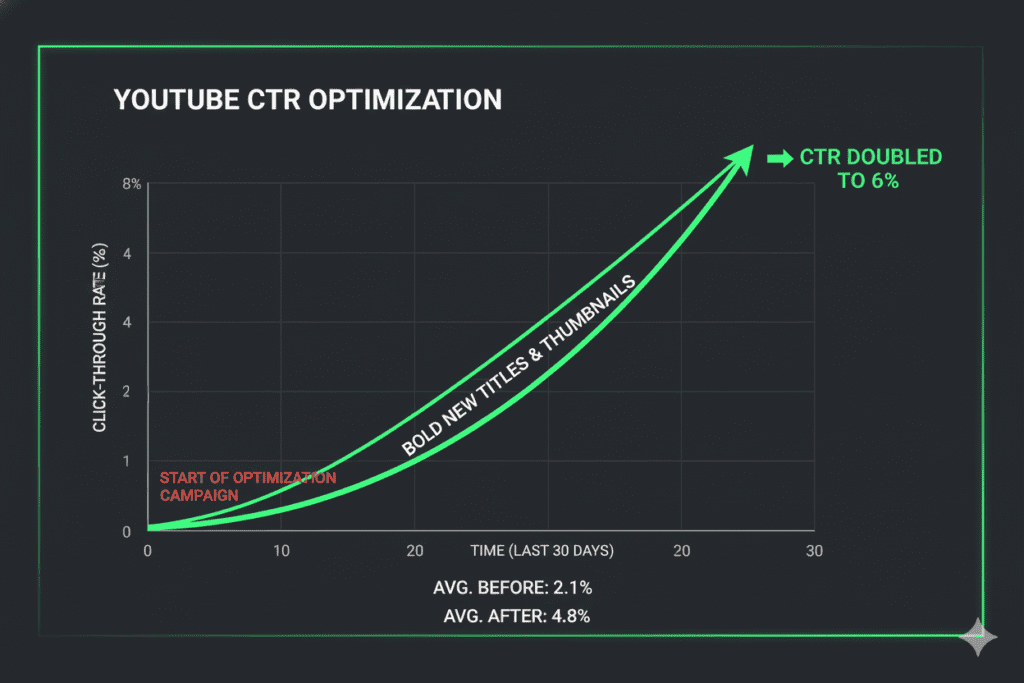
But her channel had stalled at 2,200 subscribers. Her CTR sat at 1.8%. Most of her videos got fewer than 400 views.
One Saturday morning, she stumbled across a YouTube title SEO tips thread that changed everything. She spent two hours rewriting the titles of her ten most recent videos — applying proper keyword placement, curiosity-gap language, and front-loaded search terms.
By Monday evening, three videos had already climbed in search results. Within 30 days, her overall channel CTR had jumped to 6.3%. Two of the rewritten videos crossed 10,000 views for the first time. She gained 800 new subscribers in a single month — almost 40% of her total channel count, from title rewrites alone.
No new videos. No algorithm tricks. Just smarter YouTube title SEO tips applied systematically.
That’s the compounding power of understanding how your title actually works. And in 2026, with competition at an all-time high and the algorithm more sophisticated than ever, getting your YouTube title SEO right isn’t optional. It’s the foundation of everything.
This guide gives you the complete, research-backed playbook: every YouTube title SEO tip that matters in 2026, the formulas top creators use, the mistakes that quietly kill channels, and the AI tools that make it all faster.
Why YouTube Title SEO Is Your Highest-Leverage Growth Tool
Let’s start with the data — because the numbers here are genuinely striking.
Across all niches and content types, the average YouTube CTR in 2026 falls between 2% and 10%, with the platform-wide average sitting around 4% to 5% for most creators. That means for every 100 people who see your video, at least 95 of them scroll past it. Your title is working every single second to influence which side of that equation you land on.
And the math of small improvements here is powerful. When CTR drops below 3%, you have 48 hours before YouTube stops promoting your video to new audiences. Conversely, a CTR of 10% or higher is a solid signal that your thumbnail and title are effectively sparking interest — and YouTube rewards that by pushing your video to more feeds, more search results, and more suggested sidebars.
Here’s what most creators underestimate: your title doesn’t just affect clicks. It drives the entire chain reaction of growth on YouTube.
- Your title determines search visibility. YouTube’s algorithm scans your title to understand what your video covers and who to show it to. Poor title SEO means poor discoverability — period.
- Your title sets viewer expectations. A title that accurately promises what your video delivers drives stronger watch time and retention, because viewers who click already know what they’re getting.
- Your title signals algorithm intent. A strong title should clearly state what the video delivers while sounding natural. The goal is relevance first, not keyword repetition.
- Your title affects Google rankings too. More than 25% of Google search results now include a video snippet — and your title is the primary text signal that determines whether your video earns that placement.
According to Influencer Marketing Hub’s 2026 Creator Economy Report, 78% of successful creators prioritize YouTube SEO optimization techniques as a core growth strategy, yet only 34% implement them systematically. That gap is your opportunity. The creators who treat YouTube title SEO tips as a disciplined, repeatable practice grow dramatically faster than those who write titles as an afterthought.
How YouTube’s Algorithm Actually Reads Your Title in 2026
Understanding YouTube title SEO tips starts with understanding what the algorithm is actually doing with your title when you hit publish.
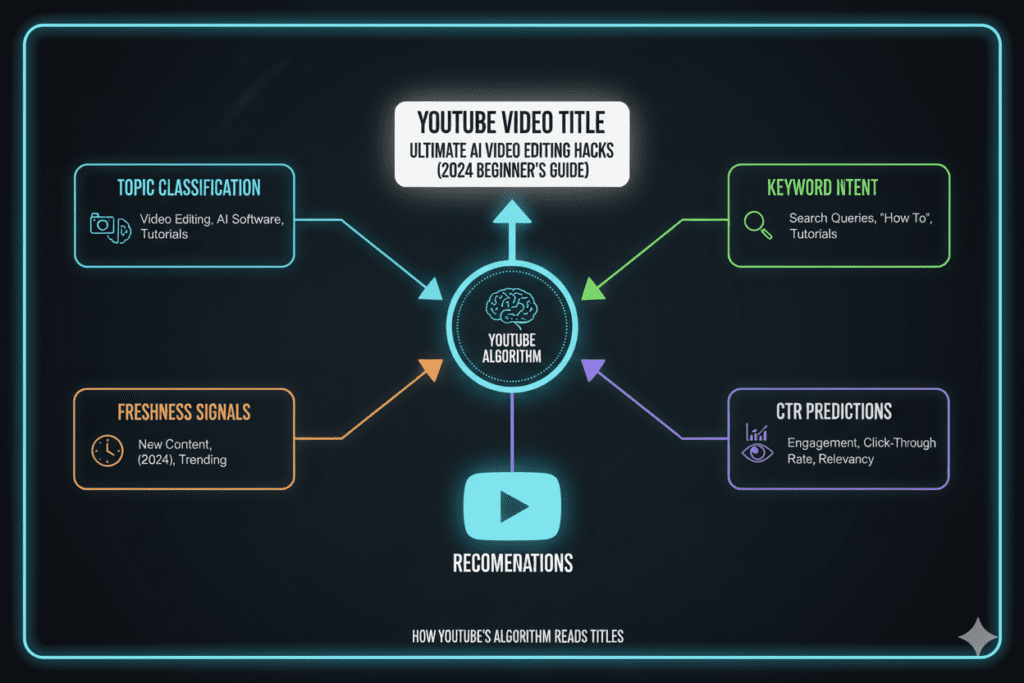
In 2026, YouTube’s algorithm reads your title on multiple levels simultaneously. It’s not just scanning for keywords anymore. YouTube looks at everything — the description, tags, captions, how long people actually watch, whether they click “Like” or drop a comment, and whether they binge more of your content afterward. Your title is the entry point to all of those signals.
Here’s specifically what the algorithm extracts from your title.
Topic Classification
YouTube’s AI scans your title and immediately categorizes your video’s subject matter. This classification determines which search queries your video can appear for, which competing videos it gets placed alongside in Suggested, and which audience segments it gets recommended to. A title like “Best Budget Smartphone in 2026: Top 5 Picks Under $300” tells YouTube exactly what the video is about and matches the types of queries real users are typing into search.
Search Intent Matching
YouTube matches your title language against the actual phrases real viewers type in the search bar. Lead with your primary keyword in the title: place it naturally near the start so it appears clearly in search. This is why front-loading your keyword matters so much — the algorithm gives higher relevance weight to words that appear earlier in the title.
CTR Signal Interpretation
Once your video is shown to an audience, the algorithm watches whether people click it. A strong CTR tells YouTube your title is relevant and compelling for that audience. A weak CTR tells it the opposite — and distribution slows down. Your title performs two jobs: ranking in search and driving clicks from impressions. Most creators optimize for one and ignore the other.
Semantic Keyword Expansion
In 2026, YouTube’s algorithm understands semantic relationships between words — not just exact keyword matches. AI engines like Google’s Gemini and Perplexity can now understand video content more deeply; they don’t just look at titles or tags anymore — they can parse transcripts, captions, and even spoken context to know exactly what’s being said. This means your title can rank for related terms it doesn’t even contain, if the rest of your metadata is consistent.
Freshness Scoring
Including a year or a time-sensitive phrase in your title sends a freshness signal. Videos with years or seasons in titles perform better — “Best Python Courses 2026” ranks higher than “Best Python Courses” in many cases because it signals recency and current relevance.
Understanding these layers is what separates a creator who guesses their titles from one who engineers them. The YouTube title SEO tips in the next section are built directly on top of how the algorithm actually works.
The 10 Most Powerful YouTube Title SEO Tips for 2026
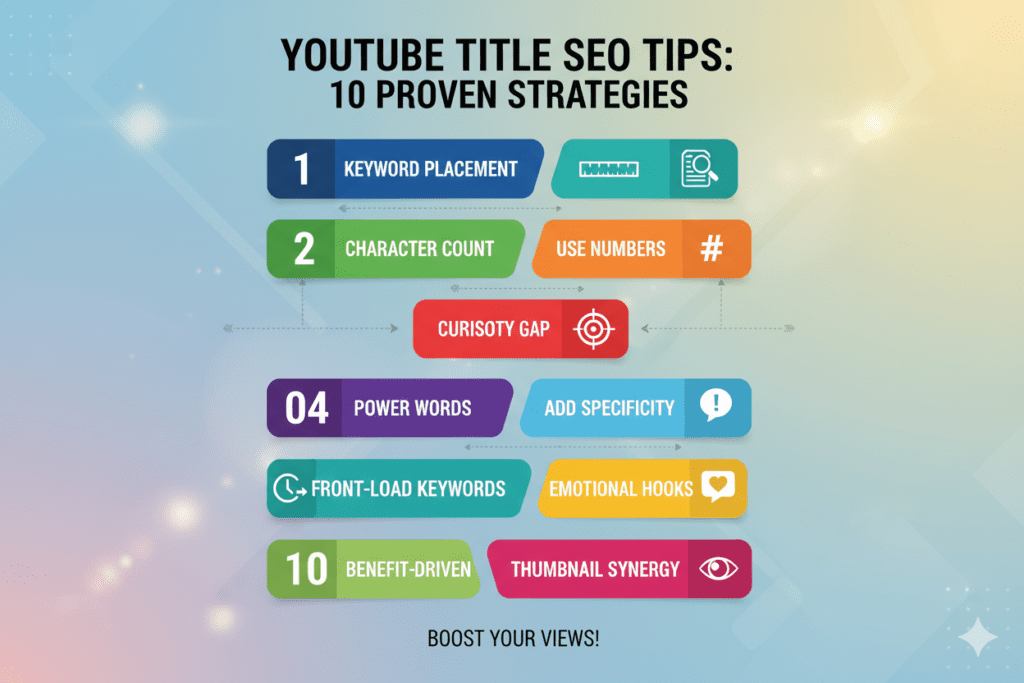
These are the highest-impact YouTube title SEO tips you can implement right now — each one backed by current research and used by channels that are consistently winning in search.
Tip 1: Front-Load Your Primary Keyword
Place your primary keyword within the first 40 characters — before truncation on mobile. This is the single most impactful positioning move you can make for title SEO. YouTube’s algorithm and viewers both read left to right. Put your most important word where it will be seen first.
Weak: “My honest thoughts on how to grow a YouTube channel in 2026” Strong: “YouTube Growth Strategy That Actually Works in 2026”
Tip 2: Keep Your Title Under 60–70 Characters
Keep titles under 60 characters when possible, and always under 100. This ensures you’re not cut off on mobile, and it forces you to be concise. Over 70% of YouTube’s audience watches on mobile. If your title gets truncated, your promise gets cut off — and nobody clicks a half-finished sentence.
Aim for the 55–65 character sweet spot. Enough space to include your keyword and a compelling hook. Short enough to display fully on every device.
Tip 3: Use Numbers — They Consistently Increase CTR
Multiple studies confirm that using numbers in titles increases CTR by 20–30%. Numbers provide concrete expectations and make content appear more structured. Numbers stop the eye, signal specific value, and create a psychological commitment loop — viewers want to see all the items on your list.
Always use numerals (7, not “seven”). Odd numbers like 5, 7, 9, and 11 consistently outperform even numbers in headline research.
Example: “7 YouTube Title SEO Tips That Doubled My CTR in 30 Days”
Tip 4: Trigger Curiosity With a Deliberate Information Gap
The curiosity gap is one of the most powerful psychological mechanisms in title writing. You reveal enough to tell viewers what the video covers — but leave just enough open that they have to click to close the loop.
Don’t try to explain the topic as if this were a school essay. Make it a mystery. If your video is about “how to flip houses,” don’t call your video “How to Flip Houses.” Instead, think of titles like “I Flipped My House and This Happened” or “I Made a Fortune Flipping My House.”
The information gap approach works across every niche — and it’s one of the YouTube title SEO tips that never goes out of style because it’s rooted in how humans are wired.
Tip 5: Speak to a Specific Audience or Problem
Generic titles compete with everyone. Specific titles own their audience segment. The more precisely your title speaks to a defined viewer and their exact struggle, the higher your CTR will be — because the right person feels like you’re talking directly to them.
Generic: “How to Save Money” Specific: “How to Save $500 a Month When You’re Living Paycheck to Paycheck”
Make the benefit obvious: write a title that promises a result or key takeaway in plain, everyday language. Specific, plain-language titles outperform clever, vague ones every time.
Tip 6: Add a Year for Freshness and Search Priority
Include a year to signal that the content is fresh and current. This works especially well for how-to content, tool comparisons, strategy guides, and any topic where viewers want the most current information.
“Best Budget Camera for YouTube” is a fine title. “Best Budget Camera for YouTube in 2026” is a better one — it signals relevance to both the viewer and the algorithm.
Tip 7: Use Brackets or Parentheses to Add Context
Brackets act as a secondary sub-headline within your title. They provide clarifying context that makes the title sharper and more clickable. Using power words and brackets makes your YouTube title more compelling and increases clicks.
Examples:
- “How to Grow on YouTube Fast [2026 Strategy]”
- “Best AI Tools for Creators (Ranked by Real Data)”
- “YouTube SEO Guide [Beginner to Advanced]”
Brackets also visually break up the title, making it easier to scan in a crowded feed.
Tip 8: Test Every Title — Then Test Again
According to research, creators who systematically test titles see 15–25% improvement in click-through rates within 30 days. Title testing is the highest-return optimization habit you can build.
YouTube Studio now includes A/B testing for titles and thumbnails. Use it religiously. If a video’s CTR is below 3% after 1,000 impressions, change the title. Test a new angle, a different keyword placement, or a stronger power word. One test every two weeks on your underperforming videos can compound into massive CTR gains over six months.
Tip 9: Never Sacrifice Clarity for Cleverness
The 2026 algorithm is smart — but it rewards clarity over creativity when the two conflict. The goal is relevance first, not keyword repetition. A strong title should clearly state what the video delivers while sounding natural.
A clever title that leaves viewers guessing what the video is actually about will hurt your CTR, your watch time, and your rankings. Viewers want to know immediately what they’re getting before they click. When in doubt, choose the clearer option.
Tip 10: Deliver on Every Promise Your Title Makes
This final YouTube title SEO tip is the most important one — and the most often ignored. Make sure the video delivers on what the title promises. Misleading your audience will hurt your channel’s performance. YouTube is smart enough to catch on if you try to mislead your audience.
A title that overpromises but underdelivers will generate high initial CTR followed by terrible retention — and low retention signals the algorithm to suppress the video immediately. The most sustainable YouTube title SEO strategy is to promise what you deliver, and then deliver more than you promised.
YouTube Title SEO Tips: The Perfect Title Formula Breakdown
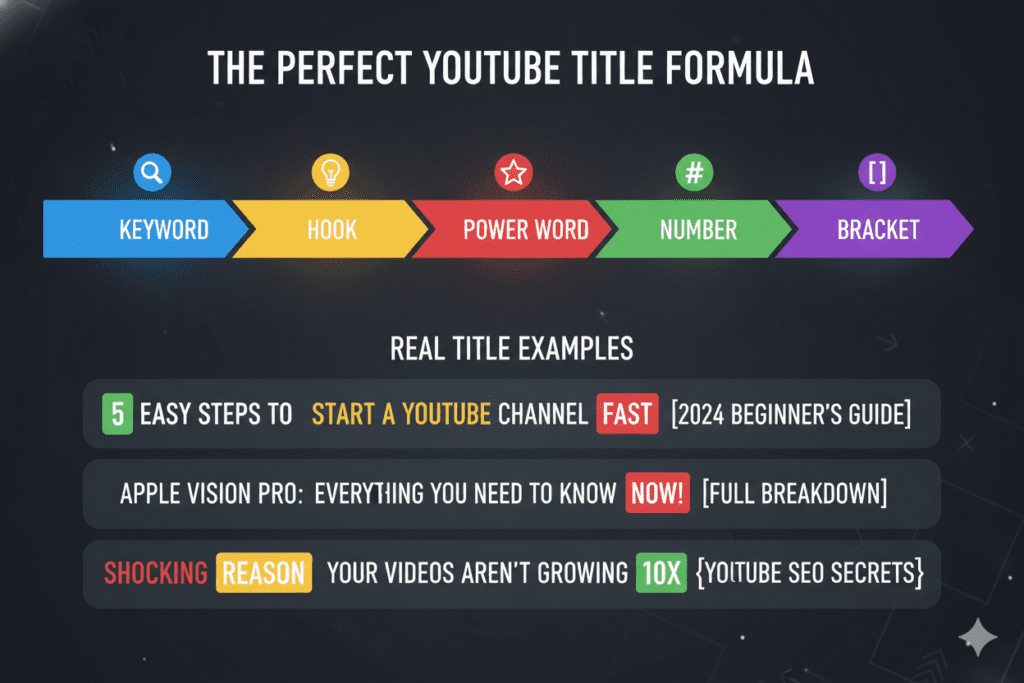
All the YouTube title SEO tips above can be distilled into a single reliable formula that top creators use across every niche:
🎯 Primary Keyword + Hook (Curiosity or Value Promise) + Power Word
Here’s how it plays out in practice:
| Component | Purpose | Example Element |
|---|---|---|
| Primary Keyword | Algorithm classification + search matching | “YouTube Title SEO” |
| Hook | Curiosity gap or clear value promise | “That Doubled My CTR” |
| Power Word | Emotional trigger + urgency | “Instantly,” “Proven,” “Fast” |
| Optional: Number | Specificity + structured value | “7 Tips” |
| Optional: Year | Freshness signal | “(2026)” |
| Optional: Bracket | Secondary context or audience qualifier | “[Beginner Guide]” |
Full Examples Using This Formula:
✅ “7 Proven YouTube Title SEO Tips That Will Double Your CTR Fast” ✅ “YouTube Title SEO: The Strategy That Grew My Channel by 400% in 2026” ✅ “YouTube Title SEO Tips Every Creator Needs to Know [2026 Update]” ✅ “How to Write YouTube Titles That Rank — The Honest SEO Guide”
Notice what each of these titles does: the primary keyword appears early, a specific value promise is made, and a power word adds urgency or credibility. None of them are clickbait. All of them are specific enough to attract the right viewer and repel the wrong one.
This is the formula that makes YouTube title SEO tips actionable instead of theoretical.
Power Words That Supercharge Your YouTube Title SEO
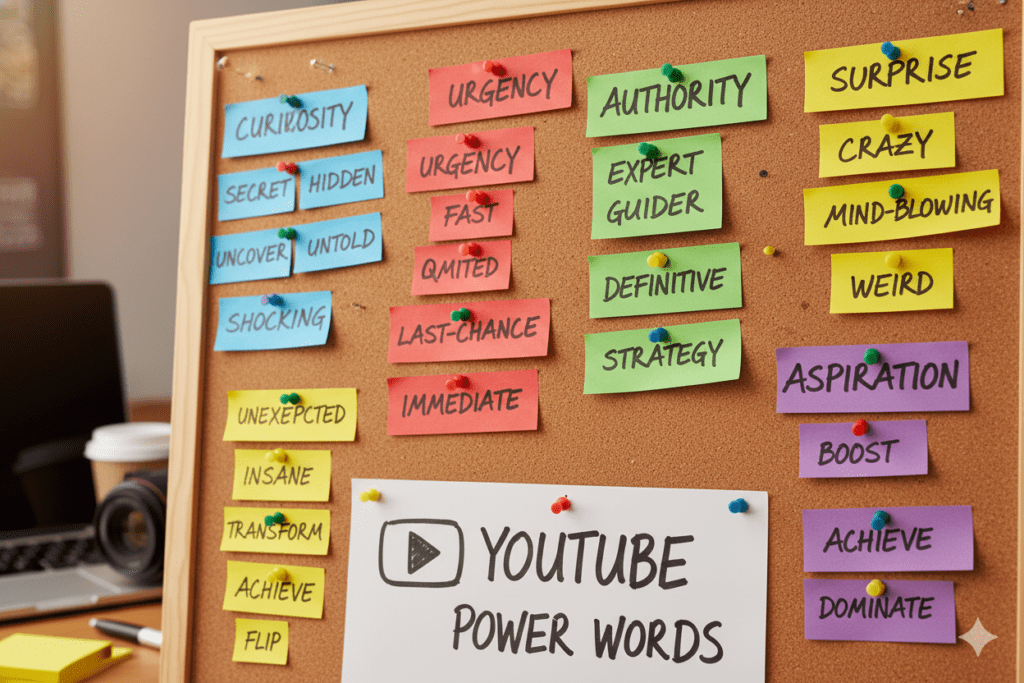
Power words are specific words used in YouTube title SEO tips that consistently trigger emotional responses — curiosity, urgency, authority, fear of missing out — and dramatically increase the likelihood that a viewer clicks your title over a competitor’s.
Here are the highest-performing power words for YouTube title SEO, organized by the emotion they trigger:
🔍 Curiosity & Intrigue Secret, Hidden, Nobody Talks About, Finally Revealed, Exposed, The Truth About, What Nobody Tells You, Behind the Scenes, Untold, Real Reason
⚡ Urgency & Immediacy Now, Today, Instantly, Fast, In 24 Hours, This Week, Before It’s Too Late, Right Now, Immediately
🏆 Authority & Trust Proven, Expert, Best, Ultimate, Complete, Science-Backed, Step-by-Step, Blueprint, Professional, Tested
😮 Surprise & Shock Surprising, Shocking, Unbelievable, Unexpected, Eye-Opening, Game-Changing, Jaw-Dropping, Mind-Blowing
📈 Aspiration & Desire Life-Changing, Transform, Skyrocket, Explosive, Crush It, Dominate, Master, Unlock, Double, Triple
🎯 Audience Specificity For Beginners, For Advanced Creators, If You’re Struggling, Without Experience, From Scratch, On Any Budget
The word “Ultimate” suggests comprehensive coverage and can boost engagement by 15% according to 2026 YouTube SEO best practices. Combine two power words thoughtfully — one for authority and one for urgency — and you create a compound effect that’s hard to scroll past.
One important caution: use power words honestly. The YouTube title SEO tips that build long-term channels are the ones that promise what the video actually delivers. A power word in front of a weak video just accelerates the drop-off — and the algorithm notices.
How ytZolo Applies YouTube Title SEO Tips Automatically
Here’s the frustrating reality for most creators trying to apply these YouTube title SEO tips manually: it takes forever, and the results are inconsistent.
You write a title. It feels good. You change it three times. You’re still not sure if the keyword is in the right place. You don’t know if the length is optimal. You have no idea whether this approach has worked for other videos in your niche — or if you’re just guessing.
That’s the problem ytZolo was built to eliminate.
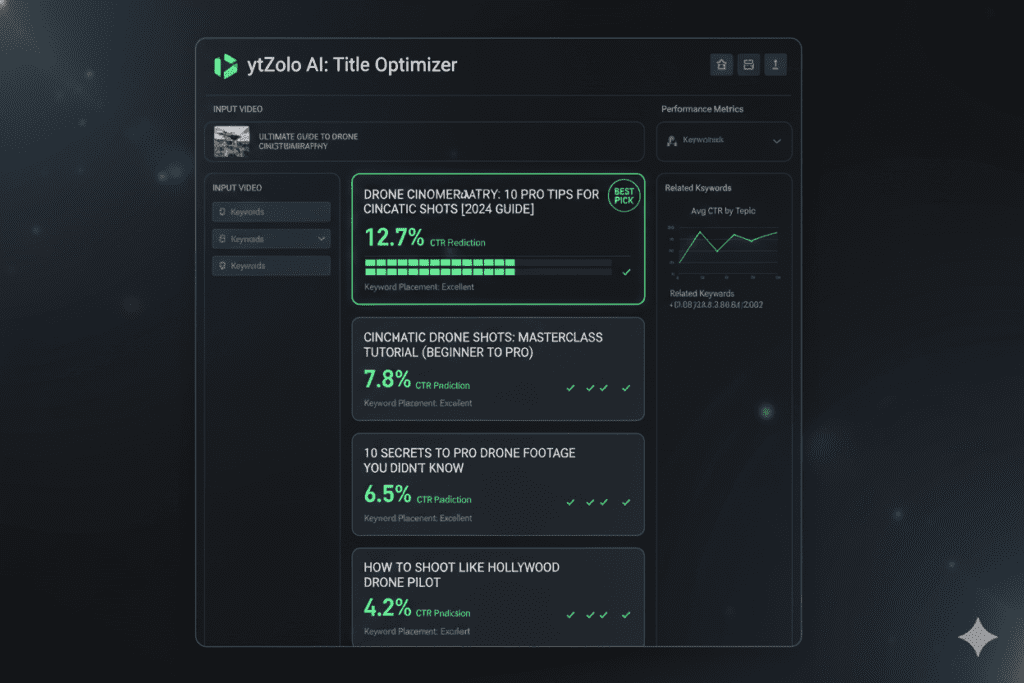
ytZolo is an all-in-one AI YouTube growth tool that takes every YouTube title SEO tip in this guide and applies them automatically — in under 60 seconds — every single time you need a new video title.
Here’s exactly how ytZolo handles YouTube title SEO for you:
- Keyword-First Title Generation — ytZolo places your primary keyword in the first 40 characters automatically, every time. No guesswork. No second-guessing keyword placement. It’s built into every output.
- CTR-Scored Title Options — Rather than giving you one title to take or leave, ytZolo generates multiple scored title variations. Each one is evaluated for search relevance, click potential, power word usage, and emotional pull. You pick the winner from a shortlist of optimized options.
- Built-In Power Word Integration — ytZolo’s AI understands which power words perform best in your niche and integrates them naturally — never forced, never clickbait. Your titles read like they were written by a seasoned creator, not an AI.
- Character Count Optimization — Every ytZolo title is automatically calibrated to the 55–70 character sweet spot. You never have to manually count characters or worry about mobile truncation again.
- Competitor Title Analysis — ytZolo analyzes top-ranking videos in your niche and identifies the title patterns driving their success. Your titles are informed by what’s already proven to work — not built in a vacuum.
- Complete Metadata Package — When ytZolo writes your title, it simultaneously generates your SEO description, tag set, and thumbnail direction. Every element is aligned to the same keyword and intent — which is exactly what the algorithm rewards.
Without AI, applying YouTube title SEO tips consistently across every video requires hours of research, writing, and testing per upload. Most creators simply don’t have that time — so they take shortcuts, write weak titles, and wonder why their growth stalls.
ytZolo removes the shortcuts by making the right approach the fast approach. You get data-backed, retention-optimized, keyword-perfect titles in under a minute. Then you get back to what you love — creating content.
Explore ytZolo’s full feature set at ytzolo.com — and visit the ytZolo blog for more actionable YouTube title SEO tips and growth strategies published every week.
Why ytZolo Is Better Than Other YouTube Title SEO Tools
The tool market for YouTube title SEO tips is crowded in 2026. Every creator has heard of VidIQ and TubeBuddy. Many have tried ChatGPT for title ideas. Some used Jasper or Copy.ai for YouTube content.
So why are the fastest-growing creators switching to ytZolo?
Because every other tool gives you data or text. ytZolo gives you results.
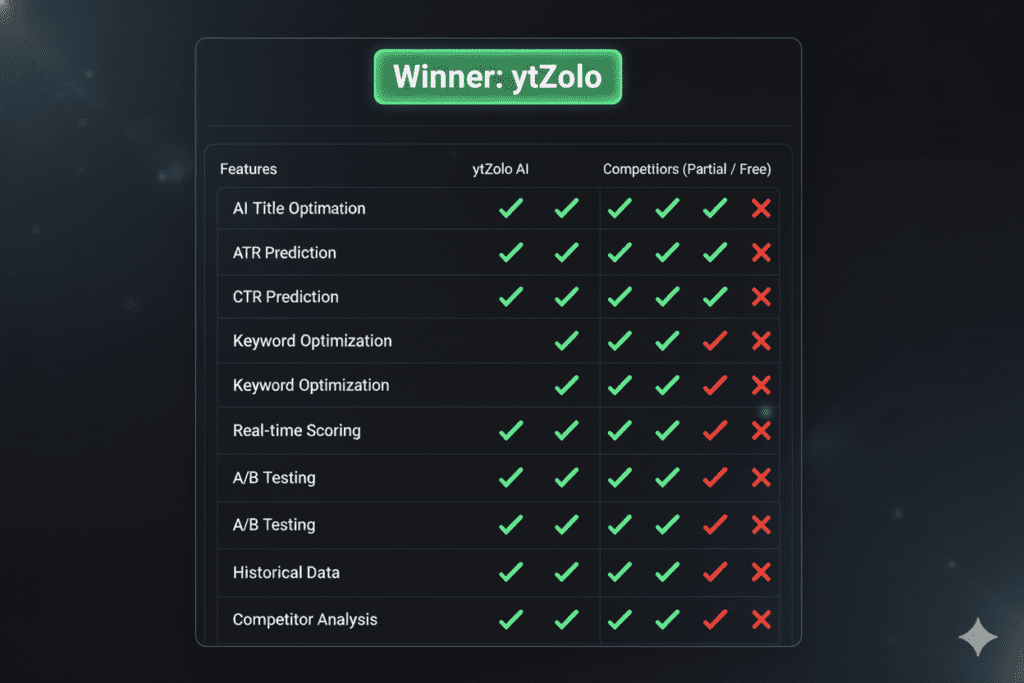
Here’s the direct comparison:
| Capability | ChatGPT Standalone | VidIQ | TubeBuddy | Jasper/Copy.ai | ytZolo |
|---|---|---|---|---|---|
| YouTube-specific title generation | ❌ Generic | Partial | Partial | ❌ Marketing focus | ✅ YouTube-native |
| Keyword front-loading (auto) | ❌ Manual | ❌ | ❌ | ❌ | ✅ Automatic |
| CTR scoring per title | ❌ | ✅ Paid tier | ✅ Paid tier | ❌ | ✅ Built-in |
| Multiple scored title variations | ❌ | ❌ | ❌ | Partial | ✅ |
| Power word integration (niche-tuned) | ❌ | ❌ | ❌ | Partial | ✅ |
| Character count auto-optimization | ❌ | ❌ | ❌ | ❌ | ✅ |
| Competitor title pattern analysis | ❌ | ✅ Paid | ❌ | ❌ | ✅ |
| Title + description + tags together | ❌ | ❌ | Partial | ❌ | ✅ Complete package |
| Thumbnail concept alongside title | ❌ | ❌ | ❌ | ❌ | ✅ |
| Time to generate 5 optimized titles | 10–20 min | 5–10 min | 5–10 min | 10–15 min | Under 60 sec |
The picture is clear. VidIQ and TubeBuddy are analytics-first platforms — they show you data and leave you to figure out what to do with it. ChatGPT produces general text that doesn’t understand YouTube’s specific ranking mechanics. Jasper and Copy.ai are built for marketing copy, not YouTube SEO.
ytZolo is purpose-built for one thing: helping YouTube creators grow their channels. Every feature is designed around the specific mechanics of how YouTube’s algorithm evaluates and distributes content in 2026. When it generates a title, it’s not just producing text — it’s applying every YouTube title SEO tip in this guide, automatically, in one seamless output.
That’s not a marginal improvement over the alternatives. It’s a fundamentally different — and dramatically more effective — way of working.
Head to ytzolo.com to experience the difference yourself.
How to A/B Test Your Titles Like a Pro
The best YouTube title SEO tips in the world are hypotheses until you test them. Title A/B testing is the professional practice that turns guesses into data — and data into consistent CTR growth.
According to research, creators who systematically test titles see 15–25% improvement in click-through rates within 30 days. Here’s the exact process.
Step 1: Identify Your Low-CTR Videos
Open YouTube Studio and sort your videos by CTR. Any video with under 3% CTR after 500+ impressions is a candidate for testing. These are your highest-leverage opportunities — the videos that already have an audience being shown them, but aren’t converting those impressions into clicks.
Step 2: Write Two New Title Variations
Apply your YouTube title SEO tips to write two meaningfully different title approaches for the same video. One might front-load the keyword differently. Another might swap to a curiosity-gap angle. Change the formula, not just one or two words — that’s what gives you statistically meaningful data.
Step 3: Use YouTube Studio’s Title Test Feature
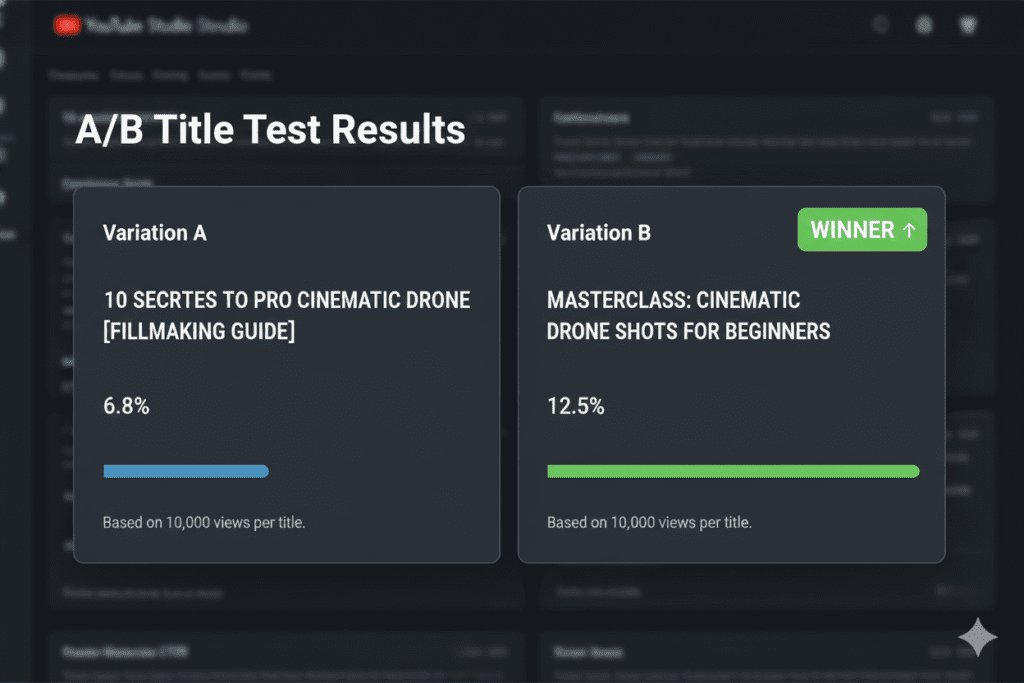
YouTube Studio allows you to A/B test titles and thumbnails natively. Set your two title variations, let the test run for 7 to 14 days, and let YouTube show each version to a portion of your audience automatically.
Step 4: Evaluate Results — CTR Is the Primary Metric
After your test window, compare CTR between the two variations. A/B testing titles via YouTube Analytics can improve CTR by 10–25% for underperforming videos. Keep the winner. Archive the loser — but record why it won. Over time, you’ll build a personal database of title patterns that resonate with your specific audience.
Step 5: Apply Winning Patterns to Future Titles
The real power of A/B testing in YouTube title SEO tips isn’t the individual result — it’s the learning. When you discover that your audience clicks more on curiosity-gap titles than direct value promises, or that they respond better to specific power words in your niche, those insights improve every future title you write.
This is the kind of systematic optimization that compounds invisibly into massive channel growth over 6 to 12 months.
YouTube Title SEO Tips by Niche: Real Examples That Work
Theory becomes strategy when you see it applied. Here are YouTube title SEO tips in action — real-world examples organized by niche that apply every principle from this guide.
💰 Finance & Investing
❌ “How to Save Money and Invest” ✅ “7 Money Moves Every 25-Year-Old Should Make Before It’s Too Late (2026)”
🏋️ Health & Fitness
❌ “Workout Tips for Beginners” ✅ “The 15-Minute Beginner Workout That Actually Burns Fat [No Equipment]”
🤖 AI & Technology
❌ “AI Tools for Content Creators” ✅ “5 AI Tools That Replaced My Entire Content Workflow in 2026”
📱 Lifestyle & Productivity
❌ “Morning Routine Ideas” ✅ “The 30-Minute Morning Routine That Tripled My Productivity (Science-Backed)”
🎮 Gaming
❌ “Tips for Getting Better at [Game]” ✅ “The Settings Nobody Changes That Will Instantly Improve Your [Game] Performance”
📸 Photography & Video
❌ “Camera Review” ✅ “Best Budget Camera for YouTube in 2026 Under $300 — Honest Comparison”
🍕 Food & Cooking
❌ “Easy Dinner Ideas” ✅ “5 Dinners That Taste Like a Restaurant Meal (Ready in Under 30 Minutes)”
📚 Education & Career
❌ “How to Get a Job” ✅ “The Resume Trick That Got Me Hired in 3 Weeks — Without Any Experience”
In every example, the optimized title does the same things: keyword first or near-first, specific number or time frame, emotional trigger or curiosity gap, and a clear promise to the viewer. These aren’t clever accidents. They’re YouTube title SEO tips applied deliberately.
Common YouTube Title SEO Mistakes (And Exactly How to Fix Them)
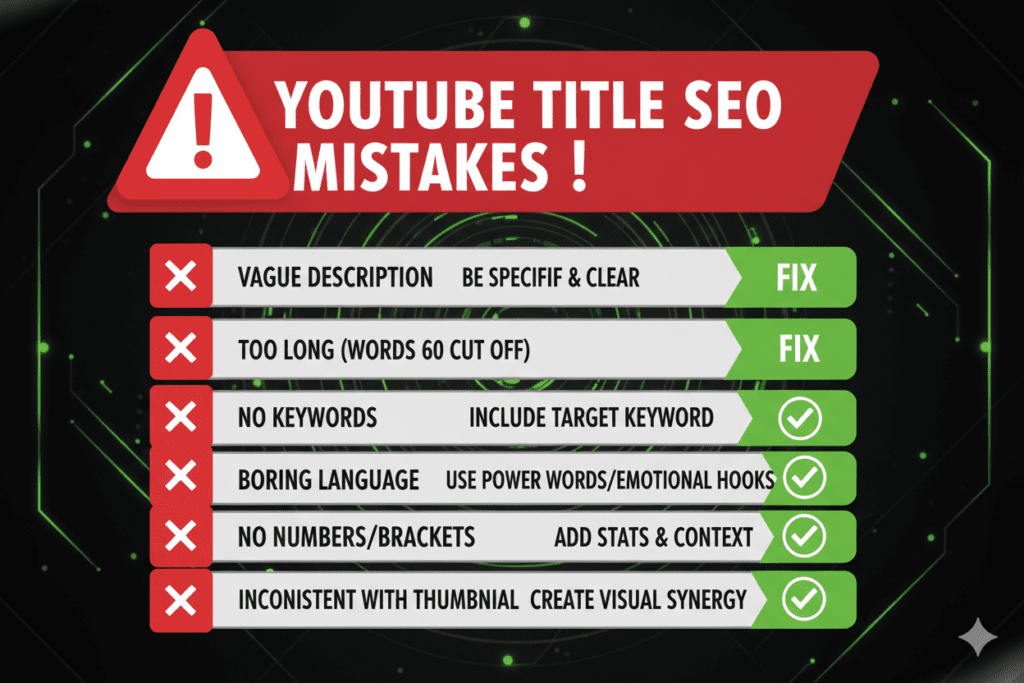
Even with the best YouTube title SEO tips in front of you, certain habits quietly undermine everything. Here are the mistakes that are most common — and most costly.
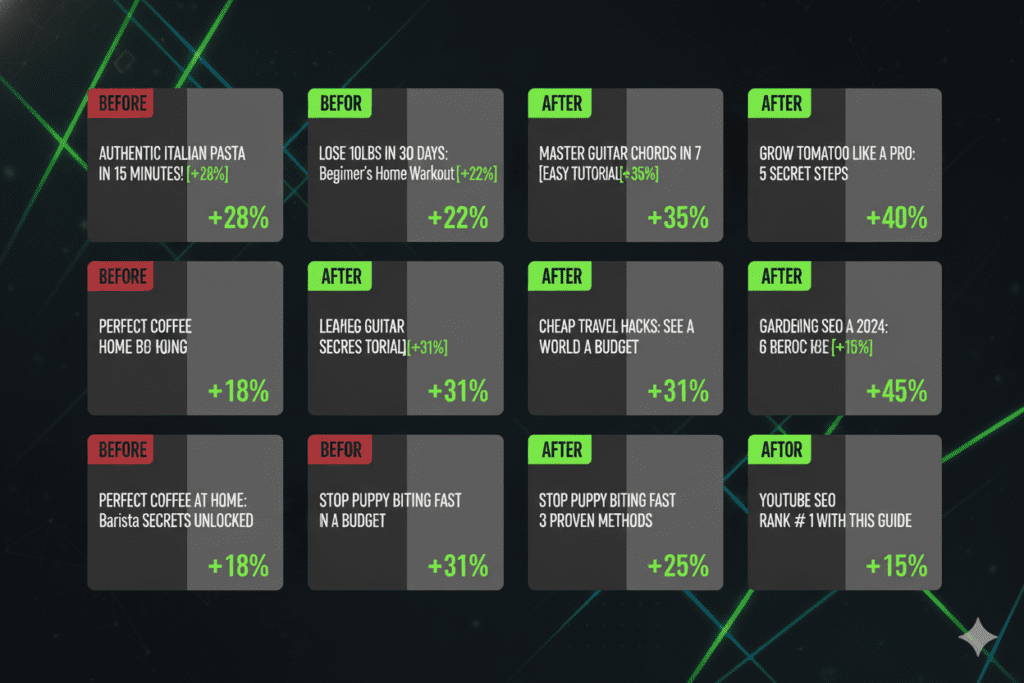
Mistake #1: Burying the keyword at the end. Placing your keyword in the last third of the title wastes your most powerful real estate. The algorithm and the viewer both see the beginning first. Fix: Rewrite with your primary keyword in the first five words, every time.
Mistake #2: Keyword stuffing. Trying to force SEO keywords into your title won’t help in 2026; that strategy became obsolete after 2017. Titles stuffed with keywords look spammy, read unnaturally, and perform poorly on CTR. Fix: Use your primary keyword once, naturally, in the first 40 characters. Let your content and description handle secondary keywords.
Mistake #3: Writing titles that are too long. Keep the title under 60 characters. Anything beyond 70 characters gets truncated on mobile, cutting off your value promise mid-sentence. Fix: Edit ruthlessly. Every word you cut makes the remaining words stronger.
Mistake #4: Using all-caps or excessive emojis. “🔥🔥BEST YOUTUBE SEO HACKS!!!🚀😱” looks spammy. It signals low-quality content and actively hurts CTR among savvy viewers. Fix: Use sentence case with strategic capitalization for key words. Use emojis sparingly — one at most, only if it genuinely adds meaning.
Mistake #5: Clickbait that doesn’t deliver. A misleading title might spike your CTR temporarily. But when viewers click through and feel deceived, they leave immediately — and that retention crash tells the algorithm your video is low quality. Retention now outweighs raw watch time. A video that holds attention consistently will outperform a longer video that loses viewers early. Fix: Your title and your video must make and keep the same promise. Always.
Mistake #6: Never updating old titles.Your titles don’t have to be permanent. YouTube title SEO tips recommend updating titles if they aren’t ranking after 2–4 weeks. Old videos with outdated titles are a goldmine of untapped traffic — and a simple rewrite can restart the algorithm’s distribution cycle for a video that’s been dormant for months.
FAQ: YouTube Title SEO Tips
Q1: What are the most important YouTube title SEO tips to implement in 2026?
The five highest-impact YouTube title SEO tips to implement immediately are: (1) place your primary keyword in the first 40 characters; (2) keep your title between 55–70 characters to prevent mobile truncation; (3) use a number or power word to increase CTR; (4) create a curiosity gap or make a specific value promise; and (5) A/B test underperforming titles within 2–4 weeks.
These tips alone, applied consistently, can lift your channel CTR by 15–25% within 30 days according to multiple 2026 research studies.
Q2: How long should a YouTube title be for maximum SEO?
The ideal YouTube title length in 2026 is 55–70 characters. Titles shorter than 45 characters often leave value on the table — you’re not communicating enough about the video’s benefit to the viewer. Titles longer than 70 characters get truncated in mobile search results and home feed displays, cutting off your keyword or hook.
The sweet spot gives you enough room to include your primary keyword, a compelling hook, and a power word — all before the character limit.
Q3: Should I update old YouTube video titles to improve SEO?
Yes, absolutely — and it’s one of the most underrated growth tactics available to creators. YouTube allows you to change titles at any time, and the algorithm re-evaluates a video when key metadata changes.
If a video has underperformed despite strong content, a title rewrite that better targets search intent or improves CTR can restart its distribution. Many creators have turned dormant videos into consistent traffic drivers simply by applying better YouTube title SEO tips to the existing content.
Q4: Does YouTube title SEO still matter in 2026 when the algorithm relies heavily on viewer behavior?
Yes — more than ever. While YouTube’s 2026 algorithm does rely heavily on viewer signals like watch time, CTR, and retention, those signals can only accumulate if people click in the first place. Your title determines whether someone clicks.
It also signals topic relevance to the algorithm for search ranking. YouTube title SEO tips help ensure your title aligns with what viewers and algorithms are looking for. And since Google now includes video snippets in over 25% of search results, a well-optimized title influences your discoverability on both YouTube and Google simultaneously.
Title SEO and viewer behavior aren’t competing priorities — great title SEO is what triggers positive viewer behavior.
Q5: What is the best AI tool for YouTube title SEO in 2026?
ytZolo is the leading AI tool for YouTube title SEO in 2026. Unlike generic AI writing tools, ytZolo is purpose-built for YouTube — automatically applying every key YouTube title SEO tip including keyword front-loading, CTR scoring, power word integration, and character count optimization.
It generates multiple scored title variations in under 60 seconds and simultaneously creates your SEO description, tags, and thumbnail direction as a complete package. For creators who want consistent, data-backed titles without hours of manual research and testing, ytZolo is the clear choice.
Conclusion: Your Title Is Either Working for You or Against You
Every single time someone scrolls past your video without clicking, that’s a title that failed to do its job. Every time they click and stay, that’s a title that earned its place in the algorithm.
In 2026, YouTube title SEO isn’t a technical checkbox. It’s the creative and strategic discipline that determines whether your videos get discovered — or disappear. The gap between a 2% CTR and a 6% CTR isn’t talent. It’s strategy. It’s the YouTube title SEO tips you apply, consistently, to every video you publish.
You now have the complete playbook. The algorithm mechanics. The 10 proven tips. The perfect title formula. The power words that trigger clicks. The A/B testing system. The niche-specific examples. The mistakes to eliminate today.
Apply these YouTube title SEO tips systematically and your results will compound. Small CTR gains become big impression gains. Big impression gains become new subscribers. New subscribers become community. Community becomes a channel that grows while you sleep.
And when you’re ready to stop doing all of this manually — when you want an AI tool that applies every single YouTube title SEO tip automatically, scores your options, and builds your complete metadata package in under 60 seconds — ytZolo is exactly that platform.
It’s the all-in-one AI YouTube growth tool built for creators who are done guessing and ready to grow with intention.
Start creating smarter, faster, and more viral YouTube content with ytZolo today.
→ Visit ytzolo.com to get started — and explore the ytZolo blog for a new YouTube title SEO tip, growth strategy, or creator deep dive published every single week.
External Resources:


Pingback: Free YouTube Thumbnail Maker AI: Best Tools in 2026