
Table of Contents
1. The Wake-Up Call Every Creator Needs to Read
Imagine waking up one morning, opening YouTube Studio, and discovering your video has been labeled — not by you — with the words “Modified or Synthetic Content.”
You didn’t add it. YouTube did. And now you can’t remove it.
This exact scenario happened to thousands of creators in early 2026. Some lost monetization. Some lost their entire channels. Many had no idea the YouTube policy for AI-created content even existed — let alone that it had quietly evolved into a hard enforcement rule.
Here’s the truth: ignorance is no longer a defense on YouTube in 2026.
The platform has made it crystal clear — if your content uses AI in a way that could mislead viewers, you must disclose it. No exceptions. No second chances if you repeatedly ignore it.
This guide will walk you through everything. What the YouTube altered or synthetic content disclosure policy official 2026 version actually requires. What you must label. What you don’t. How to do it properly. And how smart creators are using tools like ytZolo to stay compliant and keep growing at full speed.
Let’s get into it.
2. What Is the YouTube Altered or Synthetic Content Disclosure Policy Official 2026?
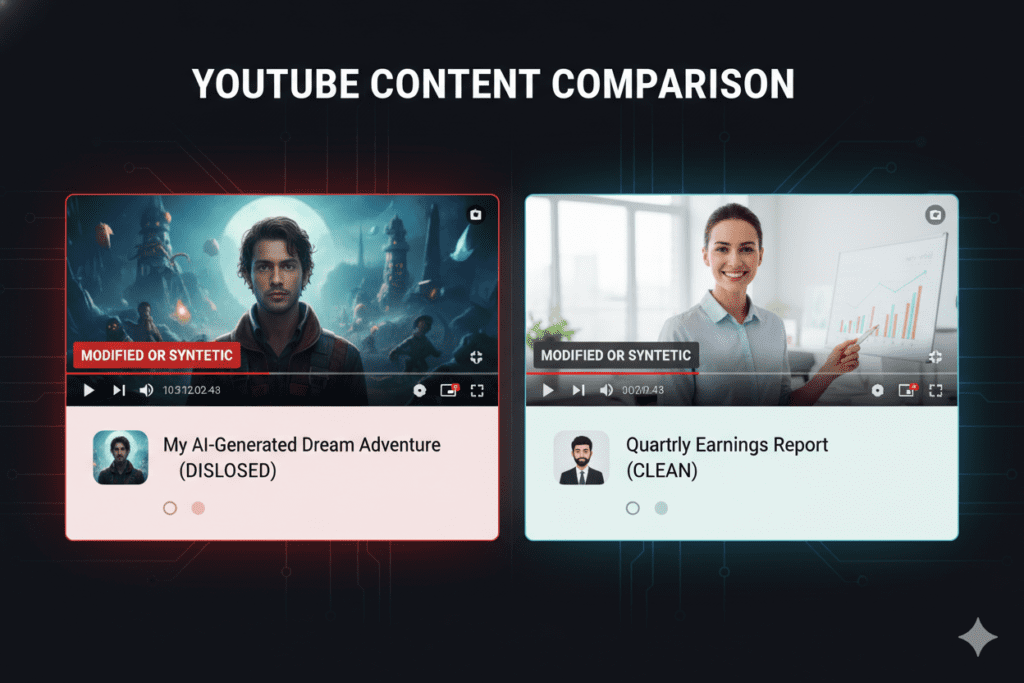
The YouTube altered or synthetic content disclosure policy is an official platform rule requiring creators to tell viewers when realistic content has been meaningfully altered or synthetically generated using AI.
In plain English: if your video uses AI to make fake things look real, you have to say so.
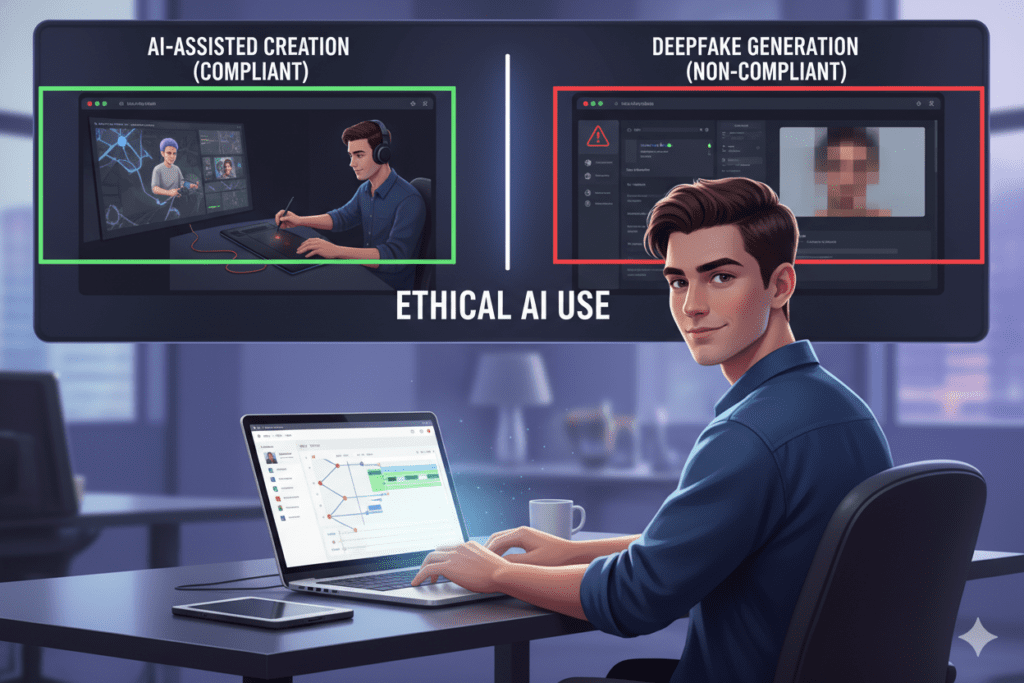
YouTube’s core mission here isn’t to punish creators who use AI. It’s to protect viewers from being deceived — especially around real people, real events, and real places, which is the foundation of the YouTube AI-generated video labeling rules.
The policy was first introduced in November 2023. It was significantly expanded through 2024 and 2025. By January 2026, YouTube entered full enforcement mode, suspending thousands of channels that had been ignoring the rules.
According to the official YouTube Blog, the goal is to require creators to disclose “realistic content — content a viewer could easily mistake for a real person, place, scene, or event — made with altered or synthetic media, including generative AI.”
Two key words guide the entire policy: realism and deception potential.
If your AI content could fool a reasonable viewer into thinking something fake is real? You must disclose it.
3. What Exactly Must You Disclose in 2026?
The YouTube altered or synthetic content disclosure policy official 2026 targets a specific type of AI use — the kind that mimics reality convincingly enough to mislead.
Here’s what requires disclosure:
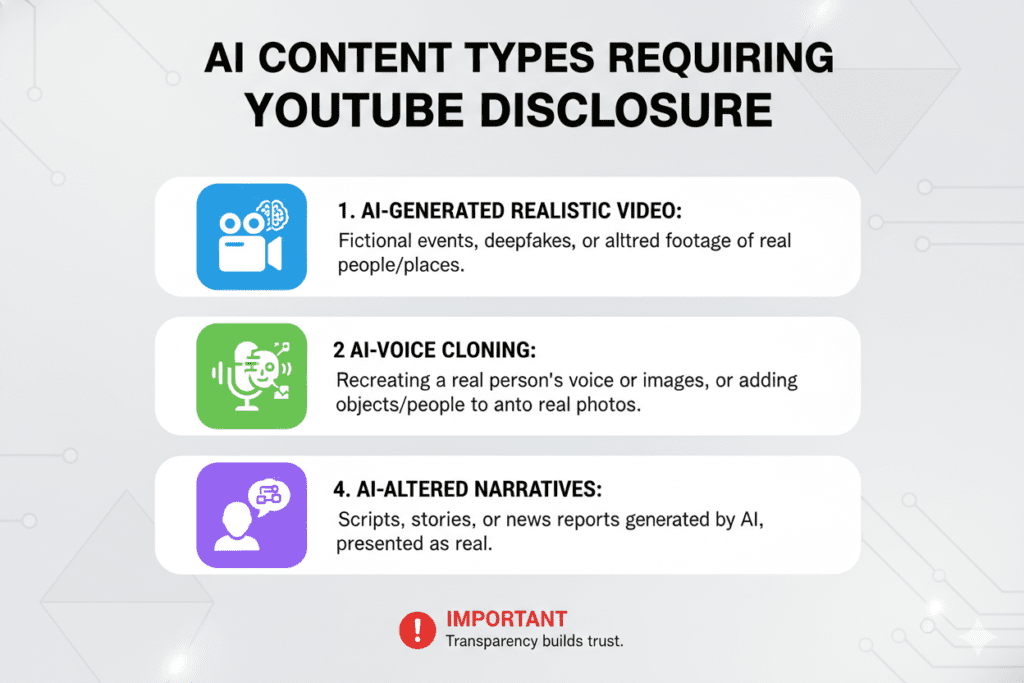
- AI voice clones of a real person — even a brief narration that sounds like an identifiable individual
- Deepfake face swaps or reenactments — replacing someone’s face, even subtly
- Synthetic voices that impersonate real people — making it sound like a celebrity or public figure said something they didn’t
- Fabricated real-world events — for example, AI-generated footage of a fake disaster presented as news
- Making a real person appear to say or do something they didn’t — this is the big one
- AI-altered footage of a real event or place — changing context or meaning through synthetic edits
- Photorealistic AI-generated scenes that never occurred — synthetic environments designed to pass as real
The YouTube synthetic content disclosure requirements applies across all video formats — long-form, Shorts, and live replays.
If any of the above applies to your content, you are legally obligated under YouTube’s official policy to disclose it before publishing.
4. What You Do NOT Have to Disclose
Good news — the YouTube altered or synthetic content disclosure policy official 2026 is targeted, not a blanket ban on all AI use.
YouTube explicitly states that disclosure is not required for:
- AI-assisted scripts, titles, or outlines — using ChatGPT or ytZolo to write your script doesn’t count
- AI thumbnail generation — design assistance doesn’t trigger the rule
- Standard filters, color correction, or background blur — minor aesthetic edits are exempt
- Animated content or motion graphics — stylized visuals that don’t try to look real
- Special effects that are clearly unrealistic — no one mistakes a cartoon explosion for real
- AI-generated voiceovers that don’t impersonate a real person — generic AI narration is fine
This is a critical distinction. Using AI tools for YouTube optimization — like generating SEO-optimized titles, descriptions, tags, and scripts — falls completely outside the disclosure requirement.
That means tools like ytZolo that help you with content creation and optimization? Totally compliant. No disclosure needed.
The policy targets deception, not productivity.
5. Step-by-Step: How to Add the Disclosure in YouTube Studio
Adding the disclosure is fast. YouTube built the process directly into YouTube Studio.
Here’s exactly how to do it:
Step 1 — Upload your video as normal Head to YouTube Studio and begin your upload process like you always would.
Step 2 — Navigate to Video Details In the left navigation panel, click on “Details.” This opens all your video’s settings.
Step 3 — Scroll down and click “Show More” Scroll past your title, description, and thumbnail settings. Click “Show More” to reveal advanced options.
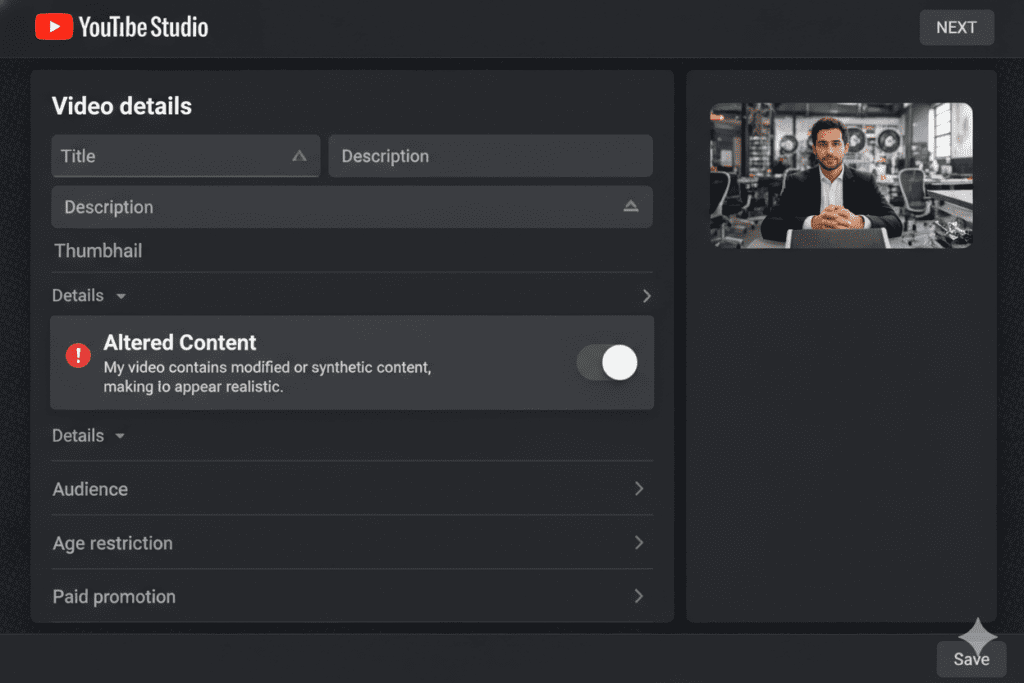
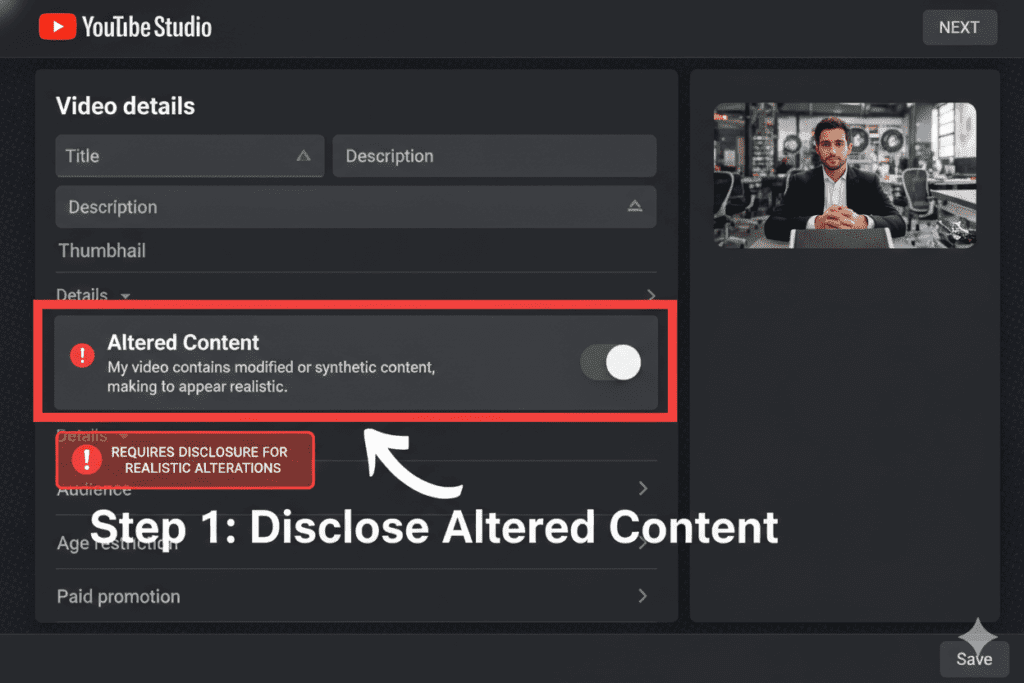
Step 4 — Find the “Altered Content” section Under the expanded options, you’ll see a section labeled “Altered Content.” This is where the disclosure toggle required by the YouTube AI-generated video labeling rules lives.
Step 5 — Select “Yes” If your content requires disclosure, select “Yes.” YouTube will automatically add a “Modified or Synthetic” label to your video’s description field.
Step 6 — Publish normally That’s it. The disclosure label is live. The entire process takes under 30 seconds.
One important note: adding this label does not reduce your video’s reach, algorithmic distribution, or monetization eligibility. YouTube has confirmed this officially.
The only thing that hurts your channel is not disclosing when you should have.
6. What Happens If You Don’t Disclose? (The Real Penalties)
This is where creators are getting burned in 2026. The penalties for ignoring the YouTube altered or synthetic content disclosure policy official 2026 are real, escalating, and career-threatening.
Here’s exactly what can happen:
YouTube labels your video — without your permission If your content clearly needs disclosure and you didn’t add it, YouTube may proactively apply a “Modified or Synthetic” label. You cannot remove it. Viewer trust takes an instant hit.
You receive a channel strike Repeated or serious failures to comply with the YouTube altered or synthetic content disclosure requirement can result in a formal channel strike. One strike is a warning. Multiple strikes mean losing upload rights — or worse.
Demonetization Under the July 2025 policy update, YouTube can strip ad revenue from non-compliant content. This applies even if you’re in the YouTube Partner Program.
Reduced distribution Your videos may be buried in recommendations, excluded from search results, or tagged with visible warnings on watch pages.
Channel termination In January 2026, YouTube executed its largest enforcement wave ever — suspending thousands of channels that had failed to comply with the YouTube synthetic content disclosure requirements combined with the inauthentic content policy.
The message from YouTube is unambiguous: transparency isn’t optional anymore.
7. How the Disclosure Policy Affects Your Monetization
Let’s clear up the biggest misconception about the YouTube altered or synthetic content disclosure policy official 2026: adding the disclosure label does not hurt your monetization.
YouTube has officially confirmed this multiple times.
The “Modified or Synthetic” label is a transparency signal for viewers — not a penalty flag for the algorithm. Your video can still earn full ad revenue, appear in recommendations, and rank in search even with the disclosure applied.
What does threaten your monetization is:
- Failing to disclose when you were required to
- Producing inauthentic AI content — mass-produced, low-effort videos with no real creative direction
- Violating the spirit of the policy — using AI to deliberately mislead viewers
The YouTube altered or synthetic content disclosure requirement exists alongside YouTube’s broader inauthentic content policy. You need to comply with both.
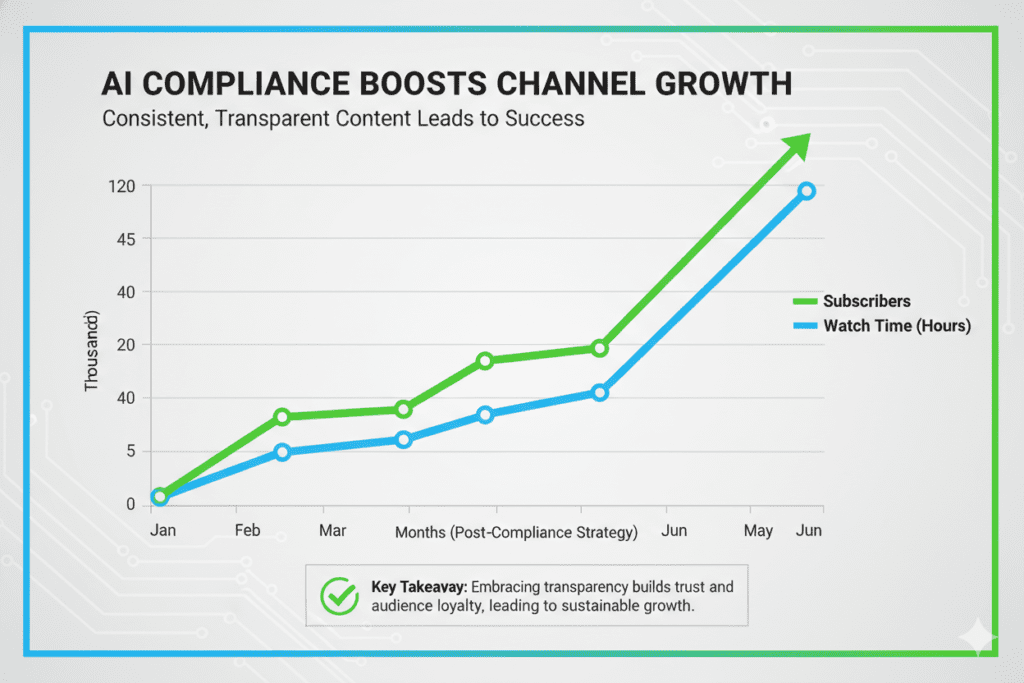
The creators who are thriving in 2026 aren’t worried about disclosure. They disclose when needed, use AI responsibly to boost their output quality, and let tools like ytZolo handle the optimization side without ever triggering the disclosure rule.
8. Why Most Creators Are Still Getting This Wrong
Here’s the uncomfortable truth: most creators who violate the YouTube altered or synthetic content disclosure policy don’t do it intentionally.
They make these common mistakes:
Mistake #1 — Assuming “AI-assisted” means “must disclose” Not all AI use requires disclosure. Using AI to write scripts, generate titles, or create non-realistic thumbnails? That’s perfectly fine without disclosure. Many creators over-stress about this and miss the actual rule: it’s only realistic, potentially deceptive content that matters.
Mistake #2 — Using realistic AI voice clones without thinking This is the most common trap. A creator uses a synthetic voice that sounds eerily similar to a real celebrity or public figure for “entertainment purposes.” That requires disclosure under the YouTube altered or synthetic content disclosure policy — no exceptions.
Mistake #3 — Not updating old videos The 2026 enforcement wave didn’t just apply to new uploads. Older videos that contain qualifying AI content can still be flagged.
Mistake #4 — Fully automating content with no human editorial judgmentYouTube isn’t just checking your disclosures. They’re also checking whether your content reflects genuine creative decisions.
Pure AI output with zero human input — no original angles, no editorial choices, no unique perspective — violates the inauthentic content policy and may fail to meet the YouTube synthetic content disclosure requirements.
Mistake #5 — Treating AI as a replacement instead of a tool The creators who got suspended in January 2026 automated everything and varied nothing. The creators who are winning today use AI to amplify their creativity — not replace it.
This is exactly why ytZolo was built the way it was. It’s an AI tool that supports your creativity. It generates titles, scripts, descriptions, and tags optimized for YouTube’s algorithm — while leaving the creative direction where it belongs: with you.
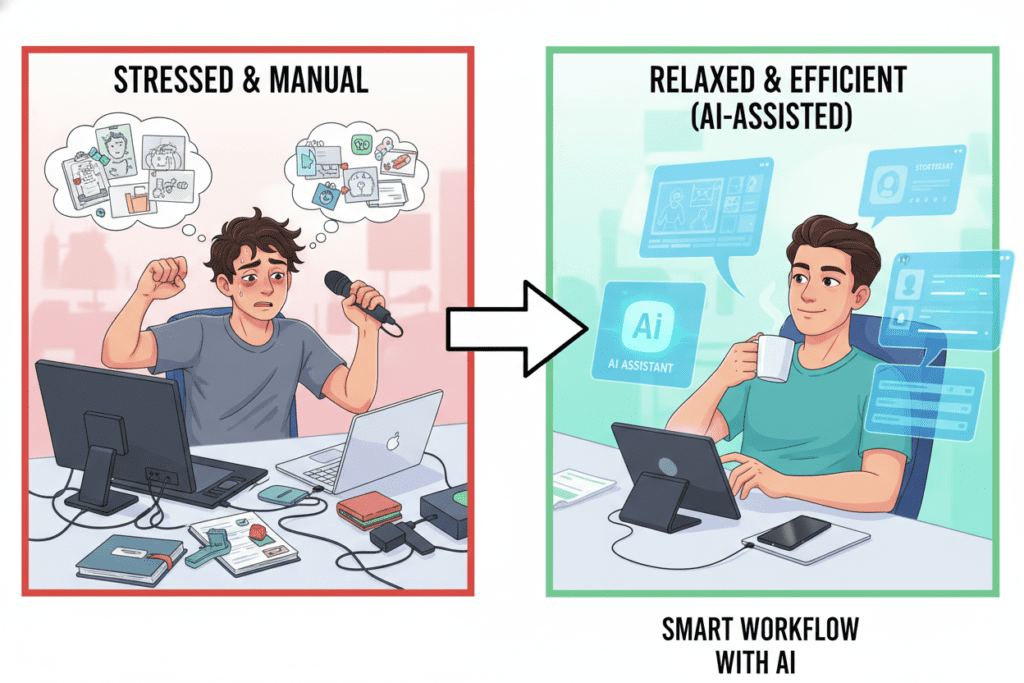
9. Why ytZolo Is the Smartest Tool for Navigating the 2026 Policy
Here’s the thing about the YouTube altered or synthetic content disclosure policy official 2026: it doesn’t punish smart AI use. It punishes deceptive AI use.
And ytZolo is built entirely around smart, compliant, high-performance AI use.
When you use ytZolo to power your YouTube content strategy, you’re using AI the right way — the way YouTube’s own policy framework explicitly allows and encourages.
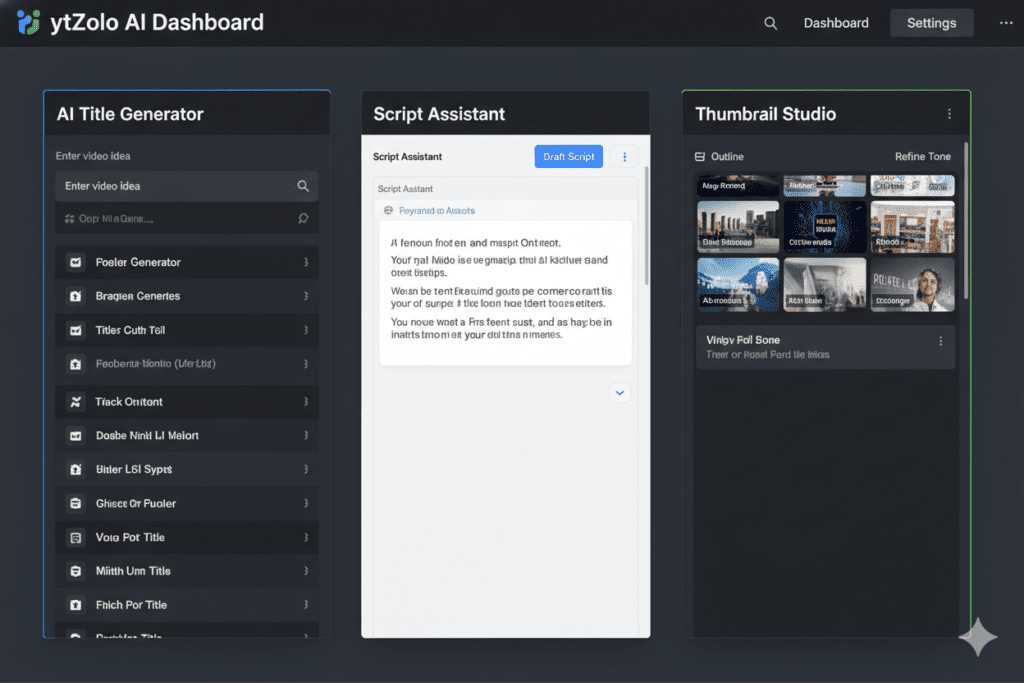
ytZolo helps you with everything that doesn’t require disclosure:
- AI-powered YouTube title generation — Click-worthy, SEO-optimized titles built for your niche
- AI script writing — Structured, engagement-optimized scripts that hook viewers and hold watch time
- AI thumbnail creation — Eye-catching visuals designed for maximum click-through rates
- SEO descriptions and tags — Fully optimized metadata that tells YouTube’s algorithm exactly what your video is about
- Viral content ideas — Know what to create before you hit record
None of these features trigger the YouTube synthetic content disclosure requirements. They’re production assistance tools — exactly the category YouTube explicitly exempts.
But here’s where ytZolo goes further: it’s not just about saving time. It’s about creating content that actually performs.
Every feature inside ytZolo is built specifically for YouTube’s algorithm — not adapted from a general AI platform with a YouTube template bolted on. The AI understands retention hooks, CTR signals, keyword intent, and what actually drives growth in your niche.
The result? You create faster, rank higher, and grow your channel — all while staying completely compliant with the YouTube altered or synthetic content disclosure policy.
Check out more strategies on the ytZolo blog to see how top creators are using AI responsibly to dominate their niches in 2026.
10. Why ytZolo Is Better Than Other Tools
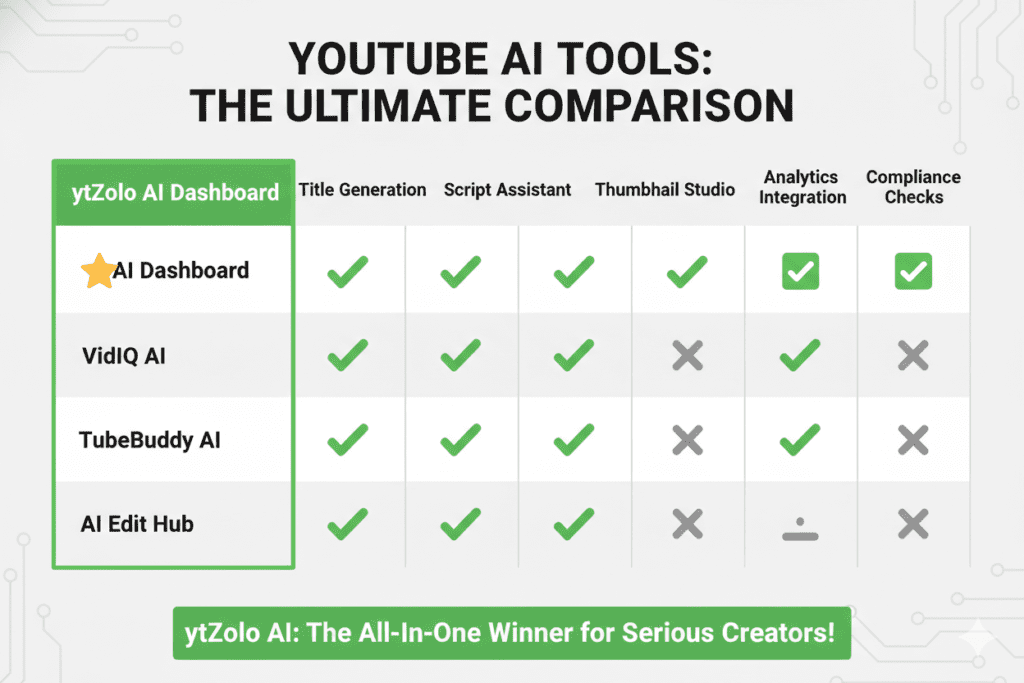
There’s no shortage of AI tools claiming to help YouTubers grow. So why does ytZolo stand apart?
| Feature | ytZolo | TubeBuddy | VidIQ | ChatGPT |
|---|---|---|---|---|
| YouTube-native AI | ✅ Built for YT | ❌ Analytics-first | ❌ Analytics-first | ❌ General purpose |
| AI Script Writing | ✅ Full scripts | ❌ No | ❌ No | ⚠️ Manual prompting |
| AI Thumbnail Generation | ✅ CTR-optimized | ❌ No | ❌ No | ❌ No |
| SEO Titles + Descriptions | ✅ All-in-one | ⚠️ Limited | ⚠️ Limited | ⚠️ Manual prompting |
| Viral Content Ideas | ✅ Niche-specific | ⚠️ Trend data only | ⚠️ Trend data only | ⚠️ Generic |
| Disclosure-Safe AI Output | ✅ Always | ✅ Yes | ✅ Yes | ⚠️ Depends on use |
| Single Dashboard | ✅ All tools unified | ❌ Multiple features | ❌ Multiple features | ❌ No |
The core difference: TubeBuddy and VidIQ are excellent analytics tools. ChatGPT and Jasper are powerful general writers. But none of them were built specifically for the YouTube creator workflow from the ground up.
ytZolo was.
Every single feature — from the hook structure in scripts to the keyword placement in descriptions — is designed around how YouTube’s algorithm actually works in 2026.
Other tools show you data. ytZolo takes action.
Manual methods are simply outdated in 2026. Spending hours crafting titles by hand, guessing at tags, and writing descriptions without SEO intent means leaving views, subscribers, and revenue on the table — every single upload.
AI isn’t the future of YouTube content creation. It’s the present. And ytZolo is where smart creators go to work.
11. FAQ: YouTube Altered or Synthetic Content Disclosure Policy Official 2026
What is the YouTube altered or synthetic content disclosure policy?
The YouTube altered or synthetic content disclosure policy requires creators to label their videos when realistic content has been meaningfully generated or altered using AI. This includes deepfakes, AI voice clones of real people, and synthetic footage of real events. Disclosure is added through a toggle in YouTube Studio under “Altered Content” during the upload process.
Does using AI to write YouTube scripts require disclosure?
No. Using AI tools to write scripts, generate titles, create descriptions, or assist with production planning does not require disclosure. The YouTube altered or synthetic content disclosure policy only applies to realistic visual or audio content that could mislead viewers into thinking something fake is real.
What happens if I don’t disclose altered or synthetic content on YouTube?
Failing to disclose can result in YouTube forcibly labeling your video with a “Modified or Synthetic” tag you cannot remove, a channel strike, demonetization, reduced algorithmic distribution, or in severe repeat cases, channel termination. As of January 2026, YouTube is actively enforcing these rules.
Does the “Modified or Synthetic” disclosure label affect my video’s views or ad revenue?
No. YouTube has officially confirmed that voluntarily adding the disclosure label does not impact a video’s reach, search rankings, recommendations, or monetization eligibility. The label is purely a transparency tool for viewers. It’s failing to disclose that triggers penalties.
Which AI tools are safe to use without triggering YouTube’s disclosure requirement?
AI tools used for production assistance — including AI title generators, script writers, SEO description tools, thumbnail creators, and tag generators — are explicitly exempted from YouTube’s disclosure requirement. Tools like ytZolo fall into this category. They help you create better, faster content without creating realistic synthetic media that could deceive viewers.
12. Conclusion: Stay Compliant, Stay Growing
The YouTube altered or synthetic content disclosure policy official 2026 isn’t a threat to creators who use AI wisely. It’s a threat to creators who use AI carelessly.
The distinction is simple: use AI to deceive → face penalties. Use AI to create better content → grow faster.
Disclosing when required protects your channel. It builds viewer trust. And frankly, it takes less than 30 seconds in YouTube Studio.
The real opportunity in 2026 isn’t just staying compliant with the YouTube altered or synthetic content disclosure rules. It’s using AI tools the right way — to create smarter, faster, and better content that the algorithm loves and audiences can’t stop watching.
That’s exactly what ytZolo was built for.
From viral AI-powered titles to retention-optimized scripts, thumbnail visuals that stop the scroll, and SEO descriptions that rank — ytZolo gives you the complete toolkit to dominate YouTube without ever worrying about disclosure violations.
The creators growing their channels right now aren’t working harder. They’re working smarter.
Start creating smarter, faster, and more viral YouTube content with ytZolo today.
👉 Visit ytZolo.com and start your free account — no credit card required.
Want to go deeper on YouTube’s AI policies and content strategy? Explore more guides on the ytZolo blog.
External Resources:

