

Table of Contents
The Wake-Up Call Most Creators Are Missing
A creator in a popular YouTube forums thread said it best last month: “I’ve been using AI voiceovers for 8 months. I had no idea I was supposed to label them. My channel got a policy warning out of nowhere.”
Sound familiar?
The YouTube AI generated content disclosure policy 2026 is now in full enforcement mode. Channels are being flagged, demonetized, and in some cases suspended — not because they’re making bad content, but because they didn’t understand a policy that went from optional to mandatory.
The painful part? Most creators using AI aren’t doing anything wrong. They just haven’t kept up with the rules.
This guide covers everything: what triggers disclosure, what doesn’t, how to comply in under 60 seconds, and why smart creators are using ytZolo to stay ahead of every policy shift while growing faster than ever.
What Is the YouTube AI Generated Content Disclosure Policy in 2026?
YouTube’s AI disclosure policy requires creators to label content that was realistically generated or significantly altered using AI, so viewers know what they’re watching.
The core idea is simple. If your video could mislead a real person into thinking something happened that didn’t — and AI helped create that illusion — you have to say so.
According to YouTube’s official support page, the policy targets “realistic AI content and meaningful changes.” Minor edits don’t count. Obviously animated or stylized content doesn’t count either.
The rule is about deceptive realism, not about whether you used AI at all.
Here’s what that looks like in practice:
- AI voice clone of a real person → must disclose
- AI-generated footage of a real event that never happened → must disclose
- Deepfake video of any person → must disclose
- AI wrote your script → no disclosure needed
- AI helped you brainstorm titles or descriptions → no disclosure needed
- AI color-graded your footage → no disclosure needed
Using ytZolo to generate titles, scripts, thumbnails, or tags? You’re fine. Tools that assist with production don’t trigger the YouTube AI generated content disclosure policy 2026. Only output that could realistically fool a viewer does.
What Triggers the Disclosure Requirement (and What Doesn’t)
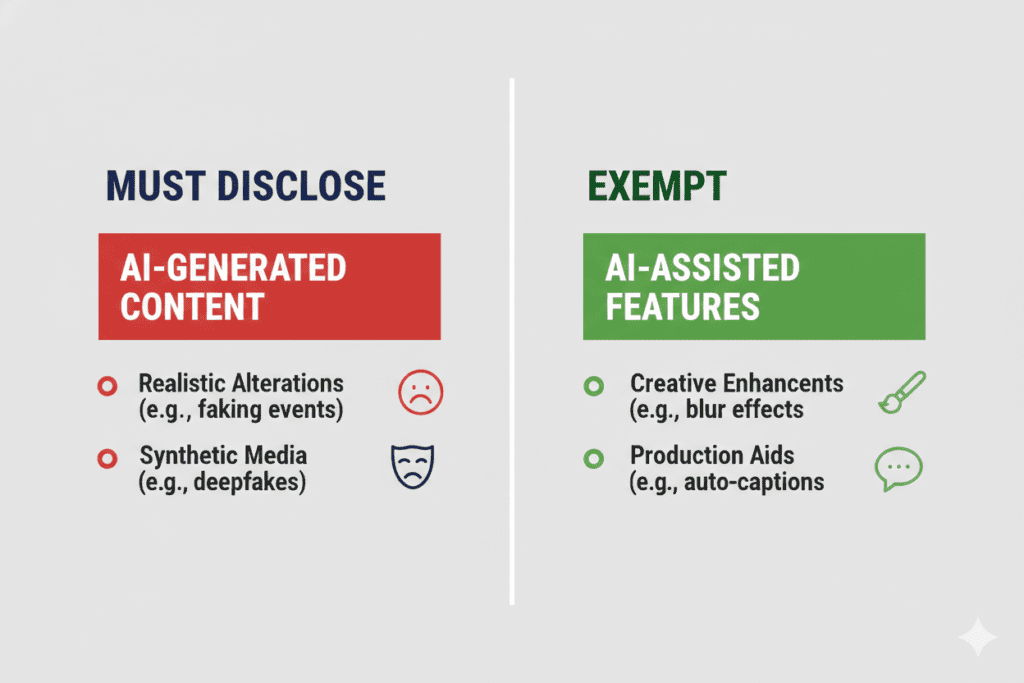
Here’s the clearest breakdown you’ll find anywhere.
You MUST disclose when your video includes:
- Synthetic voices that realistically imitate a real, identifiable person
- AI-generated video footage of real people saying or doing things they never said or did
- AI-created scenes depicting real news events that never occurred
- Any photorealistic content where viewers can’t tell if it’s real
You do NOT need to disclose when you use AI for:
- Writing scripts, outlines, or video ideas
- Generating titles, descriptions, tags, or thumbnails
- Auto-captioning or translation
- Background music generated by AI (unless it mimics a specific artist’s voice)
- Minor color corrections or visual enhancements
- Editing assistance that doesn’t alter what actually happened
The test YouTube uses: would a reasonable viewer be misled about reality? If yes, disclose. If no, move on.
This is where a lot of faceless channel creators have gotten caught. They assumed all AI usage needed a label. Some over-disclosed; others under-disclosed. The YouTube policy for AI-created content only cares about misleading realism.
If you’re using AI to generate thumbnails, improve scripts, create background visuals, or streamline editing, that doesn’t automatically trigger a disclosure requirement. The key question is whether the content could realistically mislead viewers into believing something happened when it didn’t.
This distinction is also becoming increasingly important under the YouTube AI content monetization policy 2026, as creators need to understand that disclosure and monetization are related but separate issues.
A video can be AI-assisted and still qualify for monetization, provided it offers original value and follows YouTube’s transparency guidelines.
How to Add the AI Disclosure Label in YouTube Studio
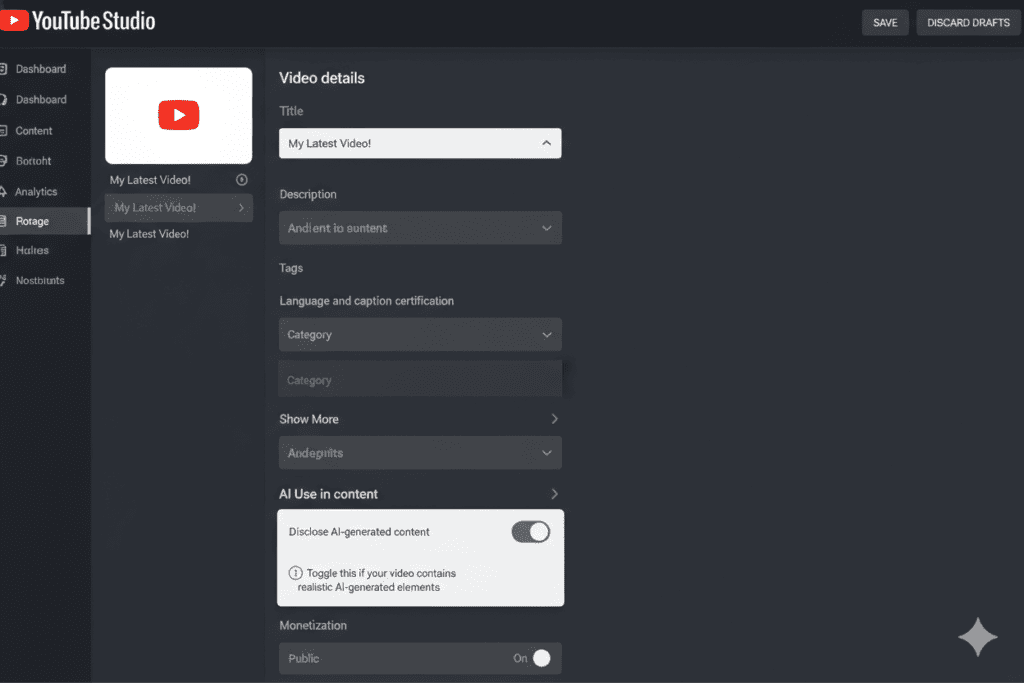
This takes less than 60 seconds. Here’s exactly how to do it:
- Open YouTube Studio and start your upload (or edit an existing video)
- Go to Video Details
- Scroll to the Attributes section
- Under “AI use”, select Yes if your content meets the disclosure criteria
- Save and publish
That’s it.
YouTube then adds a label to your video. For photorealistic or meaningfully AI-altered content, the label appears above the description and below the video player on long-form videos. On Shorts, it shows as an overlay in the bottom-left corner.
These labels are designed to provide transparency for viewers without necessarily limiting a video’s reach or visibility. Understanding how these disclosures work is an important part of the YouTube AI content monetization policy 2026, because many creators mistakenly assume that a disclosure label automatically affects monetization.
In reality, YouTube evaluates originality, value, and compliance with its broader monetization guidelines. A properly disclosed AI-assisted video can still be fully eligible for monetization as long as it delivers meaningful content and follows platform policies.
For animated or stylized AI content that isn’t photorealistic, the label goes in the expanded description instead.
A few things to know about the label:
- Disclosing does NOT hurt your video’s reach. YouTube has confirmed the label doesn’t affect recommendations or monetization eligibility.
- Most labels can be disputed. If YouTube auto-labels your video and you think it’s wrong, you can update the disclosure status in Studio.
- Some labels are permanent. Content made with YouTube’s own tools (Veo, Dream Screen) or content with C2PA metadata stays labeled forever, no disputes.
What Happens If You Don’t Disclose
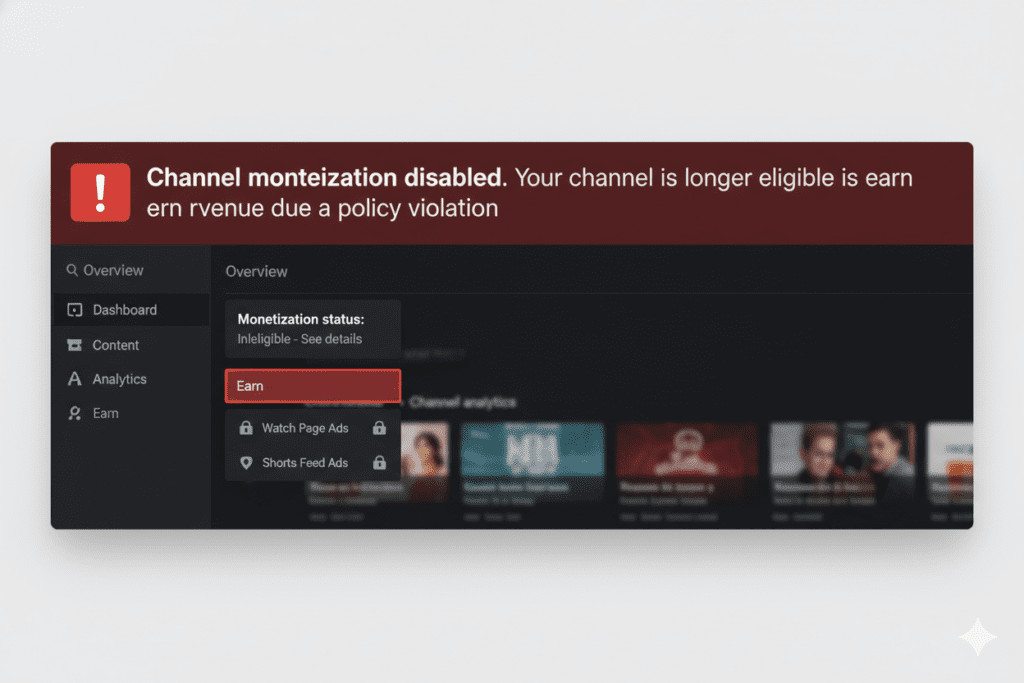
Skipping the disclosure when it’s required isn’t just a minor rule violation. YouTube’s enforcement escalates in stages:
Stage 1: Policy notification sent through Creator Studio.
Stage 2: YouTube forces the label onto your video without your input.
Stage 3: Demonetization. Your video stops earning ad revenue.
Stage 4: Content removal.
Stage 5 (for repeat offenders): Channel suspension from the YouTube Partner Program.
Thousands of creators have already been hit. Most didn’t know the rule applied to them.
The worst part is that enforcement isn’t just manual anymore. As of May 2026, YouTube rolled out automatic AI detection. The platform can now identify certain types of synthetic media and apply AI labels even when creators don’t disclose them themselves, reinforcing its YouTube AI-generated video labeling rules.
This includes content with significant photorealistic AI alterations, deepfake-style footage, and other realistic AI-generated scenes that could potentially mislead viewers.
As AI tools become more sophisticated, YouTube is relying on a combination of internal detection systems, metadata signals, and disclosure requirements to improve transparency across the platform under its YouTube policy for AI-created content.
For creators, this means the safest approach is to be accurate and proactive with disclosures rather than assuming AI-generated elements will go unnoticed.
The YouTube AI content monetization policy 2026 also reflects this shift toward transparency, rewarding creators who follow disclosure rules while continuing to focus monetization decisions on originality and viewer value rather than AI usage alone.
You can’t hide it. You can only comply.
YouTube’s New Auto-Detection System: The Part That Should Scare You

In late May 2026, YouTube announced a major update to how it handles undisclosed AI content.
According to the official YouTube Blog, the platform now uses internal detection signals to identify videos with “significant photorealistic AI use.” If a creator doesn’t disclose and YouTube’s systems catch it, they automatically apply the label.
This is a fundamental shift. Before, undisclosed AI content just sat there. Now, it gets flagged retroactively.
That includes older videos. If you published a faceless AI video 6 months ago and never labeled it, and YouTube’s system detects synthetic content, it can add the label now under the YouTube AI-generated video labeling rules.
3 things every creator needs to do immediately:
- Audit your existing uploads. Check any video that used AI voice, AI-generated footage, or realistic AI imagery.
- Apply manual disclosures to anything that qualifies before the auto-system does it for you.
- Use tools that help you track compliance, especially if you’re publishing frequently.
This is exactly where ytZolo comes in.
Why ytZolo Is the Smartest Way to Stay Compliant and Grow Faster
Here’s the irony of the YouTube AI generated content disclosure policy 2026: it actually doesn’t apply to most of what creators use AI for.
Scripts? Fine. Titles? Fine. Thumbnails? Fine. Tags and descriptions? Fine.
That’s the exact workflow ytZolo was built for.
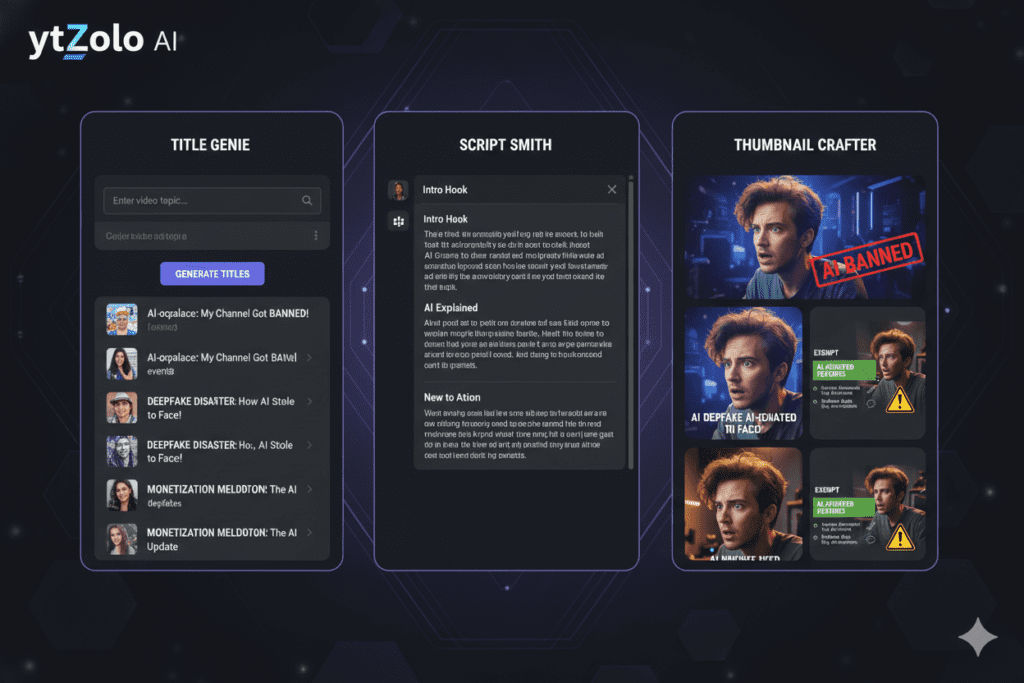
ytZolo is an all-in-one AI YouTube growth tool that handles every part of your content workflow — titles, scripts, thumbnails, descriptions, tags — without touching the types of AI use that trigger disclosure requirements. You get all the speed of AI, none of the compliance headaches.
A lot of creators struggle without a tool like this because they’re trying to manage research, scripting, SEO optimization, and thumbnail creation across 5 or 6 different apps. That’s slow. It’s expensive. And it’s easy to make mistakes.
The more tools you add to your workflow, the more time you spend switching tabs, copying information, and trying to keep everything organized. This can quickly become a major productivity bottleneck, especially for creators publishing multiple videos each week.
It’s also harder to stay updated with evolving platform requirements, including the YouTube AI content monetization policy 2026, which places greater emphasis on originality, transparency, and creator value.
Having a streamlined workflow allows creators to focus less on managing tools and more on producing engaging content that attracts viewers and supports long-term channel growth.
Manual content creation at scale is effectively outdated at this point. The creators growing fastest in 2026 aren’t doing everything by hand. They’re using smart tools that handle the repetitive work so they can focus on what actually builds an audience, while staying compliant with YouTube AI-generated video labeling rules when realistic synthetic content is involved.
Here’s what ytZolo does that most tools don’t:
- AI title generation optimized for click-through rate and search intent
- Script writing that matches your voice and channel niche
- Thumbnail concept creation built around viral visual hooks
- Description and tag optimization tuned for YouTube’s algorithm
- All in one place — no juggling multiple subscriptions
Check out ytZolo’s blog for deep dives on YouTube strategy, SEO, and staying ahead of policy changes like this one.
Why ytZolo Is Better Than Other Tools
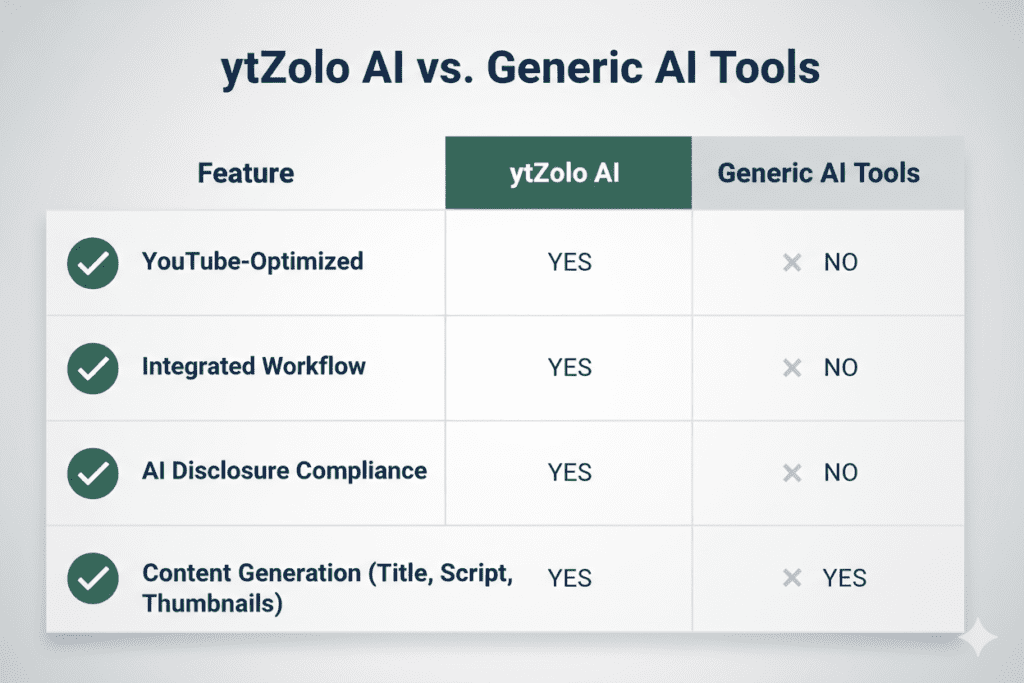
Plenty of AI tools will help you write a script or generate a thumbnail. Here’s what makes ytZolo different:
Built specifically for YouTube creators. Generic AI writing tools aren’t trained on what actually performs on YouTube. ytZolo’s outputs are tuned for the platform — the title lengths, the hook structures, the SEO patterns that move the needle.
All-in-one workflow. Tools like ChatGPT require a different prompt for every task. ytZolo handles titles, scripts, thumbnails, descriptions, and tags in a single workflow. You upload your topic and get a full content package.
Stays within safe AI use. Because ytZolo operates in the production-assistance category (scripts, optimization, metadata), everything it generates falls outside YouTube’s disclosure requirements. You grow faster and stay clean.
Optimized for virality. The tool is built around what gets clicks and views — not just what sounds good. There’s a difference, and it shows up in the data.
Time savings that actually matter. Creators using ytZolo consistently report cutting their pre-production time in half. For channels publishing 3-4 videos a week, that’s hours back every single week.
Other tools give you pieces. ytZolo gives you the whole pipeline.
FAQ: YouTube AI Disclosure Policy 2026
Q: Does using AI to write my YouTube script trigger the disclosure requirement?
No. Under the YouTube AI-generated video labeling rules, YouTube explicitly exempts production assistance uses of AI from disclosure requirements. Using AI to generate scripts, titles, descriptions, tags, or captions doesn’t require a disclosure label. Only realistic synthetic media that could mislead viewers about real events or real people does.
Q: What is the YouTube AI generated content disclosure policy 2026 in simple terms?
If your video uses AI to create realistic-looking footage of real people, real events, or real voices in a way that could fool viewers, you must add a label in YouTube Studio saying the content is AI-generated or AI-altered. The rule doesn’t apply to obviously animated, stylized, or clearly non-realistic content.
The goal is transparency, not punishment. YouTube wants viewers to understand when realistic media has been significantly modified by AI, especially in situations where it could affect their perception of what is real.
Understanding these disclosure requirements is also important under the YouTube AI content monetization policy 2026, as creators often confuse disclosure rules with monetization eligibility. I
n most cases, properly labeled AI-assisted content can still be monetized, provided it delivers original value, follows community guidelines, and complies with YouTube’s broader content quality standards.
Q: Will adding the AI disclosure label hurt my channel’s monetization?
No. YouTube has confirmed that properly disclosed AI content is fully eligible for monetization through the YouTube Partner Program. Disclosing your AI use doesn’t reduce recommendations or ad eligibility. Failing to disclose when required is what triggers demonetization.
Q: Can YouTube auto-label my video as AI-generated without my permission?
Yes. Starting May 2026, YouTube uses automated detection to identify significantly AI-generated photorealistic content. If you haven’t disclosed and the system flags it, YouTube will apply the label automatically under its YouTube AI-generated video labeling rules. Most labels can be disputed through YouTube Studio, but some (like content made with YouTube’s own AI tools) are permanent.
Q: Does ytZolo create content that requires AI disclosure?
No. ytZolo generates scripts, titles, thumbnails, descriptions, and tags — all of which fall under YouTube’s “production assistance” exemption. None of it produces synthetic voices, deepfake footage, or photorealistic AI video of real people. You can use ytZolo freely without triggering the YouTube AI generated content disclosure policy 2026.
The Bottom Line
The YouTube AI generated content disclosure policy 2026 is real, it’s enforced, and it’s only getting stricter. Auto-detection is live. Penalties are escalating. And most creators who’ve been hit weren’t even doing anything shady — they just didn’t understand where the line was.
The line is clear now: realistic synthetic media of real people and real events needs a label. Production tools like scripts, titles, thumbnails, and descriptions don’t. That’s the essence of the YouTube AI-generated video labeling rules in two sentences.
The confusion usually starts when creators assume that every form of AI assistance must be disclosed, which simply isn’t the case. YouTube’s focus is on preventing viewers from being misled by realistic AI-generated or AI-altered content, not on restricting the use of productivity tools.
This distinction is especially important when understanding the YouTube AI content monetization policy 2026. Using AI to brainstorm ideas, write scripts, generate titles, or optimize thumbnails does not automatically affect monetization.
What matters is whether your content remains original, valuable, and transparent when significant AI-generated realism is involved.
The smart move is to audit your existing videos, apply disclosures where needed, and build a content workflow that keeps you in the clear going forward.
ytZolo makes that last part easy. It’s built for the production-assistance side of AI — the side that helps you grow, without touching anything that triggers a policy violation.
Start creating smarter, faster, and more viral YouTube content with ytZolo today.
Related reading: YouTube AI Content Policy Updates and Strategy — ytZolo Blog
External sources: YouTube Help: Disclosing AI-generated content · YouTube Blog: Improving AI labels for viewers and creators

