

Table of Contents
The Creator Who Didn’t Read the Rules
Imagine waking up on a Tuesday morning, opening YouTube Studio with your coffee in hand — and seeing a demonetization notice on a video that just hit 80,000 views.
No warning. No explanation. Just a cold, automated message saying your content violated YouTube’s policies.
That’s the reality thousands of creators faced in 2025 and 2026 after YouTube ramped up enforcement of its YouTube AI generated content disclosure requirements. Some lost their entire YouTube Partner Program status. Others had their channels flagged, suspended, or removed.
The terrifying part? Most of them had no idea they were breaking any rules.
If you’re using AI tools to help create your YouTube content — and you should be — understanding YouTube AI generated content disclosure requirements is no longer optional. It’s mission-critical.
This guide breaks it all down in plain English. What you must disclose, what you don’t, how to stay compliant, and how tools like ytZolo help you use AI the right way — so you grow your channel faster without ever putting it at risk.
Let’s start from the beginning.
What Are YouTube AI Generated Content Disclosure Requirements?
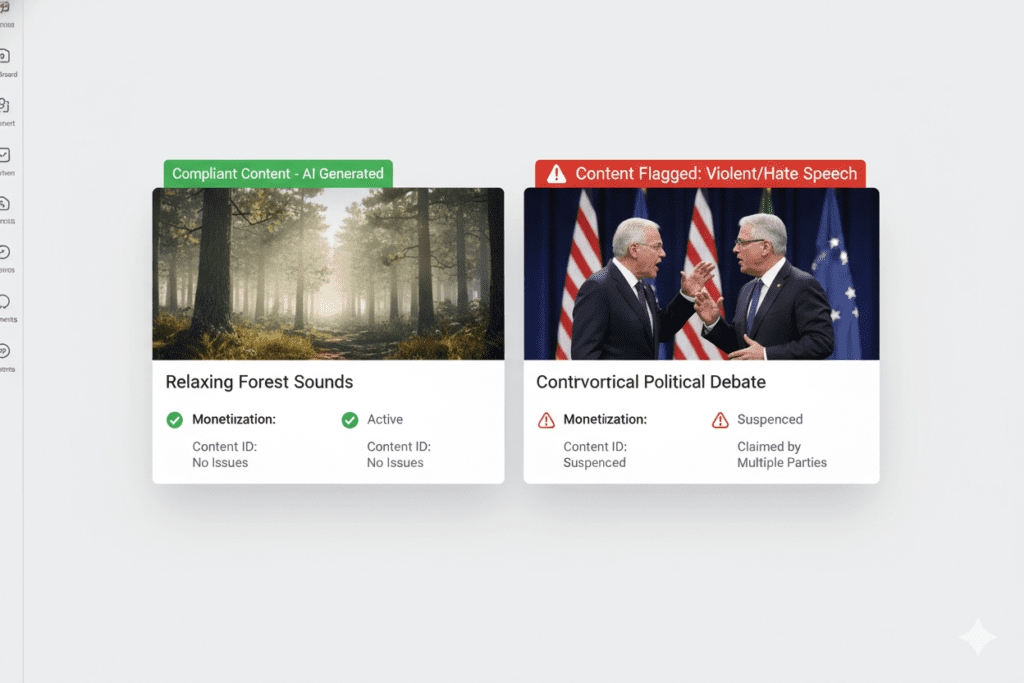
YouTube AI generated content disclosure requirements are a set of platform rules that require creators to label their videos when AI has been used to create or significantly alter content in a way that could mislead viewers.
The core principle is simple: viewers have the right to know when what they’re watching was artificially created or manipulated.
According to YouTube’s official policy, creators must disclose content that is “meaningfully altered or synthetically generated” when it appears realistic — meaning a viewer could reasonably mistake it for real footage of a real person, place, or event.
This isn’t about punishing AI use. YouTube is clear on that.
The platform actively supports AI as a creative tool. Over 20 million users used YouTube’s own AI-powered features in just one month in late 2025. The message from YouTube is loud and clear: AI is welcome. Deception is not.
Understanding that distinction is the foundation of everything that follows.
The Timeline: How This Policy Evolved
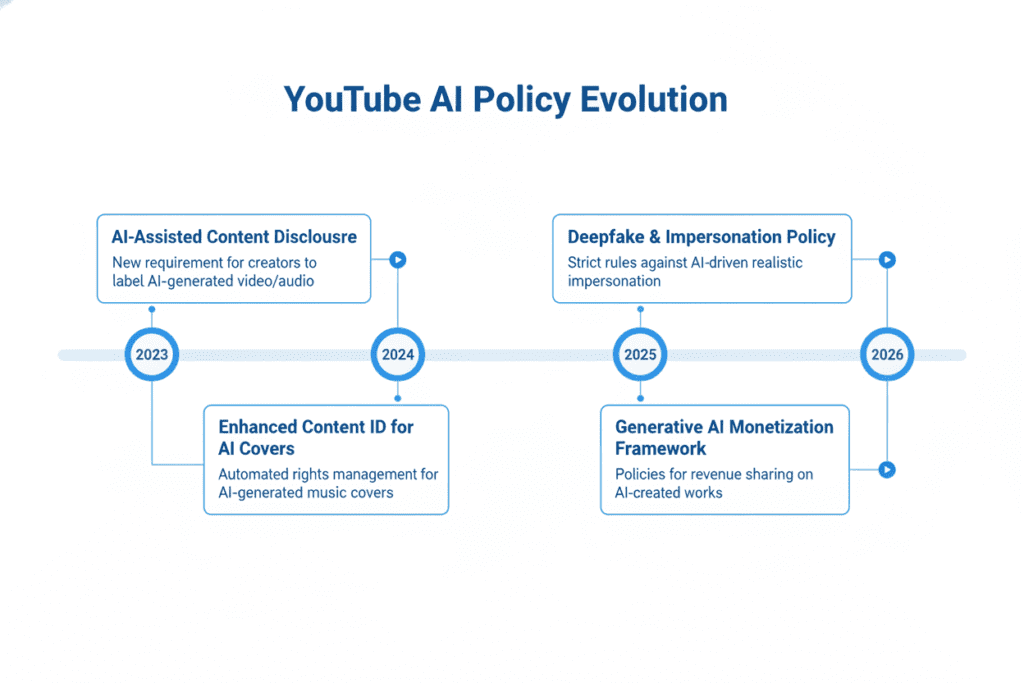
The YouTube AI generated content disclosure requirements didn’t appear overnight. They’ve been building for years — and the enforcement has intensified dramatically.
Here’s the full timeline every creator needs to know:
- November 2023 — YouTube announces its first major update on synthetic and altered content. The platform signals mandatory disclosure is coming for realistic AI-generated content.
- March 2024 — YouTube formally rolls out the AI disclosure policy. A new toggle appears in YouTube Studio during the upload process. Enforcement begins softly.
- May 21, 2025 — Mandatory disclosure requirements go fully live. YouTube’s enforcement systems begin actively scanning uploads for undisclosed synthetic content.
- July 15, 2025 — YouTube renames its “repetitious content” policy to “inauthentic content” and introduces stricter monetization standards targeting mass-produced AI videos — what the creator community calls “AI slop.”
- January 2026 — YouTube carries out its largest single enforcement wave against undisclosed AI-generated content. Thousands of channels are affected.
The pattern is obvious. These rules started as a suggestion and became a hard requirement with escalating penalties.
Creators who adapted early are thriving. Those who ignored the changes are still dealing with the fallout.
What Content MUST Be Disclosed?
This is the section that trips up the most creators. Let’s be crystal clear.
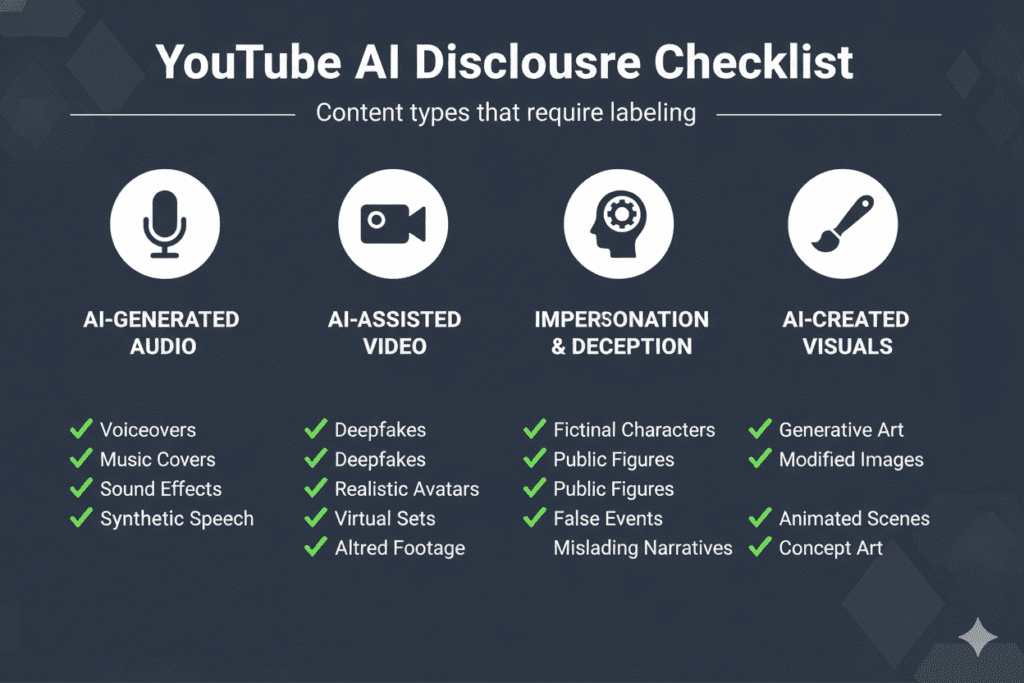
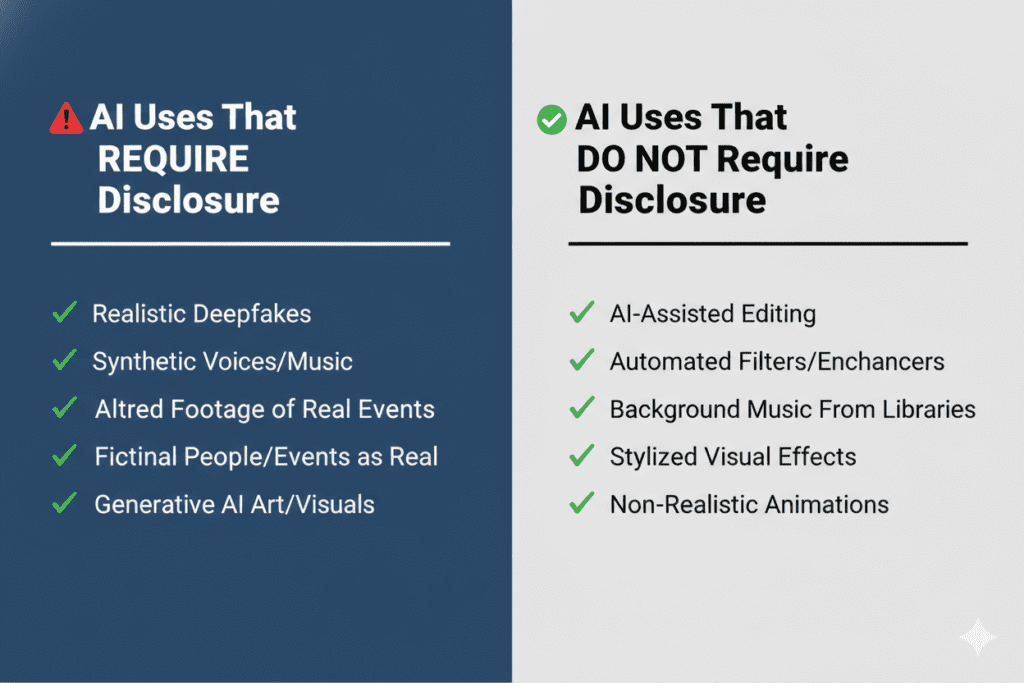
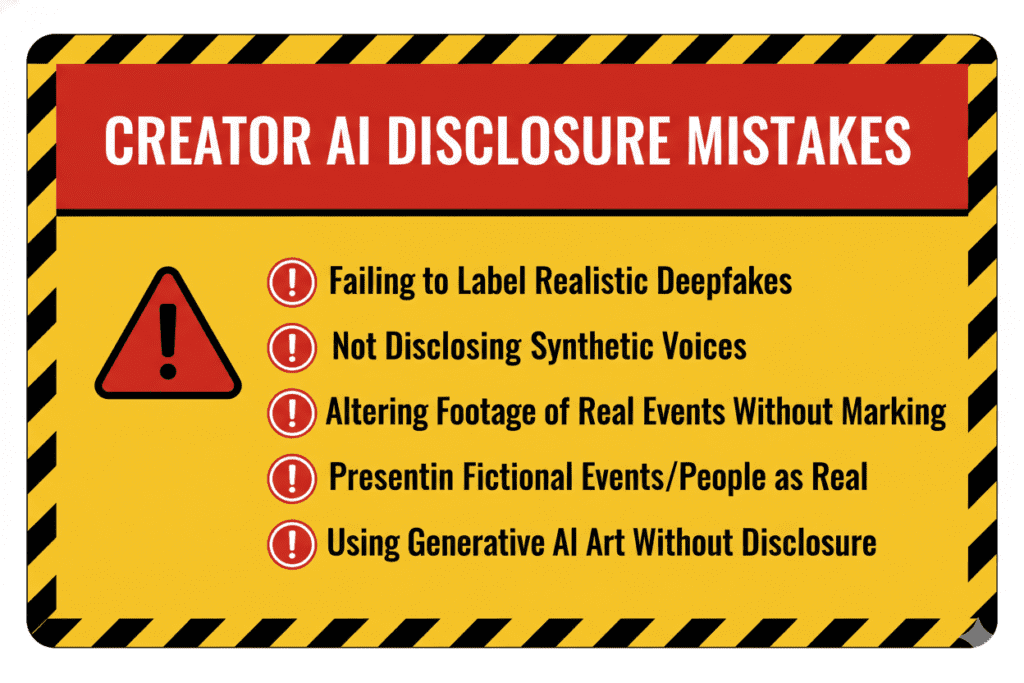
Under YouTube AI generated content disclosure requirements, you MUST disclose when your content includes:
- Synthetic or cloned voices — AI-generated voiceovers that sound like a real, identifiable person saying things they never actually said
- Realistic AI-generated visuals — Scenes, landscapes, or footage that looks real but was entirely AI-created
- Deepfakes or face manipulation — AI-altered videos that make a real person appear to say or do something they never did
- Fabricated events — AI-generated footage that depicts a news event, natural disaster, or real-world scenario that never actually happened
- AI-modified speech — Altering a real person’s voice to change what they said, even subtly
The disclosure requirement focuses on realism and the potential for viewer deception — not on how much AI you used.
If a viewer could reasonably be misled by your content, you need the disclosure label. That’s the test YouTube applies every time.
For sensitive topics — politics, health, elections, finance, and breaking news — YouTube may apply an even more prominent label directly on the video player itself, not just in the description.
What Content Does NOT Require Disclosure?
Here’s the good news. The majority of how creators use AI tools today does not trigger YouTube AI generated content disclosure requirements.
You do NOT need to disclose when you use AI for:
- Scriptwriting — Using AI tools to write your video script
- Title and description generation — Generating SEO-optimized titles, tags, and metadata
- Thumbnail creation — AI-generated thumbnail images that are clearly stylized or illustrated
- Background blur or noise reduction — Standard editing enhancements
- Color correction — Aesthetic post-processing
- Subtitles and captions — AI-generated closed captions
- Idea generation — Using AI to brainstorm video topics or outlines
- Grammar or phrasing improvements — Light AI editing of your existing copy
This is where a lot of creators panic unnecessarily. Using AI to improve your workflow is completely fine and encouraged.
The tools that help you write scripts, generate titles, build thumbnails, and optimize metadata — tools like ytZolo — fall entirely outside the disclosure zone.
You’re free to use them without any labeling requirement whatsoever.
The Real Penalties for Not Disclosing AI Content
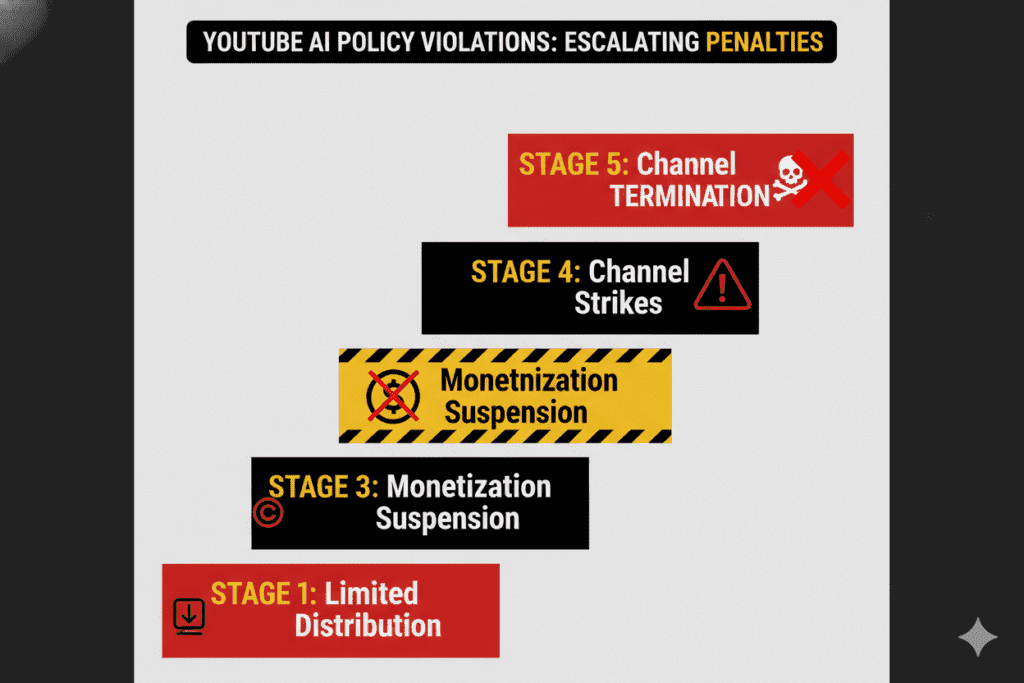
Let’s talk about what’s actually at stake. Because the consequences of ignoring YouTube AI generated content disclosure requirements are more serious than most creators realize.
Here’s what YouTube can — and does — impose for violations:
Limited Distribution
YouTube’s first response is usually a quiet throttle. Your video gets fewer recommendations, lower search visibility, and reduced reach. You might not even notice it happening — until your views tank.
Demonetization
Your video gets stripped of ad revenue. If the violation is serious enough, your entire channel loses YouTube Partner Program status. You can reapply after 30 days for standard violations — or 90 days for severe ones.
Contextual Warnings on Watch Pages
YouTube can attach a warning label directly on the watch page of your video, alerting viewers before they even press play that the content may be misleading. This destroys trust and kills watch time.
Channel Suspension
YouTube can temporarily hide your entire channel — not just one video. This has happened to channels with hundreds of thousands of subscribers who had no idea they were out of compliance.
Channel Termination
In extreme cases involving deepfakes of real people or deliberate misinformation, YouTube permanently terminates channels. This is rare but real — and it happens fast.
The enforcement isn’t random. YouTube’s systems scan for undisclosed synthetic content automatically using machine learning. Manual reviewers investigate flagged channels. The more violations pile up, the faster consequences escalate.
One video can be the start of a chain reaction that takes down everything you’ve built.
How to Add the AI Disclosure Label in YouTube Studio (Step-by-Step)
Adding the required disclosure is actually straightforward. Here’s exactly how to do it.
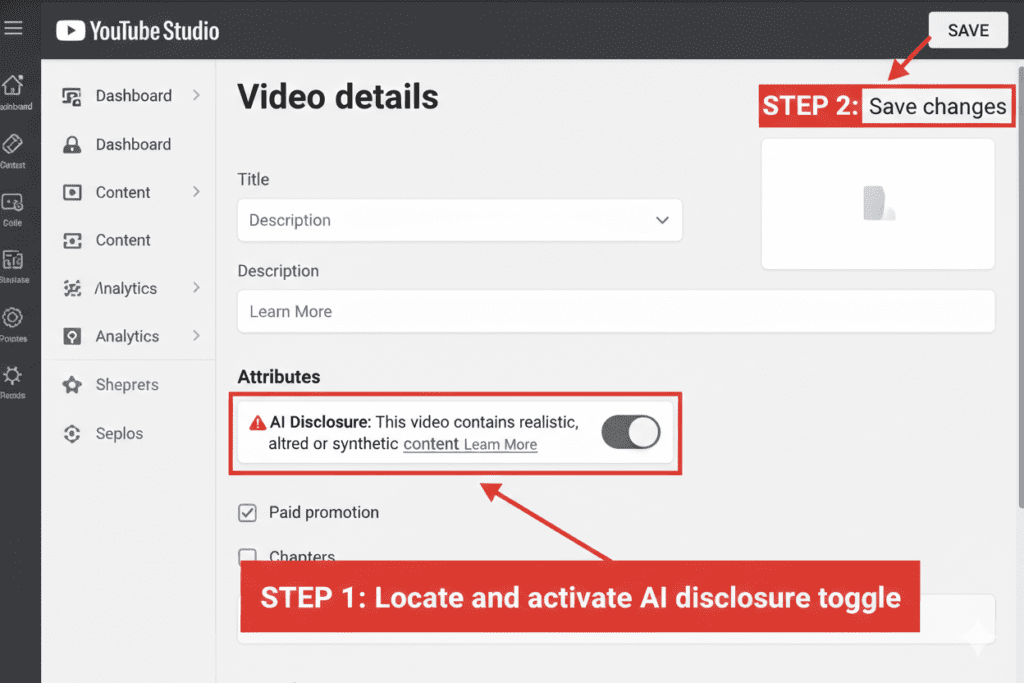
Step 1: Open YouTube Studio
Go to studio.youtube.com and click on “Create” or navigate to your video in the Content tab.
Step 2: Go to the Upload Flow or Edit an Existing Video
For new uploads, the disclosure option appears during the upload process. For existing videos, click the video you want to edit and open its details.
Step 3: Find the “Attributes” Section
Scroll down in the video details until you see the “Attributes” section. Look for “AI use” as a subsection.
Step 4: Toggle “Yes” for Applicable Content
If your video includes realistic AI-generated or meaningfully AI-altered content, select “Yes” under the AI use toggle.
If the content does not meet disclosure requirements, select “No.”
Step 5: Save and Publish
Save your changes. YouTube will automatically add the appropriate label — either in the video description for non-photorealistic content, or directly on the video player for photorealistic content.
Pro tip: If you’re unsure whether your content qualifies, default to disclosing. YouTube explicitly states that proactive disclosure protects you from penalties — and data shows that properly labeled AI content performs just as well as non-AI content with audiences.
YouTube AI Generated Content Disclosure Requirements and Your Monetization
Here’s something important that many creators don’t realize: disclosure and monetization are two separate issues.
Disclosing AI use keeps you compliant with YouTube AI generated content disclosure requirements. But it doesn’t automatically protect your monetization status.
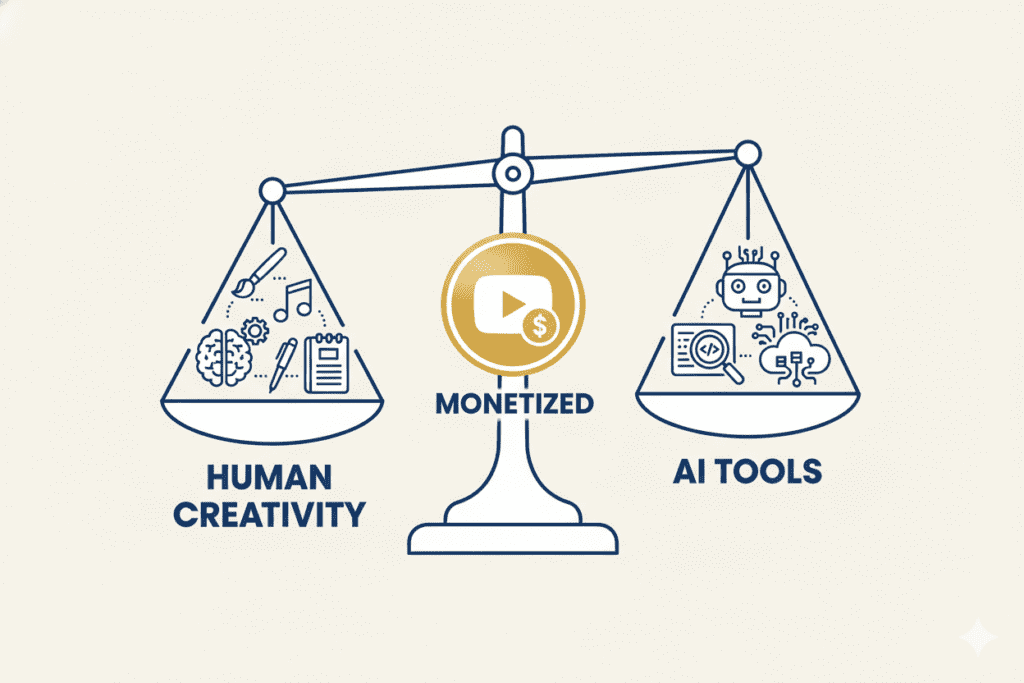
To stay in the YouTube Partner Program and keep earning ad revenue, your AI-assisted content also needs to meet YouTube’s originality standards.
That means:
- Human creativity must be present. AI can assist, but it cannot do everything. Your perspective, your judgment, your creative input must be visible in the final video.
- Mass-produced content is penalized. Uploading dozens of near-identical AI-generated videos with no original commentary is exactly what YouTube’s “inauthentic content” policy targets.
- Quality matters more than quantity. YouTube actively demonetizes channels that produce bulk, low-effort AI content — regardless of whether they disclose it.
The platform’s message is consistent: use AI as an amplifier for your human creativity. Don’t use it as a replacement.
The creators winning in 2026 are those who’ve found the balance. They use smart AI tools to handle the heavy lifting — research, scripting, optimization, thumbnails — while injecting their own voice, perspective, and storytelling into the final product.
That balance is exactly what ytZolo was built to support.
How ytZolo Helps You Stay Compliant and Grow Faster
Let’s connect the dots. You now understand YouTube AI generated content disclosure requirements. You know what to disclose, what not to disclose, and what’s at stake.
Now the question is: how do you use AI in a way that grows your channel, keeps you monetized, and stays fully compliant?
The answer is ytZolo.
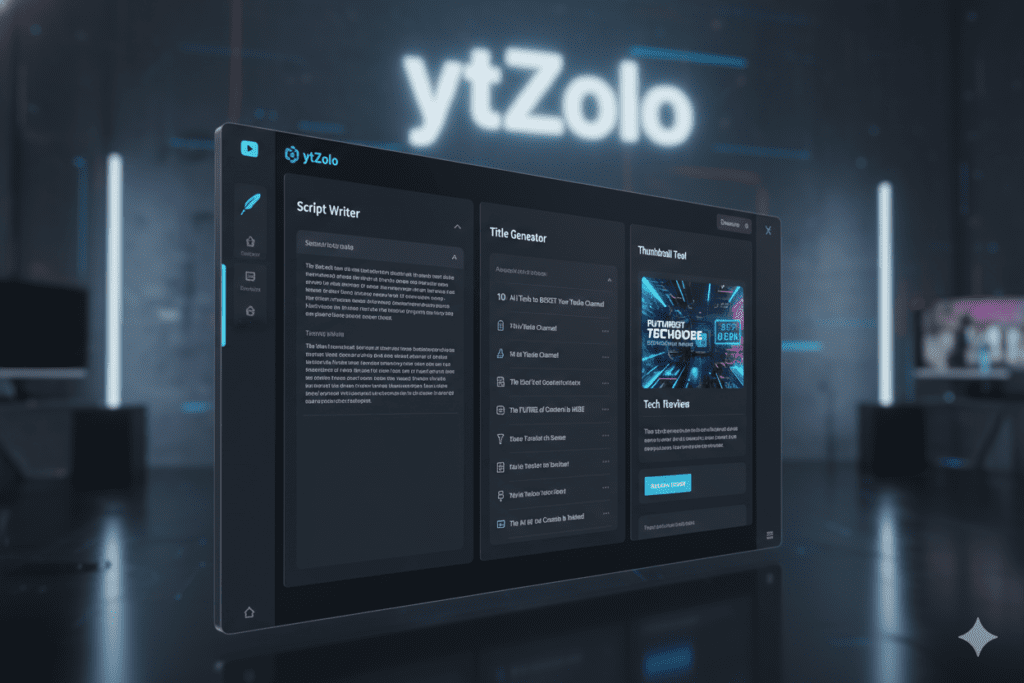
ytZolo is an all-in-one AI YouTube growth tool built specifically for creators who want to work smarter — not just faster. Every feature it offers falls into the category of AI assistance that YouTube explicitly welcomes.
Here’s what ytZolo helps you create:
- AI-generated video scripts — Full, structured scripts that sound natural and retain viewers. No synthetic voices. No deepfakes. Just a powerful writing tool that saves hours per video.
- Viral title generation — Data-driven titles built on real CTR performance across niches. No disclosure needed. Just better clicks.
- Thumbnail creation — Eye-catching, stylized visuals designed to maximize click-through rate. Clearly AI-assisted design, not deceptive realism.
- SEO-optimized descriptions and tags — Metadata that helps your videos get found. No compliance risk whatsoever.
- Video idea generation — Never run out of content ideas again. ytZolo’s AI surfaces what’s trending in your niche before your competitors find it.
Everything ytZolo does is designed to amplify your creativity — not replace it. And that’s precisely the kind of AI use YouTube rewards, not penalizes.
When you create with ytZolo, you’re building content that meets YouTube’s standards for originality, adds genuine human value, and is optimized for growth from the first second.
You don’t have to choose between using AI and staying safe. With ytZolo, you get both.
Start free at ytzolo.com — no credit card required.
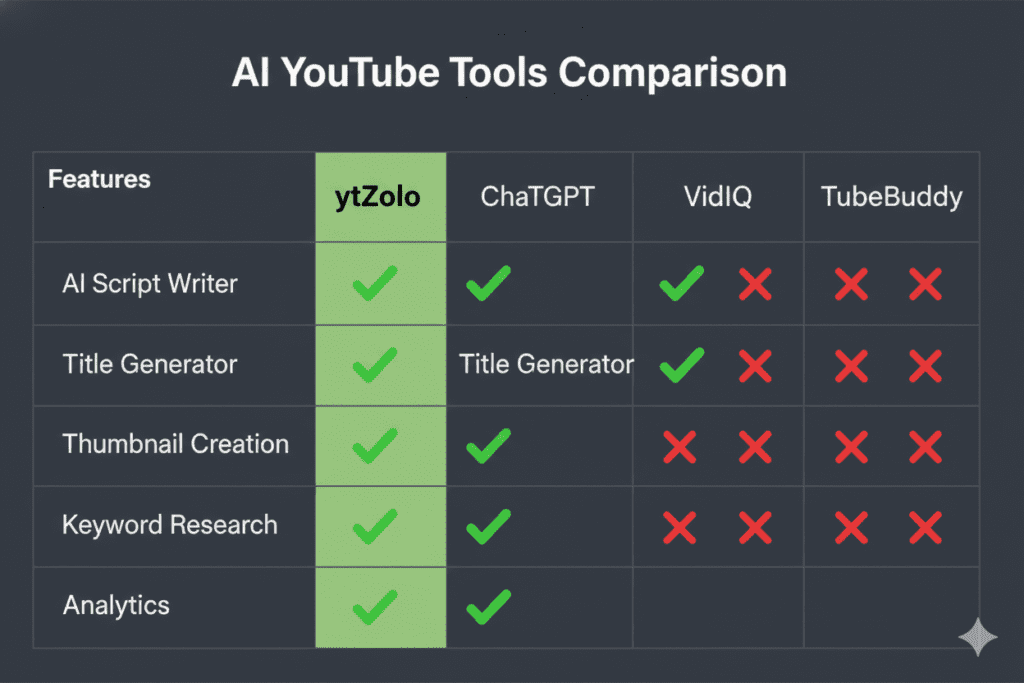
Why ytZolo Is Better Than Other Tools
The AI tool market is crowded. But when it comes to helping creators navigate YouTube AI generated content disclosure requirements while actually growing their channel, ytZolo leads by a wide margin.
Here’s how it stacks up against the alternatives:
ytZolo vs. ChatGPT
ChatGPT is a powerful general-purpose AI. But it has zero understanding of YouTube’s algorithm, compliance requirements, or what drives CTR in your specific niche.
ytZolo is YouTube-native from the ground up. Every output is trained on real YouTube performance data — so the scripts, titles, and descriptions it generates are built to rank and retain, not just to read well.
ytZolo vs. VidIQ
VidIQ is useful for keyword research and competitive analysis. But it doesn’t write your scripts. It doesn’t generate your thumbnails. And it offers zero guidance on how to stay compliant with AI disclosure rules.
ytZolo covers the full workflow — and keeps you informed about best practices along the way through the ytZolo blog.
ytZolo vs. TubeBuddy
TubeBuddy helps with YouTube Studio integration and A/B thumbnail testing. But it’s not AI-first. Its content generation capabilities are minimal, and it has no specific features to help creators stay ahead of evolving YouTube AI policies.
ytZolo vs. Jasper / Copy.ai
These are writing platforms built for blogs and marketing emails. They don’t understand YouTube’s watch time dynamics, retention patterns, or the difference between a hook that performs on video and one that reads well on a webpage.
ytZolo was designed specifically for YouTube creators. Not bloggers. Not marketers. YouTubers.
The verdict: If you want an AI tool that keeps you compliant with YouTube AI generated content disclosure requirements, supercharges your content quality, and actually grows your channel — ytZolo is the only platform doing all of it together.
Common Mistakes Creators Make with AI Disclosure
Even well-intentioned creators make these errors. Learn from them before they cost you.
- Assuming scripts need to be disclosed. They don’t. Using ytZolo to write your script is 100% compliant. The disclosure rule targets realistic visual and audio deception — not text assistance.
- Forgetting to disclose cloned voices. This is the most common violation. If your video uses an AI voice that sounds like a real person — especially someone famous — disclosure is required.
- Treating the policy as optional. As of May 2025, YouTube AI generated content disclosure requirements are mandatory. There is no grace period. Violations have real consequences.
- Using YouTube’s own AI tools and skipping the toggle. YouTube’s Dream Screen and Dream Track may auto-label in some cases — but creators are still responsible for manually disclosing when using third-party AI tools.
- Not disclosing on sensitive-topic videos. If your video touches on health, politics, finance, or breaking news — and it contains realistic AI content — YouTube will apply a prominent warning label on the video player itself if you don’t disclose first.
- Relying on low-quality AI bulk automation. Mass-producing identical AI videos doesn’t just violate the spirit of the disclosure policy — it triggers YouTube’s “inauthentic content” flag and risks full demonetization. The solution isn’t less AI. It’s smarter AI. It’s ytZolo.
FAQ
What are YouTube AI generated content disclosure requirements?
YouTube AI generated content disclosure requirements are platform rules requiring creators to label videos when AI has been used to create or significantly alter realistic content that viewers might mistake for authentic footage.
includes AI-generated visuals of real events, synthetic voices resembling real people, and deepfake manipulation of real individuals. The rules went fully mandatory in May 2025 and are actively enforced.
Does using AI to write my YouTube script require a disclosure?
No. Using an AI tool to write your video script — such as ytZolo’s script writer — does not trigger YouTube’s AI disclosure requirements. The disclosure policy applies to realistic visual and audio content that could deceive viewers, not to text-based writing assistance. You can use AI scripting tools freely without adding any disclosure label.
What happens if I don’t disclose AI-generated content on YouTube?
Failing to disclose qualifying AI content can lead to limited video distribution, demonetization, contextual warning labels placed on your video by YouTube, channel suspension, or in severe cases, permanent channel termination.
YouTube uses automated machine learning systems to detect undisclosed synthetic content, and enforcement has intensified significantly since 2025.
How do I add an AI disclosure label in YouTube Studio?
During the upload process in YouTube Studio, scroll to the “Attributes” section and look for “AI use.” Toggle “Yes” if your video includes realistic AI-generated or meaningfully AI-altered content. For existing videos, open the video details in your Content tab and make the same selection. YouTube will then automatically apply the appropriate label to your video.
Does disclosing AI content hurt my video’s performance?
No. Research and data from YouTube’s own policies confirm that properly disclosed AI content performs similarly to non-AI content. Viewers generally appreciate transparency. The real performance risk comes from not disclosing — which can trigger penalties, reduced distribution, and the erosion of audience trust that comes with getting caught.
Conclusion
The rules around YouTube AI generated content disclosure requirements are real, they’re enforced, and they’re only getting stricter.
But here’s the thing — they’re not a threat to creators who use AI the right way. They’re a filter that rewards honesty, quality, and genuine human creativity.
The creators dominating YouTube in 2026 aren’t avoiding AI. They’re using it smarter. They’re using tools that handle the technical heavy lifting — scripts, titles, thumbnails, descriptions, tags — while they focus on delivering the perspective and storytelling only a human creator can provide.
That’s the winning formula. And that’s exactly what ytZolo was built for.
ytZolo gives you every tool you need to create faster, rank higher, and grow your channel — all while staying completely within YouTube’s AI generated content disclosure requirements. No grey areas. No guesswork. Just a smart, clean content workflow that builds channels the right way.
You’ve worked too hard on your channel to lose it to a policy you could have understood in an afternoon.
Don’t wait until YouTube sends you a notice. Get ahead of the rules. Use the right tools. Build something that lasts.
Start creating smarter, faster, and more viral YouTube content with ytZolo today.
👉 Visit ytZolo.com and start for free — no credit card required.
Want to go deeper on YouTube growth strategy and compliance? The ytZolo blog publishes detailed, up-to-date guides on everything from AI content rules to thumbnail optimization and channel growth tactics.
External Resources:

