
Blog Summery
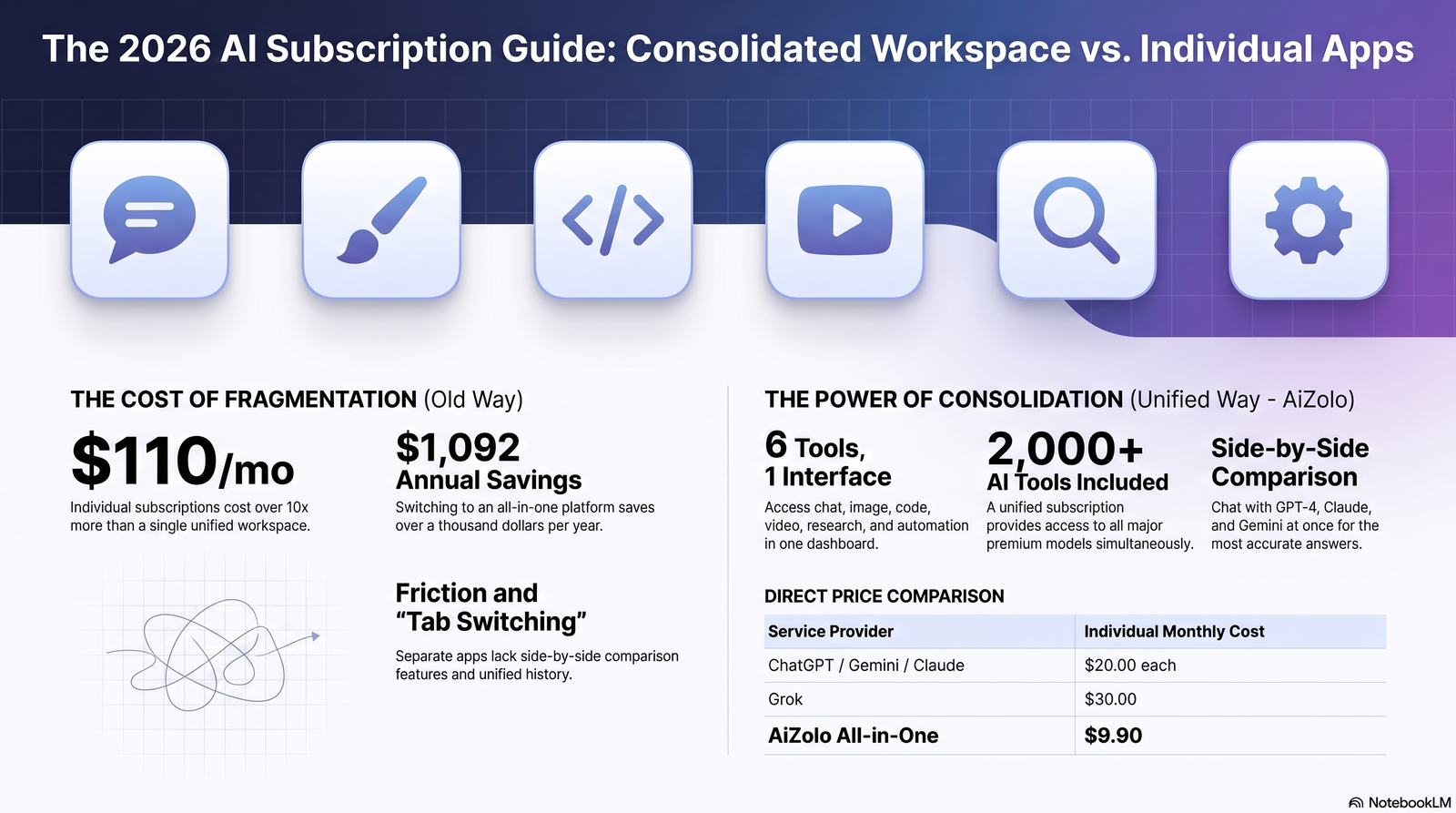
In short: “most popular AI tools” isn’t one product anymore. It’s a small set of general chatbots (ChatGPT, Gemini, Claude, Microsoft Copilot) that between them account for the large majority of usage, a distinct leader for cited research (Perplexity), and separate category leaders for images (Midjourney) and code (GitHub Copilot, Claude Code). ChatGPT still leads on raw numbers, but Gemini and Claude are the two closing the gap fastest — through different routes: Gemini via bundling into Google’s existing products, Claude via faster relative growth off a smaller base. Needing more than one model is solved with bundled platforms like AiZolo instead of stacking subscriptions
Table of Contents
Introduction
Popularity and quality aren’t the same question. This page answers one thing: which AI tools do the most people actually use, and how is that changing? It’s ranked by real usage signals — disclosed active users, web traffic share, and year-over-year growth — not by features, pricing, or which tool is “best” for a given job. (If you’re trying to pick a tool for a specific use case, our [head-to-head comparison guide] and [how to choose the right AI tool] page cover that.)
What Makes an AI Tool Popular?
Popularity isn’t just download numbers. The tools that stick around usually share four traits:
- They solve one job extremely well. ChatGPT for conversation, Midjourney for images, GitHub Copilot for code.
- They’re easy to start using. No steep learning curve, a usable free tier, browser or app access.
- They keep shipping improvements. Weekly or monthly updates instead of stagnant products.
- People recommend them to colleagues. Word of mouth still drives most AI adoption.
How We Evaluated These Tools
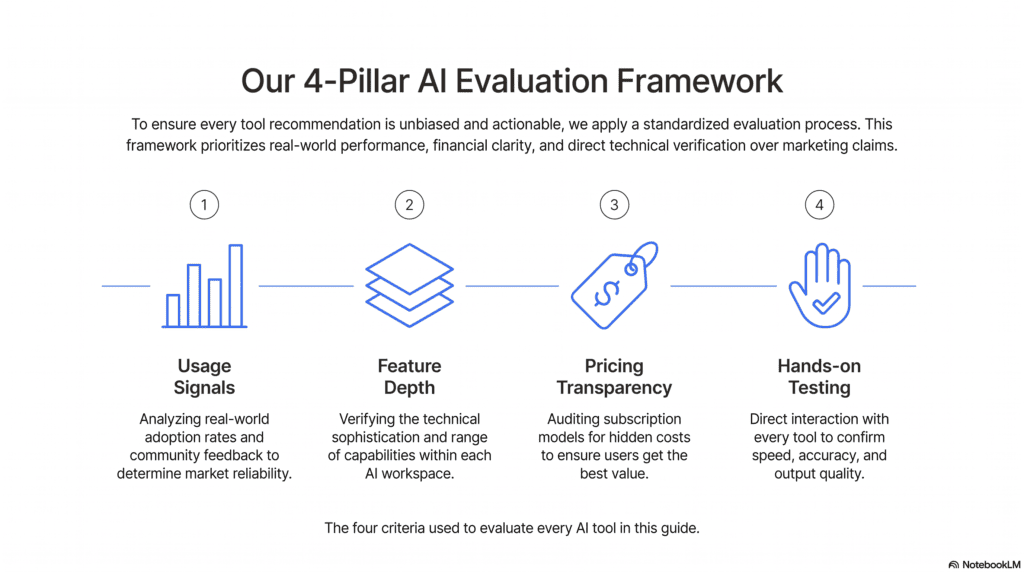
Rankings below are based on public usage signals (app store rankings, web traffic estimates, search volume), feature depth, pricing transparency, and hands-on use. Where a claim is about a specific company’s pricing or feature set, it reflects that company’s own published pricing page as of mid-2026 — always double-check current pricing on the provider’s site before subscribing, since AI pricing changes often.
The 2026 Rankings
Public companies disclose usage numbers on different schedules and using different definitions (weekly vs. monthly active users, web visits vs. app opens), so this table normalizes what’s publicly available as of July 2026 and flags the source and metric type for each row rather than pretending everything is apples-to-apples.
| Rank | Tool | Disclosed Usage Scale | Web Traffic Share (Similarweb, global, May 2026) | YoY Direction |
|---|---|---|---|---|
| 1 | ChatGPT | ~900M weekly active users (OpenAI, Feb 2026); crossed 1B monthly app users (Sensor Tower, via Reuters, June 2026) | 53.9% | ↓ share, ↑ absolute users |
| 2 | Gemini | 900M+ monthly active users, standalone app (Google I/O, May 2026) | 27.9% | ↑↑ |
| 3 | Claude | ~245M monthly active users (Sensor Tower); 952M monthly web visits | 9.2% | ↑↑↑ (fastest-growing of the top 3) |
| 4 | Microsoft Copilot | ~420M MAU across all surfaces; 20M paid Microsoft 365 seats (Microsoft Q3 FY26 earnings) | 2.8% | ↑ (paid seats), flat (web) |
| 5 | Grok | ~117M monthly active users, ~21% of X’s user base (Mar 2026 estimate) | 3.4% | ↓ (lost share this quarter) |
| 6 | Perplexity | ~45M monthly active users, more than doubled from 22M in early 2025 | 1.6% | ↓ (share slipped this quarter despite user growth) |
| 7 | DeepSeek | ~97M monthly active users (last major disclosure, April 2025) | 1.2% | ↓ |
Notes on the data: “Weekly” and “monthly” active users aren’t directly comparable, and no company reports on identical terms — this is the nature of self-disclosed usage data across competing platforms.
App-store category rank (e.g., “#3 in Productivity”) shifts daily and isn’t consistently archived publicly for every tool, so we’ve left it out rather than presenting a stale or estimated number as fact. Where we say a tool is “the fastest-growing,” that’s based on the trend in the cited source, not a guarantee it holds next quarter.
Risers and Fallers: Who Gained and Lost Ground This Year
This is the one lens neither a feature comparison nor a “how to choose” guide can give you: who’s actually taking share from whom, year over year.
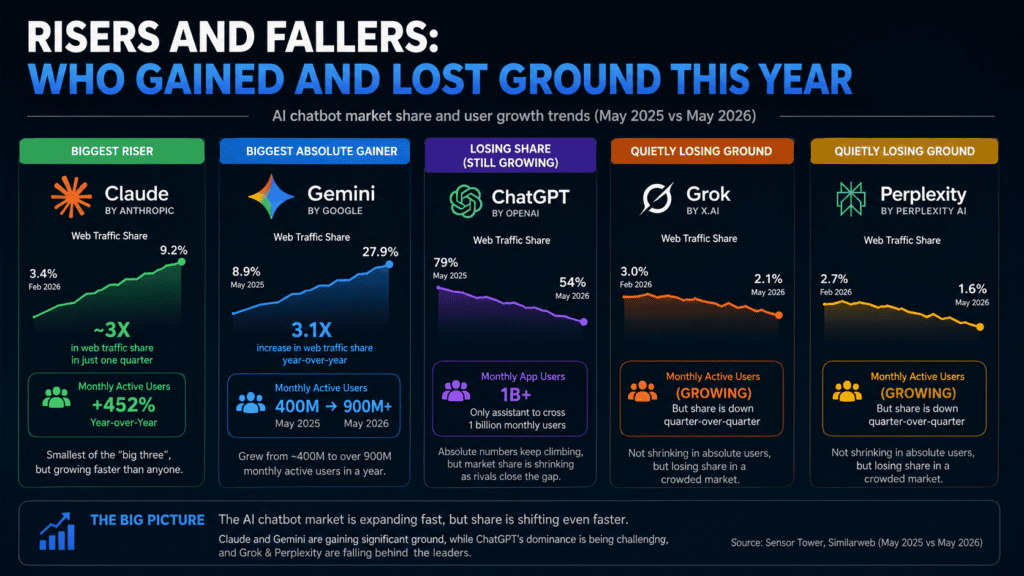
Biggest riser: Claude. Anthropic’s web traffic share went from roughly 3.4% in February 2026 to 9.2% by May — close to tripling in a single quarter — while monthly active users grew an estimated 452% year-over-year, per Sensor Tower data. Claude is still the smallest of the “big three” by raw user count, but no other major tool is growing this fast off this large a base.
Biggest absolute gainer: Gemini. Google’s standalone app went from roughly 400 million monthly active users a year ago to over 900 million by May 2026 — a jump that puts it within range of ChatGPT’s headline numbers, even accounting for the weekly-vs-monthly measurement gap. Gemini’s web traffic share also more than tripled year-over-year, from around 8.9% to 27.9%.
Losing share while still growing: ChatGPT. ChatGPT’s absolute numbers kept climbing — it’s still the only assistant to cross 1 billion monthly app users — but its share of AI-chatbot web traffic fell from around 79% in May 2025 to roughly 54% in May 2026, as Gemini and Claude ate into that lead. Growing in absolute terms while losing relative share is the defining story of ChatGPT’s 2026 so far.
Quietly losing ground: Grok and Perplexity. Both saw their web traffic share slip over the most recent quarter tracked, even though neither is shrinking in absolute users. In a market this crowded, standing still is functionally falling behind.
Category Leaderboards
Overall usage numbers mostly reflect general-purpose chatbots. Here’s how the ranking looks inside three narrower categories, by usage signal rather than by “best.”
Most-Used General Chatbot
- ChatGPT — largest by both weekly users and total web traffic
- Gemini — largest gainer, boosted by default placement in Android, Search, and Workspace
- Claude — smallest of the three by raw users, but the fastest-growing
- Microsoft Copilot — largest reach through bundled Microsoft 365 seats rather than standalone app pull
- Grok — usage concentrated among X’s existing user base
Most-Used Coding Assistant
Usage data here is thinner and less standardized than for general chatbots, so treat rankings as directional:
- GitHub Copilot — largest disclosed paid base among dedicated coding tools (4.7M paid subscribers, per Microsoft/Business of Apps data)
- Claude (via Claude Code / IDE integrations) — cited in developer surveys as the primary tool for a majority of professional developers in 2026, though Anthropic doesn’t disclose a comparable subscriber count
- Cursor — frequently cited as the fastest-growing dedicated AI coding editor, though it doesn’t publicly disclose user counts
- Gemini Code Assist — usage tied to Google Cloud developer accounts rather than a standalone app metric
Most-Used AI Image Tool
Public usage disclosures for image generators lag far behind chatbots — most companies here don’t report active-user figures at all — so this list reflects consistent appearance in third-party “most-used” tracking (Sensor Tower, Appfigures) rather than hard numbers:
- Midjourney — most consistently cited as the leading dedicated image-generation tool by usage
- GPT Image (via ChatGPT) — highest reach by default, since it’s bundled into the largest chatbot’s user base rather than used as a standalone destination
- Canva (Magic Studio / AI tools) — largest reach among non-designers, driven by Canva’s existing design-tool user base
Best AI Tools by Category
| Category | Top Pick | Why |
|---|---|---|
| Writing | ChatGPT / Claude | Strong drafting and editing across formats |
| Coding | Claude / GitHub Copilot | Best reasoning on multi-file changes |
| Marketing | Canva AI + ChatGPT | Fast copy and creative in one workflow |
| Students | Claude / Perplexity | Clear explanations with cited sources |
| Business | Microsoft Copilot / Gemini | Native fit inside existing office tools |
| Image generation | Midjourney | Most distinctive visual style |
| Video creation | Runway | Most mature text-to-video toolkit |
| Automation | Zapier AI / n8n | Connects AI steps into existing workflows |
| Research | Perplexity | Citations built into every answer |
| Multi-model comparison | AiZolo | One subscription across several premium models |
Methodology
Rankings and figures on this page are drawn from:
- Company disclosures — official statements from OpenAI, Google/Alphabet, Anthropic, and Microsoft (earnings calls, product announcement blog posts, investor materials).
- Third-party usage trackers — Sensor Tower and Apptopia app-usage estimates, cited via reporting from Reuters and TechCrunch.
- Web traffic analytics — Similarweb’s monthly AI-chatbot traffic-share snapshots.
- Developer and enterprise survey data — for coding-assistant usage claims, where no company-disclosed subscriber count exists.
All figures are dated to their disclosure month, since these numbers move quickly and a “2026” figure from January is already stale by July. Where two credible sources disagreed on a number (this happened most often for Copilot and Grok), we noted both rather than picking one. This page is updated as new disclosures come in — if you’re citing a figure from here, check the disclosure date next to it rather than the page’s last-updated date.
AI Trends to Watch in 2026
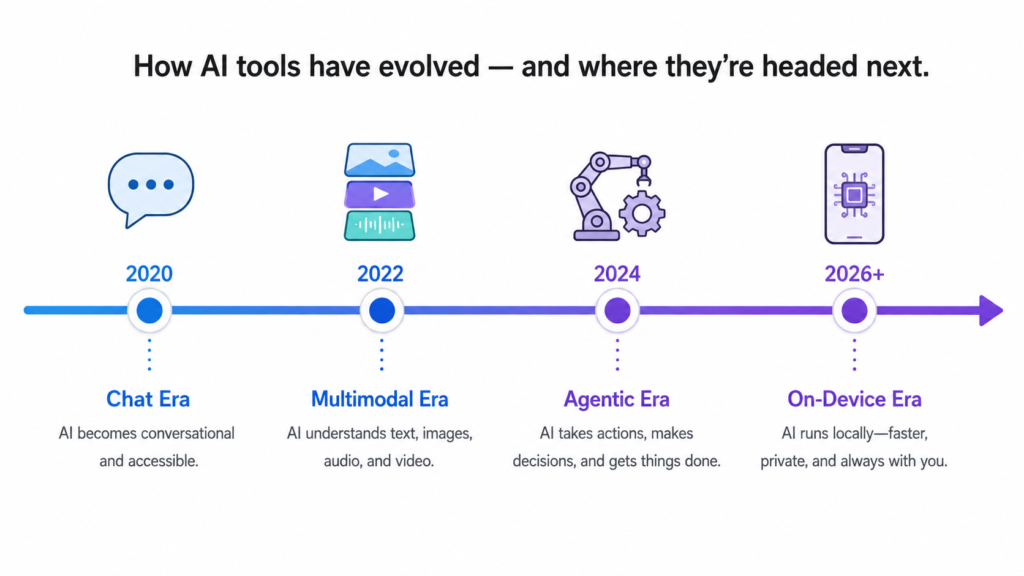
- Agentic AI: tools that can complete multi-step tasks (booking, coding, research) with less hand-holding.
- Multimodal by default: text, image, audio, and video increasingly live in one interface instead of separate apps.
- Consolidation: growth of platforms that bundle multiple models under one subscription rather than users juggling several logins.
- On-device AI: more processing happening locally on phones and laptops for speed and privacy.
FAQs
What’s the most popular AI tools right now? ChatGPT, by both weekly active users (~900 million, per OpenAI) and total web traffic share (~54%, per Similarweb). It’s also the only AI assistant to cross 1 billion monthly active app users.
Is ChatGPT still #1? Yes, by every major usage metric tracked here, but its lead is narrower than it was a year ago. Its web traffic share has fallen roughly 25 percentage points year-over-year as Gemini and Claude have grown.
Which AI tool grew the most this year? By relative growth, Claude — its web traffic share nearly tripled in a single quarter and its monthly active users grew an estimated 452% year-over-year. By absolute users gained, Gemini, which added roughly 500 million monthly active users in about a year.
Which AI software best overall? There’s no single “best” — Claude and ChatGPT lead for general writing and reasoning, Perplexity leads for cited research, and Midjourney leads for image quality.
Which AI tool do professionals use most? Knowledge workers commonly use ChatGPT or Claude for writing and analysis, Copilot inside Microsoft 365, and GitHub Copilot or Claude Code for software development.
Is ChatGPT still the most popular AI software? Yes, by raw user numbers, though Claude and Gemini have closed the gap significantly through 2025–2026.
Which AI is best for coding? Claude and GitHub Copilot are the most commonly recommended for code generation and review; Cursor is popular as a full AI-first editor.
Which AI is best for images? Midjourney is generally considered the leader for artistic quality; Adobe Firefly leads for commercially safe, enterprise-ready image generation.
What AI tool is best for business? Microsoft Copilot and Google Gemini tend to win for businesses already using Microsoft 365 or Google Workspace, since the AI sits inside existing tools.
What AI tool is best for students? Claude and Perplexity are popular with students because they explain reasoning clearly and Perplexity shows its sources.
Which AI tool has the best mobile app? ChatGPT, Claude, Gemini, and Perplexity all have well-rated native iOS and Android apps as of 2026.
13.Further Reading
For readers who want a deeper dive into that last point, AiZolo’s own blog has several head-to-head comparisons worth reading:
- Aizolo vs ChatGPT Plus: Which AI Platform Offers Better Value?
- Aizolo vs Perplexity Pro: Which AI Subscription Wins?
- Aizolo vs OpenRouter: Which AI Platform Wins in 2026?
For background on the underlying models and companies mentioned in this guide, see OpenAI, Anthropic, Google AI, and Stanford HAI’s AI Index for independent research on AI adoption trends.
14. Author
Anshika Verma AI Researcher and Technology Writer anshika@ytzolo.com
Anshika researches and reviews AI tools hands-on, including ytZolo, focusing on real pricing, real limitations, and practical fit rather than marketing claims. Her work follows Google’s E-E-A-T principles: clear sourcing, tested recommendations, and honest trade-offs over hype.

