
Blog Summery
In short: the “most popular AI tool” isn’t one product anymore — it’s a small set of chatbots (ChatGPT, Claude, Gemini, Copilot), a research tool (Perplexity), and category leaders for images (Midjourney) and code (GitHub Copilot, Claude Code). Free tiers cover casual use; paid tiers pay off once you hit real usage limits; and needing more than one model is increasingly solved with bundled platforms like AiZolo instead of stacking separate subscriptions.
Table of Contents
1. Introduction
Everyone is asking the same question this year: which AI tools actually deserve a spot on your phone or browser toolbar. There are thousands of options, and most “best AI tools” lists just repeat the same five names without explaining why.
This guide breaks down the most popular AI tools in 2026 by real usage, not marketing hype. It covers chatbots, image generators, coding assistants, and the productivity apps built on top of them, with honest pricing and plain trade-offs.
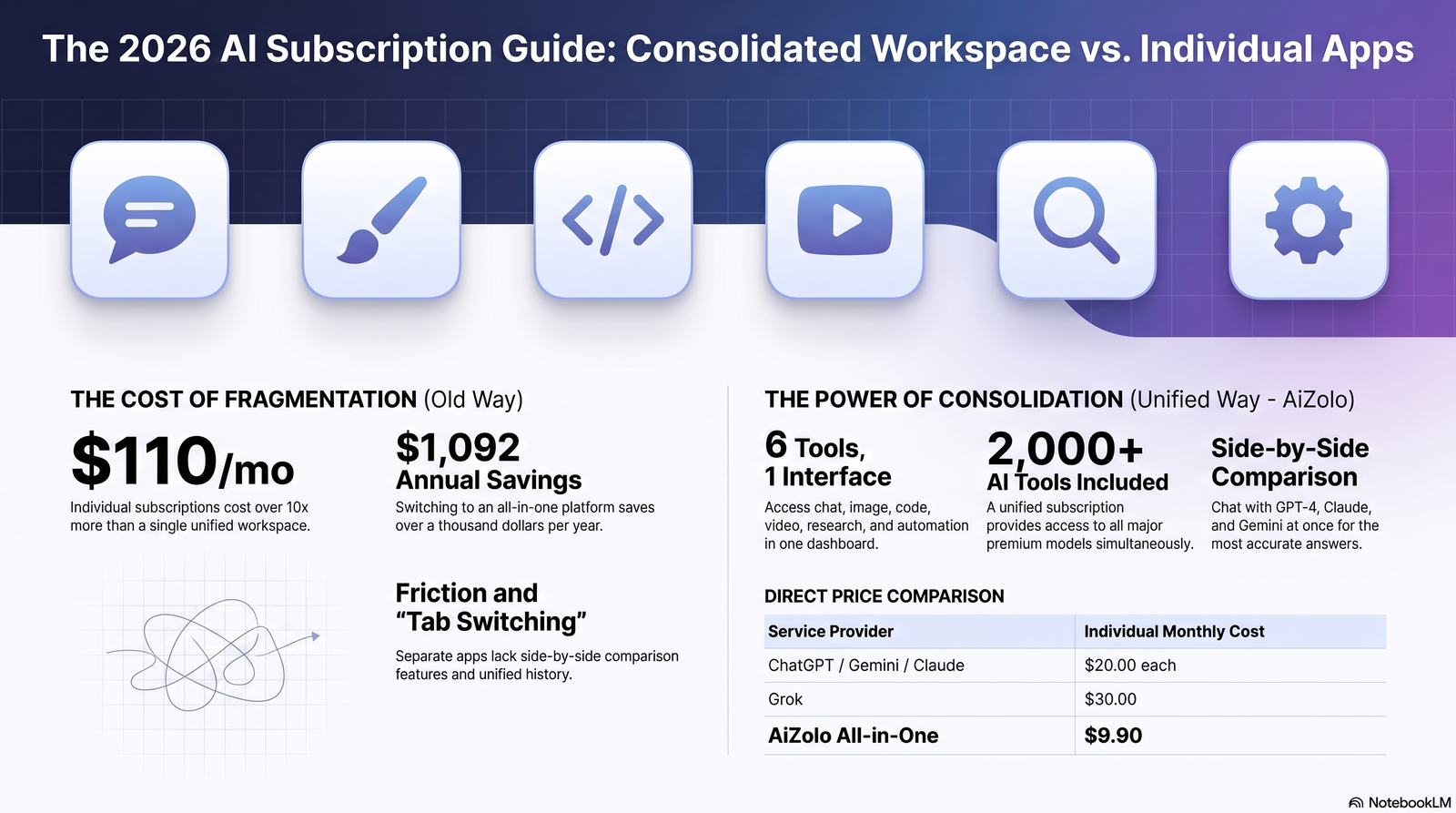
One trend worth flagging early: a growing number of people are tired of paying for four or five separate AI subscriptions. Platforms like AiZolo, which bundle access to multiple leading AI models under one subscription, have become popular specifically because they solve that “too many logins, too many bills” problem. We’ll come back to that idea when we cover free vs. paid tools.
2. What Makes an AI Tool Popular?
Popularity isn’t just download numbers. The tools that stick around usually share four traits:
- They solve one job extremely well. ChatGPT for conversation, Midjourney for images, GitHub Copilot for code.
- They’re easy to start using. No steep learning curve, a usable free tier, browser or app access.
- They keep shipping improvements. Weekly or monthly updates instead of stagnant products.
- People recommend them to colleagues. Word of mouth still drives most AI adoption.
3. How We Evaluated These Tools
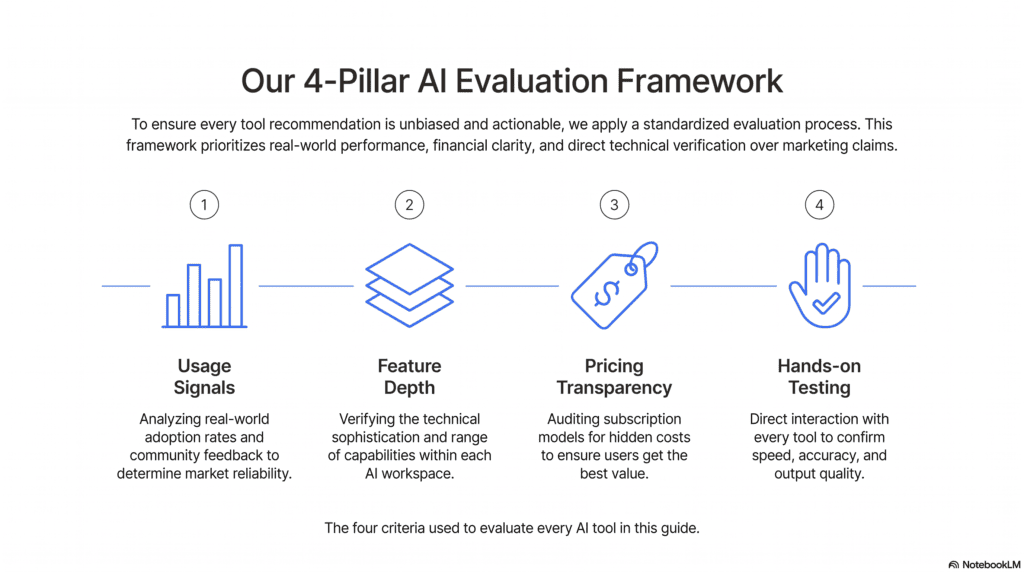
Rankings below are based on public usage signals (app store rankings, web traffic estimates, search volume), feature depth, pricing transparency, and hands-on use. Where a claim is about a specific company’s pricing or feature set, it reflects that company’s own published pricing page as of mid-2026 — always double-check current pricing on the provider’s site before subscribing, since AI pricing changes often.
4. The Most Popular AI Tools Right Now
General-Purpose AI Chatbots
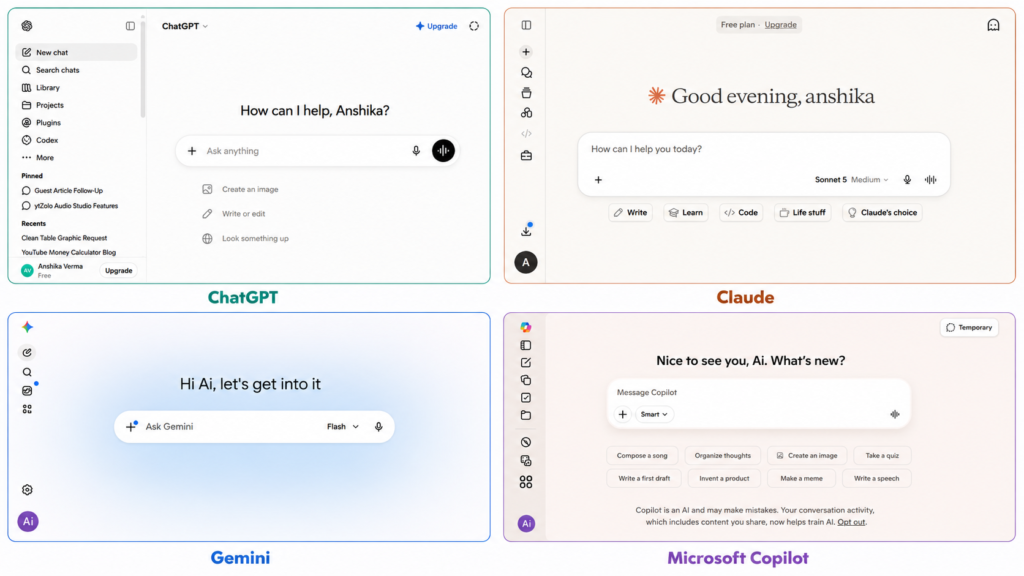
ChatGPT (OpenAI)
- Best for: general research, writing, brainstorming, everyday Q&A
- Free plan: yes, with usage limits
- Paid: Plus and Pro tiers add higher limits, advanced voice, and image/video generation
- Strengths: broadest plugin/app ecosystem, strong general reasoning, huge user base
- Weaknesses: can be verbose; higher tiers get expensive if you also want other models
Claude (Anthropic)
- Best for: long-document analysis, careful writing, coding, and tasks that need nuance
- Free plan: yes, with daily limits
- Paid: Pro and higher tiers for more usage and access to top models
- Strengths: large context windows, strong at following detailed instructions, considered one of the best for coding
- Weaknesses: fewer built-in consumer features (no native image generation)
Google Gemini
- Best for: users already inside Gmail, Docs, and Android
- Free plan: yes
- Paid: Gemini subscription tiers bundled with Google One storage
- Strengths: deep integration with Google Workspace and Search, strong multimodal (text, image, video) understanding
- Weaknesses: quality can vary across Google’s many product surfaces
Microsoft Copilot
- Best for: Microsoft 365 users (Word, Excel, Outlook, Teams)
- Free plan: yes, limited
- Paid: bundled into Microsoft 365 Copilot plans
- Strengths: sits directly inside the apps people already use for work
- Weaknesses: full value only shows up if you’re already paying for Microsoft 365
Grok (xAI)
- Best for: real-time information tied to X (Twitter), casual/less filtered conversation
- Free plan: limited access
- Paid: X Premium+ / standalone SuperGrok tiers
- Strengths: fast access to current events and trending topics
- Weaknesses: smaller ecosystem of third-party integrations
DeepSeek
- Best for: budget-conscious users and developers who want an open, low-cost model
- Free plan: yes
- Strengths: strong reasoning performance for the price, open-weight versions available
- Weaknesses: data handling and hosting location are a common concern for privacy-sensitive users
Perplexity
- Best for: research with cited sources instead of a plain chat answer
- Free plan: yes
- Paid: Perplexity Pro for more searches and model choice
- Strengths: answers come with clickable citations, good for fact-checking
- Weaknesses: less useful for open-ended creative writing
AI Image Generators
Midjourney — best for artistic, stylized imagery; Discord and web-based; paid only (no free tier). DALL·E (via ChatGPT) — best for quick, prompt-simple images inside a chat workflow. Stable Diffusion — best for developers who want full control and local/self-hosted generation; free and open-source, with paid hosted options. Adobe Firefly — best for teams already in Photoshop/Illustrator; commercially safe training data is a key selling point. Leonardo AI — best for game and concept artists who need fine-tuned, consistent styles.
AI Coding Assistants
GitHub Copilot — best for in-editor autocomplete and chat inside VS Code and JetBrains. Cursor — best for an AI-first coding editor built around multi-file, agentic edits. Claude Code — best for developers who want an AI that can plan, edit, and run code across a whole repository from the terminal.
AI Video and Audio Tools
Runway — best for AI-generated and AI-edited video clips. ElevenLabs — best for realistic text-to-speech and voice cloning.
AI Productivity and Writing Tools
Notion AI — best for teams that already live in Notion docs and databases. Grammarly — best for grammar, tone, and clarity checks layered on top of any writing app. Canva AI (Magic Studio) — best for non-designers making social posts, presentations, and quick graphics.
5. Best AI Tools by Category

| Category | Top Pick | Why |
|---|---|---|
| Writing | ChatGPT / Claude | Strong drafting and editing across formats |
| Coding | Claude / GitHub Copilot | Best reasoning on multi-file changes |
| Marketing | Canva AI + ChatGPT | Fast copy and creative in one workflow |
| Students | Claude / Perplexity | Clear explanations with cited sources |
| Business | Microsoft Copilot / Gemini | Native fit inside existing office tools |
| Image generation | Midjourney | Most distinctive visual style |
| Video creation | Runway | Most mature text-to-video toolkit |
| Automation | Zapier AI / n8n | Connects AI steps into existing workflows |
| Research | Perplexity | Citations built into every answer |
| Multi-model comparison | AiZolo | One subscription across several premium models |
6. Comparison Table
| Tool | Best For | Free Plan | Starting Price | Platform | AI Model(s) |
|---|---|---|---|---|---|
| ChatGPT | General use | Yes | $20/mo (Plus) | Web, iOS, Android | GPT family |
| Claude | Writing & coding | Yes | $20/mo (Pro) | Web, iOS, Android, desktop | Claude family |
| Gemini | Google ecosystem | Yes | Bundled w/ Google One | Web, Android, iOS | Gemini family |
| Copilot | Microsoft 365 | Yes | Bundled w/ M365 | Web, Windows, Office apps | GPT family (Microsoft-hosted) |
| Perplexity | Cited research | Yes | $20/mo (Pro) | Web, iOS, Android | Multiple, selectable |
| Midjourney | Stylized images | No | ~$10/mo | Discord, Web | Proprietary |
| GitHub Copilot | Code completion | Limited | $10/mo | VS Code, JetBrains | GPT/Codex family |
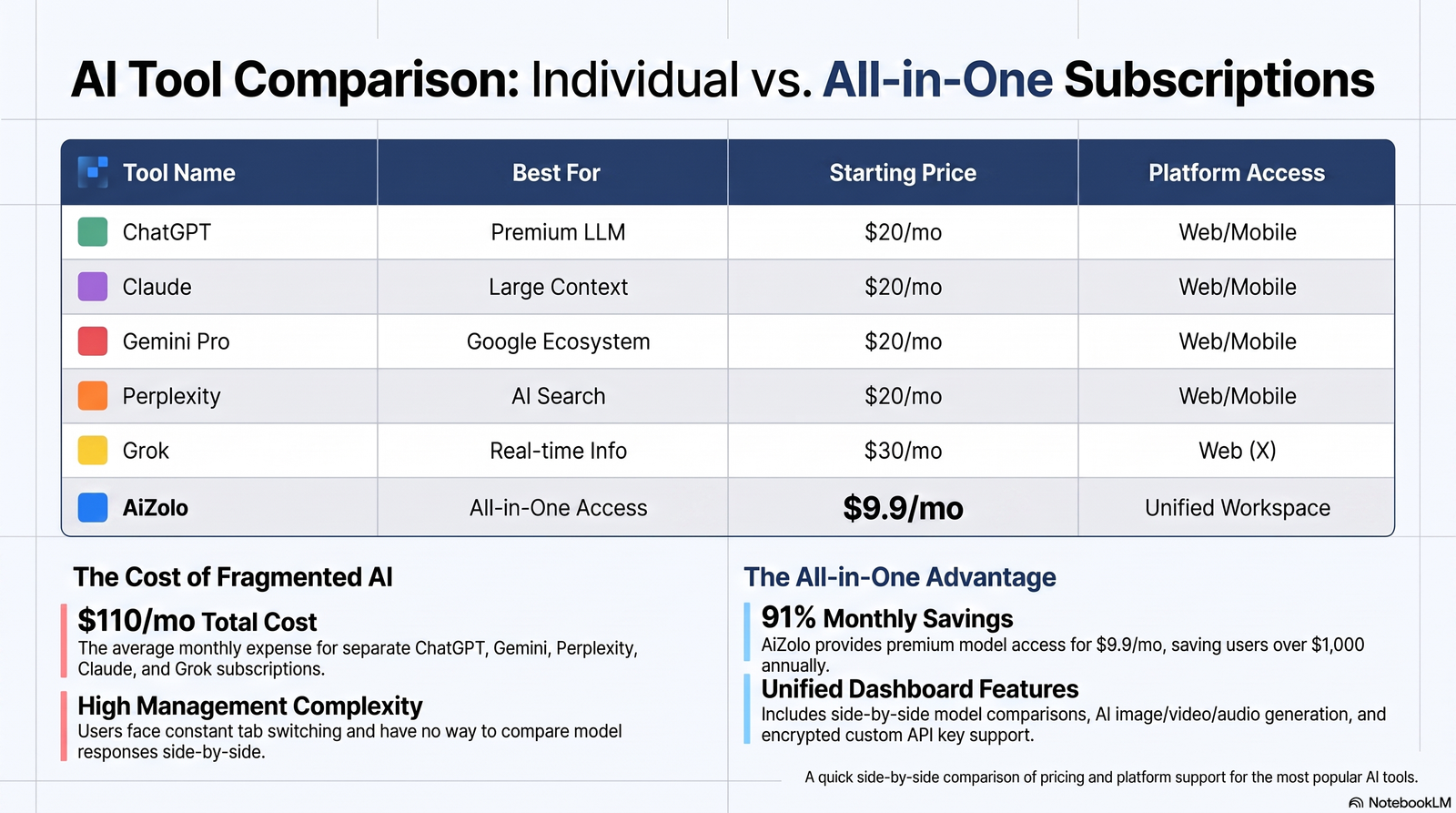
| AiZolo | Multi-model access in one place | Yes | $9.9/mo | Web | ChatGPT, Claude, Gemini, Perplexity, and others |
Pricing changes frequently — confirm current numbers on each provider’s site before purchasing.
7. Free vs. Paid AI Tools
Free tiers are genuinely usable in 2026 — good enough for casual writing help, quick questions, or occasional image generation. Paid tiers earn their price mainly through: higher usage limits, priority access during peak load, longer context/memory, and access to the newest models first.
The real cost problem shows up when someone needs more than one model. Subscribing separately to ChatGPT, Claude, Gemini, and Perplexity can add up to $70–$100 a month. This is the gap that all-in-one platforms like AiZolo aim to close, by giving access to several premium models through a single lower-cost subscription instead of four separate bills.
8. Common Mistakes When Choosing an AI Software
- Picking based on brand name alone, without testing the tool on your actual work.
- Paying for a premium tier before checking if the free plan already covers your usage.
- Ignoring platform fit — a tool that isn’t available on your phone or doesn’t integrate with your existing apps creates friction.
- Forgetting to check data and privacy settings, especially for business or client work.
- Subscribing to multiple full-price tools when a bundled option might cover the same models for less.
9. Privacy and Security
Before trusting any AI software with sensitive information:
- Check whether conversations are used to train future models, and whether you can opt out.
- Look for enterprise or “Team” tiers if you need contractual data protections.
- Be cautious with tools that store API keys — confirm they’re encrypted at rest.
- Read the retention policy: some tools delete chats after a set period, others keep them indefinitely unless you delete them manually.
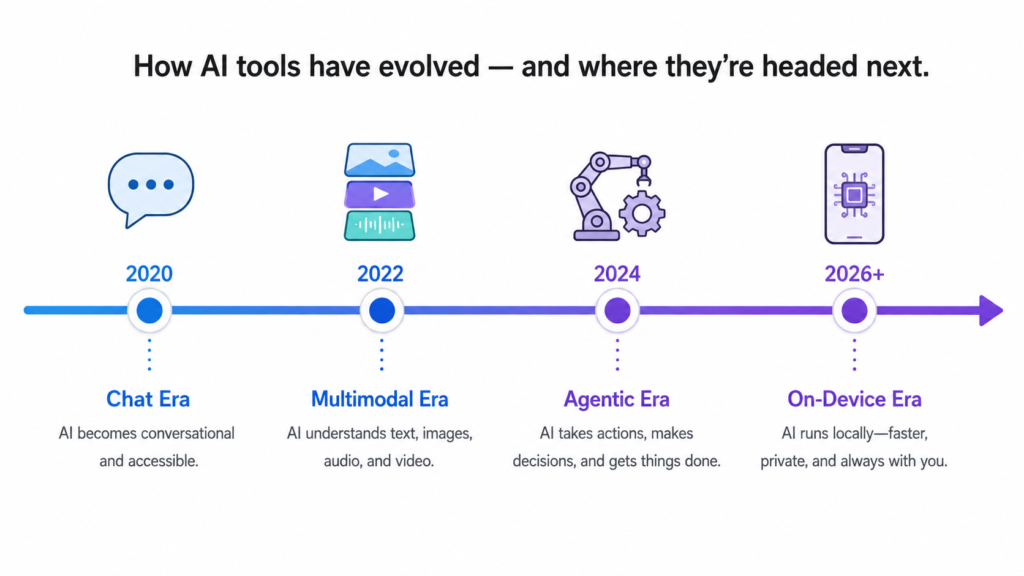
10. AI Trends to Watch in 2026
- Agentic AI: tools that can complete multi-step tasks (booking, coding, research) with less hand-holding.
- Multimodal by default: text, image, audio, and video increasingly live in one interface instead of separate apps.
- Consolidation: growth of platforms that bundle multiple models under one subscription rather than users juggling several logins.
- On-device AI: more processing happening locally on phones and laptops for speed and privacy.
11. How to Choose the Right AI Tool
- Define the single task you need solved first (writing, coding, images, research).
- Try the free tier before paying for anything.
- Check where the tool lives — browser, app, or inside software you already use.
- Compare the real monthly cost if you need more than one model.
- Re-evaluate every few months; this space moves fast.
12. FAQs
What is the most popular AI tool right now? ChatGPT remains the most widely used AI chatbot by total users, though Claude, Gemini, and Copilot have each grown quickly by embedding directly into work tools people already use.
Which AI software best overall? There’s no single “best” — Claude and ChatGPT lead for general writing and reasoning, Perplexity leads for cited research, and Midjourney leads for image quality.
Which AI tools are free? ChatGPT, Claude, Gemini, Perplexity, and Copilot all offer usable free tiers with daily or monthly limits.
Which AI tool do professionals use most? Knowledge workers commonly use ChatGPT or Claude for writing and analysis, Copilot inside Microsoft 365, and GitHub Copilot or Claude Code for software development.
Is ChatGPT still the most popular AI software? Yes, by raw user numbers, though Claude and Gemini have closed the gap significantly through 2025–2026.
Which AI is best for coding? Claude and GitHub Copilot are the most commonly recommended for code generation and review; Cursor is popular as a full AI-first editor.
Which AI is best for images? Midjourney is generally considered the leader for artistic quality; Adobe Firefly leads for commercially safe, enterprise-ready image generation.
What AI tool is best for business? Microsoft Copilot and Google Gemini tend to win for businesses already using Microsoft 365 or Google Workspace, since the AI sits inside existing tools.
What AI tool is best for students? Claude and Perplexity are popular with students because they explain reasoning clearly and Perplexity shows its sources.
Is it worth paying for more than one AI subscription? Only if you regularly hit the limits of your current tool or need capabilities it doesn’t have. Many people instead switch to a bundled platform that includes several models for less than the cost of two separate subscriptions.
What’s the difference between AI tools and AI models? A model (like GPT-5 or Claude) is the underlying engine. A tool or app is the product built around that model — the interface, features, and pricing.
Are AI writing tools safe for plagiarism checks? AI-generated text can pass plagiarism checkers since it’s original text, but many schools and employers now have separate AI-detection or AI-use policies worth checking.
Can I use multiple AI models without multiple subscriptions? Yes — platforms such as AiZolo let you access several premium AI models (including ChatGPT, Claude, Gemini, and Perplexity) from one dashboard and subscription.
Do free AI tools sell or train on my data? Policies vary by provider; most offer a setting to opt out of having your conversations used for training. Always check the specific tool’s privacy settings.
Which AI tool has the best mobile app? ChatGPT, Claude, Gemini, and Perplexity all have well-rated native iOS and Android apps as of 2026.
Featured Snippet Answers
What are the most popular AI tools? The most popular AI tools in 2026 are ChatGPT, Claude, Google Gemini, Microsoft Copilot, and Perplexity for chat and research, plus Midjourney and GitHub Copilot for images and code.
Which AI tool is best? There is no single best AI tool — the right choice depends on the task. Claude and ChatGPT lead for writing, Perplexity for research, and Midjourney for image generation.
What AI tools do professionals use? Professionals commonly rely on ChatGPT or Claude for writing and analysis, Copilot for Microsoft 365 tasks, and GitHub Copilot or Claude Code for software development.
What are the top AI tools in 2026? Top AI tools in 2026 include ChatGPT, Claude, Gemini, Copilot, Perplexity, Midjourney, and GitHub Copilot, alongside multi-model platforms like AiZolo that bundle several of these into one subscription.
Which AI tool is free? ChatGPT, Claude, Gemini, Perplexity, and Copilot all offer free tiers with usage limits, making it easy to try each before upgrading.
13.Further Reading
For readers who want a deeper dive into that last point, AiZolo’s own blog has several head-to-head comparisons worth reading:
- Aizolo vs ChatGPT Plus: Which AI Platform Offers Better Value?
- Aizolo vs Perplexity Pro: Which AI Subscription Wins?
- Aizolo vs OpenRouter: Which AI Platform Wins in 2026?
For background on the underlying models and companies mentioned in this guide, see OpenAI, Anthropic, Google AI, and Stanford HAI’s AI Index for independent research on AI adoption trends.
14. Author
Anshika Verma AI Researcher and Technology Writer anshika@ytzolo.com
Anshika researches and reviews AI tools hands-on, including ytZolo, focusing on real pricing, real limitations, and practical fit rather than marketing claims. Her work follows Google’s E-E-A-T principles: clear sourcing, tested recommendations, and honest trade-offs over hype.

