
You can monetize YouTube Shorts through YouTube Partner Program (YPP) ad revenue, affiliate marketing, brand sponsorships, and product sales. The right option will depend on your channel’s eligibility, audience, and type of content.
You should not rely solely on ad revenue. Some income methods may be available before you qualify for full YPP monetization, although earnings depend on your audience and the results you generate.
This guide explains how to monetize YouTube Shorts, the current YouTube Partner Program requirements, and the main ways creators can earn from short-form videos.
You’ll also learn how to use analytics and AI tools to plan, create, and improve Shorts without relying on promises of viral views or guaranteed income.
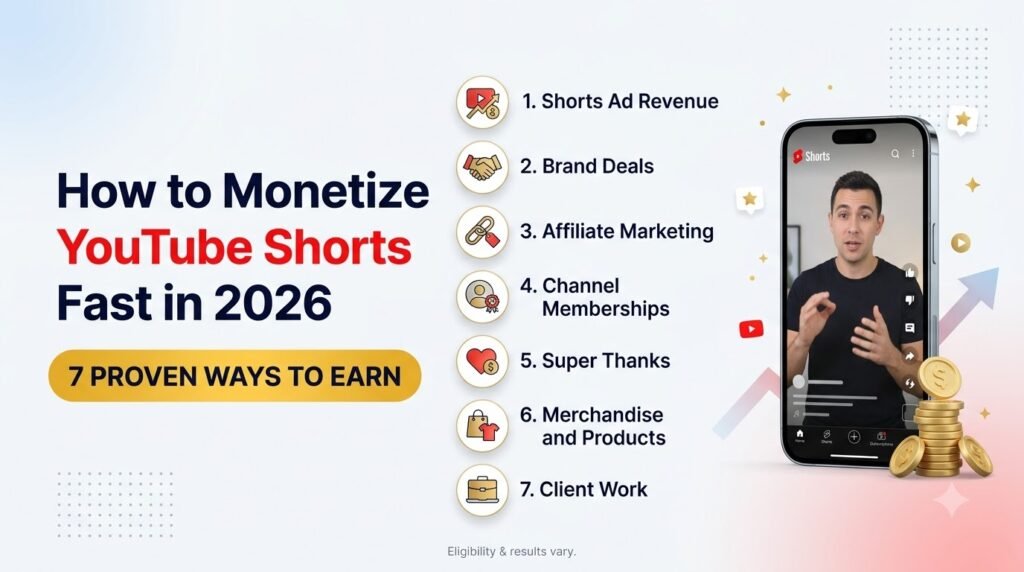
Table of Contents
What Is YouTube Shorts Monetization and How Does It Work?
YouTube Shorts monetization is the process of earning money directly from your short-form vertical videos on YouTube.
Unlike traditional long-form videos where ads play inside your video, Shorts work differently. Ad revenue is pooled from ads that play between videos in the Shorts feed, then distributed to eligible creators based on their share of total views.
Understanding this system is essential if you’re learning how to make money with YouTube Shorts, because your earnings depend on overall Shorts feed performance and your percentage of total views among eligible creators.
Here’s how the revenue system breaks down:
- Ad revenue pool is collected from all Shorts feed ads each month
- YouTube calculates a Creator Pool based on engaged views and music usage
- Your share is determined by the percentage of total Shorts views you generate
- Creators keep 45% of their allocated revenue
It’s a volume game — and that’s actually great news for hustlers who post consistently.
Think of it this way: the more quality Shorts you post, the bigger your slice of that monthly pie. That’s why knowing YouTube Shorts monetization tips is really about two things — getting qualified quickly and then scaling your output smartly.

YouTube Shorts Monetization Requirements in 2026
You need to qualify for the YouTube Partner Program (YPP) to earn Shorts Feed ad revenue directly through YouTube. The main eligibility route requires 1,000 subscribers and 10 million valid public Shorts views within 90 days.
You can qualify for full YPP ad revenue sharing through either of these routes:
- Shorts route: 1,000 subscribers and 10 million valid public Shorts views in the last 90 days.
- Long-form route: 1,000 subscribers and 4,000 valid public watch hours in the last 12 months.
In eligible countries, the expanded YPP also offers earlier access to certain fan-funding features. The lower threshold generally requires 500 subscribers, three valid public uploads in the last 90 days, and either three million valid public Shorts views in 90 days or 3,000 valid public watch hours in 12 months.
This does not automatically unlock Shorts Feed ad revenue sharing.
Meeting the thresholds does not guarantee acceptance. YouTube reviews your channel against its monetization policies, and you must complete the required steps in YouTube Studio.
After joining YPP, accept the Shorts Monetization Module to become eligible for Shorts Feed ad revenue sharing. Views earned before accepting the module are not eligible for that revenue-sharing arrangement.
Check the official YouTube Partner Program requirements for the latest eligibility details.

7 Proven Ways to Monetize YouTube Shorts Fast
There is more than one way to earn from Shorts. Some methods depend on YouTube Partner Program eligibility, while others depend on building an audience, finding clients, or selling relevant products. Choose methods that fit your content and be clear with viewers when you promote something.
1. YouTube Shorts Ad Revenue Sharing
You can earn Shorts Feed ad revenue after meeting the full YPP eligibility requirements and accepting the Shorts Monetization Module.
YouTube pools revenue from ads shown between Shorts and allocates it to eligible creators based on their share of eligible engaged views. Creators receive 45% of the revenue allocated to them from the Creator Pool.
There is no universal payment rate for every 1,000 Shorts views. Your earnings can vary, so use your own YouTube Studio revenue reports rather than relying on a fixed online estimate.
2. Brand Sponsorships and Paid Partnerships
Brands may pay creators to feature a product or service in a Short. You do not necessarily need a large subscriber count to approach brands, but you should be able to show relevant content, audience fit, and examples of your work.
To get started:
- Make a list of brands that fit your niche and audience.
- Prepare a short pitch explaining the content you can create and the value it offers.
- Share relevant examples and agree on the deliverables, payment, usage rights, and deadlines before starting.
- Clearly disclose paid partnerships and follow YouTube’s paid-promotion rules.
Sponsorship fees vary by brand, niche, audience, deliverables, and usage rights. Avoid assuming that a particular rate is guaranteed.
3. Affiliate Marketing
Affiliate marketing lets you earn a commission when someone makes a qualifying purchase through your affiliate link. You can create Shorts that demonstrate a product, explain a feature, or compare options honestly.
Important: Links placed in YouTube Shorts descriptions and comments are not clickable. Instead, consider directing viewers to a relevant link on your channel profile or to a related long-form video where appropriate. Explain clearly where viewers can find the link.
Before promoting a product, check the affiliate program’s rules and disclose your affiliate relationship. Only recommend products that are relevant to your audience, and do not promise results you cannot support.
4. YouTube Channel Memberships
Channel memberships let eligible viewers pay a recurring fee for benefits such as members-only content, badges, or other perks you offer.
Creators may become eligible through the expanded YPP, but reaching 500 subscribers alone is not enough. You must meet the applicable upload and watch-hour or Shorts-view requirements, and the channel must satisfy the feature-specific rules.
If memberships are available to your channel, offer benefits you can maintain consistently. Consider bonus content, early access, or member updates that give viewers a clear reason to join.
5. Super Thanks
Super Thanks allows eligible viewers to support creators financially on supported videos, including eligible Shorts. Availability depends on YPP participation and feature-specific requirements.
You cannot assume that every viewer will tip or predict how much they will contribute. Focus on making useful or entertaining content and thank supporters in a way that feels natural.
6. Merchandise and Product Sales
If you sell your own products, Shorts can help introduce them to potential customers. For example, a cooking creator could demonstrate a kitchen product, while an illustrator could show how a design is made.
You can also explore YouTube Shopping if your channel and products meet the relevant eligibility requirements. Otherwise, use an appropriate channel profile link or another permitted route to direct viewers to your store.
Be clear about what you are selling, what it costs, and what customers receive. Do not assume that a Short will generate sales simply because it gets views.
7. Create Short-Form Videos for Clients
You can also earn money by creating short-form videos for businesses, even if your own channel is still small. This is a service-based income method rather than YouTube ad revenue.
Build a small portfolio with examples of product demonstrations, explainers, tutorials, or other relevant formats. Then contact businesses that may need this type of content.
Rates vary according to your experience, production requirements, revisions, licensing, and the client’s budget. Agree on the scope and fee before beginning work.

How to Grow Fast Enough to Qualify for YPP
Growth on YouTube Shorts depends on how well your videos match viewers’ interests and keep them watching. To work toward YPP eligibility, focus on strong openings, useful content, consistent publishing, and reviewing your channel analytics.
Hook Viewers in the First Few Seconds
Give viewers a clear reason to keep watching from the beginning. Start with the main question, a useful result, or the problem your Short will solve instead of a long introduction.
For example, a tutorial could open with “Here’s how to add captions to a Short in three steps.” Make sure the video delivers on that opening promise.
Publish Consistently and Learn From Each Video
Choose a publishing schedule you can maintain without sacrificing accuracy or video quality. You do not need to post one to three times daily to guarantee growth; YouTube does not promise that a particular posting frequency will lead to more views.
Test different topics and formats over time. Once you identify what your audience responds to, create more videos that offer similar value without simply repeating the same content.
Use Trends When They Fit Your Audience
Trending topics and sounds may be inspiring, but they won’t necessarily get you more views. Focus on topics and sounds that relate to your niche and add your own twist or explanation.
Don’t steal other peoples videos or sounds that may be copyrighted. Providing original, relevant content is key to making people want to watch your videos.
Write Clear Titles and Use Relevant Metadata
Use a short, enticing title for the Short and make sure to include relevant keywords that accurately describe the content of the Short. Additionally, add a brief description if possible
Use a limited number of relevant hashtags instead of adding irrelevant hashtags in the description. Shorts may surface across various YouTube discovery surfaces, so you should not rely on discovery through keywords or hashtags.
Review YouTube Studio Analytics
Use the YouTube Studio to see how your viewers are interacting with your Shorts. Check out the numbers of engaged views, how many people watched versus swiped away, average view time, and subscriber growth.
Instead of comparing a single video of yours to others, analyze several videos of similar content and use the conclusions to optimize your openings, speed, topics, and explanations.
Keep in mind that the number of views does not always equal a profitable Shorts. Track your valid public Shorts views and subscriber count against YouTube’s current eligibility requirements, and check the Earn tab in YouTube Studio for your channel’s progress.

Why Creators Struggle to Monetize YouTube Shorts
Getting views does not automatically lead to income. Creators need to meet YouTube’s eligibility rules for platform monetization or build a separate business model, such as sponsorships, affiliate marketing, or product sales.
A clear content strategy can help them understand which opportunities fit their audience.
1. Relying on Views Alone
A Short can receive thousands of views without generating direct income. YouTube ad revenue depends on monetization eligibility, while income from sponsorships, affiliate links, and product sales depends on the relevant agreement or whether viewers take the intended action.
What to do: Give each Short a clear purpose. It might answer a question, introduce a product, attract relevant subscribers, or direct interested viewers to a related resource. Evaluate results against that goal rather than judging every video by views alone.
2. Posting Without a Clear Content Focus
Uploading unrelated Shorts can make it harder to develop a returning audience. If viewers are interested in one particular area that you’re providing information for, they may not be interested in another video that might be for an entirely different audience
Solution: You should pick some related areas and create content based off of them and analyze which of these tend to get the most engagement.
3. Ignoring Viewer Retention
A great opening line may hook viewers in, but the video’s tail-end must match its introduction. Lengthy intros, drawn-out pauses, and unneeded explanations can turn off viewers.
Instead, put the meaty bits of the video closer to the beginning, and trim anything that does not serve a purpose. If applicable, use retention data to see where your audience bails out.
It is also a good practice to keep videos short and to the point while making sure that each one has a primary focus.
4. Expecting Immediate Results
YouTube Shorts growth is unpredictable. Posting more frequently or following a trend does not guarantee views, subscribers, or monetization approval.
What to do: Set realistic publishing goals and evaluate results across multiple uploads. Use each video as an opportunity to learn rather than treating one high-performing or low-performing Short as a final verdict on your channel.
5. Depending on One Income Source
The creators who base their income solely on the Shorts Feed ad revenue risk having little control over their earnings. In such a case, additional monetization methods based on the audience and business strategy may be helpful.
To act upon: explore relevant affiliate programs, sponsorships, items, and services to promote in addition to ads on YouTube. It is advisable to disclose partnerships and advertise products genuinely.
6. Using Tools Without Reviewing the Results
Although artificial intelligence writing tools, voices, and editors may streamline the production process, they cannot guarantee exclusivity, engagement, and monetization.
Subpar, formulaic, or low-quality content may also incur the ire of YouTube’s monetization policies.
Instead, producers and editors should use these programs as supplementary tools and make sure that the script is accurate, the computer-generated imagery is proper, and the material offers some sort of worthwhile takeaways or information to viewers.
The most successful YouTubers do not use artificial intelligence to replace their natural talents, but to enhance their production values and create a sustainable, replicable process that prioritizes fulfilling the audience’s expectations and demands over maximizing profits or views.

Why Manual Methods Are Outdated (And What to Do Instead)
Manual processes usually involve spending a lot of time on researching the topic, writing the scripts, recording and editing the videos, etc. Even if you use AI tools to automate some of these processes, this doesn’t necessarily guarantee that your channel will see a rise in views and subscribers, thus helping you monetize your content.
Which parts of Shorts creation can AI help with?
Depending on the tools, artificial intelligence can be used to get inspiration for a video idea, write a script, create a voice-over, generate music, and come up with a title and description.
Such programs can save time and effort, as well as quickly bring out the rough draft of a project.
However, an AI creation still requires human supervision. It is essential to ensure that the script correctly conveys the required information and does not have errors.
Even if the program creates a draft of a video, an author still has to edit it and make sure that it is beneficial and unique in idea.
When should you use AI instead of working manually?
Use AI when a task is repetitive or when you need a starting point for creative work. For instance, you could create multiple outlines for your script and then rewrite the best among them to fit your audience and speech pattern.
Manual research and editing are good options for a video that requires demonstrations, specialized knowledge, personal experience, and thorough fact-checking. The key is to find a suitable balance between the two.
Does AI help you monetize YouTube Shorts faster?
AI can help you make your content more productive, giving you more time to work on ideas and improving your production quality. It doesn’t guarantee views, viral content, subscribers, YPP approval, or earnings.
The policies of YouTube review monetized channels against the Community Guidelines, which include requirements pertaining to original and authentic content.
Content that is repetitive or voluminous with little variation can be ineligible for monetization.
Use AI to support the creative process rather than publish large volumes of unreviewed videos. Your priority should be content that genuinely serves viewers and complies with YouTube’s monetization policies.

How ytZolo Helps You Monetize YouTube Shorts Fast
AI tools can help organize parts of the Shorts creation process, such as planning a topic, drafting a script, creating title options, and preparing video metadata.
They do not guarantee views, monetization approval, or income. ytZolo can support parts of this workflow while creators remain responsible for the accuracy, originality, and quality of their content.
Generate and Refine Title Ideas
Use title suggestions as starting points. Choose a title that accurately represents the video and gives viewers a clear reason to watch. Review and edit the wording instead of assuming an AI-generated title will perform better automatically.
Draft a Short Script
A script tool can help you organize a hook, the main explanation, and a closing line. Check facts, remove unnecessary wording, and make sure the finished script sounds natural for your audience.
Prepare Thumbnail Concepts
Thumbnails may help when Shorts appear in places such as YouTube Search or on channel pages. Use concepts that represent the video accurately, and check that any text or visual details remain clear at small sizes.
Create Descriptions and Tags
Use metadata tools to draft relevant descriptions and tags, then review them before publishing. Keep the wording specific to the video. Metadata should describe the content honestly, not promise better rankings or more views.
Build a Repeatable Workflow
You can use AI assistance for early drafts and repetitive planning tasks, then spend your time reviewing, editing, and improving the actual content. After publishing, use YouTube Studio to assess how viewers respond and decide what to test next.
ytZolo is a workflow aid, not a shortcut to guaranteed monetization. Your eligibility, originality, audience response, and compliance with YouTube’s policies remain important.

Choosing a tool for YouTube Shorts depends on the tasks you need help with, your budget, and how you prefer to create content. ytZolo focuses on YouTube creator workflows, while general-purpose AI tools can support a wider range of writing and creative tasks.
What should you compare when choosing a YouTube creator tool?
Before choosing a tool, consider these factors:
- Script writing: Can it help you develop ideas and organize scripts for short-form videos?
- Titles and metadata: Can it generate relevant title ideas, descriptions, and tags that you can review before publishing?
- Audio production: Does it offer voice generation, music creation, or other audio tools you need?
- Workflow: Can it reduce repetitive work without making your content generic?
- Pricing: Does the available plan fit your budget and usage requirements?
How does ytZolo fit into a Shorts workflow?
ytZolo offers tools for YouTube content creation, including script writing, title generation, thumbnail creation, metadata generation, and audio production features through Audio Studio.
These tools can help with individual production tasks, but the final result still requires your judgment. Review generated scripts for accuracy, make sure titles reflect the actual video, and check that audio and visual assets are suitable for publication.
| Your requirement | What to look for |
|---|---|
| Shorts scripts | Short-form writing and editing assistance |
| Titles and descriptions | Relevant suggestions that you can customize |
| Thumbnails | Tools suited to the video format and placement |
| Voiceovers and audio | Voice generation and audio-production features |
| Complete workflow | Features that match your actual production process |
No single tool is automatically the best choice for every creator. Compare available features, limitations, pricing, and output quality before deciding which solution fits your workflow.
You can explore ytZolo’s available features and decide whether they meet your content creation needs. Using a tool may save time on certain tasks, but it cannot guarantee higher click-through rates, viral views, YPP approval, or increased revenue.

Step-by-Step: How to Start Monetizing Shorts with AI
You can use AI tools to support your YouTube Shorts workflow, from researching topics to preparing scripts and audio. To build a monetizable channel, combine these tools with original ideas, careful editing, and a clear understanding of YouTube’s eligibility requirements.
Step 1: Choose a Clear Topic and Audience
Start with a specific audience and a topic that addresses its interests or problems. Research questions people ask in your niche, review relevant search results, and identify an angle that gives viewers something useful.
Avoid choosing topics solely because they are trending. Make sure you can create an accurate, relevant video about the subject.
Step 2: Write and Review Your Script
Draft a short script that focuses on one main idea. Use AI writing tools for brainstorming or outlining if helpful, then edit the script to remove repetition, check facts, and make the opening clear.
The first few seconds should establish what the viewer will learn or see. Ensure the rest of the video delivers on that promise.
Step 3: Prepare the Visuals and Audio
Record your own footage or use visual assets you have permission to use. You can also use suitable tools to prepare voiceovers, music, or sound effects.
Check the finished video for audio clarity, readable captions, appropriate pacing, and any licensing or disclosure requirements. Do not assume that AI-generated material is automatically eligible for monetization.
Step 4: Publish With Relevant Metadata
Write a concise title that accurately describes the video. Add a useful description and relevant hashtags where appropriate, but avoid keyword stuffing or misleading claims.
Review the final Short before publishing to make sure its title, captions, visuals, and audio match the content.
Step 5: Review Results and Improve
Use YouTube Studio to examine available metrics, including engaged views, viewed-versus-swiped-away data, audience retention, and subscriber changes.
Compare similar videos to identify patterns. If viewers leave early, consider improving the opening or removing unnecessary content. If a topic attracts the right audience, explore related questions rather than simply copying the same video.
Step 6: Choose a Suitable Monetization Method
Check the Earn tab in YouTube Studio to see your channel’s YPP eligibility and progress. If you qualify, complete the required steps and accept the relevant monetization terms.
If you are not yet eligible for Shorts Feed ad revenue sharing, consider other suitable options, such as affiliate marketing, sponsorships, or selling your own products. Follow each program’s requirements and disclose commercial relationships appropriately.
Step 7: Build a Sustainable Publishing Routine
Choose a schedule that you can maintain while keeping your content useful and original. There is no guaranteed number of Shorts per day that will make a channel viral or ensure monetization.
Use AI tools where they help with repetitive tasks, but review every video before publishing. Focus on improving content quality and understanding your audience rather than chasing a specific view count.

Bonus: LSI Keywords & Semantic Strategies to Rank Your Shorts Faster
Search optimization isn’t just for blog posts — YouTube is the world’s second-largest search engine.
Use these related keywords and phrases naturally in your titles, descriptions, and content:
- YouTube Shorts revenue sharing
- how to make money on YouTube Shorts
- YouTube Partner Program requirements 2026
- short-form video monetization strategy
- YouTube Shorts viral tips
- YouTube Shorts growth hacks
- how to get 10 million Shorts views
- YouTube Shorts ad revenue per 1000 views
- best AI tools for YouTube creators
- monetize short videos fast
- YouTube Shorts algorithm 2026
- how to grow YouTube Shorts channel
- YouTube Shorts brand deals
- affiliate marketing YouTube Shorts
- YouTube Shorts content strategy
Weaving these naturally into your content — both your videos and your descriptions — signals to YouTube exactly what your channel is about, helping you surface in search results and suggested content feeds while improving how to make money with YouTube Shorts 2026.
For a deeper dive into YouTube SEO strategy, check the ytZolo blog — it’s packed with actionable guides written specifically for creators who want to grow faster.
FAQ: Monetizing YouTube Shorts Fast
Q1: How many views do you need to monetize YouTube Shorts?
To qualify for the YouTube Partner Program through the Shorts path, you need 1,000 subscribers and 10 million public Shorts views in the last 90 days. However, you can access fan funding tools like Super Thanks with just 500 subscribers and 3 million Shorts views in 90 days while learning how to earn money from YouTube Shorts.
Q2: How much money can you make per 1,000 views on YouTube Shorts?
Most creators earn between $0.03 and $0.10 per 1,000 views (RPM) on YouTube Shorts. The exact amount depends on your niche, audience location, and whether you use licensed music in your videos. Finance and business niches typically earn more per view than entertainment niches.
Q3: Can you monetize YouTube Shorts without 1,000 subscribers?
Yes — partially. If you’re learning how to make money with YouTube Shorts 2026, with just 500 subscribers and 3 million Shorts views in the last 90 days you can access the lower-tier YouTube Partner Program, unlocking Super Thanks, channel memberships, and fan funding features. Full ad revenue sharing requires 1,000 subscribers.
Q4: What is the fastest way to get 10 million YouTube Shorts views?
The fastest path to 10 million Shorts views involves: posting consistently (ideally daily), using strong hooks in the first 1–2 seconds, riding trending topics and audio, optimizing titles and descriptions for search, and using AI tools like ytZolo to produce higher-quality content faster.
Q5: Do you need to accept a Shorts Monetization Module separately?
Yes. After being approved for the YouTube Partner Program, you must manually accept the Shorts Monetization Module inside YouTube Studio under the Earn tab. This step is not automatic — if you skip it, your Shorts will not earn any ad revenue, even with millions of views.
Conclusion: Your Journey to Monetize YouTube Shorts Fast Starts Today
Here’s what we know for certain.
YouTube Shorts is no longer an experiment. It’s a full-blown income opportunity generating real revenue for creators in every niche imaginable.
The creators who are winning aren’t necessarily the most talented. They’re the most strategic. They understand the algorithm. They post consistently. They optimize every video for discovery. And they use the right AI tools to do it faster and smarter than everyone else while mastering how to make money with YouTube Shorts.
You now have the complete roadmap to monetize YouTube Shorts fast in 2026:
- ✅ Understand the YPP requirements and both qualification paths
- ✅ Activate multiple revenue streams from day one
- ✅ Hook viewers in the first second, every single time
- ✅ Use AI to compress weeks of work into hours
- ✅ Optimize titles, descriptions, and tags for maximum reach
- ✅ Post consistently and let data guide your decisions
The only thing standing between you and a monetized Shorts channel is execution.
And that’s exactly where ytZolo becomes your unfair advantage. It’s the all-in-one AI YouTube growth tool that helps you create better titles, stronger scripts, optimized descriptions, and viral-worthy content — all in a fraction of the time it would take to do it manually.
Stop guessing. Stop grinding alone. Start using the tools that top creators are already using to grow faster.
Start creating smarter, faster, and more viral YouTube content with ytZolo today.
Want more in-depth creator strategies? Explore the ytZolo blog for tutorials, growth hacks, and the latest YouTube algorithm insights — all designed to help you build a channel that actually earns.
External Resources Referenced in This Guide:
- YouTube Partner Program Official Requirements — Google/YouTube Help
- YouTube Creator Blog — AI Tools for Shorts — YouTube Official Blog
- Short-Form Video Marketing Statistics 2026— HubSpot
Author: Anshika Verma
Anshika Verma is an SEO content writer and AI tools researcher specializing in YouTube growth, AI-powered content creation, and creator productivity. She writes evidence-based, reader-first comparisons that help creators evaluate AI tools through practical research, hands-on analysis, and unbiased insights. Her work focuses on simplifying complex AI workflows into actionable guidance while following Google’s Helpful Content and EEAT principles.

