
Negotiating YouTube brand deals involves more than agreeing on a price. Learning how to negotiate brand deals as a YouTuber means knowing how to evaluate offers, set your rate, negotiate deliverables, usage rights, exclusivity, timelines, and revisions, review contracts, and handle low offers.
For creators preparing content and channel data, ytZolo can simplify essential YouTube workflow tasks.
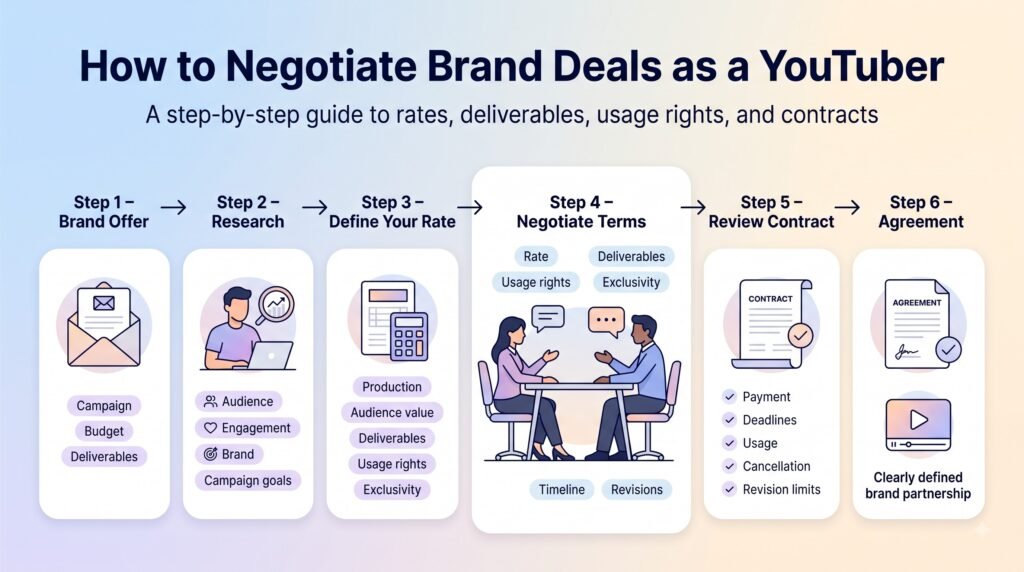
Table of Contents
Getting a brand deal is an exciting milestone for any YouTuber, but it doesn’t mean you have to accept the first offer right away.
Learning How to Negotiate Brand Deals as a YouTuber can help you get a bigger budget, more products per video, or additional compensation in the form of affiliate links or exclusive discounts.
The deal itself can also include other factors besides a higher rate, such as specific uses, usage rights, exclusivity, deadlines, revisions, advance payment, and creative direction.
Regardless of whether it is a one-time deal or a long-term project, any YouTuber must know how to negotiate offers to be able to present their needs and ensure the client gets the results they expect.
In order to do that, it is vital to be prepared and know the audience, carefully examine the offer, set the rate, and communicate professionally.
The following section discusses how to negotiate brand deals on YouTube to get desirable terms and reach an agreement that will benefit both sides.
Understand what a YouTube brand deal is really worth
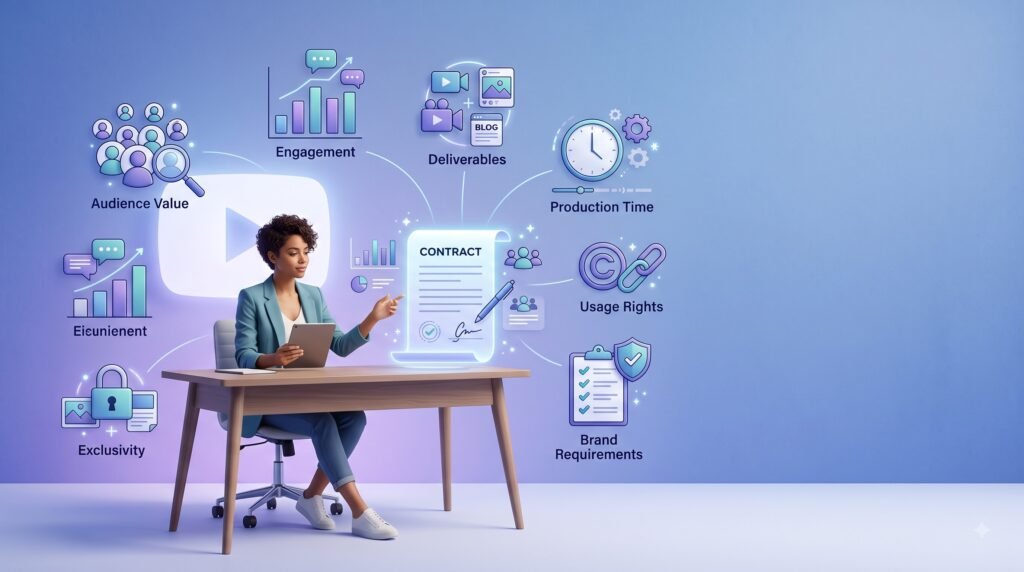
When evaluating a YouTube sponsorship, the upfront fee is only part of the equation. A useful framework from Toptal shows that Total deal value = rate + terms.
The terms dictate the true cost of the partnership, covering content volume, usage rights, competitor exclusivity windows, and delivery timelines.
What brands are actually paying for
Brands invest in creator partnerships for far more than a simple ad slot. They are buying a comprehensive marketing package that includes:
- Access to your audience: Direct entry into an established, attentive community.
- Audience relevance and niche: Highly targeted viewers who align with the brand’s specific product category.
- Engagement: Active viewer participation, comments, and community trust.
- Content production: Professional scriptwriting, filming, editing, and integration.
- Creator credibility: Your personal endorsement and authentic authority.
- Distribution through YouTube: Leveraging your channel’s algorithmic reach and search presence.
- Potential conversions: Direct sales, sign-ups, or traffic driven to the brand.
- Rights to reuse the content: Permission to repurpose your footage for their own ads or social media.
Why subscriber count isn’t the whole story
The subscriber count is a vanity metric, which usually does not correlate directly with the commercial success of the channel.
According to Forbes, the critical success factor is the audience’s specificity, the level of authority and engagement, the demographic fit, conversion power, and production quality, not the size of the audience.
In most cases, a smaller, better-targeted channel may offer significantly more significant commercial potential than a larger one with a tenfold subscriber count.
Rate vs. total deal value
In general, the language of influence is not about the number of followers; it is about the value of these followers to your business. This value is often determined by such factors as the contract’s specifics, room for exclusivity, usage rights, and multi-platform usage.
Therefore, a $2,000 deal with broad usage and 90-day exclusivity isn’t necessarily better than a $1,500 CPM deal with no exclusive rights and limited application may be a worse offer than a deal with a smaller channel but higher compensation, audience relevance, and flexibility in usage terms.
What kind of exclusivity terms or usage rights have you found hardest to negotiate in your brand deals so far?
Prepare Before Negotiating With a Brand
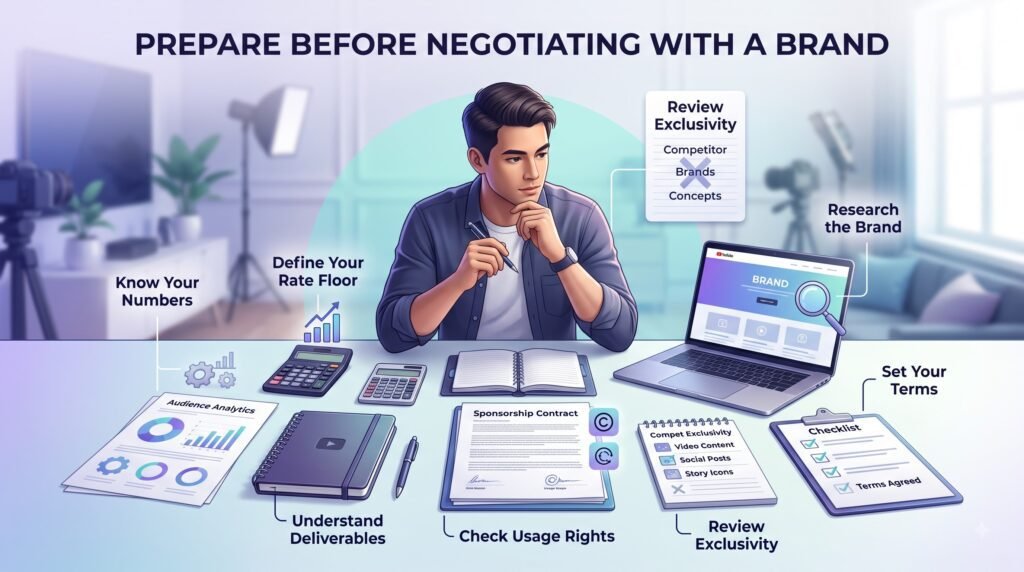
Walking into a brand negotiation without preparation is the fastest way to leave money on the table. Before you reply to that sponsorship email — or send your own pitch — there are three things worth getting in order: your numbers, your research on the brand, and a media kit that ties it all together.
Know Your YouTube Numbers
Brands are no longer paying for reach, they are now paying for performance. Before discussing rates, make sure you have gathered the relevant numbers that will tell that story.
When a channel has gone viral two years ago, but now views are significantly lower, the value of such a channel is less attractive for a brand compared to a constantly performing creator.
This is why averages on recent videos are much more important than lifetime views, something creators often fail to communicate when discussing rates with brands.
Beyond views, gather:
- Engagement — likes, comments, and shares relative to views
- Audience demographics — age, gender, location, and interests, since brands need to know if your audience matches their customer
- Watch-time or retention data — especially relevant if the brand wants a mid-roll or dedicated segment, since a video people drop off from halfway through weakens that placement
- Click-through or conversion results from previous campaigns, if you have run sponsorships before — this is often the single most persuasive number in a negotiation
- Top-performing content — the videos or formats that consistently outperform your average
- Relevant niche expertise — why your specific audience is worth more to this brand than a bigger, less-targeted one
Having these numbers ready before a brand asks for them signals professionalism and puts you in a stronger negotiating position from the first email.
Research the Brand Before Responding
Preparation isn’t just about your own channel — it’s about understanding who you’re talking to. Before you respond with a rate or a pitch, look into:
- Previous creator partnerships the brand has run
- Similar YouTubers they’ve sponsored, especially ones close to your size or niche
- Sponsored video formats they typically use — dedicated video, integration, short-form, unboxing
- Typical campaign length — a one-off video versus an ongoing multi-month partnership changes what you should charge
- Products being promoted, so you know if they genuinely fit your content and audience
- Whether the campaign leans toward awareness or conversions — a conversion-focused campaign with trackable links or codes often justifies a different rate structure than a brand-awareness placement
TubeBuddy specifically recommends researching a brand’s existing creator partnerships and campaign objectives before entering negotiations, since this context shapes both what to charge and how to position your pitch.
Build a Media Kit That Supports Your Rate
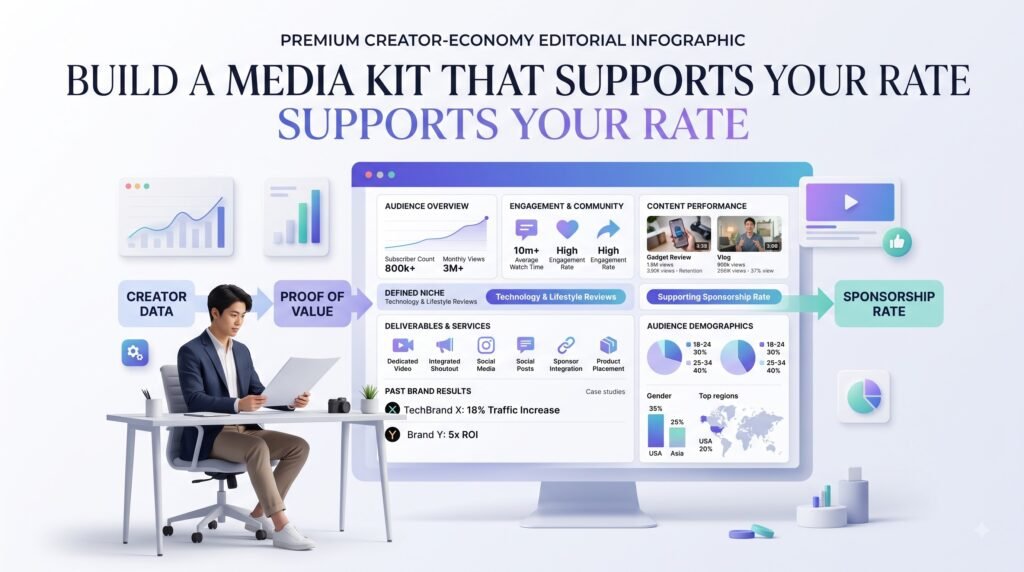
A media kit turns your numbers and research into a single, professional document you can send in seconds instead of assembling stats over email. It should include:
- Channel overview
- Audience demographics
- Average views
- Engagement metrics
- Best-performing videos
- Previous partnerships
- Content formats you offer
- Contact information
- Sponsorship packages and pricing tiers
Forbes also recommends using a media kit to demonstrate engagement metrics, past performance, and package structure, since it gives brands a fast, credible snapshot without a back-and-forth.
Putting this kit together is often the most time-consuming part of prepping for sponsors — pulling analytics, writing an audience summary, drafting package descriptions.
Tools like ytZolo, which bundle content planning, titles, descriptions, and other channel-workflow tasks into one place, can make this prep lighter by helping you organize the content and performance data you’ll eventually drop into a media kit or sponsor pitch.
How to negotiate a brand deal step by step
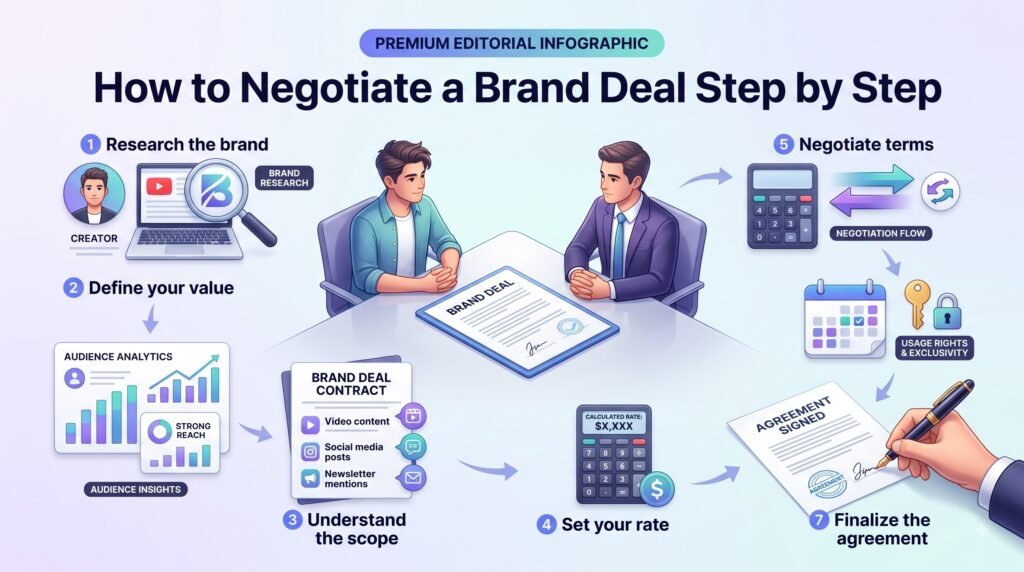
Negotiating your first brand deal can feel like a test you didn’t study for. The brand holds the budget, and you’re worried that asking too many questions will make you look difficult.
But the creators who get the best terms aren’t the ones who accept quickly—they’re the ones who gather information before naming a price.
Don’t Immediately Accept the First Offer
When a brand contacts you by email regarding a rate, the best idea is to say yes to the first offer so that they don’t change their mind. It is important to avoid agreeing immediately.
In most cases, the sum a brand is ready to pay on the first trial is at least 30 to 40 percent lower than they are actually willing to spend.
Secondly, it is necessary to keep in mind that not every negotiation starts from the middle or near the end of the scale. You can respond to the brand right away, saying that you are very grateful for contacting you, and that you would like to consider the request before replying.
Toptal suggests analyzing the whole offer before you say yes or no, not just the sum at the end. A small delay gives a customer a chance to see you as a professional who can work within a certain range and will not take the first offer just because it is an offer.
Let the Brand Explain Its Budget and Campaign Goals
Before you ever say a number, make the brand talk. A rate without context is meaningless. If they want a simple mention, that’s one price. If they want paid ad rights for six months, that’s another. Ask:
What is the campaign objective?
What deliverables are expected?
What is the timeline?
Where will the content be published?
How will the content be used?
Is paid advertising involved?
Is exclusivity required?
Get the Complete Scope Before Quoting a Rate
Don’t quote a sponsorship price until you know whether the brand wants:
- One integration
- A dedicated video
- Shorts
- Social posts
- Multiple videos
- Content licensing
- Paid advertising rights
- Exclusivity
Each element changes your workload and the value of your rights. Quoting early means negotiating against yourself.
Put the Agreement in Writing
Confirm all terms and conditions by email or contract and not by calls or messages. Verbal agreements and messages can be construed as legally binding contracts, and are often too vague for protection.
A written agreement will help to avoid scope creep, where additional deliverables are added without extra compensation. Ensure that all the terms and conditions, including compensation and dates of payment, number of revisions, and usage rights and exclusivity are documented in a written agreement.
If the brand insists on having a call, send them a follow up summary email that captures everything that was discussed. This way, you will both have a copy of the terms and conditions of the agreement
How to negotiate your YouTube sponsorship rate
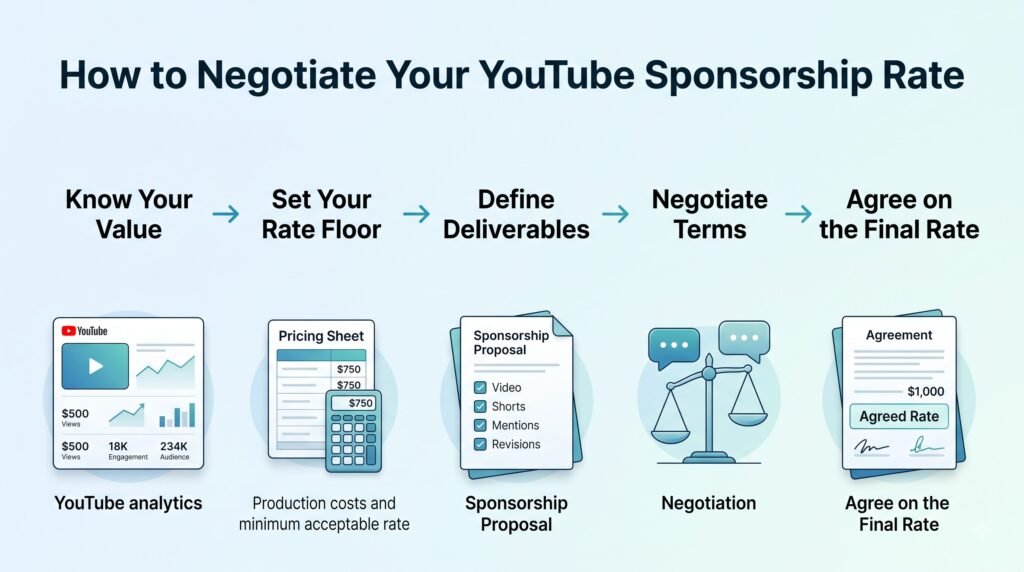
Your sponsorship rate should not be solely based on the number of views your videos get but should rather represent a significant portion of the total value that you provide to the brand.
The deal can include research, scripting, shooting, editing, revisions, exclusivity, and permission for a brand to reuse your content. In addition, you need to consider the scope of the agreement and know what will make the deal worthwhile for you before negotiating and agreeing to any terms.
Toptal also suggests establishing a minimum acceptable value for a deal before jumping into negotiations.
Once you have a clear idea of your sponsorship rate, the next step is presenting your channel professionally. Keeping your content ideas, titles, descriptions, and publishing workflow organized can make this process easier. Tools such as ytZolo can help streamline these routine YouTube tasks while you focus on the negotiation itself.
Calculate your minimum acceptable rate
To begin with, establish the rate floor, or the lowest acceptable total you are willing to take for the work. It is not necessarily the figure you share with the brand, but it acts as a personal criterion that prevents you from taking a deal that does not meet your expectations.
Consider:
- Production and filming time
- Editing and post-production
- Creative development and scripting
- Audience value and engagement
- Number and type of deliverables
- Brand requirements and revisions
- Exclusivity restrictions
- Content usage rights
- The opportunity cost of taking on the campaign
For example, a sponsored integration requiring one mention may have a very different value from a dedicated video with multiple revisions and six months of paid usage.
Should you give your rate first?
There are numerous ways to approach a negotiation, and there is no ideal tactic that would suit all cases. One of the suggested strategies is asking the brand about the budget before disclosing your rate.
By doing this, you give an opportunity to the client to get more familiar with your campaign and avoid the risk of underbidding. Toptal, for instance, recommends getting an understanding of the scope of work before providing a rate.
In case a brand asks for your rate, it is advisable not to stick to one particular number. After discussing deliverables, timelines, rights, and exclusivity, you could suggest a range or a package based on the scope of the project.
Use data to justify your rate
Your rate is easier to discuss when you can explain what supports it. Instead of saying:
“I need $2,000 for this video.”
Try:
“Based on my average views, audience demographics, engagement, and the requested deliverables, my rate for this integration is $X.”
Relevant evidence can include average views, audience demographics, engagement, previous campaign results, and audience fit. Forbes also notes that creator pricing can vary substantially according to factors such as audience size, niche, deliverables, and negotiation.
The goal is to connect your price with the business value and work involved, rather than your personal financial needs.
Don’t rely entirely on CPM
CPM, or cost per thousand views, is a decent metric to use as a benchmark while evaluating sponsorship rates, especially if your campaign is purely views-based. However, it is not the only metric that matters.
A performance-oriented brand will be more interested in clicks, conversions, sales, downloads, or any other action-based metric rather than impressions. Moreover, a fit audience and past campaign statistics can be an even better reference point than CPM, depending on the promotion goals.
Therefore, it is advisable to use CPM as a pricing guide rather than a central metric. The final rate should also consider the audience, deliverables, creatives, goals, usage rights, and exclusivity of the sponsorship deal.
Negotiate More Than Just the Price
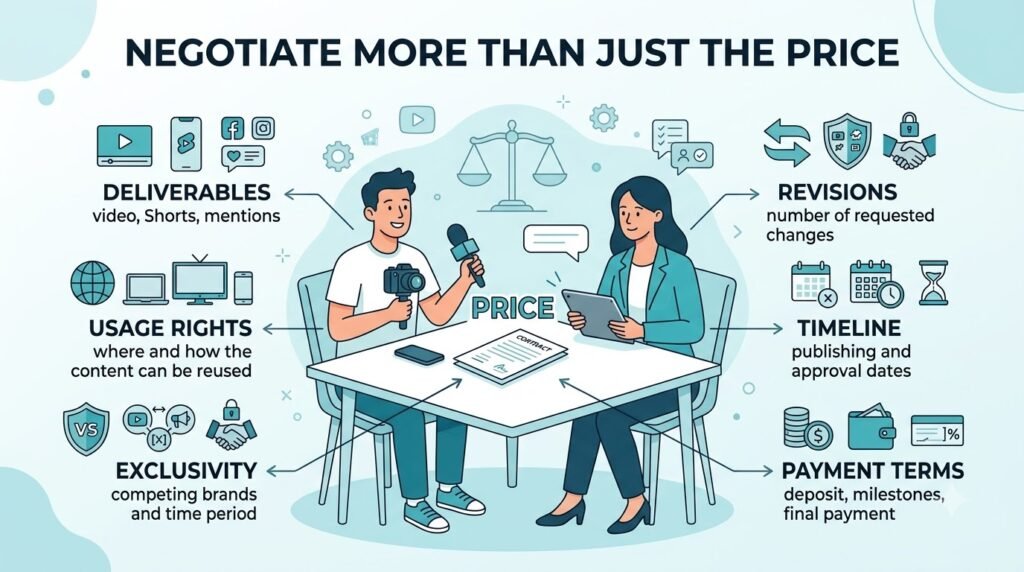
The number in the email from the sponsor is just a part of the equation. What is much more important and often forgotten by new YouTubers is the context in which the number appears.
The value of a sponsorship depends a lot on what exactly is being provided, who owns the content, what is given in exchange for the promotion, and how much time is spent on fulfilling the terms of the contract. All of these factors can greatly affect the overall value of the sponsorship, positively or negatively.
Negotiate Deliverables
Vague deliverables lead to vague expectations, and vague expectations lead to scope creep. Before agreeing to anything, define exactly:
- Number of videos included in the deal
- Dedicated vs. integrated sponsorship — a full video about the product versus a segment within a video you were already making
- Shorts — are these included, and how many?
- Social posts — Instagram, TikTok, X, or community tab posts tied to the campaign
- Mentions — verbal shoutouts separate from a dedicated segment
- Placement in video — pre-roll, mid-roll, or dedicated segment, since placement affects both effort and value
- Video length — how long the sponsored segment or full video needs to be
- Links — where they go, how many, and for how long they stay in the description
- Calls to action — what exactly you’re asking viewers to do
Avoid vague phrases like “promote the product” in any agreement. That phrase could mean a ten-second mention or an entire video, and without specifics, the brand’s interpretation usually wins by default.
Negotiate Usage Rights
Usage rights determine what happens to your content after it’s published, and they’re frequently left out of first-draft contracts. There are three levels worth distinguishing:
- Organic use: the creator publishes the sponsored video on their own channel, and that’s the end of it.
- Paid usage: the brand uses the creator’s content in its own advertisements or paid campaigns, putting money behind it to reach audiences beyond the creator’s own.
- Extended licensing: the brand gets permission to reuse the content for a defined period, even outside of active paid campaigns.
A brand asking for six months of paid usage across multiple platforms is asking for something meaningfully bigger than a single organic upload — the rate should reflect that.
Negotiate Exclusivity
Exclusivity clauses stop you from working with competing brands, but “competing” can be defined narrowly or broadly, so pin down:
- What counts as a competitor? A direct rival, or any brand in the same broad category?
- How long does exclusivity last? Weeks, months, or indefinitely?
- Does it apply to one product or an entire category? A single skincare item is different from “all beauty brands.”
- Does it cover YouTube only or all social platforms? Some clauses quietly extend to Instagram, TikTok, and beyond.
Forbes notes that exclusivity restricts future earning opportunities and recommends clearly defining the restricted category and timeframe before agreeing to it. An open-ended or overly broad exclusivity clause can quietly cost you future deals long after this one has paid out.
Negotiate the Timeline
Timelines shape how much work a deal actually takes, so they deserve the same scrutiny as deliverables. Cover:
- Script deadline
- Brand approval period — how long the brand has to review and respond
- Filming deadline
- Publication date
- Revision deadlines
- Rush delivery — what happens if the brand needs it faster than standard turnaround
A shorter turnaround can mean more work and less flexibility, so it should factor directly into how the deal is priced. A rushed one-week turnaround is a different job than a relaxed six-week one, even if the deliverables are identical.
Limit Revision Rounds
Open-ended revisions can quietly turn a single sponsored video into weeks of back-and-forth. Define upfront:
- Number of revisions included in the fee
- What qualifies as a revision — a wording tweak versus a full re-edit
- What happens if the brand changes the creative direction — this should be treated and priced differently from a standard revision
- Brand approval deadlines, so the brand can’t sit on a draft indefinitely while your schedule stalls
TubeBuddy specifically recommends defining revision limits and drawing a clear line between ordinary revisions and a completely new creative direction, since the latter often amounts to a new project rather than a tweak to the existing one.
Negotiate Whitelisting and Paid Amplification Separately
Whitelisting — monetizing through your own channels or accounts by allowing the brand to use your identity and content to run their own ads — is a separate request from asking the creator to post a sponsored video, which should be negotiated as a distinct line item.
If a brand wants to pay for ads that utilize the creator’s face and content, it’s additional value the creator is offering over and above the sponsored video, and should be reflected as such in the contract.
How to respond to a low brand offer
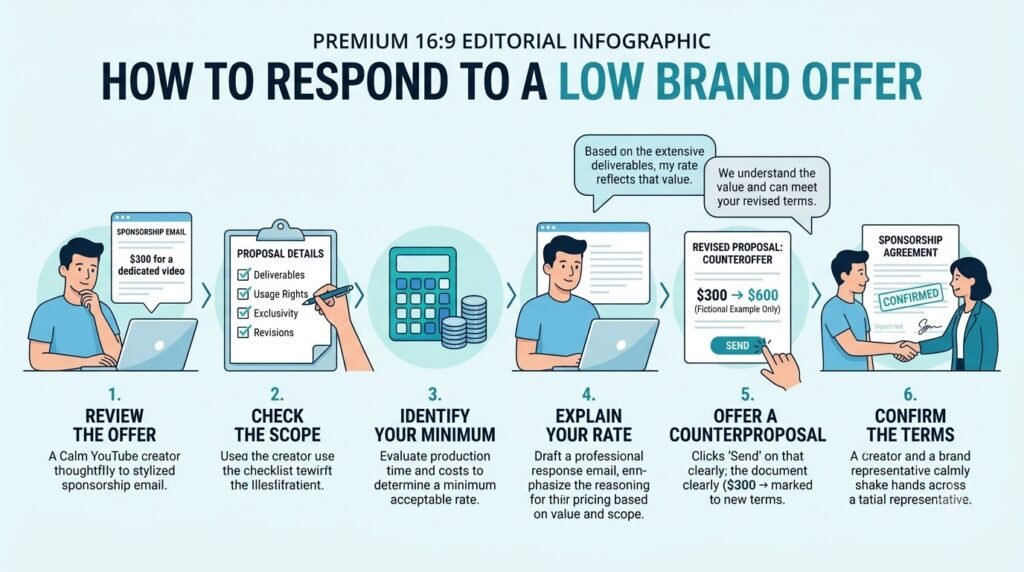
Receiving a small initial offer from a brand can be disheartening, but it serves as an excellent starting point for negotiations. There are some essential pointers on how to conduct yourself when communicating with brands.
Don’t take the first offer personally
A company may only have a small budget for collaborations and set a low initial offer to see if you accept their conditions. Try not to get upset and take the first offer personally; instead, analyze the offer rationally. Recall that all these negotiations are entirely regular, and you should not be surprised by them.
Counter with a clear number and reason
Never counter without a specific figure and a rationale. Use a simple, structured approach:
- Thank the brand for reaching out and sharing the details.
- Confirm interest in collaborating on the campaign.
- State your counter clearly using concrete numbers.
- Give one or two evidence-based reasons (e.g., audience demographics, past campaign performance).
- Ask about flexibility to keep the conversation moving forward.
If the budget is fixed, change the scope
If the brand insists their budget is fixed, resist the temptation to slash your rates. Devaluing your work sets a difficult precedent. Instead, scale back the deliverables to match their budget:
- Fewer overall deliverables
- Shorter integration length
- Removing secondary platforms (e.g., no YouTube Shorts)
- Reduced usage rights or shorter exclusivity windows
Sample counter-offer
Here is a practical template you can adapt:
“Hi [Name], thank you so much for sending over the details! I’m really excited about the prospect of working with [Brand] on this campaign.
Based on my current media kit, engagement rates, and the usage rights requested, my standard rate for this scope is $[Rate]. However, given how much I love your products, I’d love to make this work. If we can adjust the deliverables to [mention scaled-back scope, e.g., one dedicated video instead of two], I can comfortably do this for $[Counter Rate].
Let me know if you have some flexibility here to make this happen!”
What is the biggest hesitation you face when sending a counter-offer to brands?
Review the contract before signing
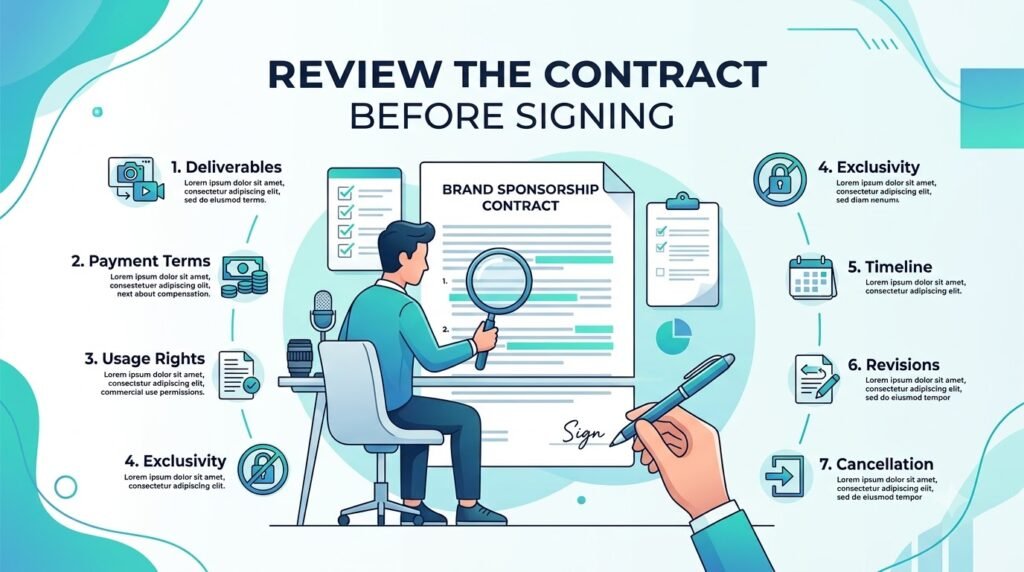
Before you sign anything, run the agreement through the same checklist you’d use for any YouTube sponsorship deal. A few careful reads now can save you from a messy dispute later.
Check the usage rights
Look closely at how the brand can use your video after it’s published. Watch for:
- Perpetual rights — the brand can use your content forever, with no expiration
- Unlimited platforms — usage isn’t limited to YouTube and can extend to their website, social channels, or third-party placements
- Paid advertising included without additional compensation — they can boost your video as an ad without paying you extra
- Undefined licensing periods — no clear end date for how long they can use the content
Any of these should be negotiated or compensated for separately.
Check the exclusivity clause
If the brand asks for exclusivity, the contract needs to spell out:
- Exact competitors you’re restricted from working with (not just “competing brands”)
- The specific product or category the exclusivity applies to
- How long the exclusivity period lasts
- Which platforms it covers
Vague exclusivity language can quietly block you from other deals for months.
Check payment terms
Payment terms need to be explicit, not implied. Cover:
- Deposit or upfront payment amount
- Payment deadline
- Invoice requirements
- Late-payment terms and penalties
- Currency and payment method
TubeBuddy recommends clearly defining payment deadlines and documenting payment terms directly in the agreement, rather than leaving them to email back-and-forth.
Check cancellation and kill fees
Make sure the contract addresses what happens if the brand cancels after scripting, cancels after filming, or if you’ve already incurred production costs. Without a kill fee clause, you could end up absorbing all the cost of a cancelled project.
Check performance-based payment
Be cautious if your entire payment is tied to views, clicks, sales, or promo code usage. A performance bonus on top of a guaranteed base fee is reasonable. Making your whole payment conditional on results shifts the brand’s business risk onto you.
Watch for unlimited revisions
Without a revision cap, a straightforward sponsorship can turn into an open-ended production project that eats far more time than you budgeted for.
Make sure the deliverables are specific
The contract should specifically identify the deliverables, such as the length of the video, the format, the platform where it will be posted, the number of mentions, and other relevant criteria, along with deadlines for each deliverable. hfg
Want this saved as a Word doc or standalone file?
How to negotiate brand deals as a small YouTuber
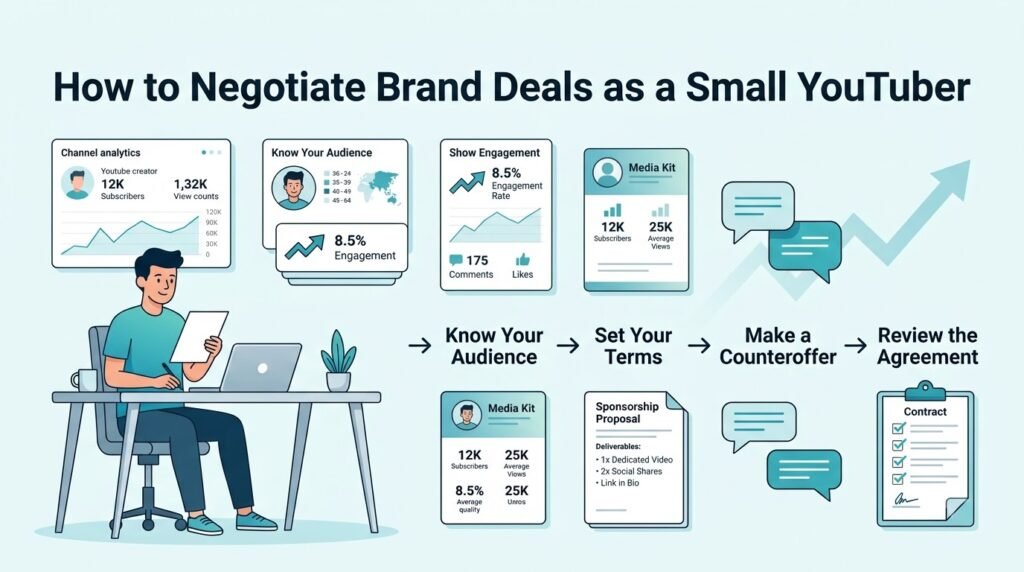
Negotiating brand deals as a creator with a modest subscriber base comes down to demonstrating value where it counts. Brands are increasingly looking beyond vanity metrics to find authentic connections.
Focus on audience fit, not subscriber count
A small channel can still offer tremendous value through:
- Strong engagement and active community participation
- A specific niche that speaks directly to a target market
- High audience trust built on genuine recommendations
- Valuable demographics that align with the brand’s buyers
- Relevant purchasing intent ready to convert
Both Forbes and Toptal emphasize that niche relevance and engagement matter far more to smart marketers than raw audience size.
Use your strongest content as proof
When pitching or negotiating, let your numbers and community do the talking. Highlight your:
- Best-performing videos with standout metrics
- Consistent views that show reliable reach
- Audience comments proving viewer enthusiasm
- Engagement rates that surpass industry averages
- Relevant product/content examples showing natural integration
Start with smaller, well-matched partnerships
Early sponsorships are invaluable stepping stones. Landing smaller collaborations will allow you to build a solid working history, work out your pitch, and accumulate a list of relevant cases that will demonstrate to others the effectiveness of your marketing.
Don’t assume you have to accept the first offer
Your lack of sponsorship experience does not mean you have to surrender every negotiable term. Also, bear in mind that brands are looking for mutually beneficial partnerships, so highlight your expectations during the negotiations.
What specific type of niche or content category is your channel focused on?
Turn One Brand Deal into a Long-Term Partnership
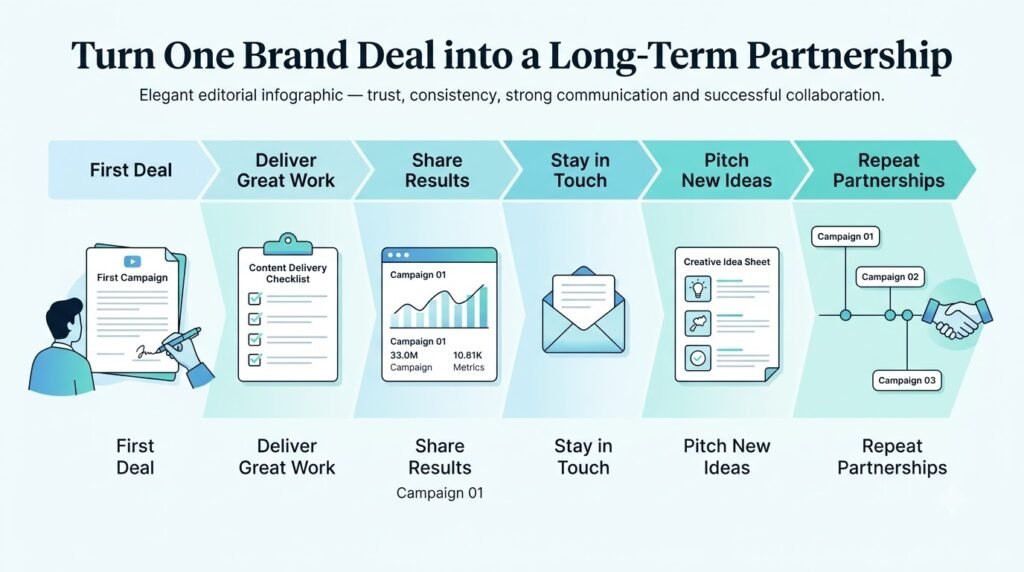
One successful campaign shouldn’t be the end. It should be the audition for a longer relationship. Brands increasingly favor creators they can trust repeatedly over one-off transactions .
Deliver Beyond the Minimum Agreed Scope
Stay professional without giving away unlimited unpaid work. You have to submit something on time, be communicative, add something extra (another story mention, a more polished asset), but not to the point of being resentful about the work you’re doing.
Share Useful Campaign Results
Send the brand relevant performance data after publication. Report saves, shares, watch time, and link clicks with context, not just vanity metrics . This positions you as a results-driven partner.
Pitch a Longer Partnership
Use successful results as the opening. A simple email works: “Thank you for an amazing campaign! [Insert stat]. Are your goals the same for next quarter? I’d love to explore a long-term partnership” .
Could be a monthly sponsorship, a three-video package, a quarterly campaign, a product launch series, or an ambassador program.
When should you walk away from a brand deal?
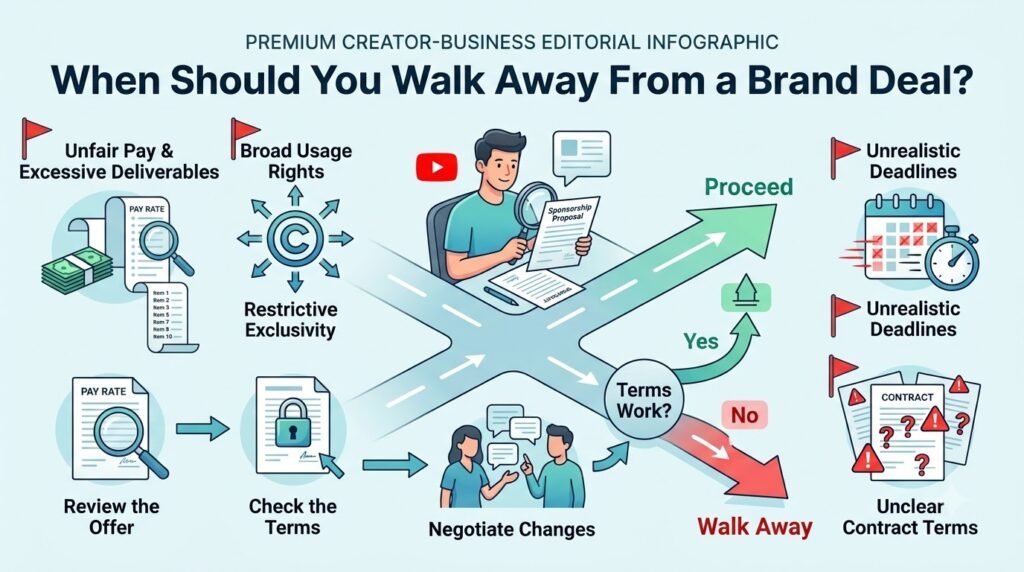
Not every offer is worth taking, even when the money looks appealing on the surface. Here’s when it’s reasonable to decline.
The compensation doesn’t match the workload
If the amount you’d have to script, film, edit, and revise before changes outweighs the total payment due, it’s a deal not worth your time.
If you’re expecting a certain amount of money, take into consideration all factors that may affect the quality or size of the deal, such as the usage rights and time you’ll have to invest.
The brand demands unlimited usage
If they won’t limit how long or where they can use your content, and won’t pay more for broader rights, that’s a red flag worth pushing back on.
Exclusivity blocks too many future opportunities
If the exclusivity terms are broad or long enough to shut out other income streams in your niche, the trade-off may not be worth it.
Payment terms create excessive risk
If most or all of your payment depends on performance metrics, or payment terms are vague, the financial risk sits mostly with you.
The brand wants unlimited revisions
Open-ended revision requests signal scope creep before the project even starts.
The partnership doesn’t fit your audience
If the product feels misaligned with your content or viewers, it can cost you trust that’s worth more than the payout.
FAQs about negotiating brand deals as a YouTuber
How do I negotiate a brand deal as a YouTuber?
Start by considering the ad requirements, your audience’s data, expected deliverables, usage rights, exclusivity, timeline, and payment terms.
Then calculate your minimum acceptable rate and make a counteroffer based on the overall scope rather than focusing only on the headline sponsorship fee.
How much should a YouTuber charge for a brand deal?
There is no universal sponsorship rate. Your price can depend on such factors as the number of views on average, such statistics as the audience’s age and level of engagement, the content’s niche, required production quality, usage rights, whether the campaign is exclusive, and its length.
Use your recent performance and the complete scope of the campaign to establish a reasonable rate.
Should I tell a brand my rate first?
Not necessarily. Before you quote a rate, ensure to clarify the company’s budget, objectives of the campaign, deliverables, timeline, usage rights of the asset, and exclusivity if any. From this information, you can be in a position to quote a suitable package or rate for the project based on the effort expected.
How do I negotiate a higher sponsorship rate?
Instead of asking for more money, use evidence. Appeal to their average views, audience relevance, engagement rate, previous campaign’s performance, production requirements, and deliverables. If the brand does not have enough money for the campaign, negotiate the scope or rights.
What should I do if a brand offers too little money?
Thank the brand and confirm that you’re interested, then make a professional counteroffer with a short explanation of how you arrived at your rate. If the budget is fixed, you can propose fewer deliverables, shorter usage rights, less exclusivity, or a different content format.
What should be included in a YouTube brand deal contract?
The contract should state deliverables, the payment amount and schedule, deadlines, limits on revisions, the content approval process, the usage rights, exclusivity, cancellation policy, disclosure, and any compensation for performance.
Should YouTubers charge separately for usage rights?
It is possible to negotiate the usage rights separately from the fee for creating and publishing the content. If the brand wants to reuse your video for its ads, on the website, all social platforms, or long-term, discuss what platforms and time frame are acceptable to you before you get paid for posting the video.
Can a small YouTuber negotiate with brands?
Yes. Number of subscribers shouldn’t be the only criteria for brands to choose upon when they want to collaborate. A channel with fewer subscribers can have a niche audience that suits the brand’s customer base. It’s better to give relevant data about the channel’s audience and performance.
Should YouTubers negotiate exclusivity?
Yes, exclusivity is worth discussing because it can prevent you from accepting other sponsorships. Define precisely which competitors are included, which platforms are included, and the duration of the exclusivity. If the exclusivity is significant, it may be necessary to devote a separate section to the negotiations.
How many revisions should a brand get?
Specify a reasonable number of revisions in the agreement. Also define what counts as a revision. A minor change to a script or product mention is different from asking you to create an entirely new concept after production has started.
Should I accept a free product instead of payment?
That depends on the value of the product/service and the amount of work that goes into it. For something simple, a free product might be acceptable compensation. However, I don’t think a product would be worth the time and effort put into a sponsored video or large-scale production.
Can YouTubers negotiate long-term brand deals?
Yes. Following a successful campaign, you could use the results to negotiate a longer term deal, such as a multi-video package, monthly sponsorship, quarterly campaign, or ongoing creator partnership. A longer term deal also provides both parties with more clarity in terms of deliverables and pricing.
When should a YouTuber reject a brand deal?
Consider saying no if the payment does not seem to be in a suitable ratio to the work involved, or the offer contains unacceptable terms, for example, too broad use of the work provided, excessively long exclusivity, vague payment description, or unlimited revisions. Focus on the whole deal, not just the promised sponsorship.
Conclusion
The art of negotiating a deal with a brand on YouTube is not just about getting paid more. It is also about finding out how valuable you are, negotiating the details of the deal, and protecting the agreement.
Before accepting a deal, it is essential to know exactly what you want and research the company enough to have an idea of what they want. Do not ask for a rate before considering what the offer will include and what you will have to do.
Keep in mind that the rate is only one aspect of the negotiation, while the rest depends on the terms and conditions. In any case, it is necessary to protect your rights and clarify the obligations of both parties in writing.
You should also know the bottom value of a deal and be prepared to make other demands if the initially requested rate is not suitable. Most importantly, do not forget that every deal can build a long-term relationship with a brand. By taking care of the details, an account owner can build a sustainable business for many years.
Author Bio
Anshika Verma is a content researcher and writer at ytZolo, covering YouTube growth, creator tools, and AI-powered content workflows. She researches and tests creator-focused tools to turn complex topics into practical, evidence-based insights.

