

Introduction: The Video That Got Demonetized Overnight
Jake had been grinding for eight months.
He’d built a faceless YouTube channel from scratch — scripting, voiceovers, stock footage, the works. His content was picking up steam. Then one morning, he woke up to an email from YouTube. His entire channel had been demonetized.
No warning. No second chance. Gone.
His crime? He’d been uploading repetitive, AI-generated content without adding any original value — and YouTube’s updated policies had finally caught up with him.
So is AI content allowed on YouTube? The short answer is yes. But the full answer is what separates growing, monetized channels from ones that get killed overnight.
In this guide, we’re going to walk through YouTube’s exact policies on AI content, what’s allowed, what gets you penalized, and how to use AI the right way to grow your channel fast.
Spoiler: tools like ytZolo make it easy to stay compliant and create content that actually ranks and converts. More on that soon.
Let’s get into it.
Table of Contents
Is AI Content Allowed on YouTube? The Direct Answer
Yes — is AI content allowed on YouTube? Absolutely. YouTube does not ban AI-generated content outright.
The platform recognizes AI tools as legitimate creative resources, similar to other production software. Creators can use AI for scriptwriting, thumbnail generation, voice synthesis, and even full video creation.
But here’s the catch.
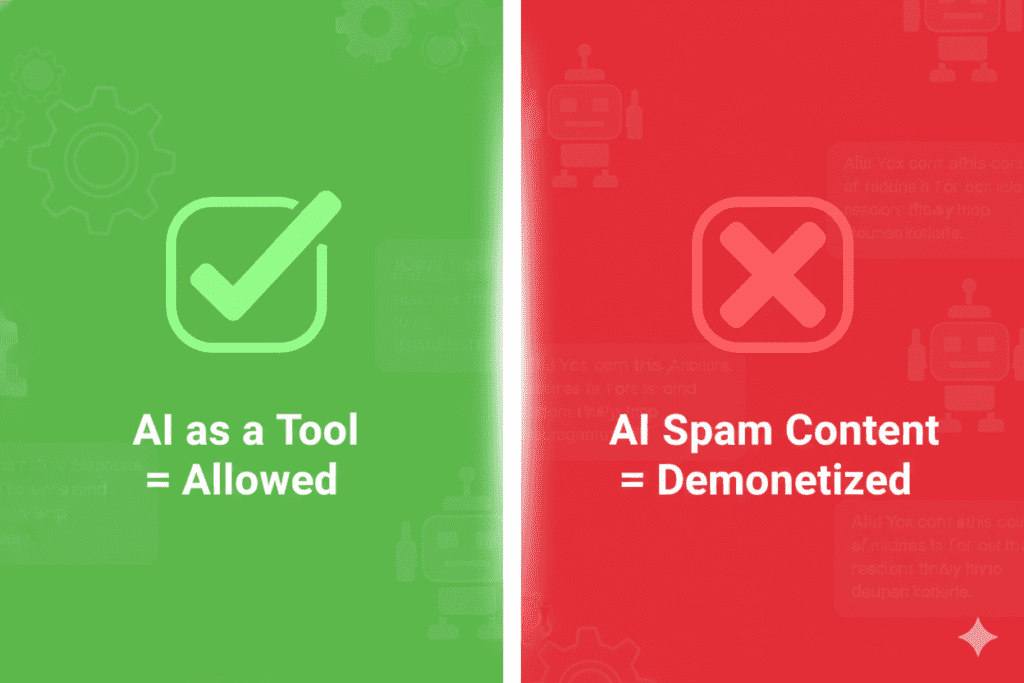
How you use AI is what determines whether your content gets rewarded or penalized. YouTube’s focus has shifted to originality, authenticity, and transparency. AI is a tool — not a replacement for human creativity.
If you’re adding your own voice, insight, storytelling, and value? You’re fine. If you’re mass-producing robotic, copy-paste content with zero personality? YouTube will come for your channel.
The rules are actually simple once you understand them. Let’s break them down.
YouTube’s AI Content Policy in 2026 (What Changed)
YouTube has rolled out significant policy updates over the past year.
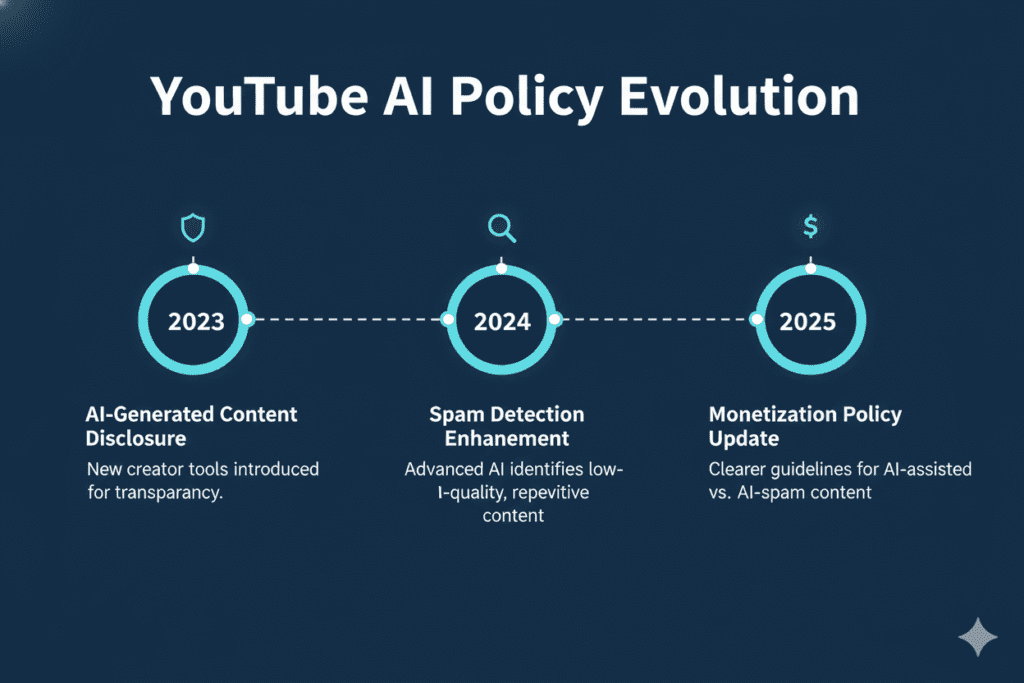
Here’s the timeline of what changed and why it matters for creators asking is AI content allowed on YouTube:
November 2023 – Synthetic Content Disclosure Introduced
YouTube announced its first major AI policy requiring creators to disclose realistic synthetic content. The platform began requiring labels on content that could mislead viewers about real people, places, or events.
March 2024 – Disclosure Labels Go Live
YouTube started displaying AI content labels in video descriptions. Creators who failed to disclose realistic altered content risked having YouTube add labels automatically — or worse, face channel penalties, raising the question is AI content allowed on YouTube.
May 2025 – Mandatory Disclosure Enforcement Begins
The disclosure toggle in YouTube Studio became mandatory for qualifying content. Creators must now actively confirm whether their video contains meaningfully altered or synthetically generated content during the upload process.
July 15, 2025 – The Big Crackdown on “Inauthentic Content”
YouTube renamed and expanded its “repetitious content” policy to “inauthentic content.” This update explicitly targets mass-produced, low-effort AI videos that lack original insight. Channels violating this policy face demonetization, strikes, or removal from the YouTube Partner Program.
So is AI content allowed on YouTube after all these updates? Yes — but the bar for quality and originality is now much higher.
What AI Content Is Allowed on YouTube
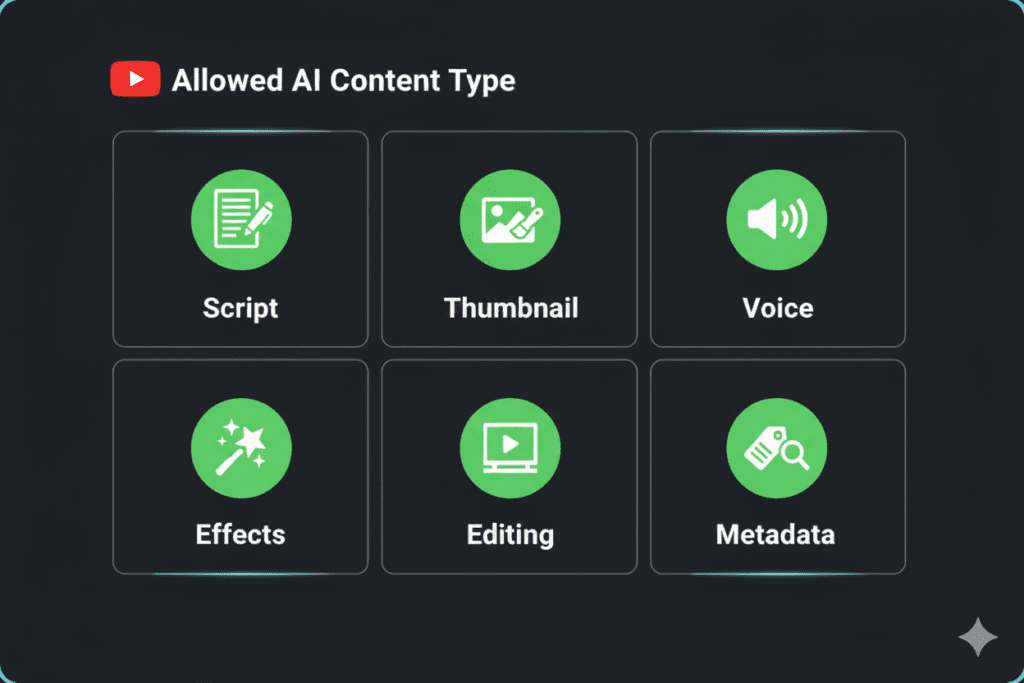
Here’s what YouTube explicitly permits. These are the green-light uses of AI in your content:
✅ AI-Assisted Scriptwriting Using AI to help you write, research, outline, or refine your video scripts is completely fine. This doesn’t require any disclosure. Tools that generate scripts — like the ones inside ytZolo — are fully compliant.
✅ AI-Generated Titles, Tags & Descriptions Optimizing your video metadata with AI is encouraged, not punished. YouTube’s algorithm rewards well-optimized metadata, and using AI to craft better titles and descriptions is smart content strategy when considering is AI content allowed on YouTube.
✅ AI-Powered Thumbnail Creation Using AI to ideate or generate thumbnail concepts doesn’t require disclosure unless the image is a realistic, deceptive depiction of a real person or event.
✅ AI Voiceovers (With Conditions) Using an AI voice for narration is allowed — as long as the voice doesn’t impersonate a specific real person without consent or disclosure.
✅ AI Visual Effects & Animations Clearly unrealistic effects, animations, and AI-generated art don’t require disclosure. If it obviously isn’t real, you don’t need to label it.
✅ AI for Post-Production Using AI for editing, noise reduction, color grading, or subtitles falls under production assistance. No disclosure needed.
The common thread: use AI as a tool to enhance your content, not as a substitute for having anything meaningful to say when asking is AI content allowed on YouTube.
What AI Content Is NOT Allowed on YouTube
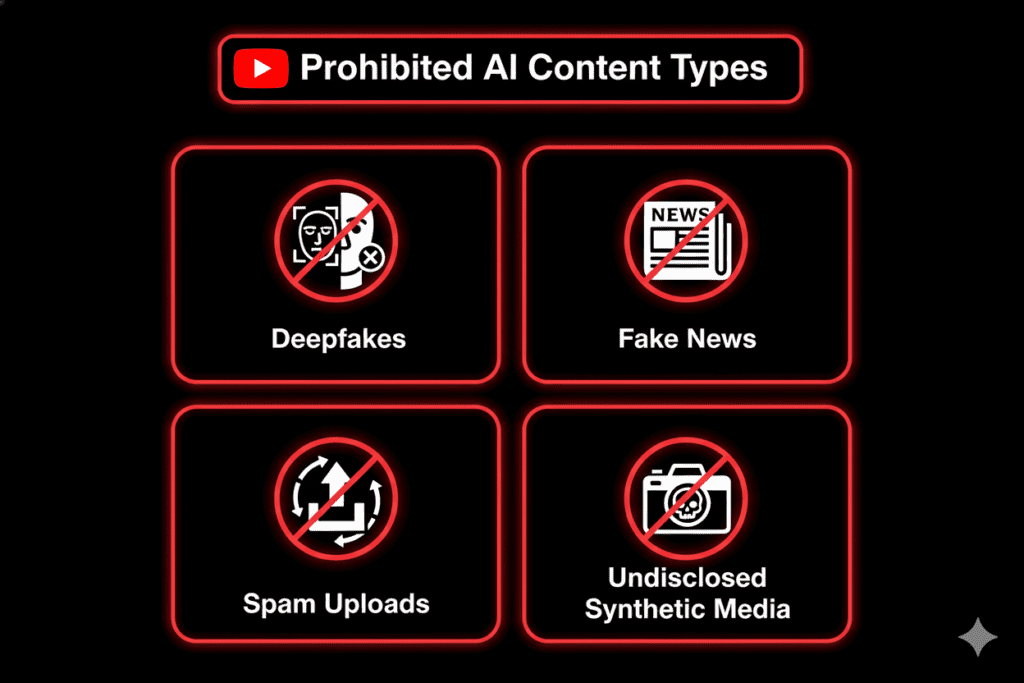
Now let’s talk about the content that gets creators in trouble. This is where is AI content allowed on YouTube gets a firm “not like this.”
❌ Deepfakes of Real People Without Disclosure Making a real person appear to say or do something they never did is a clear violation. This includes realistic AI voice clones of public figures used without permission or labeling.
❌ Fake AI News or Events Generating realistic-looking footage of events that never happened — especially around elections, disasters, or finance — is banned and can result in immediate removal.
❌ Mass-Produced, Repetitive AI Content Uploading 50 near-identical AI slideshow videos with robotic narration and zero original value is the definition of “inauthentic content” under YouTube’s 2026 policy. This triggers demonetization.
❌ AI-Generated Fake Testimonials or Advice Using AI to make it appear that a known figure gave advice they never actually gave is a serious violation — especially in health, finance, or legal niches.
❌ Undisclosed Synthetic Realism Uploading AI-generated content that looks and sounds real — without the appropriate disclosure toggle selected in YouTube Studio — can result in YouTube adding labels forcibly or striking your channel.
The bottom line: YouTube is not anti-AI. It’s anti-deception and anti-spam.
YouTube’s AI Disclosure Requirements Explained
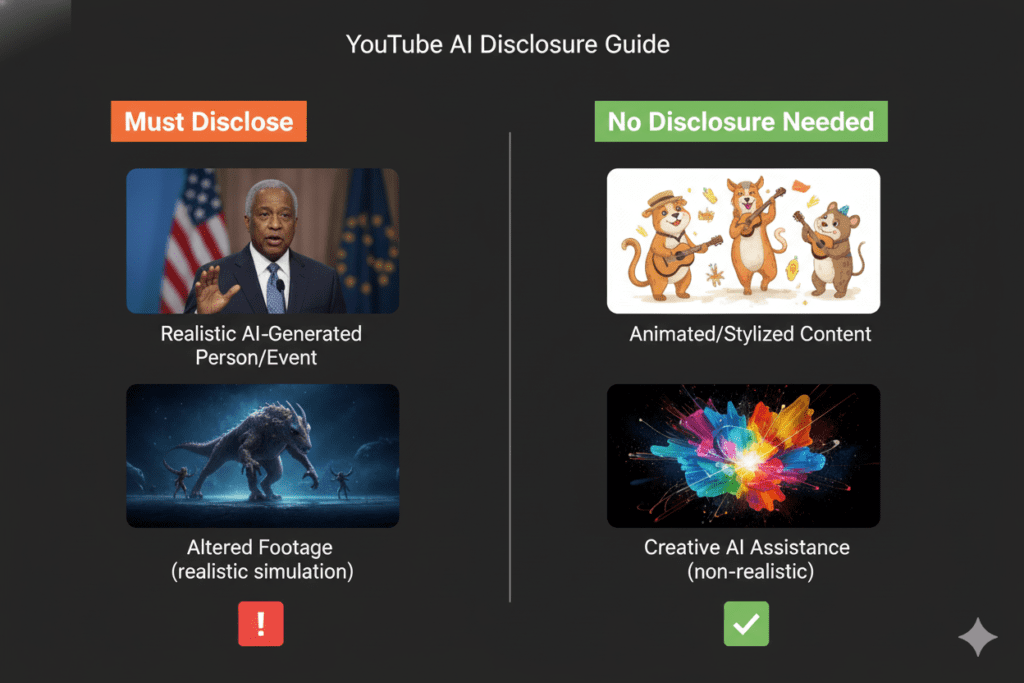
One of the most important questions around is AI content allowed on YouTube is: when exactly do you have to tell viewers your content uses AI?
According to YouTube’s official policy, you must disclose when your content:
- Makes a real person appear to say or do something they didn’t do — including AI voice clones of identifiable individuals
- Alters footage of a real event or place — for example, making a real building appear to be on fire
- Generates a realistic-looking scene that never occurred — like a fictional protest in a real city with real-looking people
You do NOT need to disclose:
- AI used for writing, planning, or scripting
- Clearly unrealistic animations or fantasy visuals
- AI-generated music (unless it imitates a specific real artist’s voice)
- Minor aesthetic edits that don’t change the meaning of footage
- AI thumbnails (unless deceptively showing fake real-world events)
Here’s the key principle: disclosure is about realism and potential to deceive — not about whether AI was involved in production at all.
If a viewer could watch your video and genuinely mistake AI-generated content for something real, disclose it when considering is AI content allowed on YouTube.
How to Disclose AI Content on YouTube (Step-by-Step)
If your content requires disclosure, here’s exactly how to do it — straight from YouTube’s official process:
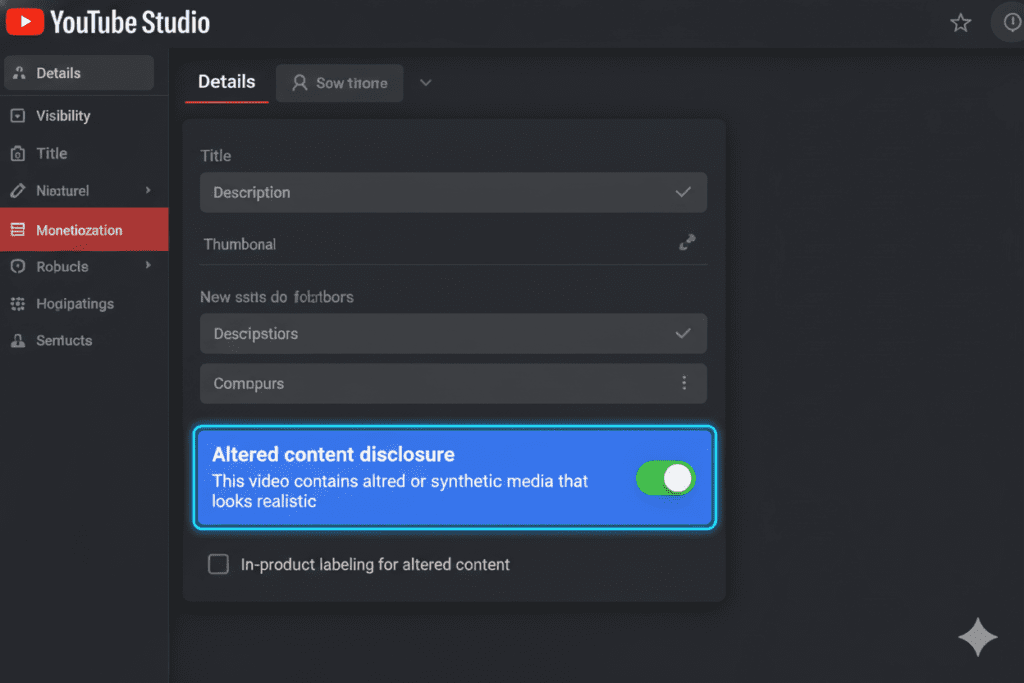
Step 1: Upload Your Video as Normal Go to YouTube Studio and begin the upload process for your video.
Step 2: Find the “Altered Content” Setting During the upload details page, scroll to find the “Altered content” toggle. This is available in YouTube Studio on both desktop and mobile.
Step 3: Select “Yes” to Disclose If your content features realistic AI-generated or altered synthetic content, select “Yes.” YouTube will automatically add a disclosure label to your video description.
Step 4: For Sensitive Topics — Expect a Prominent Label If your video covers elections, health, finance, natural disasters, or breaking news, YouTube may add a more prominent label directly on the video player itself — not just the description.
Step 5: Let YouTube’s Built-in AI Tools Auto-Disclose If you create content using YouTube’s own AI features (like generative AI Shorts effects), the platform will automatically add the disclosure for you. No extra steps needed.
One important note: if you should have disclosed but didn’t, YouTube may add the label on your behalf. Repeated non-disclosure on sensitive content can lead to strikes or removal from the YouTube Partner Program.
Can You Monetize AI-Generated YouTube Videos?
This is the question every creator wants answered: is AI content allowed on YouTube for monetization?
Yes — but only under specific conditions.
To stay monetized with AI content, your videos must:
- Be original and authentic — AI-assisted is fine; fully automated with zero human input is not
- Provide genuine value — educate, entertain, or inform. Don’t just regurgitate information in a robotic format
- Not be mass-produced using templates — uploading 30 near-identical videos using the same AI voice and script structure flags you as spam
- Meet standard YPP requirements — 1,000 subscribers and 4,000 watch hours (or 10M Shorts views) still apply
- Follow disclosure rules — undisclosed realistic synthetic content can trigger demonetization
What YouTube’s 2026 update made clear is this: AI content that adds real value can and does get monetized. The platform updated its “repetitious content” policy to “inauthentic content” specifically to go after low-effort AI spam — not creators who use AI responsibly as part of a genuine content workflow.
Use AI to work smarter. Add your perspective, your voice, and your storytelling. That combination is what YouTube rewards.
And that’s precisely the kind of workflow ytZolo was built to support.

How ytZolo Helps You Create Compliant, Viral AI Content
Here’s where everything comes together.
Understanding is AI content allowed on YouTube is step one. Executing a strategy that stays compliant and drives real growth is step two. That’s where ytZolo makes all the difference.
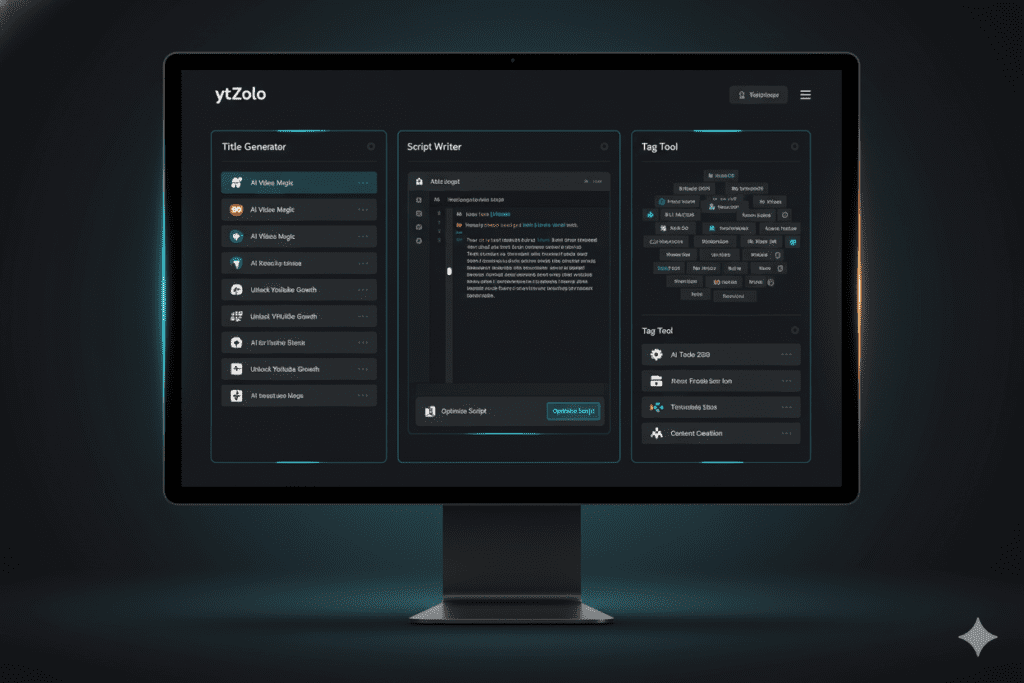
ytZolo is an all-in-one AI YouTube growth platform built specifically for creators. It’s not a generic AI writer. It’s not a basic SEO plugin. It’s a full content creation and optimization engine designed to make your videos rank, get clicked, and keep viewers watching.
Here’s how ytZolo keeps you compliant and competitive:
AI Title Generator
Generate 10 emotion-driven, SEO-optimized titles in seconds. These are crafted for click-through rate and search intent — not just keyword stuffing. Every title feels human, original, and channel-specific.
Script Writing Engine
ytZolo’s script generator creates structured, engaging, narrative-driven scripts. You add your voice, your personality, and your perspective. The result is 100% compliant with YouTube’s originality requirements — because you’ve contributed real human value.
SEO-Optimized Descriptions
Write keyword-rich, search-friendly descriptions that help YouTube understand your content. Better metadata = better discoverability. No disclosure required for this kind of AI assistance.
Tag & Hashtag Generator
Get precision-targeted tags that boost your video’s categorization in YouTube’s algorithm. Better tags mean more recommendations and more organic views.
Thumbnail Concept Generator
Get high-CTR thumbnail ideas before you open Canva or Photoshop. Creative direction, not just generation — keeping you in control of the final product.
Content Ideas Engine
Stay ahead of trends with topic suggestions before they peak. Be the first in your niche to cover hot content, not the fifteenth.
All of ytZolo’s core features — titles, scripts, descriptions, tags — fall under AI production assistance. That means no disclosure required and full monetization eligibility. You get the speed and power of AI, with none of the policy risk.
Explore everything ytZolo can do at ytzolo.com — and check out the ytZolo blog for more creator growth strategies.
Why ytZolo Is Better Than Other Tools
Let’s put it side by side.
| Feature | ytZolo | TubeBuddy | VidIQ | ChatGPT | Jasper |
|---|---|---|---|---|---|
| YouTube-native AI | ✅ | ❌ | Partial | ❌ | ❌ |
| Compliant AI scripting | ✅ | ❌ | ❌ | ✅ | ✅ |
| SEO title generator | ✅ | Limited | ✅ | ❌ | ✅ |
| Description writer | ✅ | ❌ | Limited | ✅ | ✅ |
| Tags & hashtags | ✅ | ✅ | ✅ | ❌ | ❌ |
| Thumbnail concepts | ✅ | ❌ | ❌ | ❌ | ❌ |
| Content ideas engine | ✅ | Limited | ✅ | ❌ | ❌ |
| All-in-one platform | ✅ | ❌ | ❌ | ❌ | ❌ |
| Policy-safe AI use | ✅ | ✅ | ✅ | Varies | Varies |
The verdict is clear.
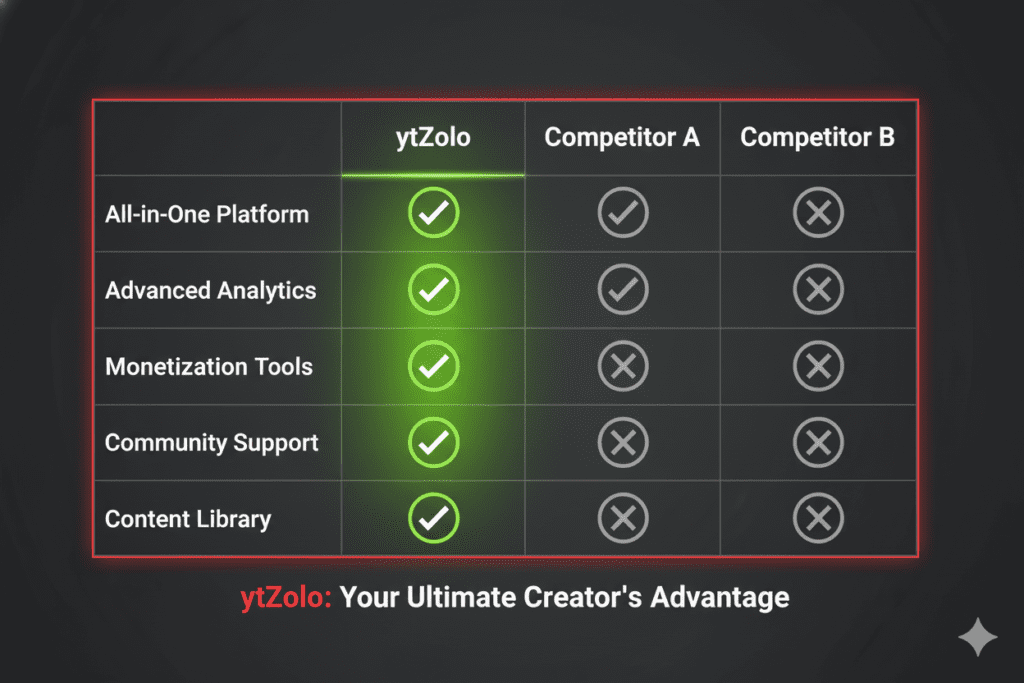
Other tools cover one or two pieces of the puzzle. ytZolo covers the whole board — and does it in a way that keeps you fully aligned with YouTube’s 2026 content policies.
When creators ask is AI content allowed on YouTube and how to use it safely, ytZolo is the tool that answers both questions at once.
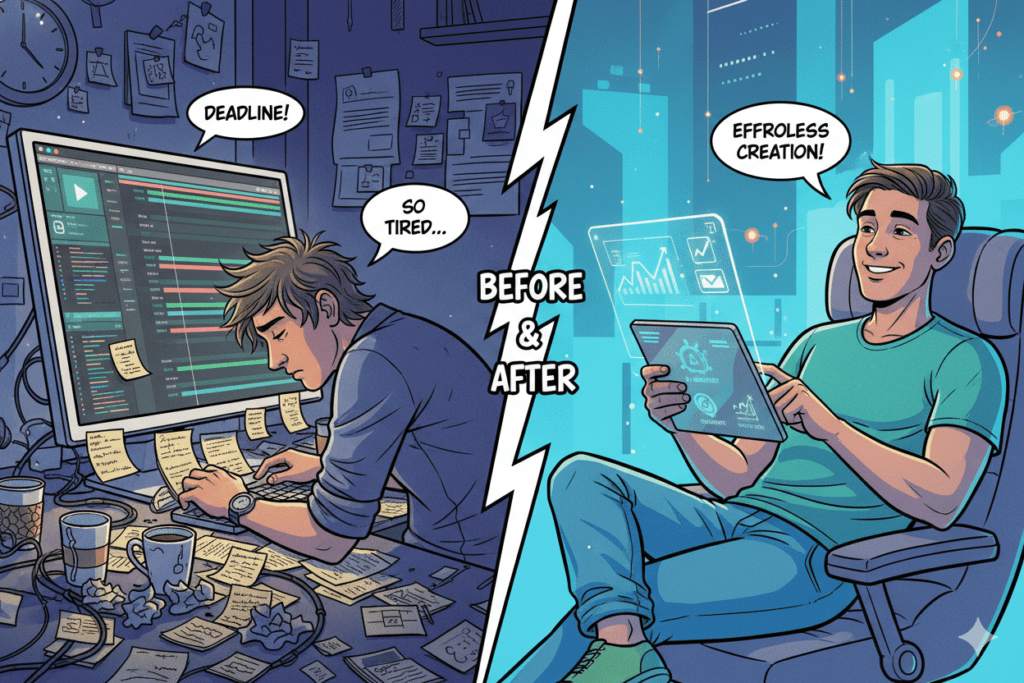
Why Manual Content Creation Is Falling Behind
Let’s be real for a second.
If you’re still writing every title from scratch, manually researching every keyword, and spending three hours on a video description — you’re fighting with one arm tied behind your back.
The creator economy in 2026 moves fast. Trends peak and die within days. Channels that adapt quickly win. Channels that don’t get buried.
Manual methods made sense in 2019. Today, they’re a liability.
Here’s what happens when you skip AI tools:
- You spend 2–3 hours on pre-production tasks that AI could handle in minutes
- Your titles are inconsistent — sometimes great, often mediocre
- Your metadata doesn’t reflect current search trends because you don’t have time to research them properly
- You burn out faster and publish less, which tanks your algorithm performance
Smart creators aren’t replacing themselves with AI. They’re using AI to handle the repetitive, time-consuming optimization work — so they can focus on what only they can do: tell great stories, build authentic connections, and show up consistently.
That’s what ytZolo enables. And that’s why creators who use it grow faster than those who don’t.
Actionable Tips: How to Use AI on YouTube Without Getting Penalized
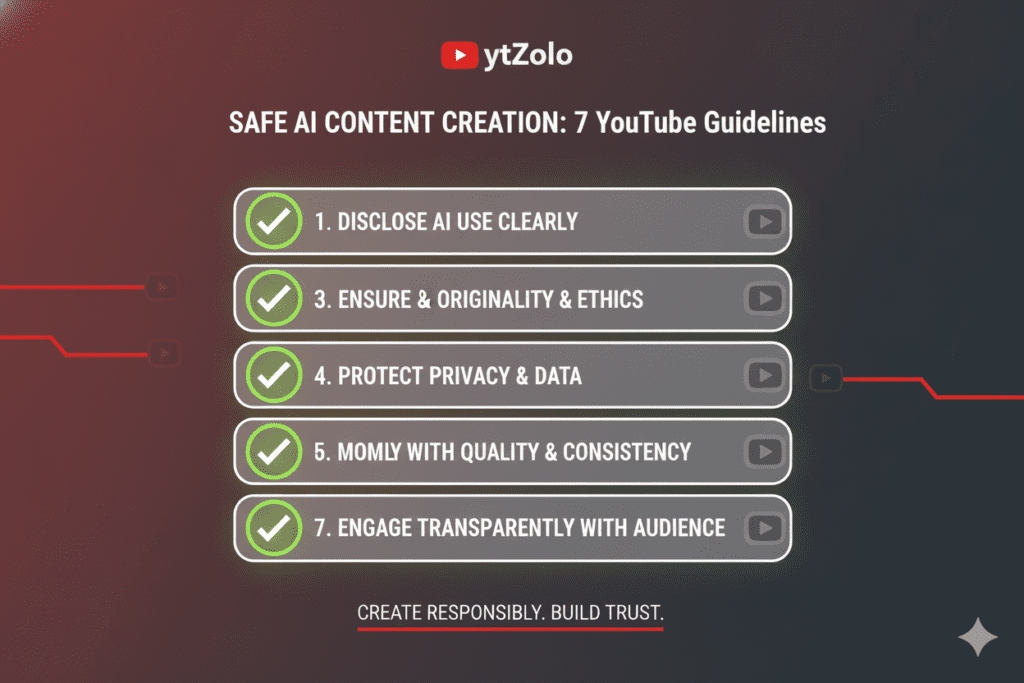
Here’s your compliance checklist. Follow this every time you publish AI-assisted content:
✅ Add Your Own Voice Narrate your content, offer personal opinions, or appear on camera. Even a brief commentary segment transforms AI-generated structure into original content.
✅ Use AI for the Workflow, Not the Whole Video Let AI handle titles, scripts, and descriptions. You handle delivery, editing, and storytelling. That combination is what YouTube’s algorithm loves.
✅ Disclose When You Should If your content features realistic synthetic media — AI voices of real people, deepfake-style footage, or fake realistic events — hit the disclosure toggle in YouTube Studio before publishing.
✅ Don’t Upload in Bulk With the Same Template Uploading 20 variations of the same format in a week is a red flag. Focus on quality over quantity. YouTube’s inauthentic content filter specifically targets repetitive templated uploads.
✅ Create Real Value First Before you publish, ask yourself: does this video genuinely help, entertain, or inform my audience? If the honest answer is no, don’t publish it.
✅ Stay Updated on Policy Changes YouTube’s AI policies are still evolving. Bookmark the YouTube Creator Blog and the ytZolo blog for the latest updates as they happen.
✅ Use ytZolo for Policy-Safe AI Optimization All of ytZolo’s features — title generation, scripts, descriptions, tags — fall under production assistance, not synthetic realistic content. No disclosure needed. Full monetization eligibility maintained.
FAQ: Is AI Content Allowed on YouTube?
1. Is AI content allowed on YouTube in 2026?
Yes, is AI content allowed on YouTube — and the answer is a clear yes. YouTube permits AI-generated and AI-assisted content as long as it meets originality standards, provides genuine value, and follows disclosure requirements for realistic synthetic media. AI tools used for scripting, SEO, titles, and descriptions don’t require disclosure at all.
2. Do I need to disclose if I use AI to write my YouTube script?
No. Using AI for writing, planning, scripting, or metadata optimization is classified as “production assistance” and does not require disclosure. You only need to disclose AI use when your final video contains realistic synthetic content that could mislead viewers about real people, places, or events.
3. Can AI-generated YouTube videos be monetized?
Yes, but only if they meet YouTube’s originality and quality standards. Videos must add real value, reflect genuine human creativity, and not be mass-produced using repetitive templates. YouTube’s July 2026 “inauthentic content” update specifically demonetizes low-effort AI spam — not content created with AI tools responsibly.
4. What happens if I don’t disclose AI content on YouTube?
If you fail to disclose realistic AI-generated content that requires labeling, YouTube may add a disclosure label on your behalf. Repeated non-disclosure on content that could mislead viewers can result in strikes, demonetization, or removal from the YouTube Partner Program.
5. What is the best AI tool for YouTube that keeps me compliant?
ytZolo is one of the best all-in-one AI YouTube tools built specifically for creators. Its core features — title generation, script writing, video descriptions, tags, and thumbnail concepts — all fall under AI production assistance, which requires no disclosure. You get full AI power with zero policy risk, plus optimization built for viral content creation.
Conclusion: AI Is Allowed — But Only the Smart Kind
Let’s bring it home.
Is AI content allowed on YouTube? Yes. Without question.
But the days of uploading lazy, bulk-produced AI slop and expecting to collect ad revenue? Those are over. YouTube’s 2026 policies have made that crystal clear.
The creators who are winning right now are the ones who use AI as a strategic growth tool — not as a shortcut around putting in real effort. They use AI to move faster, optimize smarter, and create more consistently. But the creativity, the perspective, and the storytelling? That’s still human.
That’s exactly the creator workflow ytZolo was built for.
With ytZolo, you get AI-powered titles that get clicked, scripts that hook viewers, descriptions that rank, and tags that get you discovered. All policy-safe. All built for YouTube. All in one place.
Don’t wait for your competition to figure this out before you do.
Start creating smarter, faster, and more viral YouTube content with ytZolo today.


Pingback: 7 Proven YouTube Policy on AI Generated Content Shorts Tips