
Introduction: The Rule Change That Shocked a Million Creators
Imagine waking up one morning and finding out that the content strategy you’ve been running for months could now get your channel demonetized overnight.
That’s exactly what happened to thousands of creators when YouTube dropped a bombshell update in mid-2025.
The youtube policy on ai generated content shorts changed everything. And if you’re still creating Shorts with AI tools without knowing the new rules, you’re playing with fire.
But here’s the thing — this change isn’t the end for AI-powered creators. It’s actually a massive opportunity for those who understand the rules and use the right tools.
In this guide, you’ll learn exactly what YouTube’s updated policy means, how to disclose AI-generated content correctly, and how a tool like ytZolo can help you create compliant, viral-ready Shorts faster than ever.
Let’s get into it.
Table of Contents
What Is YouTube’s Policy on AI Generated Content Shorts?
The youtube policy on ai generated content shorts is YouTube’s official set of rules governing how creators can use artificial intelligence to produce, edit, and publish short-form video content.
In simple terms: YouTube does NOT ban AI-generated content. But it does require that your content be original, authentic, and transparent about its AI use.
YouTube’s stance is clear — AI is a creative tool, not a shortcut to spam the platform with low-effort, repetitive videos.
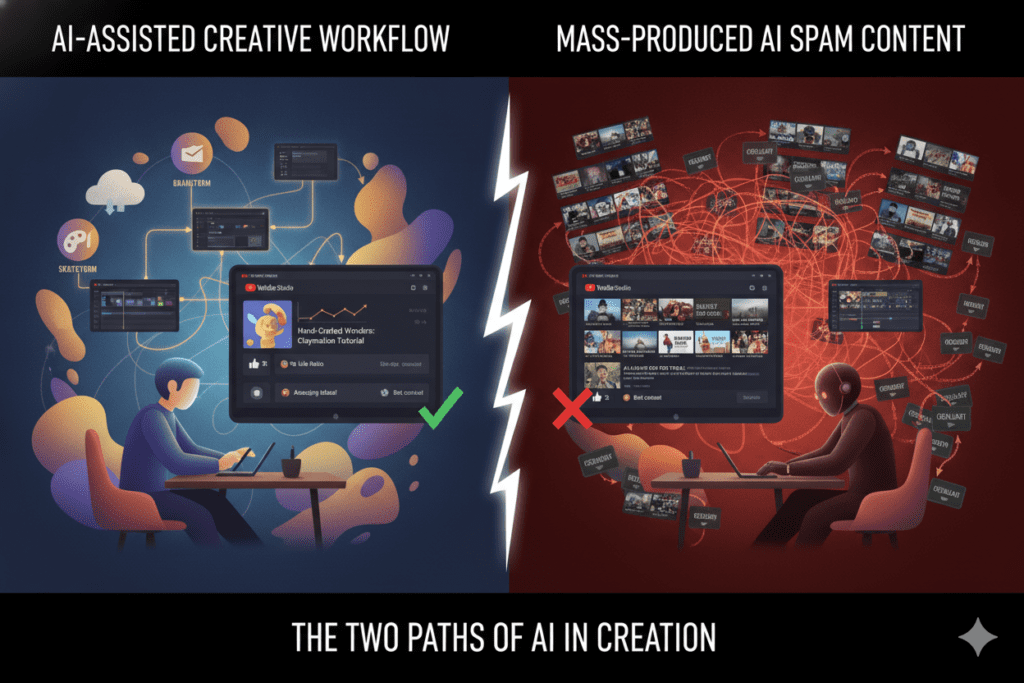
The platform distinguishes between two types of AI content:
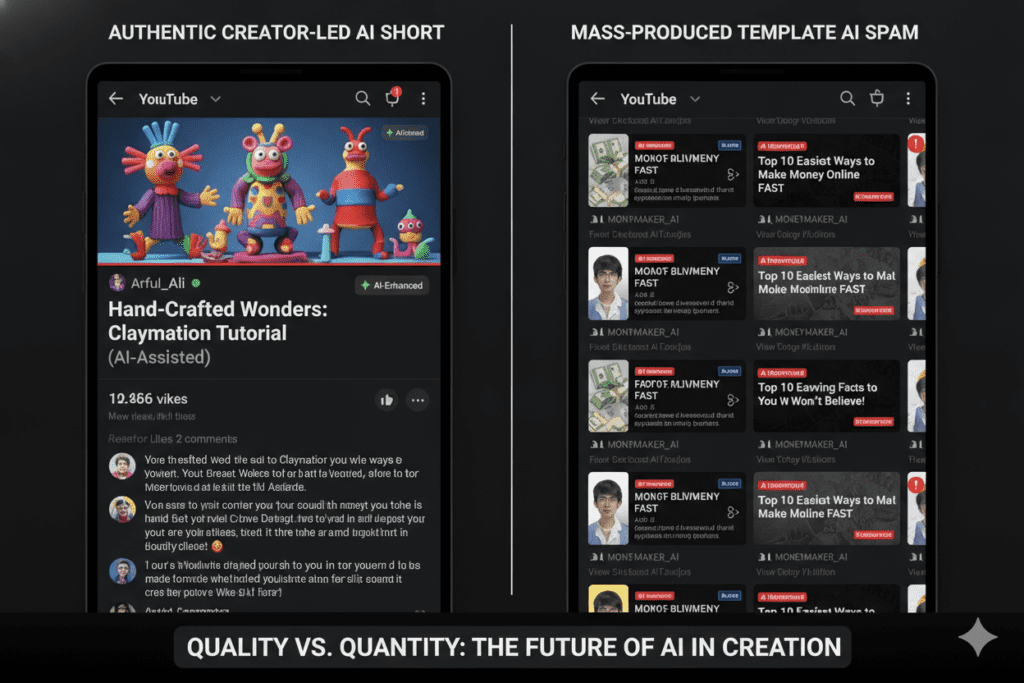
- AI-assisted content — where AI helps a human creator produce something original (allowed and monetizable)
- Mass-produced AI content — where AI generates bulk, templated videos with minimal human input (demonetized and penalized)
This is a critical distinction every creator needs to understand before uploading another Short.
The July 2025 Update: What Actually Changed
On July 15, 2025, YouTube rolled out one of its most significant policy updates in years.
Here’s exactly what changed:
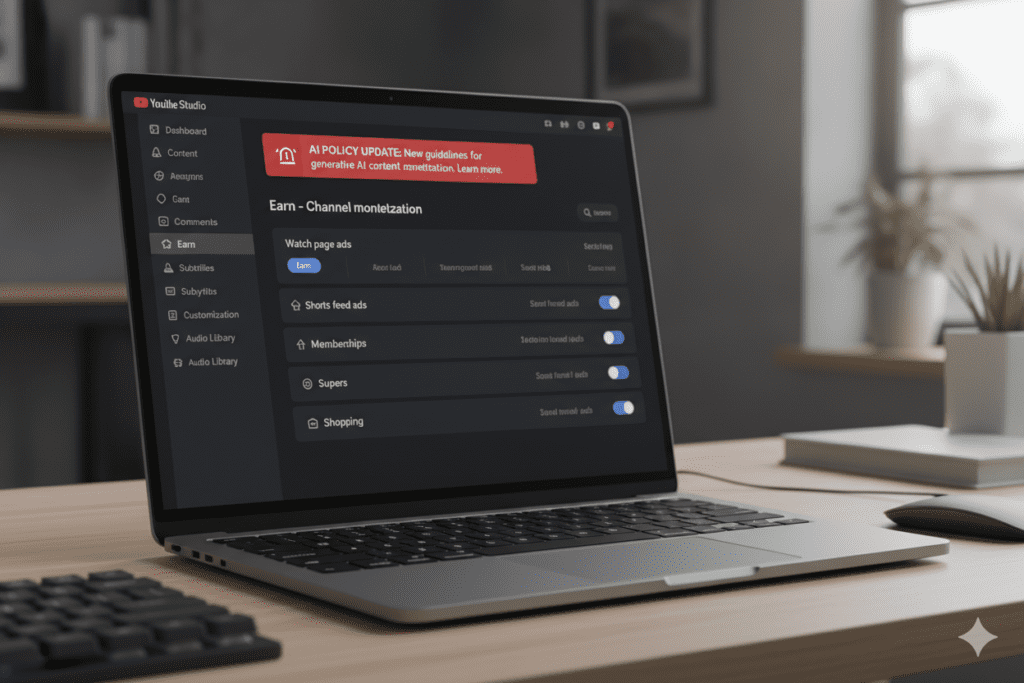
YouTube officially renamed its “repetitious content” policy to “inauthentic content“ and updated the YouTube Partner Program (YPP) guidelines to reflect it. The platform now requires content to be “significantly original and authentic” to remain eligible for monetization.
What triggered this change? The explosion of “AI slop” — low-quality, bulk-generated videos that flooded the platform after generative AI tools became widely accessible.
Up to 42% of all Shorts are now created with at least some AI assistance, according to reports from mid-2025. The problem wasn’t AI itself. The problem was creators using it to produce hundreds of near-identical videos with zero human creativity or value.
YouTube CEO Neal Mohan reinforced the platform’s position clearly: YouTube is not anti-AI. The platform actually introduced Veo 3, Google DeepMind’s photorealistic video generation model, directly into YouTube Shorts. That’s proof YouTube wants creators to use AI — just the right way.
The message is simple: use AI to enhance your creativity, not to replace it.
YouTube Rules for AI Generated Videos and Shorts
Understanding the youtube rules for ai generated videos and shorts is non-negotiable if you want to stay in the YouTube Partner Program.
Here’s a breakdown of the current rules:
Rule 1: Originality is required. Your content must reflect your unique ideas, perspective, or creative direction — even if AI helped produce it. Copying templates, recycling AI-generated scripts with no modification, or mass-producing identical videos is a violation.
Rule 2: Transparency is mandatory. If your Short contains realistic AI-generated visuals, synthetic voices that sound like real people, or AI-altered footage of real events, you must disclose it. This rule has been enforced since May 2026.
Rule 3: AI-assisted tools are welcome. Using AI for scriptwriting, caption generation, keyword research, title optimization, and thumbnail creation does NOT require disclosure. These are productivity tools, not content generators.
Rule 4: Human oversight matters. YouTube’s algorithm and human reviewers will look for evidence that a real person shaped the content. Your voice, your angle, your editorial judgment must be present in the final video.
Rule 5: Consequences are real. Channels that violate these rules can face reduced reach, demonetization, content removal, or in serious cases, channel termination.
How to Disclose AI Generated Content on YouTube Shorts
Knowing how to disclose ai generated content on youtube shorts is one of the most important steps you can take to protect your channel right now.
The process is straightforward. Here’s exactly how to do it:
Step 1: Open YouTube Studio and begin your video upload as normal.
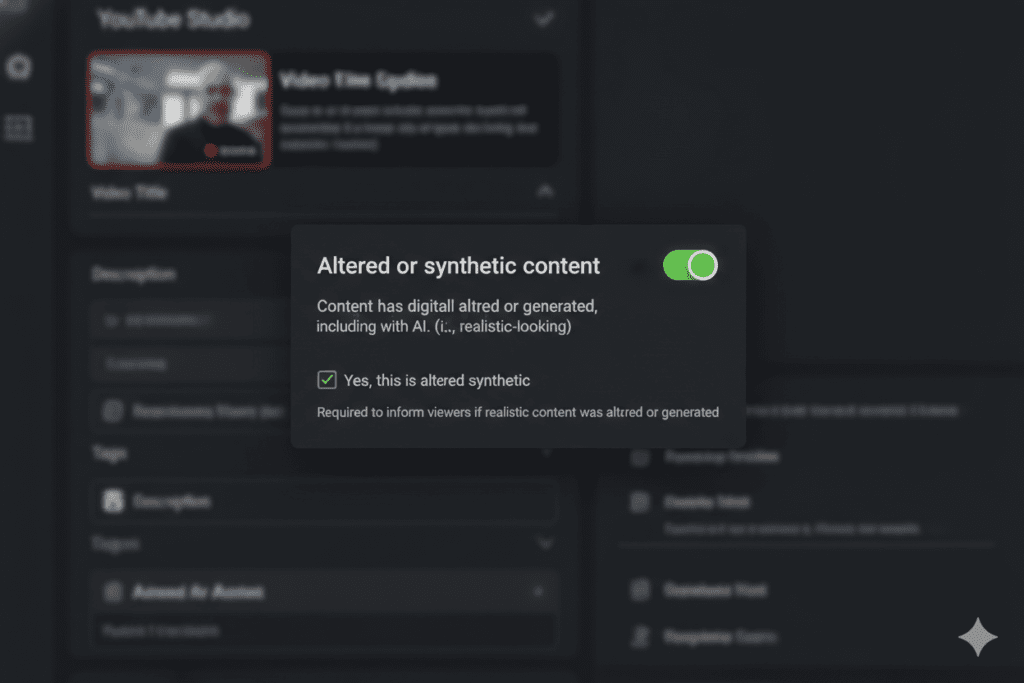
Step 2: In the Details section, look for the “Altered or synthetic content“ toggle.
Step 3: Turn the toggle ON if your Short contains realistic AI-generated or digitally altered footage that viewers might mistake for real.
Step 4: Save your settings and publish. YouTube will automatically add a disclosure label to your video.
For Shorts specifically, the disclosure label appears in the bottom left corner of the video in the scrolling feed. For sensitive topics like health, news, elections, or finance, YouTube may display a more prominent label directly on the video player.
What if you forget to disclose? YouTube’s automated detection systems can identify synthetic content and apply a label on your behalf — but they can also take enforcement action. It’s always better to disclose proactively.
What does NOT require disclosure:
- AI tools used for scriptwriting or ideation
- Color grading, beauty filters, or standard editing effects
- AI-generated captions or subtitles
- Clearly animated or stylized content that no one would mistake for reality
When in doubt, disclose anyway. It takes 10 seconds and protects your entire channel.
Does YouTube Allow AI Generated Shorts Monetization?
This is the question everyone is asking: does youtube allow ai generated shorts monetization?
The short answer is yes — but with conditions.
YouTube absolutely allows creators to monetize AI-generated Shorts. The key requirement is that the content must be original, human-led, and add genuine value to viewers.
Here’s the current monetization framework for AI content:
Monetizable AI Shorts:
- Original concepts developed by a human creator
- AI-assisted scripts reviewed and shaped by the creator
- AI-enhanced visuals that are part of a unique creative vision
- Properly disclosed realistic AI content
Non-Monetizable AI Shorts:
- Mass-produced videos using templates with minimal variation
- AI-generated content that requires no human creative input
- Repetitive videos clearly made to game the algorithm
- Undisclosed realistic AI footage that misleads viewers
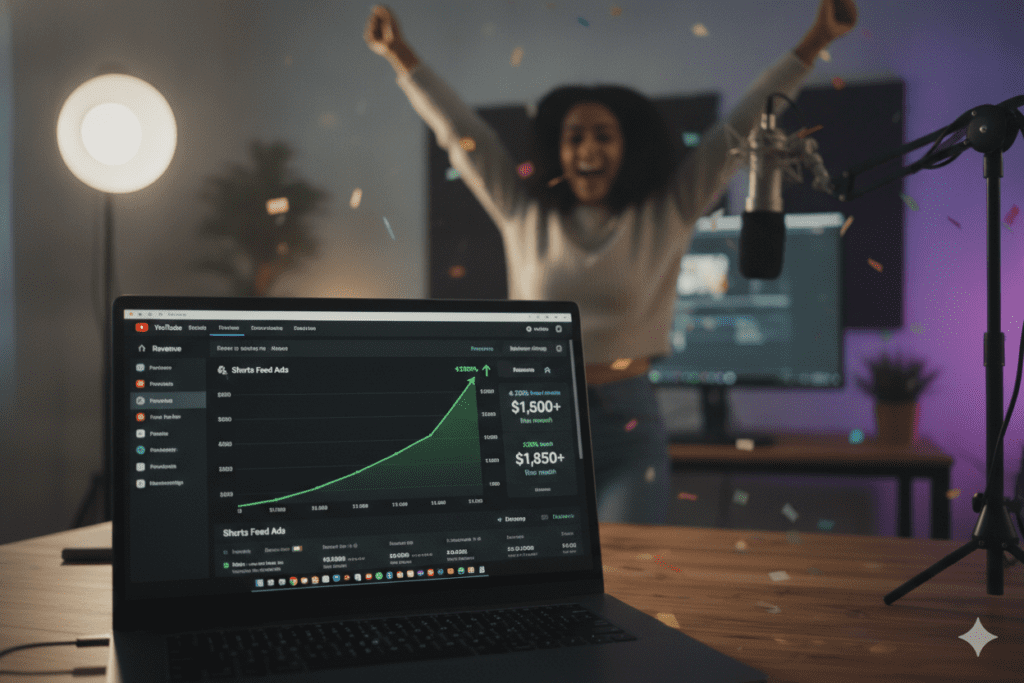
The exciting development? YouTube announced in mid-2025 that Shorts will now receive the same ad-revenue split as long-form content videos. This makes Shorts a more lucrative format than ever — but only if your content meets the originality standard.
The window of opportunity for authentic AI-assisted Shorts creators is wide open right now. Creators who combine genuine creativity with smart AI tools are positioned to grow faster than ever.
What Counts as “Inauthentic” Content?
YouTube defines “inauthentic content” as content that is mass-produced or repetitive — where there is minimal variation between videos and the content can be easily replicated at scale with little to no human input.
Here are the clearest examples of what triggers the inauthentic content flag:
- Template-based Shorts factories — hundreds of videos made from the same AI template with only the topic swapped out
- AI voice over static images — a robotic voice narrating public domain images with no original commentary
- Scraped and repackaged content — taking existing videos, running them through an AI filter, and re-uploading
- Faceless channels with zero personality — channels where every video looks identical and adds no unique perspective
Importantly, using AI itself is not what makes content inauthentic. A creator who uses AI to generate a script, records their own voiceover, adds their own face or personality, and creates unique visuals has produced authentic content — even if AI was heavily involved in the production.
The youtube ai generated content policy for shorts creators is about intent and value, not the tool used to create it.
YouTube AI Generated Content Policy for Shorts Creators: Do’s and Don’ts
Let’s make this crystal clear with a simple list every Shorts creator should bookmark.
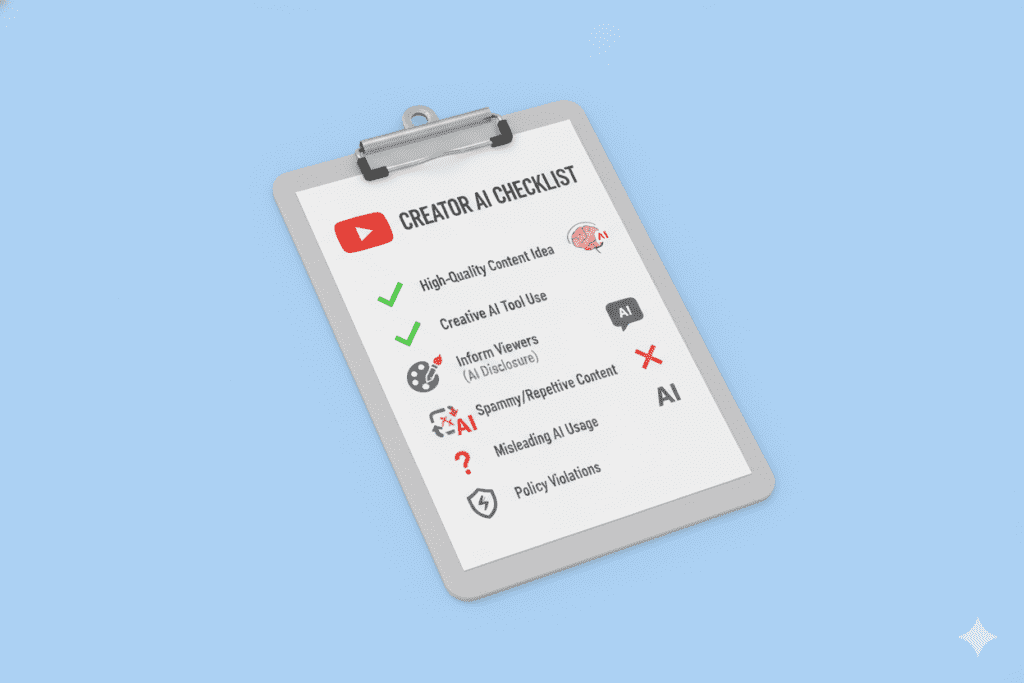
✅ DO:
- Use AI to brainstorm ideas, write scripts, and optimize titles
- Add your own voice, face, or unique perspective to every Short
- Disclose AI use when your content includes realistic synthetic visuals
- Use AI tools that are built for YouTube, like ytZolo, to create optimized content
- Review and personalize all AI-generated scripts before filming
- Maintain consistent upload schedules supported by AI efficiency
- Use AI for SEO — titles, descriptions, tags, and thumbnails
❌ DON’T:
- Upload bulk AI-generated videos with no human input
- Use AI to clone another creator’s voice or likeness without permission
- Create AI deepfakes of real people saying things they didn’t say
- Skip the disclosure toggle when your content needs it
- Rely on a single AI template for all your Shorts
- Treat AI as a replacement for your creative direction
Following these guidelines keeps your channel safe and positions you for sustainable long-term growth under the current youtube policy on ai generated content shorts.
Why Creators Struggle Without the Right AI Tools
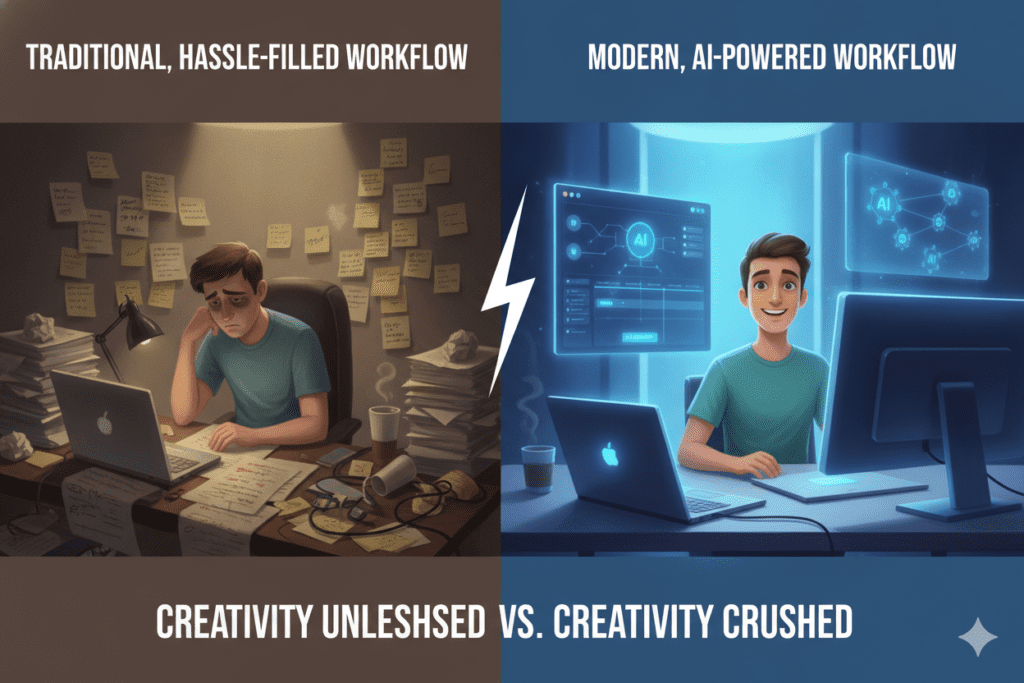
Here’s an uncomfortable truth: creating high-quality, original Shorts consistently is genuinely hard.
Most creators burn out after a few weeks. The content calendar becomes overwhelming. Ideas dry up. Scripts take hours. Thumbnails get thrown together at the last minute.
This is why so many creators turned to bulk AI generation in the first place — not out of laziness, but out of desperation. The demand for consistent content is real, and the manual process is brutal.
But the answer isn’t to spam the platform with low-effort AI videos. The answer is to use smarter AI tools that enhance your creativity without replacing it.
Manual content creation in 2026 is like navigating with a paper map while everyone around you has GPS. You’ll eventually get where you’re going — but you’ll be late, exhausted, and miles behind your competitors.
Research from HubSpot’s content marketing studies consistently shows that creators who use AI tools maintain more consistent publishing schedules and produce content significantly faster — which is exactly what the YouTube algorithm rewards.
The solution isn’t to avoid AI. It’s to use AI the right way, with the right tools.
Why ytZolo Is Better Than Other Tools
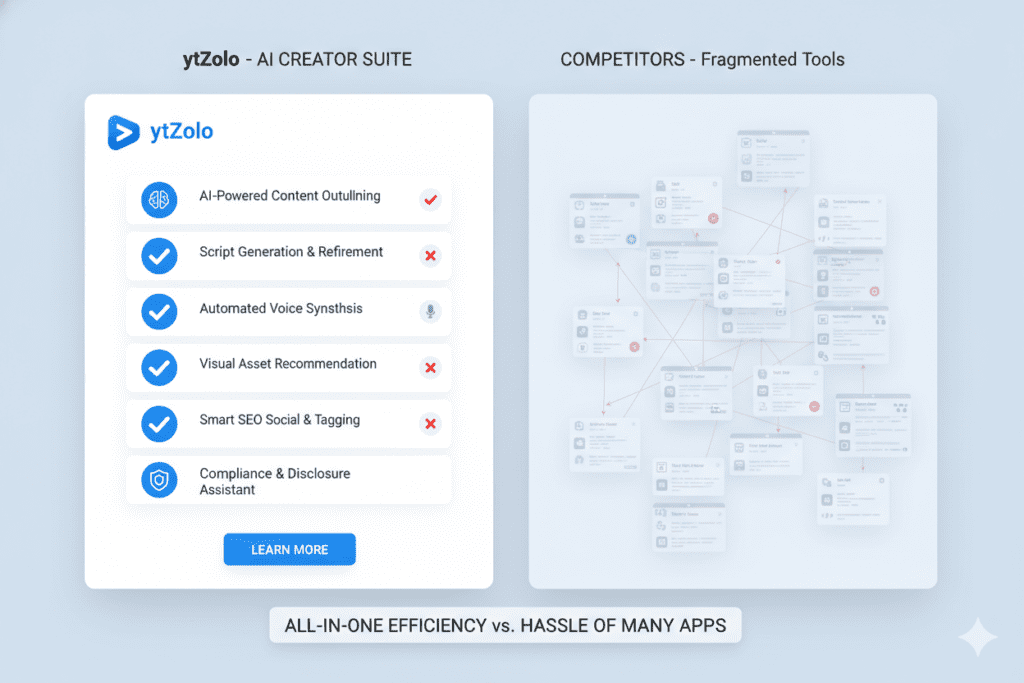
There are plenty of AI tools out there. ChatGPT, TubeBuddy, vidIQ, Jasper, Canva — creators have been cobbling together workflows using five different platforms just to publish one video.
ytZolo changes that entirely.
Here’s how ytZolo stacks up against the competition:
| Feature | ytZolo | vidIQ | TubeBuddy | ChatGPT |
|---|---|---|---|---|
| YouTube-specific AI | ✅ Built for YouTube | ⚠️ Partial | ⚠️ Partial | ❌ Generic |
| Script Generation | ✅ Full scripts | ❌ No | ❌ No | ⚠️ Generic |
| Title Optimization | ✅ SEO + CTR focused | ✅ Yes | ✅ Yes | ⚠️ Generic |
| Thumbnail Concepts | ✅ AI-powered | ❌ No | ⚠️ A/B testing only | ❌ No |
| Description & Tags | ✅ Auto-generated | ✅ Yes | ✅ Yes | ⚠️ Generic |
| End-to-End Workflow | ✅ One platform | ❌ Incomplete | ❌ Incomplete | ❌ No |
| Built for Shorts | ✅ Yes | ⚠️ Partial | ⚠️ Partial | ❌ No |
| Free to Start | ✅ No credit card needed | ⚠️ Limited free | ⚠️ Limited free | ⚠️ Limited |
The core difference: tools like vidIQ and TubeBuddy are great at analytics. ChatGPT is powerful for writing. But none of them were built specifically for the YouTube creator workflow from start to finish.
ytZolo was. Every feature inside ytZolo was designed around one question: what does a YouTube creator need to grow faster?
You can explore more comparisons and deep-dives on the ytZolo blog — they regularly break down what’s working for creators right now.
How ytZolo Helps You Stay Compliant and Go Viral
Here’s exactly how ytZolo helps you navigate the youtube policy on ai generated content shorts while still growing your channel at maximum speed.
1. AI-Powered Script Writing That’s Authentically Yours
ytZolo doesn’t generate robotic, template-driven scripts. It creates structured, engaging scripts tailored to your niche and tone — giving you a foundation that still requires your voice, your examples, and your personality to bring to life. This is exactly the kind of AI assistance YouTube rewards.
2. Viral Title Generation
Your title is the first thing the algorithm and your viewer judge. ytZolo’s title generator creates click-worthy, SEO-optimized titles built specifically for YouTube’s search and discovery system — not generic headlines from a writing tool.
3. Thumbnail Concepts That Stop the Scroll
Research shows your thumbnail drives up to 70% of your click-through rate. ytZolo’s thumbnail intelligence analyzes what’s performing in your niche and helps you build visually compelling concepts — giving you a professional designer’s eye without the cost.
4. SEO-Optimized Descriptions and Tags
Every Short needs metadata that works with the algorithm. ytZolo auto-generates keyword-rich descriptions and suggests tags that maximize your discoverability — saving you the 30 minutes it would normally take per upload.
5. Content Ideas That Never Run Dry
ytZolo’s topic discovery feature finds trending ideas in your niche with realistic competition levels for your channel size. No more staring at a blank page wondering what to post next.
The result? You get to focus on being a creator — not a content factory. And because ytZolo enhances your creative direction rather than replacing it, everything you produce under the current youtube rules for ai generated videos and shorts stays fully compliant and monetization-eligible.
You can start for free at ytzolo.com — no credit card required.
FAQ: YouTube Policy on AI Generated Content Shorts
1. Does YouTube ban AI generated content on Shorts?
No. YouTube does not ban AI generated content on Shorts. The platform allows AI-assisted content as long as it is original, authentic, and adds genuine value. What YouTube bans is mass-produced, repetitive AI content with no human creative input.
2. Do I have to disclose if I use AI to write my Shorts script?
No. Using AI for scripting, ideation, or caption writing does not require disclosure. The disclosure requirement only applies to realistic synthetic visuals, cloned voices that resemble real people, or AI-altered footage of real events that could mislead viewers.
3. Can I still monetize my YouTube Shorts if I use AI tools?
Yes, you can monetize AI-assisted Shorts as part of the YouTube Partner Program. The key is that your content must be significantly original and authentic. Mass-produced AI content that lacks human creativity is not eligible for monetization under the July 2025 policy update.
4. What happens if I don’t disclose AI content on my Shorts?
If you fail to disclose realistic AI-generated or synthetic content, YouTube’s automated systems may apply a disclosure label to your video without your permission. Beyond that, YouTube can restrict your video’s reach, demonetize it, hold it for review, or issue a community guidelines strike for repeated violations.
5. What is the best AI tool to use for YouTube Shorts that complies with YouTube’s policy?
The best AI tool for YouTube Shorts that keeps you compliant is one that enhances your creativity rather than replacing it. ytZolo is built specifically for YouTube creators — generating titles, scripts, thumbnail concepts, descriptions, and tags that support your original creative direction. It helps you work faster without crossing into the “mass-produced” territory that YouTube’s policy targets.
Conclusion: The Creators Who Adapt Will Win
The youtube policy on ai generated content shorts isn’t bad news for creators. It’s a filter.
It separates creators who use AI as a crutch from creators who use AI as a superpower. And if you’re reading this, you already have the mindset to be in the second group.
The opportunity right now is enormous. YouTube Shorts now receives the same ad revenue split as long-form videos. The platform is actively handing creators access to its own AI tools. And the creators who understand these rules — and act on them — are positioned to grow faster than ever.
The creators who ignore the youtube rules for ai generated videos and shorts will get filtered out. The ones who combine authentic creativity with smart AI assistance will rise.
Don’t try to figure out the youtube ai generated content policy for shorts creators alone. Don’t cobble together five different tools just to publish one Short. And don’t let manual workflows slow you down when the competition is moving at AI speed.
Use the right tool. Stay compliant. Create content that actually gets seen.
Start creating smarter, faster, and more viral YouTube content with ytZolo today.
Want to go deeper on YouTube growth strategies and AI tools? Check out the ytZolo blog for guides, tutorials, and the latest policy updates — all written for creators who are serious about growing.
External resources:
- YouTube’s Official Creator Blog — for the latest policy announcements directly from YouTube
- Google’s AI Content Policy Overview — YouTube’s official disclosure requirements explained
- HubSpot Content Marketing Research — data on content consistency and creator growth

