
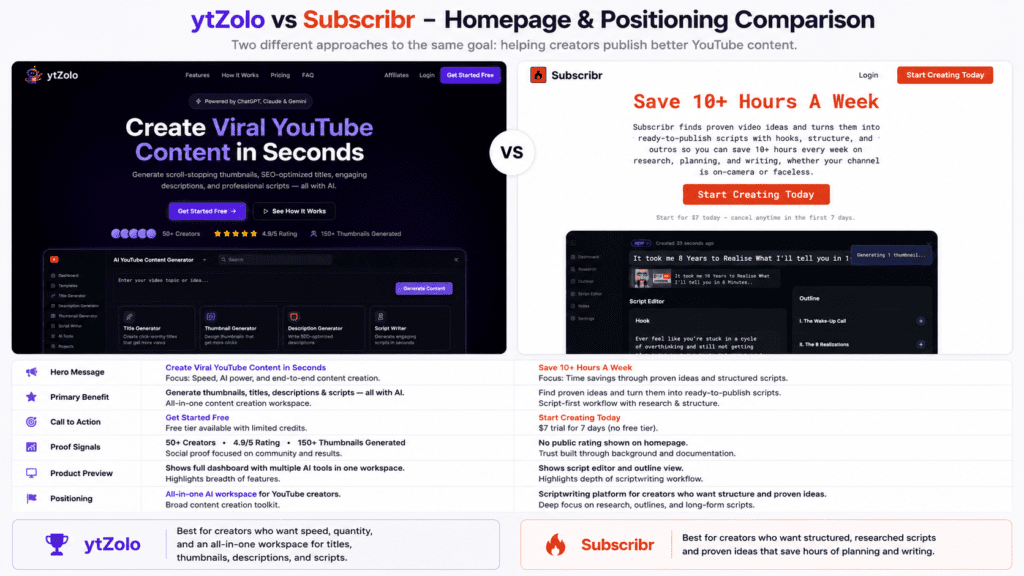
Most comparisons between AI YouTube tools ask “which one has more features?” That’s the wrong question. Feature lists make every SaaS product look roughly the same. The real question creators are trying to answer is: which platform gets a video from “I have an idea” to “I clicked publish” with the least friction for the way I actually work?
That’s the lens we’re using to compare ytZolo vs Subscribr. ytZolo was built around consolidating the whole metadata-and-thumbnail-and-script pipeline into one workspace. Subscribr, based on its own documentation and independent reviews, was built around going deep on one part of that pipeline — long-form scriptwriting — with everything else layered around it. Neither approach is “more correct.” They suit different bottlenecks.
Table of Contents
Quick Verdict
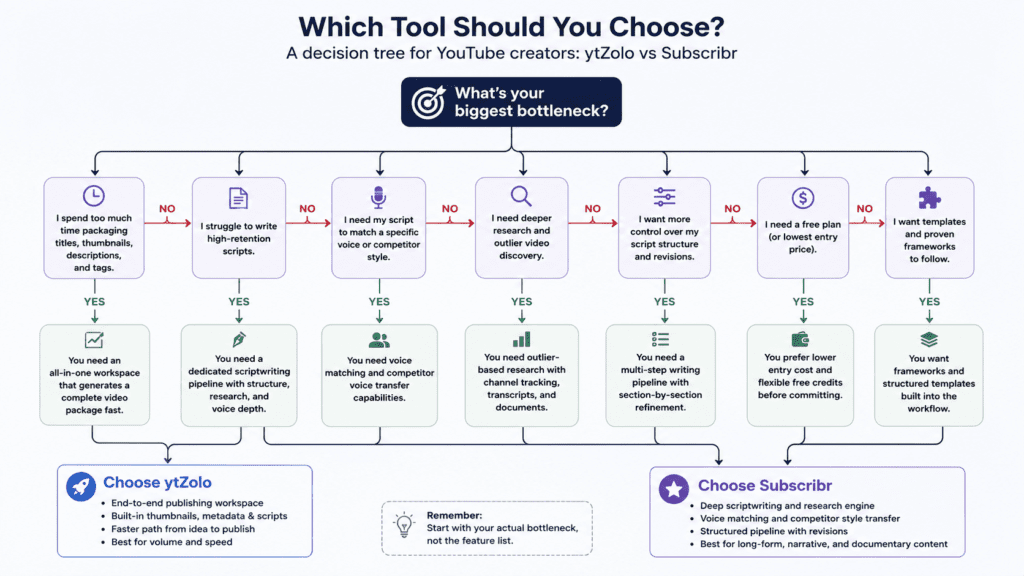
Choose ytZolo if your bottleneck is the sheer number of tools you’re juggling — you want titles, descriptions, tags, thumbnails, and a script draft generated in one place without exporting between apps. We built ytZolo around consolidation, and that’s still its clearest strength.
Choose Subscribr if your bottleneck is specifically the script — you publish long-form content and need a guided, research-driven process to go from a topic to a structured draft. Independent reviews back Subscribr’s depth here more than our own documentation currently backs ytZolo’s scripting feature.
Be cautious with ytZolo if deep, independently-validated script quality is your single most important requirement today — our public documentation of that specific feature is thinner than we’d like, and we say so below rather than overselling it.
Be cautious with Subscribr if you want a single low-cost entry point with thumbnails and metadata handled as a first-class feature, not an add-on to scripting, or if you need month-to-month billing — Subscribr’s plans are annual-only by their own site’s admission.
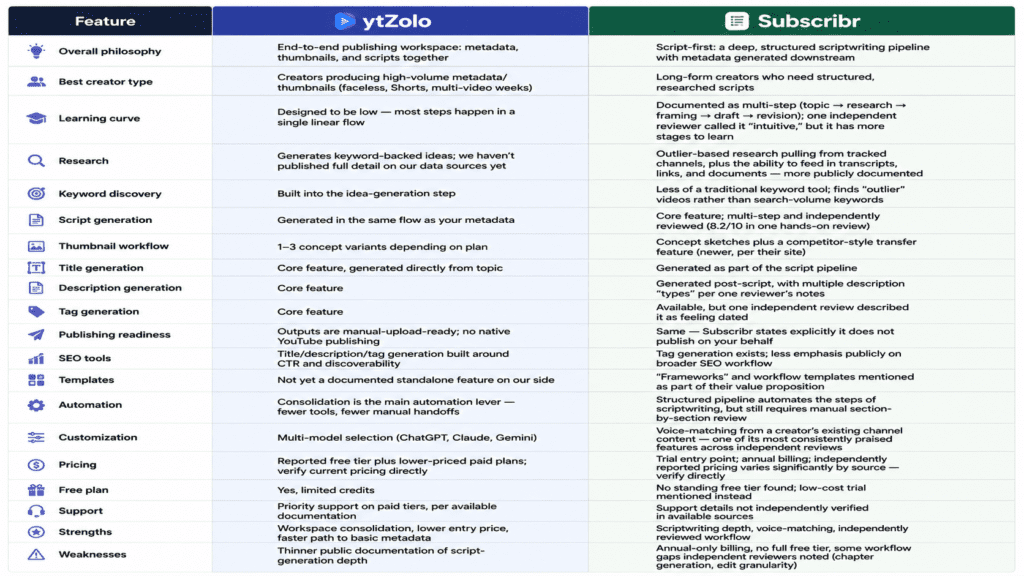
Quick Comparison Table
| Dimension | ytZolo | Subscribr |
|---|---|---|
| Overall philosophy | End-to-end publishing workspace: metadata, thumbnails, and scripts together | Script-first: a deep, structured scriptwriting pipeline with metadata generated downstream |
| Best creator type | Creators producing high-volume metadata/thumbnails (faceless, Shorts, multi-video weeks) | Long-form creators who need structured, researched scripts |
| Learning curve | Designed to be low — most steps happen in a single linear flow | Documented as multi-step (topic → research → framing → draft → revision); one independent reviewer called it “intuitive,” but it has more stages to learn |
| Research | Generates keyword-backed ideas; we haven’t published full detail on our data sources yet | Outlier-based research pulling from tracked channels, plus the ability to feed in transcripts, links, and documents — more publicly documented |
| Keyword discovery | Built into the idea-generation step | Less of a traditional keyword tool; finds “outlier” videos rather than search-volume keywords |
| Script generation | Generated in the same flow as your metadata | Core feature; multi-step and independently reviewed (8.2/10 in one hands-on review) |
| Thumbnail workflow | 1–3 concept variants depending on plan | Concept sketches plus a competitor-style transfer feature (newer, per their site) |
| Title generation | Core feature, generated directly from topic | Generated as part of the script pipeline |
| Description generation | Core feature | Generated post-script, with multiple description “types” per one reviewer’s notes |
| Tag generation | Core feature | Available, but one independent review described it as feeling dated |
| Publishing readiness | Outputs are manual-upload-ready; no native YouTube publishing | Same — Subscribr states explicitly it does not publish on your behalf |
| SEO tools | Title/description/tag generation built around CTR and discoverability | Tag generation exists; less emphasis publicly on broader SEO workflow |
| Templates | Not yet a documented standalone feature on our side | “Frameworks” and workflow templates mentioned as part of their value proposition |
| Automation | Consolidation is the main automation lever — fewer tools, fewer manual handoffs | Structured pipeline automates the steps of scriptwriting, but still requires manual section-by-section review |
| Customization | Multi-model selection (ChatGPT, Claude, Gemini) | Voice-matching from a creator’s existing channel content — one of its most consistently praised features across independent reviews |
| Pricing | Reported free tier plus lower-priced paid plans; verify current pricing directly | Trial entry point; annual billing; independently reported pricing varies meaningfully by source — verify directly |
| Free plan | Yes, limited credits | No standing free tier found; low-cost trial mentioned instead |
| Support | Priority support on paid tiers, per available documentation | Support details not independently verified in available sources |
| Strengths | Workspace consolidation, lower entry price, faster path to basic metadata | Scriptwriting depth, voice-matching, independently reviewed workflow |
| Weaknesses | Thinner public documentation of script-generation depth | Annual-only billing, no full free tier, some workflow gaps independent reviewers noted (chapter generation, edit granularity) |
Two Different Product Philosophies
It’s worth stating plainly instead of dressing it up: ytZolo and Subscribr were built to solve different first problems.
ytZolo’s philosophy is consolidation. The bet we made is that the biggest time cost in YouTube production isn’t any single task — it’s reformatting and re-pasting outputs between five separate apps (a keyword tool, a writing tool, a design tool, a tag generator, a notes doc).
So we built one workspace that generates titles, descriptions, tags, thumbnails, and a script draft from the same topic input, without you leaving the page.
Subscribr’s philosophy, based on its own documentation and the founder’s stated reasoning in public materials, is depth on one job: the blank-page problem in scriptwriting.
Their bet is that titles and tags are comparatively solved problems (lots of tools do them adequately), but going from “I have a topic” to “I have a structured, well-paced script in my voice” is the genuinely hard, underserved part — so that’s where they put the most product depth, with research ingestion, narrative framing, and voice-matching layered around the draft.
Neither philosophy is objectively better. A creator who already has a scriptwriting process they like, but loses an hour a week to manually pasting tags into YouTube Studio, is better served by ytZolo’s consolidation.
A creator who can write a serviceable title in thirty seconds but stares at a blank document for two hours trying to find the right hook is better served by Subscribr’s depth.
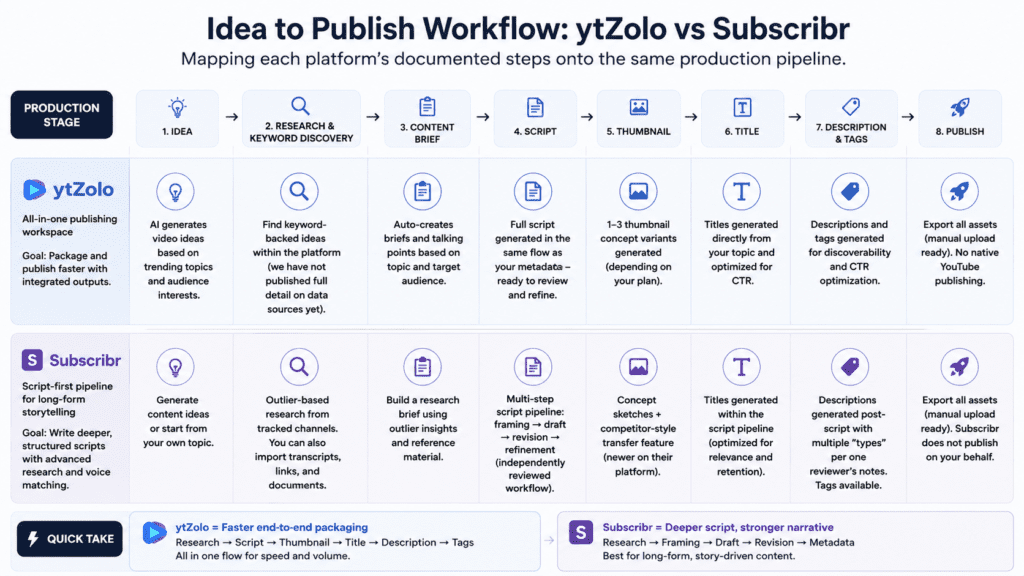
Workflow Comparison: Idea to Publish
Here’s how each platform maps onto the standard production pipeline, based on each company’s own documentation (and, for Subscribr, an independent hands-on review).
Idea → Research → Keyword Selection → Brief → Script → Thumbnail → Title → Description → Tags → Publish
ytZolo’s documented flow:
- Idea/Keyword: Enter a niche or topic; the tool surfaces keyword-backed video ideas in the same step.
- Brief/Script: Generated within the same workspace as your metadata — we have not yet published a detailed breakdown of the intermediate steps (research ingestion, drafting stages) the way Subscribr has.
- Thumbnail: Generate 1–3 concept variants depending on plan.
- Title/Description/Tags: Generated directly from the chosen idea, in the same flow.
- Publish: Manual upload to YouTube Studio — no native publishing integration.
Subscribr’s documented flow (per their site and an independent reviewer’s account):
- Idea: Outlier idea generator surfaces topics from videos outperforming the norm in a tracked niche.
- Research: Feed in up to 5,000 words of source material (web links, YouTube transcripts, your own notes); higher credit usage raises that limit.
- Brief/Framing: The tool suggests narrative angles to differentiate the video before drafting begins.
- Script: Full draft generated, then revised section-by-section (not sentence-by-sentence, per the same reviewer).
- Thumbnail: Concept sketches plus a competitor-style transfer feature.
- Title/Description/Tags: Generated after the script, with tags described by one reviewer as functional but somewhat dated.
- Publish: Manual upload — Subscribr explicitly states it does not publish on a creator’s behalf.
The honest summary: ytZolo’s flow is documented as flatter and faster to move through end-to-end because metadata and scripting happen in parallel rather than as sequential dependent stages.
Subscribr’s flow is documented as deeper at the script stage specifically, with more intermediate steps (research, framing, section revision) that take longer but, per independent review, produce a more deliberately structured draft.
How Many Handoffs Does Each Workflow Need?
We’re not going to assign this a made-up numeric score — a “Context Switching Score: 7.2/10” would just be a number we invented to look rigorous. What we can do honestly is describe where handoffs actually happen, based on documentation.
Within ytZolo: based on our own product design, the idea, title, description, tags, and thumbnail concepts are generated inside one workspace without exporting to another tool mid-process. The clearest external handoff is the final one: copying the finished metadata and assets into YouTube Studio to publish, since neither we nor Subscribr publish automatically.
Within Subscribr: per their documentation and the independent review we cited, the research, framing, drafting, and revision stages all happen inside their platform too — so script production itself doesn’t require leaving Subscribr either. The same external handoff applies at the end: manual upload to YouTube Studio.
Where handoffs are more likely for either tool, regardless of vendor claims: video editing (neither tool edits video), voiceover or recording (neither generates audio/video), and any deeper SEO/analytics work beyond basic keyword/tag suggestions, since neither platform is a full analytics suite like TubeBuddy or vidIQ.
So the realistic framing isn’t “ytZolo has fewer handoffs than Subscribr” — both are designed to minimize handoffs within their own scope. The difference is in scope: ytZolo’s scope spans more of the metadata pipeline simultaneously; Subscribr’s scope goes deeper into one part of it.
If your workflow needs both deep scripting and deep metadata generation handled without leaving a single tool, that combination isn’t fully documented as existing in either platform today.
Time to a Publish-Ready Video
We want to be careful here, because this is exactly the kind of section that tempts a vendor into making up impressive numbers. We’re not going to do that.
The only independently sourced timing data we found across either platform is from a hands-on Subscribr review, which reported most users finishing a first script in roughly 10–20 minutes inside Subscribr’s structured process, and a full script-plus-metadata package generated using about 6 credits in that reviewer’s test run.
We do not have independently verified timing data for ytZolo’s full workflow to compare against that figure, and publishing an estimate without that evidence would be exactly the kind of unsupported claim this comparison is trying to avoid.
What we can say honestly is that ytZolo’s design intent — generating metadata and a script draft in parallel rather than through sequential research-and-framing stages — is meant to reduce total time relative to a fully sequential, multi-stage process.
Whether that holds up against Subscribr’s documented timing, on a like-for-like video, is something we’d encourage you to test yourself using each platform’s free tier or trial, rather than take our word for it.
Which Tool Fits Which Creator Job
| Creator job | Better-supported choice (based on available documentation) |
|---|---|
| Publish 3 videos weekly | ytZolo’s parallel metadata-and-script generation is built to reduce per-video overhead across volume; Subscribr’s deeper per-script process may take longer per video but could reduce revision time on each one |
| Start a faceless channel | Both explicitly target this; ytZolo emphasizes bulk metadata and thumbnails, Subscribr emphasizes scaled scripting and voice-matching |
| Launch a finance channel | Subscribr’s research-ingestion (pulling source material like articles and data into scripts) is documented in more depth — useful for fact-heavy, source-dependent content. We don’t have equivalent published detail on ytZolo’s research depth |
| Grow a gaming channel | Either could work depending on whether your bottleneck is fast metadata/thumbnails per upload (ytZolo) or structured commentary/story scripting (Subscribr) |
| Scale an agency | Subscribr has more clearly documented multi-channel and multi-seat tiers. We support multi-channel use but haven’t published detailed agency-specific documentation yet — worth factoring in if agency tooling is your priority |
| Replace multiple AI tools | This is closer to ytZolo’s stated design intent — consolidating title, tag, description, and thumbnail generation that might otherwise live in separate tools |
| Increase production consistency | Subscribr’s voice-matching (training on existing channel content) is independently noted as a strength for consistency in tone across videos |
| Reduce editing time before publishing | Neither tool eliminates human editing — see What Neither Tool Does below. Subscribr’s section-by-section revision step is documented as helping structure the editing process; ytZolo’s faster generation may mean more raw editing per piece, since less time is spent on guided revision before output |
Costs That Don’t Show Up on the Pricing Page
These apply to both tools, not just Subscribr, and we’d rather flag them than let a sticker price be the whole story.
Learning curve: Subscribr’s multi-step process (research, framing, section revision) has more to learn upfront, per independent review, even though that same reviewer found it intuitive once underway. ytZolo’s flatter, more linear flow likely has a shorter learning curve, though we don’t have independent review data to confirm that the way we do for Subscribr.
Credit/usage management: Both platforms use credit systems. Independent reviews of Subscribr note that research depth and script length both consume credits, meaning heavy users may need to plan tier upgrades carefully. We’d encourage the same diligence with ytZolo’s credit allowances — check current limits on our pricing page before assuming a plan covers your weekly output.
Prompt/output rewriting: Neither tool’s output should be treated as publish-ready without a human pass. Independent reviewers of Subscribr noted they didn’t use generated scripts word-for-word even when satisfied with the structure. We’d say the same applies to ytZolo’s output — treat generated titles, descriptions, and scripts as a strong first draft, not a final copy.
Workflow fragmentation outside either tool’s scope: Video editing, voiceover, recording, and deeper analytics still require separate tools regardless of which platform you choose. Don’t expect either one to close that gap.
Annual billing commitment (Subscribr specific): Subscribr’s site states billing is annual-only. That’s a real cost consideration if you’re not sure the tool fits your workflow yet — there’s less flexibility to downgrade or cancel mid-year than with a monthly plan.
Real Creator Scenarios
Solo creator publishing weekly, mixed long-form and Shorts: Likely benefits from ytZolo’s consolidated metadata-and-thumbnail generation across formats, especially given our stated support for vertical/Shorts-specific outputs. If scripting depth becomes the bottleneck as the channel grows, Subscribr is worth evaluating specifically for that piece.
Small agency managing 4–6 client channels: Subscribr’s documented multi-channel, multi-seat tiers are a clearer fit today based on available documentation. We support multi-channel use, but haven’t published agency-specific workflow detail — worth a direct conversation with us if this is your situation.
Course creator (educational, long-form, source-heavy): Subscribr’s research-ingestion feature (pulling in PDFs, articles, and transcripts) is the better-documented fit for content that needs to cite or build on outside material accurately.
Gaming commentary channel, high upload frequency: Depends on bottleneck. If it’s mostly “I need a thumbnail and title fast for each clip,” ytZolo’s flow fits. If it’s “I need help structuring longer narrative or analysis videos,” Subscribr’s scripting depth fits better.
Finance channel: Accuracy and sourcing matter more here than almost any other niche. Subscribr’s documented ability to ingest source material directly into the research phase is relevant; we’d note that neither tool — ytZolo included — should be treated as a substitute for a creator’s own fact-checking on financial content specifically.
Podcast-to-YouTube repurposing: Neither platform is built specifically around podcast repurposing based on available documentation. Both could help with metadata and possibly scripting for accompanying YouTube-native content, but you’d still need a separate process for the audio/video conversion itself.
Documentary-style or narrative-heavy channel: Subscribr’s framing and voice-matching steps are the more directly relevant, independently reviewed features for narrative structure. This is arguably the closest match to what Subscribr was built for.
Business/brand channel managed by a marketing team: Either could work depending on team structure. If the team already has a scriptwriter and just needs faster metadata and thumbnails across many uploads, ytZolo’s consolidation fits. If the team needs scripting support itself, Subscribr’s deeper process is the better-documented option.
What Neither Tool Does
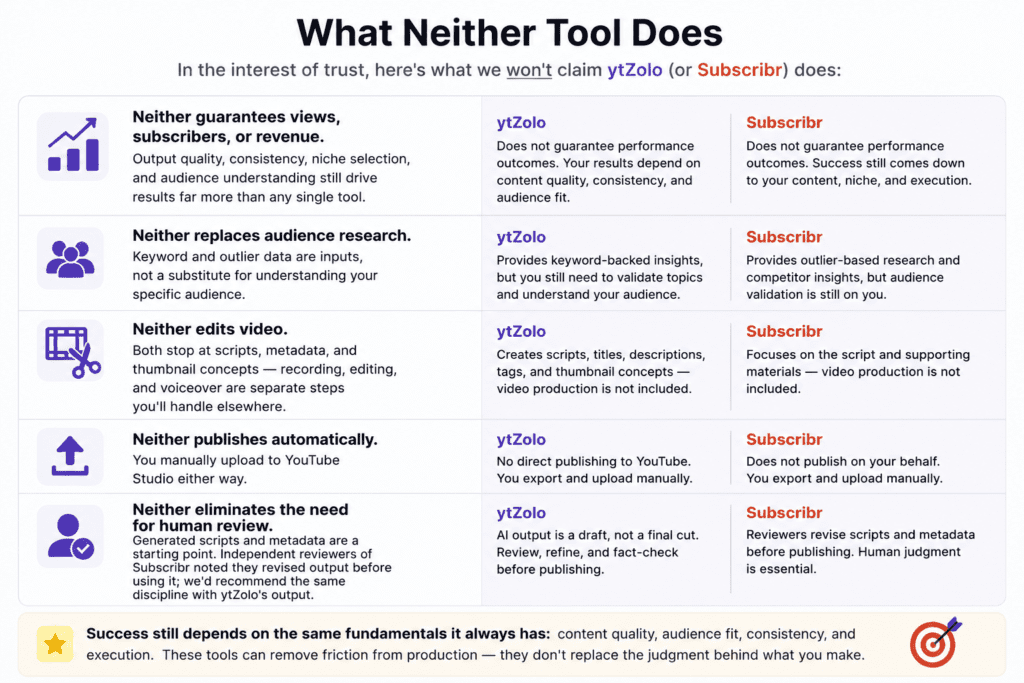
In the interest of trust, here’s what we won’t claim ytZolo (or Subscribr) does:
- Neither guarantees views, subscribers, or revenue. Output quality, consistency, niche selection, and audience understanding still drive results far more than any single tool.
- Neither replaces audience research. Keyword and outlier data are inputs, not a substitute for understanding your specific audience.
- Neither edits video. Both stop at scripts, metadata, and thumbnail concepts — recording, editing, and voiceover are separate steps you’ll handle elsewhere.
- Neither publishes automatically. You manually upload to YouTube Studio either way.
- Neither eliminates the need for human review. Generated scripts and metadata are a starting point. Independent reviewers of Subscribr noted they revised output before using it; we’d recommend the same discipline with ytZolo’s output.
Success still depends on the same fundamentals it always has: content quality, audience fit, consistency, and execution. These tools can remove friction from production — they don’t replace the judgment behind what you make.
How We’re Weighing This
We’re intentionally not publishing a weighted numeric scoring table (e.g., “Idea Generation: 8/10, Script Quality: 6/10”) here, because we don’t have evidence-backed scores for ytZolo across every category, and inventing them to look rigorous would undercut the honesty we’re aiming for in this piece. Instead, here’s our qualitative read, category by category, based on what’s documented for each platform:
- Idea generation: Comparable in stated intent; Subscribr’s outlier methodology is more publicly detailed.
- Research workflow: Subscribr is more documented (explicit source-ingestion limits and process); we haven’t published equivalent detail for ytZolo yet.
- Script quality: Subscribr has independent review evidence (8.2/10, specific praise and criticism); we don’t have comparable third-party evidence for ytZolo’s script feature today.
- Workflow efficiency (metadata + thumbnails): This is ytZolo’s strongest documented area — generation happens in parallel within one workspace.
- SEO workflow: Roughly comparable; both generate titles/descriptions/tags, neither is a full SEO analytics suite.
- Thumbnail workflow: Comparable on paper; Subscribr’s newer competitor-style-transfer feature is more advanced in description but less independently tested; ytZolo offers more limited variant counts at a reportedly lower price.
- Publishing readiness: Equivalent — neither publishes natively.
- Learning curve: Likely favors ytZolo’s flatter flow, though unconfirmed by independent review.
- Value: Depends entirely on which bottleneck you’re solving for; see Pricing below.
Pros and Cons
ytZolo
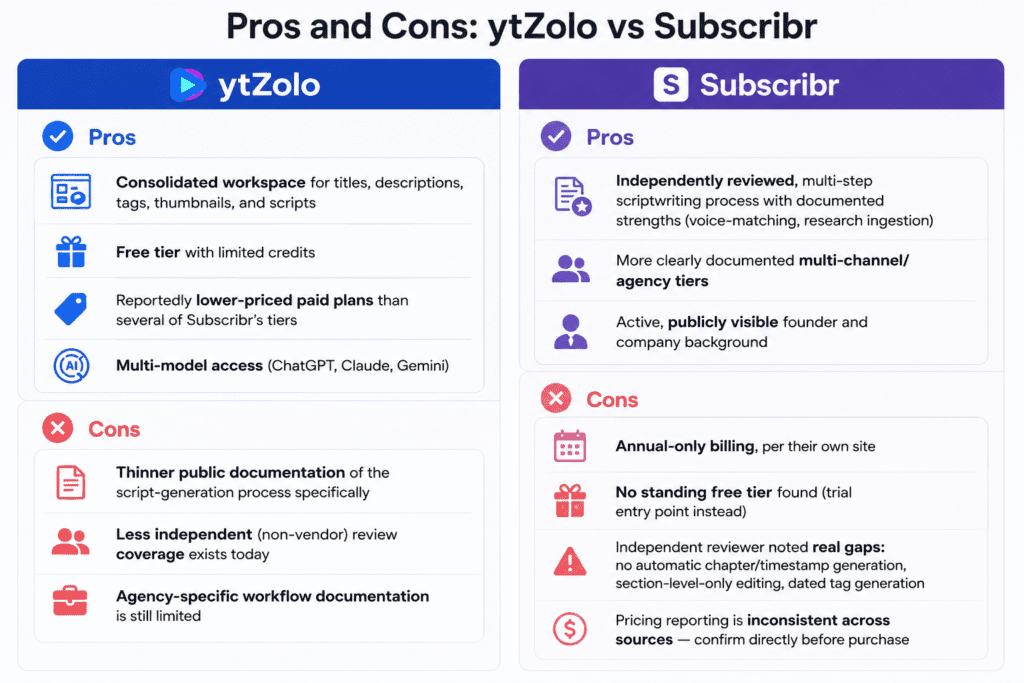
Pros:
- Consolidated workspace for titles, descriptions, tags, thumbnails, and scripts
- Free tier with limited credits
- Reportedly lower-priced paid plans than several of Subscribr’s tiers
- Multi-model access (ChatGPT, Claude, Gemini)
Cons:
- Thinner public documentation of the script-generation process specifically
- Less independent (non-vendor) review coverage exists today
- Agency-specific workflow documentation is still limited
Subscribr
Pros:
- Independently reviewed, multi-step scriptwriting process with documented strengths (voice-matching, research ingestion)
- More clearly documented multi-channel/agency tiers
- Active, publicly visible founder and company background
Cons:
- Annual-only billing, per their own site
- No standing free tier found (trial entry point instead)
- Independent reviewer noted real gaps: no automatic chapter/timestamp generation, section-level-only editing, dated tag generation
- Pricing reporting is inconsistent across sources — confirm directly before purchase
Pricing
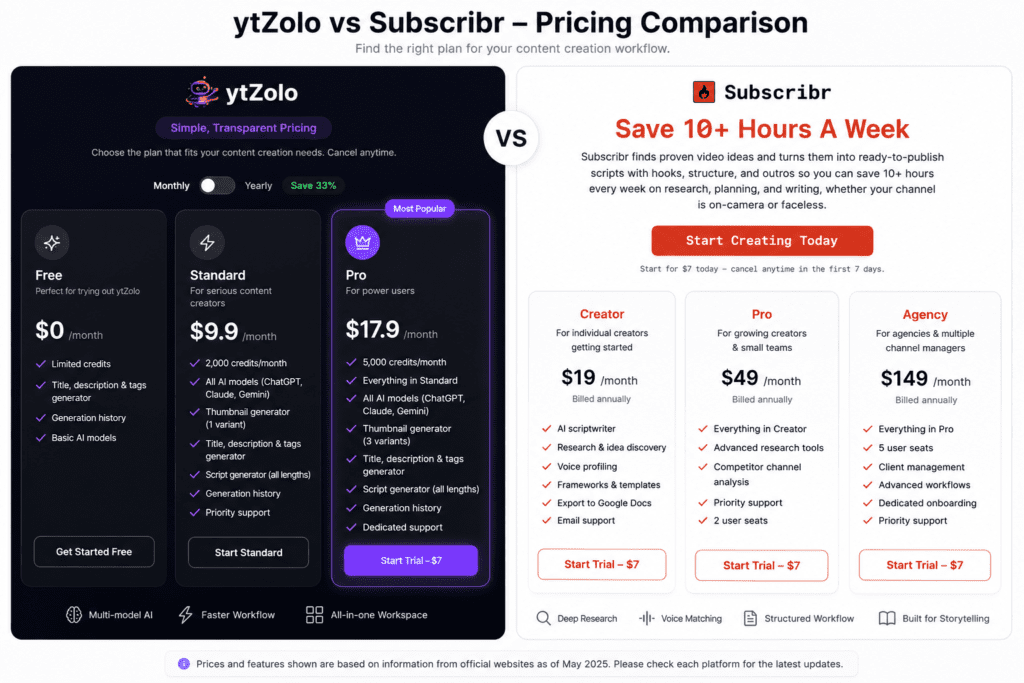
ytZolo offers a free tier with limited credits and paid plans intended to stay accessible for individual creators. Please check our current pricing page for exact numbers, since plans and credit allowances are updated periodically.
Subscribr’s pricing is genuinely harder to pin down from public sources: their site mentions a low-cost trial entry point and states billing is annual-only; independent reviews and marketplace listings (including past AppSumo lifetime-deal tiers) report a wide range of monthly-equivalent prices. Rather than repeat numbers we can’t fully reconcile, we’d point you to subscribr.ai’s current pricing page directly.
Final Recommendation
There’s no universal winner here, and we don’t think pretending otherwise would serve you. If your production bottleneck is the number of tools and exports between “I have an idea” and “I have publish-ready metadata and a thumbnail,” ytZolo’s consolidated workspace is built around exactly that problem, and our free tier is the lowest-friction way to test it against a real video you’re planning.
If your bottleneck is specifically the script — getting from a topic to a structured, well-paced, voice-matched draft — Subscribr currently has the more mature, independently reviewed process for that specific job, and that’s worth acknowledging plainly rather than trying to talk you out of it.
The most useful next step isn’t reading more comparisons — it’s running one real video idea through each platform’s free tier or trial and judging the output against your own channel’s voice and your own time.
FAQ
Is ytZolo better than Subscribr? It depends on your bottleneck. For consolidated metadata and thumbnail generation, ytZolo’s workspace is built around that. For deep, independently reviewed scriptwriting specifically, Subscribr currently has more documented strength.
Which is better for beginners? If budget and a flat learning curve matter most, ytZolo’s free tier and linear flow are a lower-friction starting point. If you specifically struggle with scriptwriting rather than metadata, Subscribr’s guided process may help more, despite a steeper learning curve and higher reported price.
Which tool writes better scripts? Based on available evidence, Subscribr — its scripting process has independent review coverage (including a specific 8.2/10 score and named strengths/weaknesses) that ytZolo’s scripting feature doesn’t yet have publicly.
Does ytZolo include thumbnail generation? Yes — 1 to 3 concept variants depending on plan tier, per available documentation.
Does Subscribr include thumbnail generation? Yes — concept sketches plus a newer competitor-style-transfer feature, per their own site.
Can Subscribr replace ChatGPT? Not entirely. Subscribr is a YouTube-specific layer that gives access to several underlying models (including ones from OpenAI and Anthropic, per their site) rather than being a general-purpose chatbot replacement.
Can ytZolo replace ChatGPT? Same answer — we provide access to multiple models (ChatGPT, Claude, Gemini) for YouTube-specific tasks, not a general-purpose chatbot replacement.
Which platform is better for YouTube SEO? Roughly comparable on paper — both generate titles, descriptions, and tags. Neither is a dedicated SEO analytics suite like TubeBuddy or vidIQ.
Which saves the most time? We don’t have independently verified timing data for ytZolo to compare directly. The only independently sourced figure available is Subscribr’s reported 10–20 minutes for a first script. We’d encourage testing both on a real video rather than relying on either vendor’s time-saving claims, including ours.
Which tool is better for faceless YouTube channels? Both explicitly target this audience. ytZolo’s strength is bulk metadata/thumbnail generation; Subscribr’s strength is scaled, voice-matched scripting.
Which is better for agencies? Subscribr currently has more clearly documented multi-channel and multi-seat tiers. We support multi-channel use but haven’t published detailed agency workflow documentation yet.
Do either tools publish directly to YouTube? No. Neither platform publishes on your behalf — both require manual upload through YouTube Studio.
Is there a free plan for either tool? ytZolo offers a free tier with limited credits. We did not find a standing free tier for Subscribr — their site instead mentions a low-cost trial entry point.
Which tool has more independent (non-vendor) reviews? Subscribr, by a meaningful margin. We’re stating this plainly because we think it matters for your decision, even though it’s not flattering to us.
What should I actually do before choosing? Run one real video idea through each platform’s free tier or trial, and compare the output against your own channel’s voice — not against either company’s marketing claims.
Questions about whether ytZolo fits your specific workflow? Contact us — including if the honest answer is that Subscribr or another tool is a better fit for what you need right now.

