
How Does the YouTube Algorithm Actually Decide What to Recommend in 2026? The system prioritizes topics of interest to you, analyzes your viewing history and the performance of the videos you watch, and learns which creators to recommend based on your satisfaction.
While the algorithm uses an extensive list of criteria, it does not rank the creators you watch the most based on a simple metric.
The knowledge of how the system works can help you optimize your content based on the most popular topics, titles, and thumbnail styles.
This article aims to present factors that have an impact on what people are going to choose and how the creators can use the available data, including the YouTube Analytics tool, to identify and confirm the existing hypotheses about the algorithm’s work, excluding unsubstantiated assumptions about the so-called inner workings of the system.
Creators who want to turn these recommendations into a practical content strategy can also explore how to get more views on YouTube using AI, which covers practical approaches to video discoverability.
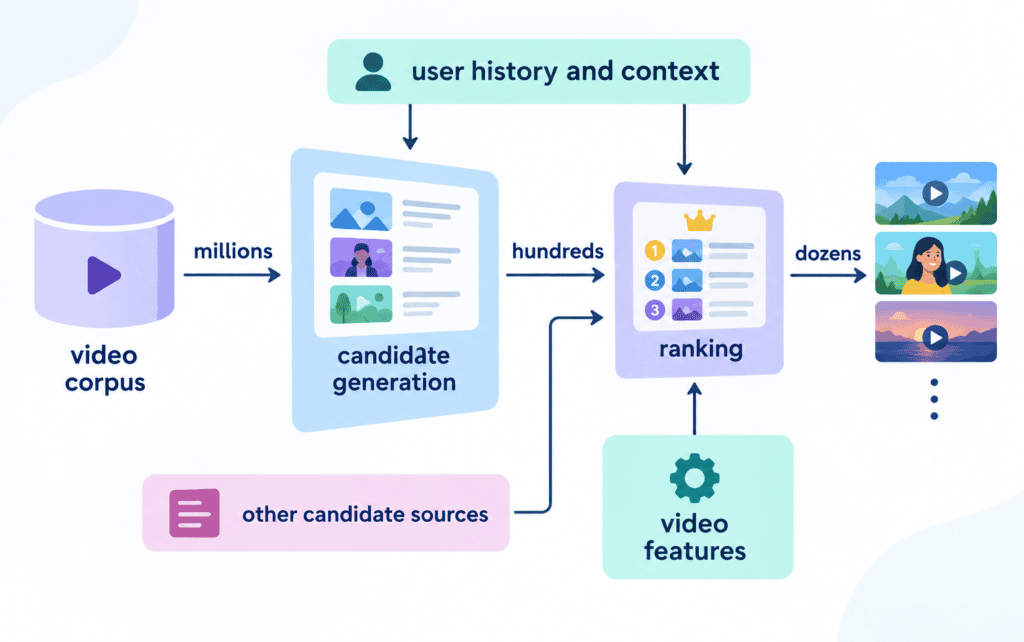
Table of Contents
What YouTube Is Trying to Predict When It Recommends a Video
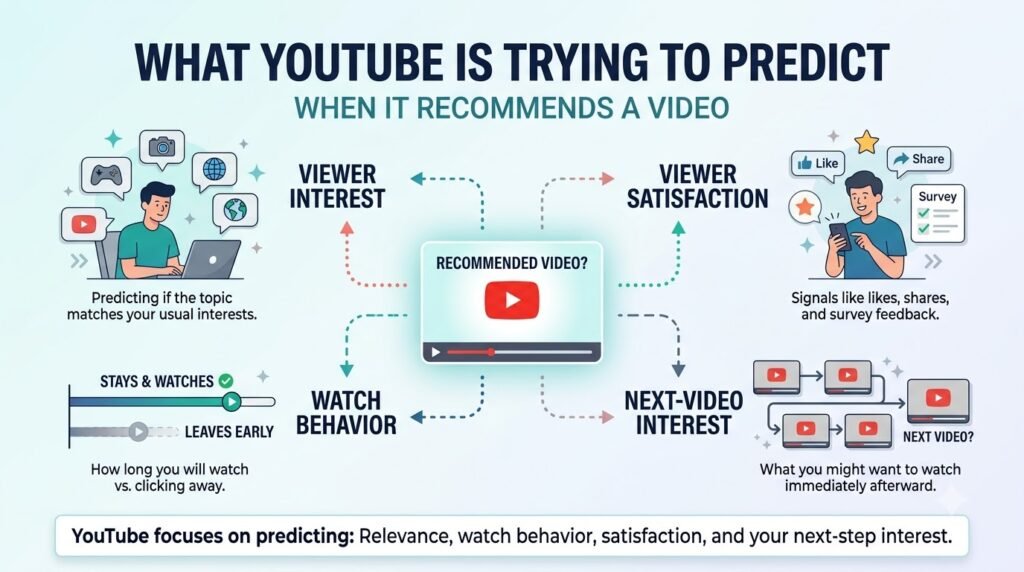
YouTube’s recommendation system has two central goals: helping viewers find videos they want to watch and maximizing long-term viewer satisfaction. The system considers viewer preferences and how people respond to content when it appears in front of them.
According to YouTube’s official recommendation system documentation, recommendations are personalized. The same video can be a strong match for one viewer and a poor match for another.
Imagine two people opening YouTube on the same evening.
One regularly watches beginner photography tutorials. The other spends most of their time watching football analysis. A new video about camera settings may be relevant to the first person but not the second.
The video itself hasn’t changed. Its relevance depends on who is watching, what they’ve enjoyed previously, and what they might want to watch next.
This is why creators shouldn’t think of the algorithm as a single scoreboard where every video competes under identical conditions. YouTube is trying to predict individual viewing preferences.
How Viewer History and Interests Shape Recommendations
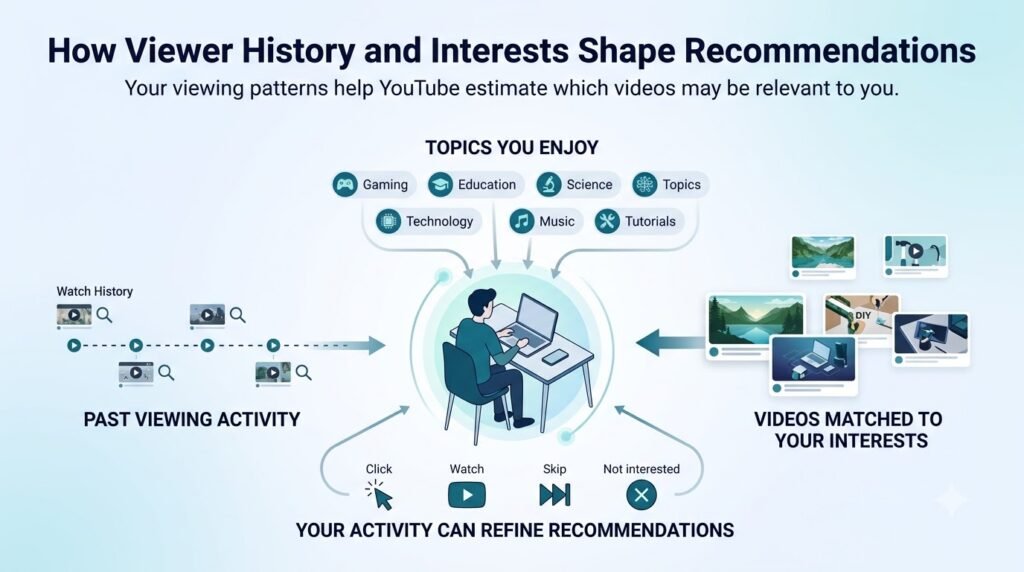
YouTube uses information about viewers’ previous activity to estimate what they might enjoy. Its official explanation of recommendations identifies several important signals.
- Watch history: Videos a person has watched help establish their interests and viewing habits.
- Search history: Topics a person searches for can inform future recommendations.
- Subscriptions: Channels a viewer follows provide useful context about their interests.
- Likes and dislikes: Positive and negative feedback helps the system understand preferences.
- Explicit feedback: Selecting “Not interested” or “Don’t recommend channel” helps YouTube find content that a viewer wants to avoid.
- Satisfaction surveys: Feedback collected after viewing helps YouTube understand satisfaction beyond viewing time alone.
The importance of individual signals can vary depending on the recommendation surface and situation. YouTube doesn’t publish a fixed weighting formula for every signal.
Once you’ve identified the audience and topic, use this YouTube SEO checklist for 2026 to review the video elements you can control before publishing.
Why two viewers can see different recommendations
Suppose a creator publishes a tutorial explaining how to edit travel videos.
A viewer who watches travel filmmaking, camera reviews, and editing tutorials may find it relevant. Another viewer who mainly watches cooking videos may never encounter it on their Home page.
That doesn’t automatically mean the second viewer’s recommendation system has judged the tutorial to be low quality. It may simply be a weaker match for that person’s interests.
For creators, this poses a practical challenge: to find the audience that will really benefit from this particular video, and make sure the topic and presentation are clear enough for those individuals to recognize them as valuable.
The Three Types of Video Performance YouTube Describes
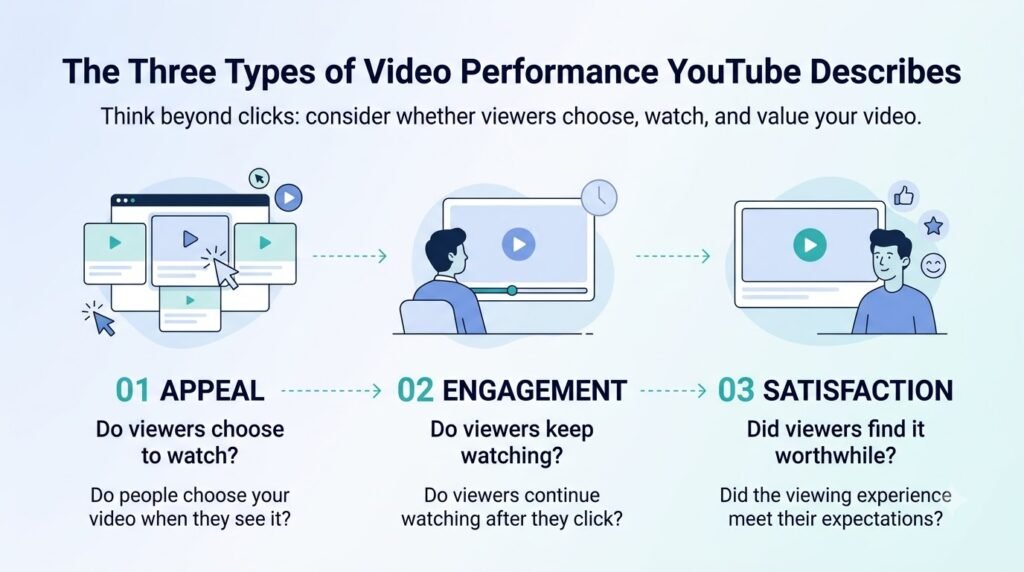
YouTube’s current documentation classifies content-performance signals into three categories: appeal, engagement, and satisfaction. This classification allows the company to appropriately interpret user reactions without attempting to quantify them as ranking factors.
1. Appeal: Do viewers choose to watch?
Appeal deals with what happens when a viewer is presented with a video. Are they persuaded to watch, ignored, or have demonstrated that they are not interested?
Titles and thumbnails can influence a viewer’s decision to watch your video. A good title informs the viewer what they will find in the video, and a good thumbnail tells them why they should be interested.
When reviewing a video’s packaging, compare the promise made by its title with the image viewers see. This guide to YouTube thumbnail optimization provides additional ideas for making that presentation clear and relevant.
A good example of a title would be “Fix Blurry Photos in Five Minutes.” This tells the viewer what problem the video will help them solve. A title like “My New Camera Setup,” on the other hand, would be less likely to attract potential viewers hoping to fix their blurry photos.
The goal is not to make the title sound exciting, but rather to help the right viewers understand what they’re going to get in the video.
A clear title should describe the video’s actual value rather than promise an outcome the content can’t deliver. For more practical guidance, see this guide to YouTube SEO titles and descriptions.
2. Engagement: Do viewers continue watching?
Engagement rate suggests the degree to which viewers are responding after getting exposed to a video. In this metric, YouTube analyzes the behavioral patterns of viewers by measuring such indicators as watches time and percentage viewed.
In this case, a metric that characterizes a larger portion of the video watched by viewers and average time is applied. However, a long tail is not necessarily always better than a short one, and high retention does not always mean that wider distribution will be achieved.
For example, let’s take two tutorial videos, one of which is four minutes and displays a brief explanation of a particular answer, while the other one is 18 minutes and demonstrates the editing process step by step.
Therefore, comparing two YouTube videos’ retention in percentage may be irrelevant if their purposes are different, and it would be fairer to examine if both deliver the expected experience to their target audiences.
3. Satisfaction: Was the viewing experience worthwhile?
Watching a video for a long time doesn’t necessarily mean someone enjoyed it. A viewer might stay because the answer is taking too long to appear, or leave early because they received the information they needed.
YouTube’s recommendation documentation reveals that satisfaction features as a component of the system’s overarching goal. Signals such as survey responses and viewer feedback help it understand whether people felt a video was worth watching.
Creators can’t see every factor behind an individual recommendation decision. They can, however, look for evidence that their videos meet the expectations set by their topics, titles, thumbnails, and openings.
The lesson to be gathered from this is simple: draw in the right audience, and provide the promised value in such a way as to make them feel that their time has been well spent.
Why Home, Suggested Videos, and Shorts Can Produce Different Results
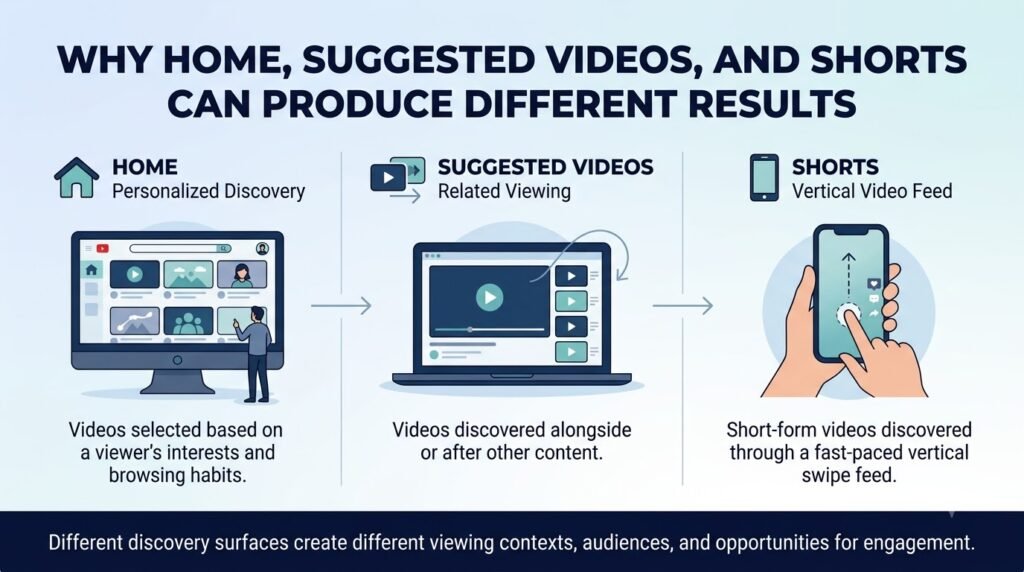
YouTube doesn’t use every recommendation surface in exactly the same way. Each surface serves a different viewing context, so the signals that matter most can vary.
| Recommendation surface | What shapes the viewing context | What creators should consider |
| Home | A personalized selection informed heavily by viewing history and interests | Make the topic relevant to the audience you want to reach |
| Suggested videos / Up Next | The video currently being watched and the viewer’s preferences | Create content that is relevant to the interests surrounding your topic |
| Shorts feed | A personalized stream of short-form videos | Deliver the idea quickly and make the viewing experience fit the format |
| YouTube Search | The viewer’s query and the relevance of available videos | Answer the specific question or need behind the search |
These distinctions follow YouTube’s official explanation of recommendations and its search and discovery guidance.
Why a video may perform well in Search but not on Home
Search and Home serve different purposes.
Someone searching for “how to replace a laptop battery” has a specific task in mind. A clear tutorial can satisfy that need even if the person has never watched the creator’s other videos.
Home recommendations are more personalized. A video may need to match the interests and viewing patterns of people who encounter it there.
This means strong search traffic doesn’t guarantee equally strong Home recommendations. The audiences and reasons for watching may differ.
Why Shorts views don’t automatically translate into long-form views
YouTube can use a viewer’s interests across different formats, including Shorts, long-form videos, and livestreams. However, a person’s preference for one format doesn’t guarantee that they’ll watch another.
Someone might enjoy a 30-second editing tip but have no interest in a 20-minute editing tutorial.Another viewer may appreciate the elaborate explanation.
The creators can experiment with both, but they should evaluate every video based on its specific goals and audience rather than attempt to assume that one approach will automatically complement or improve the other.
Why Good Videos Can Still Receive Fewer Impressions
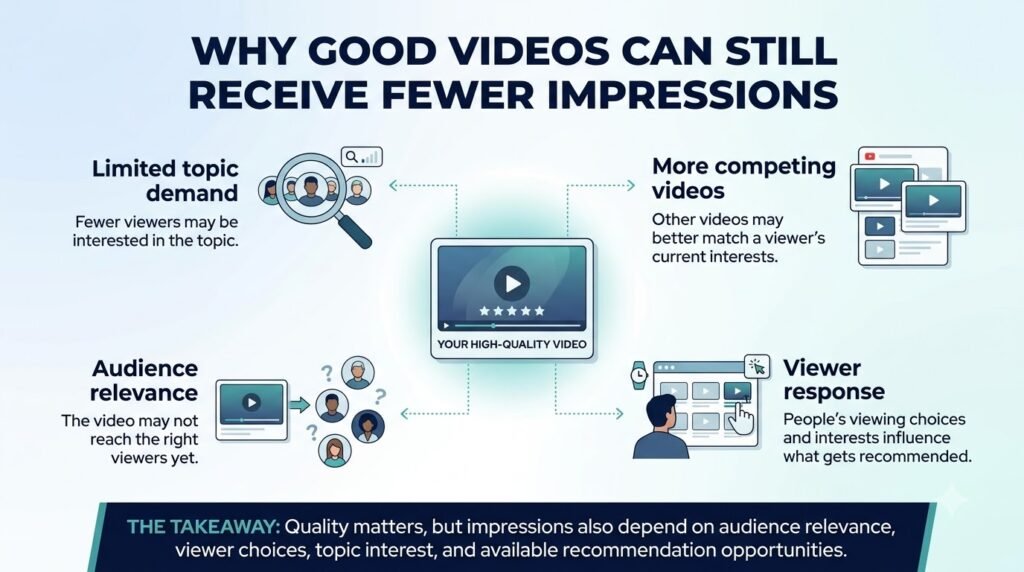
One of the most confusing situations for the creators is when the video got a decent CTR and engagement but still underperformed in terms of impressions.
YouTube algorithm has three main external factors that impact how many people can see your video and what video choices they have available at the time.
These factors are topical interest, competition, and seasonality.
Topic interest
Some topics tend to perform better than others, and it can vary both depending on the vertical and the time of the year.
For example, a tutorial for a software product release would resonate much better during the launch period than a year after the product launch. A very specific hardware question might have a tiny audience but still be viable for a long time.
One should not be surprised if their video underperforms due to topical interest.
Before choosing a topic, examine the questions your intended audience is asking and distinguish search demand from broader viewer interest. This guide to YouTube video SEO keywords explains how keyword research fits into video discovery.
Competition
YouTube recommendations are not evaluated only against a creator’s previous uploads. The system also considers other videos that a viewer might want to watch.
Imagine your video receives a 6% click-through rate and holds viewers reasonably well. Another video competing for the same audience might offer a more relevant answer or a viewing experience that those people prefer.
Your video could receive fewer impressions even though its metrics look healthy compared with your channel’s usual results.
A useful starting point is YouTube’s official guidance on external recommendation factors.
Seasonality
Viewer activity and preferences vary year-round. Holiday videos, school lessons, sports, and seasonal recipes should see a shift in traffic at a certain point.
Compare your topic’s popularity at the time of the high views to the current level. If that didn’t help the channel grow, it’s not a good sign for its future.
What Creators Can Actually Learn From YouTube Analytics
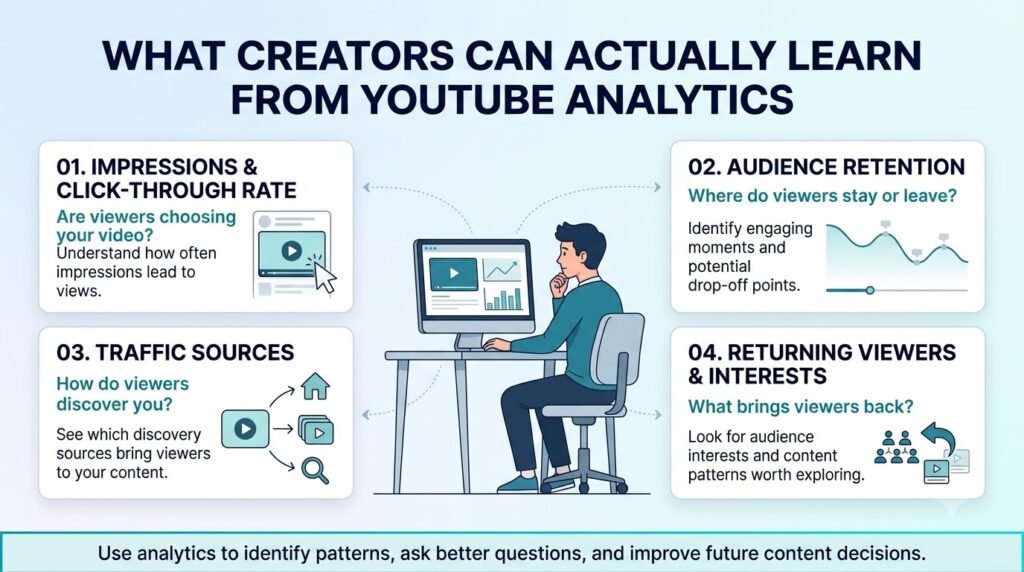
YouTube Analytics doesn’t reveal the complete internal recommendation formula. It does provide evidence about how viewers discover and respond to videos.
The most useful approach is to connect each metric to a specific question rather than treating one number as a complete explanation.
Start with traffic sources
YouTube’s analytics tool will not show you the exact calculation. It does give you evidence of the algorithm’s work.
The best way to get results is to ask these questions about a metric instead of looking for a single number that explains everything.
Interpret impressions and click-through rate together
Impressions tell how many times your YouTube’s video thumbnail was displayed on eligible pages, whereas, click-through rate (CTR) represents the percentage of users who saw your video and decided to watch it after being impressed.
However, a CTR should not be seen in a vacuum since it may significantly change depending on what traffic sources bring you viewers, what topics are promoted, and other factors.
Therefore, comparing an increase or decrease in CTR from one video to another without considering the former’s traffic sources and overall viewership is misleading.
For instance, if a video initially gains some traction only with a specific group of viewers, its CTR can decrease if a more significant amount of engagements come from other users who are not interested in the promoted material.
It does not mean that a low CTR always indicates a problem, so a change in the metric should be considered with care and other data such as traffic sources and a video’s general performance.
Use retention to investigate specific moments
Audience retention can sometimes tell us why people are abandoning our videos or rewatching them from specific points. But it’s not always clear exactly what keeps viewers engaged or drives them away, so use this graph as a jumping-off point to investigate.
Watch the portion of the video that corresponds to an unexpected drop in retention and see if the video repeats concepts, reveals answers too late, or uses transitions to jump abruptly to a new topic without sufficient context.
For a step-by-step method, read how to read YouTube Analytics retention graphs.
Compare similar videos rather than chasing a universal benchmark
A six-minute tutorial, a 25-minute interview, and a 20-second Short serve different purposes. Their performance should be interpreted in context.
Compare videos with similar formats, topics, audiences, and traffic sources when possible. Look for recurring patterns rather than reacting to every fluctuation.
The goal is to find a useful explanation and test an improvement, not to force every video to meet one arbitrary target.
A Practical Way to Make Videos More Relevant to the Right Audience
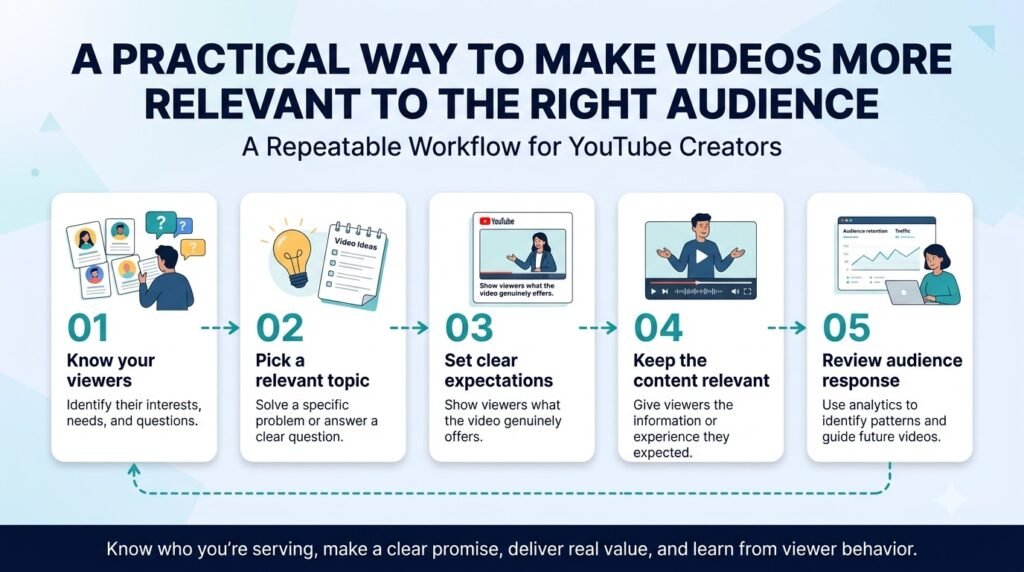
Understanding recommendations is useful only when it changes your decisions. The following workflow focuses on choices creators can control without pretending to reverse-engineer YouTube’s internal systems.
Step 1: Define the viewer and the need.
Before creating your video, define your target audience and identify the specific question, task, or interest that they have that your video will address. A focused understanding of a specific viewer need will give more direction to your video concept than a general topic.
When you’re planning the next upload, use audience questions to develop related topics rather than repeating the same video. This guide on generating YouTube video ideas from keywords offers a practical starting point.
Step 2: Determine if the topic has an audience.
Analyze YouTube’s suggested search terms, similar videos, audience responses, and topics that viewers are watching to identify if there is an ongoing interest in your topic. Define if the topic is timely or of ongoing interest.
Step 3: Ensure the title and thumbnail are accurate.
Commit to delivering on the promise of the title and thumbnail. The click is earned by being specific about the value delivered.
Step 4: Deliver value up front.
Get to the point and provide the information, example, or story that justified the click as quickly as possible. Do not waste the viewer’s time.
Step 5: Evaluate in context.
After publishing, analyze the sources of traffic, impressions, CTR, and engagement. Define one issue to solve based on the findings instead of attempting to make changes across the board.
Step 6: Apply insights to the next video.
If the data demonstrates that viewers are not watching beyond a certain point, experiment until you find an effective introduction. If the Search traffic is demonstrating that the video is attracting the desired audience, define a new question that the same viewers will want answered.
A content workflow tool like ytZolo will assist with the planning and preparation phases of the process by providing script, title, description, thumbnail, and video creation tools like the Audio Studio features. However, the tool cannot predict the YouTube algorithm or guarantee that any given video will be recommended.
YouTube Recommendation Myths That Need More Context
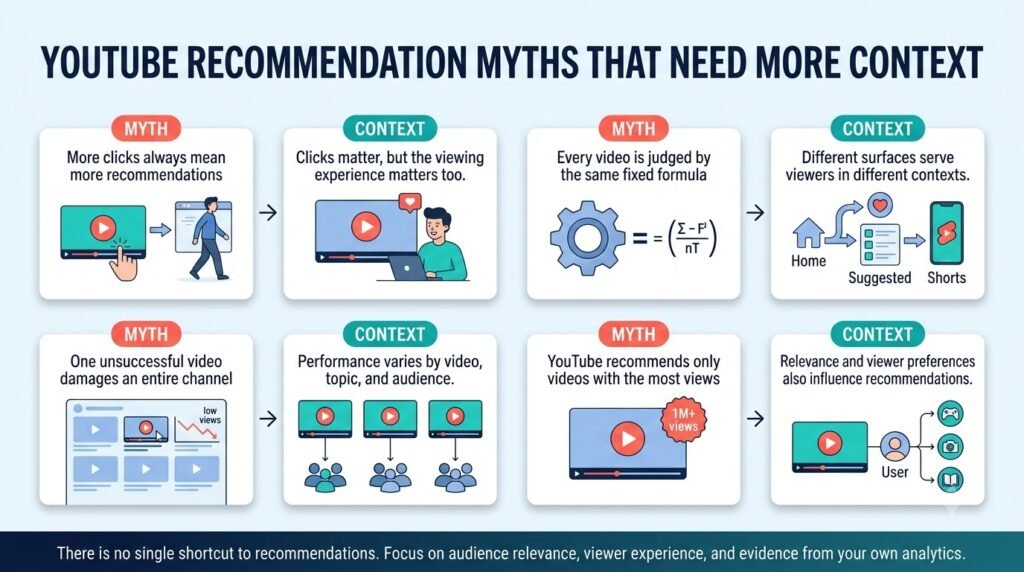
Several myths concern the algorithm of the recommendation system.
Myth: The more often a person uploads videos to their YouTube account, the more recommendations they get.
The platform encourages users to publish content with a sincere attitude rather than a concentrated desire to increase the number of uploads. Although the regularity of uploading videos helps the audience understand what to expect from the, it does not guarantee the same result in terms of recommendations.
Myth: One bad video can destroy everything. YouTube rules out the possibility that an unsuccessful video will damage the entire channel.
A video that has nothing to do with the audience is not a disaster, but continuous publication of such content can have an adverse effect on the recommendations.
Myth: A high click-through rate (CTR) guarantees an increase in views. One should consider several factors when determining the CTR.
Attracting new viewers is only one step in the YouTube success equation. One should remember about the relevance of the published content, the existing level of competition, the interests of a specific audience, and many other factors.
Myth: Tags are crucial for videos to appear in recommendations.
Tags have been given a lot of importance since the early days of the service, but in reality, their importance is quite minimal. They are needed to fix common misspellings of words that occur in video titles. To ensure that videos are discovered by exactly the people who are interested in the content described in the video, it is necessary to provide an accurate title, image, and description.
Myth: The presence of Shorts is destroying recommendations for other formats.
The situation where Short videos block Long-Form Videos does not exist because the system can recommend both formats at once. Of course, there is always the option to stop showing Shorts to those who do not want to watch them.
For further clarification, consult YouTube’s recommendation guidance and frequently asked questions.
Frequently Asked Questions
Does YouTube recommend videos based on watch time?
No. YouTube takes into account a variety of factors. While watch time can influence a recommendation, it is only one piece of the puzzle.
How does YouTube decide which videos to recommend on your homepage?
The recommendation algorithm on your homepage is built around your preferences and viewing habits. You may see different videos than your friends because everyone has different preferences.
Why are my videos no longer recommended?
Your videos might be getting fewer recommendations because of changes in your content, topics, or timing. Other creators’ content may also be affecting your recommendations. A drop in recommendations does not necessarily mean that a video is being penalized.
Does the time that I post affect long-term recommendation?
According to the official documentation, YouTube does not believe that time posted has an effect on recommendations. The timing of a video can affect its performance, especially with regards to live streams and premieres. This is due to the audience being available to watch the video.
Can my smaller channel ever hope to be recommended?
Recommendations are designed to help videos reach viewers who are interested in their content. A short subscriber count does not dictate if a channel or video can be recommended. Someone’s channel can appear in the recommendations with a small subscriber count if the audience is interested in watching.
How Does the YouTube Algorithm Actually Decide What to Recommend in 2026?
YouTube recommends videos based on each viewer’s interests, watch history, and how they respond to content. It considers signals such as whether people choose to watch, how long they stay, and whether they seem satisfied. Recommendations also vary by surface, including Home, Suggested videos, and Shorts, so strong performance does not guarantee more impressions.
Don’t subscribers to my channel count towards views?
Subscribers can help a channel’s visibility, however not everyone will watch every video that comes out. It depends on the viewer and their decisions to watch or not watch a video.
Conclusion: Focus on the Viewer, Not a Secret Formula
The answer to how does the YouTube algorithm actually decide what to recommend in 2026 comes down to three connected ideas: personalization, content performance, and external factors such as competition and topic interest.
Creators can’t control or understand every recommendation and nuance of signals. They can make videos with a clearly defined audience in mind, communicate their value honestly, fulfill their claims, and analyze viewer behavior.
Start with one recent video. Look at its traffic sources, impressions, CTR, and retention, and formulate one question for the next publication to test the hypothesis.
That gives you a more reliable basis for improving your content than chasing a supposed algorithm trick.
Author Bio
About the author: Anshika Verma is a content researcher and writer at ytZolo, specializing in YouTube strategies, AI creator tools, and evidence-based insights for content creators.

