
Choosing between an MCN and an independent YouTube channel can affect how you manage revenue, brand partnerships, content rights, and daily operations.
A multi-channel network (MCN) offers services to YouTube creators in exchange for an agreed business arrangement, which may include a share of creator revenue.
An independent creator manages these relationships directly and chooses which services or specialists to hire.
But neither option is automatically better.
An MCN can provide useful support when it offers services that would be difficult or expensive to manage independently. Staying independent can offer greater flexibility when you already have the people, tools, and systems needed to run your channel.
In this guide, we’ll compare MCNs and independent YouTube creators in 2026, including revenue sharing, brand deals, channel control, contracts, and monetization. You’ll also learn how to evaluate an MCN before signing an agreement.
For example, creators can use platforms such as ytZolo to streamline parts of their YouTube content workflow, reducing the need to rely on an MCN for every operational task.
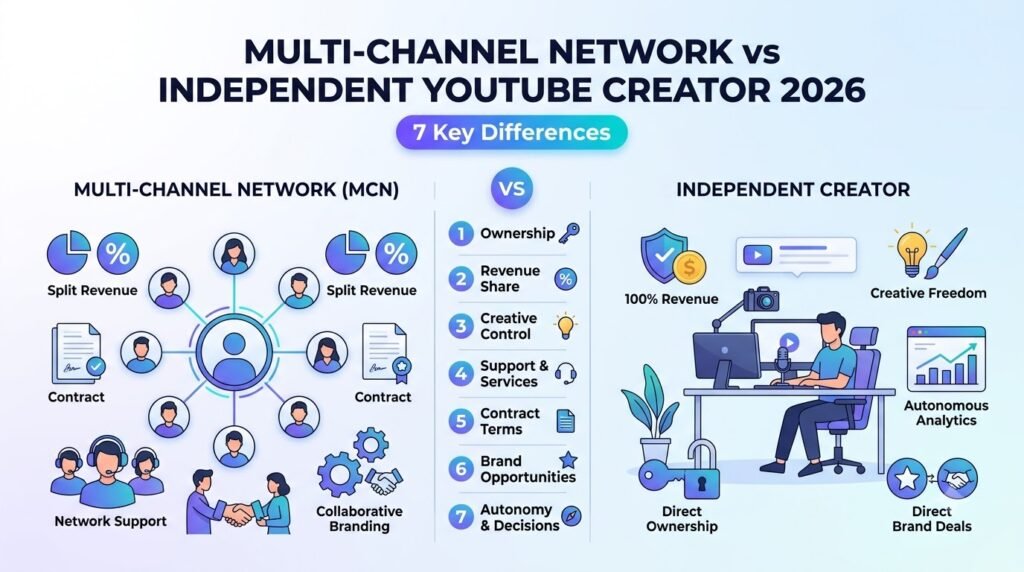
Table of Contents
Quick Answer: Should You Join an MCN or Stay Independent?
An MCN may be a good choice if you need services such as rights management, brand-deal support, creator partnerships, or centralized channel operations.
Staying independent may be more practical if you already manage your channel, production, sponsorships, and business operations yourself.
Compare the network’s actual services, revenue share, contract terms, and exit conditions before deciding.
What Is a YouTube Multi-Channel Network (MCN)?
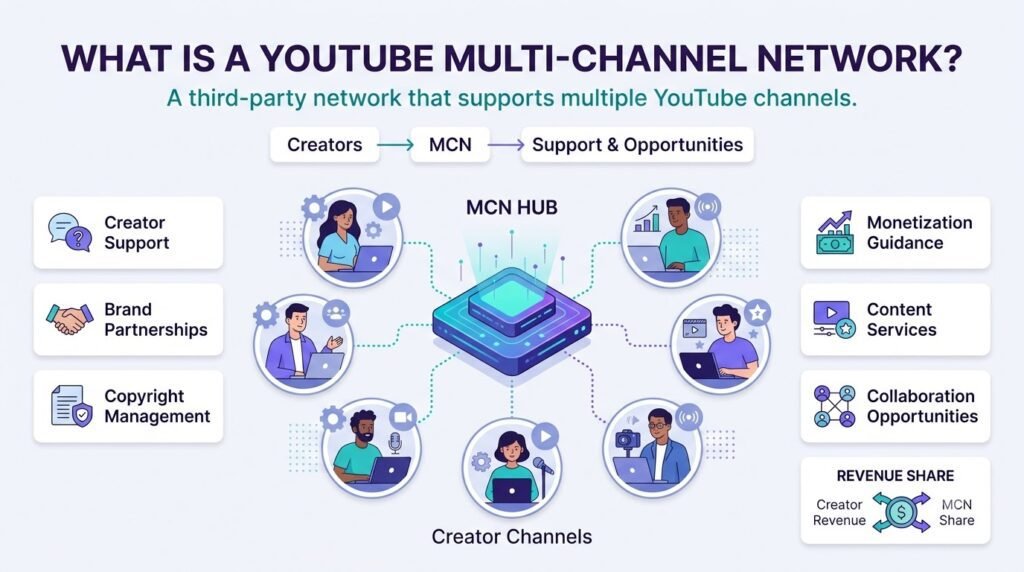
A multi-channel network (MCN) is a third-party service provider that affiliates with multiple YouTube channels and may offer services such as audience development, creator collaborations, digital rights management, monetization support, and sales.
MCNs operate independently of YouTube. They are not a requirement for joining the YouTube Partner Program or earning money from a channel.
According to YouTube, MCNs generally work with two types of channels:
Affiliate Channels
Affiliate channels remain creator-operated channels connected to an MCN’s network. Creators maintain their own relationship with YouTube through the applicable YouTube Partner Program terms while also having an operational relationship with the network.
Owned and Operated Channels
Owned and Operated (O&O) channels are obtained and actively operated by the partner, which has exclusive rights to the channel’s YouTube content under the relevant arrangement.
These two structures are different, so creators should understand which arrangement an MCN is offering before signing.
Not every MCN provides the same services. Some focus on rights management, while others offer brand sales, production support, or channel operations.
The value of joining depends on the actual services, contractual obligations, and costs involved.
What is an independent YouTube creator?
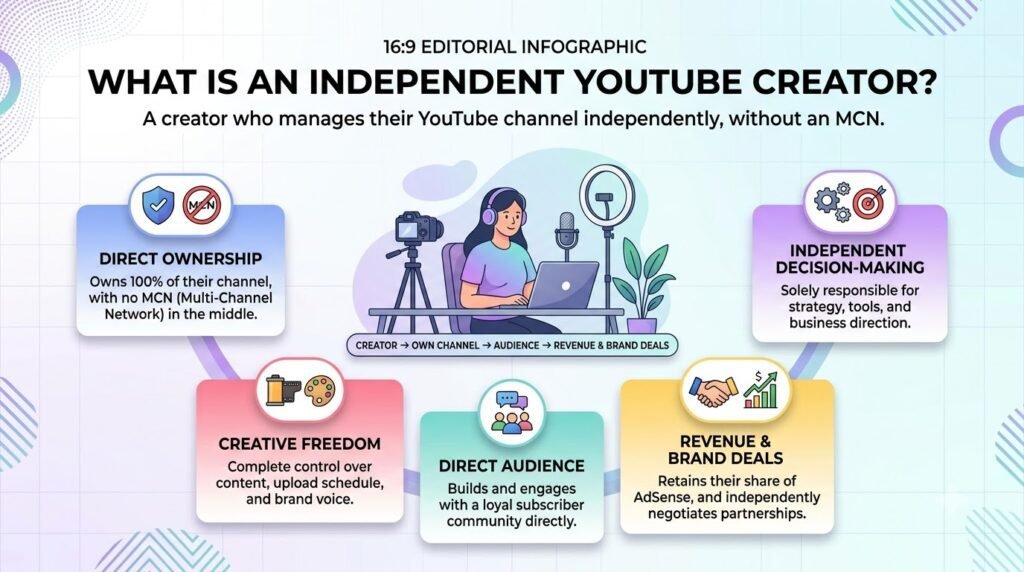
An independent YouTube creator operates a channel without joining a multi-channel network. The creator manages the channel’s business relationships and decides which services, tools, and specialists to use.
Being independent does not mean doing everything alone.
An independent creator can hire:
- Video editors for post-production.
- Thumbnail designers for video packaging.
- Freelance writers for scripts and research.
- Managers or agencies for sponsorships.
- Lawyers for contracts and copyright matters.
- Software providers for content production and organization.
The difference is that the creator chooses these services separately rather than relying on an MCN agreement.
How Do Independent Creators Make Money?
Eligible independent creators can monetize through the YouTube Partner Program and other business arrangements.
Potential income sources include:
- YouTube advertising revenue.
- YouTube Premium revenue.
- Channel memberships.
- Super Chat and Super Stickers.
- Sponsorships and brand partnerships.
- Merchandise and other eligible commerce activities.
Eligibility and availability depend on YouTube’s monetization requirements and the relevant feature.
An MCN is not necessary simply to access YouTube monetization. Independent creators can apply to the YouTube Partner Program directly when eligible.
MCN vs Independent YouTube Creator: Key Differences
An MCN and an independent YouTube channel differ mainly in how creators access services, manage business relationships, and handle channel operations.
| Comparison factor | MCN creator | Independent creator |
|---|---|---|
| Channel relationship | Affiliated with an MCN | Operates without MCN affiliation |
| Revenue | Subject to the MCN agreement | Manages YouTube earnings directly |
| Revenue sharing | MCN may receive an agreed percentage | No MCN revenue share |
| Rights management | May receive network support | Manages rights independently or hires specialists |
| Brand deals | May receive network sales support | Negotiates directly or hires an agency |
| Channel management | May receive centralized support | Controls the operating workflow |
| Production tools | Depends on the network’s offering | Chooses individual tools and providers |
| Contract | Requires an MCN agreement | No MCN affiliation agreement |
| Flexibility | Depends on contractual terms | Generally more flexibility |
| Leaving the arrangement | Must consider contract and release procedures | No MCN release process |
The main difference: An MCN provides a business relationship with potential services and obligations. An independent creator chooses and manages those services separately.
What does an MCN actually provide in 2026?
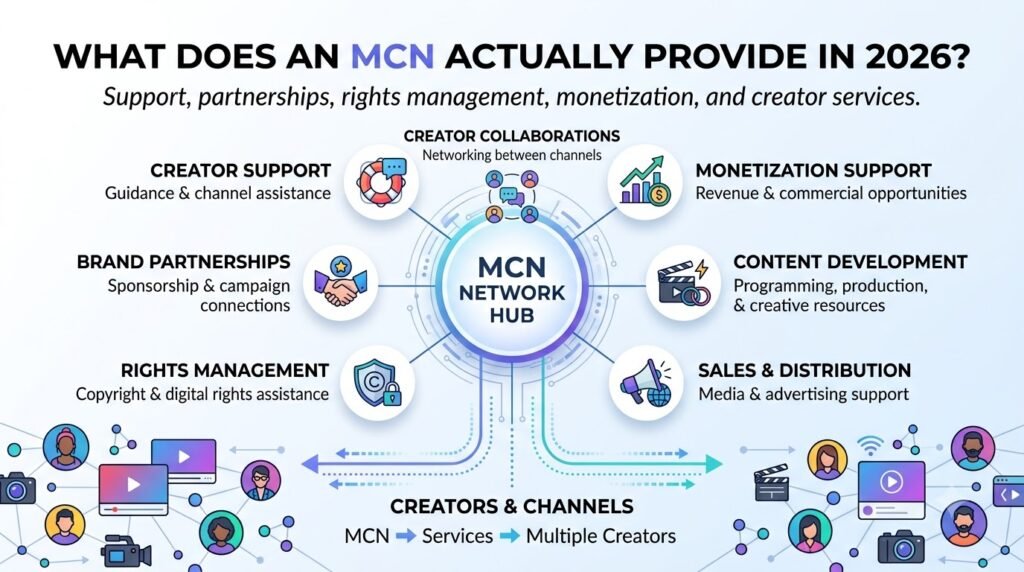
The value of an MCN depends on its actual agreement.
Possible services include digital rights management, Content ID-related operations, monetization support, creator collaborations, sales, audience development, and channel management.
Rights management could be of particular relevance to those individuals who create content which is frequently copied, or whose core business revolves around intellectual property management.
A network could also provide the creator with a contact for any operational issues. To a person with multiple channels, a centralized network could reduce the number of contacts they have to work with.
But those services should not be stated too vaguely.
A contract should specify what a network commits to deliver, the level of service provided, revenue calculation rules, and exit or termination conditions.
YouTube actually recommends that a creator understand the fees, services, obligations, contract duration, and termination conditions before signing an MCN agreement.
That makes the contract more important than the network’s sales pitch.
What can independent creators manage themselves?
An independent creator can build a modular business around the channel.
YouTube Studio can handle core channel management and analytics. YPP can provide eligible creators with monetization features and Creator Support. Creators can also use YouTube’s creator-business tools and work directly with brands.
The production side can be assembled separately.
For example:
Content: creator or researcher
Scripts: creator, writer, or AI-assisted workflow
Editing: freelancer or internal editor
Thumbnails: designer or creator tool
Sponsorships: creator, manager, or agency
Analytics: YouTube Studio
Legal: lawyer when needed
Audio: specialist or creator software
This model requires more coordination, but it also means the creator can replace one provider without restructuring the entire YouTube relationship.
That’s a major difference between an independent workflow and a network contract.
For small teams, the same principle can work without hiring a large staff. A recent ytZolo workflow guide divides the channel production into research, scripting, production, editing, packaging, publishing, and analytics, with several obligations combined when the team is small.
The point isn’t to recreate an MCN internally.
It’s to identify which tasks actually need outside help and pay for those tasks separately.
Managing a YouTube channel independently requires more than uploading videos. Creators also need to plan topics, maintain a publishing schedule, and organize upcoming content.
A YouTube content planner can help structure video ideas and keep the content calendar organized without relying on an MCN for planning support.
MCN vs Independent YouTube Creator: Revenue Comparison
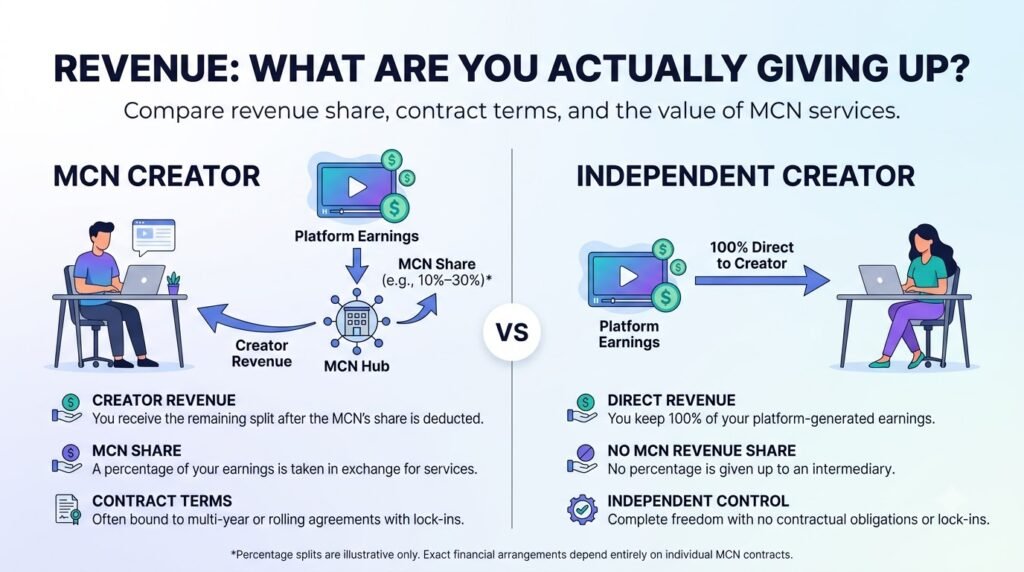
Revenue sharing is one of the biggest considerations when deciding whether to join an MCN.
YouTube explains that joining an MCN does not change the revenue share specified in its own terms. However, MCNs typically receive an agreed percentage from the creator’s portion before paying the creator.
There is no single revenue-sharing percentage that applies to every MCN. The actual arrangement depends on the contract.
Example: How Much Does an MCN Revenue Share Cost?
Consider a hypothetical creator earning $5,000 per month in eligible YouTube revenue.
Suppose the MCN agreement specifies a 15% share of the creator’s applicable revenue.
| Calculation | Amount |
|---|---|
| Monthly creator revenue | $5,000 |
| Hypothetical MCN share | 15% |
| Amount allocated to MCN | $750 |
| Remaining amount before other costs and applicable deductions | $4,250 |
This is an illustrative calculation, not a standard MCN rate or a guaranteed payment amount.
What If You Stay Independent?
An independent creator does not pay an MCN revenue share but may spend money on separate services.
For example:
| Independent expense | Example monthly cost |
|---|---|
| Video editor | $250 |
| Thumbnail designer | $100 |
| Content production tools | $50 |
| Total example expenses | $400 |
These figures are hypothetical, not market averages.
In this example, the creator spends $400 on separate services instead of allocating $750 to the hypothetical MCN arrangement.
However, the comparison is only useful if the services being purchased are equivalent.
An MCN may provide rights management or sales support that is not included in the independent creator’s expenses.
How Should You Compare the Two?
Use these calculations:
MCN cost: Revenue share + additional fees + other contractual costs.
Independent cost: Freelancers + software + agencies + specialist services + management time.
Then compare the actual services received against the money spent.
The lowest cost is not automatically the best option. The better arrangement is the one that provides the services your channel genuinely needs at a reasonable cost.
Can Independent YouTube Creators Get Brand Deals Without an MCN?
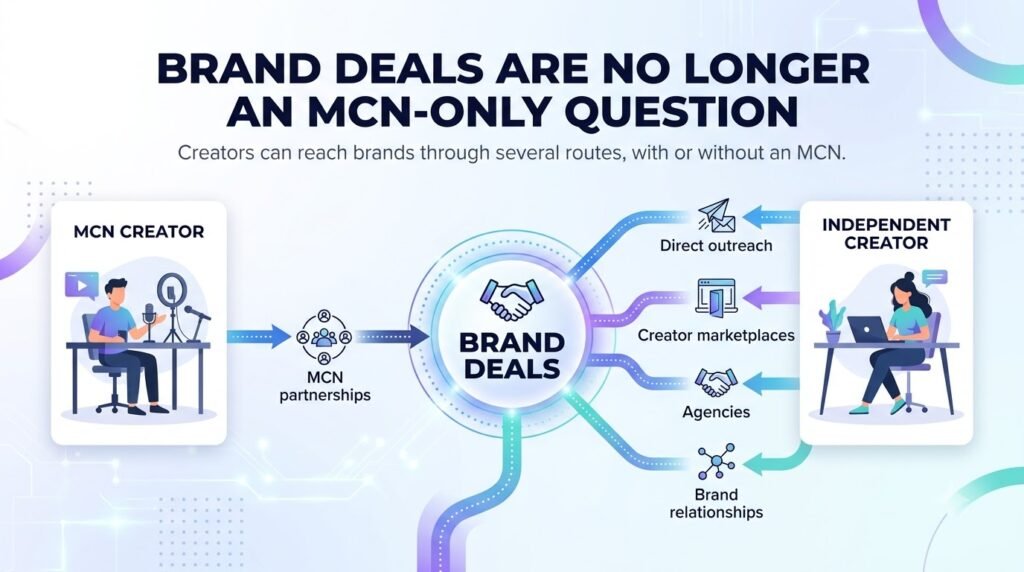
Yes. Independent creators can work directly with brands without joining a multi-channel network.
An MCN may offer sales teams, advertiser relationships, campaign management, and sponsorship support. However, these are not services that only MCNs can provide.
YouTube also offers Creator Partnerships features to eligible YouTube Partner Program creators in supported countries, including India.
Depending on eligibility and regional availability, these features can help creators:
- Receive brand partnership inquiries.
- Create and customize a media kit.
- Set preferred partnership rates.
- Share relevant channel insights with advertisers.
- Add a business manager or talent agent as a contact.
Independent creators can also approach brands directly, work with sponsorship agencies, or hire a dedicated manager.
Some services offered by MCNs, such as content planning and creator support, can also be handled independently with the right resources.
Creators can explore these free tools for content creators to manage parts of their workflow before deciding whether they need an MCN.
When Does an MCN Help With Brand Deals?
An MCN may be useful if it has an established sales team, relevant advertiser relationships, and a clear process for finding and managing sponsorships.
Before joining, ask:
- Does the network actively find brand deals?
- Does it negotiate contracts?
- Does it manage campaign delivery?
- Does it take a percentage of sponsorship revenue?
- Are brand opportunities guaranteed or simply potential introductions?
Don’t assume that joining an MCN automatically brings sponsorships.
Evaluate the actual services and contractual terms before making a decision.
Channel Ownership and Control: What Should Creators Check?
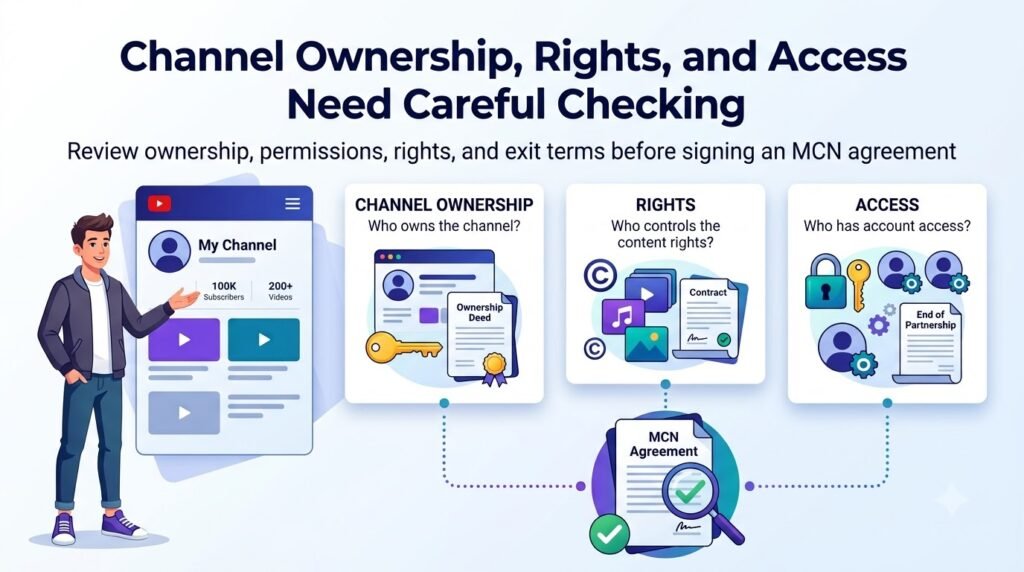
Before joining an MCN, understand the difference between channel access, content rights, and channel ownership.
These are not interchangeable.
Review the following questions before signing:
- Who owns and operates the YouTube channel?
- What access does the MCN receive?
- Can the network manage monetization or Content ID operations?
- Does the agreement grant exclusive content rights?
- Who controls existing Content ID assets?
- What happens to revenue reporting after leaving?
- What happens to active copyright claims after termination?
YouTube distinguishes affiliate channels from Owned and Operated channels. The contractual arrangement can affect how content rights and channel operations are handled.
What Happens When You Leave an MCN?
Leaving an MCN involves more than removing network access.
If you are an affiliate creator and your contract permits it, YouTube provides a process to request removal of MCN access through YouTube Studio.
Before leaving:
- Review your contract and termination conditions.
- Check any outstanding financial obligations.
- Download relevant revenue reports.
- Confirm your AdSense for YouTube account arrangements.
- Review existing Content ID claims and asset ownership.
- Check whether monetization needs to be set up again.
YouTube states that an MCN has up to 30 days to respond to an affiliate creator’s removal request, after which access may be automatically removed within that period.
Important: Removing MCN access does not automatically release you from contractual obligations. Review your agreement before starting the process.
When does joining an MCN make sense?
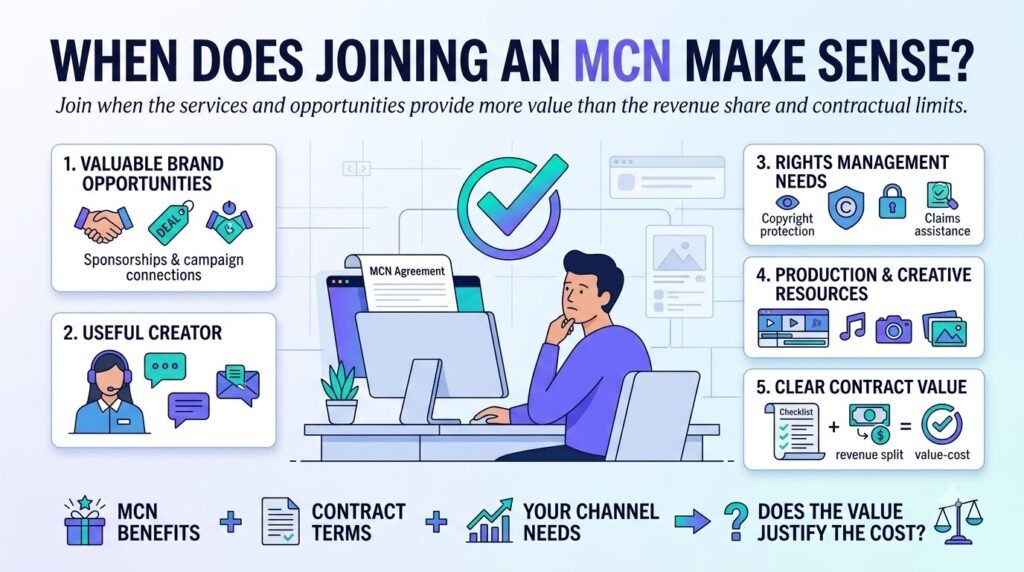
The important word is specific.
“Join us and we’ll help you grow” isn’t a specific service.
“Here is the rights-management system, reporting process, support structure, sales service, fee, and termination process” is something a creator can evaluate.
Subscriber count alone shouldn’t determine the decision.
A creator with 50,000 subscribers and a serious rights-management problem may get more value from an MCN than a creator with 500,000 subscribers who already has an experienced team.
When is staying independent more practical?
Independence can make more sense when the creator already has a strong operating system.
For example, staying independent may be practical if:
- Sponsorship inquiries already come directly.
- The creator has an editor or production team.
- YouTube Studio provides the analytics and support they need.
- Rights issues are manageable without a network.
- The creator prefers direct brand relationships.
- The creator wants maximum flexibility.
- The MCN’s revenue share exceeds the value of its services.
- The contract includes restrictions the creator doesn’t need.
An independent creator can also add support gradually.
Rather than the author creating the organization, they might hire an editor for editorial matters, a manager of sponsorships, and a specialist for rights issues and other matters.
While that creates more vendors, it keeps the contract from covering too much.
What should you ask before signing an MCN contract?
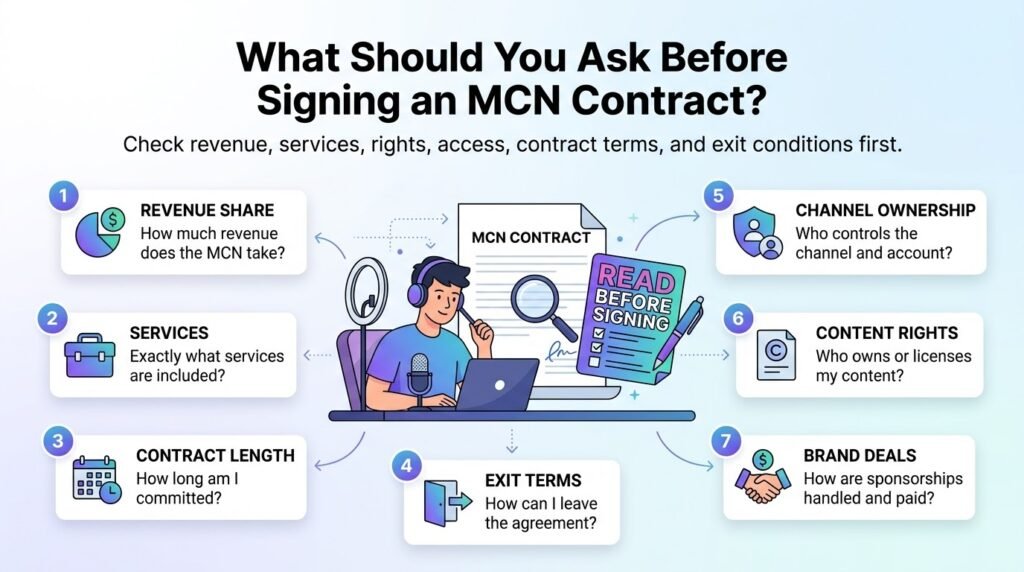
Don’t sign based only on the headline revenue split.
Ask these questions first.
1. What exactly is included?
Get the services in writing.
Ask what support is actually provided rather than relying on phrases such as “creator growth” or “premium support.”
2. How is revenue calculated?
Find out what revenue the network receives a percentage of.
Don’t assume the percentage applies to only one income source.
3. Are sponsorships included?
Clarify whether the network takes a share of sponsorship income, negotiates deals on your behalf, or simply provides introductions.
4. How long is the contract?
Check the initial term and renewal mechanism.
5. How do I terminate it?
Look for notice periods, early termination conditions, and any post-contract obligations.
6. Who controls channel access?
Understand permissions and operational responsibilities.
You should know exactly what the network can access and manage.
7. Who controls rights and Content ID assets?
Ask what happens to claims and assets when the relationship ends.
8. What happens to existing deals?
If the MCN manages sponsorships or campaigns, find out what happens to active contracts after termination.
These questions render an abstract decision process of an MCN more comparable.
The independent creator stack in 2026
One of the biggest changes in the creator economy is that independence doesn’t mean working without infrastructure.
A creator can build a stack around the exact problems they have.
YouTube Studio is capable of analyzing the channel’s analytics with reports on content performance, audience, reach, engagement, and revenue for eligible creators.
YouTube also continues to add creator-business features, including tools for brand discovery and channel insights.
Then there is the production layer.
An independent creator can combine people and software for research, scripting, titles, thumbnails, audio, editing, publishing, and sponsorship operations.
This is where creator tools such as ytZolo can fit into the workflow.
ytZolo currently documents YouTube-focused tools for scripts, titles, thumbnails, descriptions, tags, and related content-production tasks. Its newer Audio Studio also includes voice generation, multi-voice dialogue, voice changing, AI music, AI sound effects, voice isolation, dubbing, and forced alignment.
That doesn’t replace an MCN because they solve different problems.
An MCN is a business relationship and service provider.
A creator tool is part of the production workflow.
For an independent creator, that distinction matters. Software can reduce repetitive production work without requiring the creator to give a network a percentage of channel revenue.
A practical decision framework
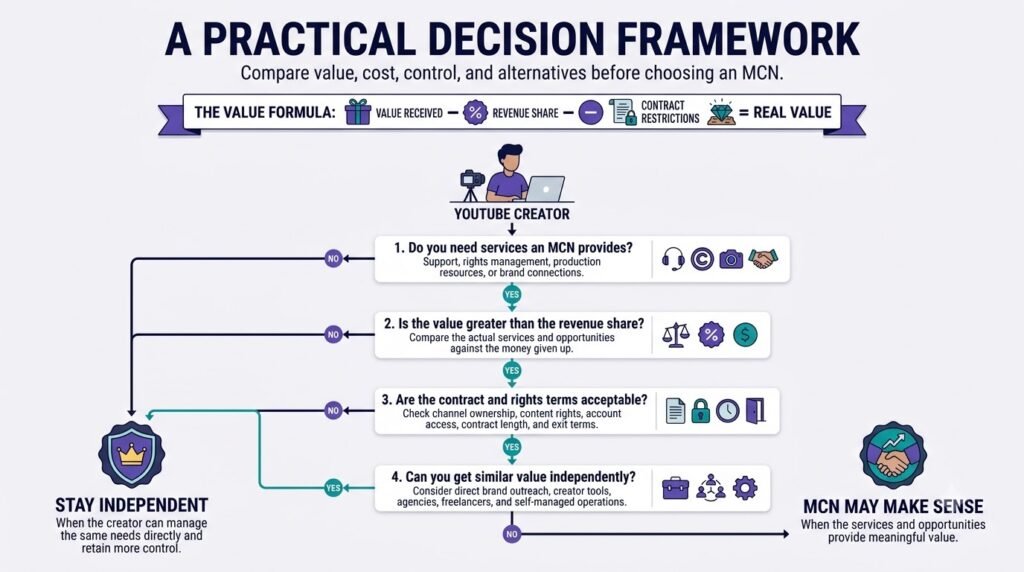
Before choosing either model, write down the five biggest problems currently slowing down your channel.
For example:
Problem: Too many copyright issues
Possible solution: MCN rights-management service
Problem: Sponsorship inquiries are increasing
Possible solution: Manager, agency, or MCN sales support
Problem: Script and packaging work takes too long
Possible solution: Internal workflow, freelancer, or creator tools
Problem: Several channels are difficult to manage
Possible solution: Centralized operations or specialized channel management
Problem: You don’t understand the contract
Possible solution: Independent legal review before signing
Then compare the cost of solving each problem independently with the cost of joining the MCN.
The result may be a clear MCN case.
It may also show that you only need one specialist service rather than a network.
That is a more useful decision than asking whether MCNs are “good” or “bad.”
Who should choose an MCN?
An MCN is worth investigating if the network provides services that are difficult to reproduce independently and the contract gives you enough value for the revenue or control you surrender.
It can be particularly relevant for creators with highly specialized rights-management needs, multiple channels, established commercial operations, or a demonstrated need for infrastructure support.
But the network should be evaluated as a service provider.
Avoid joining because someone promised algorithmic privileges, guaranteed income, or foolproof growth.
YouTube makes clear that MCNs cannot prevent copyright or Community Guidelines enforcement, and being inside a network doesn’t exempt a channel from YouTube’s policies.
Who should stay independent?
Staying independent is usually more attractive when the creator already has the necessary infrastructure.
If you can manage your channel, secure sponsorships, produce and edit content, analyze statistics, and solve typical problems on your own, an MCN is unlikely to provide significant added value.
Independence also allows you to switch platforms and service providers as needed.
You might use one workflow for a solo channel and another when you build a small team.
That flexibility can be valuable because creator businesses change quickly.
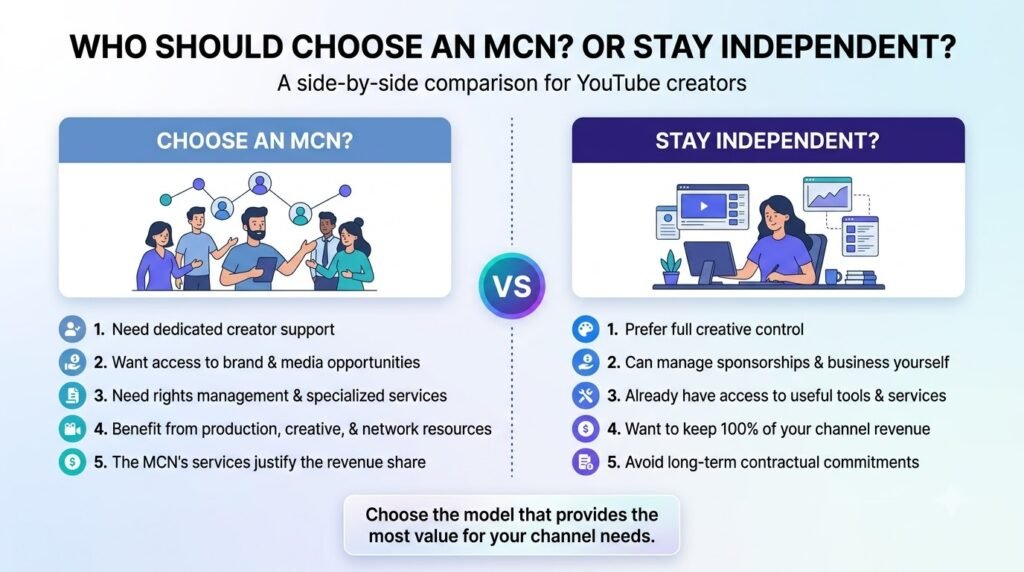
How to Evaluate an MCN Before Signing a Contract
Before joining a multi-channel network, compare its actual services against your channel’s requirements.
Use these questions to evaluate the agreement:
| What to check | Questions to ask |
|---|---|
| Services | What services are included in writing? |
| Revenue share | What percentage or fees will the network receive? |
| Payment | When and how will payments be made? |
| Brand deals | Does the network actively manage sponsorships? |
| Copyright | What rights-management support is provided? |
| Channel access | What permissions will the network receive? |
| Contract duration | How long does the agreement last? |
| Renewal | Does the agreement renew automatically? |
| Termination | What notice period is required? |
| Exit | What happens to content rights and existing claims? |
Red Flags to Watch For
Be cautious if an MCN:
- Promises guaranteed views or YouTube growth.
- Does not clearly explain its revenue share.
- Refuses to provide written service details.
- Uses vague language about channel ownership.
- Does not explain termination conditions.
- Makes unrealistic promises about copyright protection.
- Pressures you to sign without reviewing the agreement.
YouTube’s own MCN guidance recommends transparency about services, support levels, and contractual obligations. An MCN cannot prevent copyright or Community Guidelines enforcement simply because a channel belongs to its network
Final Verdict: MCN vs Independent YouTube Creator in 2026
There is no universal winner in the MCN vs independent YouTube creator comparison.
An MCN can be valuable when it provides meaningful rights management, brand-sales support, or centralized operations that justify its fees and contractual requirements.
Staying independent can be a better choice when you already have the people, tools, and processes needed to manage your channel.
Before making a decision, compare five things:
- Revenue: How much money will you give up?
- Services: What specific support will you receive?
- Control: What channel access and content rights will change?
- Contract: What are the duration and termination conditions?
- Alternatives: Can you purchase the same services independently?
For some creators, an MCN provides useful infrastructure. For others, independent operations offer more flexibility and control.
The best decision is the one that supports your channel’s actual business needs without creating unnecessary costs or restrictions.
Frequently asked questions
Do I need an MCN to monetize a YouTube channel?
No. An MCN is not required simply to participate in YouTube monetization. Eligible creators can apply to the YouTube Partner Program directly.
Independent creators can use different tools to handle tasks that might otherwise require outside support.
This includes researching video ideas, preparing scripts, creating content, and improving their publishing workflow. This guide to AI tools for YouTube creators covers tools that can support these tasks.
Does YouTube recommend specific MCNs?
The YouTube platform perceives MCNs as independent organizations that provide services to creators; therefore, the creators are advised to assess the network’s services, contract terms, reputation, and other factors.
Can an MCN guarantee YouTube growth?
Creators should be cautious about guarantees. An MCN cannot override YouTube’s recommendation systems or protect a channel from policy enforcement.
Do MCNs take a percentage of revenue?
Many MCN agreements have a revenue sharing structure; however, the terms may vary. Thus, it is critical to review the contract and identify the percentage, sources of revenue, payment terms, and additional services provided.
Can I leave an MCN?
The affiliation creators can ask to remove the MCN access if their contract allows this option. The impact will depend on the terms of the agreement and cooperation structure.
Is an MCN better for small YouTubers?
Not automatically. If a creator is small, and an MCN can address a particular issue, the affiliation can be beneficial. However, a network is not necessarily valuable due to the creator’s small size or increasing audience.
Can independent creators get brand deals?
Yes. Creators can negotiate directly with brands, work with agencies or managers, and use YouTube’s available brand-partnership tools when eligible.
Can an independent creator use AI tools instead of an MCN?
AI tools may assist in different aspects of a content pipeline, but they are not a replacement for every aspect of an MCN’s potential offering: scripting, titles, thumbnails, audio, and other production services can be facilitated by software, but legal, commercial, rights, and strategic responsibilities may require people or specialist services.
About the author
Anshika Verma is a content researcher and writer at ytZolo who researches and evaluates AI and creator tools with an evidence-based approach.
Her work focuses on researching creator workflows, AI video and audio tools, YouTube production systems, and practical differences between vendor claims and documented capabilities.
Email: anshika@ytzolo.com

