Choosing an AI tool used to mean picking a name you’d heard of. That doesn’t work anymore.
In 2026, there are dozens of capable models, and the “best” one changes depending on whether you’re writing, coding, researching, or generating an image. A side by side AI comparison — testing the same prompt across multiple models at once — is the only reliable way to know which AI actually fits your work.
This guide walks through how to compare AI models correctly, what the benchmarks really mean, and how ChatGPT, Claude, Gemini, Grok, Perplexity, DeepSeek, Copilot, and Mistral stack up across pricing, speed, privacy, coding, writing, and more. Every claim here is sourced, dated, and checked against official pricing pages as of July 2026.
Quick answer: A side by side AI comparison means running the same prompt through two or more AI models at the same time—using a multi-model platform like AiZolo—and evaluating the results next to each other for accuracy, tone, speed, and cost. It is the fastest way to find which model actually fits a specific task instead of guessing based on brand reputation.
Table of Contents
Why AI Comparisons Matter in 2026
Featured snippet answer: AI comparisons matter in 2026 because no single model wins every category anymore. Claude leads coding benchmarks, Gemini leads context window size, and ChatGPT leads ecosystem breadth — so picking one tool for every task means losing quality somewhere.
The gap between AI models used to be huge. GPT-4 was noticeably ahead of most competitors in 2023. That gap has closed.
Today, flagship models from OpenAI, Anthropic, Google, and xAI trade wins depending on the benchmark. Claude Opus 4.8 tops coding leaderboards. Gemini 3.1 Pro leads on context window and multimodal tasks. GPT-5.5 keeps the broadest set of integrations and plugins.
This specialization is exactly why side-by-side testing beats relying on last year’s “best AI” article. A model that was ahead in January can trail by June.
Cost has also become a real factor. Running one model for everything, when a cheaper model would do 90% as well on simple tasks, adds up fast across a team or a year of API usage.
How to Compare AI Models Correctly
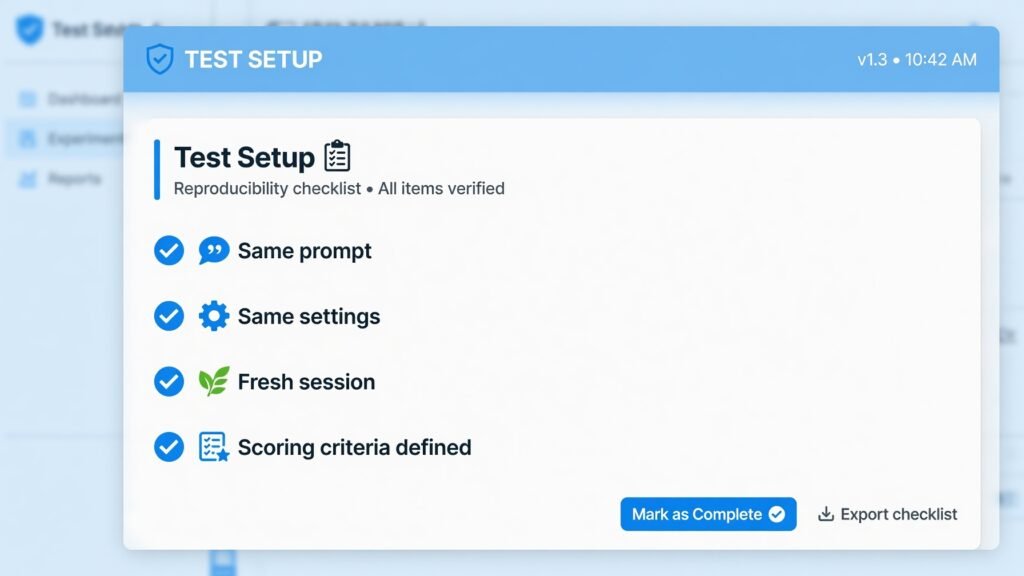
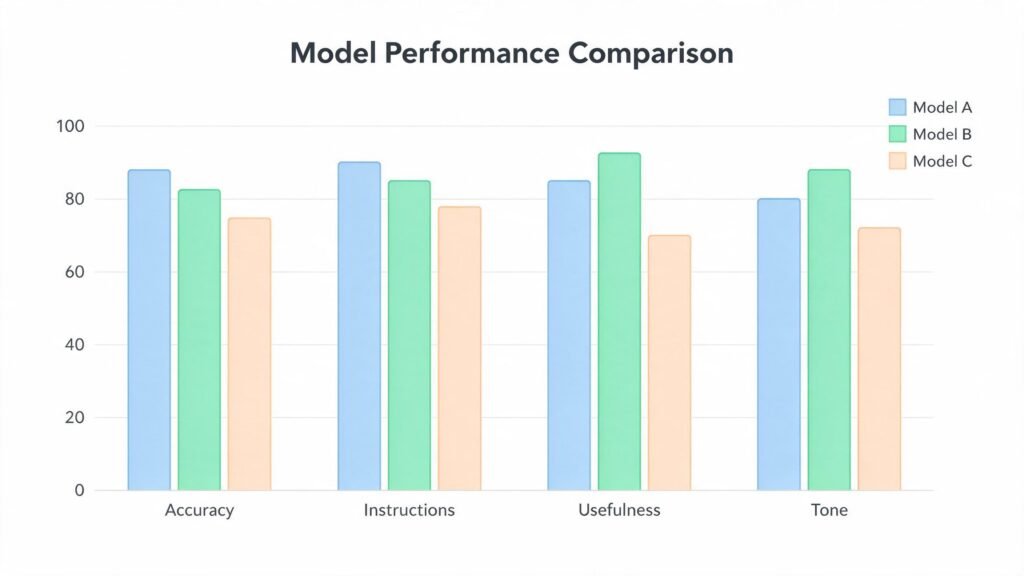
Featured snippet: To compare AI models correctly, use the same prompt across all models, test more than one task type (writing, coding, reasoning), score outputs blind without seeing which model produced them, and repeat the test more than once since outputs vary between runs.
Most casual comparisons fail for one simple reason: the person already has a favorite model, and that bias shows up in how they judge the outputs.
A fair comparison follows a few basic rules.
Use identical prompts. Even small wording changes shift outputs enough to make a comparison meaningless.
Test multiple task types. A model that writes well doesn’t automatically code well. Test the tasks you actually do.
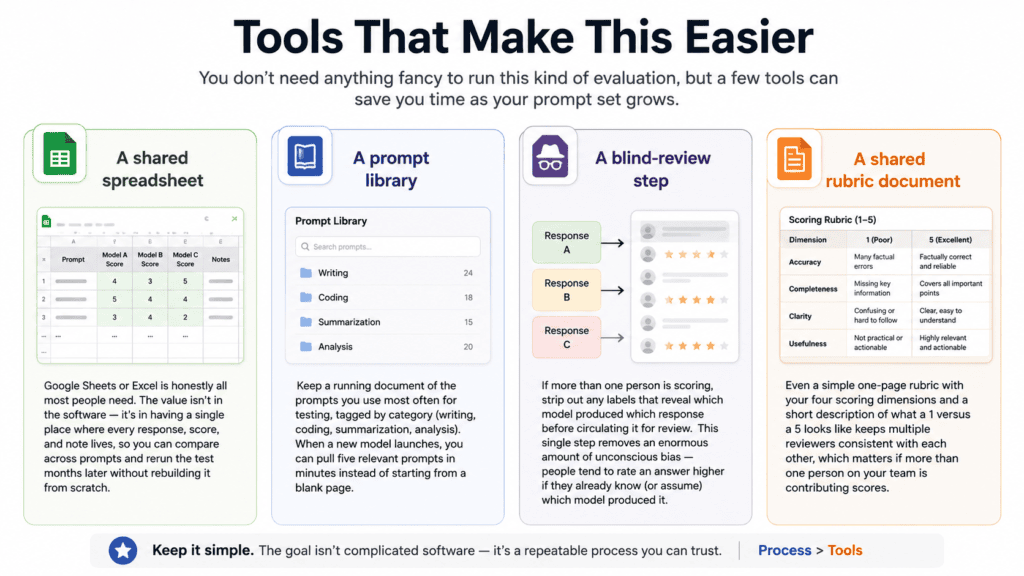
Score blind when possible. Hide the model name until after you’ve rated the output. This removes brand bias from the judgment.
Run it more than once. Language models are non-deterministic. One brilliant answer or one bad answer isn’t a pattern — three or four runs is.
Separate the model from the interface. ChatGPT’s app might feel nicer than Claude’s, but that’s a UX preference, not a measure of which model reasons better.
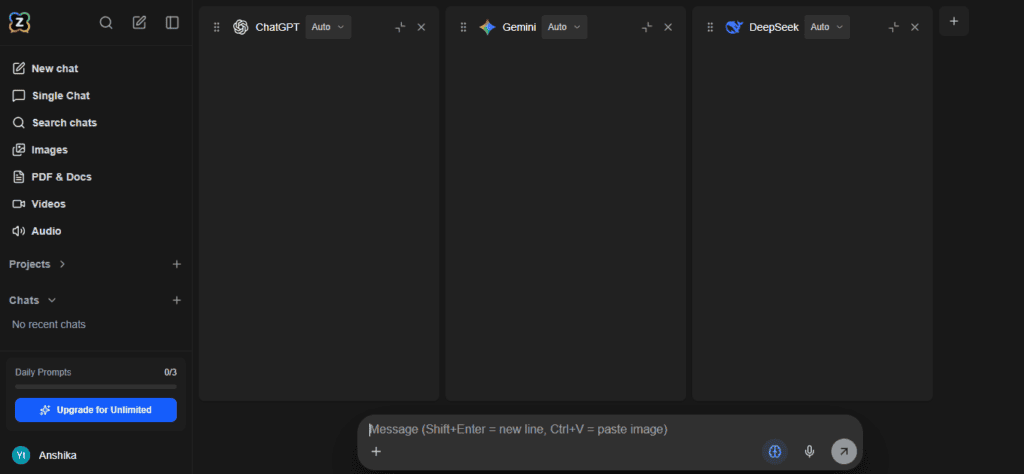
Tools built specifically for this — like a dedicated AI model comparison tool — remove most of the manual friction, since they run the same prompt across models in parallel columns instead of requiring tab-switching.

AI Benchmark Explanation: What the Numbers Actually Mean
Featured snippet answer: AI benchmarks are standardized tests that measure a model’s performance on specific tasks like coding (SWE-bench), math (GPQA, AIME), or general reasoning (MMLU). They’re useful for directional comparison but shouldn’t be read as exact predictors of real-world quality, since each lab tests under slightly different conditions.
Benchmark names get thrown around constantly, so here’s what the common ones actually measure.
SWE-bench Verified / SWE-bench Pro tests whether a model can fix real GitHub issues in real codebases. This is the standard reference for coding capability. Claude Opus 4.8 leads the field on the harder SWE-bench Pro set and sits first on the LMArena coding leaderboard, scoring 88.6% on SWE-bench Verified.
MMLU (Massive Multitask Language Understanding) tests general knowledge across dozens of academic subjects. It’s a broad reasoning check, not a specialized one.
GPQA (Graduate-Level Google-Proof Q&A) tests PhD-level science reasoning that can’t be solved with a quick search.
HumanEval and MBPP are older coding benchmarks that test whether generated code passes functional tests, still used as a secondary coding reference.
The catch: labs run benchmarks on their own infrastructure with their own prompting setups, so each vendor publishes its own numbers on its own scaffold, and the benchmark variants differ, meaning results should be read as directional rather than an exact head-to-head leaderboard.
This is the core argument for a hands-on side by side AI comparison over reading a benchmark table: benchmarks tell you what a lab optimized for, not necessarily how the model performs on your specific prompt.
External references: SWE-bench (Stanford/Princeton), arXiv.org papers on LLM evaluation, Hugging Face Open LLM Leaderboard
Side by Side AI Comparison Table: All Major Models at a Glance
Featured snippet answer: As of July 2026, Claude Opus 4.8 leads coding benchmarks, Gemini 3.1 Pro offers the largest 1M-token context window, GPT-5.5 has the broadest ecosystem and plugin support, and DeepSeek V4 is the cheapest API option for developers.
| AI Model | Maker | Best For | Context Window | Starting Price | Standout Trait |
|---|---|---|---|---|---|
| GPT-5.5 (ChatGPT) | OpenAI | Versatility, image generation | 128K–200K | Free / $20 Plus | Broadest ecosystem, plugins, voice mode |
| Claude Opus 4.8 / Sonnet 5 | Anthropic | Coding, long-form writing | 200K–1M | Free / $20 Pro | 88.6% SWE-bench Verified, agentic coding |
| Gemini 3.1 Pro | Long documents, multimodal | Up to 1M | Free / $19.99 AI Pro | Native Search grounding, huge context | |
| Grok 4.3 | xAI | Real-time X/Twitter data | Large | Free / $30/mo | Less filtered tone, X integration |
| Perplexity Pro | Perplexity | Research with citations | N/A (search-based) | Free / $20 | Sourced, cited answers |
| DeepSeek V4 | DeepSeek | Cheap API, self-hosting | 1M (V4 Pro) | Free chat / pay-as-you-go API | $0.14 per 1M input tokens |
| Mistral Large 3 | Mistral AI | EU data sovereignty | Large | Free / API pricing | GDPR-friendly hosting, open-weight options |
| Microsoft Copilot | Microsoft | Microsoft 365 integration | Varies by model | Free / bundled with M365 | Native Word, Excel, Outlook integration |
| AiZolo | AiZolo | Comparing multiple models at once | Varies by connected model | Free / $9.9/mo | Runs GPT, Claude, Gemini, Grok side by side |
Sources: official pricing pages of each provider, checked July 2026. Prices and limits change frequently — verify before purchasing.

ChatGPT vs Claude vs Gemini
Featured snippet answer: ChatGPT (GPT-5.5) wins on ecosystem breadth and image generation. Claude (Opus 4.8) leads coding and long-form writing quality. Gemini 3.1 Pro wins on context window size and native Google Search integration. All three cost about $20/month at the standard tier.
This is the matchup most people actually search for, and it’s the closest three-way race in the industry right now.
ChatGPT is built to handle a wide range of tasks in a single interface — writing, coding, analysis, image generation — and has the broadest ecosystem of third-party integrations of the three. If you want one tool that does everything reasonably well, this is it.
Claude’s context window at the standard tier is designed for work involving large amounts of text at once, and Claude Sonnet is the default model on the Pro plan, with more capable models available for complex tasks. In blind writing tests, Claude won four of eight rounds against ChatGPT and Gemini, with its largest margins in writing-focused categories.
Gemini has native Google Search built into how it answers questions, so when asked about something current, it draws from live web results as part of its reasoning — a capability ChatGPT only offers as a separate, invokable tool, and Claude doesn’t include by default.
On pricing,all three cost $20/month for their pro tiers, with free tiers available for all, though API pricing varies — Gemini tends to be cheapest per token while Claude offers the best value for complex tasks.
Bottom line: pick ChatGPT for an all-rounder with the deepest plugin ecosystem, Claude for coding and writing quality, and Gemini if your work involves current events or very long documents.
Screenshot Recommendation: Instead of an illustration, use a real annotated screenshot here — three browser windows of ChatGPT, Claude.ai, and Gemini answering the identical prompt, cropped to show just the response text. Real screenshots build more trust than illustrations for this exact comparison because readers want to see actual output style, not a mockup.
ChatGPT vs Grok
Featured snippet answer: ChatGPT wins on ecosystem, plugin support, and image generation quality. Grok wins on real-time access to X/Twitter data and a less restricted conversational tone, but its best features are locked behind a $300/month SuperGrok Heavy tier.
Grok’s biggest differentiator isn’t raw intelligence — it’s data freshness from X and a noticeably more casual, less hedged tone in responses.
Grok 4.3 adds document generation and video input, but locks its best features behind the $300/month SuperGrok Heavy tier, which puts it well above ChatGPT’s $20 Plus plan for anyone who wants the full feature set.
For most users who don’t need real-time social media context, ChatGPT’s broader plugin ecosystem and lower entry price make it the more practical daily driver.
ChatGPT vs Perplexity
Featured snippet answer: ChatGPT is a general-purpose assistant for writing, coding, and analysis. Perplexity is a research-focused tool that pairs AI reasoning with live web search and cited sources. Choose Perplexity when you need sourced answers; choose ChatGPT for broader task versatility.
Perplexity is a conversational search engine that combines large language models with real-time web search — instead of just returning links, it reads the web and gives sourced, cited answers, making it less of a writing assistant and more of a research partner.
Perplexity Pro at $20/month now includes 200 Pro Search queries per week and 20 Deep Research reports per month — a real cut from earlier limits, worth checking before you commit if deep research volume matters to you.
For a student verifying facts or a journalist building a source list, Perplexity’s citations are the deciding feature. For drafting content or writing code, ChatGPT remains the more flexible tool.
ChatGPT vs DeepSeek
Featured snippet answer: ChatGPT offers a polished consumer app with the widest plugin ecosystem. DeepSeek offers frontier-level coding performance at a fraction of the API cost, with no consumer subscription tier at all — it’s free to chat and pay-as-you-go for API access.
The gap here is almost entirely about cost and control rather than raw quality.
DeepSeek V4 Flash costs $0.14 input and $0.28 output per million tokens, with cache hits at just $0.0028 per million input tokens — dramatically cheaper than GPT-5.5’s API pricing.
DeepSeek isn’t the easiest option for non-technical users since there’s no polished paid tier or dedicated power-user plan, but for developers and technical teams, the combination of a free chat interface and ultra-low API pricing makes it one of the most cost-effective AI tools available.
DeepSeek’s open-weight license also means it can be self-hosted, which matters for teams with strict data-residency requirements that a closed API can’t satisfy.
ChatGPT vs Copilot
Featured snippet answer: ChatGPT is a standalone AI assistant. Microsoft Copilot is the same class of AI embedded directly into Word, Excel, Outlook, and Windows, bundled with a Microsoft 365 subscription. Choose Copilot if your work already lives inside Office; choose ChatGPT for a more flexible standalone tool.
Microsoft Copilot’s paid tier is bundled with Microsoft 365 Personal at $19.99 per month, which includes Word, Excel, PowerPoint, Outlook, and 1TB of OneDrive storage alongside Copilot AI access.
For coding specifically, GitHub Copilot is a separate product with its own tiers, and it recently tightened access — Copilot paused new individual sign-ups and tightened usage limits in late April 2026, pulling some Claude models from the Pro plan.
If your daily work is already inside Microsoft 365, Copilot’s native integration saves real friction. If you work across many apps and platforms, ChatGPT’s standalone flexibility wins.
ChatGPT vs Mistral
Featured snippet answer: ChatGPT leads on general capability and ecosystem size. Mistral, a French AI lab, leads on European data sovereignty and offers some of the cheapest flagship-class API pricing available, with both open-weight and closed models.
Mistral Large 3 is a large mixture-of-experts model from France, popular in Europe for data sovereignty compliance, which matters for businesses bound by GDPR or EU data-residency rules that a US-hosted model can complicate.
On raw price, Mistral Large 3 is the cheapest flagship-class API at $0.50 per 1 million input tokens among major labs — a strong option for cost-sensitive developers who don’t need Claude or GPT-level polish.
Open-Source vs Closed-Source AI Models

Featured snippet answer: Closed-source models (ChatGPT, Claude, Gemini) are generally more polished and easier to use out of the box. Open-source models (Llama, DeepSeek, Mistral, Qwen) are free or near-free to run, can be self-hosted for privacy, and have closed much of the performance gap in 2026.
The open-source gap has narrowed faster than most people expected.
Llama 4 Maverick beats GPT-4o on benchmarks, and DeepSeek matches commercial models at a fraction of the cost, making open-weight models ideal for developers, enterprises with data sovereignty needs, or anyone willing to use third-party hosting.
The trade-off is support and polish. Closed models come with a finished app, customer support, and predictable uptime. Open models require someone on your team to manage hosting, updates, and security — a real cost even when the model itself is free.
| Factor | Closed-Source (ChatGPT, Claude, Gemini) | Open-Source (Llama, DeepSeek, Mistral, Qwen) |
|---|---|---|
| Setup | Instant, sign up and go | Requires hosting or API setup |
| Cost | Fixed monthly subscription | Pay-per-token or self-hosting cost |
| Data control | Provider’s servers | Can be fully self-hosted |
| Support | Official support channels | Community-driven |
| Customization | Limited to prompts/settings | Full fine-tuning control |
| Best for | Individuals, most businesses | Developers, privacy-sensitive teams |
AI Pricing Comparison
Featured snippet answer: Most flagship AI subscriptions converge around $20/month in 2026 — ChatGPT Plus, Claude Pro, Google AI Pro, and Perplexity Pro all sit at this price point. Budget options start at $4.99–$8/month, and power-user tiers run $100–$300/month.
<cite index=”31-3″>The standard tier across ChatGPT, Claude, Google AI Pro, and Perplexity all sit at $20/month in July 2026, a real industry convergence point</cite>. That convergence isn’t coincidence — it’s the price each company found consumers would tolerate before churning.
| Plan | Monthly Price | Notes |
|---|---|---|
| ChatGPT Free | $0 | Limited GPT-5.5 messages |
| ChatGPT Go | $8 | Budget tier |
| ChatGPT Plus | $20 | Full GPT-5.5 access |
| ChatGPT Pro | $200 | Unlimited usage |
| Claude Free | $0 | Limited messages |
| Claude Pro | $20 ($17 annual) | Full model access |
| Google AI Plus | $4.99 | Entry tier |
| Google AI Pro | $19.99 | 1M-token context, 2TB storage |
| Google AI Ultra | $99.99 | Highest limits |
| Perplexity Pro | $20 | 200 searches/week, 20 deep research/month |
| Perplexity Max | $200 | Unlimited queries |
| Grok SuperGrok Heavy | $300 | Full feature unlock |
| DeepSeek | Free chat + API | No subscription tier |
| AiZolo Free | $0 | Limited access to all models |
| AiZolo Pro | $9.9/mo ($99.9/yr) | Unlimited comparisons across all connected models |
Pricing changes often — verify on each provider’s official pricing page before purchasing.
For anyone paying for two or more subscriptions separately, the math tends to favor a multi-model platform. A side by side AI comparison tool that bundles access to several premium models, like AiZolo‘s all-in-one plan, can replace the cost of maintaining separate ChatGPT, Claude, Gemini, and Grok subscriptions individually.

Privacy Comparison
Featured snippet answer: Claude gives users the clearest opt-out from model training, with a 30-day data retention window when training is off. ChatGPT and Gemini train on conversations by default unless the user opts out manually. DeepSeek’s data policies are the least transparent of the major providers for US and EU users.
Privacy differences are often the deciding factor for business users, and they’re easy to overlook when comparing just speed or accuracy.
ChatGPT and Gemini train on user data by default, opt-out available in Settings > Data Controls for ChatGPT and by turning off Keep Activity for Gemini. Claude makes training a user choice — left off, it does not train on your chats and keeps a 30-day retention window.
For regulated industries, this distinction matters more than any benchmark score. A 30-day retention window with opt-in training is a materially different risk profile than a default-on training policy.
Open-weight, self-hosted models (Llama, DeepSeek, Mistral) offer the strongest privacy guarantee of all, since data never has to leave your own infrastructure — at the cost of managing that infrastructure yourself.

External references: Anthropic Privacy Policy, OpenAI Privacy Policy, Google AI Privacy
Speed Comparison
Featured snippet answer: Smaller, distilled models (Gemini Flash, Grok Fast, DeepSeek Flash) respond fastest, often in under a second for short prompts. Flagship reasoning models (Claude Opus, GPT-5.5 Pro, Gemini 3.1 Pro) trade speed for depth, especially in “thinking” modes that can take 10–60 seconds on complex prompts.
Speed isn’t a single number — it depends heavily on which variant of a model you’re using.
Lightweight variants like Gemini 3.5 Flash or Grok 4.1 Fast are built specifically for low-latency use cases: chat support, quick lookups, real-time applications. Flagship “thinking” models intentionally slow down to reason step by step before answering, which improves accuracy on hard problems but costs response time.
For time-sensitive workflows — customer support bots, live coding autocomplete — the fast, smaller models are usually the right pick even though they score lower on raw capability benchmarks.

Accuracy Comparison
Featured snippet answer: No single AI model is most accurate across every domain. Claude and GPT-5.5 lead on complex reasoning tasks, Gemini leads when answers require current information via Search grounding, and Grok has reported one of the lowest hallucination rates on fact-based prompts among major chatbots.
Pick Grok for the lowest hallucination rate on fact-based prompts, then verify with Perplexity for cited sources — no AI tool should be trusted blindly for high-stakes decisions.
That last point deserves emphasis: even the most accurate model still produces confidently wrong answers occasionally. For anything with real consequences — medical, legal, financial — a second model or a cited source should confirm the first answer.
Coding Comparison
Featured snippet answer: Claude Opus 4.8 currently leads coding benchmarks with 88.6% on SWE-bench Verified, ahead of GPT-5.5 and Gemini 3.1 Pro. DeepSeek V4 Pro offers frontier-competitive coding performance at a fraction of the API cost of Claude or GPT.
| Model | SWE-bench Verified | Notable Strength |
|---|---|---|
| Claude Opus 4.8 | 88.6% | Full-file refactors, large codebases |
| DeepSeek V4 Pro | ~80.6% | Best price-to-performance for coding |
| GPT-5.5 | Competitive, ecosystem-strong | Best IDE plugin support |
| Gemini 3.1 Pro | Improving, trails top two | Strong within Google Cloud stack |
Claude Opus 4.8 is built around hybrid extended thinking, computer use, and deep integration with Claude Code, Anthropic’s agentic coding tool, and its context window stayed at a standard 200K tokens on the bet that reasoning quality and tool reliability matter more than raw window size for agentic, multi-file engineering work.
For teams already inside GitHub, Copilot’s advantage is convenience: it stitches tab-completion, agent mode, and code review into VS Code, JetBrains, Visual Studio, and other editors with a model picker, so you can choose Claude or GPT models from inside a single subscription rather than juggling separate accounts.
Video Recommendation: Link to Anthropic’s official Claude Code demo video and a GitHub Copilot feature walkthrough from Microsoft’s official YouTube channel. Real product demos build more trust for developer readers than a written description of an IDE workflow.
Writing Compariso
Featured snippet answer: Claude consistently rates highest for writing quality and tone control in blind head-to-head tests. GPT-5.5 tends toward more formulaic structure. Gemini writes competently but is less adaptable to specific style instructions.
Claude Opus 4.8 is the strongest pure writer and tops human-preference voting precisely on open-ended writing tasks like marketing copy, essays, and brand-voice-sensitive content.
Claude produces the most natural, least “AI-sounding” prose, follows style instructions precisely, and avoids the generic filler that plagues other models, while ChatGPT tends toward formulaic structures and Gemini writes competently but lacks Claude’s voice adaptability.
For anyone writing at volume — content teams, agencies, newsletter writers — this difference compounds. A model that needs less editing per piece saves real time across hundreds of drafts.
Research Comparison
Featured snippet answer: Perplexity is the strongest AI for research tasks that need cited sources. Gemini is strongest for research requiring current, real-time information via native Search grounding. Claude and GPT-5.5 are stronger for synthesizing and reasoning over long documents you already have.
For research tasks where you need sources, Perplexity is arguably better than any general-purpose chatbot, since citations are built into every answer by default rather than added as an afterthought.
For document-heavy research — legal contracts, academic papers, financial reports — Gemini 3.1 Pro or GPT-5.5’s 1-million-token context window lets the whole document fit in one prompt without retrieval engineering, which matters when accuracy depends on not losing earlier context.
Image Generation Comparison
Featured snippet answer: ChatGPT (via GPT-image tools) and Google’s models are the most accessible options for photorealistic and illustrative image generation built directly into a chat interface. Dedicated tools like Midjourney still lead on artistic control, but require a separate subscription and workflow.
Native image generation inside a chatbot (ChatGPT, Gemini) is fastest for quick, iterative work — describe, generate, refine, all in one conversation. Dedicated image platforms still win on fine-grained artistic control for professional creative work.
Multi-model platforms that bundle image generation alongside chat, like AiZolo’s image generator feature, remove the need to jump between a chat tool and a separate image tool mid-task.
Screenshot Recommendation: Use a real screenshot grid showing the same prompt run through 2–3 different image generators. Readers judge image quality visually, so an actual output comparison is far more convincing than a written description.
Video Generation Comparison
Featured snippet answer: AI video generation is younger and less standardized than text or image generation. Google’s Veo models lead on quality and native Gemini integration. Other platforms offer text-to-video as an add-on feature rather than a core product.
Gemini wins on Google integration, video generation via Veo, and very long contexts, making it the most complete option for users already inside the Google ecosystem who want video generation without a separate subscription.
For casual, prompt-based video creation without committing to a full production suite, bundled tools inside a multi-model platform — including AiZolo‘s video generator — offer a lower-friction starting point than a dedicated, higher-cost video-only tool.
Enterprise Comparison
Featured snippet answer: For enterprise deployment, ChatGPT has the widest existing adoption, Claude offers the largest enterprise context windows and the strongest safety track record, Copilot has the deepest Microsoft 365 integration, and Gemini integrates natively with Google Cloud and Workspace.
ChatGPT has achieved widespread adoption in Fortune 500 companies; Claude emphasizes safety and very large context windows in its Enterprise edition; Microsoft’s Copilot is deeply integrated into the Microsoft ecosystem with proven ROI in productivity campaigns; and Google’s Gemini is bundled into Google Cloud and Workspace for an end-to-end experience.
The practical decision usually comes down to existing infrastructure rather than raw model quality: a Microsoft shop leans Copilot, a Google Workspace org leans Gemini, and organizations without a strong platform lock-in have the most freedom to choose on merit.
For procurement teams evaluating vendors, three questions tend to matter more than any benchmark score: does the vendor offer a signed data processing agreement, does it support single sign-on and role-based access, and does its default data retention policy match your compliance requirements without extra configuration.
All four major providers now offer enterprise tiers that answer yes to each — the differences show up in price, minimum seat counts, and how much custom contract negotiation is available.
| Provider | Enterprise Strength | Typical Fit |
|---|---|---|
| ChatGPT Enterprise | Widest existing employee familiarity | Companies wanting fast, low-training-cost rollout |
| Claude Enterprise | Largest context windows, strongest published safety record | Regulated industries, legal, finance |
| Microsoft Copilot | Native Microsoft 365 and Azure integration | Existing Microsoft-stack organizations |
| Google Gemini Enterprise | Native Google Cloud and Workspace integration | Existing Google-stack organizations |

API Comparison
Featured snippet answer: Gemini offers the cheapest API pricing among flagship models at roughly $2/$12 per million input/output tokens. Claude Opus 4.8 costs $5/$25. GPT-5.5 costs around $5/$30. DeepSeek V4 is dramatically cheaper than all three at $0.14–$0.435 per million input tokens.
| Model | Input ($/1M tokens) | Output ($/1M tokens) |
|---|---|---|
| DeepSeek V4 Flash | $0.14 | $0.28 |
| DeepSeek V4 Pro | $0.435 | $0.87 |
| Mistral Large 3 | $0.50 | — |
| Gemini 3.1 Pro | $2.00 | $12.00 |
| Claude Opus 4.8 | $5.00 | $25.00 |
| GPT-5.5 | $5.00 | $30.00 |
| AiZolo Pro Plan | $9.90/mo (Includes 3M tokens/mo) |
Note: For developer workflows, AiZolo offers an encrypted Bring Your Own Key (BYOK) feature, allowing you to bypass platform token limits and route your own developer API keys through their comparison interface.
Claude Opus 4.8’s API pricing remains at $5 per million input tokens and $25 per million output tokens, with up to 90% savings through prompt caching — a detail that changes the real-world cost significantly for high-volume, repetitive workloads.
For developers building products, the right choice depends on volume: generating 1 million words via the cheapest API can cost less than a cup of coffee on DeepSeek V4 Flash, while the same workload on a premium model can cost over $200. Model selection is often the single biggest lever on API cost.

Multi-Model Platforms: Comparing AI Without Switching Tabs
Featured snippet answer: A multi-model AI platform lets you send one prompt to several AI models simultaneously and compare the answers side by side in one interface, instead of manually copying prompts between separate apps and subscriptions.
This is the category side by side AI comparison searches are usually really pointing toward: not “which single AI is best,” but “how do I compare them without the manual work.”
Manually running the same prompt through ChatGPT, then Claude, then Gemini means three separate tabs, three separate logins, and three separate subscriptions. A dedicated comparison platform collapses that into one screen.
AiZolo is one example of this category. It gives users access to GPT-4, Claude, Gemini, and more in a single chat and comparison view — the platform’s own positioning centers on letting people compare responses across ChatGPT, Google Gemini Pro, Perplexity Sonar Pro, Claude, and Grok side by side, alongside image, video, and audio generation, without paying for each service individually.
A useful way to think about when this category makes sense: if you already find yourself copying a prompt into a second AI tool “just to check” — you’re already doing manual multi-model comparison, and a dedicated tool just removes the copy-paste step.
For a full breakdown of how AiZolo compares to running a single subscription like ChatGPT Plus, see Aizolo vs ChatGPT Plus: Which AI Platform Offers Better Value? — it walks through the actual pricing and feature trade-offs in detail.

A Real-World Example: Testing One Prompt Across Three Models
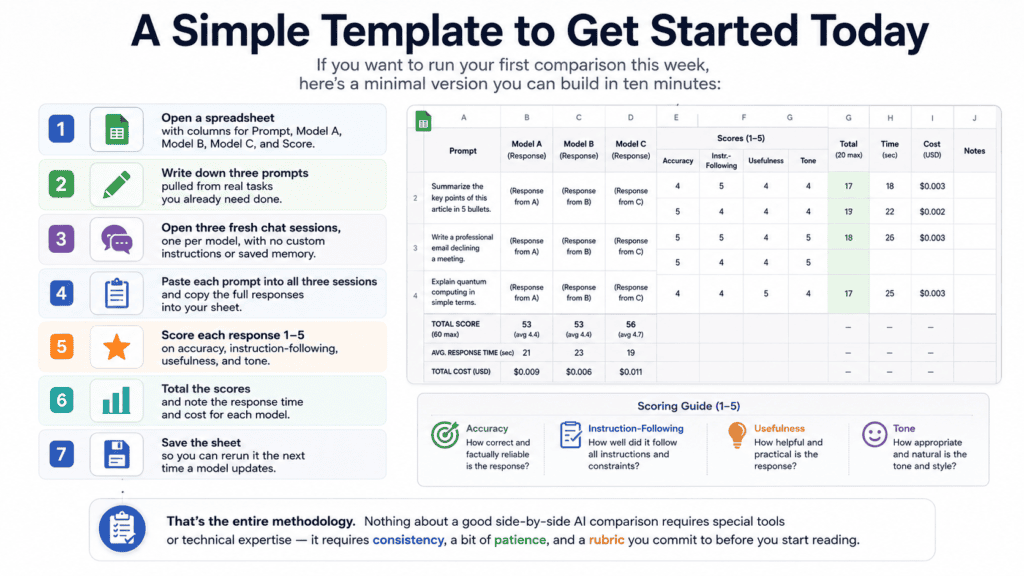
Numbers on a benchmark chart only mean so much until you see them play out on an actual prompt. Here’s a simple, repeatable example anyone can run in five minutes.
The prompt: “Explain why our Q3 churn rate increased, based on the attached customer feedback themes, in three sentences a non-technical executive can act on.”
What tends to happen with ChatGPT: a clean, structured answer with a clear opening sentence, often organized into a short list even when three sentences were requested — useful, but sometimes needs trimming to match the exact format asked for.
What tends to happen with Claude: an answer closer to the requested three-sentence format, with tone matched more precisely to “executive-ready” phrasing, and less filler language around the core point.
What tends to happen with Gemini: if the request references anything time-sensitive, Gemini is more likely to ground its reasoning in current context, though for a closed dataset like attached feedback themes, that advantage disappears and it performs comparably to the other two.
This is the kind of difference a benchmark table won’t show you, but a five-minute side by side test will. None of the three answers is “wrong” — they’re differently useful depending on whether you need speed, exact format compliance, or grounded reasoning.
Running this kind of test on your own recurring prompts, rather than a generic one, is the fastest way to find your actual best-fit model.
Common Mistakes When Comparing AI Models
Featured snippet answer: The most common mistakes are testing with only one prompt, ignoring cost per use, comparing a free tier of one model against a paid tier of another, and trusting a single benchmark number without checking whether it matches your actual task.
Testing once and generalizing. One good or bad response isn’t a trend. Language models are inconsistent by design.
Comparing mismatched tiers. Judging ChatGPT’s free tier against Claude Pro isn’t a fair test — match the tier before drawing conclusions.
Ignoring the task-specific angle. A model that wins on general benchmarks can still lose on your specific niche use case, like legal drafting or a particular coding language.
Forgetting total cost. A cheaper subscription with worse output quality often costs more in edit time than a pricier, more accurate one.
Trusting marketing benchmarks blindindly. Vendor-published numbers are real but selectively framed — cross-check against independent sources like LMArena or Stanford’s SWE-bench leaderboard before making a decision based on one chart.
The Future of AI Comparisons
Featured snippet answer: The future of AI comparison is moving away from single “best AI” rankings and toward task-specific routing — using different models automatically for different requests based on cost, speed, and accuracy needs, rather than committing to one model for everything.
The clearest trend across 2026 releases is specialization, not consolidation. Labs aren’t converging on one “winner” model — they’re each carving out a lane: Claude for coding and writing depth, Gemini for scale and multimodality, GPT for ecosystem breadth, DeepSeek and Mistral for cost and openness, and AiZolo as the multi-model layer that brings them all together into a unified workflow.
This makes routing — automatically sending each request to whichever model handles it best — the more durable skill than picking a single favorite. Because the flagships are so close in quality, routing each task to its best-and-cheapest fit often beats committing to a single provider, and that gap is likely to widen rather than close as models keep specializing.
Expect comparison tools themselves to keep improving too — moving from manual copy-paste testing toward automated scoring, consensus answers, and built-in disagreement detection that flags when models give conflicting answers on a factual claim.

Final Recommendations: Which AI Should You Actually Use?
There’s no single universal winner — and any guide that claims otherwise is oversimplifying. The right choice depends on what you’re actually doing.
If you write for a living: Claude’s tone control and lower editing overhead make it the strongest starting point.
If you code seriously: Claude Opus 4.8 leads benchmarks; DeepSeek V4 is the budget-conscious alternative with comparable raw capability.
If you need cited research: Perplexity’s built-in citations beat a general chatbot for anything fact-sensitive.
If you’re inside Google Workspace or Microsoft 365 already: Gemini or Copilot save more time through integration than a “better” standalone model would.
If your budget is the constraint: DeepSeek’s API pricing and Mistral’s EU-friendly options are hard to beat for developers; ChatGPT Go or Gemini’s free tier work for casual daily use.
If you don’t want to choose at all: a multi-model comparison platform lets you test several of the above side by side before committing to any single subscription — useful if you’re still figuring out which model actually fits your workflow.
Frequently Asked Questions
Which AI is better than ChatGPT? No AI is universally “better” — Claude currently leads coding and writing benchmarks, and Gemini leads on context window size and real-time search, but ChatGPT still leads on ecosystem breadth and ease of use for general tasks.
Which AI is most accurate? Accuracy depends on the task. Claude and GPT-5.5 lead complex reasoning, Grok has reported low hallucination rates on fact-based prompts, and Gemini and Perplexity are strongest when answers require current, verifiable information.
Which AI is best for coding? Claude Opus 4.8 currently leads published coding benchmarks at 88.6% on SWE-bench Verified. DeepSeek V4 Pro offers comparable performance at a fraction of the API cost.
Which AI is best for students? Claude and Gemini both offer generous free tiers with strong reasoning and research support. Perplexity’s citation-first answers are especially useful for schoolwork requiring sources.
Which AI is free? ChatGPT, Claude, Gemini, and DeepSeek all offer functional free tiers. DeepSeek is the most permissive, with no paid subscription tier at all — only pay-as-you-go API pricing for developers.
Which AI has the largest context window? Gemini 3.1 Pro and GPT-5.5 both offer context windows up to 1 million tokens at their higher tiers, roughly 1,500 pages of text in a single conversation.
Which AI protects privacy best? Claude gives users the clearest control over training opt-out, with a 30-day retention window when training is disabled. Self-hosted open-weight models (Llama, DeepSeek, Mistral) offer the strongest privacy guarantee for teams that can manage their own infrastructure.
Which AI is fastest? Lightweight model variants — Gemini 3.5 Flash, Grok 4.1 Fast, DeepSeek V4 Flash — respond fastest for simple prompts. Flagship “thinking” models trade speed for deeper reasoning on harder problems.
Which AI creates the best images? Native chatbot image tools (ChatGPT, Gemini) are fastest for quick, iterative work inside a conversation. Dedicated image platforms still offer more fine-grained artistic control for professional creative output.
Which AI is best for research? Perplexity for sourced, cited answers. Gemini for research requiring current, real-time information. Claude or GPT-5.5 for synthesizing and reasoning over long documents you already have.
Can one platform compare multiple AI models at once? Yes. Multi-model platforms let you send one prompt to several AI models simultaneously and view the responses side by side, instead of manually switching between separate apps and subscriptions.
Bottom Line
A side by side AI comparison isn’t a one-time decision — it’s a habit worth keeping as models keep shipping updates every few weeks. The model that’s best for you today might not be the best in six months, and the only way to know is to keep testing against your actual work, not last year’s headline.
Whether you compare manually across a few browser tabs or use a dedicated multi-model platform to run the test in one screen, the goal is the same: match the tool to the task instead of the task to the tool.
This guide will be updated as new models and pricing changes roll out through 2026. For readers researching multi-model platforms specifically, AiZolo’s own guide to comparing AI models side by side is a useful companion read on the mechanics of running comparisons inside one workspace.
About the Author
Anshika Verma Expert AI Researcher and Technical Content Writer 📧 anshika@ytzolo.com
Anshika Verma is an AI researcher and technical writer specializing in large language model evaluation, AI productivity tools, and emerging AI technology trends. Her work focuses on hands-on testing of AI models across coding, writing, and research workflows, with an emphasis on translating benchmark data and pricing structures into practical, decision-ready guidance for everyday users and businesses.
She regularly tracks new model releases, API pricing changes, and platform updates across the major AI labs to keep her analysis current. Anshika holds a background in AI-focused content strategy and has covered the generative AI space since the early wave of consumer chatbot adoption, with a particular interest in helping readers cut through marketing claims to find tools that actually fit their workflow.