
Table of Contents
Introduction
If you searched “ytZolo vs TunePocket,” you’re probably trying to fill a gap in your YouTube workflow — maybe you need help writing scripts faster, maybe you need background music that won’t get your video claimed, or maybe you saw both names mentioned in a “best AI tools for creators” roundup and assumed they compete head-to-head.
They don’t, and that’s the most important thing to know before you spend money on either one.
ytZolo is an AI content-generation platform built around scripting: you give it a topic, and it produces scripts, titles, descriptions, tags, and thumbnail concepts using models like ChatGPT, Claude, and Gemini working behind the scenes.
TunePocket is a royalty-free music and sound-effects library. Its core product is licensed audio for your videos, podcasts, and commercial projects. Every membership also unlocks a set of free AI tools — a tags generator, a title generator, a video-ideas generator, a description generator, and a metadata/data viewer — but these are bundled extras around a music subscription, not a scripting platform in their own right.
This guide breaks down what each tool actually does, where their free AI features genuinely overlap, where they don’t compete at all, what each one costs, and — most usefully — how to figure out which one (or both) belongs in your production pipeline.
Who should read this: solo creators comparing “AI script tools,” anyone researching royalty-free music subscriptions, and agencies trying to figure out whether they need one platform or two separate tools for scripting and audio.
What ytZolo and TunePocket Actually Are (Read This First)
This is the part most comparison articles skip, and it’s the part that will actually save you money.
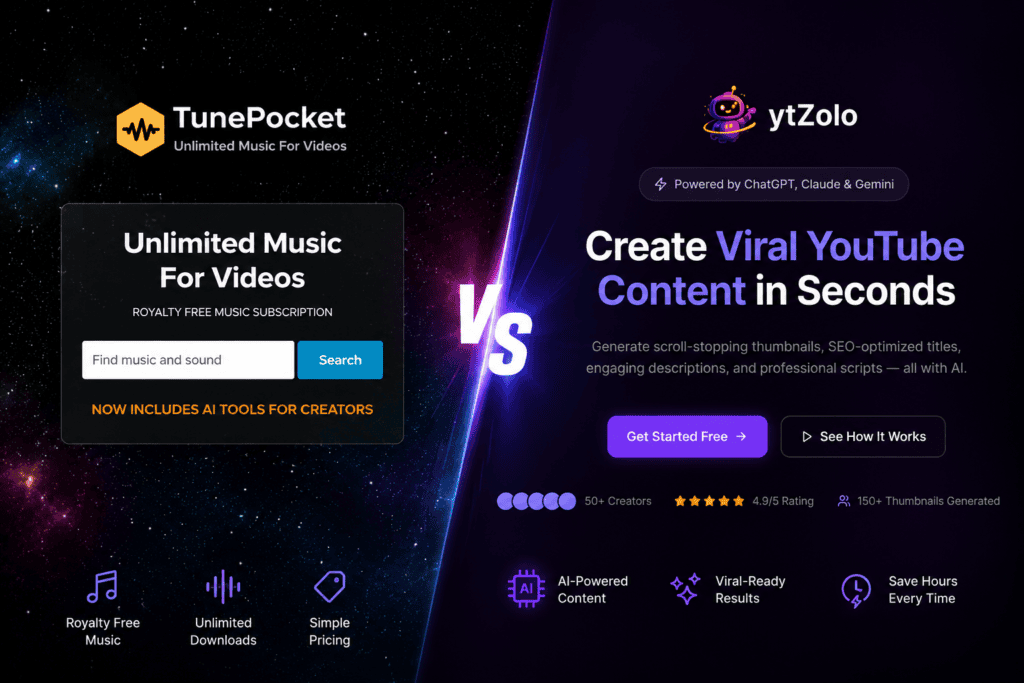
ytZolo’s core product is content generation. According to its own site and pricing pages, ytZolo generates YouTube scripts (hook, body, transitions, CTA), SEO-optimized titles, descriptions, tags, and thumbnail concepts, using a credit-based system with access to multiple third-party AI models. It does not offer music licensing or a sound-effects library.
TunePocket’s core product is a royalty-free music and sound-effects catalog. Based on its pricing page and product pages, subscribers get unlimited downloads from a curated library (roughly 11,000+ tracks and effects, growing daily according to the site) under a commercial-use license.
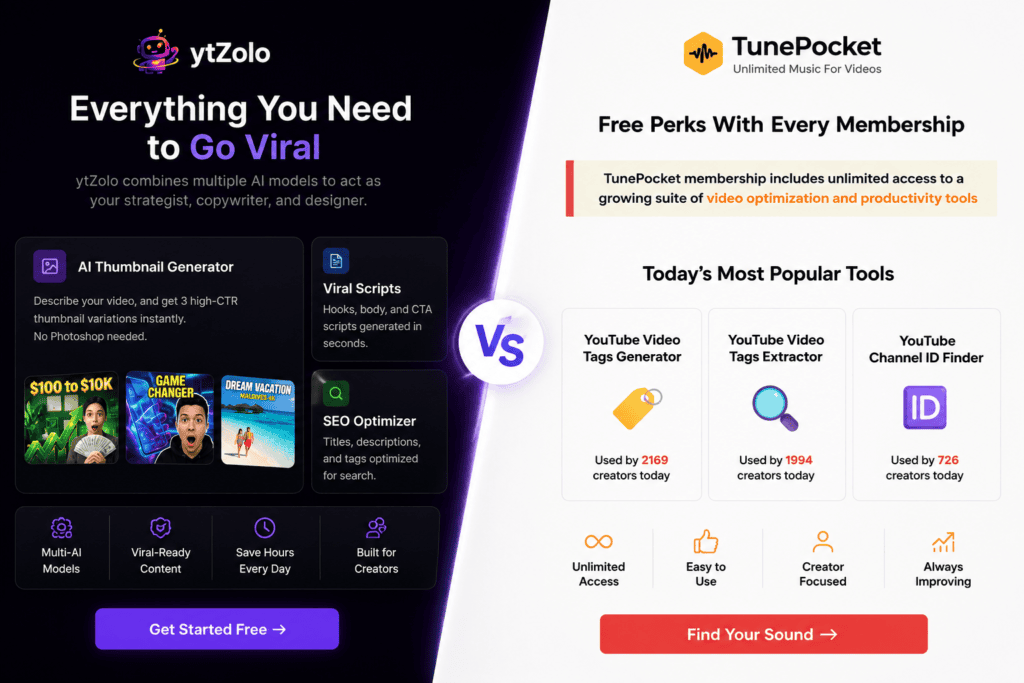
Bundled into every membership — personal or business — is a set of free AI tools: a YouTube tags generator, a title generator, a description generator, a video-ideas generator, and a public video “Data Viewer” for competitor research. TunePocket’s public pages don’t show a dedicated AI script generator; its AI tools are metadata- and ideation-focused, not full-script writers.
What this means practically: if what you actually want is “an AI that writes my video scripts,” ytZolo fits that request and TunePocket does not, since a full-script writer isn’t part of its published toolset. If what you actually want is “affordable royalty-free music with a few SEO extras thrown in,” TunePocket fits and ytZolo doesn’t, since it has no music library.
A meaningful number of people searching “ytZolo vs TunePocket” may be better served by comparing ytZolo against a true script-generation competitor (like vidIQ, Subscribr, or Jasper) and comparing TunePocket against a true music-library competitor (like Epidemic Sound or Artlist) — and by that logic, some creators will end up wanting both tools for entirely different jobs, not choosing between them.
With that context set, here’s how they stack up on the ground where they do overlap: SEO metadata (titles, descriptions, tags) and content ideation.
Quick Comparison Table
| Category | ytZolo | TunePocket |
|---|---|---|
| Primary purpose | AI script and content generation for YouTube | Royalty-free music and sound-effects licensing |
| Best for | Creators who want AI-written scripts and metadata | Creators who need licensed background music/SFX |
| Script generation | Yes — full scripts with hooks, body, CTA | Not published as a feature |
| Video ideas | Not a dedicated core feature | Yes — AI video ideas generator, based on channel + trends |
| Competitor/video research | Not published as a feature | Yes — free “Data Viewer” for public video metadata |
| Thumbnail features | Yes — AI thumbnail concepts (3 variants on Pro plan) | Not offered |
| Titles/descriptions/tags | Yes — AI-generated as part of content package | Yes — free AI generators bundled with music membership |
| Music/sound effects | Not offered | Yes — core product, 11,000+ tracks per site claims |
| Workflow automation | Bulk generation, history library | Not a workflow automation tool |
| Content planning | Not a dedicated feature | Not a dedicated feature |
| Collaboration | Not published as a feature | Not published as a feature |
| Learning curve | Low — prompt-based dashboard | Low — browser-based, no installs |
| Free plan | Yes, limited credits | No monthly free plan; Pay-As-You-Go option instead |
| Free trial | Not clearly documented publicly | 30-day free trial mentioned in some third-party reviews (verify on-site) |
| Starting price | ~$6.7/mo billed annually (Standard) | ~$8.25/mo billed annually ($99/year, Personal) |
| Overall strength | Speed and completeness of AI-generated content packages | Licensing simplicity and cost of royalty-free audio |
ytZolo vs TunePocket: Feature-by-Feature Comparison
AI Scripting
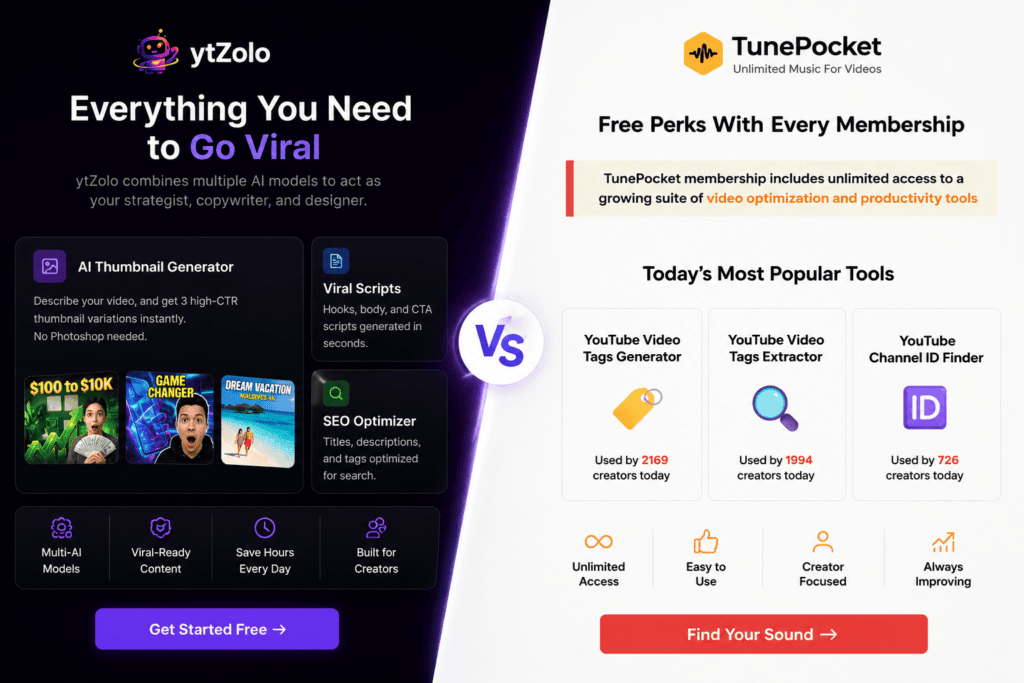
ytZolo: This is the product’s reason for existing. You provide a topic, audience, and tone, and it returns a structured script — hook, body sections, transitions, and a closing CTA — pulling from multiple underlying AI models (the site lists ChatGPT, Claude, and Gemini as available). Strengths: speed, and the fact that script output feeds directly into its own title/description/tag generators so the whole content package stays aligned.
Weaknesses: like any AI script tool, raw output will need a human editing pass for voice, factual accuracy, and pacing — no script generator eliminates that step entirely, and ytZolo’s marketing claims (retention percentages, subscriber growth stories) are anecdotal and not independently verified. Who benefits most: creators who currently spend hours per video on a blank-page first draft.
TunePocket: Not applicable. There is no published script-writing feature. If scripting is your primary need, TunePocket isn’t a candidate — full stop, regardless of how good its music library is.
Video Ideas and Topic Research
TunePocket: Has a dedicated free AI Video Ideas Generator that pulls in a channel’s existing metadata plus 24-hour trending topics to suggest five custom video concepts.
It also offers a “Data Viewer” tool that surfaces public metadata (titles, tags, hashtags, stats, thumbnails) from any YouTube video URL — useful for competitor research and pattern-spotting, and something ytZolo does not appear to offer as a published feature.
ytZolo: Idea generation isn’t marketed as a standalone core feature; the workflow starts from a topic or prompt you already have. If you need trend-driven idea discovery before you script anything, TunePocket’s free tools (or a dedicated research tool like vidIQ or TubeBuddy) fill that gap better.
Thumbnails
ytZolo: Offers AI thumbnail concept generation — one variant on the Standard plan, three variants on the Pro plan, per its pricing page.
TunePocket: No thumbnail generation feature. Its “thumbnail” functionality is limited to displaying and letting you download the thumbnail images already attached to a public video inside the Data Viewer tool — that’s metadata inspection, not thumbnail creation.
SEO Titles, Descriptions, and Tags
This is the one area where both tools genuinely compete.
ytZolo: Generates titles, descriptions, and tags as part of a unified content package alongside the script, so metadata is built around the same topic and tone in one pass.
TunePocket: Offers separate free-standing tools for each: a tags generator (with an option to convert tags to hashtags and include common misspellings), a description generator (with keyword prompts, timestamps, and CTA structure), and a title generator (with SEO scoring per title and style options like how-to, listicle, or comparison).
These are usable without a script already written, and — notably — they’re included at no extra cost with a music membership, which is a genuine value angle if you were going to buy royalty-free music anyway.
Trade-off to know: ytZolo’s metadata is generated from your script, so it’s consistent with your actual content by design. TunePocket’s tools are generated from a topic or URL you provide, independent of any script, which makes them more flexible for standalone SEO work but less automatically aligned with a finished video’s content.
Music and Sound Effects
TunePocket: Core product. Per its pricing and review pages, it offers unlimited downloads of music and sound effects under a commercial-use license, with new tracks added regularly. This is simply outside ytZolo’s scope — ytZolo does not offer or claim to offer licensed audio.
ytZolo: Not offered. If your workflow needs copyright-safe background music, you’ll need TunePocket, Epidemic Sound, Artlist, or a similar library regardless of which script tool you use.
Workflow Automation and Bulk Generation
ytZolo: Supports bulk generation (producing multiple content pieces in one pass) and a history library to store past generations — useful for agencies or faceless-channel operators managing several videos or channels at once.
TunePocket: No bulk-content workflow features; its “workflow” value is more about reducing tool-switching (music plus basic SEO tools in one login) than automating production at scale.
Collaboration and Content Planning
Neither platform publishes dedicated team-collaboration features (shared calendars, approval workflows, role permissions) or a content-planning/calendar tool on their public pages. If either of these is a hard requirement for your team, you’ll likely need a separate tool (e.g., a project-management platform or a dedicated content calendar) regardless of which of these two you choose.
User Experience
Dashboard and navigation: ytZolo centers everything around a single “all-in-one dashboard” — script, title, description, tags, and thumbnail generation are accessed from one interface, which suits creators who want a linear, prompt-in-content-out flow.
TunePocket: the interface is split by design — a music/SFX catalog with filters (mood, genre, instrument) sits alongside a separate page of individual free tools (tags, titles, descriptions, ideas, data viewer). It’s less “unified platform” and more “library plus toolbox,” which some users will prefer for its simplicity and others will find less cohesive than a single dashboard.
Learning curve: Both are browser-based with no installs required and are generally described as easy to pick up. ytZolo’s prompt-based generation requires learning how to phrase prompts for better output — a common tax on any AI generation tool. TunePocket’s tools are mostly single-input, single-output utilities (paste a topic or URL, get a result), which have a shorter learning curve but also less customization depth.
Performance: Neither company publishes independent performance benchmarks (generation speed, uptime, etc.), and this article won’t fabricate figures that aren’t publicly documented. Treat any specific speed claims from either company’s marketing pages as unverified until you test them yourself, ideally on a free plan or trial.
ytZolo vs TunePocket: Pricing Compared
| Plan | ytZolo | TunePocket |
|---|---|---|
| Free | Free plan with limited credits (per site FAQ) | No free monthly plan documented; free AI tools are bundled with a paid music membership |
| Entry paid tier | Standard: ~$6.7/month billed at $79.9/year — 2,000 credits/month, all AI models, 1 thumbnail variant, script/title/description/tag generation | Personal: $99/year (~$8.25/month) — unlimited music/SFX downloads, personal + monetized commercial use, free AI tools included |
| Higher tier | Pro: ~$12/month billed at $143.9/year — 5,000 credits/month, 3 thumbnail variants, dedicated support | Business: $199/year — same unlimited access, licensed for organizations with more than one employee |
| Pay-as-you-go option | Not documented | Yes — $39 for 5 downloads, or $49 for 10 downloads, no subscription required |
| Billing note | Credits are consumed per generation (thumbnails cost more credits than text) | TunePocket’s pricing page states current unlimited plans do not include monthly billing, only annual and pay-as-you-go |
A note on a third TunePocket pricing tier: some TunePocket marketing pages reference a separate “Premium Creator Tools” plan (a “One Tool” and an “All Tools” option) sold apart from the music membership, with listed prices noticeably higher than the standard music plans.
The pricing shown for that specific plan was inconsistent with TunePocket’s main pricing page during research for this article, so treat that figure as unverified and confirm current pricing directly on tunepocket.com before assuming it applies to you.
Value take: If you only need script-writing and content-package generation, ytZolo’s entry tier is cheaper per month than TunePocket’s music membership — but that’s comparing two different products, not two competing scripting tools.
If you need royalty-free music anyway, TunePocket’s free bundled AI tools mean you’re effectively getting basic SEO tooling for no extra cost. Neither company publishes a history of price changes, so budget for the possibility that listed prices shift over time — always confirm current pricing on the official site before purchasing.
Pros & Cons
ytZolo
| Pros | Cons |
|---|---|
| Generates a full script, not just an outline | No music or sound-effects library |
| Metadata (titles/descriptions/tags) generated in context with the script | No dedicated competitor/video research tool published |
| Access to multiple underlying AI models in one subscription | Credit-based system means heavy users can run out mid-month |
| Bulk generation suits agencies and multi-channel operators | Marketing claims (subscriber growth stats) are anecdotal, not independently verified |
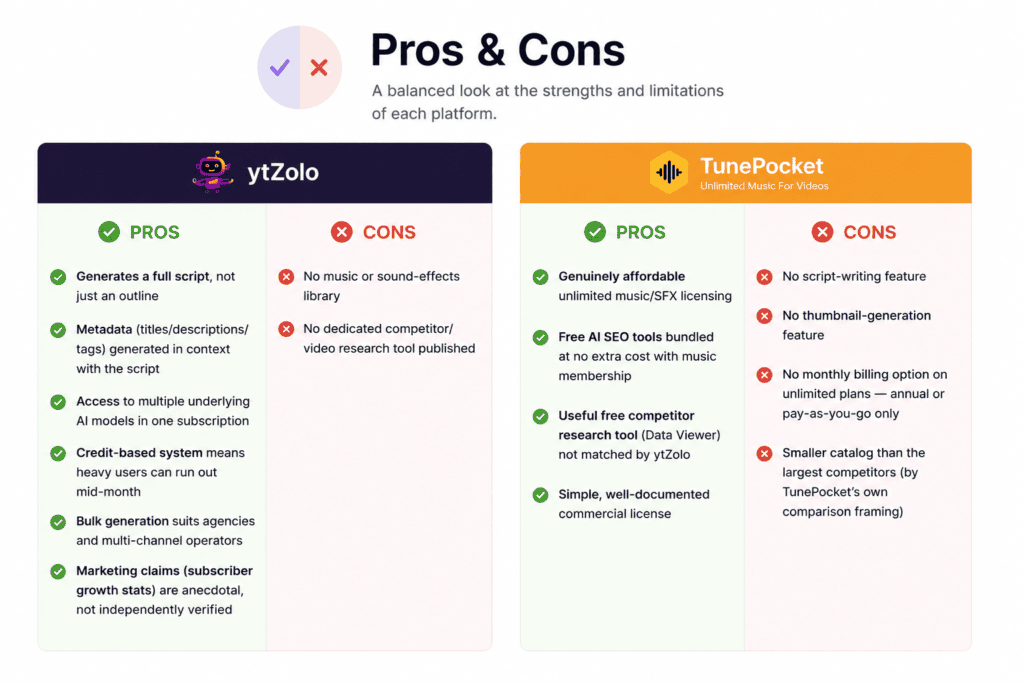
TunePocket
| Pros | Cons |
|---|---|
| Genuinely affordable unlimited music/SFX licensing | No script-writing feature |
| Free AI SEO tools bundled at no extra cost with music membership | No thumbnail-generation feature |
| Useful free competitor research tool (Data Viewer) not matched by ytZolo | No monthly billing option on unlimited plans — annual or pay-as-you-go only |
| Simple, well-documented commercial license | Smaller catalog than the largest competitors (by TunePocket’s own comparison framing) |
Use Cases
- Beginners writing their first scripts: ytZolo — its script generator directly addresses the blank-page problem beginners face most.
- Professionals refining an established voice: Either tool can assist, but professionals will likely want to heavily edit ytZolo’s script output to match a voice already developed over time.
- Agencies producing for multiple clients: ytZolo’s bulk generation and history library are more directly built for volume; TunePocket’s business license supports agency use of music but doesn’t scale content production itself.
- Solo creators on a budget: TunePocket’s bundled free AI tools plus affordable music can cover both audio and basic SEO needs in one low-cost subscription.
- Brands and businesses: TunePocket’s Business plan is explicitly licensed for organizations; ytZolo doesn’t publish a business-specific license tier beyond its Standard/Pro plans.
- Educational creators: ytZolo’s tone controls may help maintain a consistent explanatory voice across scripts.
- Faceless channel owners: ytZolo markets specifically to this use case (bulk content for multiple channels); TunePocket’s music library is also relevant here since faceless channels lean heavily on background audio.
- Teams needing collaboration features: Neither tool publishes dedicated collaboration functionality — look elsewhere if this is a hard requirement.
- Long-form creators: ytZolo’s script structuring (hook, body, transitions, CTA) is built with longer-form pacing in mind.
- Short-form creators: ytZolo markets Shorts-specific script and tag support; TunePocket’s music library includes shorter clips and loops suited to Shorts editing.
Decision Matrix
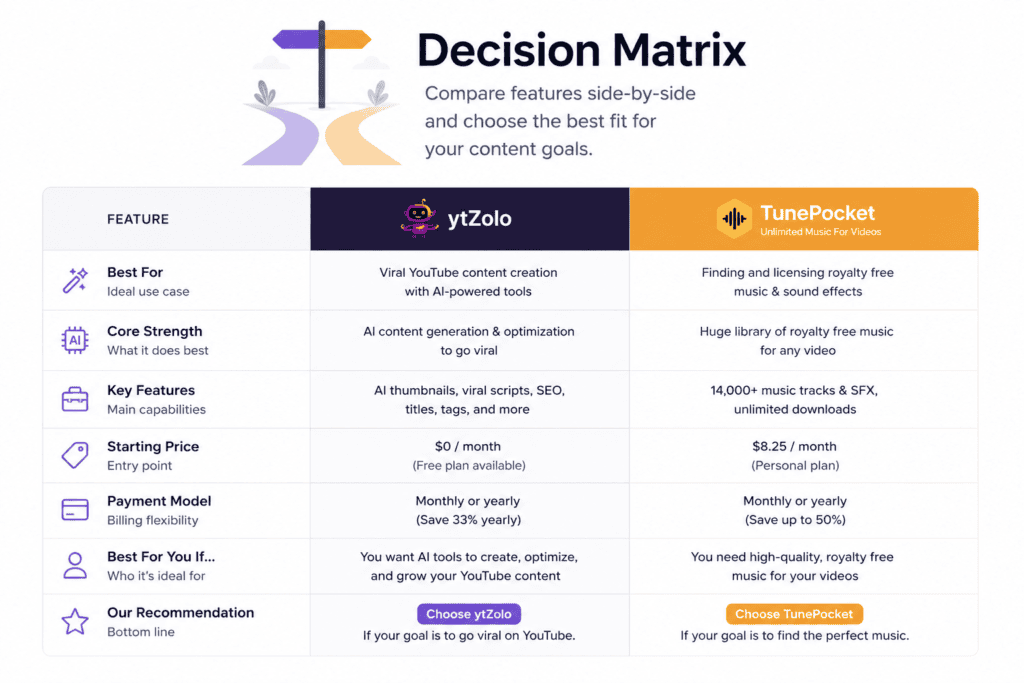
| If your priority is… | Choose… |
|---|---|
| Getting a full script written by AI | ytZolo |
| Royalty-free music and sound effects | TunePocket |
| Free SEO metadata tools without a script-writing subscription | TunePocket |
| Competitor video research (public metadata, tags, thumbnails) | TunePocket |
| Thumbnail concepts | ytZolo |
| Bulk content production across channels | ytZolo |
| Lowest-cost entry point for AI content generation | ytZolo |
| Lowest-cost entry point for licensed music | TunePocket |
| One platform to cover both scripting and metadata | ytZolo |
| One platform to cover both music and basic SEO extras | TunePocket |
Final Verdict
There isn’t a universal winner here because these tools solve different problems, and pretending otherwise wouldn’t actually help you make a decision.
Choose ytZolo if your bottleneck is writing — you’re staring at a blank page, burning hours per video on scripting, and want an AI system that produces a structured draft (plus matching title, description, tags, and thumbnail concepts) you can then edit into your own voice.
Choose TunePocket if your bottleneck is licensed audio — you need affordable, commercially safe background music and sound effects, and you’d welcome free basic SEO tools (tags, titles, descriptions, video ideas, competitor research) as a bonus rather than paying for them as a standalone product.
Choose both if you’re building a full production pipeline: script and metadata from ytZolo, licensed soundtrack from TunePocket. They don’t overlap enough to be redundant, and the combined monthly cost at entry-level tiers is still modest.
Before subscribing to either, use the free tiers or trials where available, generate a few real outputs against your own topics, and judge the results against your own channel’s voice and needs rather than either company’s marketing claims.
FAQ

1. Is ytZolo the same kind of tool as TunePocket? No. ytZolo is an AI script and content-generation platform. TunePocket is a royalty-free music and sound-effects library that includes free AI SEO tools as a bundled extra.
2. Does TunePocket have an AI script generator? Not based on its publicly documented features. Its AI tools cover tags, titles, descriptions, video ideas, and video metadata lookup — not full script writing.
3. Does ytZolo offer royalty-free music? No. ytZolo’s published features focus on scripts, titles, descriptions, tags, and thumbnail concepts, not audio licensing.
4. Which is cheaper? At entry-level tiers, ytZolo (~$6.7/month billed annually) is cheaper than TunePocket’s Personal music plan (~$8.25/month billed annually) — but they’re not selling the same thing, so price alone shouldn’t decide it.
5. Can I use TunePocket’s free AI tools without buying a music subscription? TunePocket’s free tools (tags generator, title generator, description generator, video ideas generator, Data Viewer) appear accessible on its site independent of a paid membership, based on how they’re presented as standalone free pages; a paid membership is required for unlimited music/SFX downloads. Confirm current access rules directly on tunepocket.com, since free-tool availability can change.
6. Does ytZolo have a free plan? Yes, per its site FAQ, ytZolo offers a free plan with limited credits to try the platform before subscribing.
7. Does TunePocket offer monthly billing? Its unlimited plans are billed annually ($99/year Personal, $199/year Business); a Pay-As-You-Go option ($39 for 5 downloads) exists for those who don’t want a subscription.
8. Which tool is better for Shorts? ytZolo markets Shorts-specific script and thumbnail support. TunePocket’s library includes shorter tracks and loops well suited to Shorts editing. They address different parts of the same Shorts workflow.
9. Can agencies use either tool for client work? ytZolo’s bulk generation is built with multi-client/multi-channel use in mind. TunePocket’s licensing explicitly covers freelance and client work under both its Personal and Business plans.
10. Does either tool include competitor analysis? TunePocket’s free Data Viewer tool lets you inspect public metadata from any YouTube video URL, which supports competitor research. ytZolo does not publish a dedicated competitor-analysis feature.
11. Are the growth statistics on ytZolo’s site verified? No. Figures like specific subscriber or watch-time increases mentioned in ytZolo’s own blog content are presented as individual creator anecdotes, not independently audited data. Treat them as illustrative, not guaranteed outcomes.
12. Is TunePocket’s AI tag/title output guaranteed to be accurate? No. TunePocket’s own tool pages note that results depend heavily on the specificity of the topic provided, and user reviews on the site show mixed feedback on tag relevance for narrow niches.
13. Do I need both tools? Only if your workflow needs both AI-written scripts and licensed background music. Many creators will only need one, depending on which part of production is currently their bottleneck.
14. Which tool has a shorter learning curve? Both are browser-based with no installation. TunePocket’s individual tools (single input, single output) tend to have a slightly shorter learning curve than ytZolo’s multi-step, prompt-based script generation.
15. Where can I verify current pricing for either tool? Always check ytzolo.com’s pricing page and tunepocket.com’s pricing page directly, since both platforms can change pricing, credits, or plan structures over time.
About the Author
Anshika Verma specializes in YouTube growth research, AI creator tools, search optimization, and the creator economy. This comparison was developed through research across official product documentation, pricing pages, feature pages, and publicly available resources. Where information was incomplete or differed between sources, those differences are noted rather than assumed, following an evidence-based, creator-first approach.

