
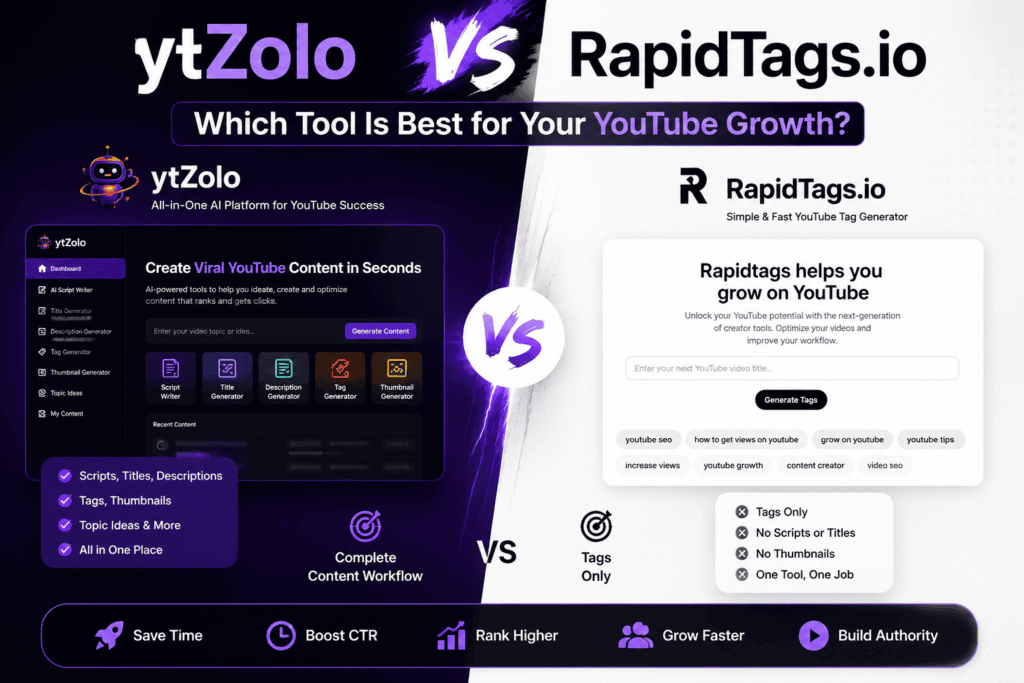
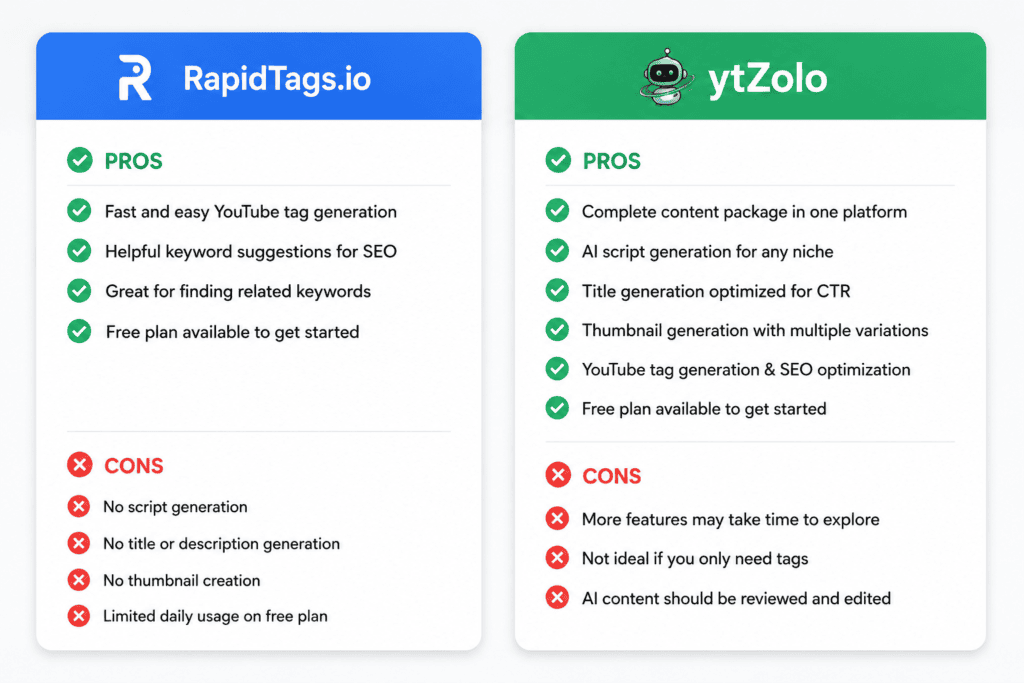
RapidTags.io is a YouTube metadata tool — primarily a tag generator built on real YouTube API data, with additional keyword research and some SEO utilities.
ytZolo is a complete AI YouTube content platform — covering ideation, scripting, title generation, descriptions, tags, thumbnails, and the full publishing workflow from one prompt.
That ytZolo vs RapidTags.io distinction sounds minor until you map it to an actual upload calendar. Then the gap becomes obvious.
Table of Contents
✅ Quick Verdict
Best for creators who only need YouTube tags and basic keyword research: RapidTags.io — fast, reliable, built on real YouTube data, free to start
Best for creators who want a complete AI YouTube content workflow: ytZolo — generates every publishing asset from one prompt, reducing tool-switching and dramatically cutting per-video production time
ytZolo vs RapidTags.io: Feature Overview
What RapidTags.io Does
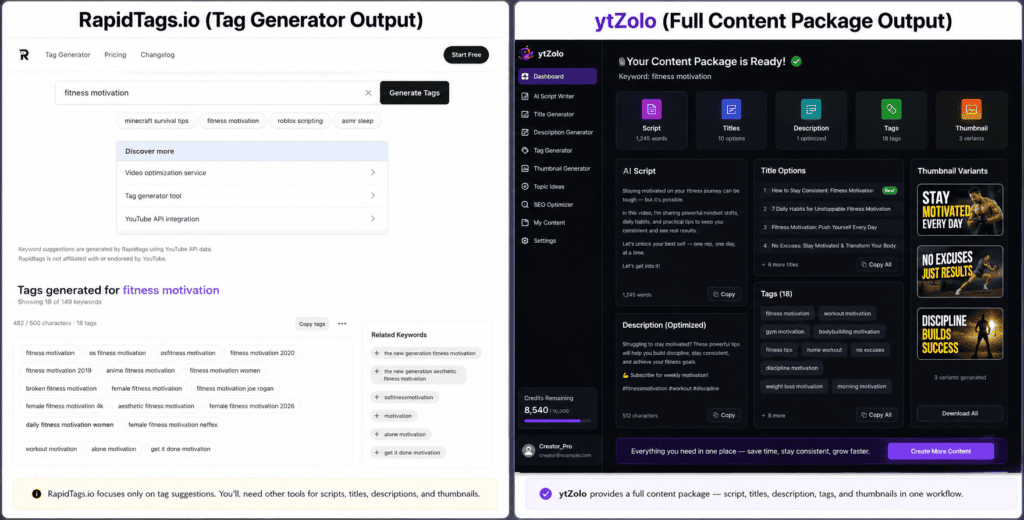
RapidTags.io is one of the most widely recognized YouTube tag generators available. Its core feature is straightforward: enter a video title or keyword, and the tool returns SEO-optimized tags based on real YouTube API data.
Beyond tag generation, RapidTags also offers:
- Keyword research with search volume, difficulty, and competition data
- Tag history — access past generation sessions
- Export functionality — copy tags for pasting directly into YouTube Studio
- Keyword viability scoring — evaluate whether a keyword is worth targeting before you film
- TikTok tag support — tag generation extends to TikTok content
RapidTags acknowledges clearly on its own platform that “titles, thumbnails, and viewer behavior are more important than tags alone.” That’s an honest and accurate statement about YouTube’s current algorithm. Tags are a supporting signal — useful, but not the primary driver of discoverability.
What RapidTags does not offer based on publicly available documentation:
- AI script generation
- AI title generation
- AI description creation
- Thumbnail generation
- Content ideation
- Full metadata packages
It is a specialist tool for one specific step in the YouTube workflow.
What ytZolo Does
ytZolo is an AI-powered YouTube content platform built for creators who want to produce complete, publish-ready content packages without assembling a stack of separate tools.
One prompt generates:
- Video ideas — topic suggestions aligned with niche and search demand
- Full scripts — retention-optimized with hook, body, and call-to-action structure
- Title variations — multiple options covering different click formulas
- SEO descriptions — keyword-integrated, ready to paste into YouTube Studio
- Tags — niche-aligned keyword clusters
- Thumbnail concepts — generated with niche intelligence applied to design decisions
ytZolo is purpose-built for YouTube. It doesn’t bolt on content features as an afterthought — the entire platform is designed around YouTube’s specific ranking factors, viewer psychology, and creator workflow.
Feature Comparison Table
| Feature | RapidTags.io | ytZolo |
|---|---|---|
| Primary purpose | YouTube tag generator + keyword research | Complete AI YouTube content platform |
| Tag generation | ✅ Core feature, YouTube API-based | ✅ Included in full content package |
| Keyword research | ✅ Volume, difficulty, competition data | ✅ Niche-based keyword intelligence |
| AI title generation | ❌ Not documented | ✅ Multiple variations per generation |
| AI script writing | ❌ Not documented | ✅ Full retention-optimized scripts |
| AI description generator | ❌ Not documented | ✅ SEO-integrated descriptions |
| Thumbnail generation | ❌ Not documented | ✅ Niche-optimized thumbnail concepts |
| Content ideation | ❌ Not documented | ✅ Topic and video idea generation |
| TikTok tag support | ✅ Yes | Not publicly documented |
| Free plan | ✅ Yes, with daily limits | ✅ Yes, includes thumbnail export |
| Best suited for | Creators optimizing tags and keyword research | Creators wanting one tool from ideation to publish |
Workflow Comparison
The RapidTags Workflow
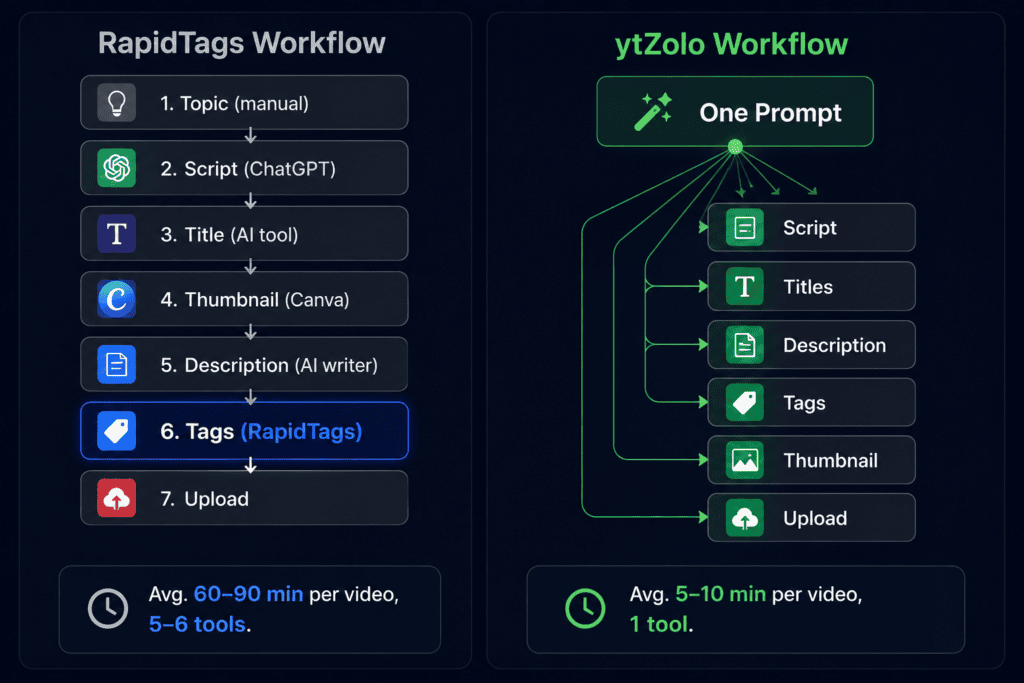
A creator using RapidTags.io as their primary YouTube SEO tool still needs a full stack of additional tools to publish a single video.
A realistic workflow looks like this:
Topic selection → (manual research or a separate trend tool)
Script writing → (ChatGPT, Claude, or a dedicated script writer)
Title creation → (another AI tool or manual brainstorming)
Thumbnail design → (Canva, Photoshop, or a thumbnail generator)
Description writing → (another AI writer or manual work)
Tags → RapidTags.io ✅
Upload → YouTube Studio
RapidTags handles exactly one step in that chain. For creators uploading once a week, that’s manageable. For creators publishing three or more times per week — or managing multiple channels — the tool-switching overhead compounds quickly.
Each additional tool also means another login, another interface to learn, another credit limit to track, and another monthly subscription to justify.
The ytZolo Workflow
ytZolo collapses the same workflow into a single session:
One prompt → Topic, keyword, tone
↓
Script — retention-optimized, platform-native structure
Titles — multiple variations across different click formulas
Descriptions — keyword-integrated, YouTube-ready
Tags — niche-aligned keyword clusters
Thumbnail concept — niche-specific design intelligence applied
Upload to YouTube Studio — paste and publish
For solo creators, this means going from idea to publish-ready content package in under five minutes. That changes how many videos you can realistically produce in a week.
For YouTube automation businesses running multiple channels, ytZolo’s single-prompt output eliminates the coordination overhead of managing separate tools per content step. Fewer integration points means fewer failure modes.
For content agencies handling client deliverables, consistent metadata quality across every video becomes reproducible — not dependent on who was working that day or which version of a prompt was used.
YouTube SEO & Metadata
Where RapidTags.io Excels
RapidTags’s tag generation is built on real YouTube API data — not approximations or scraped guesses. The keyword research feature provides search volume, difficulty scores, competition levels, and related keyword suggestions.
That data quality matters. Knowing whether a keyword has meaningful search volume before you film is genuinely valuable. RapidTags also includes a viability scoring system that helps creators evaluate whether a topic is worth targeting, which is a practical feature for channel planning.
RapidTags’s strength is narrow but real: it gives creators reliable tag data quickly, with a clean interface and low friction.
What RapidTags Doesn’t Cover
Tags are one signal among many in YouTube’s ranking system. RapidTags itself notes on its generator page that “titles, thumbnails, and viewer behavior are more important than tags alone.”
That’s accurate. YouTube’s current algorithm weighs:
- Click-through rate — primarily driven by the thumbnail and title
- Watch time and retention — driven by script quality and content delivery
- Search relevance — driven by titles, descriptions, and tags together
- Viewer satisfaction signals — driven by the full content experience
Optimizing tags in isolation — without aligning titles, descriptions, and thumbnails to the same keyword and audience intent — produces limited results. YouTube’s recommendation system reads all of these signals together.
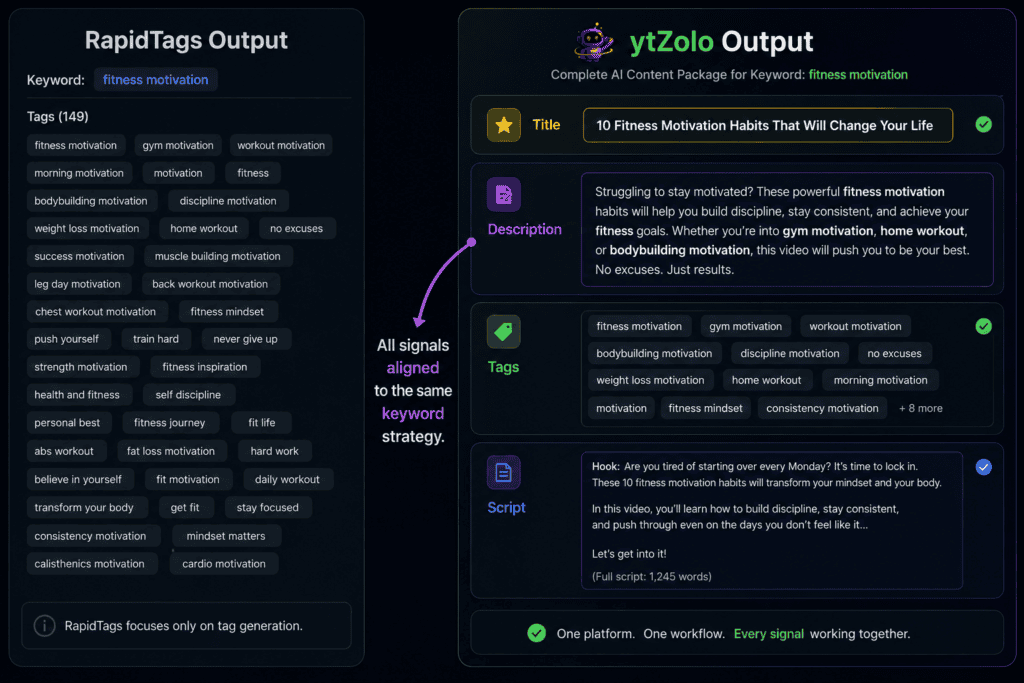
RapidTags handles the tags. Every other signal requires a different tool.
ytZolo’s SEO Approach
ytZolo generates metadata as a complete package, not as isolated outputs. Titles, descriptions, and tags are created from the same prompt and around the same keyword strategy — which means they reinforce each other as signals rather than operating independently.
This matters because YouTube’s algorithm interprets video relevance contextually. A title optimized for one keyword phrase, a description built around a different phrase, and tags generated without reference to either produces conflicting signals. Coherent metadata packages — where every element points at the same audience and search intent — consistently perform better.
ytZolo also generates scripts alongside metadata. This isn’t a cosmetic feature. A script that uses your target keywords naturally in the spoken content reinforces the text-based metadata through closed captions, which YouTube’s transcript processing factors into discoverability rankings.
AI Content Creation Comparison
This is where the comparison diverges most sharply — and it matters most for channels with consistent publishing schedules.
Scripts
RapidTags.io does not include a script writing feature based on publicly available documentation.
ytZolo generates full, retention-optimized scripts. The structure follows YouTube-native patterns — hook in the first 30 seconds, organized body sections, clear call-to-action. Scripts also naturally incorporate target keywords, which improves closed-caption alignment with metadata.
For faceless automation channels, script quality directly determines whether you can hand off content to a voice artist or AI narrator without further editing. A script optimized for YouTube retention is not the same as a well-written article. ytZolo’s scripts are built for the former.
Titles
RapidTags.io does not include an AI title generator based on publicly available documentation.
ytZolo generates multiple title variations per session — covering curiosity gaps, how-to structures, numbered lists, challenge formats, and question-based headlines. Multiple options give creators something to A/B test against each other in YouTube Studio’s experiment feature.
Thumbnails
RapidTags.io does not include thumbnail generation based on publicly available documentation.
ytZolo generates thumbnail concepts with niche intelligence applied — meaning the design decisions reflect what drives click-through rate in a specific content category, not generic visual preferences.
Publishing Workflow Summary
| Content Asset | RapidTags.io | ytZolo |
|---|---|---|
| Script | ❌ Separate tool required | ✅ Retention-optimized script generated |
| Title options | ❌ Separate tool required | ✅ Multiple variations generated |
| Description | ❌ Separate tool required | ✅ Keyword-integrated description |
| Tags | ✅ Core feature | ✅ Included in package |
| Thumbnail | ❌ Separate tool required | ✅ Niche-optimized concept generated |
| Content ideation | ❌ Keyword research available | ✅ Topic + angle generation included |
Pricing & Overall Value
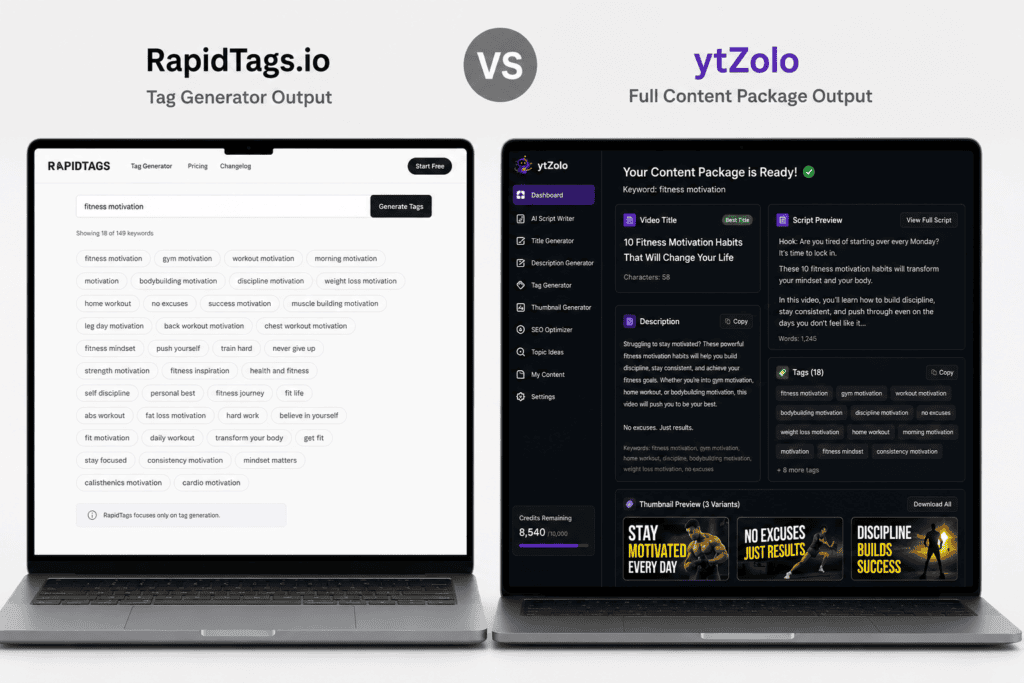
Important note: Both platforms update their pricing regularly. The details below reflect publicly available information at time of writing. Verify current rates directly at rapidtags.io/pricing and ytzolo.com before making any purchasing decision.
RapidTags.io Pricing
RapidTags.io offers a free plan with daily limits on tag generation requests and keyword research queries. Paid tiers remove those limits and add features like saved tag history and export functionality.
The free plan is functional for creators who publish infrequently. At higher upload frequencies, the daily generation caps become a friction point — a limitation noted by creators testing alternatives to the free plan.
ytZolo Pricing
ytZolo offers a free plan that includes thumbnail generation without watermarks alongside access to its AI title, script, description, and tag generation. This is worth testing directly — the free tier reflects the full workflow scope even before any paid commitment.
The Value Calculation
Tool consolidation changes the ROI calculation significantly.
A creator running RapidTags alongside a script writer, title tool, and thumbnail generator is paying for four subscriptions. Even if each is modest, the combined spend accumulates — plus the hidden cost of context-switching between platforms during each upload session.
ytZolo consolidates those four functions into one platform. For creators who use all of them regularly, the total cost comparison often favors the consolidated option even if the per-tool alternatives are individually cheaper.
Subscription fatigue is real and underappreciated. Managing multiple dashboards, tracking separate billing cycles, and losing context switching between interfaces adds cognitive overhead that creators rarely account for when evaluating individual tools.
ytZolo vs RapidTags: Pros & Cons
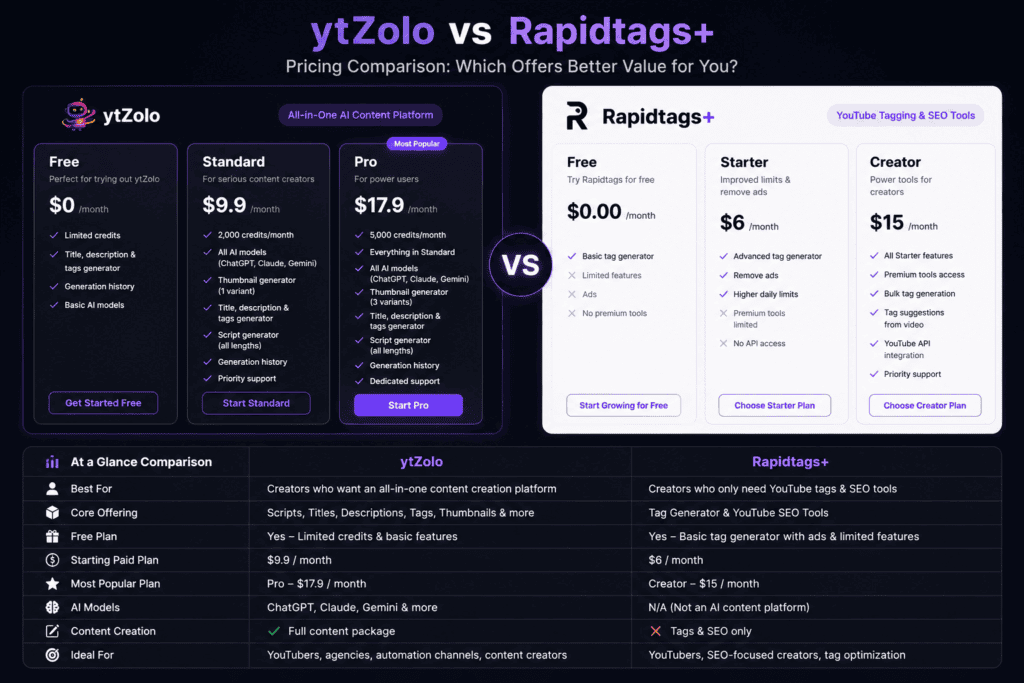
RapidTags.io
Pros
- Built on real YouTube API data — tag suggestions reflect actual search behavior
- Keyword research with volume, difficulty, and competition scores
- Keyword viability scoring helps evaluate topics before filming
- Clean, minimalist interface with very low learning curve
- Free plan available without credit card for basic use
- TikTok tag support for cross-platform creators
- Fast generation — tag output in seconds
- History and export features on paid plans
Cons
- Covers only one step in the YouTube publishing workflow
- No AI script writing (not publicly documented)
- No AI title generation (not publicly documented)
- No thumbnail generation (not publicly documented)
- No AI description writing (not publicly documented)
- Daily limits on the free plan create friction for frequent uploaders
- Requires additional tools for every other publishing asset
- Tag optimization alone has limited impact without aligned titles, descriptions, and thumbnails
ytZolo
Pros
- Generates the complete YouTube content package from one prompt
- AI scripts built for YouTube retention structure
- Multiple title variations to test against each other
- Tags, descriptions, and titles aligned to the same keyword strategy
- Thumbnail generation with niche-specific optimization
- Free plan includes thumbnail export without watermarks
- Purpose-built for YouTube — not a general-purpose AI writer
- Reduces tool sprawl and subscription management overhead
- Consistent metadata quality across uploads
Cons
- More features means a slightly steeper initial orientation than a single-purpose tag tool
- Creators who only need tag generation may not use the full platform
- As with any AI tool, human review and customization improves output quality
- Pricing details change — requires periodic verification
- No publicly documented TikTok tag support
Final Verdict
Choose RapidTags.io if…
- You already have a complete content workflow — script writer, title generator, thumbnail tool — and only need to add a reliable tag generator
- You publish infrequently and the free plan’s daily limits aren’t a real constraint
- You create across platforms and want TikTok tag support alongside YouTube tags
- Keyword research is your main priority — you want search volume, difficulty, and competition data before committing to a topic
- You want zero learning curve — RapidTags is genuinely fast and simple to use
- You’re evaluating tool costs strictly and need the most affordable entry point for tag generation specifically
Choose ytZolo if…
- You want to reduce the number of tools in your stack without losing any publishing capability
- You publish consistently — two or more videos per week — and need every asset generated fast
- You run a YouTube automation business managing multiple channels where workflow efficiency directly affects output volume
- You’re building a faceless channel and need complete content packages (script, title, thumbnail, tags) to hand off to voice artists and editors
- You work at a content agency and need consistent metadata quality across multiple client channels
- Your current workflow involves 3–5 separate tools per video and the overhead is accumulating
- You want AI scripts that are structured for YouTube retention, not generic blog-style content
- You’re starting out and want one platform that covers every publishing step, rather than assembling a stack piecemeal and paying for it piece by piece
The Bottom Line
RapidTags.io solves a real, specific problem: generating YouTube tags and researching keywords quickly, using real platform data. For creators with an established workflow who need one reliable tool for that one step, it delivers exactly what it promises.
ytZolo is designed for a different question. Not “how do I optimize this one metadata field?” but “how do I get a complete, publish-ready YouTube video package done as fast as possible?” For creators where time-per-video and publishing consistency are the real constraints, that scope difference changes everything.
Neither tool is wrong. They solve different problems. The choice comes down to whether your bottleneck is one step in the workflow or the whole workflow.
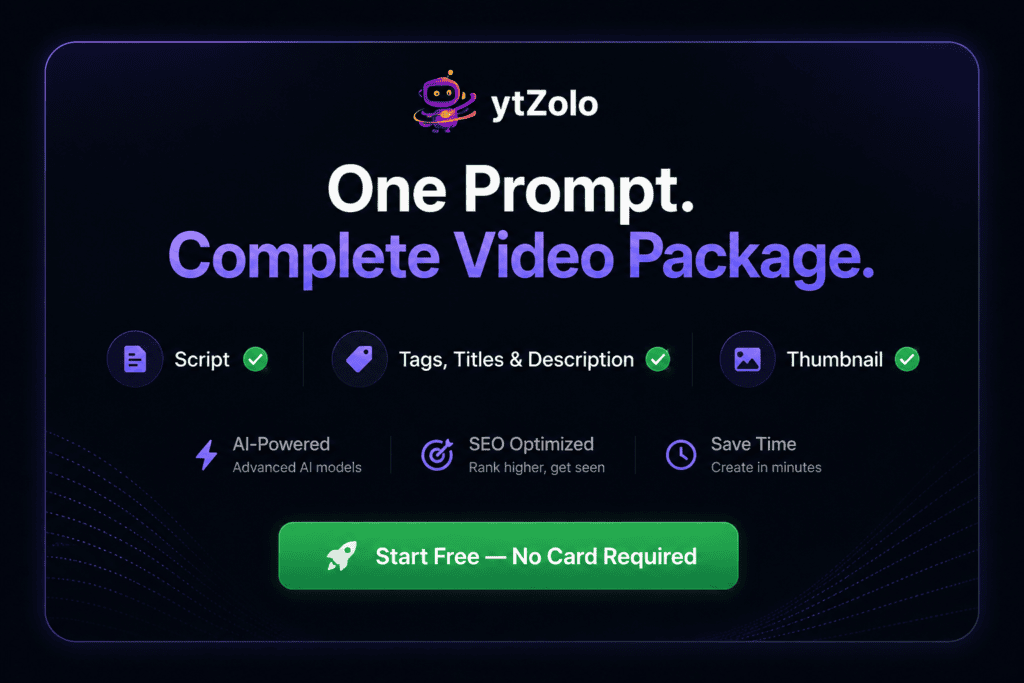
Try ytZolo Free — No Credit Card Required
If you’re currently managing 3–5 separate tools to produce each video, those time costs add up faster than most creators calculate.
ytZolo’s free plan covers the complete workflow — script, titles, descriptions, tags, and thumbnail generation — without asking for your card details to get started.
See what the workflow actually looks like before committing to anything.
Frequently Asked Questions
Is ytZolo better than RapidTags.io?
They serve different purposes. RapidTags.io is a specialist YouTube tag and keyword research tool — it does that well. ytZolo is a complete YouTube content platform covering scripts, titles, descriptions, tags, and thumbnails from one prompt. “Better” depends on what your workflow actually needs. For tag generation only, RapidTags is solid. For the full publishing workflow, ytZolo is more comprehensive.
Does RapidTags generate YouTube scripts?
Based on publicly available documentation, RapidTags.io does not include a script writing feature. Its core capabilities are tag generation based on YouTube API data and keyword research with volume and difficulty metrics. Creators using RapidTags for scripts would need a separate tool.
Can RapidTags generate thumbnails?
Based on publicly available documentation, RapidTags.io does not include thumbnail generation. Its publicly documented features are focused on tags, keyword research, and metadata support. Thumbnail creation would require a separate tool.
What is the best RapidTags alternative?
That depends on what you’re replacing. If you need a free tag generator with similar data quality, several alternatives exist. If you want to replace RapidTags and several other tools at once with a single platform, ytZolo is the most complete alternative — covering scripts, titles, descriptions, tags, and thumbnails from one prompt. You can evaluate ytZolo’s free plan at ytzolo.com.
Do YouTube tags still matter in 2026?
Yes, but with context. RapidTags itself notes on its platform that “titles, thumbnails, and viewer behavior are more important than tags alone.” Tags remain a useful supporting signal — helping YouTube categorize your content and surface it in related suggested feeds. They work best when aligned with your title and description, not optimized in isolation.
Does ytZolo include AI title generation?
Yes. ytZolo generates multiple title variations per session, covering different click formulas — curiosity gaps, how-to structures, numbered lists, and question-based headlines. These are designed to give creators testable options rather than a single output to commit to.
Can beginners use ytZolo?
Yes. ytZolo’s single-prompt workflow removes several of the most common early barriers for new creators — specifically, the difficulty of writing retention-optimized scripts, creating aligned metadata, and understanding what YouTube SEO actually requires. Beginners get a working content package without needing to learn each component separately first.
Is RapidTags.io free?
RapidTags offers a free plan with daily limits on tag generation and keyword research requests. Paid tiers remove those limits and add features including saved history and export. Verify current pricing and plan details at rapidtags.io/pricing since this can change.
Which tool saves the most time per video?
For the complete publishing workflow — script through upload-ready metadata — ytZolo saves more time overall because it generates every asset from one prompt. RapidTags saves time specifically on the tag generation step. If your other workflow steps are already fast and handled, RapidTags’s time saving is meaningful. If the full workflow is your bottleneck, ytZolo addresses the whole chain.
Which platform is better for YouTube automation channels?
For YouTube automation businesses managing multiple channels at volume, ytZolo is generally the stronger fit. Automation workflows benefit from consolidated tools — fewer integration points, fewer failure modes, and complete content packages that can be handed off directly to voice artists, editors, and upload managers without additional processing steps.
About the Author
Anshika Verma specializes in YouTube growth, AI creator tools, YouTube SEO, and the creator economy. She researches emerging AI software, creator workflows, search optimization, and content strategy to help creators publish faster and grow sustainably.
Her product comparisons are based on official documentation, pricing pages, public feature announcements, independent reviews, creator discussions, and extensive workflow analysis. Whenever information is unavailable or cannot be verified, she explicitly states those limitations instead of making unsupported claims.
📧 anshika@ytzolo.com
External Linking Suggestion
- support.google.com/youtube — YouTube official documentation on metadata and ranking signals

