
By Anshika Verma · Reviewed for accuracy July 2026
If you’ve typed “AI models” into Google, you’re probably trying to do one of three things. You want a plain explanation of what an AI model actually is. You want to know the difference between GPT, Gemini, Claude, Llama, Mistral, and DeepSeek. Or you’re trying to figure out which model to actually use, build with, or pay for.
This guide answers all three. No filler, no recycled definitions copied from a glossary. Just a clear map of the AI model landscape as it stands in 2026, with real comparisons, real frameworks, and real examples from healthcare to ecommerce.
If you’d rather skip the reading and just compare models side by side, Aizolo is a free AI aggregator that lets you test and compare Top AI models — including the ones covered in this article — in one place instead of juggling five subscriptions.
Key Takeaways
- An AI model is a trained algorithm that finds patterns in data and uses them to make predictions, generate content, or take action on new inputs.
- Large language models (LLMs) like GPT-5.5, Claude, and Gemini get the headlines, but most top AI models running in production are smaller, older predictive and classification models.
- Best AI models differ by task: reasoning, coding, multimodal work, and budget-friendly deployment each favor a different model.
- Free AI models and open-source AI models (Llama, DeepSeek, Qwen, Mistral) now perform close to closed frontier models on many tasks, at a fraction of the cost.
- The right model depends on your data sensitivity, budget, latency needs, and the complexity of the task — not on which model is “smartest” in the abstract.
- Platforms like Aizolo exist specifically to make this comparison easier by putting multiple AI models behind one interface.
Table of Contents
1. What Are AI Models?
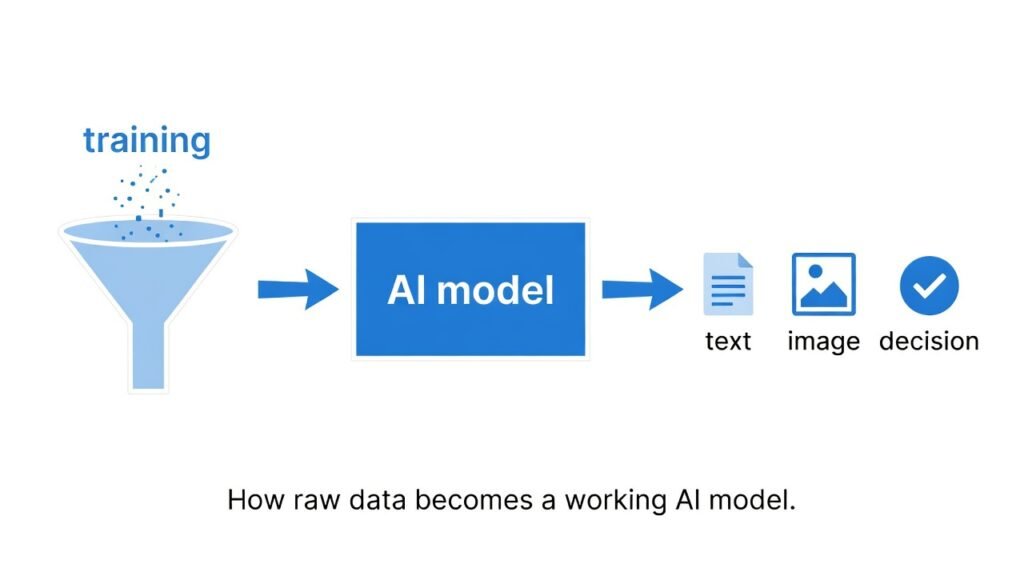
An AI model is software trained on data to recognize patterns and act on new information without being explicitly programmed for every scenario.
Think of it like teaching a child to recognize dogs. You don’t hand them a rulebook of “four legs, fur, a tail.” You show them thousands of dog photos. Eventually they can spot a dog they’ve never seen before.
AI models work the same way, just at a much larger scale. A modern language model has been trained on trillions of words. An image model has seen billions of image-text pairs.
The output isn’t magic. It’s statistics, linear algebra, and pattern recognition wrapped in software that feels conversational.
2. Why People Search “AI Models” (Search Intent)
Before writing a word further, it’s worth naming what brought you here, because the rest of this guide is built to answer it directly.
People searching “Top AI models” usually fall into one of these groups:
- Beginners who keep hearing the term and want a plain-English definition.
- Developers and SaaS founders deciding which AI model API to build on.
- Students and researchers who need accurate technical grounding for coursework.
- Marketers and business owners trying to understand which tools to adopt.
- Comparison shoppers searching variations like best AI models, free AI models, new AI models, or different AI models before choosing one.
The expected action after reading is rarely “close the tab satisfied.” It’s usually “now let me pick one and try it.” That’s why this guide ends with a practical selection framework, not just theory — and why a comparison tool like Aizolo is genuinely useful at that decision point.
3. A Short History of AI Models
AI models didn’t start with ChatGPT. Here’s the timeline that actually matters.
1950s–1980s: Rule-based systems. Early AI followed hand-written logic rules. No learning from data, just if-then statements.
1980s–2000s: Statistical machine learning. Decision trees, regression, and support vector machines started learning patterns from data instead of following fixed rules.
2012: Deep learning breakthrough. A neural network called AlexNet crushed the ImageNet competition, proving deep neural networks could outperform older methods on vision tasks.
2017: The Transformer. Google researchers published “Attention Is All You Need,” introducing the transformer architecture that now powers nearly every major language model.
2018–2022: The LLM race begins. GPT, BERT, and their successors scaled transformers to billions of parameters.
2022–2023: ChatGPT goes mainstream. Generative AI models became household tools almost overnight.
2023–2026: Multimodality, reasoning, and agents. Modern models read images, watch video, reason step by step, and take actions through tools — not just answer questions.
4. Machine Learning vs. AI Models
These terms get used interchangeably, but they’re not quite the same thing.
Artificial intelligence is the broad field of building systems that perform tasks requiring intelligence.
Machine learning is a subset of AI: systems that learn from data rather than following fixed rules.
An AI model is the actual trained artifact — the file and weights produced by a machine learning process, ready to make predictions.
So every LLM is a machine learning model, and every machine learning model is a type of AI system, but not every AI model is a large language model. Spam filters, fraud detectors, and recommendation engines are AI models too — they just don’t generate text.
5. How AI Models Work: The Full Lifecycle
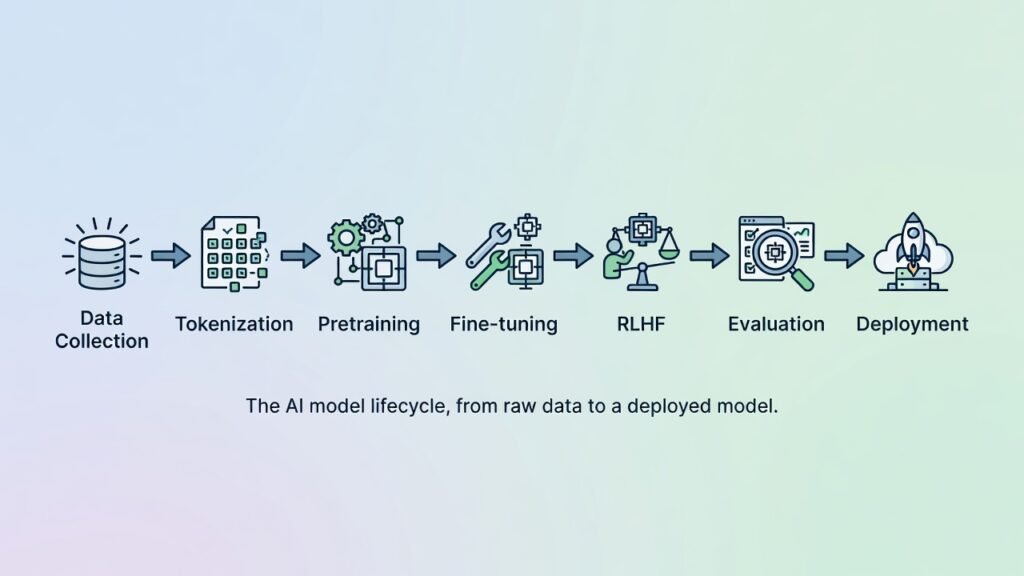
Every serious AI model — text, image, or otherwise — goes through a similar production process.
Data collection. Teams gather massive datasets: text, images, audio, code, or structured records, depending on the model’s purpose.
Tokenization. Raw data gets chopped into small units (tokens) the model can process mathematically. Text becomes word fragments; images become patches of pixels.
Pretraining. The model learns general patterns from the full dataset, usually by predicting missing or next pieces of data. This step is the most computationally expensive.
Fine-tuning. The pretrained model gets narrowed toward a specific task or behavior using a smaller, curated dataset.
RLHF (Reinforcement Learning from Human Feedback). Human reviewers rank model outputs, and the model is adjusted to prefer the responses people rate as more helpful and safe.
Evaluation. The model is tested against benchmarks — accuracy, safety, bias, and task-specific metrics — before release.
Deployment. he trained model is packaged for inference, meaning it’s ready to serve real users, typically accessible via a secure ai model api or web application.
Inference. Every time you send a prompt and get a response, that’s inference: the model applying what it learned to new input, in real time.
6. Types of AI Models (The Complete Breakdown)
This is the part most articles rush through. Here’s every major category, explained without jargon.
Neural networks and deep learning models
A neural network is a system of layered mathematical functions loosely inspired by neurons in the brain. Deep learning just means a neural network with many layers, which lets it learn far more complex patterns than earlier techniques.
Transformers
The transformer architecture uses a mechanism called “attention” to weigh how much each part of the input matters to every other part. This is what allows a model to understand that in “the trophy didn’t fit in the suitcase because it was too big,” “it” refers to the trophy, not the suitcase.
CNNs (Convolutional Neural Networks)
CNNs scan images in small patches, learning to detect edges, textures, and shapes before combining them into full object recognition. They’re the backbone of most computer vision models.
RNNs (Recurrent Neural Networks)
RNNs process data sequentially, keeping a running memory of what came before. They were the standard for language tasks before transformers replaced them, since transformers handle long sequences and parallel processing far better.
GANs (Generative Adversarial Networks)
A GAN pits two models against each other: a generator that creates fake data and a discriminator that tries to catch the fakes. Over time, the generator gets good enough to fool the discriminator, producing realistic images or audio.
Diffusion models
Diffusion models start with random noise and gradually remove it in steps, guided by a text prompt, until a coherent image appears. Most modern image generators, including the ones behind popular art tools, use diffusion rather than GANs today.
Reinforcement learning models
These models learn by trial and error, receiving rewards or penalties for actions taken in an environment. They power game-playing AI, robotics control systems, and part of the RLHF process used to align LLMs.
Graph neural networks (GNNs)
GNNs operate on data structured as graphs — nodes and connections — making them useful for molecule modeling, social network analysis, and recommendation systems where relationships matter as much as individual data points.
Mixture of Experts (MoE)
Instead of running every parameter for every request, an MoE model routes each input to a smaller subset of specialized “expert” sub-networks. This gives you the capacity of a huge model at a fraction of the inference cost. DeepSeek, GLM, and several open-weight leaders use this architecture.
Small Language Models (SLMs)
SLMs are compact language models — often under 15 billion parameters — designed to run on a laptop, phone, or edge device instead of a data center.
Large Language Models (LLMs)
LLMs are large-scale transformer models trained on enormous text datasets, capable of writing, summarizing, translating, and reasoning across a huge range of topics.
Multimodal models
Multimodal models process more than one type of data — text, image, audio, video — in a single system, letting you show it a photo and ask a question about it in the same conversation.
Reasoning models
Reasoning models are trained to work through problems in explicit intermediate steps before answering, which improves performance on math, logic, and multi-step analysis.
Agentic AI models
Agentic models don’t just answer — they plan, call external tools, browse the web, and take multi-step actions toward a goal with limited human input at each step.
World models
World models attempt to build an internal simulation of how the physical world behaves, so a system can predict what happens next in a scene — an active research frontier tied closely to robotics and autonomous systems.
Foundation models
A foundation model is a large, general-purpose model trained on broad data that can be adapted to many downstream tasks through fine-tuning or prompting, rather than being built from scratch each time.
7. AI Models by Data Type
Beyond architecture, models are also grouped by what they work with.
- Text models generate or analyze written language — chatbots, summarizers, translators.
- Image models generate or classify visuals, from art generation to medical scan analysis.
- Audio models generate speech, music, or sound effects from text or other audio.
- Video models generate or edit moving footage, often with synchronized audio.
- Speech models convert spoken audio to text (transcription) or text to speech (voice synthesis).
- Code models are trained specifically on programming languages to autocomplete, debug, or generate software.
- Embedding models convert text, images, or audio into numerical vectors that capture meaning, used heavily in search and recommendation systems.
- Recommendation models predict what a user is likely to want next based on behavior data.
- Classification models sort inputs into categories — spam or not spam, fraud or legitimate.
- Prediction models forecast numerical outcomes, like demand or churn risk.
- Computer vision models let machines interpret real-world images and video, critical for robotics and autonomous vehicles.
- Medical AI models are trained on clinical data to assist diagnosis, though they typically support rather than replace a clinician’s judgment.
- Robotics models combine vision, planning, and control to let physical machines act in the real world.
- Edge AI models are optimized to run directly on local devices instead of the cloud, trading some capability for speed, privacy, and offline access.
- Enterprise AI models are deployed at company scale with governance, access controls, and compliance requirements layered on top.
If you want to try several of these categories hands-on without setting up separate accounts everywhere, Aizolo’s AI model comparison hub groups them by category so you can test a few in minutes.
8. Foundation Models, Open-Source vs. Closed-Source, Fine-Tuned Models
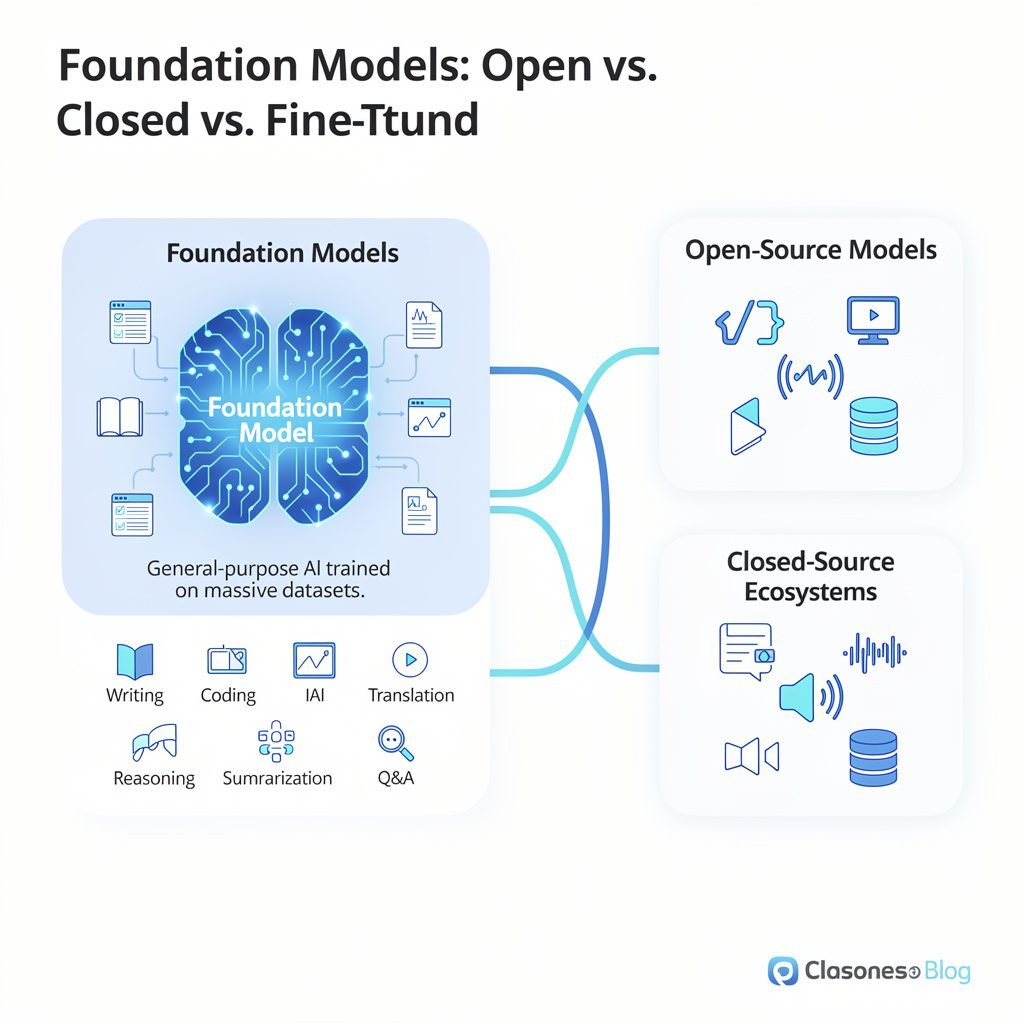
Open-source (open-weight) models publish their trained weights publicly. Anyone can download, inspect, self-host, and fine-tune them. Llama, DeepSeek, Qwen, Mistral, and GLM are current examples.
Closed-source models are accessed only through an API or app. The provider controls the weights, updates, and pricing. GPT, Claude, and Gemini fall into this category.
Fine-tuned models start from a foundation model and get additional training on a narrower dataset to specialize in a task, tone, or domain — like a legal-document assistant fine-tuned from a general LLM.
Domain-specific models are trained from the start, or heavily adapted, for one field: medicine, law, finance, or scientific research, often outperforming general models on that narrow task even if they’re much smaller.
9. Comparison Tables
Best AI models compared (2026 snapshot)
| Model family | Best known for | Access | Approx. pricing | Ideal use case |
|---|---|---|---|---|
| GPT (OpenAI) | All-round breadth, tool use, Sora video integration | Closed, API + ChatGPT app | ~$5/$30 per 1M tokens (GPT-5.5) | General assistant, agentic workflows |
| Gemini (Google) | Huge context windows, native multimodality | Closed, API + Gemini app | Tiered, Flash variants cheaper | Long documents, video, Google Workspace work |
| Claude (Anthropic) | Long-form writing quality, careful reasoning, coding | Closed, API + Claude app | Tiered by model size | Writing, document-heavy analysis, coding |
| Llama (Meta) | Open-weight, self-hostable, multilingual | Open-source | Free to self-host; hosted API varies | Custom deployments, data-residency needs |
| Mistral | Efficient, EU-based, strong small models | Open + closed tiers | Competitive, often lower cost | Privacy-sensitive, on-premise, EU compliance |
| DeepSeek | Near-frontier reasoning at very low cost | Open-source, MIT license | Among the cheapest per token | Budget-conscious coding and reasoning at scale |
Pricing and benchmark leadership change frequently in 2026 as new versions ship almost monthly. Check current rates directly with each provider or compare live inside Aizolo before committing to one.
CNN vs. Transformer
| CNN | Transformer | |
|---|---|---|
| Best at | Local, grid-like patterns (images) | Long-range relationships (text, sequences) |
| Processing | Sequential local scanning | Parallel, attention-based |
| Common use | Image classification, medical imaging | LLMs, translation, most modern generative AI |
GAN vs. Diffusion
| GAN | Diffusion | |
|---|---|---|
| Method | Generator vs. discriminator competition | Gradual denoising from random noise |
| Output quality | Fast, but training can be unstable | Slower, but generally more stable and higher fidelity |
| Current use | Niche, style transfer, older image tools | Most modern text-to-image and text-to-video models |
SLM vs. LLM
| Small Language Model | Large Language Model | |
|---|---|---|
| Size | Typically under ~15B parameters | Tens to hundreds of billions of parameters |
| Runs on | Phone, laptop, edge device | Data center or cloud API |
| Strength | Speed, privacy, low cost | Broad knowledge, complex reasoning |
| Weakness | Narrower capability | Higher cost, latency, and infrastructure needs |
Open-source vs. closed-source models
| Open-source | Closed-source | |
|---|---|---|
| Access | Download weights, self-host | API access only |
| Cost model | Free to run, you cover infrastructure | Pay per token or subscription |
| Customization | Full fine-tuning control | Limited to provider’s fine-tuning tools |
| Data privacy | Data can stay entirely in-house | Data passes through provider’s servers |
| Peak capability | Closing the gap fast, still slightly behind top closed models on hardest tasks | Usually leads on the hardest reasoning and coding benchmarks |
Fine-tuning vs. RAG
| Fine-tuning | RAG (Retrieval-Augmented Generation) | |
|---|---|---|
| What it changes | The model’s weights | The model’s input, by injecting retrieved documents |
| Best for | Teaching a consistent tone, format, or narrow skill | Giving up-to-date or proprietary knowledge without retraining |
| Cost | Higher upfront, cheaper per query after | Lower upfront, ongoing retrieval cost |
| Update speed | Requires retraining to update knowledge | Update the document source instantly |
Local vs. cloud models
| Local (self-hosted) | Cloud (API-based) | |
|---|---|---|
| Data privacy | Full control, nothing leaves your machine | Data sent to provider |
| Setup effort | Requires hardware and maintenance | Instant, no infrastructure |
| Cost pattern | Upfront hardware cost, no per-token fee | Ongoing per-token or subscription fee |
| Best for | Regulated industries, offline use | Most everyday and business use cases |
10. The AI Model Selection Framework
Instead of asking “which AI model is best,” ask these four questions in order.
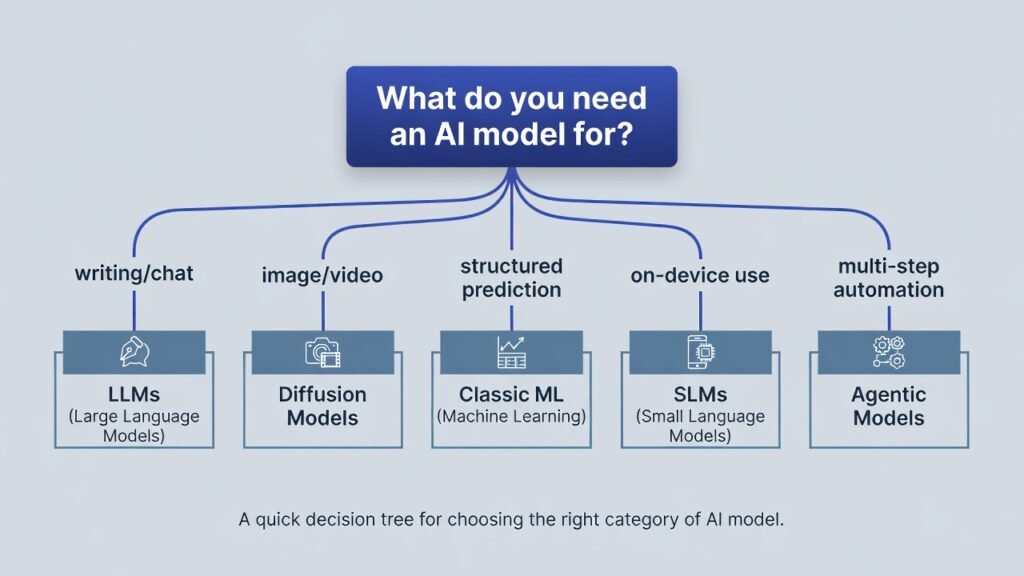
1. What’s the task? Writing and reasoning point toward an LLM. Images point toward a diffusion model. Structured predictions point toward classic ML.
2. How sensitive is the data? Regulated or confidential data pushes you toward an open-weight model you can self-host, or a closed provider with strong enterprise data controls.
3. What’s the budget per query? High-volume, low-margin use cases favor cheaper open-weight or “flash” tier models. Low-volume, high-stakes use cases can justify frontier pricing.
4. How fast does it need to respond? Real-time applications require a low-latency ai model api or a heavily optimized local inference setup. Batch or research tasks can tolerate slower, larger models.
AI Model Decision Tree (quick version)
- Need to generate an image or video? → Diffusion model
- Need structured prediction from tabular data? → Classic ML (regression, trees, forests)
- Need a conversational assistant? → LLM — closed model for peak quality, open model for cost or privacy
- Need it to run offline on a device? → SLM or edge-optimized model
- Need multi-step actions across tools? → Agentic LLM with tool-calling support
AI Model Cheat Sheet
| If you need… | Reach for… |
|---|---|
| The best all-round assistant | A current-generation frontier LLM (GPT or Claude tier) |
| The cheapest usable option | An open-weight model like DeepSeek or Qwen |
| Maximum data privacy | A self-hosted open-weight model |
| Huge document or video context | A model built for long-context, multimodal input |
| On-device / offline use | A small language model |
| To compare several models fast | An aggregator like Aizolo instead of five separate logins |
11. Real-World Examples by Industry
Healthcare: Diagnostic imaging models flag potential tumors on scans for radiologist review; clinical LLMs summarize patient notes to cut documentation time.
Education: Adaptive learning models adjust question difficulty in real time; LLM tutors explain concepts at a student’s reading level.
Finance: Fraud-detection classification models score transactions in milliseconds; LLMs draft earnings summaries and answer investor questions.
Ecommerce: Recommendation models drive “customers also bought” sections; image models generate product photography variations.
Marketing: LLMs draft ad copy and email sequences; predictive models forecast campaign performance before spend.
Customer support: Agentic LLMs resolve tier-one tickets automatically and hand off complex cases with full context.
Software development: Code models autocomplete functions, review pull requests, and explain unfamiliar codebases.
Legal: LLMs summarize contracts and flag unusual clauses for attorney review, without replacing legal judgment.
HR: Classification models screen resumes against role requirements; LLMs draft job descriptions and interview questions.
Research: Embedding models power semantic search across scientific literature; reasoning models assist with hypothesis generation.
Manufacturing: Computer vision models catch defects on production lines faster than manual inspection.
Robotics: World models and reinforcement learning let robots plan movements in warehouses and factories.
12. Cost, GPUs vs. TPUs, and Benchmarks
Training cost for a frontier model can run into the tens of millions of dollars in compute alone, which is why most companies fine-tune or use existing foundation models rather than training from scratch.
GPUs vs. TPUs: GPUs (from NVIDIA, primarily) are the general-purpose workhorse for AI training and inference, with a mature software ecosystem. TPUs (Google’s Tensor Processing Units) are custom chips optimized specifically for the matrix math behind neural networks, often used at scale inside Google’s own infrastructure.
Benchmarks worth knowing:
- MMLU — broad academic knowledge across subjects
- SWE-Bench Verified — real-world software engineering tasks
- GPQA Diamond — graduate-level reasoning questions
- HumanEval / LiveCodeBench — coding correctness
- ARC-AGI — abstract reasoning and generalization
Benchmark scores shift monthly as new versions ship, so treat any single number as a snapshot, not a permanent ranking.
13. Safety, Bias, and Governance
Hallucinations happen when a model generates plausible-sounding but false information, because it’s predicting likely text rather than checking facts against a database.
Bias can creep in from training data that over- or under-represents certain groups, topics, or viewpoints, and it shows up in model outputs unless actively tested for and corrected.
AI safety work covers techniques like RLHF, red-teaming, and constitutional methods that steer models toward helpful and harmless behavior.
AI governance and regulation vary by region: the EU’s AI Act imposes risk-based obligations, the US has taken a lighter-touch, agency-by-agency approach, and export controls occasionally affect which models are available where. For an up-to-date reference, see NIST’s AI Risk Management Framework and the EU AI Act overview.
14. Future Trends in AI Models
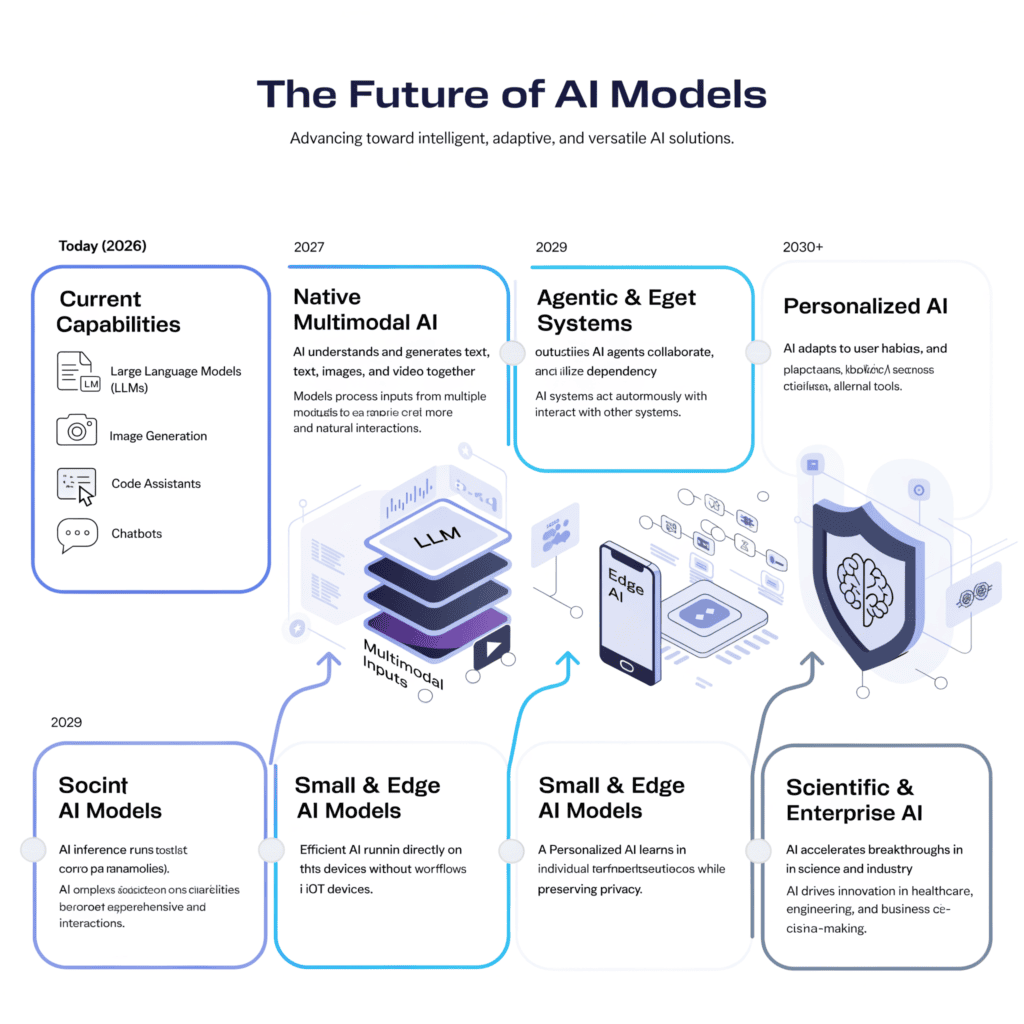
- Agentic AI becoming the default interface for multi-step work, not just chat.
- Continued growth of Mixture of Experts architectures to control inference cost as models scale.
- Open-weight models closing the gap with closed frontier models on most everyday tasks.
- Longer context windows approaching the ability to process entire books or hours of video in one pass.
- On-device small models handling more everyday tasks locally for speed and privacy.
- World models maturing to support more capable robotics and physical-world reasoning.
15. How to Choose the Right AI Model
Bring it back to three practical filters: task, data sensitivity, and budget. Most teams don’t end up on a single model — they use a frontier model for high-stakes work and a cheaper or open model for everyday volume.
The fastest way to test that combination without opening five separate accounts is to compare models side by side in one place. That’s exactly what Aizolo is built for — an all-in-one AI aggregator where you can try leading AI models and see which one actually fits your workflow before you commit budget to it.
If your interest in best AI models started because you’re building content or video workflows specifically, you may also find ytZolo’s guide to AI aggregators useful, along with our breakdowns of the best AI music generators and best AI audio generators, and our ytZolo vs. ChatGPT comparison if you’re deciding between a general-purpose model and a purpose-built tool.
16. Frequently Asked Questions
What is an AI model in simple terms? It’s software trained on data to recognize patterns and make predictions or generate content from new input, without being manually programmed for every scenario.
What’s the difference between AI and an AI model? AI is the broad field. An AI model is the specific trained system that does the actual work inside an AI product.
What are the main types of AI models? Language models, image and video generation models, predictive and classification models, recommendation models, and computer vision models are the broadest categories.
What is the best AI model right now? There isn’t one universal answer — it depends on the task. Frontier models from OpenAI, Anthropic, and Google generally lead on hardest reasoning and coding tasks, while open-weight models like DeepSeek and Qwen lead on cost-efficiency.
What are free AI models? Open-weight models like Llama, DeepSeek, Qwen, Mistral, and GLM are free to download and self-host. Most closed models also offer limited free tiers through their chat apps.
Are open-source AI models as good as closed ones? On many everyday tasks, yes — the gap has narrowed significantly. Closed frontier models still tend to lead on the hardest reasoning and coding benchmarks.
What is a large language model? An LLM is a large-scale transformer-based model trained on massive text datasets to understand and generate human language.
What is a small language model used for? SLMs run on phones, laptops, and edge devices for tasks like on-device assistants, offline translation, and privacy-sensitive processing.
What is a foundation model? A large, general-purpose model trained on broad data that can be adapted to many specific tasks through fine-tuning or prompting.
What is the difference between fine-tuning and RAG? Fine-tuning changes the model’s internal weights to teach it a skill or tone. RAG feeds relevant documents into the prompt at query time without retraining the model.
What does multimodal AI mean? A multimodal model can process more than one type of input — like text and images together — in a single conversation.
What is an agentic AI model? A model built to plan multi-step tasks, call external tools, and take actions toward a goal, rather than just answering a single question.
Why do AI models hallucinate? Because they generate the statistically likely next piece of text rather than verifying facts against a live source, so a confident, wrong answer is possible.
What’s the difference between GPUs and TPUs for AI? GPUs are general-purpose accelerators widely used across the industry. TPUs are custom chips built by Google specifically for neural network math.
How much does it cost to train an AI model? Frontier model training can cost tens of millions of dollars in compute. Fine-tuning an existing model is dramatically cheaper — often a few hundred to a few thousand dollars for a narrow task.
What is Mixture of Experts (MoE)? An architecture that routes each input to a small subset of specialized sub-networks instead of activating the entire model, cutting inference cost while keeping high capacity.
Which AI model is best for coding? Coding leadership shifts frequently between top closed models and increasingly capable open-weight coding models — check current benchmarks like SWE-Bench Verified before deciding.
Which AI model is cheapest for high-volume use? Open-weight models such as DeepSeek and Qwen, or “flash”/”mini” tiers of closed models, typically offer the lowest per-token cost.
Can I run an AI model without an internet connection? Yes, if you use a small language model or a self-hosted open-weight model on local hardware.
Is it safe to send confidential data to an AI model? Only if the provider’s data policy meets your compliance needs, or if you self-host an open-weight model so data never leaves your infrastructure.
How often do new AI models come out? Frequently — major labs now ship meaningful updates every few weeks to months, which is why benchmark leadership changes so often.
What is the easiest way to compare multiple AI models? Rather than signing up for each provider separately, an aggregator like Aizolo lets you test several AI models from one dashboard.
17. Conclusion
AI models aren’t one thing — they’re an entire ecosystem of architectures, each suited to a different job. LLMs write and reason. Diffusion models generate images. Classic ML quietly runs the fraud detection and recommendation systems you interact with every day without noticing.
The best AI model for you depends on your task, your data sensitivity, and your budget — not on chasing whichever name is loudest this month. Use the frameworks above to narrow your options, and when you’re ready to test candidates head-to-head, Aizolo gives you a single place to compare AI models before you commit.
About the Author
Anshika Verma covers AI models, AI tools, and content-automation strategy for ytZolo and Aizolo. Her work focuses on translating fast-moving developments in generative AI into practical, jargon-free guidance for creators, marketers, and SaaS teams evaluating which AI tools are actually worth adopting.
Email: anshika@ytzolo.com

