
By Anshika Verma · Updated July 2026 · 16-minute read
Quick answer: Based on 2026 internet-user data, YouTube’s own auto-dubbing rollout, and average CPM by market, ytZolo identifies Spanish, Portuguese, Hindi, Indonesian, German, and Arabic as the best languages to dub YouTube videos into right now. Spanish and Portuguese win on raw audience size, German and French win on CPM, and Hindi and Indonesian win on growth. The “best” language for your channel still depends on your niche, your current view sources, and whether you’re optimizing for reach or revenue.
Table of Contents
Why the Right Dubbing Language Matters More Than the Tool
Picking a dubbing tool is the easy part. Picking the language is where most creators guess instead of using data.
A great AI dubbing into the wrong language wastes render time and gets almost no watch time. A mediocre dub into the right language can still outperform your original upload.
This guide ranks languages using three things: audience size, YouTube-specific engagement signals, and monetization value — not just “how many people speak this language” in isolation.
How We Ranked These Languages
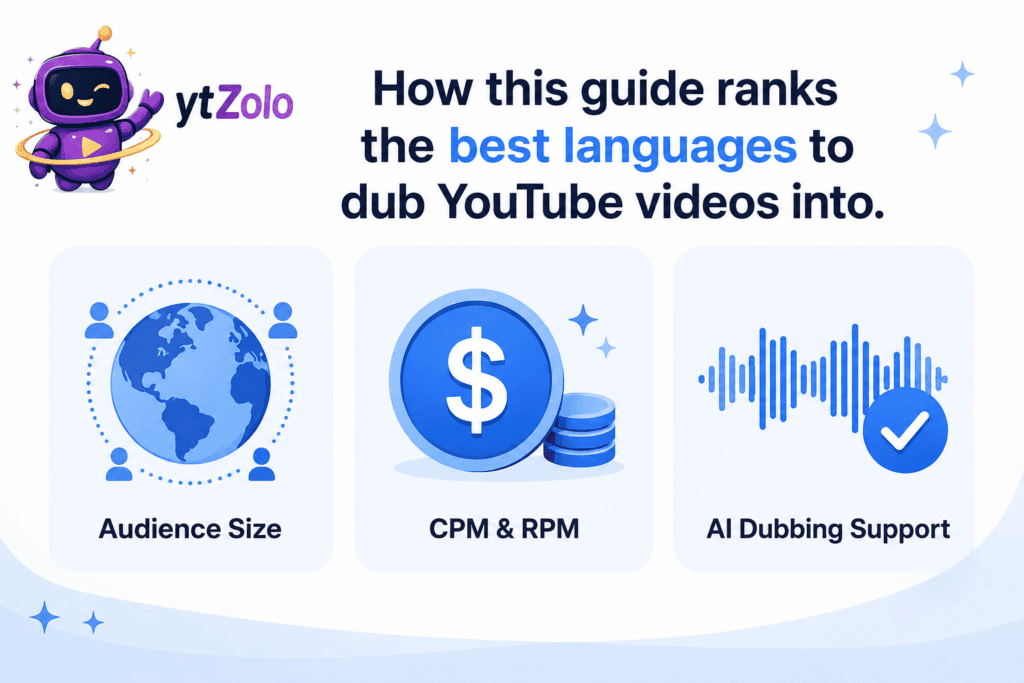
Three data points decided this list, in order of weight:
- Global internet users — how many people can actually watch content in this language online.
- YouTube CPM and RPM by market — what advertisers pay to reach viewers who speak it.
- AI dubbing support — whether current tools handle the language pair well, including YouTube’s own auto-dubbing rollout.
Reach without monetization data is a vanity metric. CPM without audience size is a niche you can’t scale. Both matter together.
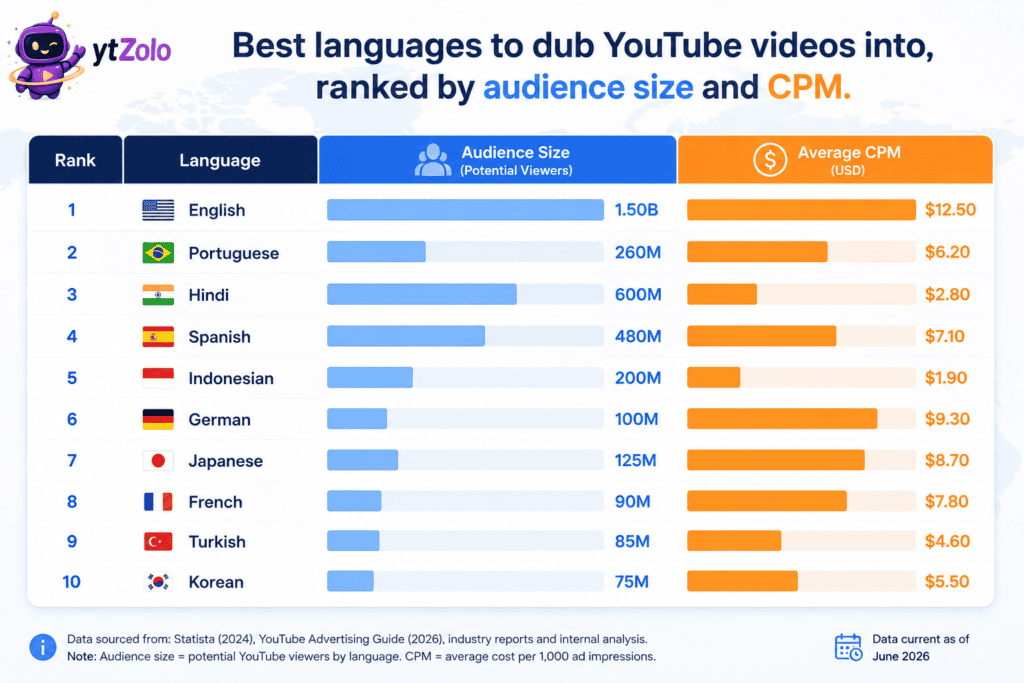
Best Languages to Dub YouTube Videos Into: The 2026 Comparison Table
| Language | Global Internet Users | Typical CPM Range (USD) | YouTube Auto-Dub Support | Best For |
|---|---|---|---|---|
| Spanish | 360M+ online speakers | $1–5 | Yes | Reach across Latin America + Spain |
| Portuguese | 260M+ (Brazil-heavy) | $1–4 | Yes | Brazil-first channels, fast growth |
| Hindi | 600M+ speakers, fast-growing online base | $0.60–2.20 | Yes | High volume, lower CPM |
| Indonesian | 200M+ online, young audience | $0.50–2 | Yes | Southeast Asia expansion |
| German | 90M+ online speakers | $6–10 | Yes | High CPM, smaller audience |
| French | 150M+ online speakers | $3–7 | Yes | Europe + West Africa reach |
| Japanese | 118M+ online speakers | $4–9 | Limited | Niche, high-engagement audiences |
| Arabic | 420M+ speakers, growing fast | $1–3 | Partial | MENA expansion |
| Italian | 50M+ online speakers | $4–8 | Yes | Mid-size, high-CPM Europe |
| Russian | 116M+ online speakers | $1–3 | Partial | Broad reach, variable ad demand |
Figures are directional averages compiled from public internet-usage and creator-monetization data; always confirm current numbers before budgeting a campaign.
Spanish: The Default First Dubbing Language
Spanish has over 600 million native speakers, and a large share of them are active YouTube viewers across Mexico, Spain, Argentina, and Colombia.
Most creators see the fastest early win here simply because YouTube’s auto-dubbing already supports Spanish natively, alongside Expressive Speech for more natural tone.
CPM is moderate, not top-tier, but volume usually compensates. Spanish is the safest first pick if you’re only dubbing into one additional language this year.
Portuguese: Underrated Volume, Especially Brazil
Portuguese gets overlooked because it’s a “smaller” global language on paper. In practice, Brazil alone has one of the largest YouTube-watching populations in the world.
Brazilian audiences engage heavily with tutorials, gaming, and finance content, and dubbed videos there routinely outperform subtitle-only uploads.
Portuguese also benefits from YouTube’s native auto-dub support, making it a low-effort test before committing to a full custom dub.
Hindi: The Volume Play
Hindi has roughly 600 million speakers and one of the fastest-growing online populations on earth, driven largely by India’s mobile-first internet growth.
CPM is low compared to Western markets, typically $0.60–$2.20, but the sheer view volume can still meaningfully add to total ad revenue.
Hindi is best treated as a reach strategy, not a revenue strategy — pair it with a higher-CPM language for balance.
Indonesian: The Fastest-Growing Audience on This List
Indonesia has one of the youngest, fastest-growing internet populations in Southeast Asia, and YouTube usage there skews heavily toward mobile viewing.
Indonesian is now part of YouTube’s Expressive Speech rollout, meaning auto-dubbed audio sounds noticeably less robotic than it did a year ago.
CPM is modest, but competition from other creators dubbing into Indonesian is still comparatively low — an underserved-market advantage worth testing early.
German: The Highest-CPM Language Worth Dubbing Into
German audiences are smaller in raw numbers but consistently deliver some of the strongest CPMs outside the core English-speaking markets.
If your channel covers finance, tech, or B2B topics, German dubbing can produce outsized revenue per view compared to broader-reach languages.
The tradeoff is scale — Germany’s internet population is a fraction of Hindi or Spanish speakers, so total revenue depends more on niche fit than volume.
French: Europe Plus a Growing African Audience
French is spoken across Europe, Canada, and a rapidly growing set of West and Central African markets, giving it a broader reach than most creators assume.
CPM sits in a healthy middle range, and YouTube auto-dubbing already supports French with Expressive Speech.
French is a strong second or third dubbing language for channels already succeeding in Spanish or German.
Japanese: Small Audience, High Engagement
Japanese isn’t a volume play — the online population is smaller and dubbing support is more limited than for the languages above.
What Japanese offers instead is unusually high engagement and CPM, particularly for gaming, tech, and anime-adjacent niches.
If your existing English content already pulls Japanese viewers organically, a dedicated Japanese dub can be worth the extra manual review it typically needs.
Arabic: The Fastest-Growing Reach Opportunity
Arabic covers over 420 million speakers across a wide geographic spread, and online adoption is accelerating quickly across the Gulf and North Africa.
Dubbing support is improving but still less mature than for Spanish or Portuguese, so expect more manual review of translated scripts here.
CPM varies enormously by country within the Arabic-speaking world, so targeting Gulf-region viewers specifically can meaningfully change your numbers.
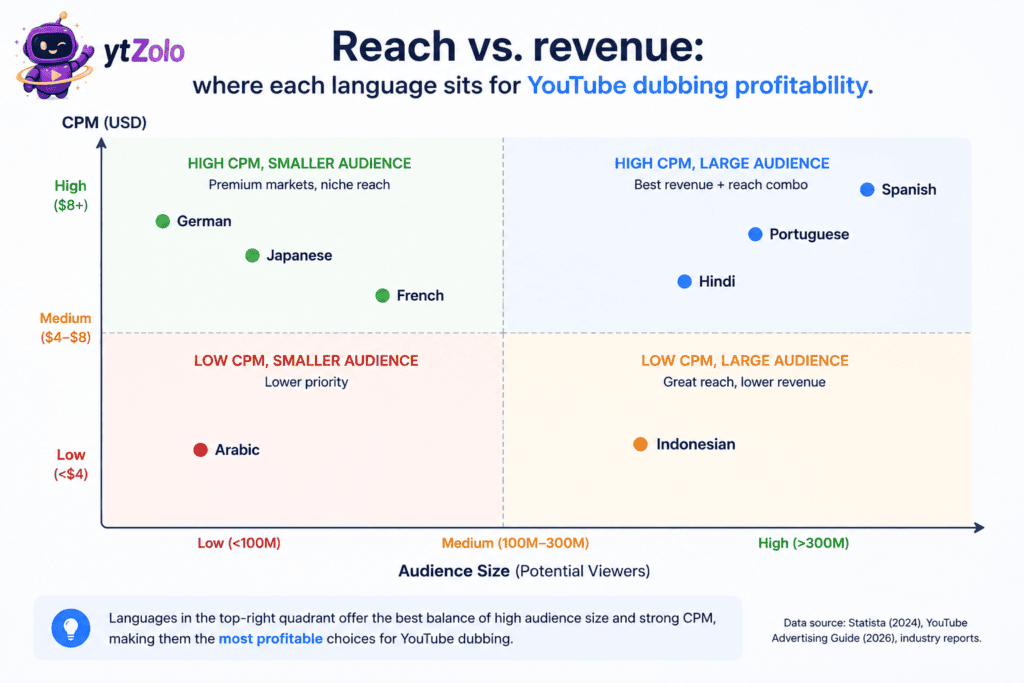
Most Profitable YouTube Dubbing Languages: Reach vs. Revenue
Not every high-audience language is a high-revenue language, and this is where most “best languages” lists get it wrong.
High-reach, lower-CPM: Hindi, Indonesian, Arabic — these add total revenue mostly through volume.
Lower-reach, high-CPM: German, Japanese, Italian — these add revenue per view rather than through scale.
Balanced: Spanish, Portuguese, French — solid audience size paired with workable, mid-range CPM.
The most profitable youtube dubbing languages for your specific channel depend on which viewers already watch your English uploads. Check YouTube Studio → Analytics → Audience → Geography before choosing, rather than dubbing blind.
YouTube International Audience Languages: What YouTube’s Own Data Shows
YouTube has confirmed that a majority of watch time on the platform comes from outside a creator’s home country, which is a strong signal that youtube international audience languages deserve more planning than an afterthought subtitle file.
YouTube’s auto-dubbing update in early 2026 expanded coverage to 27 languages and added Expressive Speech in eight of them — English, French, German, Hindi, Indonesian, Italian, Portuguese, and Spanish.
That list isn’t random. It closely mirrors the languages with the strongest combination of audience size and advertiser demand — the same shortlist this guide arrives at independently.
AI Dubbing Language Pairs: Which Combinations Work Best Right Now
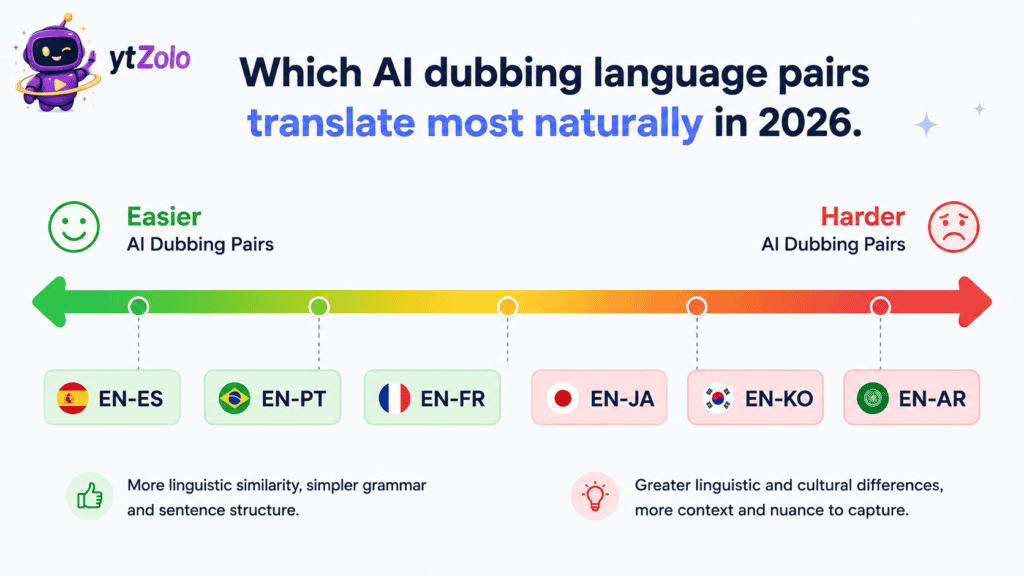
Not all ai dubbing language pairs perform equally, even on the same tool. Translation quality and voice naturalness vary depending on how structurally similar the source and target languages are.
Easier pairs: English↔Spanish, English↔Portuguese, English↔French, English↔Italian — closer grammar and rhythm generally produce more natural-sounding AI voice output.
Harder pairs: English↔Japanese, English↔Korean, English↔Arabic — bigger structural gaps mean translated lines often run longer or shorter than the original, so review pacing carefully before publishing.
Improving fast: English↔Hindi and English↔Indonesian have both seen real quality gains as tools add Expressive Speech-style models rather than flat text-to-speech.
If you’re evaluating tools for these pairs specifically, this AI dubbing software comparison breaks down which platforms handle voice cloning and pacing best per language.
How to Choose Your Next Dubbing Language: A Practical Checklist
Before picking a language, confirm the following:
- [ ] Check your current non-English view sources in YouTube Analytics.
- [ ] Compare that data against this guide’s audience-size and CPM figures.
- [ ] Confirm your chosen AI dubbing tool supports that language pair well.
- [ ] Decide whether you’re optimizing for reach (Hindi, Indonesian, Arabic) or revenue per view (German, Japanese, Italian).
- [ ] Test on your three best-performing videos before dubbing your entire back catalog.
- [ ] Translate your title, description, and tags alongside the audio track — dubbing without localized metadata leaves visibility on the table.
Dubbing vs. Subtitles: A Quick Note Before You Commit
Dubbing and subtitles solve different problems, and picking one doesn’t have to mean skipping the other entirely.
Subtitles are cheaper and faster to add, but dubbed audio tends to hold attention longer for viewers who don’t read comfortably in the caption language.
If you’re weighing the two for a specific channel, our dubbing vs. subtitles breakdown compares watch-time impact and setup effort side by side.
What Dubbing Actually Costs, and How Accurate It Is Today
Budget and translation quality are usually the two blockers that stop creators from testing a new language at all.
Pricing varies widely by tool and whether voice cloning or lip sync is included — our AI dubbing cost guide walks through per-minute versus subscription pricing in detail.
On quality, modern AI translation is strong for straightforward spoken content, though idiom and humor still benefit from a human review pass — a point covered more deeply in our AI dubbing accuracy guide.
Turning a Dubbed Video Into a Full Localization Strategy
Dubbing the audio track is one step, not the whole job. A translated video sitting under an English-only title and description still misses most of its potential search traffic in that language.
Pair every dub with translated metadata, localized thumbnails where text is involved, and — if you publish supporting blog content — translated on-page copy rather than just the embedded video.
Our full YouTube video localization guide walks through the metadata, captions, and publishing workflow that makes a dub actually discoverable in its target market.
Italian and Russian: The Middle-Tier Options Worth a Second Look
Italian sits in an interesting spot — a smaller audience than Spanish or French, but CPM that regularly outperforms both, especially in finance, lifestyle, and tech niches.
YouTube’s auto-dubbing already supports Italian, which lowers the barrier to testing it before committing to a fully custom dub with voice cloning.
Russian offers broad reach across Russia and parts of Eastern Europe and Central Asia, though advertiser demand and platform dynamics in that market are more variable than in Western Europe.
Both languages work best as a third or fourth dubbing language once you’ve already validated demand with Spanish, Portuguese, or German.
Building a Multi-Language Rollout Instead of a One-Off Dub
Most creators treat dubbing as a single decision — pick one language, dub the catalog, move on. A more durable approach treats it as a rolling test.
Start with one reach language and one revenue language dubbed side by side on your five best-performing videos, then compare watch time and RPM by market after two to three weeks.
Expand into a third language only once the first two show a clear lift, rather than committing your entire back catalog to an untested market on day one.
This staged approach also gives your AI dubbing tool time to improve on the specific language pair you’re using, since translation and voice models are updated frequently.
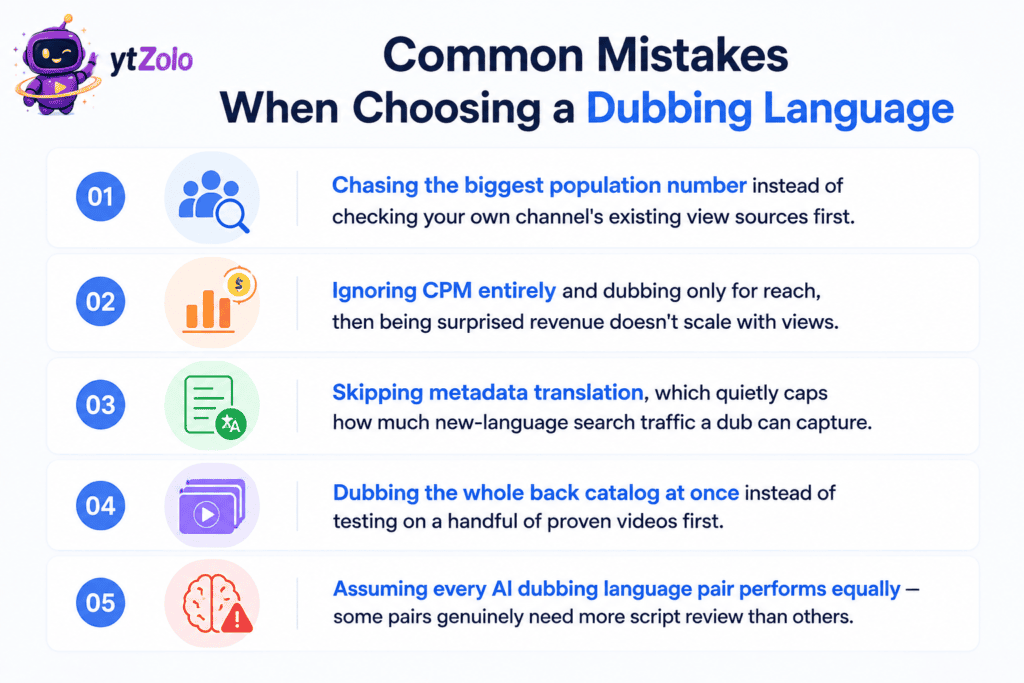
Common Mistakes When Choosing a Dubbing Language
- Chasing the biggest population number instead of checking your own channel’s existing view sources first.
- Ignoring CPM entirely and dubbing only for reach, then being surprised revenue doesn’t scale with views.
- Skipping metadata translation, which quietly caps how much new-language search traffic a dub can capture.
- Dubbing the whole back catalog at once instead of testing on a handful of proven videos first.
- Assuming every AI dubbing language pair performs equally — some pairs genuinely need more script review than others.
Frequently Asked Questions
What is the best language to dub YouTube videos into? Spanish is usually the strongest first pick for reach, thanks to its large, YouTube-active global audience and strong AI dubbing support. German or Japanese tend to win on CPM if your niche fits those markets.
What are the most profitable YouTube dubbing languages? German, Japanese, and Italian typically deliver the highest CPM per view, while Hindi, Indonesian, and Arabic drive profitability mainly through view volume rather than per-view rate.
Which YouTube international audience languages does YouTube’s auto-dubbing support? As of the 2026 update, YouTube’s auto-dubbing covers 27 languages, with Expressive Speech specifically live in English, French, German, Hindi, Indonesian, Italian, Portuguese, and Spanish.
Are some AI dubbing language pairs harder to translate than others? Yes. Pairs with closer grammatical structures, like English-Spanish or English-French, tend to sound more natural than structurally distant pairs like English-Japanese or English-Korean.
Should I dub into a high-reach language or a high-CPM language first? Check your existing non-English viewers in YouTube Analytics first. If you don’t have that data yet, Spanish is a safe reach-first test and German is a safe CPM-first test.
Does dubbing replace the need for subtitles? No. Subtitles remain useful as a backup for viewers who prefer reading along or have hearing difficulties, even on a fully dubbed video.
How much does it cost to dub a YouTube video into a new language? Costs range from free tiers with watermarks and limited minutes up to $50+ per month for creator plans, depending on whether voice cloning and lip sync are included.
How accurate is AI translation for dubbing today? Modern AI translation handles straightforward spoken content well, though a quick human review before publishing still catches most idiom and tone mismatches.
Final Takeaway
There’s no single universally “best” language — there’s a best language for what your channel is actually trying to achieve.
Start with Spanish or Portuguese if reach is the goal, German or Japanese if revenue-per-view matters more, and always check your own analytics before committing a full production budget to any one market.
About the Author
Anshika Verma Email: anshika@ytzolo.com
Anshika Verma researches AI creator tools, multilingual video production, and YouTube growth workflows at ytZolo. Her work focuses on testing AI dubbing, voice, and localization platforms against real production use cases — translating that testing into practical, data-backed guidance for creators, agencies, and marketing teams navigating multilingual publishing.

