
The most practical way to understand how to price sponsorship rates for a YouTube channel is to start with recent video performance, then adjust the base rate for the actual work and rights the brand is buying.
Subscriber count alone isn’t enough. A sponsorship may consist of an integration, a dedicated video, Shorts, scripting, filming, editing, revisions, exclusivity, content licensing, or paid advertising rights.
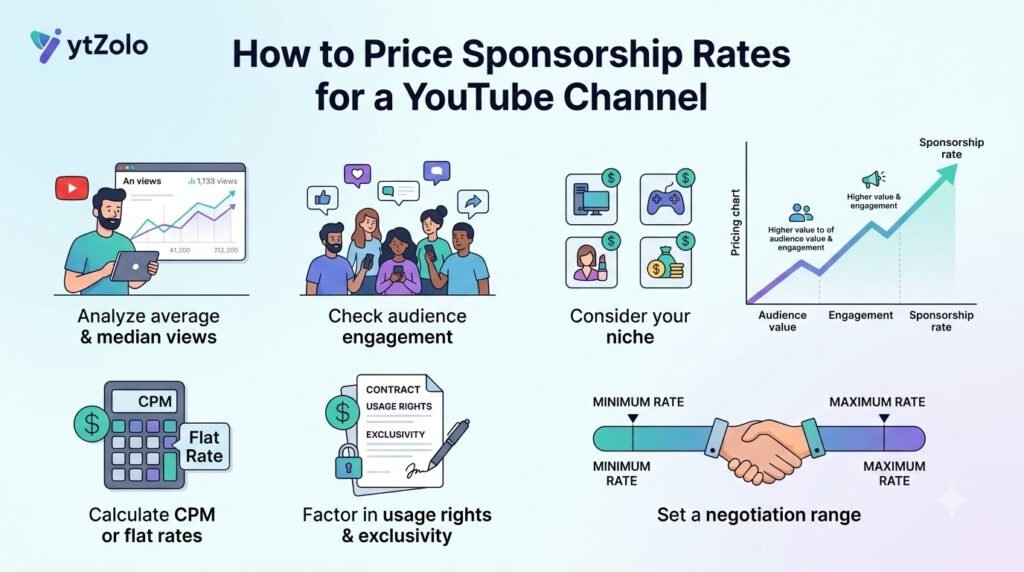
A useful starting framework is:
Base sponsorship rate = realistic expected views × negotiated CPV or CPM benchmark
After calculating the base sponsorship rate, one should adjust it according to deliverables, production work, audience fit, rights, exclusivity, timelines, and campaign scope.
For creators planning sponsored content, ytZolo can help with the content creation and planning side, including scripts, titles, thumbnails, and other YouTube workflow tasks.
Table of Contents
Quick answer
To price a youtube sponsorship, calculate a realistic view baseline from your recent videos, use a market benchmark as a starting point and then add/subtract according to the scope of the deal itself.
For example, don’t price a 60-second integration and a dedicated sponsored video from the same base number. A dedicated video usually requires substantially more creator time and gives the brand more exposure.
The final quote should reflect both audience value and production scope.
What actually determines a YouTube sponsorship rate?
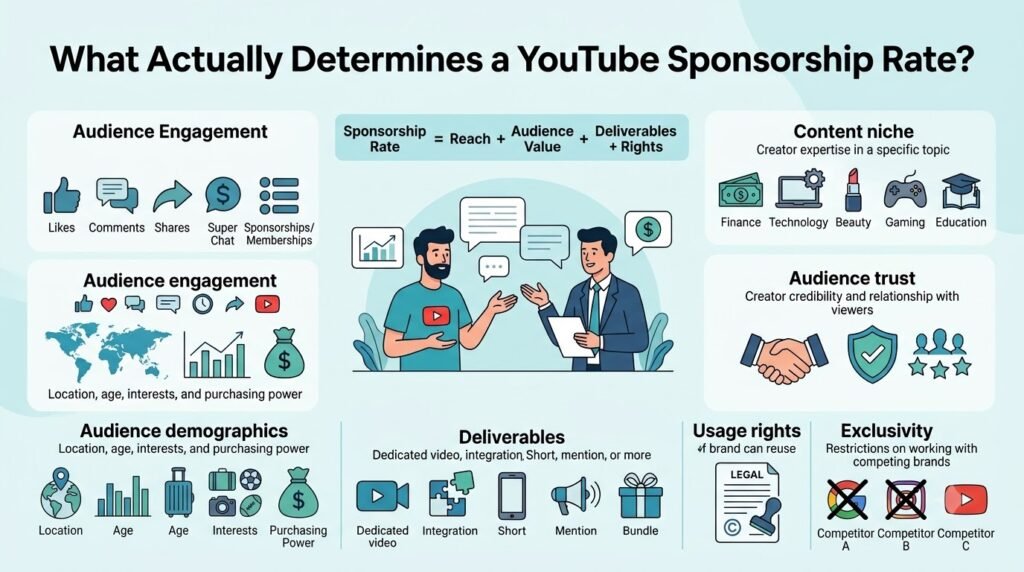
A sponsorship rate isn’t simply the price of your subscribers.
Brands can be paying for several things at once:
- Access to your audience
- Audience relevance
- Expected views
- Creator credibility
- Content production
- Product integration
- Distribution
- Campaign results
- Content usage rights
- Exclusivity
This is why two channels with similar subscriber counts can have very different sponsorship prices.
ThoughtLeaders similarly identifies niche, audience demographics, production quality, brand alignment and views as important pricing factors.
The practical takeaway is simple:
Price the campaign, not just the channel.
The four ways creators can price YouTube sponsorships
There isn’t one mandatory pricing model. Four approaches are particularly useful.
1. Cost per view
CPV means cost per expected view.
The basic formula is:
Sponsorship rate = expected views × CPV
For example, if your realistic expected views are 80,000 and you negotiate a $0.04 CPV:
80,000 × $0.04 = $3,200
ThoughtLeaders uses a similar CPV framework and currently discusses a broad 0.01–0.10 range. However, that range should be treated as directional rather than a guaranteed market price.
Your niche, audience, geography, campaign scope and rights can move the actual quote considerably.
2. Cost per thousand views
CPM expresses the same idea per 1,000 views.
The formula is:
Sponsorship rate = expected views ÷ 1,000 × CPM
For example:
80,000 expected views ÷ 1,000 = 80
At a $40 CPM:
80 × $40 = $3,200
CPM can make comparisons easier because advertising and creator-marketing discussions often use the metric.
But don’t confuse sponsorship CPM with YouTube’s advertising CPM. A creator sponsorship includes creator production and distribution, so the economics aren’t identical.
3. Flat-fee pricing
A flat fee is easier when the deliverable is clearly defined.
For example:
$2,500 for one 60-second integrated sponsorship in one long-form video.
The price isn’t calculated entirely from views. It includes the agreed deliverable, production requirements, expected audience exposure and negotiated terms.
Flat fees are common because creator campaigns are negotiated individually. Shopify’s current influencer-pricing guidance also notes that creator rates vary substantially by platform, audience, niche and campaign scope.
4. Hybrid pricing
A hybrid deal combines an upfront payment with performance compensation.
For example:
$1,500 base fee + affiliate commission on tracked sales.
This can make sense when the brand wants performance incentives and the creator wants some guaranteed compensation for the production work.
The important point is that commission should not replace fair payment for substantial production work unless both sides intentionally agree to that structure.
How to calculate your base YouTube sponsorship rate
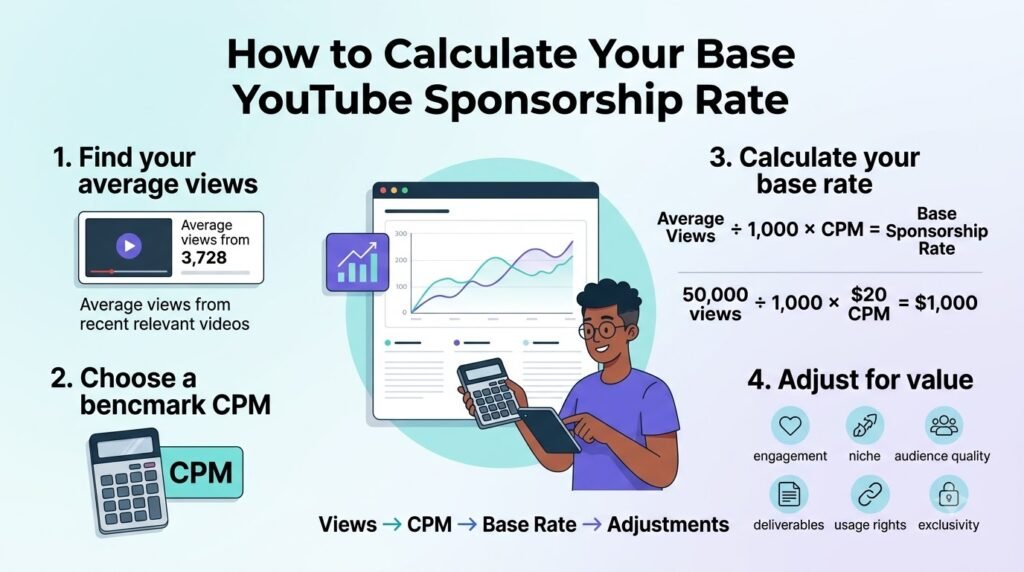
This is the most useful part of the pricing process.
Don’t start by asking:
“How much do YouTubers with 50,000 subscribers charge?”
Start with your own channel data.
Step 1: Calculate your realistic average views
Look at your recent videos rather than lifetime channel performance.
A practical starting point is your last 5–10 comparable long-form videos.
Separate:
- Shorts
- long-form videos
- livestreams
- unusually viral videos
- videos with completely different formats
For example:
| Video | Views |
| Video 1 | 52,000 |
| Video 2 | 47,000 |
| Video 3 | 61,000 |
| Video 4 | 44,000 |
| Video 5 | 49,000 |
The average is:
50,600 views
That’s more useful for sponsorship planning than a channel with 100,000 subscribers simply assuming every sponsored video will reach 100,000 people.
Recent performance is also emphasized in ytZolo’s existing brand-deal guidance, which recommends looking at current averages rather than relying on old viral performance.
Why median views can be useful
A single viral video can distort an average.
If your last five videos received:
10K, 12K, 14K, 15K and 100K views,
the arithmetic average is 30.2K.
But 100K isn’t necessarily a realistic expectation for your next sponsored upload.
In cases like this, the median of 14K may provide a more conservative planning baseline. The goal isn’t to make your number artificially low.
Step 2: Choose a reasonable CPV or CPM benchmark
Once you have your expected views, you can apply a benchmark.
Use external benchmarks as reference points, not automatic prices.
Your actual rate can depend on:
- niche
- audience location
- audience purchasing relevance
- average views
- engagement
- content format
- production effort
- sponsorship placement
- previous campaign results
- usage rights
- exclusivity
- campaign length
Step 3: Adjust for audience quality
Two channels can receive the same number of views but offer different value to a sponsor.
Imagine:
Channel A
80,000 views from a broad entertainment audience.
Channel B
80,000 views from viewers actively researching professional software.
A software company may value Channel B differently because the audience is closer to its target customer.
Useful audience information includes:
- geographic distribution
- age groups
- relevant interests
- audience categories
- content niche
- returning viewers
- engagement patterns
- evidence from previous campaigns
This is why your YouTube media kit should show more than subscriber count.
Your pillar guide on how to make a media kit for YouTube sponsorships covers the audience and performance information brands can use when evaluating a creator.
It’s to avoid selling a brand a view expectation that your channel doesn’t consistently deliver.
Step 4: Separate integrations from dedicated videos
This is one of the easiest places to make a pricing mistake.
Sponsored integration
The sponsor appears inside an otherwise organic video.
For example:
A 60-second product segment inside a 10-minute tutorial.
The creator still produces the main video, while the brand receives a defined segment.
Dedicated sponsored video
The entire video focuses on the sponsor or its product.
That changes the production and opportunity cost.
The creator may need to:
- develop a concept
- research the product
- write the script
- film the entire video
- demonstrate the product
- edit the content
- complete revisions
- coordinate brand approval
Don’t use the same rate for both formats simply because they receive a similar number of views.
Step 5: Add production costs
Your sponsorship price should account for the work required to deliver it.
Ask:
- How long will research take?
- Does the brand require a custom script?
- Do I need to film additional footage?
- Is product testing required?
- How much editing is involved?
- Does the brand require revisions?
- Does the sponsor need approval before publishing?
- Will I need new graphics or animations?
- Is travel involved?
A simple integration might add relatively little work.
A dedicated product review involving testing, filming and multiple revision rounds can require substantially more.
ThoughtLeaders also identifies production time as a factor creators should account for when pricing sponsorships.
Step 6: Price usage rights separately
This is one of the most important parts of sponsorship pricing.
A brand may ask for permission to reuse your sponsored content.
That can mean very different things.
Organic reposting
The brand shares the creator’s content on its own social channels.
Website usage
The brand places your video or clips on its website or landing pages.
Paid advertising
The brand uses your content in paid campaigns.
Extended licensing
The brand wants to use the content for a defined period, such as 30, 90 or 180 days.
Perpetual usage
The brand wants ongoing usage without a defined end date. These shouldn’t automatically be bundled into the basic sponsorship fee.
Shopify’s 2026 influencer-pricing guidance specifically identifies usage rights as a factor that can increase creator compensation and recommends defining duration and channels upfront.
A useful structure is:
Base creator fee + usage rights fee
rather than:
Base creator fee = unlimited rights forever
The second approach can give away valuable rights without the creator realizing it.
Step 7: Price exclusivity
Exclusivity restricts what other brands you can work with.
For example, a sponsor might request:
Don’t promote competing project-management software for 30 days.
That’s different from:
Don’t work with any competing software company for six months.
The longer and broader the restriction, the greater the commercial opportunity cost.
Before agreeing to exclusivity, you have to define:
- competitor’s category
- named competitors if appropriate
- duration
- geographic scope
- whether affiliate relationships are included
- whether old partnerships are affected
Your fee should be based on the real restrictions being imposed, not the theoretical value of “exclusivity” as a buzzword.
Step 8: Add a rush fee when the timeline is unusually short
Suppose your normal sponsorship workflow takes three weeks.
A brand suddenly wants:
Product delivered Monday. Script Tuesday. Video Friday. That can disrupt your publishing schedule and other paid work.
A rushed campaign can therefore justify a higher quote. The specific percentage of revenue that should be shared is a matter for negotiation, rather than an industry standard.
The important thing is to make the rush requirement visible before agreeing to the final price.
A practical YouTube sponsorship pricing formula
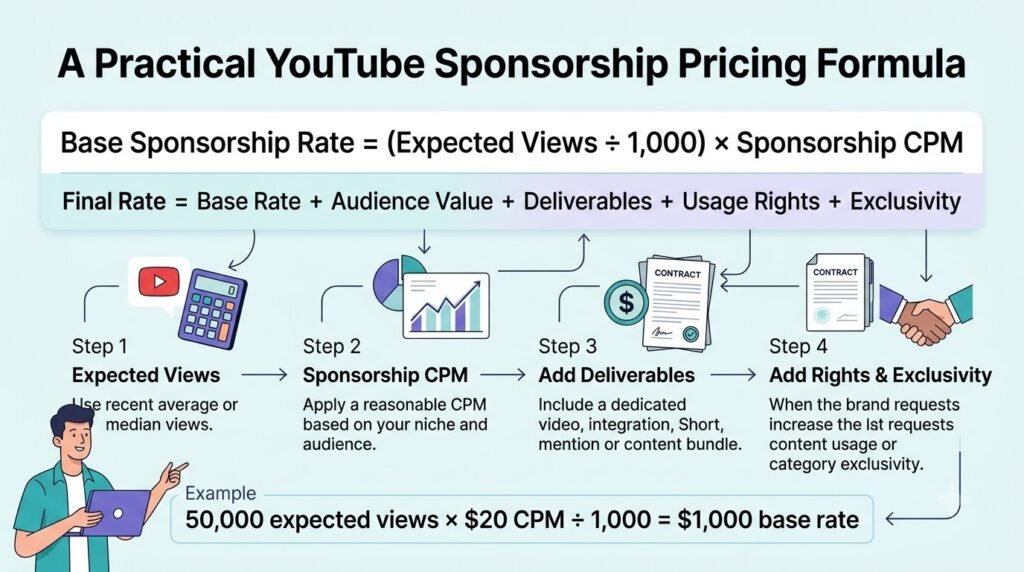
Once you’ve estimated your base audience value, use the following framework to organize the final sponsorship quote:
Final sponsorship quote = base audience value + production scope + usage rights + exclusivity + rush requirements − package discount
The base audience value can be estimated using either of these approaches:
Expected views × negotiated CPV
or
Expected views ÷ 1,000 × negotiated CPM
For example, if a channel expects 50,000 views and uses a hypothetical $0.04 CPV:
50,000 × $0.04 = $2,000
That $2,000 is a starting point rather than a guaranteed final rate. The creator should then consider the specific deliverables, production requirements, usage rights, exclusivity, and timeline agreed with the brand.
This is a decision-making framework, not a universal industry pricing standard. Sponsorship rates vary by creator, audience, niche, content format, campaign scope, and negotiated terms.
Example: pricing a 50,000-view YouTube sponsorship
Imagine a creator’s recent comparable videos average approximately 50,000 views.
Suppose the creator uses a hypothetical $0.04 CPV as an internal starting benchmark.
50,000 × $0.04 = $2,000
That $2,000 is not automatically the final quote.
Now consider the campaign:
- 60-second integration
- creator writes and edits the segment
- one reasonable revision round
- no paid usage
- no exclusivity
- standard timeline
The creator could use the $2,000 figure as the starting point for the negotiation.
Now change the brief:
- dedicated sponsored video
- detailed product demonstration
- two revision rounds
- 90-day paid usage
- 60-day category exclusivity
- seven-day turnaround
It’s no longer the same $2,000 job.
The audience exposure may be similar, but the scope and rights are materially different.
That’s why copying a CPV number into every sponsorship quote can produce poor pricing.
How to price sponsorships if you have no previous brand deals
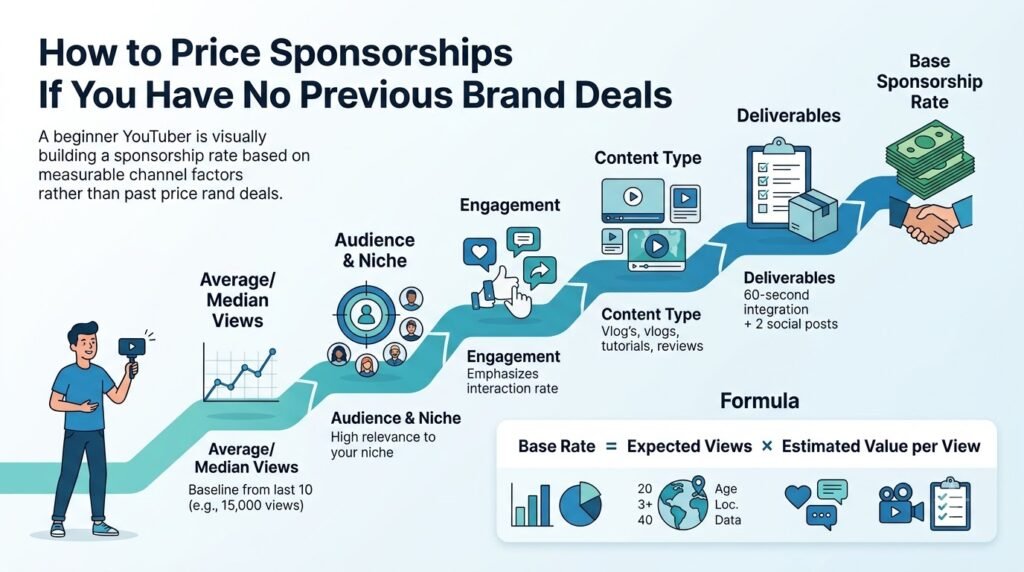
You don’t need five previous sponsors to create a pricing model.
Use evidence from your organic content.
Start with:
- Recent average or median views
- Audience demographics
- Engagement
- Relevant top-performing videos
- Retention patterns
- Content quality
- Specific relevance
- Deliverables requested
Then explain your rate based on the evidence.
For example:
“My recent comparable videos average around 45,000 views, with a strong audience fit for your product. For the requested integration, my rate is $X and includes one sponsored segment and one revision.”
That’s more defensible than:
“I have 30,000 subscribers, so I charge $X.”
Your media kit can use your strongest organic videos as evidence when you don’t have sponsorship case studies yet. This strategy is recommended by ytZolo’s media-kit guide for new creators who have not partnered with sponsors before.
How to price different YouTube sponsorship formats
Long-form integrations
Price the sponsorship around the expected exposure and the amount of work required to create the sponsored segment.
Consider placement, script requirements, revisions, approval, links, and any additional usage rights.
Dedicated sponsored videos
A dedicated video generally requires more production work and gives the sponsor more control over the content focus.
Price the full production scope rather than simply multiplying your integration rate.
YouTube Shorts
Use comparable Shorts performance rather than automatically applying your long-form rate.
Consider:
- Typical Shorts views
- Vertical production
- Sponsorship placement
- Scripting
- Product integration
- Editing
- Usage rights
If a brand wants both long-form and Shorts, price each deliverable first and then create the package.
Livestream sponsorships
Consider:
- Stream duration
- Sponsor placement
- Number of mentions
- Product demonstration
- Audience size
- Chat interaction
- Recording availability
- Reuse rights
Multi-video packages
For multiple deliverables, calculate the value of each item before applying any package discount.
A package discount should reflect the commitment or production efficiencies created by the larger campaign.
Should you price sponsorships based on subscribers?
Not by themselves.
Subscribers provide context, but they don’t tell you exactly how many people will watch the sponsored video.
Consider two channels:
| Metric | Channel A | Channel B |
| Subscribers | 100K | 50K |
| Typical views | 12K | 45K |
| Audience relevance | Medium | High |
| Recent performance | Declining | Consistent |
A subscriber-only formula would make Channel A look more valuable.
A sponsorship evaluation based on expected reach and audience relevance could produce a very different assessment.
That doesn’t mean subscribers have no value.
They are useful as one contextual metric.
They simply shouldn’t be the entire pricing model.
Should sponsorship rates appear in your media kit?
Not necessarily.
Your media kit and rate card serve different purposes.
A media kit explains:
- who you are
- who your audience is
- what your channel does
- recent performance
- relevant content
- previous partnerships
- sponsorship formats
A rate card focuses on:
- starting prices
- deliverables
- packages
- add-ons
- terms
For many creators, a useful approach is:
Media kit → brand conversation → campaign scope → custom quote
This prevents an old static price from becoming the anchor for every future deal.
What should be included in a YouTube sponsorship quote?
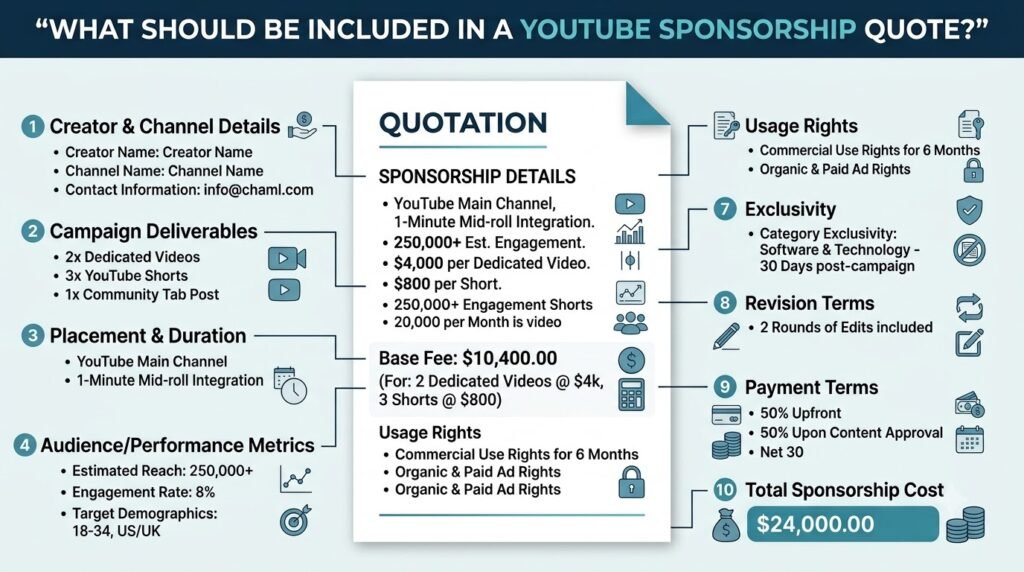
A sponsorship quote should do more than state a price. It should clearly explain what the brand is paying for, what the creator will deliver, and which terms apply to the campaign.
A clear quote can include the following:
Deliverables
Specify exactly what content you’re creating.
For example:
- One 60-second integration
- One dedicated YouTube video
- One YouTube Short
- One livestream mention
- A multi-video package
Avoid vague descriptions such as “YouTube promotion.”
Placement
Explain where the sponsorship will appear.
For a long-form video, this could be a pre-roll, mid-roll, or naturally integrated segment. For Shorts or livestreams, specify how the product or brand will be featured.
Revisions and approval
State how many revision rounds are included and what the brand can approve.
For example:
Revision: One reasonable revision round included.
If the brand expects script approval, product changes, or multiple rounds of edits, define that before agreeing to the fee.
Usage rights
Specify how the brand can use the sponsored content.
Clarify:
- Where the content can be reposted
- Whether website use is included
- Whether paid advertising is permitted
- Which platforms are covered
- How long the rights last
Paid advertising and extended licensing should not automatically be treated as part of the basic sponsorship fee.
Exclusivity
If the brand wants you to avoid working with competitors, define the restriction clearly.
Specify:
- Which products or companies count as competitors
- How long the restriction lasts
- Whether affiliate relationships are included
- Whether the restriction applies to all content or only sponsored content
A short category restriction is materially different from a broad, long-term exclusivity clause.
Timeline and publishing requirements
Include the expected delivery and publishing window.
If the brand requires an unusually short turnaround, make the rush requirement clear before agreeing to the final price.
Payment terms
Specify the agreed fee and payment schedule.
For example:
Fee: $X
Payment: 50% upfront and 50% upon publication
The actual payment structure should be agreed upon by both parties.
Cancellation terms
Clarify what happens if the campaign is cancelled after work has started.
This is particularly important when the creator has already completed research, scripting, filming, editing, or other campaign work.
Example sponsorship quote
Deliverable: 60-second integrated sponsorship in one long-form YouTube video
Revision: One reasonable revision round
Usage: Creator’s YouTube channel only
Exclusivity: None
Publishing: Within the agreed campaign window
Fee: $X
Putting these details in writing helps both sides understand the scope before the campaign begins. It also makes it easier to adjust the price when the brand requests additional deliverables, usage rights, exclusivity, or a faster turnaround.
What if the brand asks for a lower rate?
Don’t immediately reduce the price.
First ask what they want to change.
A lower budget can sometimes be accommodated by reducing scope.
For example:
Original request
- Dedicated video
- 90-day paid usage
- 60-day exclusivity
- Two revisions
Reduced-scope option
- Integrated segment
- Organic use only
- No exclusivity
- One revision
The second package costs less because the brand is buying less.
This is generally more useful than simply cutting your fee while keeping the same workload and rights.
ytZolo’s existing brand-deal guide similarly recommends evaluating the complete scope before responding to a sponsorship rate and considering deliverables, rights, exclusivity, revisions and timelines.
Don’t confuse YouTube sponsorships with YouTube advertising
A sponsorship is not the same thing as buying YouTube ads through Google Ads.
In a creator sponsorship, the brand pays the creator for branded content or an integration.
YouTube’s own policies define branded content broadly to include content influenced by a brand partner in exchange for something of value, including payment, products or sponsorships.
If a video contains paid promotion, YouTube requires creators to use the paid-promotion disclosure process in Studio.
Creators may also have legal disclosure obligations depending on where they and their audiences are located. For example, the FTC says material connections between influencers and brands generally need to be disclosed clearly and conspicuously when U.S. law applies.
This is one reason sponsorship pricing should be treated as a business agreement rather than simply an advertising CPM calculation.
How to use YouTube Analytics when setting your rate
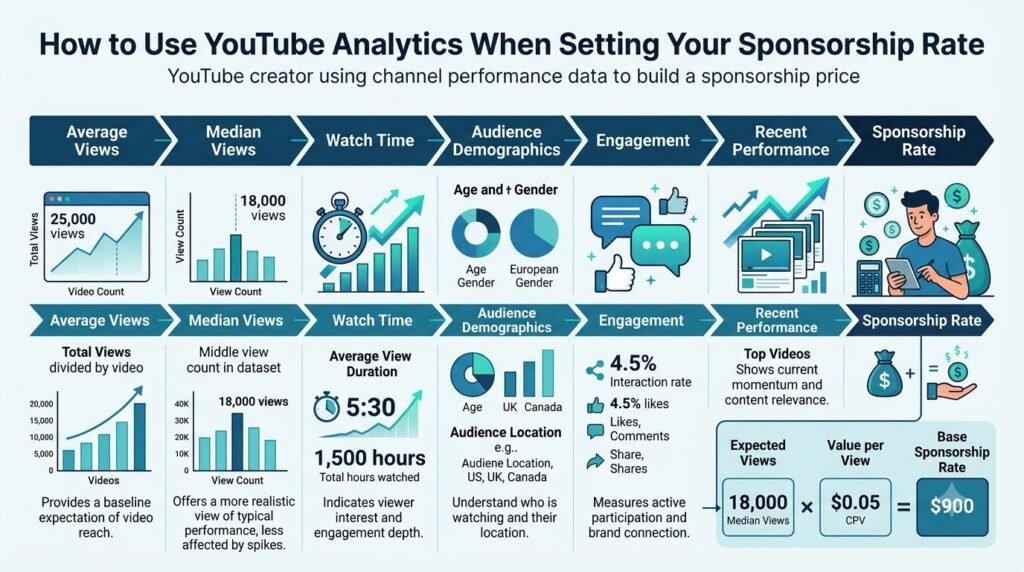
YouTube Analytics can help support a sponsorship quote with evidence from your actual channel performance.
Instead of relying only on subscriber count or a single successful video, use several relevant metrics to show brands what your channel typically delivers.
Recent views
Start with recent videos that are comparable to the sponsored content you’re being asked to create.
For example, if the brand wants a sponsored segment in a long-form tutorial, look at recent long-form tutorials rather than mixing Shorts, livestreams, and unrelated viral videos into the same calculation.
Recent performance gives you a more useful picture of the views a future sponsored video might reasonably receive.
Median performance
An average can be distorted by one unusually successful video.
For example, if your recent videos received 10,000, 12,000, 14,000, 15,000, and 100,000 views, the 100,000-view video significantly increases the average.
The median can provide a more conservative view of typical performance in situations like this.
You don’t have to use the median in every sponsorship quote. The important point is to choose a performance measure that represents your comparable content honestly.
Audience data
Audience data can help demonstrate whether your viewers match the brand’s target market.
Relevant information can include:
- Geographic distribution
- Age ranges
- Audience interests
- Returning viewers
- New versus returning viewers
- Relevant audience segments
A smaller audience with strong relevance to a brand’s target customers may be commercially different from a much larger but less relevant audience.
Retention
Audience retention can provide additional context when discussing sponsored placement.
For example, if viewers consistently watch through a particular section of your videos, a naturally integrated sponsorship in that part of the content may have a different value from a placement that occurs after a significant drop-off.
Retention shouldn’t be used to guarantee sponsorship results. It is simply another piece of evidence that can help you understand how viewers interact with your content.
Previous campaign performance
If you’ve worked with brands before, previous campaign results can strengthen your pricing discussions.
Depending on the campaign, useful evidence may include:
- Link clicks
- Conversion data
- Affiliate sales
- Promo-code usage
- Engagement
- Views
- Watch time
Only use metrics you can substantiate. If you don’t have previous sponsorship data, your organic channel performance can still provide useful evidence for your first campaigns.
Use Analytics as supporting evidence
YouTube Analytics shouldn’t replace the sponsorship pricing calculation.
Instead, use it to support the assumptions behind your quote.
Your pricing calculation establishes a starting value, while your Analytics data helps demonstrate why your expected views, audience fit, and campaign assumptions are reasonable.
Your recent guide on how to read YouTube Analytics retention graphs can support this part of the content workflow.
Common mistakes when pricing YouTube sponsorships
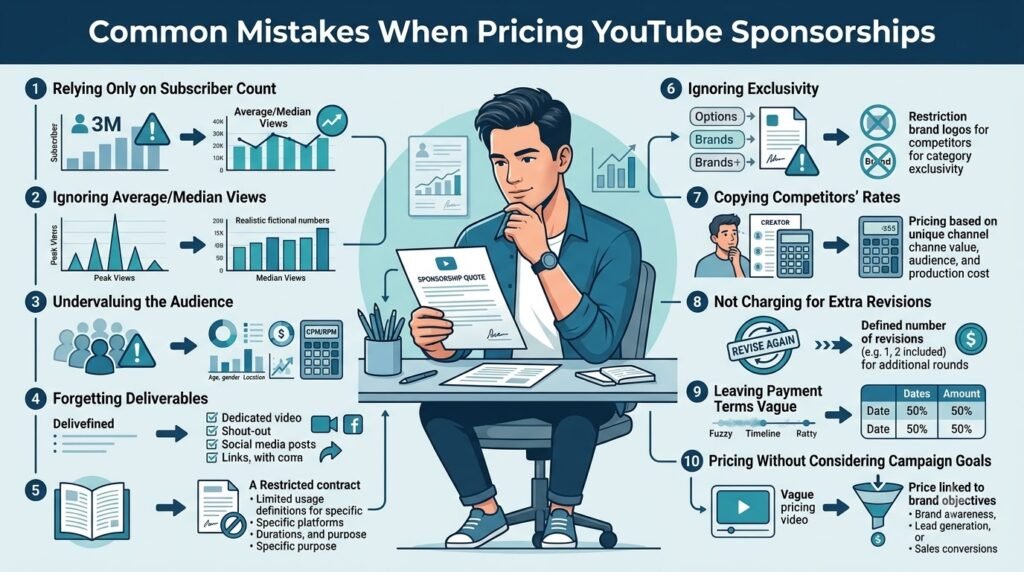
Pricing from subscriber count alone
Subscribers don’t tell you the likely views on the sponsored upload.
Using one viral video as your benchmark
A viral video can make your expected performance look unrealistic.
Treating every view as equal
Audience relevance matters.
Giving away usage rights
Paid advertising or broad licensing can have significant commercial value.
Ignoring exclusivity
A restriction can prevent you from accepting competing sponsorships.
Forgetting revisions
Unlimited revisions can turn a profitable deal into an inefficient one.
Quoting before understanding the brief
You can’t price accurately if you don’t know what the brand wants.
Publishing a permanent rate card
Your rates can change as your audience, performance, demand and workload change.
Discounting without reducing scope
If the budget falls, consider changing the deliverables instead of simply accepting less money for the same work.
How to know if your sponsorship price needs updating
Review your rates periodically rather than waiting until a negotiation feels uncomfortable.
Look at:
- recent average views
- recent median views
- audience changes
- new content formats
- campaign results
- inbound sponsorship demand
- production workload
- repeat sponsors
- new licensing requests
- exclusivity requests
If your channel has changed significantly, an old rate card may no longer represent the current scope or value of your work.
Keep records of completed campaigns.
Over time, you’ll have your own historical pricing data, which can be more useful than copying a generic sponsorship calculator.
Frequently asked questions
How much should I charge for a YouTube sponsorship?
There is no universal amount. Start with realistic views from comparable recent videos, apply a suitable pricing benchmark, then adjust for deliverables, production, usage rights, exclusivity and campaign requirements.
What is a good CPV for a YouTube sponsorship?
Published benchmarks are varied. At present, ThoughtLeaders offers CPVs ranging from $0.01 to $0.10, but its Frequently Asked Questions offer a narrower 0.02–0.06 range. It should remind users that such figures are a useful point of reference but cannot be used as universal benchmarks.
Should I charge separately for usage rights?
If the brand wants to reuse your content beyond the original sponsorship, define the channels, duration and purpose. Additional licensing or paid-media usage can justify additional compensation.
How much should I charge for exclusivity?
There is no universal percentage. Define the competitor category and restriction period first, then price the opportunity cost created by that restriction.
Can a small YouTube channel charge for sponsorships?
Yes. Subscriber count isn’t the only factor in sponsorship pricing. A smaller channel can have a clearly defined audience and strong relevance to a particular brand.
How do I price my first sponsorship?
Use recent organic performance, audience fit, content quality and the requested deliverables as evidence. Don’t invent a sponsorship history you don’t have.
Should I use a YouTube sponsorship calculator?
A calculator can offer an opening estimate, but should not be relied upon for views, audience, production requirements, rights and exclusivity.
Conclusion
Learning how to price sponsorship rates for a YouTube channel starts with realistic expectations about your audience and content performance. Recent comparable views provide a more useful starting point than subscriber count alone.
From there, account for the actual campaign scope. Integrations, dedicated videos, Shorts, usage rights, exclusivity, revisions, and rush timelines can all change the final quote.
Before sending a proposal, define exactly what the brand is buying and use your channel data to support the rate you quote.
About the author
Anshika Verma is a content and SEO researcher at ytZolo who researches and evaluates AI and creator tools with a focus on practical workflows, documented product capabilities, and evidence-based content.
Her research approach separates verified platform information from interpretation and recommendations. For creator-economy topics, she reviews current platform documentation, product information, competing resources, and practical use cases before developing the content.
Contact: anshika@ytzolo.com

