
Quick Summary: Voice conversion is the AI process that changes how a voice sounds — pitch, tone, texture — while keeping the words, timing, and emotion exactly as they were spoken. This guide breaks down the analysis-mapping-reconstruction pipeline, the model types behind it, where it shows up in real products, and how it fits into a full AI Audio Studio like ytZolo’s.
You record a line. It’s a good take — the timing lands, the emotion is right. But the voice itself isn’t the one you want attached to the video.
That’s the exact problem voice conversion was built to solve.
This article is a deep dive, not a repeat of what our AI voice changer guide already covers at a glance. Here, we unpack the mechanics: what actually happens inside the model, why some conversions sound flawless and others sound robotic, and how the technology has evolved from statistical models to today’s neural systems.
Table of Contents
What Is Voice Conversion, Exactly?
Voice conversion is a speech-processing technique that changes a speaker’s vocal identity while leaving the linguistic content untouched.
In plain terms: the words stay the same. The pacing stays the same. Only the voice producing them changes.
Researchers describe it as a task where a source speaker’s utterance is transformed to sound as if a target speaker said it, without altering what was actually said. This distinguishes the technique from tools that generate speech from scratch, which we’ll compare shortly.
Every AI voice changer on the market — real-time or post-production — is a consumer-facing wrapper around this underlying conversion process.
Why This Topic Matters Right Now
This technology used to be a research-lab curiosity. Now it sits inside consumer apps, YouTube production suites, call center software, and dubbing pipelines.
That jump happened because deep learning made the technology fast enough for real products, not just academic papers.
At the same time, voice-cloning misuse and deepfake audio have made the underlying mechanics worth understanding — not just using. Knowing how conversion works also explains why platforms now require disclosure of AI-altered voices on YouTube.
The Voice Conversion Pipeline: Analysis, Mapping, Reconstruction
Nearly every modern conversion system, regardless of the specific architecture, follows the same three-stage pipeline.
Stage 1: Speech Analysis
The system takes raw audio — a waveform or spectrogram — and breaks it into measurable components.
Speech researchers describe speaker individuality as existing at three levels: segmental (the actual sounds), supra-segmental (pitch, rhythm, stress), and linguistic (the words and meaning themselves).
The analysis stage extracts all three, turning raw sound into structured features a model can work with.
Stage 2: Feature Mapping
This is where the actual “conversion” happens. The extracted features are mapped from the source speaker’s characteristics to a target speaker’s characteristics.
Deep learning changed this stage the most. Older statistical models relied on handcrafted rules. Modern neural networks learn a speaker embedding — a compact numerical fingerprint of a voice — and a separate linguistic embedding for content, then recombine them for a new target.
That separation, called disentanglement, is what lets a system swap the speaker without disturbing the words.
Stage 3: Reconstruction
Finally, a vocoder rebuilds an audio waveform from the mapped features. This is the step that determines how natural the final voice actually sounds.
A weak vocoder introduces the buzzy, metallic artifacts people associate with “robotic” AI voices. A strong neural vocoder produces breath sounds, natural pitch drift, and texture that’s difficult to distinguish from a real recording.
What Actually Gets Converted: Identity vs. Content
It helps to think of a spoken sentence as two layers stacked on top of each other.
The content layer is the words, grammar, and meaning. This step is designed to leave that layer completely alone.
The identity layer is everything that makes a voice recognizably yours — pitch range, resonance, accent texture, and vocal-tract characteristics. This is the layer the conversion process replaces.
Prosody — the rhythm, stress, and melody of speech — sits in between. Good systems preserve your original prosody even while changing the identity layer, which is why a well-converted voice still sounds excited when you were excited, or hesitant when you paused.
Cheaper systems flatten prosody along with identity, which is one of the biggest reasons converted voices can sound emotionally dead even when the words are technically correct.
Parallel vs Non-Parallel Voice Conversion
Not all conversion systems are trained the same way, and the training data type shapes what the tool can actually do.
Parallel voice conversion trains on matched pairs — the same sentence spoken by both the source and target speaker. It produces excellent quality but is impractical at scale, since you rarely have identical scripted recordings from both voices.
Non-parallel voice conversion trains on unrelated recordings from each speaker, with no matching sentences required. This is what makes today’s voice-cloning-from-a-sample tools possible, and it’s the approach most commercial platforms use.
Non-parallel systems needed a real breakthrough to work well, and disentanglement-based deep learning is exactly that breakthrough. Without it, non-parallel training produced garbled, inconsistent output.
This is also why some tools ask for “just 10 seconds” of sample audio while others want several clean minutes — the underlying model architecture determines the minimum data it needs to build an accurate speaker embedding.
The AI Models Behind Modern Voice Changers
You don’t need a machine learning background to understand the model families doing the heavy lifting. Here’s the short version, without the equations.
- Autoencoder-based models compress audio down to its core features, then rebuild it with a new speaker’s identity swapped in. This is the most common backbone for lightweight, fast conversion.
- GAN-based models (Generative Adversarial Networks) pit two networks against each other — one generates the converted voice, the other tries to catch flaws — which pushes output quality higher over training.
- Diffusion-based models build the output gradually, refining noise into a clean waveform step by step. These currently produce some of the most natural-sounding results, at the cost of more processing time.
- Sequence-to-sequence models handle timing and alignment directly, which matters for conversions where pacing needs to shift slightly to sound natural in the target voice.
Commercial tools rarely use just one of these in isolation. Most blend architectures, tuning the mix for either real-time speed or post-production polish.
Voice Conversion vs. Speech Synthesis vs. Voice Cloning
These three terms get lumped together constantly, so it’s worth being precise.
Speech synthesis (text-to-speech) generates audio from typed text, with no original recording involved at all. Our dedicated Speech Synthesis vs Voice Conversion breakdown covers this distinction in more depth if you’re choosing between the two for a project.
Voice cloning builds a reusable model of one specific voice from sample audio, so that voice can be reused later — often paired with either synthesis or conversion as the delivery method.
Voice conversion always starts with an existing recorded performance and changes how it sounds, keeping the original timing and emotion intact.
If you typed a script and got audio back, that’s synthesis. If you spoke into a mic and got a different voice back, that’s conversion.
Real-Time vs Post-Production Conversion
The same underlying technology splits into two very different products depending on latency requirements.
Real-time conversion has to process audio within milliseconds for live streaming or voice chat, which limits how much refinement the model can apply. Post-production conversion has no such rush, so it can prioritize quality over speed. Our guide on real-time voice changing versus post-production workflows walks through which one fits your use case.
Where This Technology Shows Up in the Real World
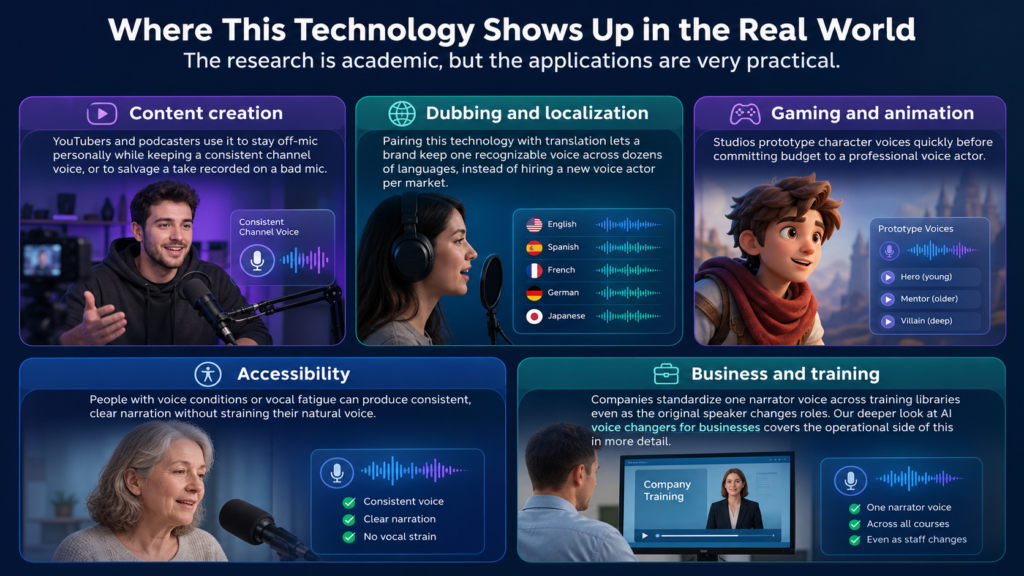
The research is academic, but the applications are very practical.
Content creation. YouTubers and podcasters use it to stay off-mic personally while keeping a consistent channel voice, or to salvage a take recorded on a bad mic.
Dubbing and localization. Pairing this technology with translation lets a brand keep one recognizable voice across dozens of languages, instead of hiring a new voice actor per market.
Gaming and animation. Studios prototype character voices quickly before committing budget to a professional voice actor.
Accessibility. People with voice conditions or vocal fatigue can produce consistent, clear narration without straining their natural voice.
Business and training. Companies standardize one narrator voice across training libraries even as the original speaker changes roles. Our deeper look at AI voice changers for businesses covers the operational side of this in more detail.
Common Problems: Why Conversion Sometimes Sounds Off
Even solid systems can produce noticeably artificial output, and it usually comes down to a handful of causes.
Noisy source audio gives the analysis stage bad data to work with, which cascades into every later stage.
Extreme pitch targets — converting a deep voice into a very bright one — force the model to guess more, introducing artifacts.
Flattened prosody strips out natural rhythm, leaving flat, monotone delivery even when the words are accurate.
We cover this exact failure pattern in much more depth in why AI voices sound robotic, including the fixes that actually move the needle.
How to Judge Conversion Quality
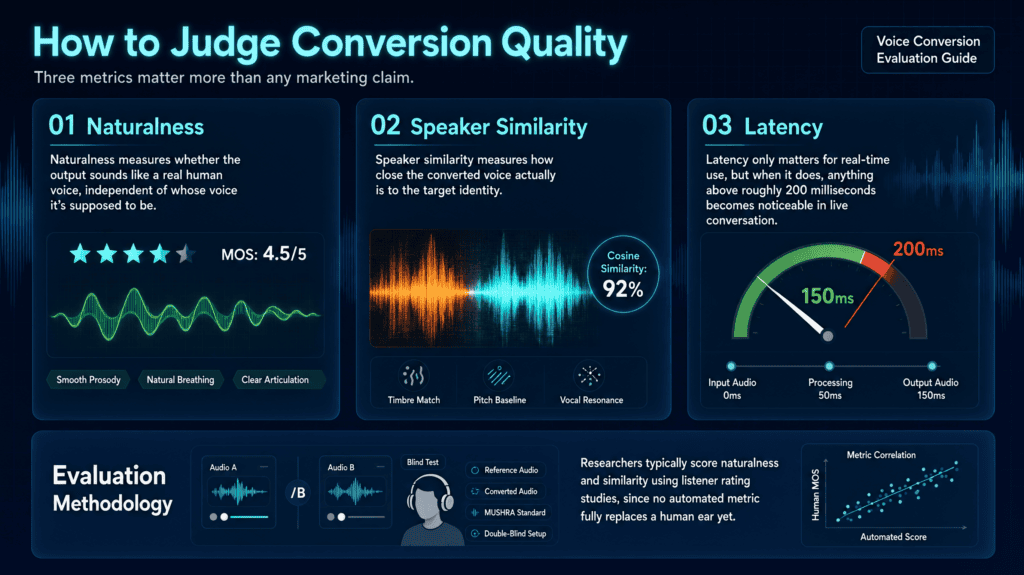
Three metrics matter more than any marketing claim.
Naturalness measures whether the output sounds like a real human voice, independent of whose voice it’s supposed to be.
Speaker similarity measures how close the converted voice actually is to the target identity.
Latency only matters for real-time use, but when it does, anything above roughly 200 milliseconds becomes noticeable in live conversation.
Researchers typically score naturalness and similarity using listener rating studies, since no automated metric fully replaces a human ear yet.
Ethics, Consent, and Disclosure
This technology raises real questions it can’t answer on its own — those come down to policy and consent.
Using the technique on your own recorded voice is generally uncontroversial. Cloning someone else’s voice without permission is a different matter entirely, both ethically and, increasingly, legally.
YouTube’s official policy requires creators to disclose when altered or synthetic content sounds realistic enough that a viewer could mistake it for something that genuinely happened. Voice-cloned narration used to translate a creator’s own content is specifically named as something that typically needs a label.
This isn’t a penalty for using the technology — it’s a transparency requirement so audiences know what they’re hearing.
Voice Conversion Inside a Full Creator Workflow
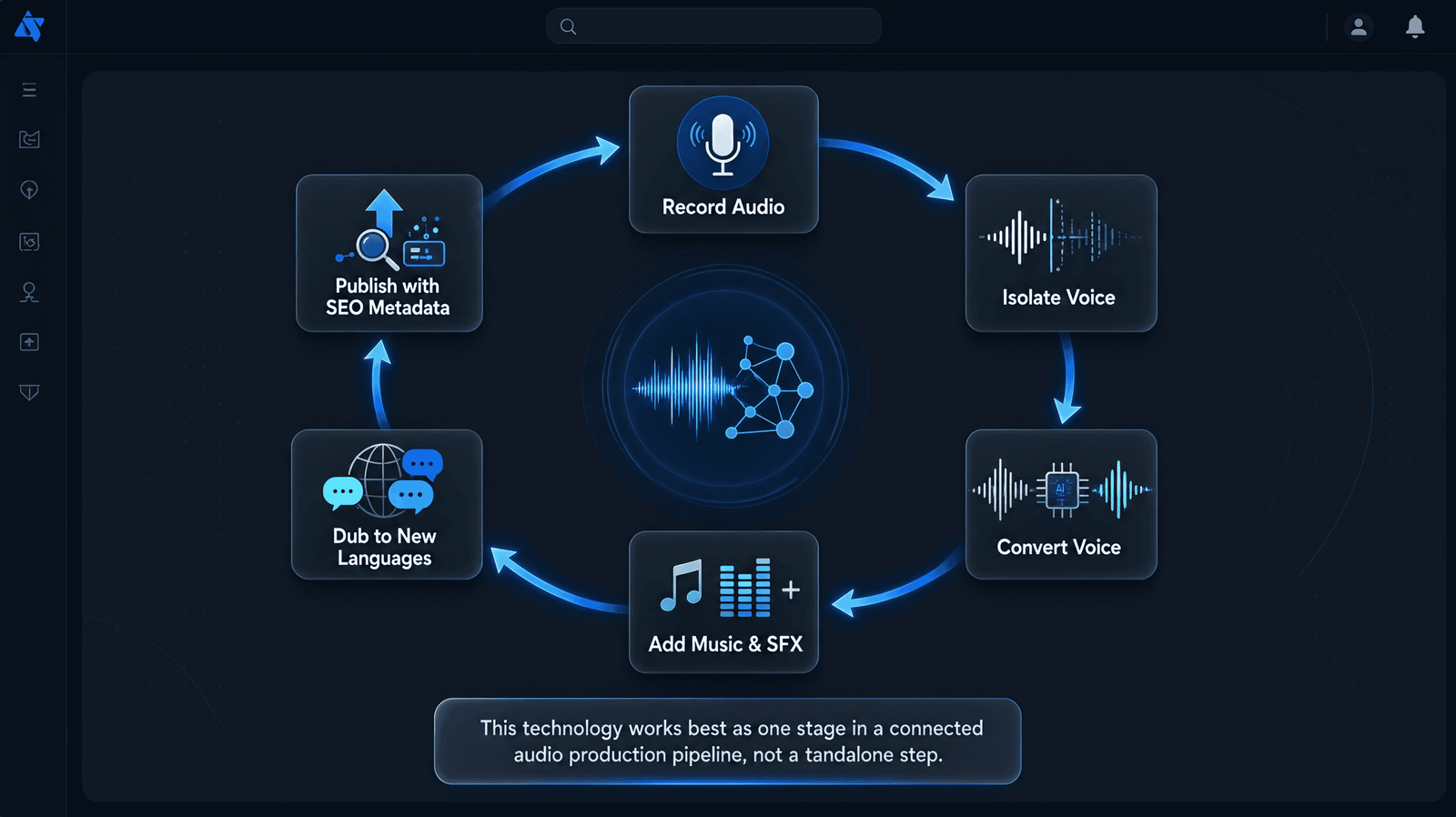
On its own, a converter is one link in a longer chain.
Inside ytZolo, converted audio pairs naturally with an AI voice isolator to clean noisy input before conversion even starts, since cleaner source audio consistently produces cleaner output.
From there, an AI music generator can score the finished scene, and an AI sound effects generator fills in everything from footsteps to ambience.
For channels producing multi-character content, pairing this process with an AI dialogue generator turns a single recorded track into a full back-and-forth conversation with distinct voices.
And for multilingual publishing, the same converted voice can feed straight into AI dubbing, keeping one consistent identity across every language version of a video.
Getting Started With the Technology
If you’re ready to try it rather than just read about it, the process is more approachable than the underlying math suggests.
Our step-by-step guide to changing your voice with AI walks through recording clean source audio, picking or cloning a target voice, and fine-tuning the output before export. For a side-by-side look at which tools handle this best in 2026, see our best AI voice changers comparison.
Screenshot recommendation: Capture ytZolo’s voice-changer interface showing the source-audio upload panel next to the target-voice selection library, with the “Run Conversion” button visible — useful for readers who want to see the workflow before signing up.
Frequently Asked Questions
Is voice conversion the same as voice cloning? No. Voice cloning builds a reusable model of one specific voice from sample audio. The conversion step is what applies a voice — cloned or preset — to an existing recording.
Does this technology work in any language? Most modern systems are language-agnostic in principle, since they operate on acoustic features rather than word meaning, though quality still depends on how much training data the model saw for that language.
How much sample audio does it need? It depends on the architecture. Non-parallel, embedding-based systems can work from as little as several seconds, while higher-fidelity results generally benefit from a few clean minutes.
Can a converted voice be detected as AI-generated? Increasingly, yes. Audio forensics and watermarking research are advancing alongside the underlying technology, and platforms are building detection into their moderation systems.
Why does converted audio sometimes mispronounce words? This usually points to a mapping-stage issue rather than the words themselves — the model is struggling to align the target voice’s phonetic patterns with the source content.
Is real-time conversion lower quality than post-production? Generally, yes, because it trades some refinement for speed. That said, better hardware and lighter models continue to close the gap.
Final Thoughts
Voice conversion is easier to understand than it first appears. At its core, the technology analyzes a spoken recording, separates the speaker’s identity from the words and emotional delivery, and reconstructs the performance using a different voice. The goal is not to change what is being said, but who appears to be saying it while preserving timing, tone, and natural expression.
Once you understand the analysis, mapping, and reconstruction pipeline, along with the difference between parallel and non-parallel training methods, it becomes much easier to evaluate voice conversion tools. The most convincing systems retain emotional nuance, pronunciation, and speech rhythm instead of producing robotic or overly processed audio.
That knowledge also helps you recognize why some tools deliver broadcast-quality results while others still sound artificial.
As AI audio technology continues to improve, voice conversion is becoming a practical production tool for YouTubers, podcasters, educators, marketers, and businesses.
Whether you’re localizing content, protecting a speaker’s identity, creating multiple character voices, or streamlining video production, choosing a platform that integrates voice conversion with the rest of your content creation pipeline will deliver far better results than relying on voice swapping alone.
Ready to see it in action? Explore ytZolo’s AI Audio Studio or check pricing plans to get started.
About the Author
Anshika Verma is a content and SEO researcher at ytZolo, specializing in AI audio and video production technology for creators. She writes about voice AI, YouTube growth, and creator tooling, drawing on hands-on testing of voice conversion, dubbing, and text-to-speech systems across the industry.
📧 anshika@ytzolo.com
Sources referenced: “Overview of Voice Conversion Methods Based on Deep Learning,” Applied Sciences, MDPI (2023); YouTube Help Center — Disclosing Altered or Synthetic Content.

