
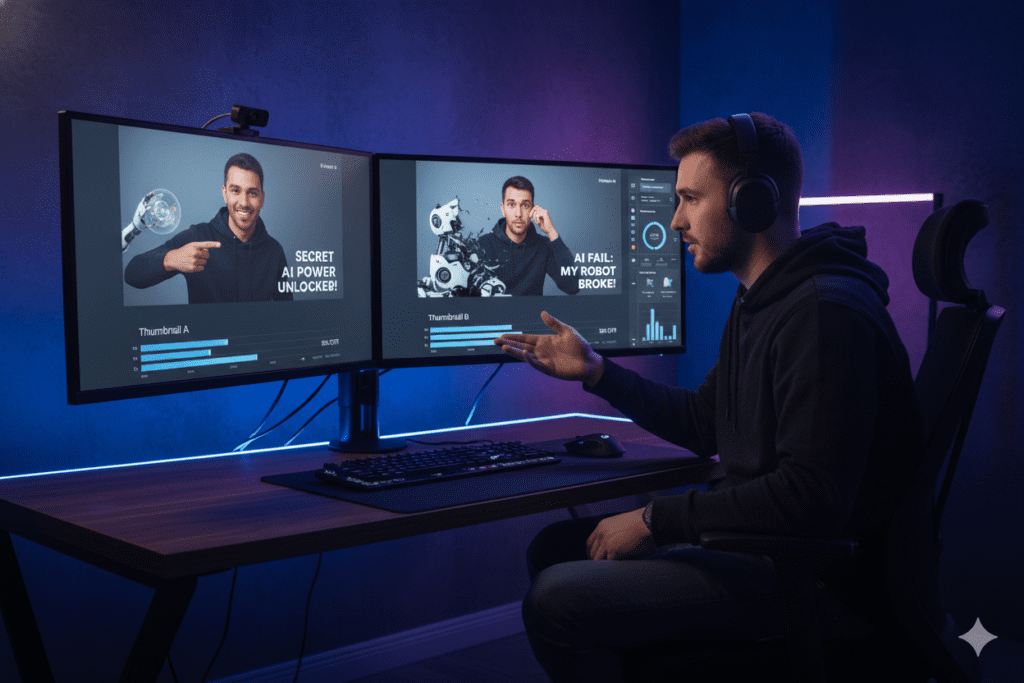
You spent 8 hours filming. Another 3 editing. You hit publish and wait.
47 views in 72 hours. The algorithm ignored you completely.
Sound familiar? Here’s what’s actually happening: your video content is probably fine. Your thumbnail and title are the problem. They’re the first thing a viewer sees, and if they don’t click, nothing else matters.
Learning how to use AI for YouTube thumbnail & title A/B testing 2026 is the fastest way to fix this. Creators who test consistently see CTR improvements of 15 to 40% from testing alone. Some have seen 300%+ gains with a single swap.
This guide shows you exactly how to do it.
Table of Contents
Why your CTR matters more than your content quality
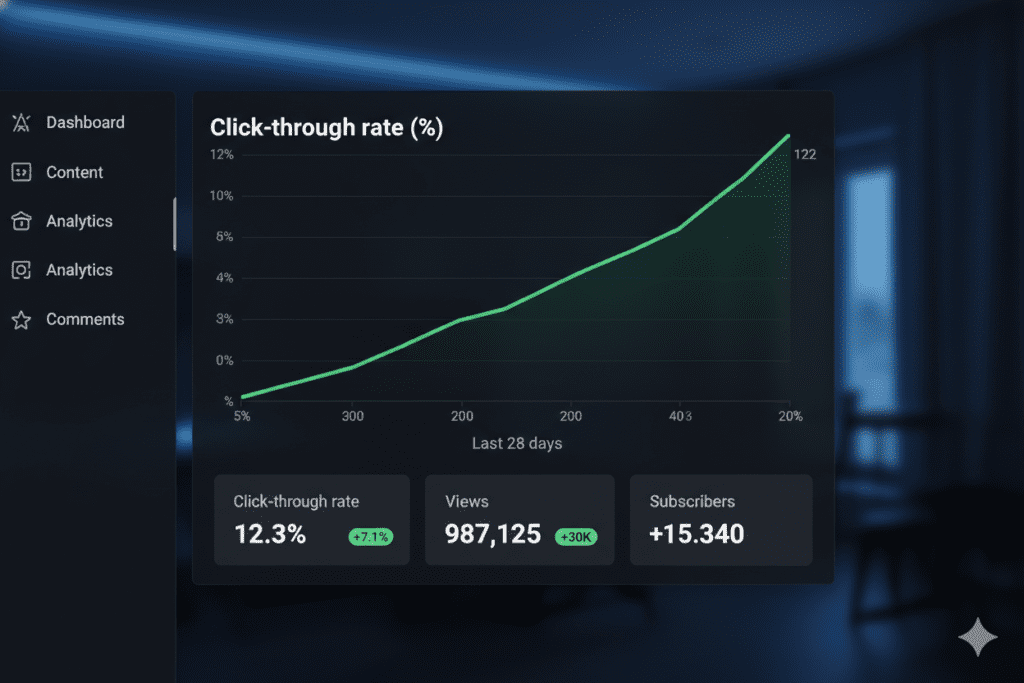
A 4% CTR means 4 out of every 100 people who saw your video decided to click. A 8% CTR doubles your traffic on the exact same impressions.
The YouTube algorithm reads CTR (Click-Through Rate) as a powerful signal of relevance and viewer interest. A high CTR tells YouTube that people find your content appealing and worth watching.
As a result, the platform is more likely to recommend your video across the homepage, search results, suggested videos, and other discovery surfaces.
This leads to more impressions, more clicks, and ultimately more views. The effect compounds over time, creating a growth cycle that can significantly expand your channel’s reach—especially when you apply a structured youtube test and compare thumbnails 2026 approach.
This is exactly why learning how to use AI for YouTube thumbnail & title A/B testing 2026 has become increasingly important for creators. AI tools can generate multiple thumbnail and title variations, analyze performance patterns, predict audience preferences, and help identify which combinations are most likely to attract clicks.
Instead of relying on guesswork, creators can make data-driven decisions backed by AI insights. By continuously testing and optimizing thumbnails and titles, you can improve CTR, increase watch time opportunities, and give the YouTube algorithm stronger signals that your content deserves wider distribution.
Following a YouTube thumbnail A/B testing guide 2026 helps creators implement a structured testing process, allowing them to compare multiple creative variations and identify what resonates most with their audience. Rather than making decisions based on assumptions, AI-powered testing reveals real perform
In 2026, AI-powered A/B testing is no longer just a competitive advantage—it’s becoming an essential part of a successful YouTube growth strategy.
A 1% CTR improvement on a video getting 50,000 impressions is 500 extra views. Every month. From the same video. Without touching the content once.
That’s why smart creators stopped obsessing over upload frequency and started obsessing over packaging.
What A/B testing actually is (and what it isn’t)
A/B testing means showing 2 (or more) versions of your thumbnail or title to different viewer groups, measuring which one gets more clicks, and keeping the winner.
It’s a controlled experiment. One variable at a time. Test the thumbnail, hold the title constant. Test the title, hold the thumbnail constant. Mix them only when you have a clear hypothesis.
This is where AI YouTube thumbnail analyzers become extremely powerful in 2026, because they help you predict CTR performance, compare variations instantly, and identify which visual elements are most likely to drive clicks before you even publish.
By combining structured testing with an AI YouTube thumbnail analyzer, creators can eliminate guesswork, validate ideas faster, and systematically improve both thumbnails and titles based on real engagement signals rather than intuition.
What it isn’t: changing your thumbnail because you got bored of it. Or switching titles based on a gut feeling. That’s guessing. A/B testing is data.
YouTube’s native “Test & Compare” feature (rolled out broadly in 2024-2025) lets you test up to 3 variations inside YouTube Studio, with the algorithm automatically determining the winner based on watch time and impressions. It’s free and built-in.
The catch? It only runs the test. It doesn’t help you create better variations to test in the first place. That’s where AI comes in. This is exactly where understanding how to use ai for youtube thumbnail & title a/b testing 2026 becomes a game-changer for creators.
Instead of manually guessing design ideas or title hooks, AI can generate multiple high-performing thumbnail concepts, suggest emotionally driven title variations, and even align them with audience behavior patterns.
By combining AI-generated variations with structured A/B testing, creators can build a continuous feedback loop where each test improves the next set of ideas, leading to consistently higher CTR and better video performance over time, especially when applying a youtube test and compare thumbnails 2026 workflow.
How to use AI for YouTube thumbnail & title A/B testing 2026
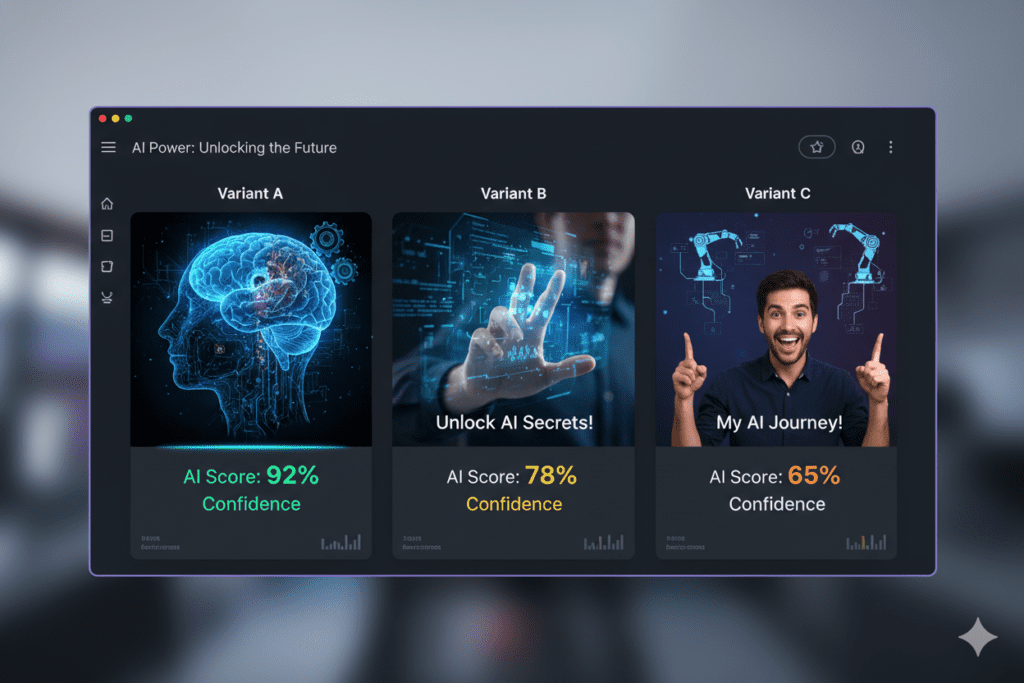
The workflow breaks into 3 stages:
Stage 1: Generate strong test candidates
Before you can test, you need options worth testing. AI tools like ytZolo generate multiple thumbnail concepts and title variations based on your video topic, niche, and what’s already working on the platform. You’re not starting from a blank canvas; you’re starting from patterns that already get clicks.
Stage 2: Run the test
Upload your top 2–3 variations to YouTube Studio’s Test & Compare feature. Let it run. Minimum 48 hours, ideally through a full week to account for day-of-week audience differences, following a structured youtube test and compare thumbnails 2026 workflow to ensure reliable, data-driven results.
Stage 3: Extract the learning
The winner matters less than why it won. Was it the color contrast? The face expression? The curiosity-driven title vs the direct one? Log that. Apply it to your next video before testing.
That compound learning is what separates channels that grow from channels that plateau.
Step-by-step: running your first AI-powered A/B test with ytZolo
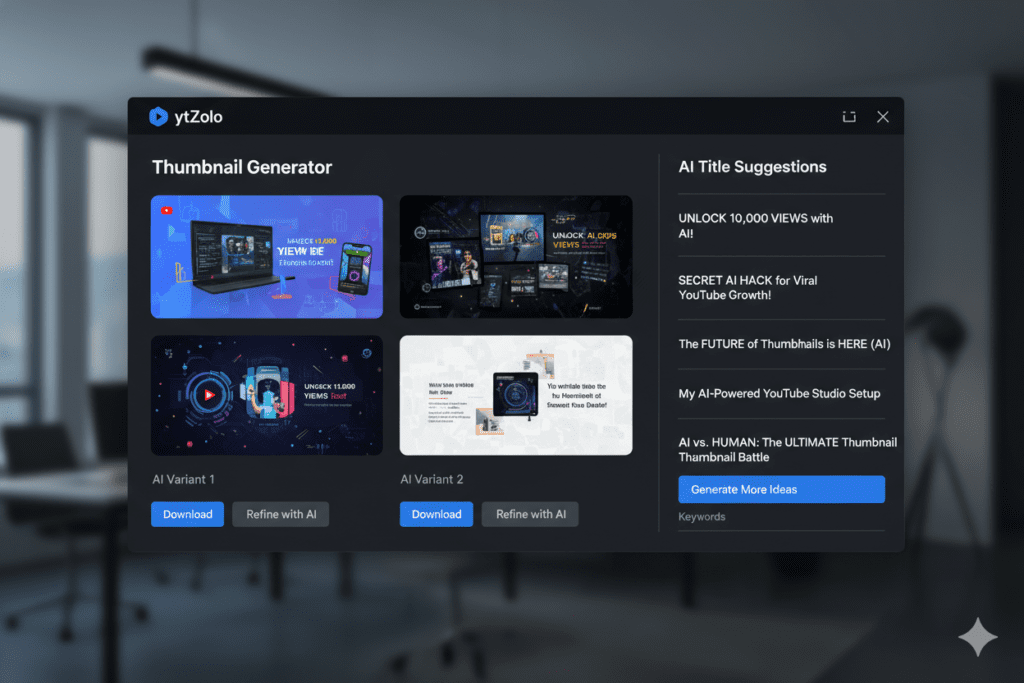
Here’s the exact workflow:
Step 1: Go to ytZolo and enter your video topic
Type in your video’s core topic. ytZolo’s AI generates title variations optimized for CTR, curiosity, and search volume simultaneously.
Step 2: Generate thumbnail concepts
Use ytZolo’s AI thumbnail generator to create 2–3 visual concepts based on your topic. It applies CTR-optimized layouts: high contrast, emotional hooks, bold fonts, face placement. Export at 1280×720, YouTube’s required spec, then integrate them into a youtube test and compare thumbnails 2026 workflow to evaluate which design performs best in real audience conditi
Step 3: Pick your 2 strongest candidates
One “safe” option (clear, informative) and one “bold” option (unexpected, curiosity-driven). The gap between them is where the learning happens.
Step 4: Upload to YouTube Studio > Analytics > Test & Compare
Set up your test. Both variations go live, YouTube splits impressions between them, and you get data.
Step 5: Review after 7 days minimum
Look at CTR and average view duration together. A thumbnail that drives more clicks but kills watch time is a net negative for the algorithm. The real winner improves both. This is especially important in a youtube test and compare thumbnails 2026 strategy, where performance is evaluated holistically rather than on clicks alone.
Step 6: Save the learnings in a testing journal
10 disciplined tests consistently outperform 1 lucky guess. The journal is your competitive advantage over time.
Why ytZolo is better than other tools
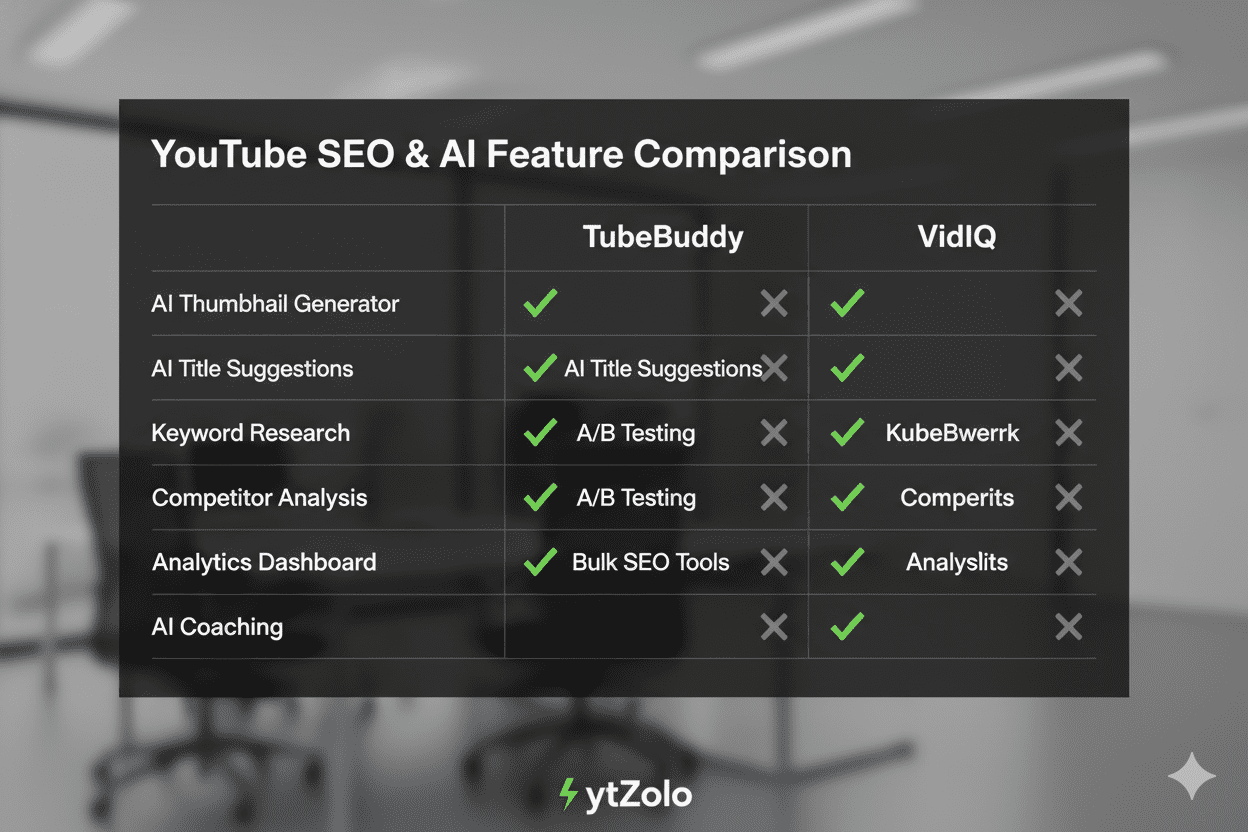
There are solid tools in this space. TubeBuddy runs the tests well. VidIQ does AI thumbnails. Canva handles the design. But you’re paying for 3-4 subscriptions and switching between platforms constantly.
ytZolo is built to handle the full workflow in one place.
| Feature | ytZolo | TubeBuddy | VidIQ | Canva |
|---|---|---|---|---|
| AI title generation | ✅ | Limited | ✅ | ❌ |
| AI thumbnail creation | ✅ | ❌ | ✅ | Template only |
| Script generation | ✅ | ❌ | ❌ | ❌ |
| Description + tags | ✅ | ✅ | ✅ | ❌ |
| All-in-one workflow | ✅ | Partial | Partial | ❌ |
| Built for viral content | ✅ | ❌ | Partial | ❌ |
The difference is that most tools only help with one piece of the packaging puzzle. ytZolo generates your title ideas, thumbnail concepts, video descriptions, tags, and scripts all in one place. You stay in a single workflow, move faster, and build a consistent creative system instead of juggling multiple tools.
This is also the core idea behind how to use ai for youtube thumbnail & title a/b testing 2026—bringing every part of the content packaging process into one AI-driven loop.
When your titles and thumbnails are generated, tested, and refined together, you eliminate fragmentation and make optimization much more systematic.
ytZolo helps creators not just test ideas, but actually produce better variations from the start, so every A/B test becomes more meaningful and performance-focused over time—especially when applied within a youtube test and compare thumbnails 2026 workflow.
For creators who publish 2-4 times a week, that time savings is massive. For creators who are just starting out, having an AI that understands YouTube (not just graphic design) means you skip the 6-month learning curve on what actually gets clicks.
Check out ytZolo’s blog for more creator-focused guides on growing your channel with AI.
What to test: thumbnails vs titles vs both
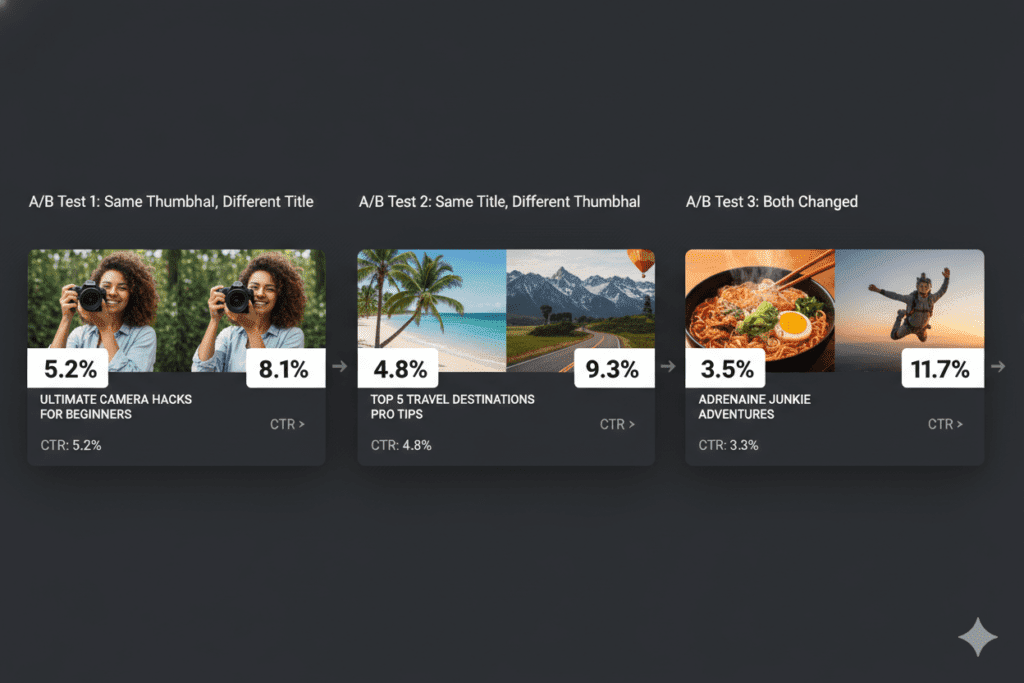
Test titles when:
- Your video is getting impressions but low CTR (people are seeing it, not clicking)
- You’re in a competitive niche where dozens of similar videos exist
- Your content is search-based (tutorials, reviews, how-tos)
Question-based titles consistently outperform statement titles in search-driven niches. A gaming channel testing title variations on Minecraft content saw a 12% CTR improvement switching to question-based titles.
Test thumbnails when:
- Your video gets clicks from suggested/browse but watch time is strong
- You’re in a visual niche (cooking, travel, beauty, gaming)
- You’ve already got a solid title formula that’s working
Test both when:
- You’re launching a new content series
- You’re trying to break into a new niche
- An older video stalled and you want to revive it (evergreen content responds well to thumbnail refreshes)
Ali Abdaal’s team saw a video jump from roughly 300,000 views to 1.1 million after one thumbnail swap. Same video, same title, completely different packaging.
This is a strong example of how powerful youtube test and compare thumbnails 2026 has become in modern YouTube growth strategy, where small packaging changes can dramatically shift CTR and overall distribution.
How to read your results and actually act on them
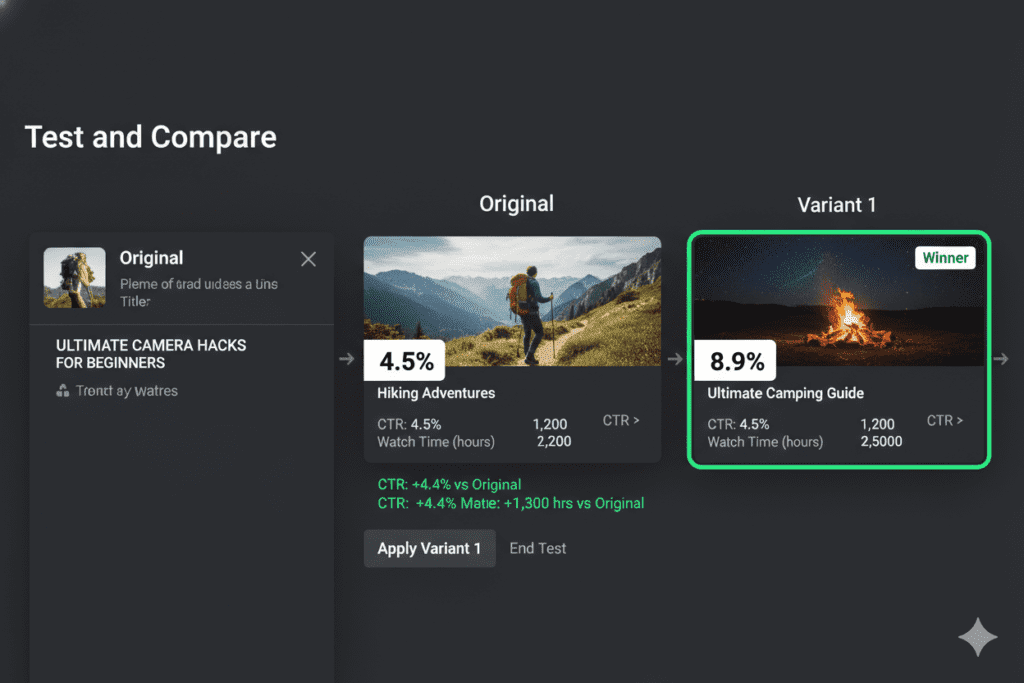
YouTube’s Test & Compare picks a winner based on watch time, not just clicks. Pay attention to both:
- CTR went up, watch time went down: the thumbnail promised something the video didn’t deliver. The title might have been clickbait. Don’t use it.
- CTR went up, watch time stayed the same: clean win. Ship it.
- No significant difference after 2 weeks: the variations weren’t different enough. Go bolder on the next test.
vs no face? Number in title vs open question?
One thing most guides skip: document the why behind every test. What design principle were you testing? High contrast vs low contrast? Face vs no face? Number in title vs open question?
This is a crucial step in how to use ai for youtube thumbnail & title a/b testing 2026, because without tracking intent, your data becomes noise instead of insight. When you log the reasoning behind each experiment, AI tools can later analyze patterns across your tests and identify what consistently drives higher CTR.
For example, you might discover that emotional faces outperform text-heavy thumbnails, or that question-based titles outperform numeric list formats in your niche. This is a key insight in a youtube test and compare thumbnails 2026 strategy, where repeated experiments reveal clear patterns in what drives higher CTR and audience engage
Over time, this turns A/B testing into a learning system rather than random experimentation, helping you refine both creative strategy and performance outcomes with far more precision.
After 10 tests, you’ll have a personal playbook for your channel and your audience. That’s worth more than any tool.
Common A/B testing mistakes that waste your time

Changing too many variables at once. If you change the thumbnail color, the face expression, the text overlay, AND the title simultaneously, you’ll never know what moved the needle.
Testing for too short a window. 24 hours isn’t enough data. Different days attract different audiences. Run tests for 7-14 days.
Ignoring watch time. A beautiful thumbnail that misleads viewers hurts your channel long-term. The algorithm tracks abandonment and viewer satisfaction signals.
Test the full package, not just the click, especially in a youtube test and compare thumbnails 2026 strategy where both CTR and retention are evaluated together to ensure sustainable growth.
Not testing at all. The biggest mistake is posting and hoping. Every video is a hypothesis. Test it.
Running out of good variants to test. This is where AI earns its keep. Tools like ytZolo generate multiple strong thumbnail and title options quickly, so you never go into a test with weak candidates. Weak variants mean weak data.
FAQ
What is AI A/B testing for YouTube thumbnails and titles?
AI A/B testing means using artificial intelligence to generate multiple thumbnail and title variations, then running controlled experiments to measure which version gets more clicks and watch time.
Tools like ytZolo create optimized variants based on YouTube-specific performance patterns, which you then test inside YouTube Studio’s Test & Compare feature—making a youtube test and compare thumbnails 2026 workflow far more efficient and data-driven.
How many variations should I test at once?
Start with 2. One control (your original or most “expected” option) and one challenger. YouTube Studio supports up to 3 variations. Testing more than 2 is fine, but keep one constant variable so you know what drove the difference.
How long should I run a YouTube A/B test?
At minimum, you should run tests for 7 days to capture full day-of-week audience variation, since viewer behavior often changes between weekdays and weekends. For evergreen content with lower traffic, extend the test window to 2–3 weeks so you can collect enough impressions for statistically reliable data instead of drawing conclusions from random spikes or dips.
This becomes even more effective in how to use ai for youtube thumbnail & title a/b testing 2026, where AI systems can continuously monitor performance trends over time and adjust recommendations based on accumulated data rather than short-term results.
By combining proper testing duration with AI-driven analysis, creators can avoid premature decisions and ensure that CTR improvements are based on stable audience behavior patterns rather than temporary fluctuations.
Does changing a thumbnail help older videos?
Yes, often dramatically. Refreshing the thumbnail on evergreen content is one of the fastest wins in YouTube growth. One creator saw a sustained bump in daily views months after a single thumbnail swap on a 2-year-old video. YouTube re-tests packaging changes, especially when you apply a structured youtube test and compare thumbnails 2026 approach to validate which version performs better over time.
How is ytZolo different from using Canva for thumbnails?
Canva is a design tool. It gives you templates but doesn’t understand YouTube’s click psychology. ytZolo is trained on what actually performs on the platform: CTR-optimized layouts, contrast patterns, text placement, emotional hooks. It also handles titles, descriptions, scripts, and tags in the same workflow, so you’re building your entire video package in one place instead of 4 different tools.
Wrap up
How to use AI for YouTube thumbnail & title A/B testing 2026 isn’t complicated. Generate strong candidates with AI, run controlled tests, learn from the data, and apply those lessons forward. The channels that do this consistently compound their growth.
The ones that don’t stay stuck. This is where a youtube test and compare thumbnails 2026 mindset becomes essential, turning every upload into a structured experiment that improves CTR, watch time, and long-term channel performance.
Every percentage point of CTR improvement is views you’re leaving on the table right now.
ytZolo gives you the AI to generate better test candidates, the tools to build your full content package, and the speed to test more frequently. Stop guessing what your audience wants to click. Start measuring it.
Start creating smarter, faster, and more viral YouTube content with ytZolo today.
Further reading:

