
Excerpt: YouTube’s 2026 crackdown on “AI slop” and repetitive content is reshaping monetization. Here’s exactly what counts as inauthentic content, what’s still safe, and how to protect your channel.
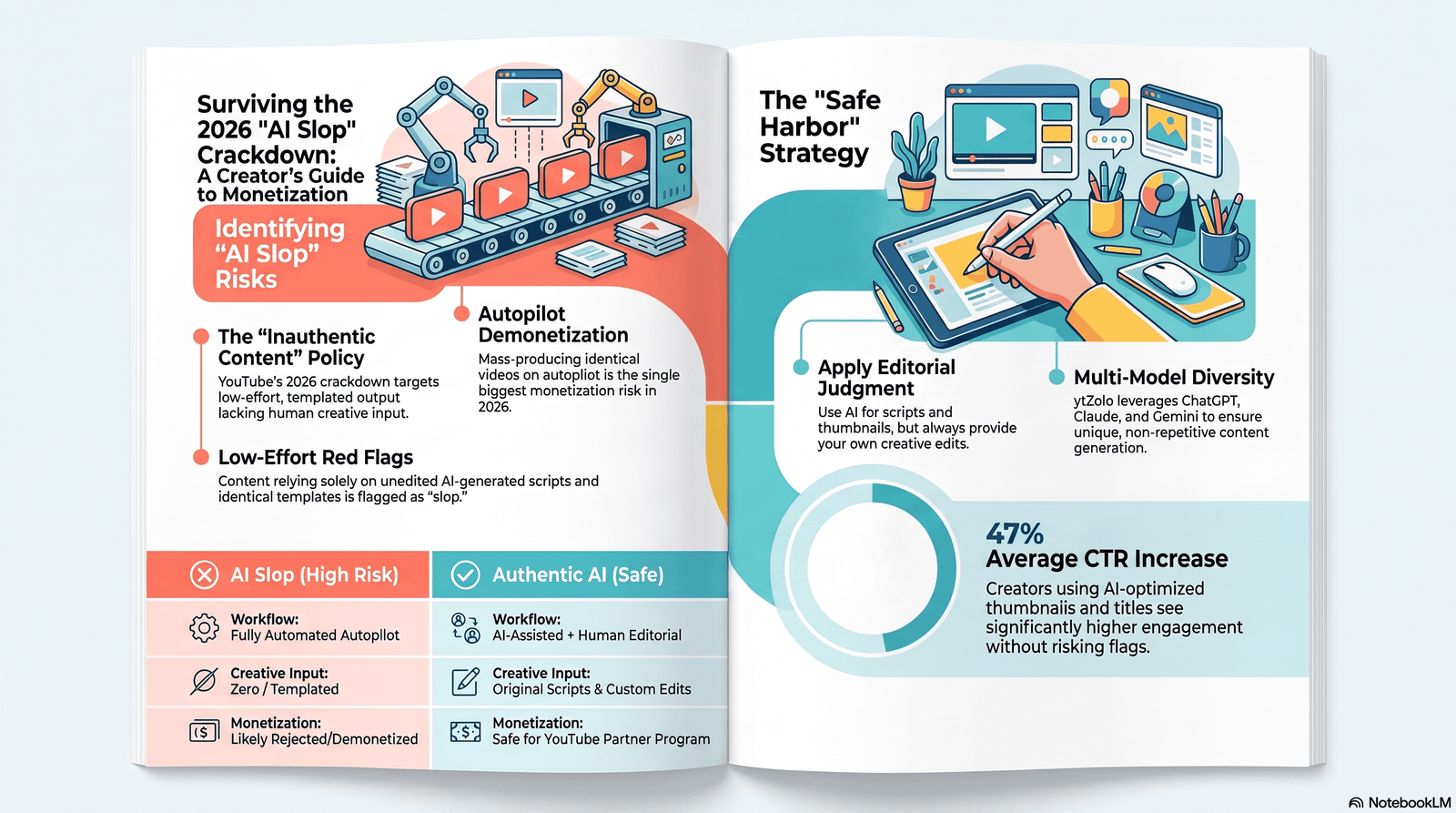
If you’ve searched for youtube repetitive content policy ai slop 2026, you’re probably worried about one of three things: your channel got flagged, your application to the YouTube Partner Program got rejected, or you’re building a new channel and don’t want to build it on a foundation that YouTube is actively demonetizing.
You’re right to be careful. YouTube’s “inauthentic content” policy (formerly called “repetitious content”) is the single biggest monetization risk facing creators in 2026, especially anyone using AI tools, templated formats, or faceless automation.
Quick Summary: YouTube doesn’t penalize AI use — it penalizes low-effort, templated output with no human creative input. Tools like ytZolo help creators stay on the safe side of this line by generating original scripts, titles, thumbnails, and voiceovers that still need — and reward — your own editorial judgment, instead of mass-producing identical videos on autopilot.
This guide covers the entire policy in plain English: what counts as AI slop, what’s still safe to publish, how the review process actually works, and a practical checklist you can run your channel through today.
Table of Contents
YouTube Repetitive Content Policy AI Slop 2026: Policy Overview
Quick answer: YouTube’s repetitive content policy (renamed “inauthentic content” in July 2025) blocks monetization for channels that publish mass-produced, templated, or AI-generated videos with little variation. It sits inside YouTube’s broader channel monetization policies and applies to your entire channel, not just one video.
YouTube doesn’t ban AI. It bans low-effort, formulaic output that’s designed to farm views instead of serve viewers. According to YouTube’s own guidance, monetized content must be your original creation and must not be mass-produced, generic, repetitive, or manipulative. That’s the whole policy in one sentence — everything else is detail and examples.
This matters because YouTube isn’t just a video platform anymore. It’s the most-watched screen in the average American living room, and YouTube says it has been the #1 service in U.S. streaming watchtime for nearly three years. When a platform that size worries about content quality, it changes enforcement — and that’s exactly what’s happening with AI slop in 2026.
Featured snippet answer: The YouTube repetitive content policy, now called “inauthentic content,” disqualifies channels from monetization if their videos look template-driven, offer little variation between uploads, or are mass-produced — including with AI — without added original insight.
What Changed in 2026
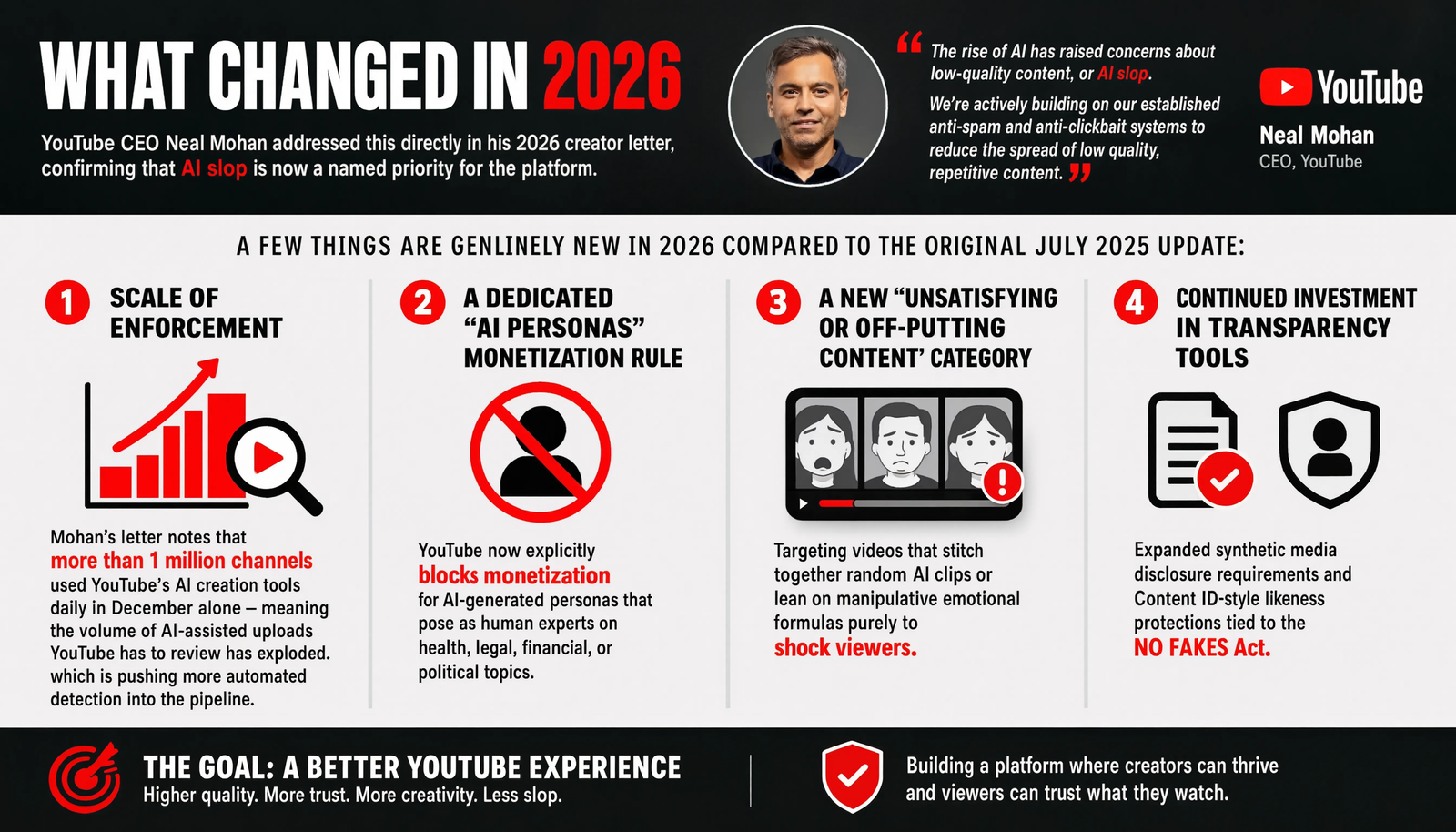
YouTube CEO Neal Mohan addressed this directly in his 2026 creator letter, confirming that AI slop is now a named priority for the platform. He wrote that the rise of AI has raised concerns about low-quality content, or “AI slop,”and that YouTube is actively building on its established anti-spam and anti-clickbait systems to reduce the spread of low quality, repetitive content.
A few things are genuinely new in 2026 compared to the original July 2025 update:
- Scale of enforcement. Mohan’s letter notes that more than 1 million channels used YouTube’s AI creation tools daily in December alone — meaning the volume of AI-assisted uploads YouTube has to review has exploded, which is pushing more automated detection into the pipeline.
- A dedicated “AI Personas” monetization rule. YouTube now explicitly blocks monetization for AI-generated personas that pose as human experts on health, legal, financial, or political topics.
- A new “Unsatisfying or Off-putting Content” category, targeting videos that stitch together random AI clips or lean on manipulative emotional formulas purely to shock viewers.
- Continued investment in transparency tools, including expanded synthetic media disclosure requirements and Content ID-style likeness protections tied to the NO FAKES Act.
The core enforcement mechanism, though, is the same one YouTube quietly rolled out in mid-2025 and has been refining since.
The July 2025 rename, explained
On July 15, 2025, YouTube renamed its long-standing “repetitious content” guideline to “inauthentic content.” YouTube was explicit that this was a clarification, not a new rule: the update better clarifies that the policy includes content that is repetitive or mass-produced, and this type of content has always been ineligible for monetization under existing rules that reward original, authentic work.
Crucially, YouTube also confirmed there was no change to the separate reused content policy, which covers commentary, clips, compilations, and reaction videos.
Rene Ritchie, YouTube’s Head of Editorial & Creator Liaison, downplayed the update publicly, describing it as a minor clarification of a policy that already existed — and noting that the content it targets was already the kind of thing users would call spam.
What Is AI Slop?
Quick answer: “AI slop” is a creator-economy term for low-effort, mass-produced content generated (fully or partly) by AI with minimal human editing, originality, or added insight. YouTube doesn’t use the term in policy text, but Neal Mohan uses it directly in his own 2026 letter to describe the exact content this policy targets.
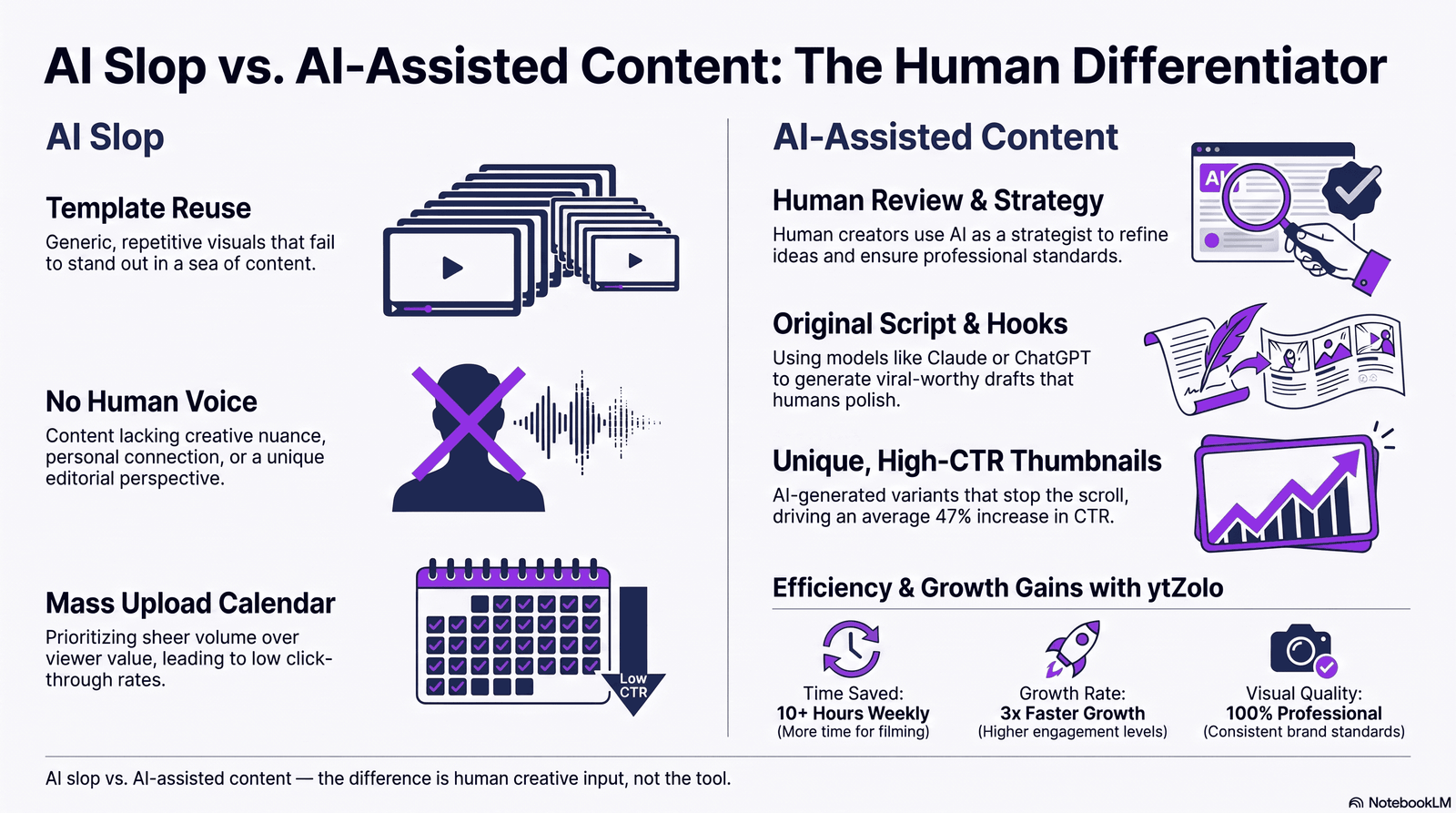
AI slop is not defined by the tool used. It’s defined by the absence of a creative decision. A video becomes slop when:
- The script, voiceover, and visuals were generated without a human reviewing or reshaping the output
- Dozens of videos on the same channel follow an identical structure with only the topic swapped
- The video exists purely to occupy search real estate or farm impressions, not to genuinely help or entertain a viewer
- Nothing in the video reflects the creator’s own research, opinion, voice, or editorial choices
YouTube’s own policy language backs this up. Its “Generic or Repetitive Content” section specifically lists AI-generated content made with generic or unoriginal templates giving the impression of mass production without adding the creator’s original, authentic insights or perspective as a violation.
Good AI Usage vs. Bad AI Usage
YouTube’s policy page is unusually specific here, and it’s worth reading closely because most creators assume “using AI” is the violation. It isn’t.
| Allowed to Monetize (Good AI Usage) | Not Allowed to Monetize (Bad AI Usage) |
|---|---|
| Using AI to edit video scripts while you write the core ideas | AI-generated scripts with no human review, published as-is |
| Using AI to visualize a character or narrative you personally invented | AI slideshows with generic narration and no original storyline |
| AI-generated background visuals supporting a story you wrote | Videos where AI clips are stitched together with no coherent arc |
| A Short that puts your own creative spin on a trending format | A Short that copies a trending format with zero personal variation |
| AI voiceover paired with your own research, structure, and commentary | AI voiceover reading a scraped or auto-generated script verbatim |
YouTube states this directly: automated tools are fine as long as the final product still demonstrates your creative vision and provides educational or entertainment value. On the flip side, videos that stitch together unrelated or inconsistent AI clips to surprise or shock viewers fall under the newer “Unsatisfying or Off-putting Content” violation.
Featured snippet answer: AI tools themselves are allowed on YouTube. What gets demonetized is content where AI output replaces human creative judgment entirely — no original script, no personal commentary, and no meaningful variation between uploads.
If you want one place to generate thumbnails, scripts, titles, and voiceovers instead of juggling separate tools, ytZolo covers all four in a single workflow. It’s built to speed up production without pushing you toward the templated, one-click output this policy targets.
Repetitive Content Explained
YouTube calls this category “Generic or Repetitive Content,” and it’s the direct successor to the old “repetitious content” rule. The test YouTube applies is whether the substance of each video is materially different, not whether the format looks the same.
What’s allowed (same format, different substance)
- Keeping the same intro and outro across every upload — same intro and outro for your videos, but the bulk of your content is different is explicitly fine.
- Running a recurring series with the same characters, as long as each video has a distinct storyline, focus, or concept.
- Doing product review videos in a consistent format, as long as each one adds specific, unique insight.
What’s not allowed (same format, same substance)
- Content where each video doesn’t deliver creative, educational, or other value to the viewer and feels interchangeable.
- Characters placed in the same situation over and over again with the same outcome — a highly similar storyline template repeated at scale.
- Image slideshows, templated storylines, or scrolling text with minimal or no narrative, commentary, or educational value.
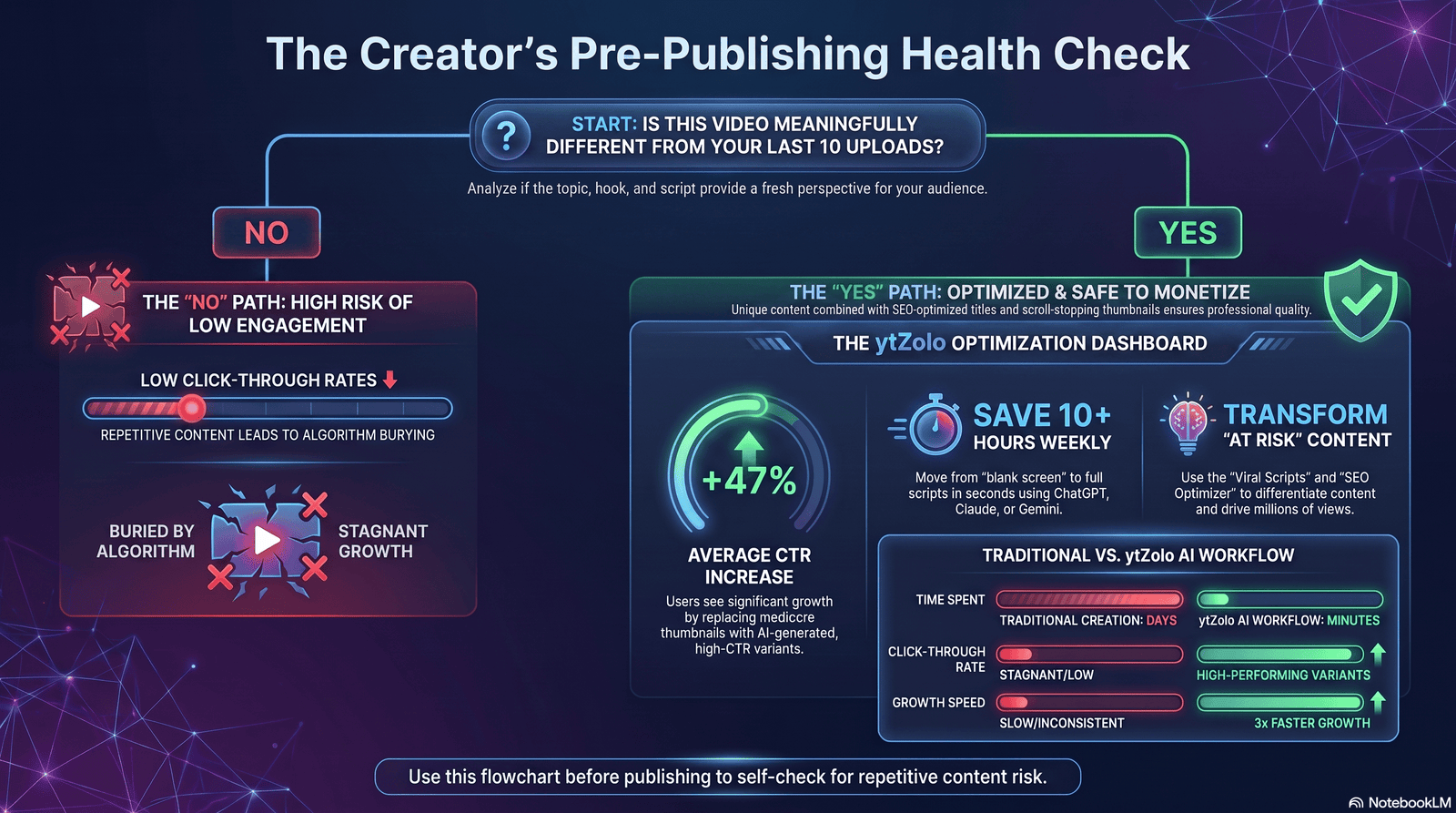
The dividing line is simple: could a regular viewer tell your videos apart if you removed the titles and thumbnails? If yes, you’re probably fine. If every video plays out identically with a new topic dropped in, that’s the pattern YouTube is targeting.
Comparison Table: Repetitive vs. Transformative Content
| Signal | Repetitive (Flagged) | Transformative (Compliant) |
|---|---|---|
| Storyline | Same template, new topic | Unique angle or argument each time |
| Voice/commentary | Generic narration, no opinion | Personal insight, analysis, or humor |
| Visual variation | Identical stock footage patterns | Custom or contextually chosen visuals |
| Editing effort | Minimal, automated | Visible human editing decisions |
| Viewer value | Fills time, low retention intent | Teaches, entertains, or informs |
Spam vs. Reused Content vs. AI Slop vs. Transformative Content
Creators often lump these terms together, but YouTube treats them as separate (if overlapping) policies. Getting the distinction right matters because the fix for each one is different.
| Category | Definition | Example | Fix |
|---|---|---|---|
| Spam | Content designed purely to manipulate views, engagement, or search ranking | Bot-farmed comments, misleading clickbait titles | Follow Community Guidelines |
| Reused content | Content taken from another source without significant original commentary | Movie clips stitched together with no narration | Add substantive commentary, editing, or a storyline — see YouTube’s guidance on edited footage from other creators where you add a storyline and commentary |
| AI slop | Mass-produced, low-effort content generated with minimal human input | 50 AI-narrated “Top 10” videos using the same script structure | Add original research, voice, and editorial judgment |
| Transformative content | Content that adds enough original value to stand on its own | A reaction video with genuine analysis and commentary | This is the goal — no fix needed |
Notably, reaction and commentary formats are still safe. YouTube confirmed reaction videos where you comment on the original video remain an example of what’s allowed to monetize, and this wasn’t touched by the 2025 update.
Monetization Rules and YPP Review
How the review actually works
YouTube doesn’t watch every video on a channel. Instead, reviewers assess your channel holistically, focusing on a specific set of signals.
According to YouTube’s official policy, reviewers may focus on your channel’s main theme, most viewed videos, newest videos, biggest proportion of watch time, video metadata (including titles, thumbnails, and descriptions), and channel’s “About” section.
This is why a single risky video rarely tanks a channel — but a pattern across your top-performing or newest content will. The reused content policy in particular applies to your channel as a whole, and violations can result in monetization being removed from the entire channel, not just individual videos.
YPP eligibility basics
To join the YouTube Partner Program, you still need the baseline thresholds — 1,000 subscribers and either 4,000 public watch hours in the past 12 months or 10 million Shorts views — but meeting the numbers no longer guarantees approval.
Channels built primarily on mass-produced or templated content, including AI-assisted work, are increasingly rejected at the application stage or removed after admission if patterns emerge later.
Manual review and human oversight
YouTube has also been expanding human review capacity around ad suitability, noting that some videos undergoing checks — including private videos — may get an additional review that’s completed by a human, with monetization decisions sometimes taking up to 24 hours as a result.
The appeal process
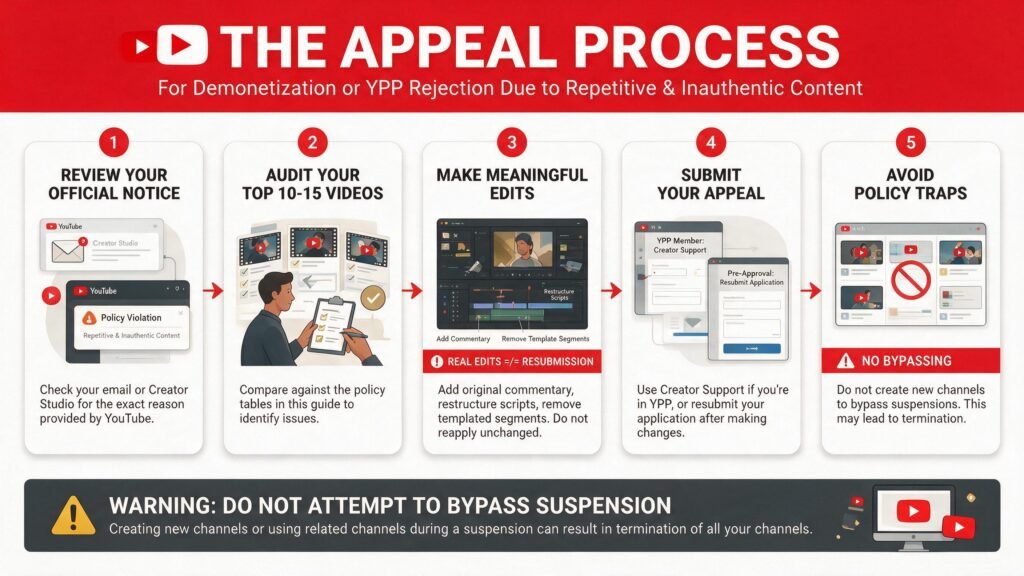
If your channel is demonetized or your YPP application is denied for repetitive or inauthentic content:
- Read the specific reason in your email or Creator Studio notification — YouTube states it will inform you in writing by email or in product when we have to enforce our policies and outline your options.
- Audit your top 10–15 videos against the tables in this guide before appealing.
- Make real edits — add commentary, restructure scripts, remove templated segments — rather than reapplying unchanged.
- Reapply through Creator Support if you’re already in YPP, or resubmit your application after meaningful changes if you were rejected pre-approval.
- Avoid creating a new channel to bypass suspension. YouTube explicitly warns that doing so, or applying to YPP with related channels during a suspension, could lead to termination of all channels.
Real Examples From Creators
While YouTube doesn’t name specific channels it demonetizes, patterns reported across the creator community and covered by industry press in 2025–2026 fall into a few recurring categories:
- “Faceless facts” channels publishing 5–10 videos a day, each using the same AI voice, same stock B-roll style, and near-identical script structure with only the topic swapped. These are consistently flagged under the “Generic or Repetitive Content” policy.
- AI storytelling channels using near-identical thumbnail templates and titles (“You Won’t Believe What Happened When…”) with formulaic plot beats — flagged under the newer “Unsatisfying or Off-putting Content” rule when the narrative feels manufactured purely for shock value.
- Slideshow news/finance channels reading scraped articles over stock images with robotic TTS narration — a textbook example of the content that exclusively features readings of other materials you did not originally create, like text from websites or news feeds violation.
- Compliant automation channels, by contrast, tend to survive review because they layer a consistent human voice, original scripting, and channel-specific commentary on top of an efficient production pipeline — proving that automation and authenticity aren’t mutually exclusive when the workflow is used well. Creators building this kind of pipeline often use a YouTube description generator alongside original scripting rather than letting AI handle the whole video end-to-end.
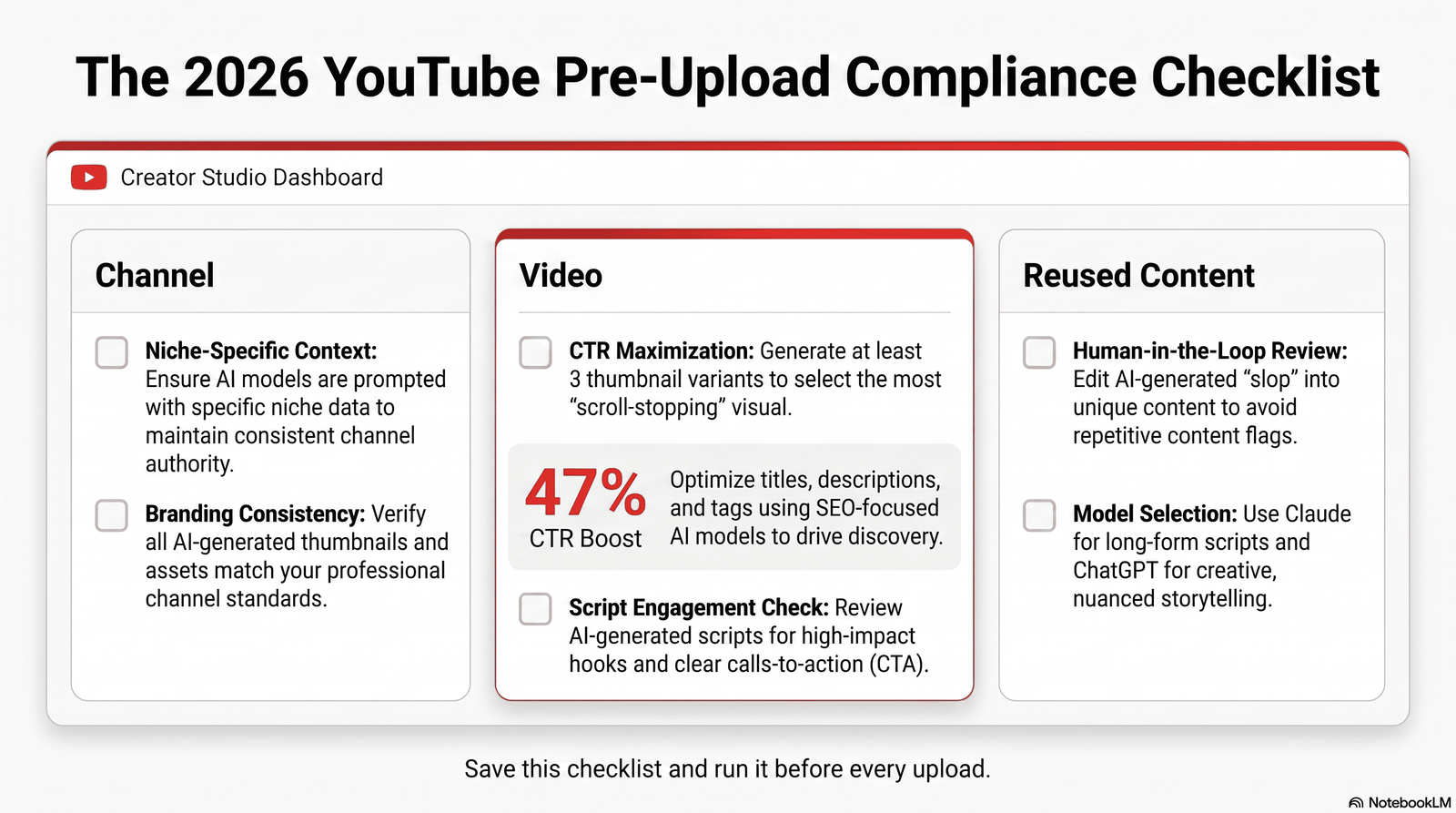
Creator Compliance Checklist
Run every video — and your channel as a whole — through this list before publishing.
Channel-level checklist:
- [ ] Do your last 10 uploads have genuinely different substance, not just different titles?
- [ ] Does your “About” section accurately describe how you make your content?
- [ ] Would a new viewer be able to tell two of your videos apart with the sound off?
- [ ] Are your thumbnails and titles honest representations of the video content?
Video-level checklist:
- [ ] Did a human write, rewrite, or substantially edit the script?
- [ ] Does the video include your own commentary, opinion, or original research?
- [ ] If AI voice or visuals were used, did you direct the creative choices rather than accept default output?
- [ ] Is the storyline or structure distinct from your last five uploads?
- [ ] Would this video be interesting to watch even without the “AI-generated” label?
Reused-content checklist (for reaction, commentary, and clip formats):
- [ ] Are you visible or clearly present in the content, per YouTube’s guidance on content that primarily features the uploading creator in the video?
- [ ] Did you add narrative structure and commentary, not just reaction sounds?
- [ ] Is your added value obvious to a viewer without reading a description?
Best Practices for Safe AI Workflows
- Start with a human premise, not a prompt. Decide the angle, argument, or story before AI touches anything.
- Edit the AI output, don’t publish it raw. Rewrite at least a meaningful portion of any AI-generated script in your own words and voice.
- Vary structure deliberately. If you run a series, change the storyline, guest, product, or conflict each episode — not just the topic label.
- Keep a consistent creative signature. A recognizable host voice, editing style, or recurring segment format helps reviewers (and viewers) see continuity of authorship.
- Disclose synthetic and altered media where required. YouTube requires creators to disclose when they’ve created realistic altered or synthetic content, particularly anything that could be mistaken for real footage.
- Batch-plan your SEO metadata, not your storylines. Tools that help with titles, tags, and descriptions save time without touching the part of your video that actually needs to be original — this is different from tools that generate entire scripts on autopilot. A workflow-focused SEO content process keeps research and drafting fast without hollowing out the finished video.
- Design original thumbnails for each concept. Templated thumbnails with swapped text are a visible repetition signal — pairing a thumbnail workflow with unique imagery per video helps avoid the “identical template” pattern reviewers look for.
- If you localize content, dub thoughtfully. Multilingual expansion is safe and encouraged — YouTube reported more than 6 million daily viewers watching at least 10 minutes of autodubbed content in December — but each dubbed version should still represent a faithful, complete adaptation rather than a stripped-down clone. Reviewing an AI dubbing workflow before scaling into new languages helps keep quality consistent across versions.
Common Mistakes
- Assuming “no copyright strike” means “compliant.” Reused content policy is separate from copyright. YouTube states plainly that this guideline applies even if you have permission from the original creator, and it’s judged independently of fair use or copyright status.
- Publishing at a volume no human could realistically review. Ten AI videos a day is a red flag regardless of quality, because it signals template-driven production.
- Treating disclosure as a substitute for originality. Labeling a video “AI-generated” doesn’t exempt it from the repetitive content policy — the content itself still has to add value.
- Ignoring the “About” page and metadata. Reviewers explicitly check video metadata (including titles, thumbnails, and descriptions), so vague or automated descriptions can hurt you even when the video itself is fine.
- Reapplying to YPP without changing anything. Resubmitting an unchanged channel after rejection almost always results in the same outcome.
- Confusing “off-putting” with “controversial.” The Unsatisfying or Off-putting Content policy targets manipulative structure and shock-for-shock’s-sake editing, not opinions or difficult topics handled with a real narrative.
Policy Timeline
| Date | Update |
|---|---|
| 2018–2024 | “Repetitious content” exists as part of YPP monetization policy, largely unenforced at scale |
| April 2024 | Google clarifies scaled content abuse in its core search spam policies, targeting AI-generated pages made with little added value |
| July 15, 2025 | YouTube renames “repetitious content” to “inauthentic content,” clarifying it covers mass-produced and repetitive content; reused content policy unchanged |
| Late 2025 | Industry reporting confirms enforcement is expanding, with AI narration and slideshow channels among the most frequently flagged |
| January 21, 2026 | Neal Mohan’s CEO letter names “AI slop” directly and confirms YouTube is building on anti-spam systems to reduce repetitive AI content |
| 2026 | New “Unsatisfying or Off-putting Content” and “AI Personas Related to Sensitive Topics” monetization policies formalized |
Common Myths vs. Facts
| Myth | Fact |
|---|---|
| “YouTube bans AI-generated videos.” | False. YouTube allows AI tools as long as the final video reflects human creative input and adds real value. |
| “Adding an AI disclosure label protects monetization.” | False. Disclosure is a transparency requirement, not a monetization exemption. |
| “One flagged video gets your whole channel demonetized instantly.” | Mostly false. Reviewers look for channel-wide patterns, though repeated violations can affect the entire channel. |
| “Reaction and commentary videos are being cracked down on.” | False. YouTube explicitly confirmed no change to the reused content policy covering reactions, clips, and commentary. |
| “Faceless channels are automatically against policy.” | False. Faceless formats are allowed; the issue is templated, low-effort scripts and visuals, not the absence of a face. |
| “Appeals never work.” | False. Channels that make substantive, documented changes before reapplying do get reinstated. |
Frequently Asked Questions
What is YouTube’s repetitive content policy? It’s a YouTube Partner Program rule, now called “inauthentic content,” that blocks monetization for channels publishing mass-produced, templated, or generic videos with little variation between uploads.
What does “AI slop” mean on YouTube? AI slop refers to low-effort, mass-produced content created mostly or entirely by AI with minimal human editing, originality, or insight — a term YouTube’s own CEO used in his January 2026 letter to creators.
Is using AI tools against YouTube’s monetization policy? No. YouTube allows AI-assisted content as long as the finished video demonstrates the creator’s own creative vision and adds educational or entertainment value.
Will AI voiceover get my channel demonetized? Not by itself. AI voiceover paired with an original script, structure, and commentary is compliant. AI voiceover reading a generic or scraped script without human input is not.
What’s the difference between repetitive content and reused content? Repetitive content is about templated, formulaic production across a channel. Reused content is about repurposing someone else’s material without adding meaningful commentary or modification. They’re evaluated as separate policies.
Can faceless YouTube channels still get monetized in 2026? Yes. Faceless channels are not banned. What matters is whether each video is materially distinct and adds real value, not whether a creator appears on camera.
How does YouTube review channels for repetitive content? Reviewers assess a channel’s main theme, most-viewed and newest videos, watch time distribution, and metadata like titles, descriptions, and thumbnails, rather than reviewing every single video.
Does having permission from the original creator protect reused content? No. YouTube’s reused content policy applies even with permission from the original creator, since it’s separate from copyright and fair use considerations.
What happens if my channel gets flagged for inauthentic content? Monetization can be limited or removed, and in repeated cases, YouTube may suspend Partner Program access for the entire channel rather than just individual videos.
Can I appeal a repetitive content demonetization? Yes. Creators can make substantive edits to their content and reapply through Creator Support, though resubmitting unchanged content typically leads to the same result.
Are reaction videos affected by the 2025–2026 policy updates? No. YouTube confirmed there was no change to the reused content policy that governs reaction videos, commentary, clips, and compilations.
What counts as a “template” YouTube will flag? Videos where characters, storylines, or structures repeat with the same outcome across uploads, or where visuals and narration follow an identical pattern with only the topic changed.
Does AI-dubbed or localized content count as repetitive? No, as long as each localized version is a complete, faithful adaptation rather than a stripped-down duplicate created purely to multiply upload count.
Is there a specific subscriber or watch-hour threshold affected by this policy? No. The baseline YPP thresholds of 1,000 subscribers and 4,000 watch hours (or 10 million Shorts views) are unchanged; this policy affects content quality eligibility, not the numeric thresholds themselves.
What is the “Unsatisfying or Off-putting Content” policy? A 2026 monetization rule targeting videos that rely on emotionally manipulative formulas, mimic existing formats until they feel interchangeable, or stitch together AI clips purely to shock viewers.
Can AI-generated “expert” personas be monetized? No. YouTube’s AI Personas policy blocks monetization for AI-generated characters presenting themselves as human experts on health, legal, financial, or political topics.
Does slideshow-style content automatically violate the policy? Not automatically, but slideshows with minimal or no narrative, commentary, or educational value are specifically listed as a violation example.
How is this related to Google’s Helpful Content system? Both systems target the same underlying problem — content mass-produced for algorithmic reach rather than viewer value — with YouTube enforcing it on-platform and Google Search enforcing it through spam policies like scaled content abuse.
Conclusion
The youtube repetitive content policy and AI slop crackdown in 2026 isn’t a ban on AI tools, faceless formats, or automation. It’s a filter for effort and originality. YouTube has said this plainly, from the formal policy language about mass-produced content to Neal Mohan naming AI slop directly in his 2026 letter to creators.
The channels that stay monetized are the ones where a real person is still making the decisions that matter — the angle, the script, the structure, the voice — even when AI helps execute the production. Use this guide’s checklist before every upload, audit your channel’s patterns regularly, and treat AI as a production assistant, not a replacement for editorial judgment.
Author
Anshika Verma is a YouTube SEO strategist and creator-economy researcher who has spent years tracking Google Search Central updates, YouTube Partner Program policy changes, and the practical impact of AI creator tools on channel monetization.
My work focuses on translating dense platform policy into workflows real creators can act on, drawing on hands-on testing of AI writing, voice, and thumbnail tools across dozens of YouTube channels. I write for ytZolo on YouTube SEO, AI content policy, and creator monetization strategy.
Email: anshika@ytzolo.com

