
Quick Summary: AI-generated music is not automatically copyright free just because a machine made it. Whether a track is safe to use depends on the platform’s license terms, your subscription tier, and how you plan to use the video. This guide explains what “copyright free” really means, how AI music licensing works, and what to verify before publishing YouTube videos, whether you’re using ytZolo or another AI music generator.
Table of Contents
Introduction
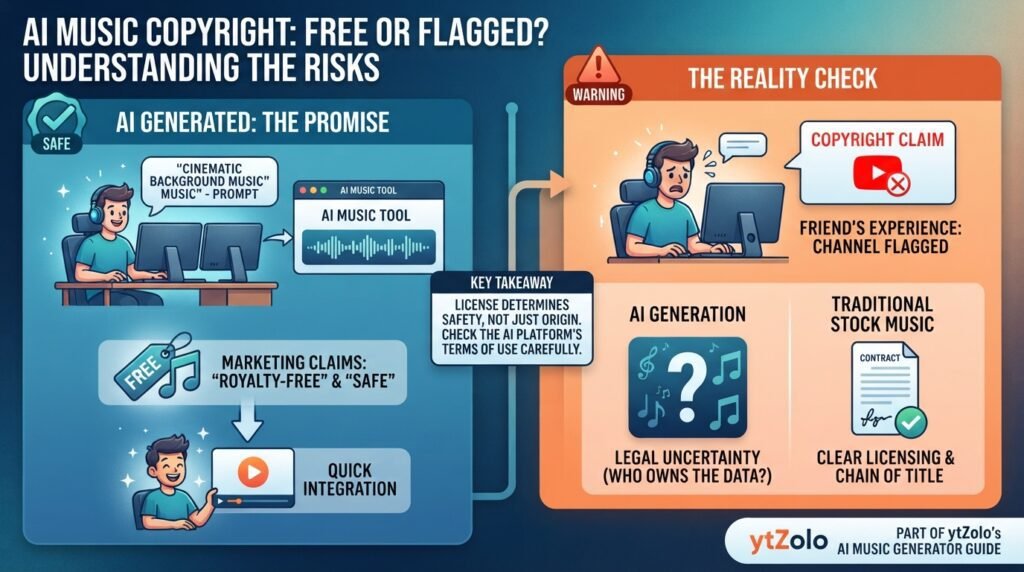
You typed “cinematic background music” into an AI tool, got a track in ten seconds, and dropped it into your video. It felt free. It felt safe. Then a friend mentioned their channel got a copyright claim on an “AI-generated” track, and now you’re not so sure.
That confusion is common, and it’s reasonable. The phrase AI music copyright free gets thrown around by tool marketing pages, but it’s rarely explained with any real nuance.
This guide answers the question directly: is AI-generated music copyright free, and what actually determines whether a track is safe to publish, monetize, and keep using long-term.
We’ll also cover how licensing works, what triggers a YouTube claim, and how this compares to traditional stock libraries — the same conversation started in ytZolo’s broader AI music generator guide.
What “Copyright Free” Actually Means
“Copyright free” sounds absolute, but it’s a loose, informal phrase — not a legal category with one fixed definition.
In the strictest sense, something is copyright free when no one holds exclusive rights over it. Works in the public domain fit this description, since their copyright has expired or was never claimed.
Most AI-generated tracks don’t fall into that category. They’re usually covered by a license — a set of permissions granted by the platform that made them, not a total absence of rights.
That distinction matters more than it sounds. A license can be broad and generous, or narrow and restrictive, and the word “free” doesn’t tell you which one you’re getting.
Is AI-Generated Music Copyright Free? The Short Answer
No, not automatically. Whether AI-generated music is copyright free depends entirely on the platform’s terms of service and which plan you’re using.
Some AI music tools grant a broad commercial license the moment you generate a track, even on a free tier. Others restrict commercial use to paid plans only.
A track can also be copyright-free in the sense that no third-party rights holder can claim it, while still requiring you to hold an active subscription to keep using it legally.
So when someone asks “is AI music copyright free,” the honest answer is: it depends on the tool, the license tier, and how carefully you read the fine print before publishing.
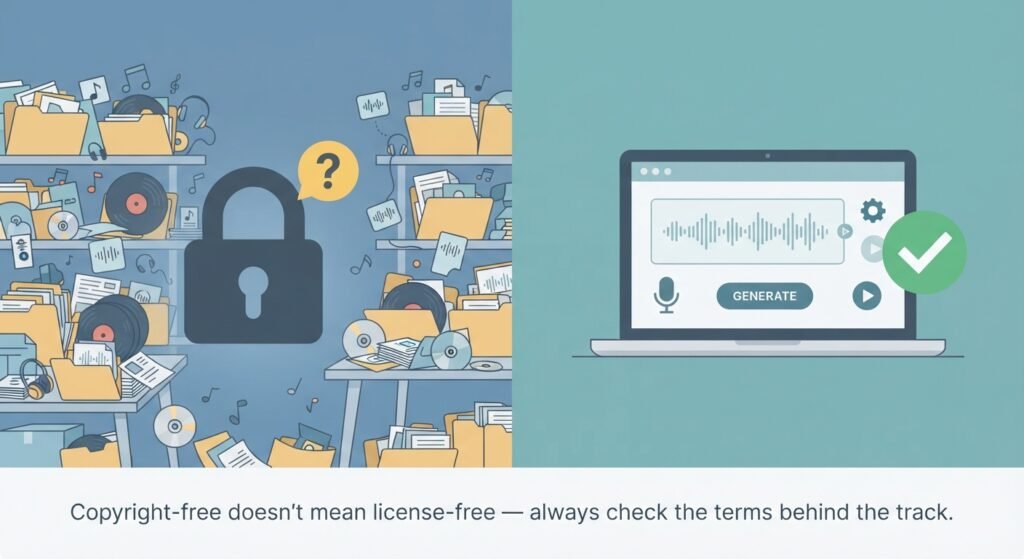
![Split illustration: a stock music library with a padlock icon on one side, and an AI music generator interface with a checkmark icon on the other side, labeled clearly to compare licensing clarity]
Understanding Licensing: The Terms Every Creator Confuses
This is where most creators get tripped up, so it’s worth slowing down. A few terms get used interchangeably even though they mean different things.
Copyright-free means no individual or company is actively asserting ownership over the piece. It doesn’t guarantee you have permission to use it commercially.
Royalty-free means you pay once (or nothing) and don’t owe ongoing per-use fees. It says nothing about who owns the underlying composition.
Public domain means the copyright has expired, was forfeited, or never existed. True public domain music is genuinely free of any owner’s claim.
Creative Commons licenses sit in between — some allow commercial use, some don’t, and some require attribution. The Creative Commons organization publishes clear explanations of each license type if you want the full breakdown.
When it comes to ai music copyright free claims specifically, most platforms are really describing a license grant, not a legal absence of copyright. Read that grant before you rely on it.
The safest habit is simple: treat every AI music tool’s terms of service page as required reading, not boilerplate to skip past.
Who Owns AI-Generated Music?
Ownership of AI-generated music is still an evolving legal question, and the answer varies by country and by platform.
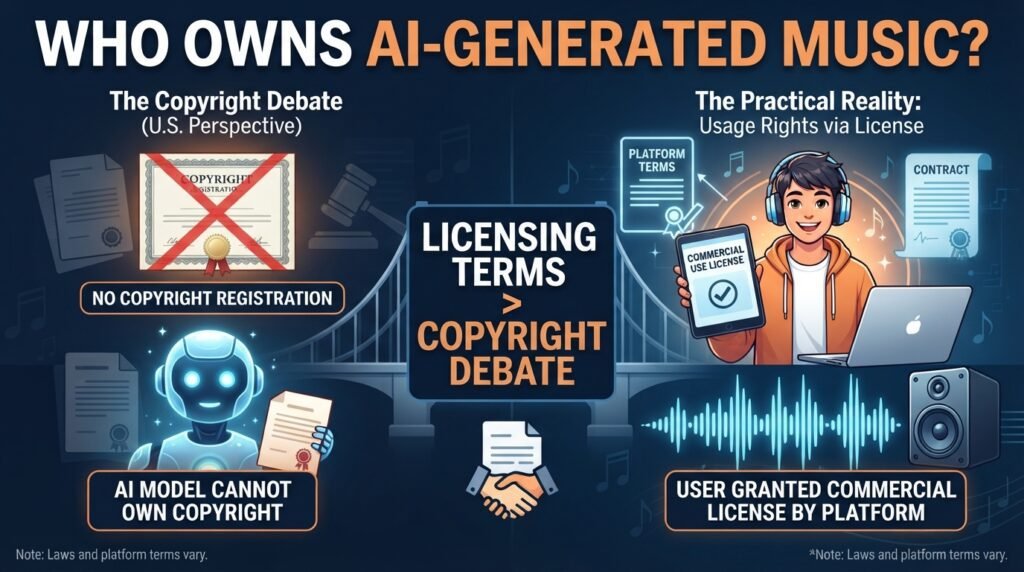
In the United States, the U.S. Copyright Office has stated that works produced without meaningful human creative input generally can’t hold copyright registration on their own.
In practice, this means the AI model itself doesn’t own the track — but the platform’s terms often assign usage rights to you, the person who generated it, through contract rather than pure copyright law.
That’s an important nuance. You may not “own” an AI track in the traditional copyright sense, but your license can still give you full permission to use it commercially.
This is exactly why licensing terms matter more than ownership debates for most creators. You need permission to use the track, not necessarily a copyright certificate for it.
How AI Music Platforms License Their Output
Different AI music tools structure their licenses differently, and reading three or four of them side by side makes the pattern clear.
Some platforms grant a commercial license automatically on every generated track, regardless of subscription tier, as long as you’re not reselling the raw audio itself.
Others gate commercial use behind a paid plan, meaning free-tier tracks are fine for personal projects but not for monetized YouTube content.
A smaller group requires attribution — crediting the platform or tool in your video description — even on paid plans, which many creators miss.
Tools built specifically for creators, discussed in ytZolo’s AI music generator vs traditional libraries comparison, tend to lean toward content-safe, commercially cleared output by default, since that’s what their audience actually needs.
The takeaway: never assume. Two tools that both say “royalty-free” can have meaningfully different rules about monetized use, resale, or license survival after cancellation.
Can You Monetize a Video That Uses AI Music?
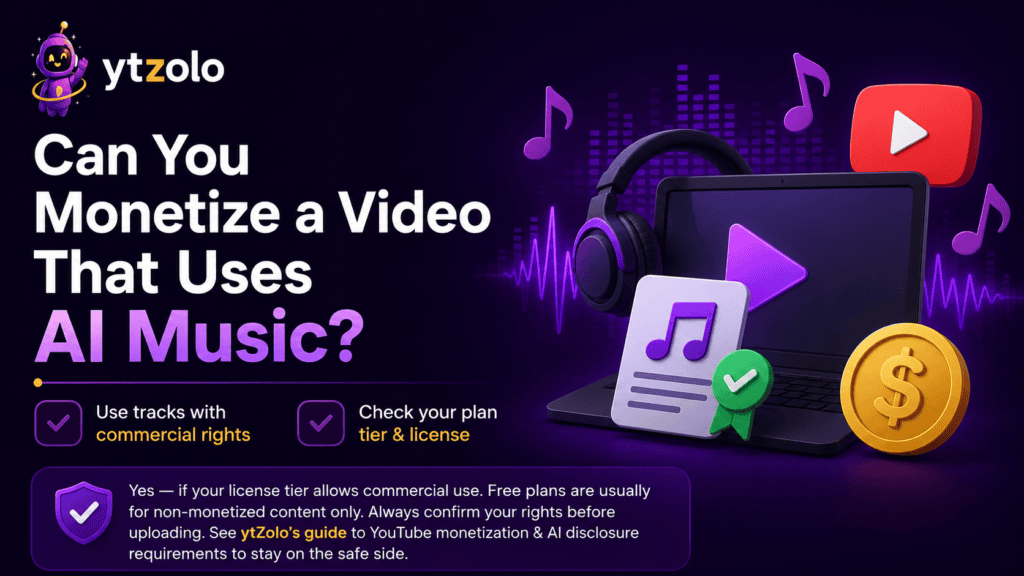
In most cases, yes — if you’re using a track under a license tier that explicitly permits commercial use.
Free tiers are the most common exception. Many platforms allow free-tier tracks for non-monetized content only, and reserve commercial rights for paying subscribers.
This connects directly to YouTube’s own monetization rules, which focus less on how a track was made and more on whether you have the right to use it — a distinction covered in more depth in ytZolo’s guide to YouTube monetization and AI disclosure requirements.
Before you monetize, confirm two things: your plan tier supports commercial use, and the specific track wasn’t generated under a trial or demo mode with different rules.
Will AI Music Trigger a YouTube Copyright Claim?
Properly licensed AI-generated music is built to avoid Content ID matches, since it isn’t registered to a third-party rights holder the way a commercial song is.
That said, “AI-generated” isn’t automatically “claim-proof.” Some AI vocal tools produce output that closely mimics existing artists or songs, which can raise separate legal risk beyond Content ID.
YouTube’s own Content ID system scans uploaded audio against a database of registered works. Original instrumental AI tracks typically aren’t in that database, which is why claims are rare — not impossible.
If a claim does land on a video using AI music, the fastest fix is checking your license proof (a screenshot or download record from the platform) and disputing through YouTube’s standard process.
AI Music vs Traditional Stock Music: A Licensing Comparison
| Factor | AI-Generated Music | Traditional Stock Music |
|---|---|---|
| Copyright ownership | Usually licensed, not “free” of copyright | Held by the original composer or library |
| Content ID risk | Low, if properly licensed | Low to moderate, depends on the library |
| Commercial use | Often tier-dependent | Usually tied to active subscription |
| Uniqueness | High — generated per prompt | Low — same track reused by many creators |
| License clarity | Varies significantly by platform | Generally standardized within one library |
This table makes one thing clear: “AI-generated” and “copyright free” aren’t the same claim, and neither format eliminates the need to check licensing terms.
For a deeper side-by-side, ytZolo’s AI music generator guide covers how AI tools stack up against libraries like Epidemic Sound and Artlist on cost, search time, and consistency.
The Legal Gray Area: Training Data and Ongoing Lawsuits
Part of why ai music copyright free claims feel murky is that the underlying legal landscape is still moving.
Tools like Suno and Udio, which generate full songs with vocals, have faced public lawsuits from major record labels over how their models were trained.
Those cases center on training data, not on whether a generated output itself infringes — but the outcomes could eventually reshape how platforms describe their licenses.
Instrumental, background-focused tools generally carry lower legal exposure than full-song vocal generators, simply because they’re not reproducing recognizable lyrics or vocal styles tied to a specific artist.
None of this means AI music is unsafe to use. It means the safest approach is choosing platforms with clear, written commercial terms rather than assuming “AI-made” equals “legally clean.”
![Timeline graphic showing three stages: prompt entry, AI music generation, and license confirmation before publishing to YouTube]
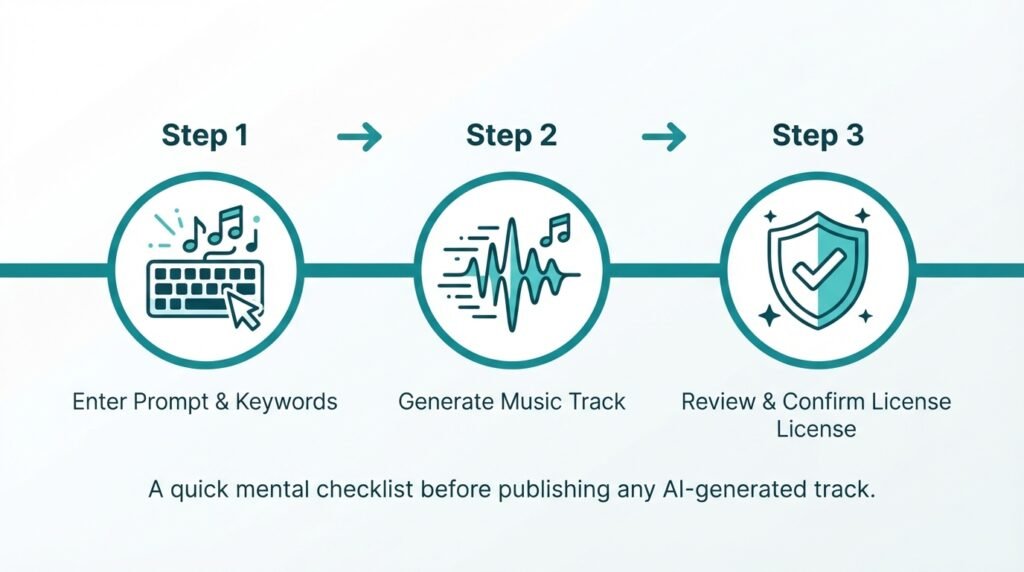
A Simple Checklist Before You Publish
Run through this short list before uploading a video that uses AI-generated background music.
- Confirm your subscription tier includes commercial use rights.
- Save a screenshot or record of the track’s generation date and license terms.
- Check whether the platform requires attribution in your description.
- Avoid full-song AI generators with vocals for monetized content unless the license is explicit.
- Re-check terms periodically — platforms update licensing language more often than creators expect.
This takes a few minutes per video, which is far less time than resolving a Content ID dispute after the fact.
Where ytZolo Fits Into This
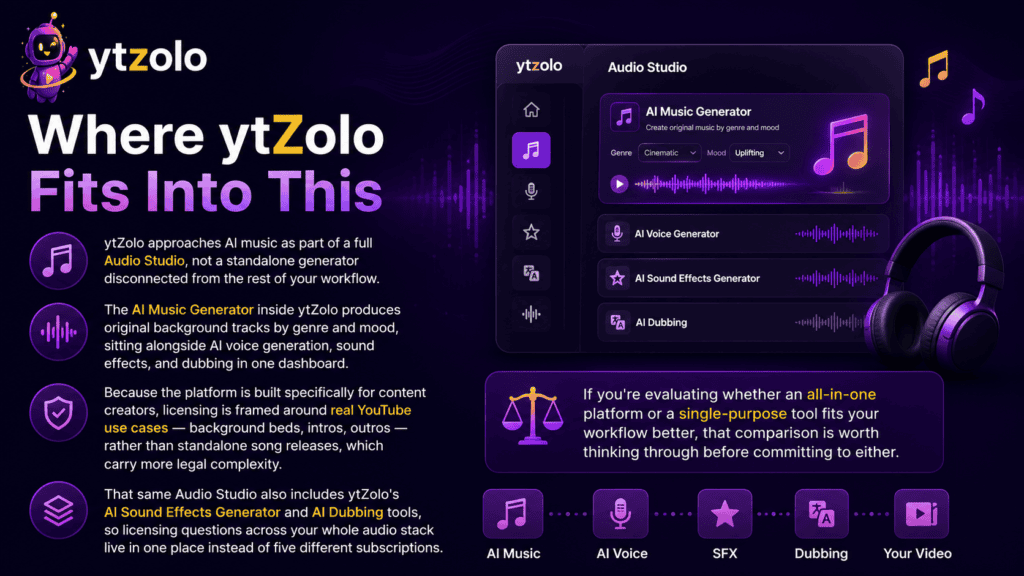
ytZolo approaches AI music as part of a full Audio Studio, not a standalone generator disconnected from the rest of your workflow.
The AI Music Generator inside ytZolo produces original background tracks by genre and mood, sitting alongside AI voice generation, sound effects, and dubbing in one dashboard.
Because the platform is built specifically for content creators, licensing is framed around real YouTube use cases — background beds, intros, outros — rather than standalone song releases, which carry more legal complexity.
That same Audio Studio also includes ytZolo’s AI Sound Effects Generator and AI Dubbing tools, so licensing questions across your whole audio stack live in one place instead of five different subscriptions.
If you’re evaluating whether an all-in-one platform or a single-purpose tool fits your workflow better, that comparison is worth thinking through before committing to either.
Common Mistakes Creators Make
Assuming “AI-generated” means “legally clear.” The generation method doesn’t override the platform’s license terms.
Using free-tier tracks on monetized videos. This is the single most common mistake, and it’s an easy one to avoid by checking your plan first.
Not saving proof of license. If a claim ever comes in, having a record of when and under what terms you generated the track speeds up resolution significantly.
Treating full-song AI generators like background music tools. Vocal-heavy AI songs carry different legal exposure than instrumental beds.
Skipping the terms of service entirely. It’s not exciting reading, but it’s the one document that actually answers “is this AI music copyright free for my use case.”
Frequently Asked Questions
Is AI-generated music copyright free? Not automatically. Most AI music is covered by a license from the platform, not a total absence of copyright, so the terms of that license determine what you can legally do with it.
Can I use AI music on monetized YouTube videos? Usually yes, if your plan includes commercial use rights. Free tiers often restrict monetized use, so confirm your tier before publishing.
Does AI music trigger Content ID claims? Properly licensed, original AI tracks rarely trigger claims since they aren’t registered to a third-party rights holder, though it’s not an absolute guarantee.
What’s the difference between copyright-free and royalty-free AI music? Copyright-free means no one is asserting ownership; royalty-free means you don’t pay per use after licensing. They aren’t always the same thing.
Who legally owns a track I generate with AI? Ownership varies by jurisdiction and platform. In the U.S., fully AI-generated output generally can’t be copyrighted on its own, but your license still grants usage rights.
Is it safe to use AI music across multiple YouTube channels? Check your specific plan — some licenses limit reuse across multiple channels or commercial clients.
Do I need to credit the AI music tool in my video description? Some platforms require attribution even on paid plans, so this is worth confirming in the terms of service directly.
What happens if I cancel my subscription — can I keep using tracks I already made? This varies by platform and should be confirmed before you rely on it for already-published content.
Is instrumental AI music safer than vocal AI music, legally? Generally yes, since vocal-heavy tools face more legal scrutiny around mimicking real artists and lyrics.
How can I verify an AI music platform’s licensing terms? Read the terms of service page directly, focusing on the sections covering commercial use, attribution, and what happens after cancellation.
Final Thoughts
The honest answer to “is AI-generated music copyright free” is that it depends — on the platform, the plan, and how carefully you read the license before you hit publish.
Treating AI music copyright free claims as a starting point for research, rather than a guarantee, is the habit that actually protects your channel long-term.
The good news is that this research takes minutes, not hours, once you know which three or four questions to ask a platform’s terms of service page.
Whatever tool you choose, pair licensing awareness with a workflow that keeps your scripting, voice, music, and SEO connected — which is the broader approach covered in ytZolo’s AI music generator guide.
Author
Anshika Verma Email: anshika@ytzolo.com
Anshika researches AI creator tools, YouTube licensing questions, and content automation hands-on, testing platforms across scripting, SEO, thumbnails, and audio production before writing about them. Her recommendations are based on direct use of these tools and a close reading of their published terms, rather than promotional claims.

