
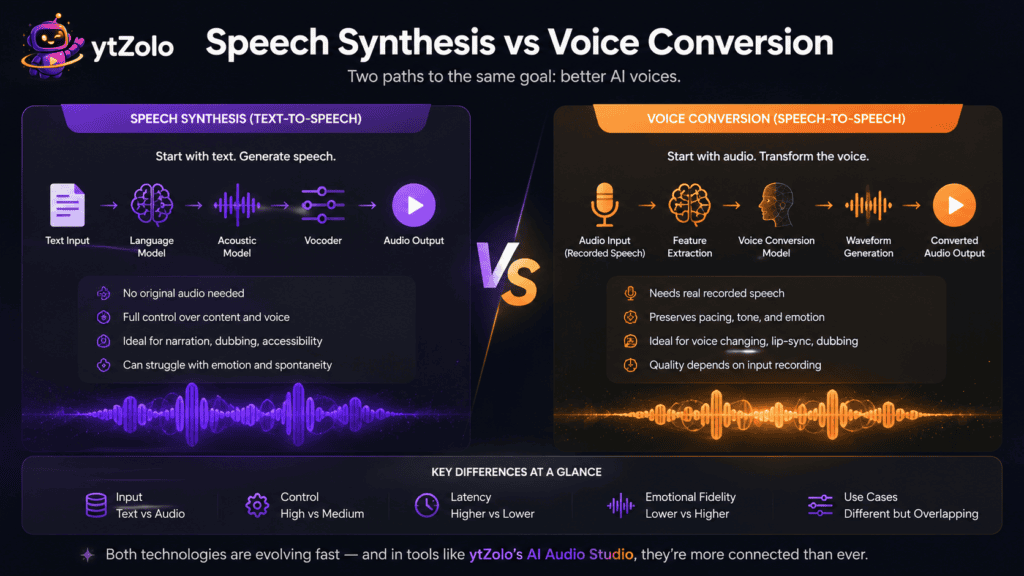
Quick Summary: Speech synthesis vs voice conversion comes down to one question — does the audio start as text, or as a recording? Speech synthesis (text-to-speech) builds a voice from written words with no original performance involved. Voice conversion starts with a real recording and changes how it sounds, keeping the original pacing and emotion intact. This guide breaks down both pipelines stage by stage, compares them on data, latency, and control, and shows where the two technologies increasingly overlap inside tools like ytZolo’s AI Audio Studio.
Type a script and a voice reads it back. Record yourself and get a different voice back instead. Both feel like magic from the outside, and both get lumped under “AI voice tech” in casual conversation.
But speech synthesis vs voice conversion isn’t just a naming difference. The two technologies solve different problems, use different model architectures, and fail in different ways when they go wrong.
This article is the deep, architecture-level comparison — not a repeat of our lighter AI voice changer guide, which introduces the topic in a single section. Here, we go stage by stage through both pipelines, compare them on real technical criteria, and help you decide which one actually fits your project.
Table of Contents
The Core Distinction, in One Sentence
If there’s no original recording, it’s speech synthesis. If there’s a real recording being transformed, it’s voice conversion.
That single line resolves most confusion. Everything else — the models, the data requirements, the use cases — flows from that starting condition.
Speech synthesis, also called text-to-speech (TTS), builds an entire voice performance from scratch, using only written words as input. Voice conversion takes a performance that already happened and changes its vocal identity while leaving the timing and emotion alone.
How Speech Synthesis Actually Works
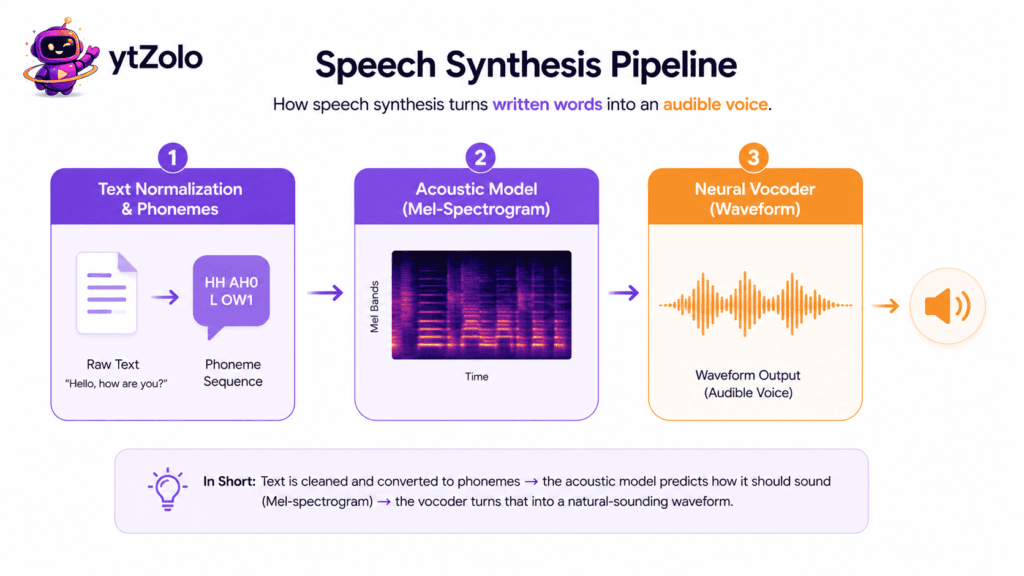
A modern speech synthesis system is a cascade of three stages, each solving a narrower problem than the last.
Stage 1: Text Analysis and Normalization
Raw text is messy for a machine to read aloud. Numbers, abbreviations, dates, and symbols all need to be expanded into the words a speaker would actually say.
This stage also converts words into phonemes, the individual sound units that make up speech, using a process called grapheme-to-phoneme conversion. Errors introduced here — a mispronounced name, a misread abbreviation — carry through every later stage of synthesis.
Stage 2: Acoustic Modeling
This is where the system decides what the speech should sound like. An acoustic model predicts a spectral representation, usually a mel-spectrogram, from the phoneme sequence produced in stage one.
Early neural systems like Tacotron used an attention-based, sequence-to-sequence design that generated audio one step at a time. Newer non-autoregressive models like FastSpeech predict duration, pitch, and energy directly, which allows much faster, parallel generation without sacrificing much quality.
The acoustic model is also where prosody gets decided — the rhythm, stress, and pitch contour that make a sentence sound like a question, a statement, or an excited exclamation.
Stage 3: Vocoding
A vocoder converts the predicted spectral features into an actual playable waveform. This step determines most of what listeners perceive as “naturalness.”
Older vocoders produced the buzzy, mechanical texture people associate with classic robotic TTS. Neural vocoders such as WaveNet, HiFi-GAN, and diffusion-based models changed that by learning to generate raw audio samples that closely match real human speech texture, including breath noise and micro-variations in pitch.
Some newer systems collapse all three stages into a single end-to-end model, going directly from text to waveform. This simplifies training but generally needs far more data to reach the same quality as a well-tuned three-stage pipeline.
How Voice Conversion Actually Works
Voice conversion follows a different three-stage pattern: analysis, mapping, and reconstruction. We cover this pipeline in full depth, including parallel versus non-parallel training and the model families behind it, in our dedicated Voice Conversion Explained guide.
The short version: the system separates a recording into a content layer (the words and timing) and an identity layer (pitch, resonance, vocal-tract characteristics). It then swaps the identity layer for a target speaker’s characteristics while leaving the content layer untouched, and a vocoder reconstructs the final waveform.
The key structural difference from synthesis: voice conversion never predicts what is said. It only ever changes how it sounds, because the “what” already exists in the source recording.
Speech Synthesis vs Voice Conversion: Side-by-Side Comparison
| Factor | Speech Synthesis (TTS) | Voice Conversion |
|---|---|---|
| Input | Written text only | An existing audio recording |
| Output source | Fully generated from scratch | Transformed from real performance |
| Original performance needed? | No | Yes |
| Controls timing and emotion | The model decides, or SSML tags guide it | The original speaker already set it |
| Typical models | Tacotron, FastSpeech, VITS + neural vocoder | Autoencoder, GAN, diffusion, seq2seq |
| Minimum training data per voice | Hours of clean, transcribed audio (or a short sample for cloned voices) | Seconds to minutes for embedding-based systems |
| Best for | Narration with no prior recording, IVR, audiobooks | Re-voicing an existing take, live streaming, dubbing your own voice |
| Common failure mode | Mispronunciation, flat prosody on unusual text | Robotic artifacts from extreme pitch targets |
| Real-time capable? | Yes, on modern lightweight models | Yes, with latency under roughly 200ms on strong hardware |
This table is the fastest way to settle a speech synthesis vs voice conversion decision for a specific project. If you don’t have a recording to start from, synthesis is the only option. If you already have a great take in the wrong voice, conversion is almost always the better fit.
Where Each Technology Gets Its Voice From
This is the most technically important — and most commonly misunderstood — part of the speech synthesis vs voice conversion comparison.
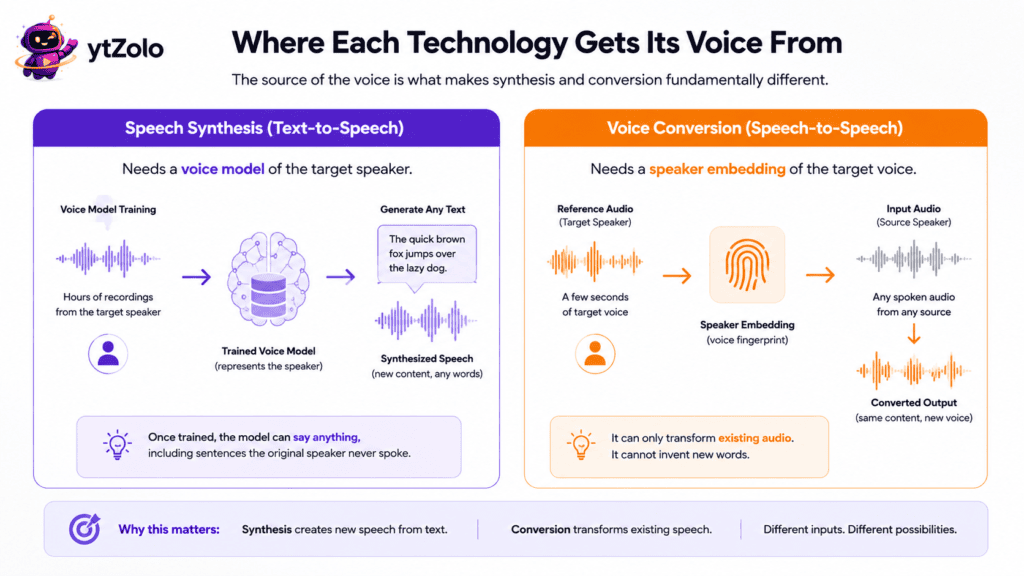
A speech synthesis system needs a voice model: a trained representation of one specific speaker’s vocal characteristics, built ahead of time from hours of that speaker’s recordings, or from a shorter sample in zero-shot cloning setups. Once trained, the system can generate that voice saying anything at all, including sentences the original speaker never spoke.
A voice conversion system needs a speaker embedding, a compact numerical fingerprint of a target voice, often extractable from just a few seconds of reference audio. But it can only apply that identity to audio that was already spoken by someone else. It cannot invent new words.
That distinction explains a lot of confusing marketing language. A platform advertising “clone your voice and generate anything” is almost certainly doing synthesis with a cloned voice model, not conversion. A platform advertising “sound like someone else on your live stream” is doing conversion.
How Each Technology Is Measured
Researchers and product teams don’t just listen and guess. Both technologies get scored on a mix of subjective and objective metrics.
Naturalness (Mean Opinion Score, or MOS) asks human listeners to rate how human the output sounds, independent of whose voice it is. This metric applies to both synthesis and conversion.
Intelligibility, usually measured through Word Error Rate on a speech-recognition pass of the output, matters far more for synthesis. A conversion system rarely changes the words, so intelligibility issues are less common, unless the mapping stage introduces artifacts.
Speaker similarity measures how close the output voice is to the intended target identity. This metric is central to voice conversion evaluation and to voice-cloning quality checks in synthesis.
Latency only matters when a system runs in real time — live streaming, voice chat, or interactive assistants. Full pipeline latency, from input to audible output, generally needs to stay under roughly 200 to 300 milliseconds to feel natural in a live conversation.
The Hybrid Zone: Where Synthesis and Conversion Overlap
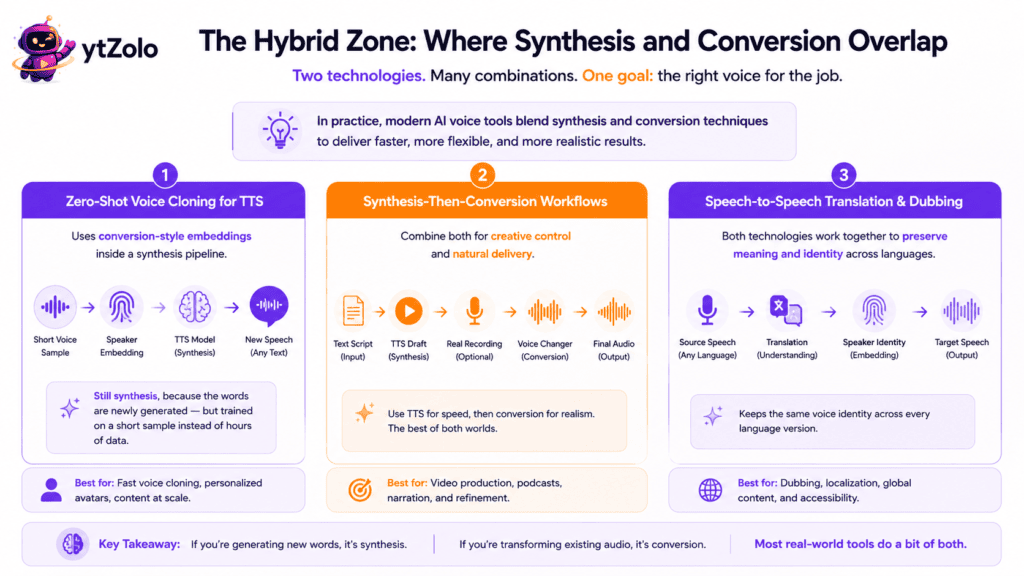
The cleanest way to explain speech synthesis vs voice conversion is as two separate categories. In practice, modern products blur that line constantly.
Zero-shot voice cloning for TTS borrows conversion’s speaker-embedding approach and plugs it into a synthesis pipeline. Instead of training a dedicated voice model from hours of data, the system extracts an embedding from a short sample and conditions the acoustic model on it.
Technically, this is still synthesis, since there’s no original recording of the actual sentence being generated, but it uses conversion-style speaker representation to get there faster.
Synthesis-then-conversion workflows are common in production. A creator might generate a rough draft with text-to-speech to lock in pacing, then record a real read-through and run it through a voice changer for a more natural final pass, blending both technologies into one deliverable.
Speech-to-speech translation and dubbing often layer both technologies together: synthesis or conversion produces the target-language audio, and a consistent speaker identity is preserved across every language version through the same embedding.
Understanding this overlap matters because it explains why so many tools advertise themselves loosely as “AI voice” platforms without specifying which underlying process is doing the work. Knowing the distinction lets you ask the right question before you buy: am I generating a voice, or transforming one?
Choosing Between Speech Synthesis and Voice Conversion
Run through these questions before picking a technology for your project.
Do you already have a recording? If yes, and you like the performance but not the voice, conversion is the faster and usually higher-quality path. If no, synthesis is your only option.
Does the script change often? Frequently updated scripts, like training modules or ad variants, favor synthesis, since regenerating from new text is faster than re-recording a source performance for conversion.
Do you need exact pacing control over an existing performance? A voice actor’s specific comedic timing, or a genuine emotional read, is much easier to preserve through conversion than to reproduce through synthesis controls.
Is this for live use? Both technologies support real-time modes, but conversion is more common for live streaming specifically because it’s built to run continuously on a live audio input.
How many voices do you need, and how fast? Synthesis scales cleanly across unlimited text with one trained or cloned voice. Conversion scales across unlimited source recordings with one target identity.
For a full walkthrough of picking a tool once you’ve settled on conversion, our guide on the best AI voice changers in 2026 covers the evaluation criteria that matter most.
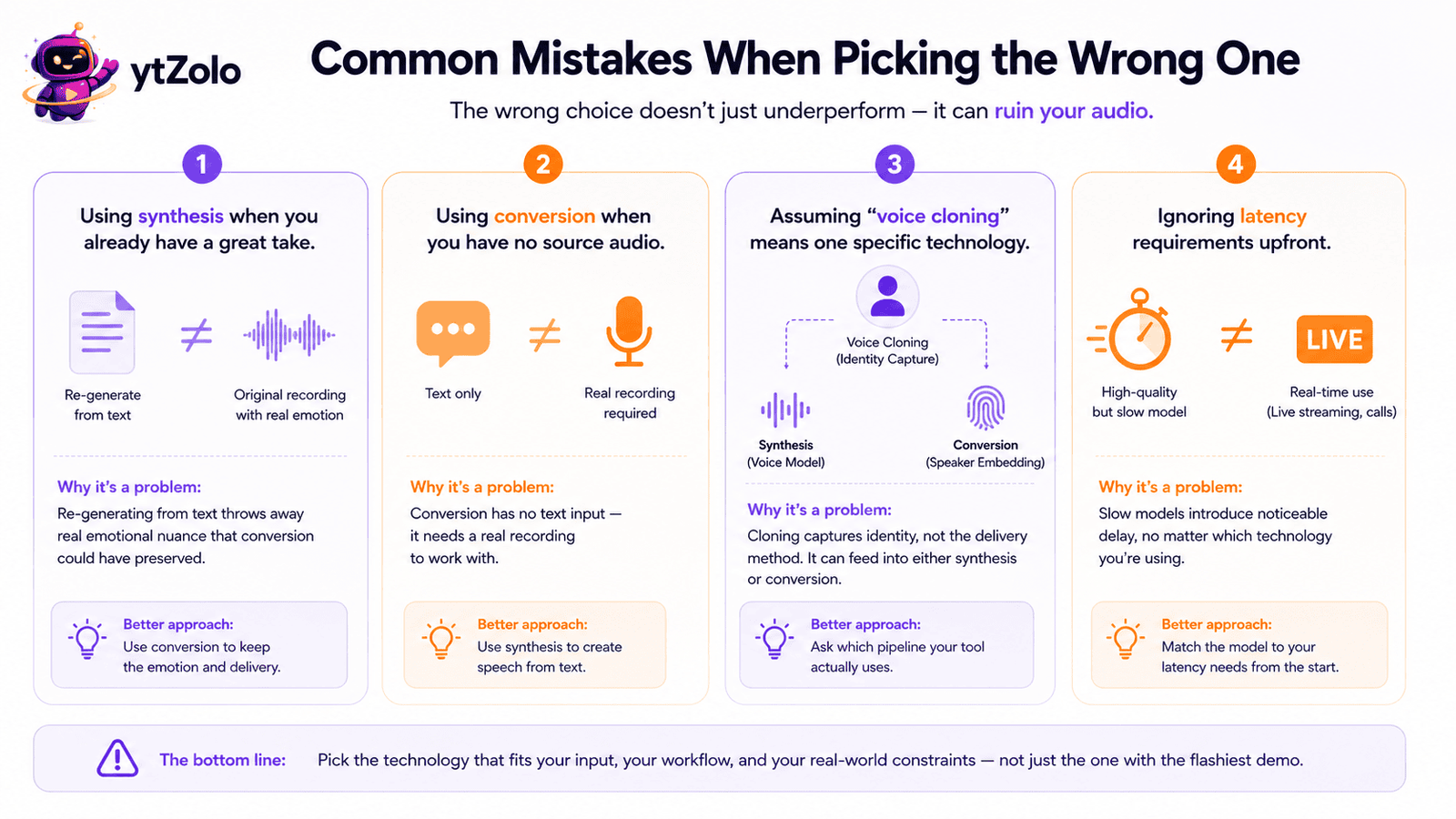
Common Mistakes When Picking the Wrong One
Using synthesis when you already have a great take. Re-generating from text throws away real emotional nuance that conversion could have preserved from the original recording.
Using conversion when you have no source audio. Some creators try to skip recording entirely and expect a voice changer to invent speech. Conversion has no text input — it needs a real recording to work with.
Assuming “voice cloning” means one specific technology. Cloning describes the identity-capture step, not the delivery method. It can feed into either a synthesis voice model or a conversion speaker embedding, so the term alone doesn’t tell you which pipeline you’re using.
Ignoring latency requirements upfront. Picking a high-quality but slow diffusion-based model for a live-streaming use case will introduce noticeable delay, regardless of which of the two technologies it belongs to.
Related Topics Worth Knowing
A few closely related concepts round out this comparison without needing their own section here:
- What Is an AI Voice Changer? — the consumer-facing product built on top of voice conversion technology.
- How to Change Your Voice with AI — a step-by-step walkthrough for anyone applying conversion for the first time.
- Best AI Voice Changers in 2026 — a practical buyer’s checklist for comparing conversion-based tools on quality, latency, and workflow fit.
- Real-Time AI Voice Changer — how live conversion handles the latency constraints described above.
- AI Voice Generator — the product category built on speech synthesis rather than conversion.
- Why Does My AI Voice Sound Robotic? — a troubleshooting guide for the naturalness failures both technologies can produce.
- AI Voice Changer for Businesses — how companies apply conversion for training, localization, and support use cases.
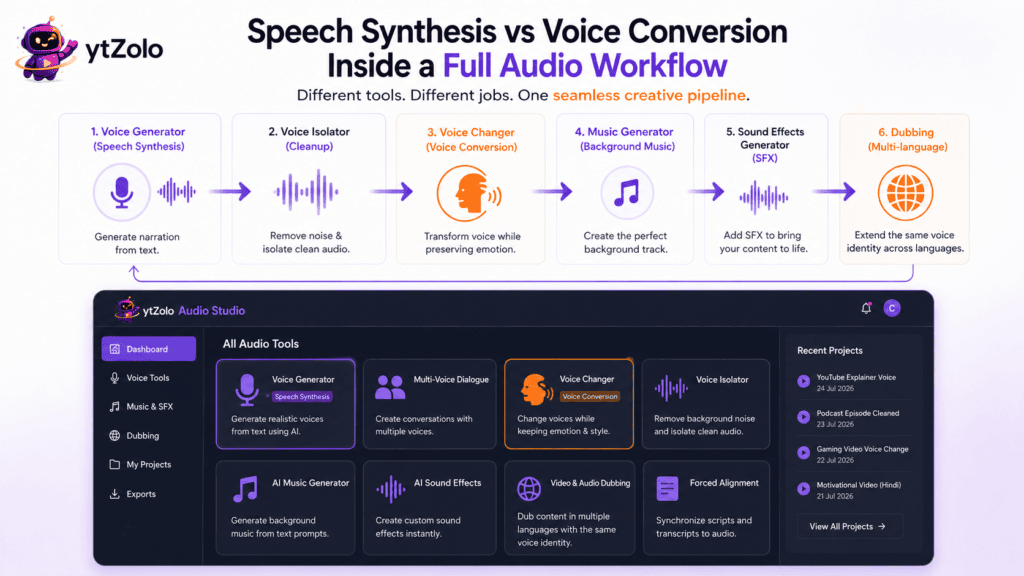
Speech Synthesis vs Voice Conversion Inside a Full Audio Workflow
In production, these technologies rarely stand alone.
Inside ytZolo’s AI Audio Studio, a creator might generate narration with the voice generator, clean up a separately recorded track with the AI voice isolator, then apply the voice changer to that cleaned recording for a consistent channel identity. An AI music generator and AI sound effects generator round out the final mix, and dubbing extends the same voice identity across languages.
Understanding speech synthesis vs voice conversion at this level isn’t just academic — it’s what lets a content team pick the right tool for each part of that pipeline instead of forcing one technology to do a job it wasn’t built for.
Screenshot recommendation: Capture ytZolo’s Audio Studio dashboard showing the voice generator and voice changer as separate tool tiles, to visually reinforce that they are distinct technologies inside one workflow.
Frequently Asked Questions
Is speech synthesis the same as text-to-speech? Yes. Speech synthesis and text-to-speech (TTS) refer to the same technology — generating spoken audio from written text with no original recording involved.
Is voice conversion the same as a voice changer? Essentially yes. A voice changer is the consumer-facing product; voice conversion is the underlying technique it runs on.
Can voice conversion generate new sentences that were never recorded? No. Conversion only transforms audio that already exists. Generating new sentences from text is synthesis, not conversion.
Which one sounds more natural, speech synthesis or voice conversion? Both can sound highly natural on modern neural models. Synthesis quality depends heavily on the acoustic model and vocoder; conversion quality depends heavily on source audio cleanliness and how close the target voice is to the original.
Do speech synthesis and voice conversion use the same AI models? They share some underlying building blocks, like neural vocoders and speaker embeddings, but the acoustic modeling stage differs significantly, since synthesis predicts sound from text while conversion transforms sound that already exists.
Which technology is better for dubbing? Both appear in dubbing workflows. Synthesis generates the translated line from a script; conversion can preserve a specific speaker’s identity across every language version.
Can I combine speech synthesis and voice conversion in one project? Yes, and many production workflows do exactly that — synthesizing a first draft for timing, then converting a real read-through for the final, more natural pass.
Why does synthesized speech sometimes mispronounce words, while converted speech doesn’t? Synthesis has to predict pronunciation from text, which can fail on unusual names or abbreviations. Conversion starts from audio where the words were already spoken correctly, so pronunciation errors are far less common.
Final Thoughts
Speech synthesis vs voice conversion ultimately comes down to where the performance originates. Synthesis builds a voice from nothing but text, running it through text analysis, acoustic modeling, and vocoding. Voice conversion starts with a real recording and swaps the identity layer while preserving the original timing and emotion.
Both technologies rely on increasingly similar deep learning building blocks, and the line between them keeps blurring through zero-shot voice cloning and hybrid production workflows. But the underlying question never changes: is there an original recording, or isn’t there?
Once you can answer that for your own project, choosing between speech synthesis and voice conversion — or using both together — becomes a straightforward decision instead of a confusing one.
Ready to try both inside one workflow? Explore ytZolo’s AI Audio Studio or see pricing plans to get started.
About the Author
Anshika Verma is a content and SEO researcher at ytZolo, specializing in AI audio and video production technology for creators. She writes about voice AI, YouTube growth, and creator tooling, drawing on hands-on testing of voice conversion, dubbing, and text-to-speech systems across the industry.
📧 anshika@ytzolo.com
Sources referenced: Sisman et al., “An Overview of Voice Conversion and its Challenges,” arXiv; VQTTS: High-Fidelity Text-to-Speech Synthesis, arXiv; Components of Text-to-Speech Synthesis Systems; “Overview of Voice Conversion Methods Based on Deep Learning,” Applied Sciences, MDPI (2023).
Note: Feature availability inside ytZolo’s Audio Studio should be verified directly on ytzolo.com before publishing, as tools and plans update over time.

