
July 24, 2026 · 13 min read
Quick Summary: An AI voice changer for business converts recorded or live speech into a different voice while keeping the original words, timing, and emotion intact. Companies use it to standardize training narration, protect agent identity in support calls, localize marketing at scale, and cut voiceover costs — without booking a studio for every update. This guide covers real use cases, how to choose a tool, and how to avoid the robotic-sounding output that undermines brand trust.
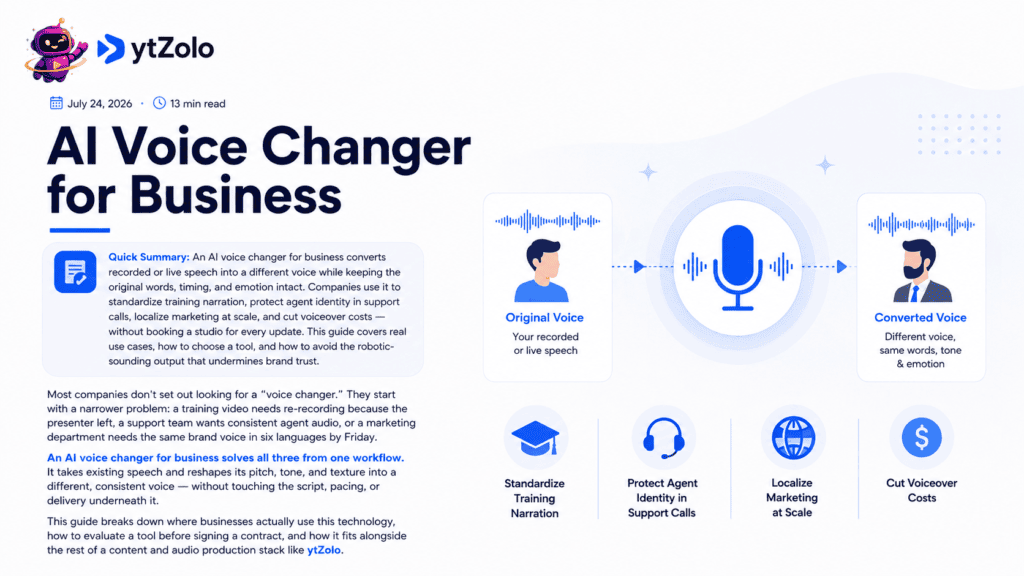
Most companies don’t set out looking for a “voice changer.” They start with a narrower problem: a training video needs re-recording because the presenter left, a support team wants consistent agent audio, or a marketing department needs the same brand voice in six languages by Friday.
An AI voice changer for business solves all three from one workflow. It takes existing speech and reshapes its pitch, tone, and texture into a different, consistent voice — without touching the script, pacing, or delivery underneath it.
This guide breaks down where businesses actually use this technology, how to evaluate a tool before signing a contract, and how it fits alongside the rest of a content and audio production stack like ytZolo.
Table of Contents
What Is an AI Voice Changer for Business?
An AI voice changer for business is the same core technology used by creators, applied to operational, revenue-facing content instead of entertainment.
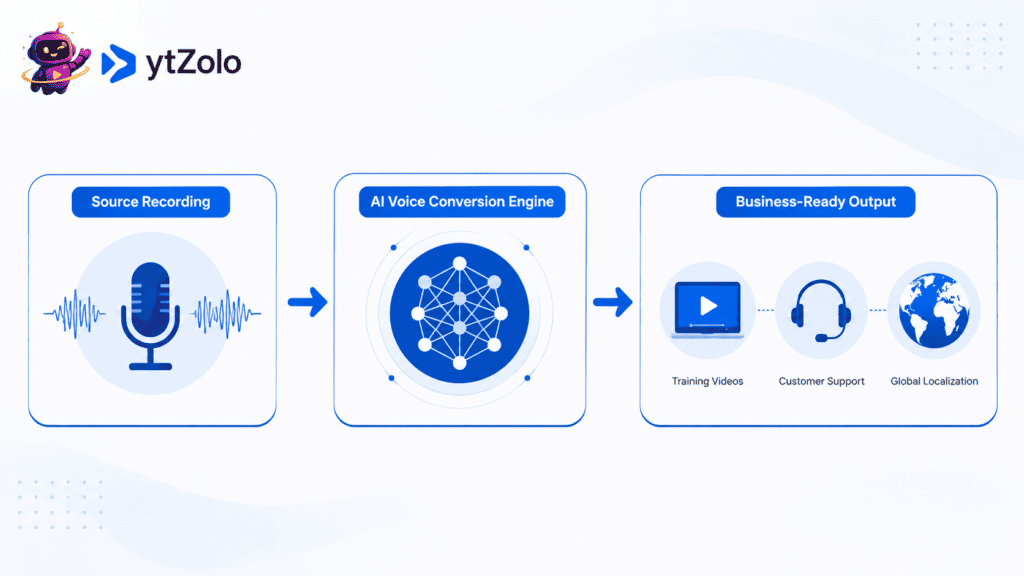
It uses machine learning to separate what was said from how it physically sounded, then remaps the vocal characteristics onto a target voice. The words, pacing, and emotional delivery stay untouched.
For a deeper technical breakdown of that separation process, our guide to what an AI voice changer actually is covers the fundamentals in plain language.
The business version of this tool typically adds things consumer apps skip: bulk file processing, brand-voice locking, team seats, and export formats that plug into existing L&D or marketing systems.
Why Businesses Are Adopting AI Voice Changers in 2026
Voice AI has moved from a novelty to a budget line. Industry research on contact-center technology suggests Gartner expects conversational AI to cut contact center labor costs by roughly $80 billion in 2026, and a large share of companies are folding voice tools into customer service by the same year.
That spending isn’t limited to chatbots and phone agents. It also covers the quieter use case of converting and standardizing recorded voice content across training libraries, support scripts, and marketing assets.
For most teams, the appeal isn’t novelty — it’s three practical wins: lower cost per minute of finished audio, faster turnaround on revisions, and one consistent voice across hundreds of files.
Core Business Use Cases for an AI Voice Changer
The label “voice changer” undersells how broadly this fits into day-to-day operations. Here’s where it actually shows up on a task list.
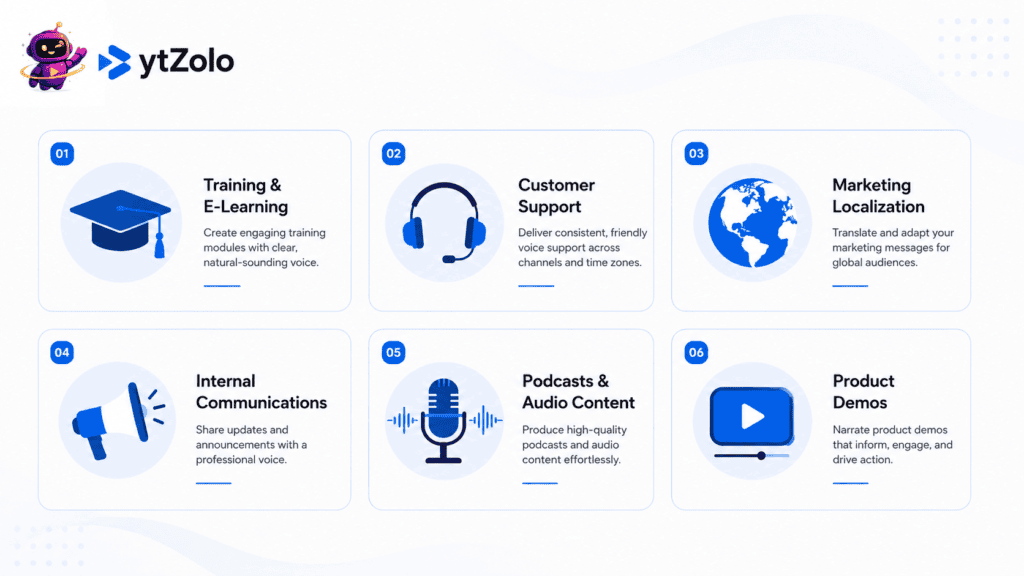
Corporate Training and E-Learning Narration
Training libraries age badly when the original narrator leaves the company or goes on leave.
An AI voice changer for business lets a team re-voice updated modules with the same narrator identity, so the catalog never sounds patched together.
This matters most for compliance training, onboarding, and product certification courses that get revised every quarter but can’t afford a new studio session each time.
Customer Support and IVR Systems
Support teams use voice conversion two ways: protecting agent identity on recorded calls used for training, and standardizing the voice behind IVR and call-routing prompts.
Call resolution accuracy for well-configured voice AI systems now exceeds 92%, and much of that reliability depends on the underlying audio sounding clear and consistent rather than jarring or synthetic.
A converted, brand-consistent voice also means a customer hears the same “company voice” whether they’re on a phone tree in New York or a support video shot in another office.
Marketing, Ads, and Multilingual Brand Voice
A brand’s voice is an asset, but hiring the same voice actor across ten regional markets is slow and expensive.
Pairing an AI voice changer with dubbing lets a company keep one recognizable tone across dozens of markets, instead of a different actor — and a different personality — per language.
Our guide on AI dubbing and localization covers how converted voices carry over into translated video without losing timing sync.
Internal Communications and Executive Updates
Not every executive wants their exact voice attached to every recorded town hall or policy update.
A converted narrator voice keeps internal videos consistent in tone while giving leadership the option to stay off-mic personally when needed.
Podcasts, Webinars, and Audiobook Publishing
Publishers and B2B podcast teams use voice conversion to fix inconsistent studio sessions or standardize a narrator’s tone across an entire audiobook catalog.
This avoids the alternative — flagging every slightly-off recording for a costly re-record with the original voice talent.
Product Demos and Explainer Videos
Product teams often record dozens of short demo clips that get updated every release cycle.
Re-voicing a script update takes minutes with a converted voice, instead of re-booking a presenter for a two-minute clip.
Accessibility and Compliance Recordings
Some regulated industries require narrated disclosures, safety scripts, or accessibility audio that must stay tonally neutral and consistent across every version.
An AI voice changer for business keeps that narration uniform even as scripts are updated for new regulations.
Real-Time vs Post-Production Voice Changing for Business Needs
Businesses generally don’t need live voice conversion the way streamers do — most use cases involve recorded content that gets reviewed before publishing.
Our real-time AI voice changer guide explains the latency tradeoffs for live use, which matter more for support calls than for training videos.
For nearly everything covered above, post-production conversion is the better fit: slower, but noticeably cleaner and more natural-sounding output.
Understanding the mechanics behind that process helps when evaluating vendors — our full voice conversion explainer walks through the analysis, mapping, and reconstruction stages in more depth.
Choosing an AI Voice Changer for Your Business: What to Check
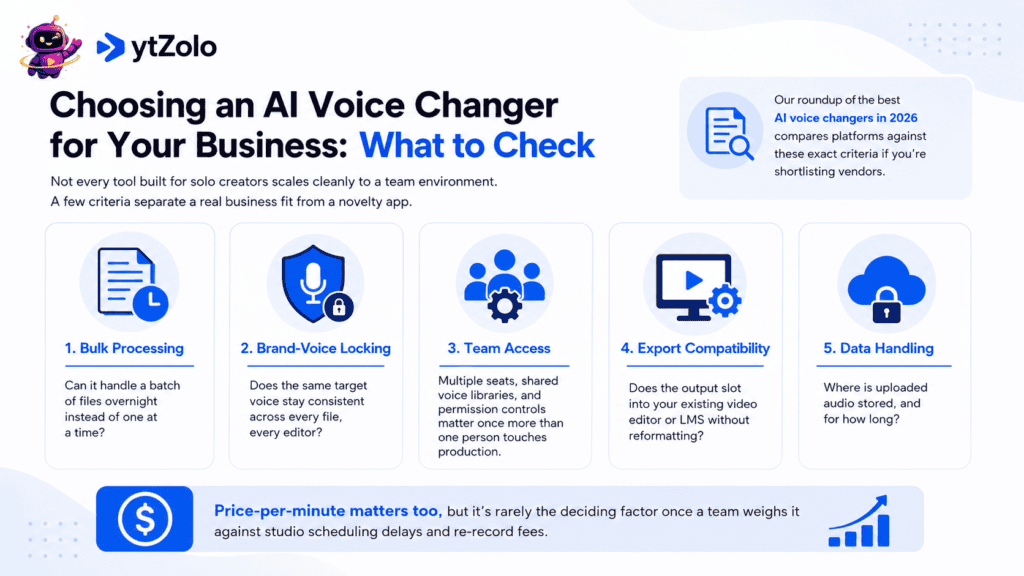
Not every tool built for solo creators scales cleanly to a team environment. A few criteria separate a real business fit from a novelty app.
- Bulk processing. Can it handle a batch of files overnight instead of one at a time?
- Brand-voice locking. Does the same target voice stay consistent across every file, every editor?
- Team access. Multiple seats, shared voice libraries, and permission controls matter once more than one person touches production.
- Export compatibility. Does the output slot into your existing video editor or LMS without reformatting?
- Data handling. Where is uploaded audio stored, and for how long?
Our roundup of the best AI voice changers in 2026 compares platforms against these exact criteria if you’re shortlisting vendors.
Price per minute matters, but it’s rarely the factor that determines long-term value. Most businesses save far more by reducing studio scheduling delays, avoiding repeated voiceover sessions, minimizing re-record costs, and speeding up content updates.
The right AI voice changer delivers consistent, scalable production that outweighs small differences in pricing.
Avoiding the Robotic-Sounding Voice Problem in Business Recordings
Nothing undercuts a training video or ad faster than a voice that sounds obviously synthetic.
This almost always traces back to noisy source audio, over-processed pitch shifting, or an engine that strips out natural rhythm and pausing.
Our full breakdown of why AI voices sound robotic covers the fix in detail, but the short version for business teams: record in a quiet room, and choose a target voice reasonably close to the original speaker’s range.
When AI voices sound robotic, users disengage; when they sound human, trust and conversion both improve — which is exactly why quality control matters more for customer-facing audio than for a quick internal note.
AI Voice Changer vs AI Voice Generator: Which Does a Business Need?
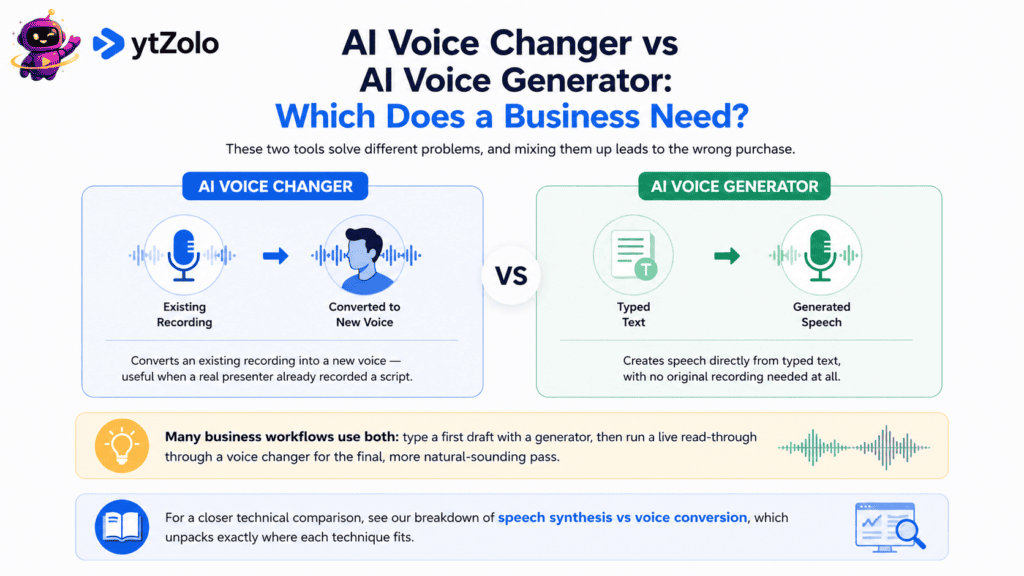
These two tools solve different problems, and mixing them up leads to the wrong purchase.
A voice changer converts an existing recording into a new voice — useful when a real presenter already recorded a script.
A voice generator, like ytZolo’s AI Voice Generator, creates speech directly from typed text, with no original recording needed at all.
Many business workflows use both: type a first draft with a generator, then run a live read-through through a voice changer for the final, more natural-sounding pass.
For a closer technical comparison, see our breakdown of speech synthesis vs voice conversion, which unpacks exactly where each technique fits.
Compliance, Disclosure, and Brand Safety
Using a converted voice isn’t a legal problem by default, but disclosure rules can apply depending on the platform and context.
YouTube’s own policy requires creators to disclose content that has been meaningfully altered or synthetically generated when it could realistically mislead a viewer about who is speaking.
For internal training or a stylized brand character, disclosure usually isn’t necessary. For a cloned executive voice standing in for a real person in public-facing content, it typically is.
Building a simple internal policy — which recordings need a disclosure label, and which don’t — avoids ambiguity before a video ever gets published.
Cost and ROI: Voice Actors vs an AI Voice Changer for Business
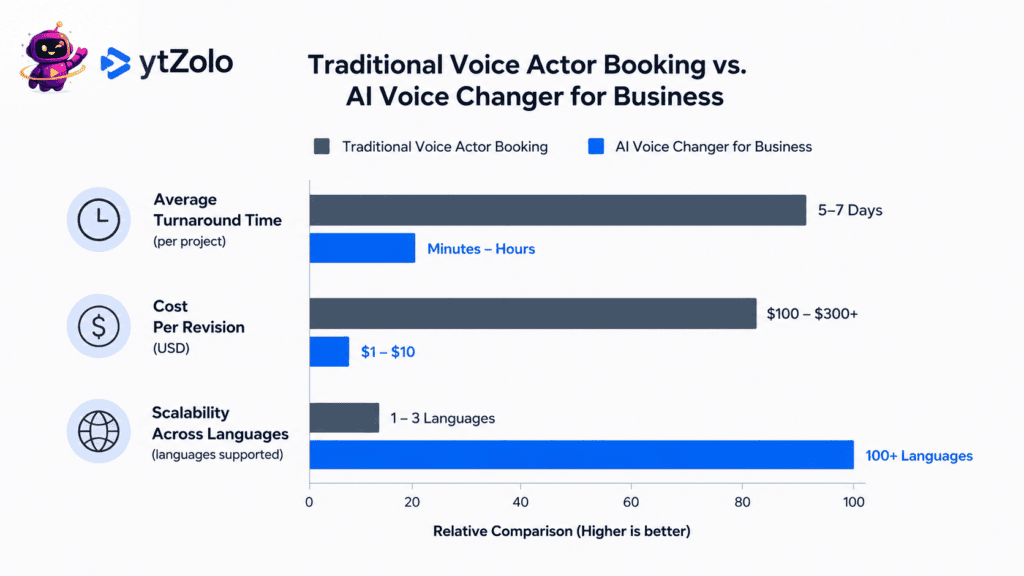
A single professional voice actor session can run several hundred dollars, plus scheduling lead time measured in days, not hours.
Multiply that across quarterly training updates, regional marketing variants, and product demo refreshes, and the studio-booking model gets expensive fast.
Roughly 80% of businesses plan to fold AI-driven voice technology into customer service operations by 2026, largely because the alternative — scaling a human voice team to match content volume — doesn’t hold up financially.
A business that owns its own voice conversion workflow can turn a revision around in hours, run it past internal review, and publish the same day.
How to Get Started with an AI Voice Changer for Business
The workflow is straightforward once a team picks a tool and a target voice.
- Audit existing recordings. Flag which training modules, ads, or support scripts actually need re-voicing.
- Choose or clone a target voice. Pick a preset that matches your brand tone, or clone one from an approved sample.
- Run a small pilot batch. Convert five to ten files before committing to the full catalog.
- Review for consistency. Check pacing, tone, and pronunciation across the batch, not just one clip.
- Document a disclosure policy. Decide upfront which outputs need a synthetic-content label.
- Scale to the full library. Once the pilot passes review, batch-process the remaining files.
Our step-by-step guide on how to change your voice with AI walks through the same process from a single-file, creator-first angle if your team is starting smaller.
How ytZolo Supports Business Voice Workflows
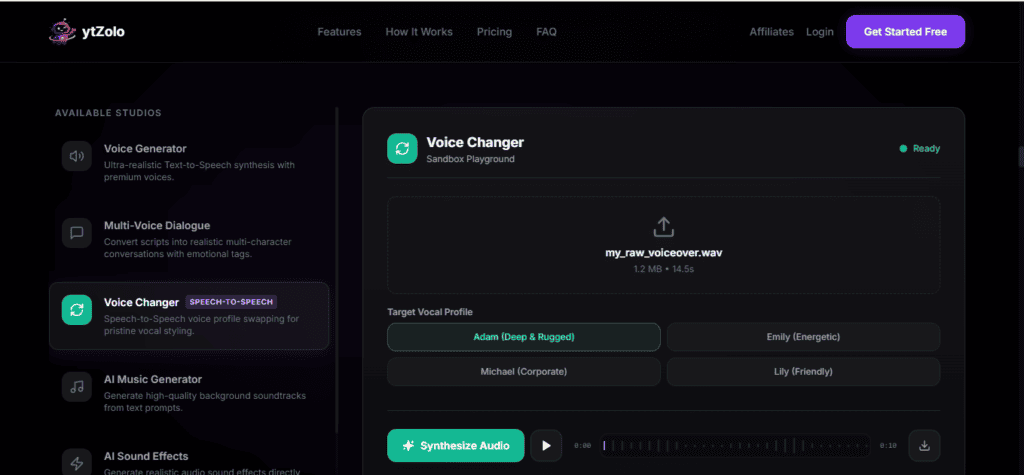
Inside ytZolo, an AI voice changer for business doesn’t sit alone — it connects to the rest of a content pipeline.
Noisy source recordings can run through an AI voice isolator first, since cleaner input consistently produces cleaner converted output.
Once the voice is set, teams can add an AI music generator for background scoring or an AI sound effects generator for polish, without leaving the dashboard.
For multi-market content, the same converted voice feeds directly into AI dubbing to produce localized training or marketing videos without re-recording from scratch in every language.
Teams weighing platforms side by side may find our ytZolo vs VEED comparison useful for understanding how an all-in-one workflow compares to stitching together separate tools.
Frequently Asked Questions
Is an AI voice changer for business different from a consumer voice changer? The underlying technology is similar, but business tools typically add bulk processing, team access, and brand-voice locking that consumer apps skip.
Can small businesses use this, or is it only for large enterprises? Small teams benefit too — a single consistent narrator voice across a growing training library or ad set is often more valuable at small scale than large.
Does converting a voice affect audio quality? Quality depends on the source recording and the engine. Clean input audio and a reasonably matched target voice produce the most natural results.
Do businesses need to disclose AI-altered voices publicly? It depends on the platform and whether the altered voice could realistically mislead a viewer about who is speaking. Internal or clearly fictional content usually doesn’t require it.
How does this differ from an AI voice generator? A voice changer converts an existing recording. A voice generator creates speech from typed text with no original recording at all — some workflows use both.
Can this replace a company’s entire voice-over budget? Not entirely for every use case, but it typically absorbs the recurring, high-volume work — training updates, demo refreshes, localization — that used to consume the largest share of that budget.
Final Thoughts
An AI voice changer for business is no longer just a creative novelty. It’s a practical production tool that helps organizations standardize training narration, protect agent identity, localize marketing content, and update audio without repeatedly hiring voice actors or booking studio sessions.
The biggest gains come from faster turnaround, consistent brand voice, and lower long-term production costs rather than the technology itself.
The most successful teams also avoid treating voice conversion as a standalone feature. Instead, they build it into a complete audio workflow: start with clean recordings, apply AI voice conversion, enhance the output with background music and sound effects, and dub content into multiple languages for global audiences.
Platforms like ytZolo bring these capabilities together in one workflow, making it easier to create professional, scalable audio content while maintaining quality, consistency, and efficiency across every project.
Ready to see it inside a full creator and business audio suite? Explore ytZolo’s AI Audio Studio or check pricing plans to get started.
About the Author
Anshika Verma is a content and SEO researcher at ytZolo, specializing in AI audio and video production technology for creators and businesses. She writes about voice AI, workflow automation, and content tooling, drawing on hands-on testing of voice conversion, dubbing, and text-to-speech systems across the industry.
📧 anshika@ytzolo.com
Sources referenced: YouTube Help Center — Disclosing Altered or Synthetic Content; industry voice-AI adoption data via Ringly.io Voice AI Statistics 2026, AInora Voice AI Market Data 2026, and AssemblyAI: Voice AI in 2026.

