
By Anshika Verma · Content & SEO Researcher, ytZolo · Updated July 2026
Quick answer: No. AI-generated sound effects are not automatically copyright-free. While the audio is usually created from scratch rather than copied from existing recordings, your right to use it depends on the platform’s licensing terms and your subscription plan. With ytZolo, creators should always review the applicable commercial-use terms before publishing monetized YouTube videos to avoid licensing issues.
A creator downloads a “free” sound effect, drops it into a video, hits publish, and two weeks later gets a copyright claim notification. This happens more often than most editors expect, and it’s rarely because the sound was stolen — it’s because nobody checked what “free” actually meant.
That confusion is exactly what this guide clears up. If you’re searching ai sound effects copyright free, you’re really asking two separate questions: is the audio itself protected by copyright, and are you personally allowed to use it commercially? The answers aren’t the same thing.
This page builds on the broader comparison in ytZolo’s AI sound effects generator guide, which touches on licensing in its FAQ section. Here, we go deeper into exactly what governs your right to use generated audio.
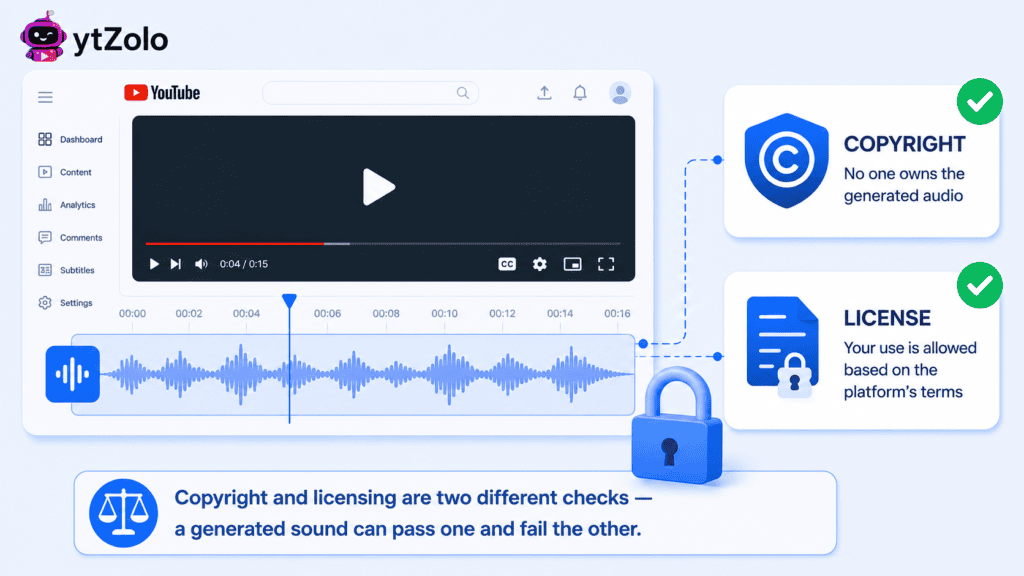
Table of Contents
What “Copyright-Free” Actually Means
“Copyright-free” gets used loosely online, and that looseness is where most confusion starts.
Technically, copyright-free means no one holds an exclusive legal right over a piece of work — it’s either in the public domain or was never eligible for protection. True copyright-free audio is rare.
Royalty-free is different. It means you don’t pay a fee every time you use the clip, but you still operate under a license with specific terms and restrictions.
Most sound effects marketed as “free” — AI-generated or stock — are royalty-free under a license, not copyright-free in the strict legal sense. That distinction matters more than it sounds.
Are AI Sound Effects Copyright-Free? The Straight Answer
So, are ai generated sound effects royalty free in a way you can safely use them? Usually yes, in the sense that you won’t pay per-use fees. Copyright-free is a different claim entirely.
When a model generates a new sound wave from a text prompt, that output typically isn’t a copy of an existing recording, so it doesn’t carry someone else’s copyright claim tied to sampling. That’s a genuine advantage over pulling a clip from an unclear-origin source.
But the platform that built the generator still sets the rules for how you’re allowed to use what it produced. That’s a contract question, governed by their terms of service, not a copyright-law loophole you can rely on blindly.
In short: the audio itself is usually free of someone else’s copyright. Your permission to use it commercially is a separate matter, and that’s the part creators skip.
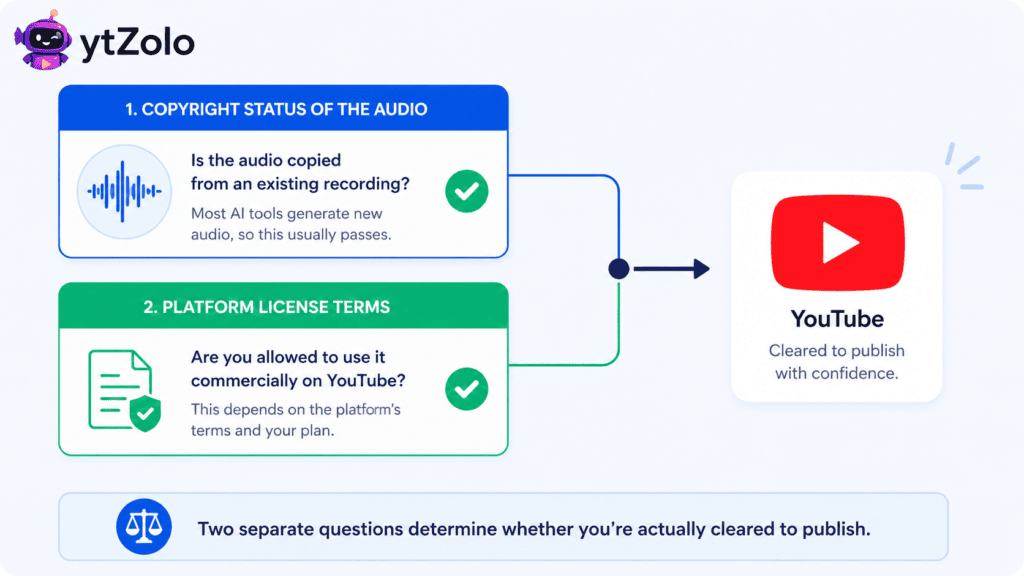
Two Layers of Rights You Need to Understand
Untangling ai sound effects copyright free questions gets easier once you separate it into two layers.
Layer one: the copyright status of the output. Was this sound copied from an existing recording, or synthesized fresh? Most reputable AI tools generate new waveforms, which sidesteps direct sampling infringement.
Layer two: your license to use that output. This is set entirely by the platform’s terms of service — what you can do with the file, whether commercial use is allowed, and whether attribution is required.
Creators who only check layer one and skip layer two are the ones who end up with an unexpected ai sfx copyright claim on a monetized video. Both layers need a quick check before publishing.
Can I Use AI Sound Effects on YouTube Commercially?
This is the question that actually matters for most creators, and it depends heavily on which plan you’re using.
Free tiers. Most platforms cap free-tier output at non-commercial use, or require attribution somewhere in your video description. Some allow limited commercial use with credits attached — always check the specific wording.
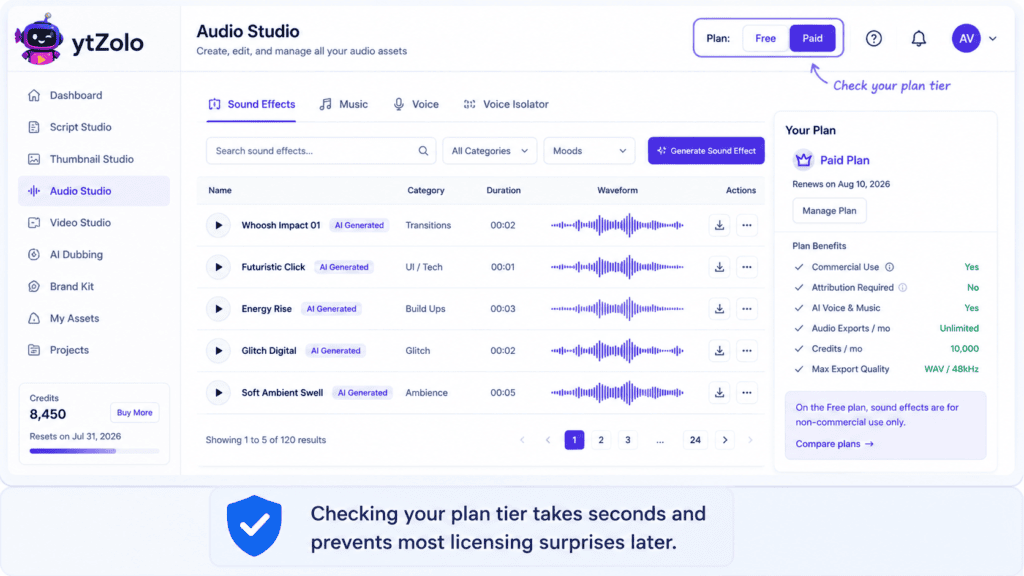
Paid tiers. Paid plans typically include a broader commercial license, covering monetized YouTube videos without an attribution requirement. This is usually the safer path once a channel is generating revenue.
So can I use ai sound effects on youtube commercially? On a paid plan, generally yes. On a free plan, only if the platform explicitly says so — never assume it by default.
The safest habit: read the licensing section before you generate, not after the video is already published and earning ad revenue.
What Triggers an AI SFX Copyright Claim
An ai sfx copyright claim on YouTube usually traces back to one of a handful of causes, and most are avoidable with a quick check upfront.
- Using free-tier output on a monetized video without confirming commercial clearance first.
- Downloading from a third-party site that repackaged AI-generated audio without preserving the original license terms.
- Assuming “AI-generated” automatically means unclaimable, when the platform’s own terms still restrict certain uses.
- Mixing in stock clips with unclear licensing alongside AI audio, muddying which sound actually triggered the claim.
- Publishing before checking whether the tool’s free tier requires attribution in the video description.
None of these are really about the AI itself — they’re about skipping a two-minute licensing check before hitting publish.
AI Generated Sound Effects Royalty Free: What the Label Actually Covers
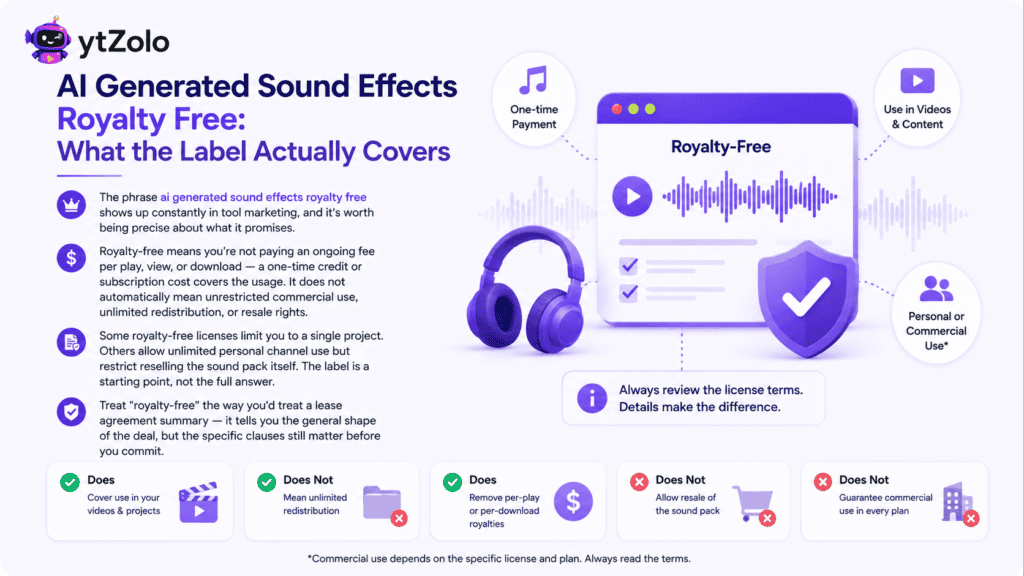
The phrase ai generated sound effects royalty free shows up constantly in tool marketing, and it’s worth being precise about what it promises.
Royalty-free means you’re not paying an ongoing fee per play, view, or download — a one-time credit or subscription cost covers the usage. It does not automatically mean unrestricted commercial use, unlimited redistribution, or resale rights.
Some royalty-free licenses limit you to a single project. Others allow unlimited personal channel use but restrict reselling the sound pack itself. The label is a starting point, not the full answer.
Treat “royalty-free” the way you’d treat a lease agreement summary — it tells you the general shape of the deal, but the specific clauses still matter before you commit.
Free vs Paid Plans: Licensing at a Glance
| Plan Type | Typical Commercial Use | Attribution Required | Best For |
|---|---|---|---|
| Free tier | Often restricted or limited | Frequently yes | Testing prompts, non-monetized projects |
| Paid tier | Usually included | Rarely required | Monetized YouTube videos, client work |
| Open-source, self-hosted | Depends entirely on your own deployment terms | Varies | Technical users managing their own licensing |
This mirrors the broader licensing pattern covered in ytZolo’s AI sound effects vs stock library comparison, where subscription-based access — not the audio format itself — is usually what determines whether you’re cleared to publish.
How ytZolo’s Audio Studio Fits Into This
Inside ytZolo’s AI Audio Studio, sound effects generation sits alongside AI music, voice generation, and dubbing tools in one dashboard.
As with any platform, the exact commercial-use terms for generated sound effects are set out in ytZolo’s Terms of Service, and creators should check the current plan details there before publishing monetized content.
The practical benefit of a bundled platform isn’t a licensing shortcut — it’s that you’re checking one set of terms instead of juggling separate licenses across four different single-purpose tools.
How to Check a Platform’s License Before You Publish
A short checklist saves far more time than dealing with a claim after the fact.
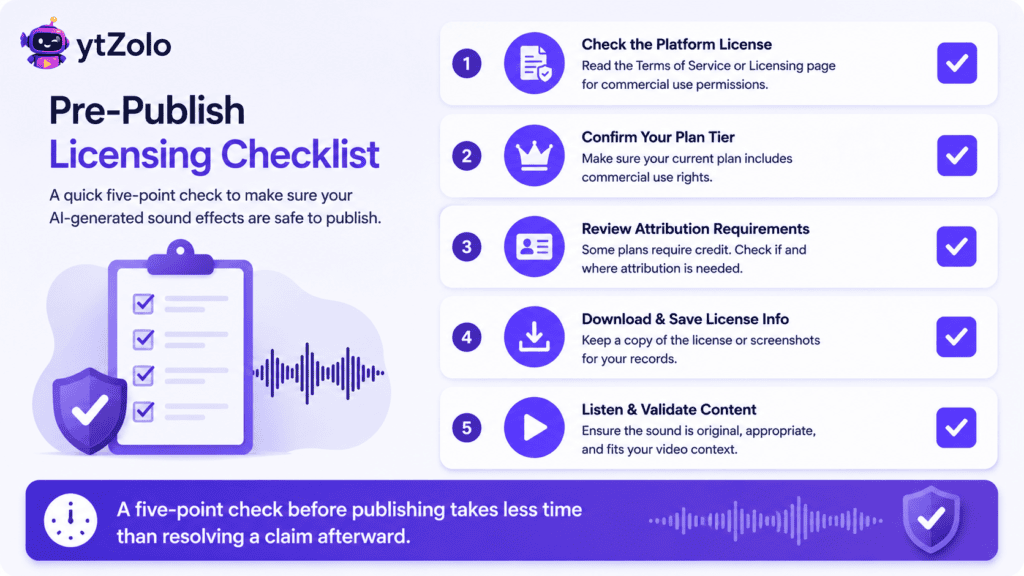
- Find the plan tier you’re actually on — free, starter, or pro — since licensing terms almost always differ by tier.
- Search the terms of service for “commercial” to jump straight to the relevant clause instead of reading the whole document.
- Check for an attribution requirement, and if one exists, note exactly where it needs to appear (description, credits, etc.).
- Confirm whether the license is per-project or ongoing, especially if you plan to reuse the same sound across multiple videos.
- Save a copy or screenshot of the terms at the time you generated the clip, in case terms change later and you need proof of what applied then.
This same habit applies whether you’re checking an AI generator’s terms or a stock library’s subscription license — the AI sound effects vs stock library guide covers how that second category handles licensing in more detail.
Common Myths About AI Sound Effects and Copyright
A few misconceptions keep circulating in creator forums, so it’s worth addressing them directly.
Myth: “If it’s AI-generated, it’s automatically copyright-free.” False — the output usually avoids sampling-based infringement, but the platform’s usage terms still apply.
Myth: “Free tier means free for any use, including monetized videos.” False — most free tiers explicitly restrict or condition commercial use.
Myth: “Once I download the file, the license doesn’t matter anymore.” False — the license governs ongoing use, not just the download moment.
Myth: “Royalty-free and copyright-free mean the same thing.” False — royalty-free refers to payment structure, not legal ownership status.
Clearing up these myths is really the whole point of asking whether ai sound effects copyright free claims hold up — most don’t, once you check the actual terms behind them.
Where to Verify: Trusted External References
For a plain-language overview of how licensing categories work more broadly, Creative Commons offers a useful outside reference point, particularly for community-uploaded audio libraries.
For platform-specific terms, always default to the primary source — the AI tool’s own terms-of-service page — rather than a forum thread or a third-party blog summarizing it secondhand.
Building Better Prompts Doesn’t Change the License
It’s worth separating two skills that often get conflated: writing a good prompt, and understanding your license.
A well-written prompt controls what the sound is — its object, material, action, and pacing, as covered in ytZolo’s AI sound effect prompts guide. It has no bearing on what you’re legally allowed to do with the result.
Even a perfectly generated, highly specific sound effect still falls under whatever license your plan carries. Prompt quality and licensing clearance are two entirely separate checks.
A Note for Gaming and High-Volume Channels
Gaming channels tend to generate the highest volume of sound effects per video — hit markers, UI chimes, transitions — which makes licensing checks even more important to get right early.
Since gaming content often reuses the same handful of cues across dozens of videos, a licensing mistake on a free-tier sound doesn’t just risk one video — it risks every video that reused that same clip.
Locking in a paid plan with clear commercial terms before building a recurring “house sound” is usually worth it once a gaming channel starts publishing multiple videos a week.
Free Tools Worth Testing First
If you’re still comparing options before committing to a paid plan, ytZolo’s roundup of the best free AI sound effects generator tools breaks down which free tiers are genuinely usable and which come with the tightest restrictions.
Testing two or three free tiers side by side is the fastest way to compare not just audio quality, but how each platform actually words its commercial-use restrictions.
FAQ
1. Are AI sound effects copyright-free? Not in the strict legal sense. The audio usually avoids someone else’s copyright since it’s newly generated, but your right to use it still comes from the platform’s license terms.
2. Can I use AI sound effects on YouTube commercially? Generally yes on a paid plan. On a free plan, only if the platform explicitly permits commercial use — check before publishing.
3. What’s the difference between copyright-free and royalty-free? Copyright-free means no one holds legal rights over the work. Royalty-free means you don’t pay per use, but a license with specific terms still applies.
4. Will I get an AI SFX copyright claim if I use a free-tier sound on a monetized video? It’s possible if the free tier restricts commercial use. Read the specific terms for your plan before publishing monetized content.
5. Does AI-generated audio ever get flagged by YouTube’s Content ID? It’s uncommon for genuinely original AI-generated audio, but it can happen if a platform’s output resembles licensed reference material closely enough to trigger a match.
6. Do I need to credit the AI tool I used? Only if the platform’s terms require attribution, which is more common on free tiers than paid ones.
7. Can I resell sound effects I generated with AI? Usually not without a specific resale or redistribution license — most standard plans cover personal or channel use only.
8. Is ytZolo’s Audio Studio cleared for commercial YouTube use? Terms vary by plan tier — check ytZolo’s Terms of Service for the current commercial-use details before publishing.
9. How is this different from stock library licensing? Stock libraries tie usage rights to an active subscription; AI generators tie usage rights to the platform’s terms of service and your plan tier — different structure, same need to verify before publishing.
10. What’s the safest habit for avoiding licensing issues altogether? Check your plan’s commercial-use clause before generating, save a record of the terms at that time, and default to paid tiers for anything going on a monetized channel.
Final Takeaway
The honest answer to “are ai sound effects copyright free” is: mostly free of someone else’s copyright, but not automatically free to use however you want. Those are two different guarantees, and only one of them is usually true.
The fix isn’t complicated — check your plan tier, search the terms for “commercial,” and save a record of what you found. That two-minute habit prevents nearly every licensing surprise creators run into later.
For the full landscape of tools and their published licensing terms, ytZolo’s AI sound effects generator comparison is a good next stop, alongside the AI sound effects vs stock library breakdown if you’re weighing both options for your channel.
Author
Anshika Verma 📧 anshika@ytzolo.com
Anshika is a Content & SEO Researcher at ytZolo who reviews AI creator tools hands-on, with a particular focus on licensing terms, pricing structures, and real production workflows across voice, music, and sound-design platforms. She writes to help YouTube creators separate marketing claims about “free” audio from what platform terms actually allow, based on documentation she’s personally checked rather than assumptions carried over from stock-library norms.

