
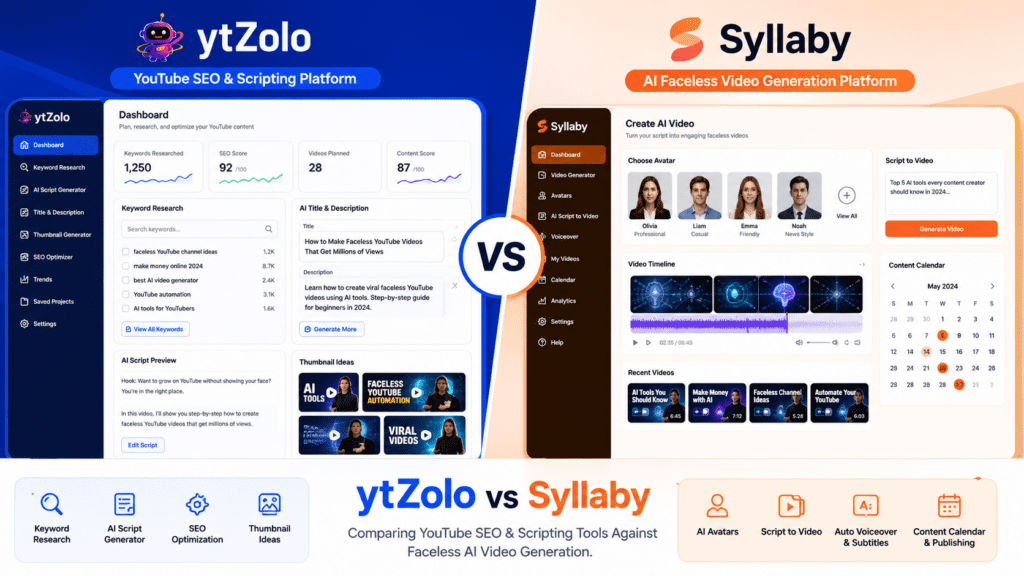
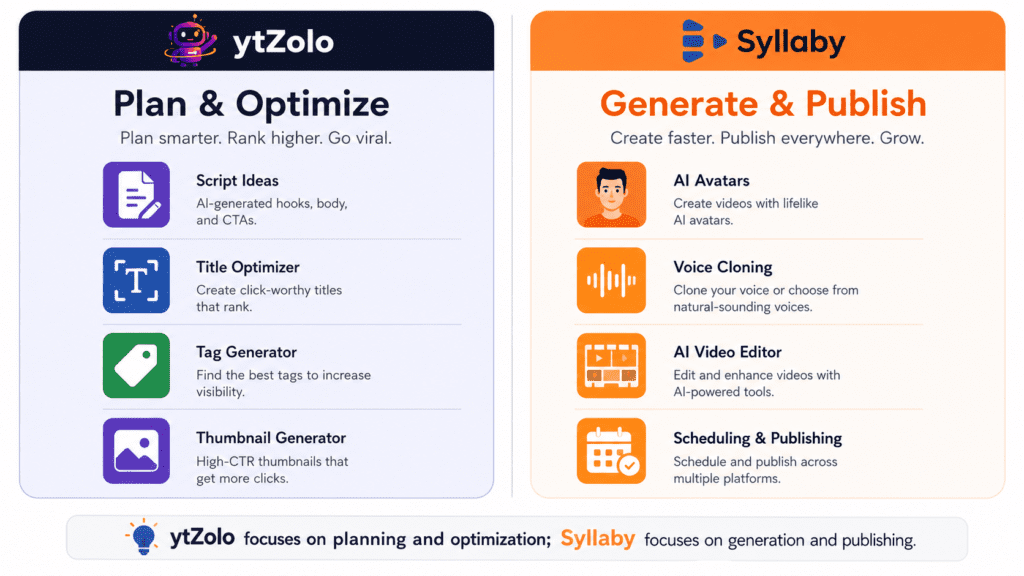
Comparing ytZolo vs Syllaby is a little like comparing a research-and-writing desk to a film studio — both sit inside the broader world of AI content creation, but they were built to solve different problems. ytZolo is oriented around YouTube SEO, video scripting, and metadata: titles, descriptions, tags, and thumbnail direction. Syllaby is oriented around AI video generation itself — turning a topic into a finished faceless video, complete with AI avatars, voice cloning, and multi-platform scheduling.
This creator-first comparison exists to help you figure out which tool (or combination of tools) actually closes your specific workflow gap, rather than to declare a universal winner. Every claim below is drawn from official product pages, pricing pages, independent reviews, and creator discussions, and every place where public information was inconsistent or incomplete is flagged directly rather than smoothed over.
Table of Contents
Quick Verdict
For creators who just need the short version:
ytZolo is generally the better fit if your workflow gap is YouTube SEO, video scripting, and metadata — it’s best for beginners who want structured titles and descriptions without a keyword research background, and best value for creators who don’t need full video rendering.
Syllaby is generally the better fit for faceless YouTube and short-form creators who need AI-generated video, AI avatars, and voice cloning to go from idea to finished, publishable video without filming anything.
For AI scripting specifically, both tools generate scripts, but they’re optimized for different outputs — ytZolo for YouTube-native long-form and Shorts copy, Syllaby for short, hook-driven scripts feeding directly into its own video generator.
Agencies managing high video volume will likely lean toward Syllaby’s bulk generation and scheduling tools, while agencies managing multiple client channels’ SEO and metadata will lean toward ytZolo.
Key Takeaway: These platforms overlap at the idea/script stage but diverge sharply after that — the tool stops at text and thumbnail concepts, while Syllaby continues all the way through to a rendered, publishable video.
Comparison Table
| Category | ytZolo | Syllaby |
|---|---|---|
| Purpose | AI YouTube SEO, scripting, and metadata generation | AI faceless video creation and multi-platform publishing |
| Best For | Creators needing titles, descriptions, tags, thumbnails | Faceless YouTube, Shorts, TikTok, and Reels creators |
| Pricing | Reported from roughly $6.7–$12/month on paid tiers (third-party sources; confirm on official site) | Reported from $29/month (Basic) up to $153/month (Premium), plus a one-time lifetime access option |
| Free Plan | Yes — limited credits | Yes — 7-day free trial, reportedly including a substantial starting credit allocation |
| AI Script Writing | Yes — long-form and Shorts scripts | Yes — short, structured scripts feeding directly into video generation |
| Keyword Research | Yes — described as trend detection / idea generation | Yes — “Idea Discovery” engine analyzing real search data and questions |
| Thumbnail Generator | Yes — concepts and variants on paid tiers | Yes — reported thumbnail generation feature, credit-metered |
| Title Generator | Yes — CTR-scored title options | Not a core focus; titles are secondary to video generation |
| Description Generator | Yes | Not a primary documented feature |
| Tag Generator | Yes | Not a primary documented feature |
| Video Workflow | No video creation — text/image outputs only | Full pipeline: script → AI visuals/avatar → voiceover → assembled video |
| Publishing | Not a publishing tool | Direct scheduling and publishing to YouTube, TikTok, Meta, and Google |
| Integrations | Multi-model AI access reported (ChatGPT, Claude, Gemini) | YouTube, TikTok, Meta, Google integrations for publishing |
| Analytics | Limited, tied to generated content performance | Includes post-publish performance tracking, per official site |
| Learning Curve | Low — prompt-based interface | Low to moderate — more steps involved (idea → script → visuals → schedule) |
| Customer Support | Priority/dedicated support on paid tiers, per third-party listings | Email support plus one-on-one onboarding calls, per official site |
| Pros | Fast metadata generation, YouTube SEO focus, lower entry cost | Full idea-to-video pipeline, no filming required, strong faceless-content fit |
| Cons | No video creation capability | Credit system can be complex; long-form YouTube not the primary use case |
| Overall Rating | Not independently benchmarked at scale — limited large-sample third-party review data available | Mixed independent reviews; one source cites a 3.4/5 average on Trustpilot |
What Is ytZolo?
ytZolo is an AI YouTube automation tool built around the planning and optimization stage of content production. According to ytZolo’s own site, the platform generates scripts, titles, thumbnails, descriptions, and tags automatically, targeting creators, influencers, marketers, and businesses.
Target audience: Beginner and professional YouTubers, agencies managing multiple channels, and marketers who need YouTube metadata generation without hand-writing every title and tag set.
Core features (per ytZolo’s site and third-party tool directories):
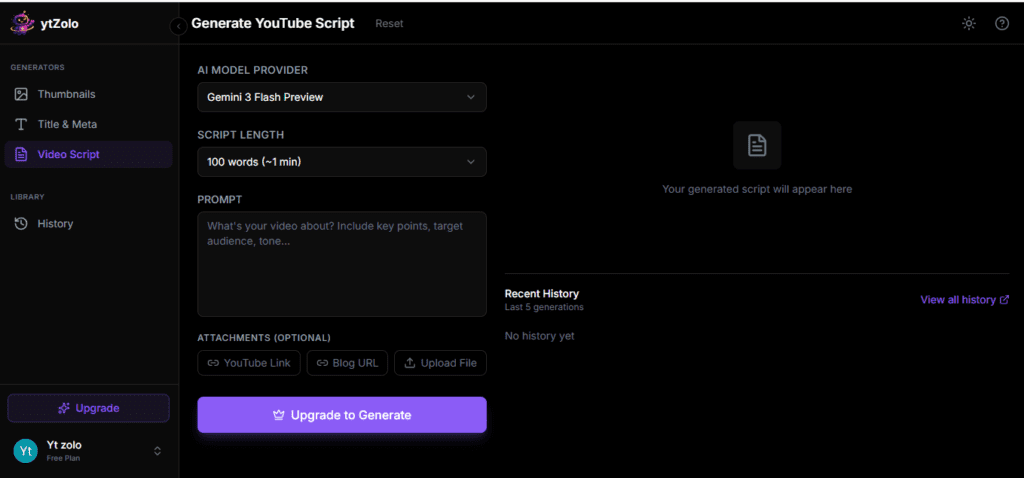
- AI script generator for long-form and Shorts content
- Title generator producing multiple CTR-oriented options
- Description and tag generator aimed at YouTube optimization
- Thumbnail concept and variant generation
- Reported multi-model AI access, giving users access to ChatGPT, Claude, Gemini, and more models for diverse content needs
Ideal users: Creators whose bottleneck is the blank page — deciding what to title a video, how to structure a script, or what tags will help it get discovered.
Strengths: Speed of metadata generation, a lower reported entry price point than full video-rendering platforms, and a workflow purpose-built for YouTube rather than adapted from a general-purpose writing tool.
Weaknesses: No video editing or generation capability at all — it’s strictly a pre-production and optimization tool. Independent, large-sample third-party review coverage is thinner than for more established SEO tools, which makes some claims harder to verify beyond the company’s own materials.
What Is Syllaby?
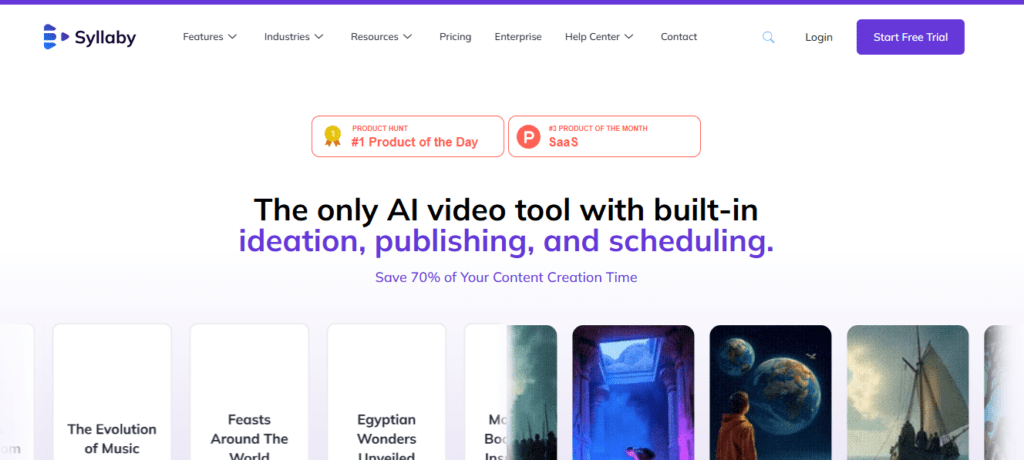
Syllaby is an AI-powered platform built around generating complete, publishable videos — particularly faceless content — from a topic or idea. Per Syllaby’s own site, the platform helps users create scroll-stopping vertical videos for TikTok/IG Reels or cinematic horizontal videos for YouTube and ads, integrating multiple underlying AI video models.
Who it’s built for: According to an independent review, Syllaby’s primary creator types are faceless YouTube channel operators (history, education, motivation, travel, food niches), TikTok and Instagram Reels creators, short-form content producers, niche topic creators who prefer anonymity, and multi-platform social media managers.
Content workflow: Syllaby’s process runs from idea discovery (keyword and question research) through script generation, AI visual/avatar assembly, voiceover, and finally scheduling and publishing — all inside one platform.
AI avatar capabilities: Syllaby offers a substantial avatar library — one hands-on review reported over 30 options and different art styles — plus a “Real Clone” feature that, per Syllaby’s site, is designed to keep your video character maintain the same look, feel, and presence across every scene.
Script generation: Syllaby’s scripts are generated from data-backed topic and keyword research rather than a blank prompt. One independent tester described the process as starting with an AI-driven content idea generator that surfaced several topics I thought my audience cared about had virtually no search volume, while other overlooked topics were getting significant search traffic.
Video creation: Syllaby integrates several current AI video generation models. According to an independent review, the platform’s integration of cutting-edge AI video generation models including Sora 2, Google VEO 3, and Seedance is a notable differentiator versus avatar-only competitors.
Strengths: A genuinely complete idea-to-published-video pipeline, strong faceless-content and avatar tooling, multilingual support (one source cites content creation in languages), and direct publishing integrations.
Limitations: Independent reviews note Syllaby is not ideal for long form videos, with one review stating plainly that Syllaby shines with shorts. It’s not designed for YouTube long form production. Reviewers also flag that advanced editors may find the visual control restrictive compared to full video editing software, and that AI voices, while improved, can feel generic depending on style.
Feature-by-Feature Comparison
AI Scripting
Overview: Both platforms generate scripts, but for different purposes and lengths.
How ytZolo approaches it: The platform’s script generator is built for full YouTube videos — long-form structure with hooks, sections, and CTAs, plus separate short-form scripts for Shorts.
How Syllaby approaches it: Syllaby generates shorter, structured scripts specifically designed to feed into its own video generation pipeline, optimized for short-form platforms and faceless delivery.
Real-world workflow: A creator planning a 12-minute YouTube video would lean on ytZolo’s long-form script generator, then likely edit and film manually or send that script to a separate editing tool. A creator planning a 60-second faceless Shorts video would use Syllaby to go from script directly to a rendered, avatar-narrated video without ever touching a camera.
Winner: Depends on output length — ytZolo for long-form YouTube scripting, Syllaby for short-form scripts intended for immediate AI video generation.
Topic and Keyword Research
Overview: Both platforms offer some form of AI-driven topic discovery, described in similar language but built on different underlying data approaches.
How ytZolo approaches it: The Tool’s trend detection module surfaces niche-relevant topics with reported search demand and competition signals.
How Syllaby approaches it: Syllaby’s Idea Discovery engine analyzes real search queries and questions, showing search volume and competition score per topic — one independent tester specifically praised the keyword validation feature for preventing wasted production time on low-demand topics.
Real-world workflow: A creator unsure what to make next would run a niche or broad topic through either engine to surface specific, validated content angles before writing a single word.
Winner: Both platforms offer comparable value here; independent, hands-on testing exists for Syllaby’s Idea Discovery specifically, giving it slightly more third-party verification at this time.
Thumbnail Generation
Overview: Thumbnail tools matter significantly for YouTube CTR, and both platforms offer some form of generation, though depth differs.
How ytZolo approaches it: Dedicated thumbnail generator with multiple variants unlocked on higher tiers, positioned as a core feature rather than an add-on.
How Syllaby approaches it: Thumbnail generation exists but is credit-metered as a secondary feature (reported at roughly one credit per three thumbnails by one detailed pricing breakdown) alongside its primary video generation focus.
Real-world workflow: A creator optimizing an existing long-form YouTube video’s CTR would use ytZolo’s dedicated thumbnail tool for multiple test variants; a Syllaby user would typically generate a thumbnail as part of finishing a video already produced on the platform.
Winner: ytZolo, for creators whose primary need is thumbnail testing and optimization specifically.
Title, Description, and Tag Generation
Overview: This is squarely a YouTube SEO tools function.
How ytZolo approaches it: Dedicated generators for each — titles, descriptions, and tags — designed around YouTube’s discovery algorithm.
How Syllaby approaches it: Not a primary documented feature; Syllaby’s focus is video generation rather than metadata copywriting.
Real-world workflow: A creator finishing a video edit and needing publish-ready metadata would use ytZolo. Syllaby users typically need a separate step or tool for detailed metadata beyond what’s auto-suggested during publishing.
Winner: ytZolo.
AI Video Creation
Overview: This is the single biggest functional gap between the two platforms.
How ytZolo approaches it: The software does not create video at all.
How Syllaby approaches it: Syllaby generates complete videos — AI visuals or avatars, voiceover, subtitles, and assembly — integrating models including Sora 2, Google VEO 3, and Seedance, per independent reporting.
Real-world workflow: A faceless channel operator with zero footage and zero desire to film would use Syllaby end-to-end. A creator with existing footage who just needs better titles wouldn’t touch Syllaby’s video generation at all.
Winner: Syllaby, decisively — this is its core competency.
Short-Form Content
Overview: Both platforms support short-form workflows, but Syllaby is more purpose-built for it.
How ytZolo approaches it: Generates Shorts scripts, vertical thumbnail concepts, and trending tag suggestions.
How Syllaby approaches it: Built natively for vertical, short-form output across TikTok, Reels, and YouTube Shorts, with bulk generation for producing multiple short videos in one session.
Winner: Syllaby for full production; ytZolo for the scripting/metadata layer specifically.
Long-Form Planning
Overview: Long-form YouTube production requires more structural planning than short-form.
How ytZolo approaches it: Full-length video scripts, chapter timestamps, and SEO-optimized descriptions for extended videos.
How Syllaby approaches it: Reviewers note Syllaby is not designed for YouTube long form production, making it a weaker fit here.
Winner: ytZolo.
Workflow Automation
Overview: Both platforms aim to reduce manual steps, but automate different parts of the pipeline.
How ytZolo approaches it: Automates the research-to-metadata pipeline (topic → title → script → description → tags → thumbnail concept).
How Syllaby approaches it: Automates the idea-to-published-video pipeline (topic → script → visuals/avatar → voice → schedule → publish), including bulk generation for multiple videos at once.
Winner: Syllaby covers a longer automated chain end-to-end; the tool automates a narrower but YouTube-SEO-specific chain.
Content Calendar
Overview: Planning consistency matters for channel growth.
How ytZolo approaches it: Limited documented content calendar functionality based on available sources.
How Syllaby approaches it: Built-in content calendar and bulk scheduler, with one independent tester describing the ability to plan content weeks in advance, schedule posts across multiple platforms and set publishing at optimal times.
Winner: Syllaby.
Branding
Overview: Consistent visual identity across videos matters for channel recognition.
How ytZolo approaches it: Limited branding tools; output is primarily text and thumbnail concepts rather than full visual branding systems.
How Syllaby approaches it: AI avatar consistency (via Real Clone and its avatar library) helps maintain a recognizable on-screen presence across videos without filming.
Winner: Syllaby, for video-level branding specifically.
Templates
Overview: Templates speed up repetitive content types.
How ytZolo approaches it: Not extensively documented in available sources.
How Syllaby approaches it: Reviewers reference video templates and pre-built frameworks for short-form content structure.
Winner: Syllaby, based on available documentation — though this is an area where public detail is limited for both platforms.
Ease of Use
Overview: Both platforms are marketed as beginner-friendly, though the underlying complexity differs.
How ytZolo approaches it: Single input-to-output flow (topic in, metadata out) with minimal steps.
How Syllaby approaches it: More steps involved given the fuller pipeline, though one hands-on reviewer noted the platform walks you through a systematic workflow that actually mirrors how content creators think.
Winner: ytZolo for pure simplicity; Syllaby for guided complexity that still avoids a steep learning curve, per independent testing.
Team Collaboration
Overview: Agencies and teams need multi-user support.
How ytZolo approaches it: Limited documented collaboration features compared to Syllaby.
How Syllaby approaches it: Supports script, video project, and idea sharing among team members, with Enterprise-tier team collaboration and multi-account management.
Winner: Syllaby.
Export Options
Overview: What you can actually take out of the platform matters for downstream workflows.
How ytZolo approaches it: Text and thumbnail image export.
How Syllaby approaches it: Full video export; one source notes exporting a finished faceless video carries no additional credit charge.
Winner: Syllaby, since it produces the finished asset.
Integrations
Overview: Connecting to other tools and platforms reduces manual handoffs.
How ytZolo approaches it: Multi-model AI access reported (ChatGPT, Claude, Gemini).
How Syllaby approaches it: Direct integrations with YouTube, TikTok, Meta and Google for scheduling and publishing.
Winner: Syllaby, for publishing integrations specifically; ytZolo, for underlying AI model choice.
Performance
Overview: Reliability and speed affect real-world usability.
How ytZolo approaches it: No large-scale independent performance benchmarking currently available in public sources.
How Syllaby approaches it: Mixed signals — strong praise in hands-on reviews for output quality, but a cited 3.4 out of 5 stars on Trustpilot average suggests inconsistent experiences across a broader user base.
Winner: Inconclusive — public data is too limited on ytZolo’s side and mixed on Syllaby’s side to declare a clear winner.
Pricing Value
Overview: Covered in depth in the dedicated Pricing Comparison section below, but summarized here: ytZolo’s reported entry pricing is lower, largely because it isn’t rendering video.
Winner: ytZolo for lower-cost entry; Syllaby for creators who need the full production pipeline it replaces (which would otherwise require multiple paid tools).
Support
Overview: Support quality affects onboarding and troubleshooting.
How ytZolo approaches it: Priority and dedicated support reported on paid tiers via third-party directories.
How Syllaby approaches it: Email support plus one-on-one user interview/tutorial assistance, according to Syllaby’s own site, along with in-app tutorial videos on every page.
Winner: Syllaby, based on the more detailed, verifiable support documentation available.
Learning Resources
Overview: Onboarding materials reduce time-to-value.
How ytZolo approaches it: Blog content covering YouTube growth strategies and platform usage tips.
How Syllaby approaches it: Knowledge base, video tutorials, and per-page contextual tutorial videos, per Syllaby’s own site.
Winner: Syllaby, based on more extensively documented in-app learning resources.
User Experience
Creator workflow: ytZolo follows a linear, single-purpose flow: input a topic, receive metadata outputs. Syllaby follows a multi-stage flow: idea discovery, script generation, visual/avatar assembly, voiceover, editing, and scheduling — more steps, but each stage builds toward a finished, publishable video rather than raw text.
Dashboard: ytZolo’s dashboard is described in third-party directories as an all-in-one dashboardcentralizing content creation tasks. Syllaby’s dashboard, per an independent multi-day test, is structured to mirror how creators actually think through production: “What should I create? → What should I say? → How should I present it?”
Navigation: Both platforms are described as approachable for non-technical users, though Syllaby inherently involves more screens given its longer pipeline (idea → script → video → schedule vs. ytZolo’s single-screen input/output model).
Speed: ytZolo’s text and image outputs generate quickly since no video rendering is involved. Syllaby’s video generation speed will vary by model choice (lighter models like Seedance Lite render faster and cheaper than premium models like Sora 2 Pro or Veo 3 Quality, based on documented credit consumption rates).
Ease of learning: Both platforms are positioned for beginners with no prior technical or editing experience. One independent 7-day test of Syllaby specifically noted the platform avoided the common failure pattern of AI tools with steep learning curves and cluttered interfaces.
Pricing Comparison
Pricing is an area where the two platforms differ structurally, not just numerically — ytZolo charges primarily for text/image generation volume, while Syllaby charges for AI video rendering, which is inherently more resource-intensive and reflected in higher price points.
ytZolo Pricing (reported by third-party tool directories)
| Plan | Price | Includes |
|---|---|---|
| Free | $0/month | Limited credits, title/description/tag generator, basic AI models |
| Standard | Reported around $6.7/month (billed annually) | 2,000 credits/month, all AI models, single-variant thumbnails, script generator |
| Pro | Reported around $12/month (billed annually) | 5,000 credits/month, three-variant thumbnails, dedicated support |
These numbers come from a third-party AI tools directory rather than ytZolo’s own live pricing page, so treat them as directional and verify current pricing before subscribing.
Syllaby Pricing (reported across multiple third-party sources, with some variance)
| Plan | Price (Monthly) | Credits/Month | Notes |
|---|---|---|---|
| Basic | Widely reported at $29/month ($24.67/month billed annually) | 500 (1,000/month on annual billing per some sources) | 1 voice clone, video editor, 20 scheduled posts, 5GB storage |
| Standard | Reported at $78/month | Higher tier, exact credit figure varies by source | Expanded scheduling and storage |
| Pro | Reported at $102/month | ~1,500–2,000 range depending on source | 3 voice clones, priority features |
| Premium | Reported at $153/month | 5,000 | 5 voice clones, unlimited scheduling, maximum storage |
| Enterprise | Custom pricing | Custom | Team collaboration, multi-account management, dedicated support |
| Lifetime Access | One-time payment (limited availability, per Syllaby’s own promotional page) | Fixed allocation, resets monthly per terms | Marketed as a limited-quantity offer; terms and credit resets should be confirmed directly |
Important pricing caveat: Third-party sources show meaningful disagreement on Syllaby’s exact numbers — some report a Basic tier as low as $21.25–$25/month, others confirm $29/month as the standard rate, and promotional/coupon sites list various discounted rates that may not reflect standard pricing. One free-trial detail is consistent across sources: Syllaby offers a 7-day free trial, providing users with 50,000 credits to test its capabilities, though generated videos during the trial include a watermark.
Hidden costs: Both platforms use credit-based systems on paid tiers, and Syllaby’s credit consumption varies significantly by feature — premium AI video models (like Sora 2 Pro or Veo 3 Quality) consume credits far faster than lighter models, meaning your effective monthly video output can vary widely even on the same plan depending on which models you choose.
Refund policy: Syllaby states that paid subscription fees are non-refundable except when required by law, but the company will gladly refund any unused credits remaining in your account within the first 30 days. ytZolo’s refund terms were not clearly detailed in the sources reviewed for this article — confirm directly on ytZolo’s refund policy page before purchasing.
Best value: For creators who only need scripting, titles, and metadata, ytZolo’s lower reported entry pricing makes it the better value. For creators who need actual finished video output, Syllaby’s pricing — while higher — replaces what would otherwise require several separate paid tools (avatar generator, voice cloning service, scheduler, and editor).
Pros and Cons
ytZolo
Pros:
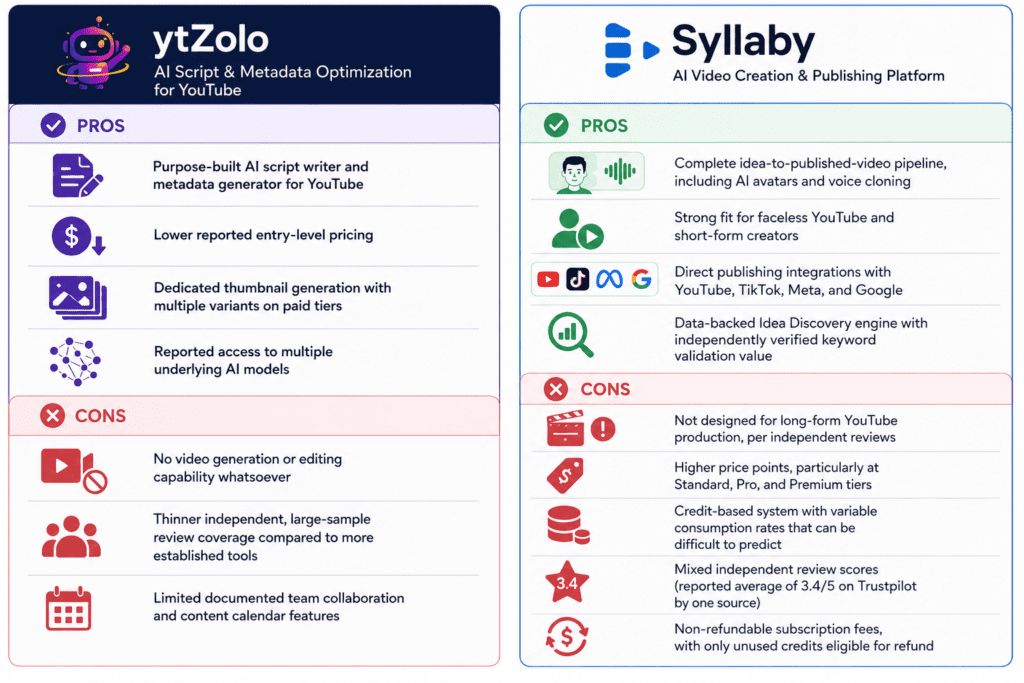
- Purpose-built AI script writer and metadata generator for YouTube
- Lower reported entry-level pricing
- Dedicated thumbnail generation with multiple variants on paid tiers
- Reported access to multiple underlying AI models
Cons:
- No video generation or editing capability whatsoever
- Thinner independent, large-sample review coverage compared to more established tools
- Limited documented team collaboration and content calendar features
Syllaby
Pros:
- Complete idea-to-published-video pipeline, including AI avatars and voice cloning
- Strong fit for faceless YouTube and short-form creators
- Direct publishing integrations with YouTube, TikTok, Meta, and Google
- Data-backed Idea Discovery engine with independently verified keyword validation value
Cons:
- Not designed for long-form YouTube production, per independent reviews
- Higher price points, particularly at Standard, Pro, and Premium tiers
- Credit-based system with variable consumption rates that can be difficult to predict
- Mixed independent review scores (reported average of 3.4/5 on Trustpilot by one source)
- Non-refundable subscription fees, with only unused credits eligible for refund
Which Tool Is Better For
Beginners: ytZolo for creators intimidated by SEO and metadata; Syllaby for creators intimidated by filming and editing. Both are designed to lower a different barrier to entry.
Professional creators: Established long-form YouTubers will likely prefer ytZolo’s scripting and metadata tools paired with a separate professional editor, since Syllaby is not built for long-form production.
Agencies: Agencies producing high-volume short-form content across multiple client accounts may prefer Syllaby’s bulk generation, scheduling, and multi-account management. Agencies focused on SEO and metadata optimization across many channels may prefer ytZolo.
Educational creators: Depends on format — long-form educational YouTube content favors ytZolo’s scripting depth; short-form educational content (explainers, quick tips) favors Syllaby’s faceless video pipeline.
Businesses: Businesses producing marketing video content at scale, especially without an on-camera spokesperson, are a strong fit for Syllaby’s avatar and Real Clone features. Businesses primarily focused on YouTube channel SEO performance may lean toward ytZolo.
Faceless YouTube creators: Syllaby is purpose-built for this use case, per multiple independent reviews highlighting faceless YouTube channel operators as a primary user type.
Short-form creators: Syllaby, given its native vertical-format support and bulk generation capability.
Long-form creators: ytZolo for scripting and metadata; note that neither platform alone fully replaces a dedicated long-form video editor.
SEO-focused creators: ytZolo, given its dedicated title, description, and tag generation tools built specifically around YouTube discovery.
Budget-conscious users: ytZolo’s reported entry pricing is meaningfully lower, though budget-conscious creators specifically needing AI video generation may find Syllaby’s Basic tier or its lifetime access option a better long-term value than paying for multiple separate AI video tools.
Real Creator Scenarios
Creator A — needs keyword research. A gaming YouTuber wants to know which topics in their niche have real search demand before scripting another video. Recommendation: Both platforms offer relevant tools here — ytZolo’s trend detection for YouTube-specific title/tag research, or Syllaby’s Idea Discovery engine if the creator is also open to producing short-form spinoff content from the same research. If the end goal is purely long-form YouTube optimization, ytZolo is the more directly aligned choice.
Creator B — needs AI video generation. A creator wants to start a faceless history channel but has no interest in filming, editing, or hiring a video editor. Recommendation: Syllaby, given its complete script-to-video pipeline, avatar library, and voice cloning — this is precisely the workflow gap it’s built to close. ytZolo would only help with the scripting and title stage, leaving the creator to solve video production separately.
Creator C — needs thumbnails. An established creator with strong video content but weak click-through rates wants to systematically test better thumbnails. Recommendation: ytZolo, given its dedicated thumbnail generator offering multiple variants per topic, purpose-built for CTR testing rather than as a secondary feature within a larger video pipeline.
Alternatives
Neither ytZolo nor Syllaby covers the entire YouTube production pipeline in isolation, so it’s worth knowing where other tools fit:
- VidIQ and TubeBuddy — browser extensions focused on keyword research, SEO analytics, and thumbnail A/B testing rather than content generation. Relevant if your priority is data-driven optimization without full AI scripting or video generation. See our ytZolo vs TubeBuddy comparison for a deeper breakdown.
- VEED — a browser-based AI video editor suited to creators who already have footage and need editing, subtitles, and export tools rather than AI-generated video from scratch. See our ytZolo vs VEED comparison.
- Pictory and InVideo — AI tools that convert scripts or existing content (like blog posts) into videos using stock footage, positioned closer to Syllaby’s territory but with a different visual approach. See our ytZolo vs Pictory comparison.
- Canva — useful as a complementary design tool for custom thumbnails or supplementary graphics, though it is not an AI YouTube automation platform in the same sense as either ytZolo or Syllaby.
- ChatGPT — a general-purpose AI writing tool that can produce YouTube scripts, but as several independent guides note, it lacks native YouTube optimization and requires more manual prompt engineering to get platform-ready output compared to purpose-built tools.
Final Verdict
ytZolo vs Syllaby isn’t really a head-to-head rivalry so much as two tools addressing adjacent but distinct problems in the AI content creation stack. ytZolo is a YouTube SEO and scripting tool: strong at titles, descriptions, tags, and thumbnail direction, but incapable of producing video.
Syllaby is an AI video generator: strong at turning a validated topic into a finished, publishable faceless video with avatars and voice cloning, but explicitly weaker for long-form YouTube production and metadata optimization.
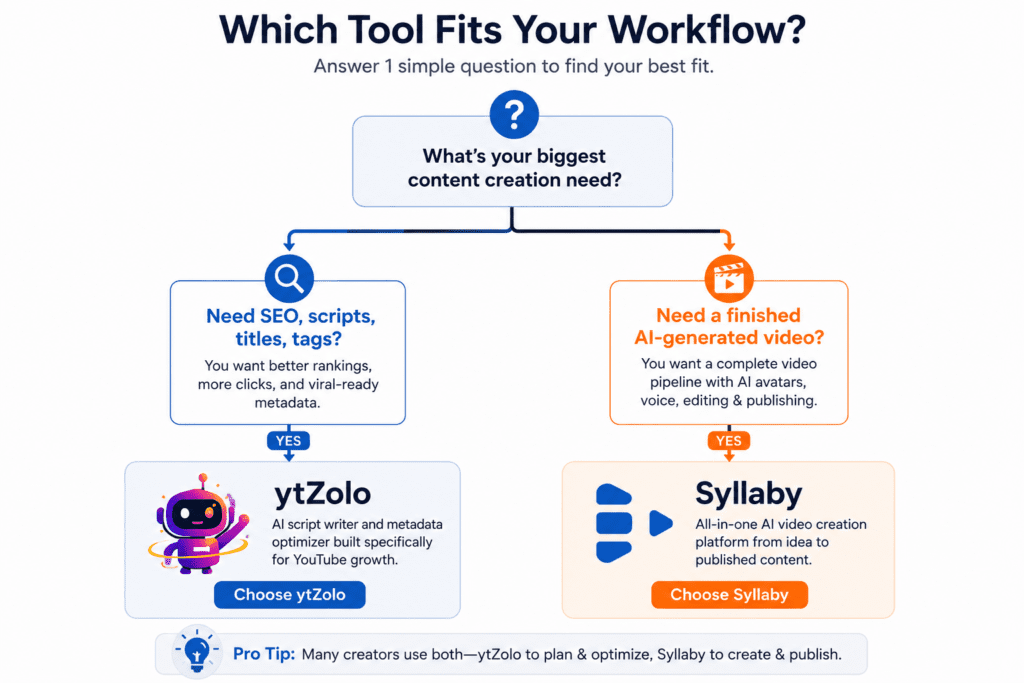
If your workflow gap is “I don’t know what to title this video or how to write compelling metadata,” ytZolo is the more directly relevant tool. If your workflow gap is “I have no footage and no desire to film, but I need a finished video,” Syllaby is the more directly relevant tool.
Creators and agencies producing at real scale may find good reason to use both — Syllaby’s Idea Discovery and video pipeline for short-form faceless content, alongside ytZolo’s metadata tools for long-form YouTube optimization. Pricing, credit systems, and feature tiers have shifted for both platforms during 2026, so confirm current terms directly on each official pricing page before subscribing to either.
FAQ
1. Is ytZolo better than Syllaby? Neither is universally better. ytZolo focuses on YouTube SEO, scripting, and metadata generation. Syllaby focuses on generating complete AI videos, particularly faceless content. The right choice depends on whether your workflow gap is planning/optimization or actual video production.
2. Does Syllaby generate videos? Yes. Syllaby’s core function is generating complete videos from a topic or script, using AI avatars, AI-generated visuals, voice cloning, and integration with video generation models including Sora 2, Google VEO 3, and Seedance, per independent reporting.
3. Can ytZolo replace multiple AI tools? Within its scope — scripting, titles, descriptions, tags, and thumbnails — ytZolo consolidates several typically separate tools into one dashboard. It does not replace a video editor, avatar generator, or voice cloning tool, which is where a platform like Syllaby or VEED would come in.
4. Which is cheaper, ytZolo or Syllaby? Based on third-party pricing reports, ytZolo’s entry-level tiers are meaningfully cheaper than Syllaby’s, largely because ytZolo doesn’t render video, which is a more resource-intensive process reflected in Syllaby’s higher price points (reported from $29/month up to $153/month across tiers).
5. Does Syllaby help with YouTube SEO? Syllaby’s Idea Discovery engine performs keyword and question research relevant to SEO, but it does not offer the dedicated title, description, and tag generation tools that ytZolo is built around. For deep YouTube metadata optimization specifically, AI tool is more directly aligned.
6. Which is better for beginners? Both are designed to be approachable for non-technical users, but they solve different beginner problems: ytZolo removes the “what do I title this” barrier, while Syllaby removes the “I don’t know how to film or edit” barrier.
7. Can ytZolo and Syllaby be used together? Yes. There’s minimal functional overlap beyond the idea/script stage, so some creators use ytZolo for YouTube-specific metadata and long-form scripting while using Syllaby for short-form, faceless video production.
8. Does ytZolo generate thumbnails? Yes. Based on third-party tool directory listings, ytZolo includes a dedicated thumbnail generator producing concepts and, on paid tiers, multiple visual variants.
9. Which has better AI writing, ytZolo or Syllaby? Both generate AI-written scripts, but for different formats — The tool for full YouTube-length scripts and Shorts, Syllaby for short, structured scripts designed to feed directly into video generation. Neither platform’s writing quality has been independently benchmarked at scale in the sources reviewed for this article, so this is worth testing directly against your own content style.
10. Which is best for faceless channels? Syllaby, based on its avatar library, Real Clone consistency feature, and voice cloning tools, which are purpose-built for faceless content production. ytZolo can support a faceless channel’s scripting and metadata needs but does not produce the video itself.
11. Does Syllaby work for long-form YouTube videos? Independent reviews indicate Syllaby is primarily optimized for short-form content and is explicitly described as not ideal for long-form YouTube production. Creators focused on long-form content should weigh this limitation carefully.
12. Is there a free trial for either platform? Yes. ytZolo offers a free plan with limited generation credits, and Syllaby offers a 7-day free trial reported to include a substantial starting credit allocation, though trial-generated videos include a watermark.
Author
Anshika Verma
Anshika Verma is a YouTube growth and creator economy researcher specializing in AI creator tools and search optimization. As a writer for ytZolo, her evidence-based comparison articles rely on strict, hands-on research of product data and documentation to prioritize transparency over promotion. Aligning with Google’s E-E-A-T principles, her creator-first approach ensures readers get clear, verified facts to make informed software decisions.
Email: anshika@ytzolo.com

