
By Anshika Verma · Updated July 2026 · ~15-minute read
Quick Answer: AI dubbing cost in 2026 typically ranges from $0.55 to $2.40 per minute on entry-level paid plans, or roughly $200–$800 to dub a full hour of video. Free tiers exist but usually cap length, add watermarks, or skip voice cloning. Your final ai dubbing pricing depends on video length, number of target languages, and whether lip sync or voice cloning is included. Platforms like ytZolo bundle dubbing with scripting, SEO, and thumbnails, which can lower your effective cost per video since you’re not paying for five separate subscriptions.
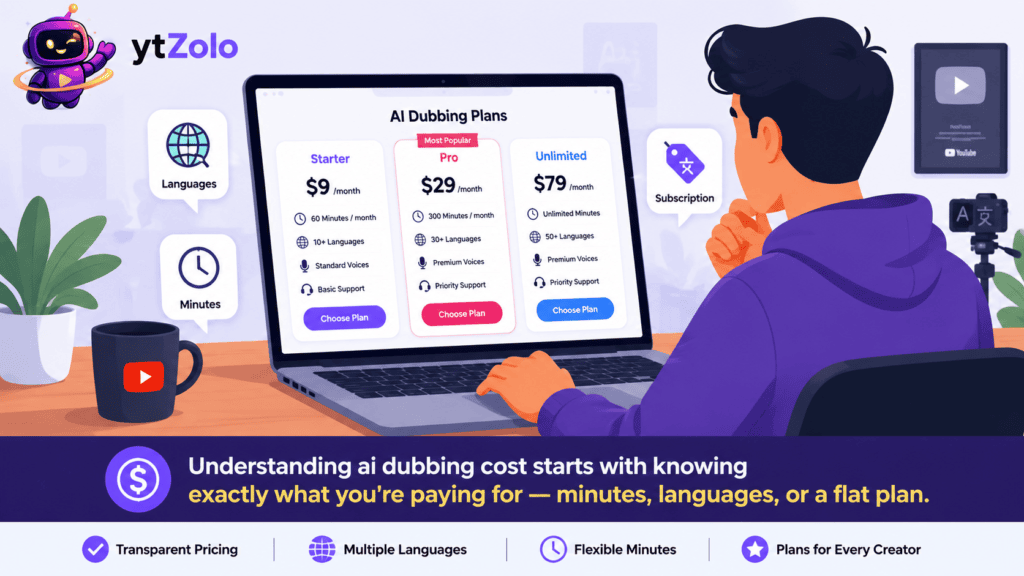
You’ve got a video that’s doing well. Now you’re wondering what it’ll actually cost to get it dubbed into two or three new languages.
That’s a fair question, and the honest answer is: it depends on the platform, the length of your video, and a few hidden variables most pricing pages don’t spell out clearly.
This guide breaks down real ai dubbing cost numbers across the tools creators compare most, shows you how to estimate the cost to dub a video before you commit, and points you toward the cheap ai dubbing tools worth testing first.
Table of Contents
What Actually Determines AI Dubbing Cost
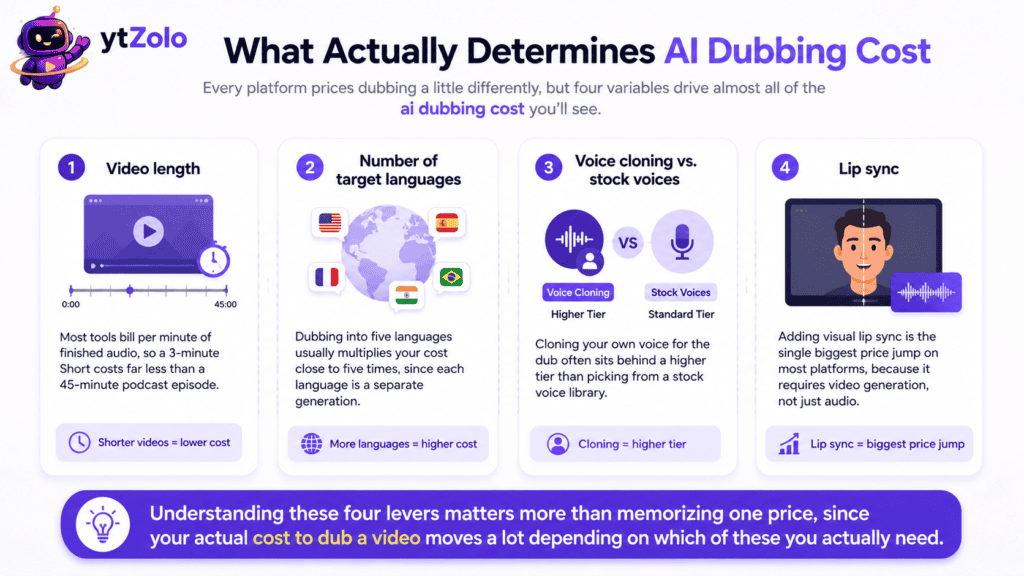
Every platform prices dubbing a little differently, but four variables drive almost all of the ai dubbing cost you’ll see.
Video length. Most tools bill per minute of finished audio, so a 3-minute Short costs far less than a 45-minute podcast episode.
Number of target languages. Dubbing into five languages usually multiplies your cost close to five times, since each language is a separate generation.
Voice cloning vs. stock voices. Cloning your own voice for the dub often sits behind a higher tier than picking from a stock voice library.
Lip sync. Adding visual lip sync is the single biggest price jump on most platforms, because it requires video generation, not just audio.
Understanding these four levers matters more than memorizing one price, since your actual cost to dub a video moves a lot depending on which of these you actually need.
AI Dubbing Pricing by Platform: 2026 Comparison
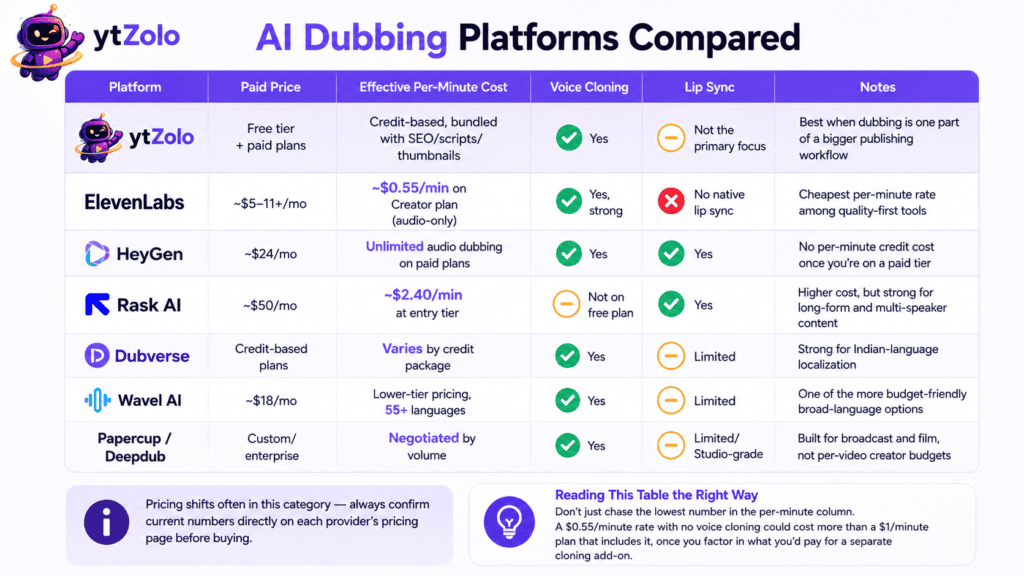
Here’s where ai dubbing pricing lands across the platforms creators ask about most, based on entry paid tiers as of mid-2026.
| Platform | Entry Paid Price | Effective Per-Minute Cost | Voice Cloning | Lip Sync | Notes |
|---|---|---|---|---|---|
| ytZolo | Free tier + paid plans | Credit-based, bundled with SEO/scripts/thumbnails | Yes | Not the primary focus | Best when dubbing is one part of a bigger publishing workflow |
| ElevenLabs | ~$5–11+/mo | ~$0.55/min on Creator plan (audio-only) | Yes, strong | No native lip sync | Cheapest per-minute rate among quality-first tools |
| HeyGen | ~$24/mo | Unlimited audio dubbing on paid plans | Yes | Yes | No per-minute credit cost once you’re on a paid tier |
| Rask AI | ~$50/mo | ~$2.40/min at entry tier | Not on free plan | Yes | Higher cost, but strong for long-form and multi-speaker content |
| Dubverse | Credit-based plans | Varies by credit package | Yes | Limited | Strong for Indian-language localization |
| Wavel AI | ~$18/mo | Lower-tier pricing, 55+ languages | Yes | Limited | One of the more budget-friendly broad-language options |
| Papercup / Deepdub | Custom/enterprise | Negotiated by volume | Yes | Limited/Studio-grade | Built for broadcast and film, not per-video creator budgets |
Pricing shifts often in this category — always confirm current numbers directly on each provider’s pricing page before buying. Our full AI dubbing software comparison covers features beyond just price if you want the complete picture.
Reading This Table the Right Way
Don’t just chase the lowest number in the per-minute column.
A $0.55/minute rate with no voice cloning could cost more than a $1/minute plan that includes it, once you factor in what you’d pay for a separate cloning add-on.
How Much Does It Cost to Dub a Video? Real Examples
Let’s turn ai dubbing cost into numbers you can actually budget against.
A 10-minute YouTube video, one language, audio-only dubbing: roughly $5–$25 depending on platform and whether voice cloning is included.
A 60-minute long-form video or podcast episode, one language: commonly falls between $35 and $150 on creator-tier plans, before any lip sync is added.
The same 60-minute video dubbed into five languages: expect your total cost to dub a video to scale close to five times the single-language number, since each language is a separate generation pass.
Adding lip sync to any of the above: budget for a meaningful jump — often 30–100% more per minute — since lip sync requires reshaping video frames, not just generating audio.
These are estimates, not quotes. Always run a short test clip on your shortlisted tool before committing your full video library.
Free AI Dubbing: What “Free” Really Means
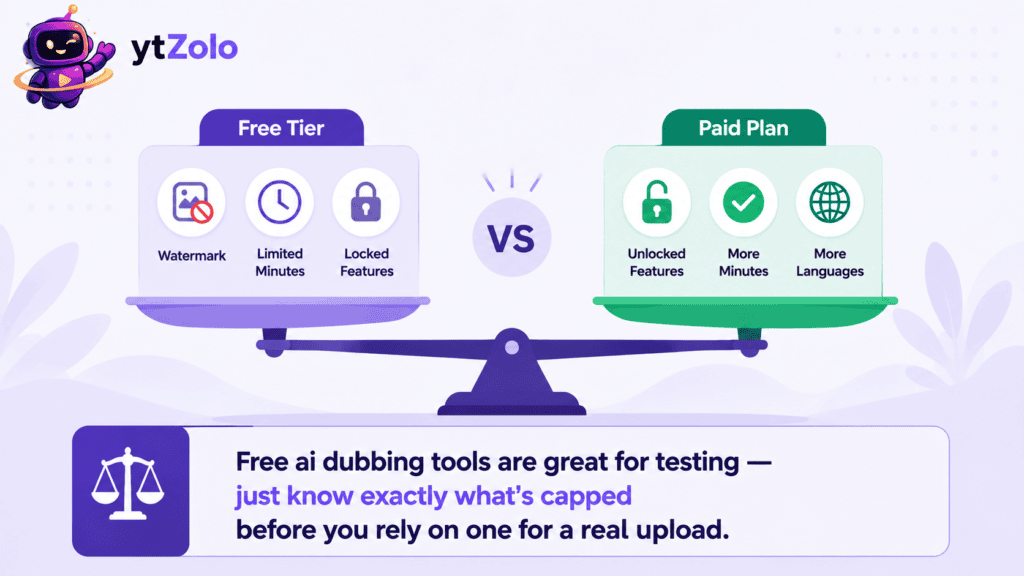
Almost every platform in this comparison offers some kind of free tier, and it’s genuinely useful for testing before you spend anything.
But “free” almost always comes with real limits attached.
- A cap on video length or total minutes per month
- Watermarks burned into the output
- Stock voices only — no voice cloning
- No lip sync at any price point on the free tier
- A limited selection of target languages
Free tiers are the right move for testing quality and workflow fit. They’re not built to carry a real, ongoing production schedule.
Cheap AI Dubbing Tools Worth Testing
If your budget is tight, a handful of cheap ai dubbing tools consistently show up as good starting points for creators.
ElevenLabs tends to offer the lowest effective per-minute rate among quality-first platforms, though it charges per target language separately.
Wavel AI covers 55+ languages at a lower monthly price point, which works well if breadth matters more than the deepest editing controls.
ytZolo’s free tier is worth trying first if you also need scripting, titles, and thumbnails, since it removes the cost of running four separate subscriptions for one video.
The cheapest option on paper isn’t always the cheapest option in practice — factor in what you’d otherwise pay for tools you’d need anyway, like an AI voice generator or a captioning tool.
AI Dubbing Cost vs. Traditional Studio Dubbing
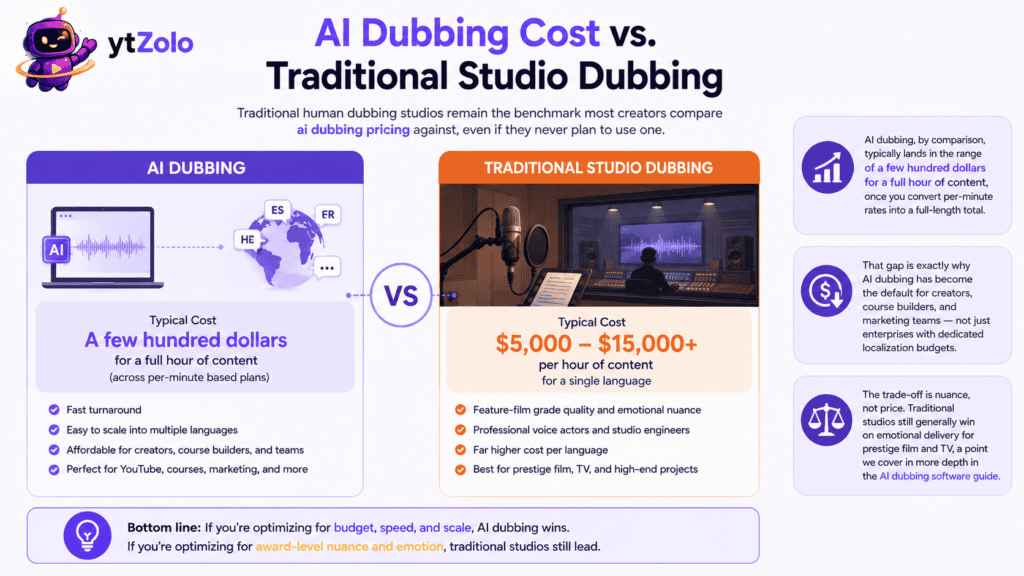
Traditional human dubbing studios remain the benchmark most creators compare ai dubbing pricing against, even if they never plan to use one.
Professional studio dubbing commonly runs $5,000 to $15,000 per hour of content for a single language, once you factor in voice actors, engineers, and studio time. Feature-film-grade dubbing can climb far higher per language.
AI dubbing, by comparison, typically lands in the range of a few hundred dollars for a full hour of content, once you convert per-minute rates into a full-length total.
That gap is exactly why AI dubbing has become the default for creators, course builders, and marketing teams — not just enterprises with dedicated localization budgets.
The trade-off is nuance, not price. Traditional studios still generally win on emotional delivery for prestige film and TV, a point we cover in more depth in the AI dubbing software guide.
Hidden Costs That Inflate Your Final Bill
A few line items catch creators off guard after they’ve already picked a platform based on the headline ai dubbing cost.
Per-language multipliers. Some tools charge per language even within the same plan, so five languages isn’t always covered by one flat fee.
Credit consumption on retries. Regenerating a line after a script edit often consumes credits again, so review your translated script before final generation.
Export or download fees. A few platforms gate high-resolution or watermark-free exports behind a separate charge.
API or overage pricing. Going past your monthly minute cap usually triggers a higher per-minute overage rate than your base plan.
Reading the fine print on these four items before you commit saves more money than chasing the lowest advertised rate.
How to Lower Your AI Dubbing Cost Without Hurting Quality
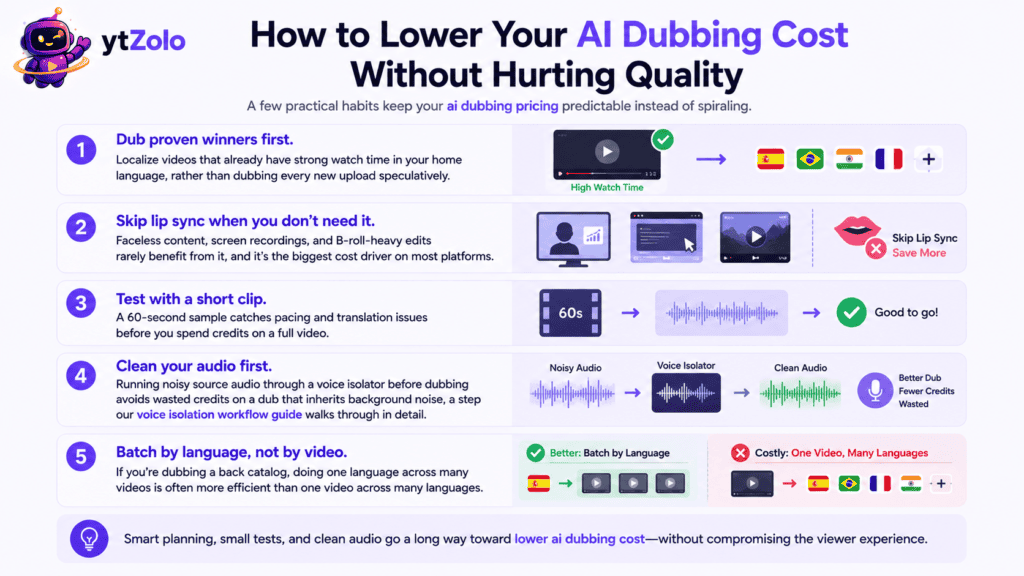
A few practical habits keep your ai dubbing pricing predictable instead of spiraling.
Dub proven winners first. Localize videos that already have strong watch time in your home language, rather than dubbing every new upload speculatively.
Skip lip sync when you don’t need it. Faceless content, screen recordings, and B-roll-heavy edits rarely benefit from it, and it’s the biggest cost driver on most platforms.
Test with a short clip. A 60-second sample catches pacing and translation issues before you spend credits on a full video.
Clean your audio first. Running noisy source audio through a voice isolator before dubbing avoids wasted credits on a dub that inherits background noise, a step our voice isolation workflow guide walks through in detail.
Batch by language, not by video. If you’re dubbing a back catalog, doing one language across many videos is often more efficient than one video across many languages.
Does Cheaper Always Mean Lower Quality?
Not necessarily, but it’s worth checking before you commit a full catalog to the lowest-priced option.
A lower ai dubbing cost sometimes reflects a smaller language list or a simpler translation engine rather than an inferior voice.
The safest test is still a short dialogue-heavy clip on your actual content, since accuracy varies more by content type — multi-speaker interviews, fast-paced dialogue, idiom-heavy scripts — than by price tier alone.
If accuracy is your main concern before spending anything, our comparison guide on AI dubbing software breaks down which tools handle multi-speaker and idiom-heavy content best.
Budgeting for YouTube-Specific Dubbing
If you’re dubbing specifically for YouTube, your budget decision connects to a bigger localization question, not just the sticker price.
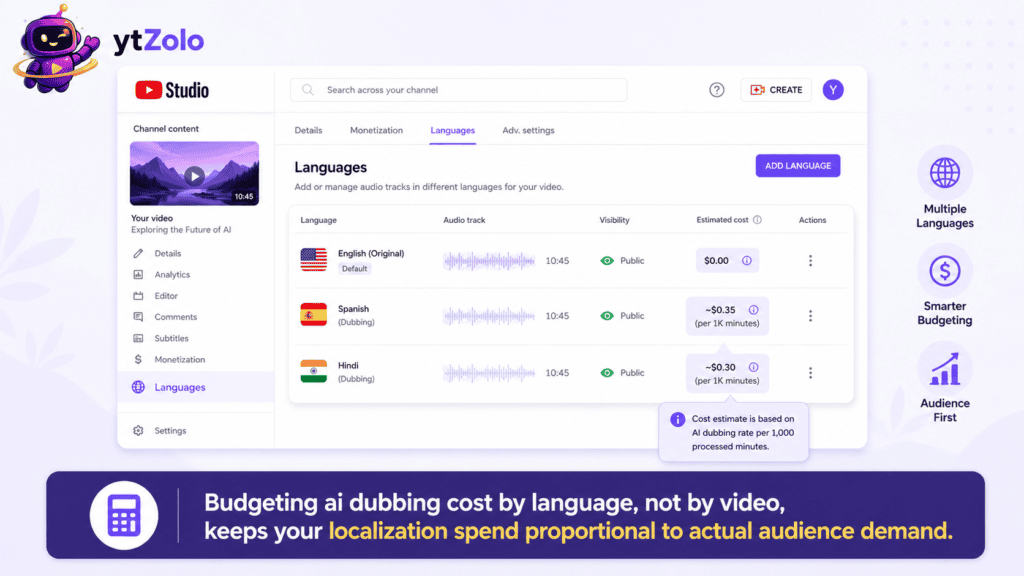
Deciding between dubbing and subtitles first affects how much you’ll actually spend, since subtitles cost close to nothing while dubbing scales with minutes and languages — our full dubbing vs. subtitles breakdown walks through when each makes financial sense.
Once you’ve decided dubbing is worth the spend, how to dub a YouTube video step-by-step shows the actual workflow so you’re not paying for regenerations caused by a rushed first pass.
And before spending on every possible market, it’s worth checking which languages actually convert best for YouTube dubbing, since prioritizing the right two or three languages stretches your budget much further than dubbing broadly on day one.
Which Pricing Model Fits Your Channel?
- You’re testing dubbing for the first time → Start on a free tier before comparing paid ai dubbing pricing.
- You want dubbing alongside scripts, SEO, and thumbnails → A bundled platform like ytZolo may cost less overall than four separate subscriptions.
- Voice quality matters most and you’ll skip lip sync → ElevenLabs offers a competitive per-minute rate for audio-only dubs.
- You need visible lip sync for talking-head marketing → Expect to pay more, and budget for HeyGen or a comparable lip-sync-first tool.
- You’re localizing hundreds of hours of broadcast content → Custom enterprise pricing from a studio-grade provider makes more sense than a per-minute creator plan.
AI Dubbing Cost: FAQs
What is the average ai dubbing cost per minute? Most creator-tier plans fall between $0.55 and $2.40 per minute in 2026, depending on whether voice cloning or lip sync is included.
How much does it cost to dub a video for YouTube? A typical 10-minute video runs roughly $5–$25 for one language on audio-only dubbing, scaling up with length, languages, and lip sync.
Is there a truly free way to dub a video? Yes, most major platforms offer a free tier, though expect watermarks, a length cap, and no voice cloning at that level.
Why do some cheap ai dubbing tools charge per language? Because each language is a separate transcription, translation, and voice-generation pass — the underlying compute cost scales with every added language.
Does lip sync always cost extra? On almost every platform, yes. Lip sync requires video generation on top of audio generation, which is priced as a premium layer.
Is ai dubbing pricing cheaper than hiring a translator and voice actor separately? Generally yes, often by a wide margin, since AI dubbing bundles transcription, translation, and voice synthesis into one automated pipeline instead of paying multiple specialists per language.
Do bundled platforms like ytZolo actually save money? They can, if you’d otherwise be paying for separate scripting, SEO, and thumbnail tools anyway — the savings come from consolidation, not necessarily a lower per-minute dubbing rate alone.
Should I pick the cheapest tool available? Not automatically. Test a short clip first, since translation accuracy and voice quality vary more by content type than by price tier.
A Note on Publishing Localized Content
Per Google’s Search Essentials and spam policies, dubbing a video’s audio alone doesn’t help it rank in a new language market — the surrounding title, description, and transcript need translating too, since search engines index text, not audio tracks.
Publishing a dubbed video with no other localized page content risks looking like thin content built mainly to capture search traffic rather than serve viewers, which Google’s spam policies are specifically built to deprioritize.
Pair every dub with translated metadata, and treat the ai dubbing cost as one part of a full localization budget, not the whole line item.
Final Verdict
There’s no single “correct” ai dubbing cost — the right number depends on how many minutes, languages, and features (voice cloning, lip sync) your project actually needs. The more complex your localization workflow, the more your final pricing can vary, so it’s important to compare plans based on the features you’ll actually use instead of just the headline price.
For most YouTube creators, starting with a free tier, testing a short clip, and dubbing only your proven-winning videos keeps the cost to dub a video proportional to the audience you’re actually trying to reach. As your international viewership grows, you can gradually expand into additional languages without committing a large budget upfront.
If you want dubbing folded into the same workspace that already writes your scripts and generates your thumbnails, it’s worth testing ytZolo‘s free tier before comparing it against a dedicated, single-purpose dubbing platform. An all-in-one workflow can simplify content production, reduce the need for multiple subscriptions, and make scaling multilingual YouTube content much more efficient.
About the Author
Anshika Verma is a content and SEO researcher at ytZolo, specializing in AI audio and video production technology for creators. She researches AI dubbing, voice synthesis, and multilingual video production, testing pricing and output quality against real production use cases rather than relying on marketing pages alone.
📧 Contact: anshika@ytzolo.com
This article follows Google’s Search Essentials and Helpful Content guidance — pricing figures reflect entry-level paid tiers as of July 2026 and change frequently across this category, so always confirm current numbers directly on each provider’s pricing page before purchasing.

