
By Anshika Verma · Content & SEO Researcher, ytZolo · Updated July 2026 · ~13 min read
Quick answer: YouTube video localization means adapting a video’s audio, captions, title, description, and thumbnail so it feels native to a viewer in another language and region — not just translated word for word. The fastest way to do this at scale in 2026 is AI dubbing paired with localized metadata, since audio alone won’t help YouTube’s search systems find your video in a new market. Platforms like ytZolo make this easier by keeping dubbing, voice generation, and SEO metadata in one workspace instead of five separate tools.
Table of Contents
What Is YouTube Video Localization?
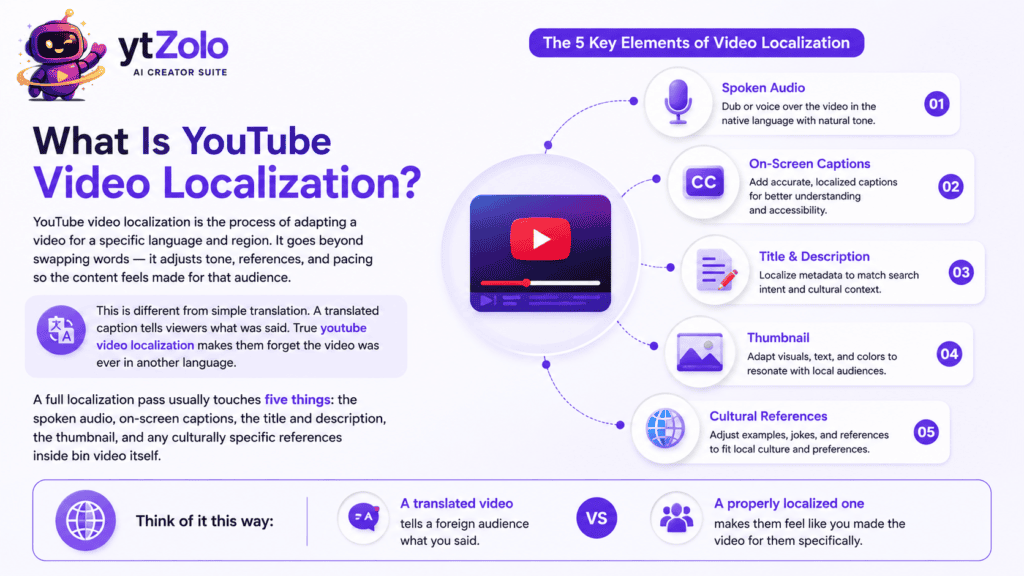
YouTube video localization is the process of adapting a video for a specific language and region. It goes beyond swapping words — it adjusts tone, references, and pacing so the content feels made for that audience.
This is different from simple translation. A translated caption tells viewers what was said. True youtube video localization makes them forget the video was ever in another language.
A full localization pass usually touches five things: the spoken audio, on-screen captions, the title and description, the thumbnail, and any culturally specific references inside the video itself.
Think of it this way: a translated video tells a foreign audience what you said. A properly localized one makes them feel like you made the video for them specifically.
Who Actually Needs YouTube Video Localization?
Not every channel needs to localize on day one, but a surprising number of channels are already leaving international viewers on the table without realizing it.
- Educational and how-to channels often have search demand in languages the creator never targeted directly.
- Product review and tech channels frequently see organic non-native traffic from viewers who understand the visuals but not the narration.
- Course creators and coaches can unlock entirely new customer segments by localizing a handful of flagship videos.
- Gaming and entertainment creators benefit from dubbing because their audience skews younger and more likely to switch language tracks.
If your YouTube Analytics already shows a meaningful slice of watch time from countries outside your primary language, that’s your signal to start.
Why a Global YouTube Strategy Matters Right Now
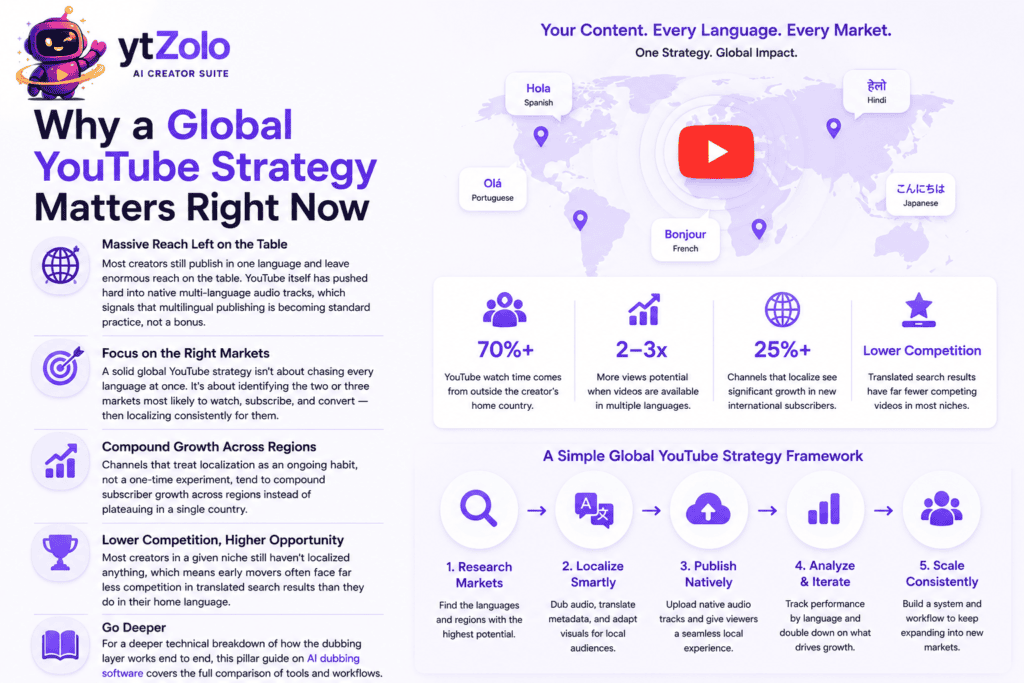
Most creators still publish in one language and leave enormous reach on the table. YouTube itself has pushed hard into native multi-language audio tracks, which signals that multilingual publishing is becoming standard practice, not a bonus.
A solid global youtube strategy isn’t about chasing every language at once. It’s about identifying the two or three markets most likely to watch, subscribe, and convert — then localizing consistently for them.
Channels that treat localization as an ongoing habit, not a one-time experiment, tend to compound subscriber growth across regions instead of plateauing in a single country.
There’s also a competitive angle worth noting. Most creators in a given niche still haven’t localized anything, which means early movers often face far less competition in translated search results than they do in their home language.
For a deeper technical breakdown of how the dubbing layer works end to end, this pillar guide on AI dubbing software covers the full comparison of tools and workflows.
Localization vs. Translation vs. Subtitling
These three terms get used interchangeably, but they aren’t the same thing, and mixing them up leads to weaker results.
- Translation converts words from one language to another, nothing more.
- Subtitling/captioning displays translated text on screen while the original audio keeps playing.
- Localization adapts everything — audio, visuals, pacing, and cultural context — for a specific audience.
Dubbing and subtitles are both localization tools, but they perform differently on watch time and retention. This comparison of AI dubbing vs. subtitles breaks down exactly which one wins for which content type.
Most successful multilingual channels use both together: dubbed audio for the primary experience, subtitles as a backup for viewers who prefer reading.
The Core Components of Localizing a YouTube Channel
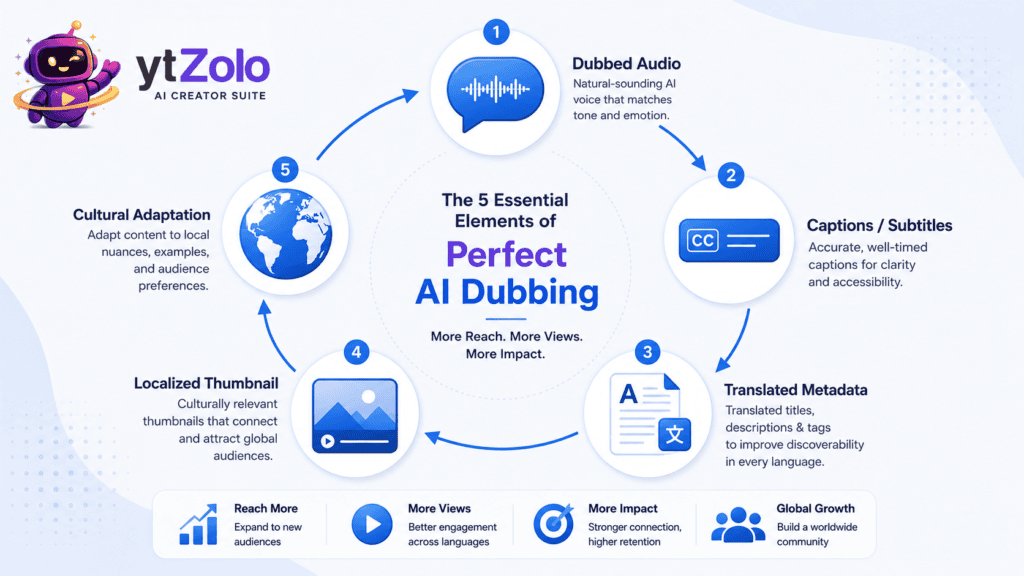
To properly localize a youtube channel, you need more than a translated voice track. Each piece below plays a distinct role in how discoverable and watchable the video becomes.
1. Dubbed Audio
The spoken track carries the most emotional weight. A well-dubbed voice preserves tone, pacing, and personality instead of sounding like a flat narrator reading a script.
2. Localized Captions and Subtitles
Captions give search engines crawlable text and give viewers a fallback if they mute the video or prefer reading. They also support accessibility for a wider audience.
3. Translated Title, Description, and Tags
This is the step creators skip most often — and it’s the one that actually gets a video found. A dubbed audio track alone won’t help you rank in another language’s search results.
4. Region-Specific Thumbnails
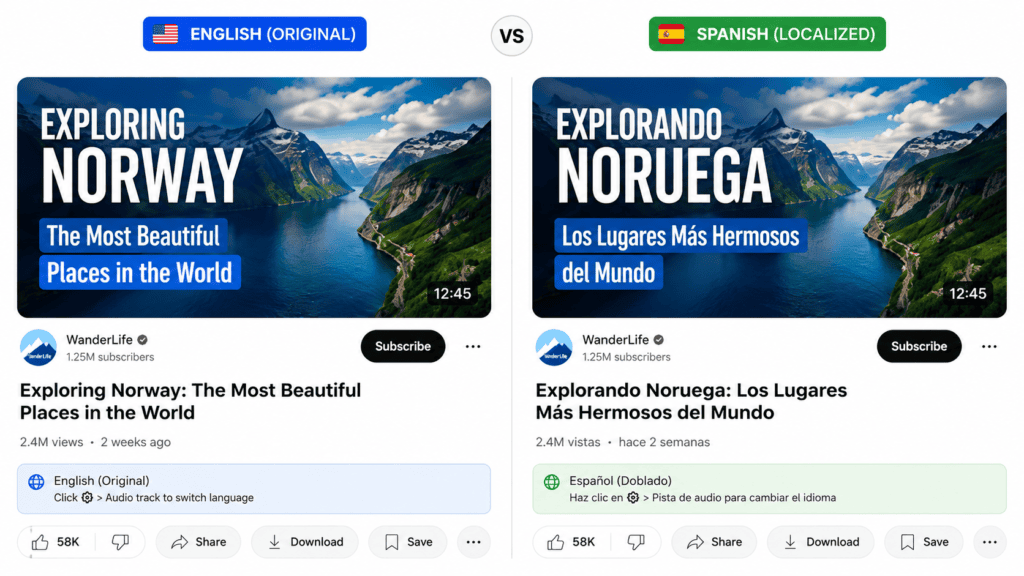
A thumbnail with text in the wrong language, or an image referencing something unfamiliar in that market, quietly kills click-through rate before the video even plays.
5. Cultural Adaptation of References
Jokes, idioms, and pop-culture mentions often don’t translate cleanly. A good localization pass catches these and adapts them instead of leaving an awkward literal translation.
How AI Dubbing Fits Into a Localization Workflow
AI dubbing is the engine that makes modern multilingual youtube content realistic at creator scale. Instead of booking a studio and a voice actor per language, the pipeline runs through speech recognition, translation, and voice synthesis in minutes.
The general workflow looks like this: transcribe the original audio, translate the transcript, generate a new voice track, then align it to the original video’s timing. Some tools add voice cloning so the dubbed voice still sounds like the original creator.
If you haven’t dubbed a video before, this step-by-step walkthrough on how to dub a YouTube video covers the exact process from upload to publish.
Platforms like ytZolo’s AI Audio Studio bundle dubbing with voice generation, voice isolation, and music creation, so the audio side of localization doesn’t require switching between four separate tools.
Choosing the Best Languages to Dub Into First
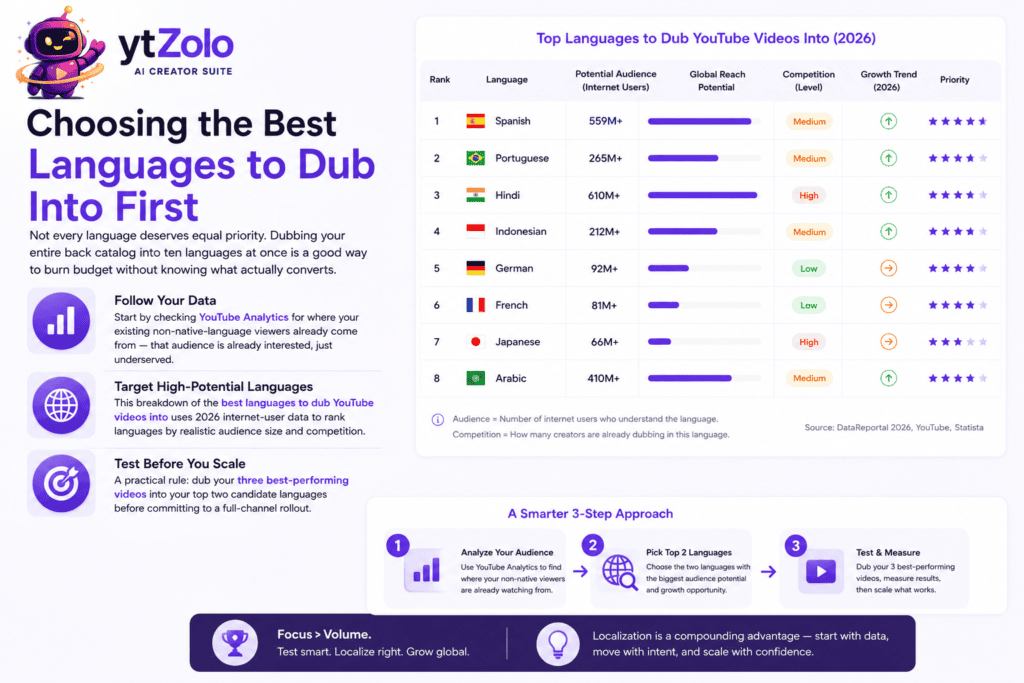
Not every language deserves equal priority. Dubbing your entire back catalog into ten languages at once is a good way to burn budget without knowing what actually converts.
Start by checking YouTube Analytics for where your existing non-native-language viewers already come from — that audience is already interested, just underserved.
This breakdown of the best languages to dub YouTube videos into uses 2026 internet-user data to rank languages by realistic audience size and competition.
A practical rule: dub your three best-performing videos into your top two candidate languages before committing to a full-channel rollout.
Budgeting for YouTube Video Localization
Cost is usually the first question creators ask, and it varies a lot depending on approach.
AI dubbing tools typically price per minute of finished audio or through monthly credit plans, which is dramatically cheaper than booking a studio and a voice actor for every language.
Traditional studio dubbing can run into hundreds of dollars per finished minute once you factor in translation, voice talent, and engineering time — a cost that simply doesn’t scale across a full back catalog.
Because AI dubbing pricing shifts often, it’s worth testing a free tier or trial credit on one video before committing budget to a full localization rollout across multiple languages.
A Step-by-Step Process to Localize Your YouTube Channel
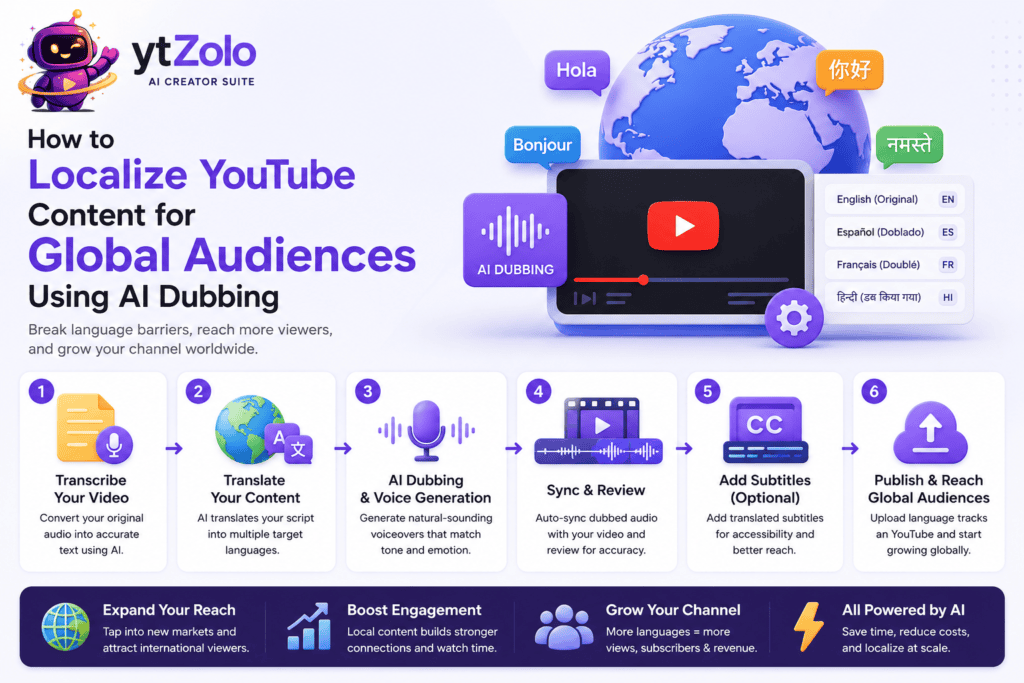
Here’s a repeatable workflow for youtube video localization that scales as your channel grows.
- Audit your top-performing videos. Localize proven winners before untested new uploads — you’re testing a market, not gambling on unproven content.
- Pick two or three target languages based on existing audience data, not guesswork.
- Dub the audio track using an AI dubbing tool, and review the translated script before final generation.
- Generate localized captions in the same target language for accessibility and search indexing.
- Translate the title, description, and tags — never leave this step for later.
- Design a localized thumbnail if the original contains text or region-specific visuals.
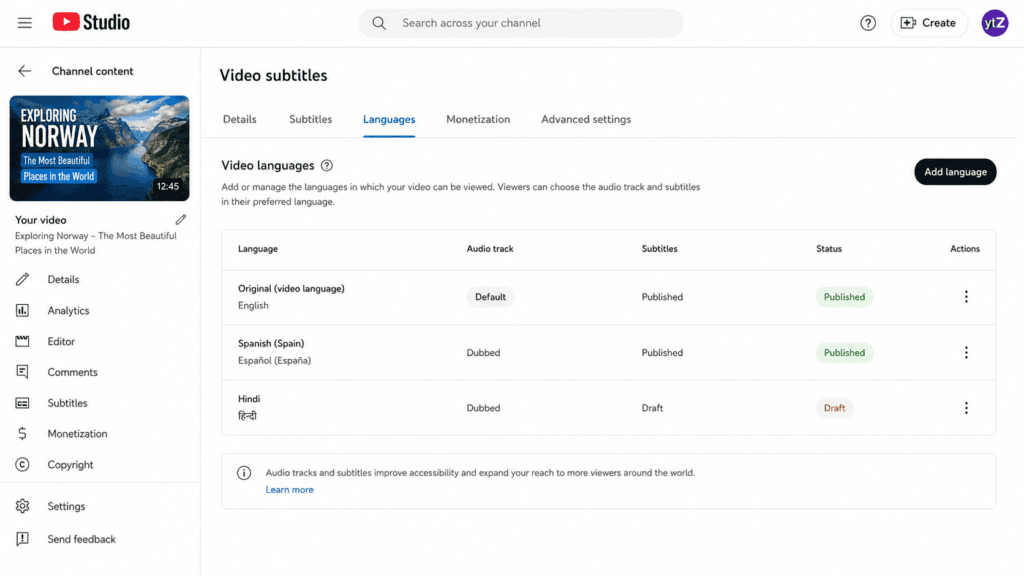
- Upload the additional audio track through YouTube Studio’s language settings.
- Track performance by region in YouTube Analytics and double down on what works.
SEO Considerations for Multilingual YouTube Content
Dubbing changes what viewers hear, but it doesn’t automatically change what Google or YouTube can read. Search systems still rely heavily on text.
According to YouTube’s own documentation on multi-language audio, a video becomes discoverable in a translated title and description language specifically because the search systems index that translated text — not the audio track itself.
That means multilingual youtube content only gets full SEO value when the audio dub is paired with fully translated metadata for that language, not just a swapped voice track.
For the metadata side of this, a dedicated YouTube SEO pass per language — titles, descriptions, and tags — matters just as much as the dubbing itself.
Google’s own Search Essentials guidance also warns against publishing thin, auto-translated pages that exist only to capture search traffic. Pair any dubbed video embed on your own site with genuinely useful, localized surrounding content, not a bare auto-translation.
Accessibility Benefits Beyond Reach
Localization isn’t only about chasing new markets — it genuinely improves access for viewers who are already trying to watch your content.
Viewers with reading difficulties, or those who simply prefer listening over reading captions, get full access to a video instead of a subtitle-only experience.
Dubbed audio also removes the “caption fatigue” problem, where viewers have to split attention between reading text and watching the visuals on screen.
Localizing Shorts vs. Long-Form Videos
Short-form and long-form content don’t need the same localization approach, and treating them identically wastes effort.
Shorts benefit most from quick, punchy dubbed audio and localized on-screen text, since viewers decide whether to keep watching within the first couple of seconds.
Long-form videos justify the fuller youtube video localization treatment — full script review, localized description, and translated tags — because the SEO and watch-time payoff compounds over a much longer runtime.
If your channel publishes both formats, prioritize localizing long-form flagship videos first, then use Shorts as fast, low-cost tests for a new language before a bigger investment.
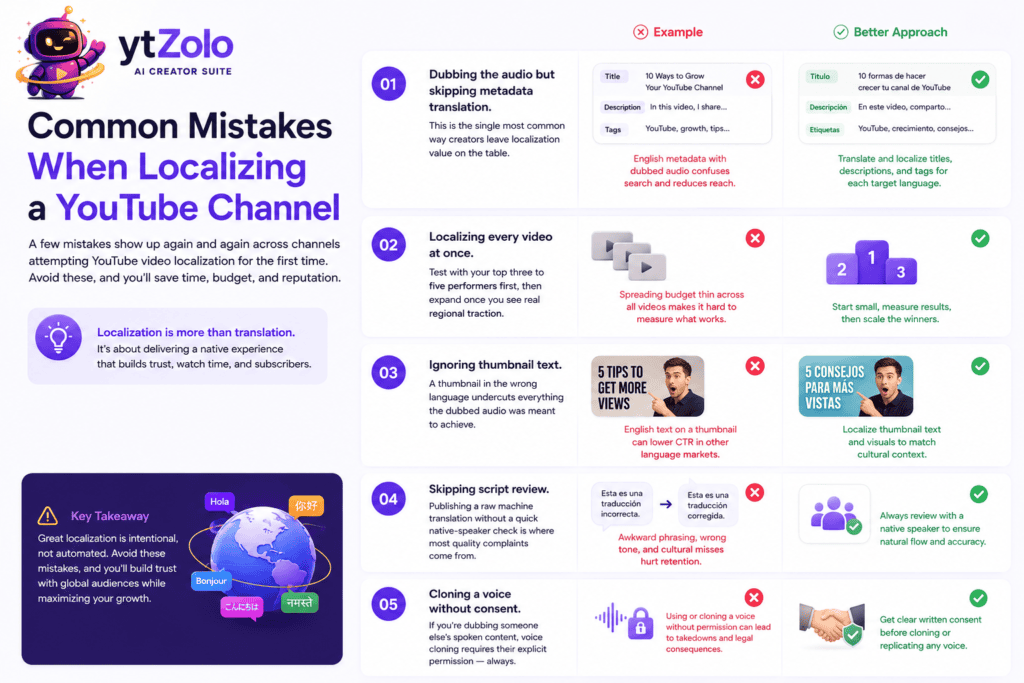
Common Mistakes When Localizing a YouTube Channel
A few mistakes show up again and again across channels attempting youtube video localization for the first time.
- Dubbing the audio but skipping metadata translation. This is the single most common way creators leave localization value on the table.
- Localizing every video at once. Test with your top three to five performers first, then expand once you see real regional traction.
- Ignoring thumbnail text. A thumbnail in the wrong language undercuts everything the dubbed audio was meant to achieve.
- Skipping script review. Publishing a raw machine translation without a quick native-speaker check is where most quality complaints come from.
- Cloning a voice without consent. If you’re dubbing someone else’s spoken content, voice cloning requires their explicit permission — always.
Measuring Whether Your Localization Strategy Is Working
Localization only counts as successful if it’s actually moving numbers, not just adding language options nobody watches.
Track these signals per language in YouTube Analytics: watch time, average view duration, click-through rate, and subscriber growth by region.
If a dubbed language consistently underperforms your original after a fair testing window, it’s fine to pause that language and reallocate effort toward one with real traction.
A genuine global youtube strategy treats each language almost like its own mini-channel — worth its own performance review, not a one-time checkbox.
Tools That Support End-to-End Localization
Manually juggling a transcription tool, a translation service, a voice generator, and a separate SEO tool slows down youtube video localization and multiplies the chance of mismatched metadata.
An integrated platform like ytZolo brings scripting, YouTube SEO, thumbnail generation, AI dubbing, voice generation, and AI music together in one workspace — so a localized upload doesn’t require exporting between four different apps.
For creators who also handle disclosure requirements around AI-generated voices, this guide on YouTube’s AI-generated content disclosure rules is worth reviewing before publishing dubbed content at scale.
Frequently Asked Questions
What does YouTube video localization actually include? It includes dubbed or translated audio, localized captions, a translated title and description, region-specific thumbnails, and cultural adaptation of references inside the content.
Is dubbing required to localize a YouTube channel? No, but it significantly improves watch time and retention compared to subtitles alone, especially for audiences who don’t read captions consistently.
How many languages should I start with? Two or three, based on where your existing audience already comes from, is a more realistic starting point than dubbing into ten languages immediately.
Does localization actually help YouTube SEO? Indirectly, yes. The audio itself isn’t indexed, but a translated title, description, and tags allow the video to surface in that language’s search results.
How long does it take to localize one video? With AI dubbing tools, a single video can be dubbed and captioned in minutes to a couple of hours, compared to days or weeks with traditional studio dubbing.
How much does YouTube video localization cost? It depends heavily on approach — AI dubbing tools are priced per minute or by subscription and are far cheaper than studio dubbing, which can run into hundreds of dollars per finished minute.
Can I localize a YouTube channel without dubbing every video? Yes. Most creators start by localizing their top three to five best-performing videos rather than an entire back catalog at once.
Final Thoughts
A real global youtube strategy isn’t a single dub — it’s a repeatable system covering audio, captions, metadata, and thumbnails together. Skip any one piece and the rest underperforms.
Start small: pick your best-performing video, dub it into one or two languages your audience already shows interest in, translate the full metadata, and measure the result before scaling further.
Most creators overthink the first step and underthink the follow-through. The channels that win internationally aren’t the ones that dub the most videos — they’re the ones that stay consistent with the process month after month.
The fastest way to test this without juggling five separate tools is to run one video through a platform that already handles dubbing, voice generation, and SEO metadata together. Try ytZolo free and dub your first video today — no separate translation service, voice tool, or metadata rewrite required.
About the Author
Anshika Verma Email: anshika@ytzolo.com
Anshika Verma is a Content & SEO Researcher at ytZolo, specializing in AI audio, video localization, and YouTube growth workflows. Her work focuses on testing AI dubbing, voice, and multilingual publishing tools against real production use cases, translating that testing into practical guidance for creators and marketing teams navigating global YouTube growth.

