
By Anshika Verma · Content & SEO Researcher, ytZolo · Updated July 2026 · ~18-minute read
Quick answer: AI dubbing accuracy in 2026 is genuinely close to human quality for calm, single-speaker, conversational speech — think tutorials, vlogs, and course videos. It gets noticeably weaker on fast emotional dialogue, overlapping speakers, and heavy accents. If you’re asking “does AI dubbing sound real,” the honest answer is: often yes, sometimes no, and the gap depends entirely on the source audio and the tool you choose.
This article is a supporting deep-dive to our complete AI dubbing software comparison, and focuses specifically on one question that guide only touches briefly: accuracy and naturalness.
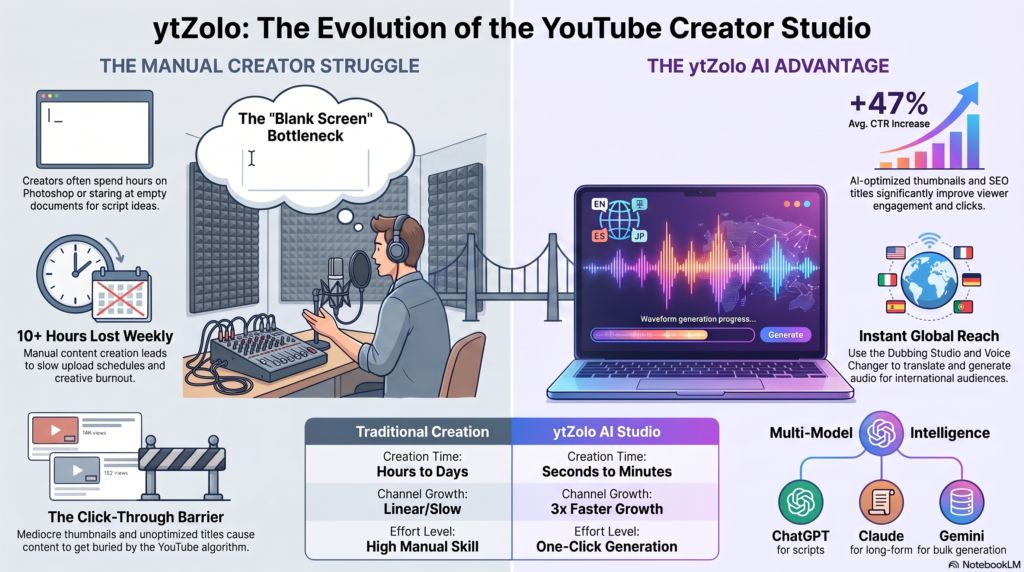
Table of Contents
What Does “AI Dubbing Accuracy” Actually Mean?
AI dubbing accuracy isn’t one number. It’s really three separate scores stacked together.
Transcription accuracy measures whether the AI heard the original speech correctly. Translation accuracy measures whether the meaning survived the language switch. Voice accuracy measures whether the final audio sounds like natural human speech, not a robotic read.
A tool can nail two of these and still sound off. That’s usually why a dub “sounds wrong” even when every word is technically correct.
Why Everyone’s Suddenly Asking This Question
Two years ago, AI dubbing accuracy was inconsistent enough that most creators avoided it for anything public-facing. That’s shifted fast.
YouTube’s own auto-dubbing rollout put AI-translated audio in front of millions of viewers by default, normalizing the format overnight. Naturally, more people started comparing quality across tools.
At the same time, large language models replaced older phrase-based translation engines almost everywhere. That single change did more for natural sounding AI dubbing than any voice-synthesis upgrade in the same period.
Does AI Dubbing Sound Real in 2026? The Honest Breakdown
Here’s where AI dubbing accuracy genuinely holds up against a human ear:
- Clear, single-speaker narration — tutorials, explainer videos, course content
- Moderate pacing — content that isn’t rapid-fire comedy or auctioneer-speed delivery
- Formal and semi-formal registers — business content, product walkthroughs, news-style delivery
And here’s where it still slips:
- High-emotion dialogue — grief, anger, and sarcasm are the hardest emotional states to reproduce convincingly
- Overlapping speakers — interviews and panel discussions confuse speaker separation
- Regional slang and idiom — even accurate word-for-word translation can miss the cultural point entirely
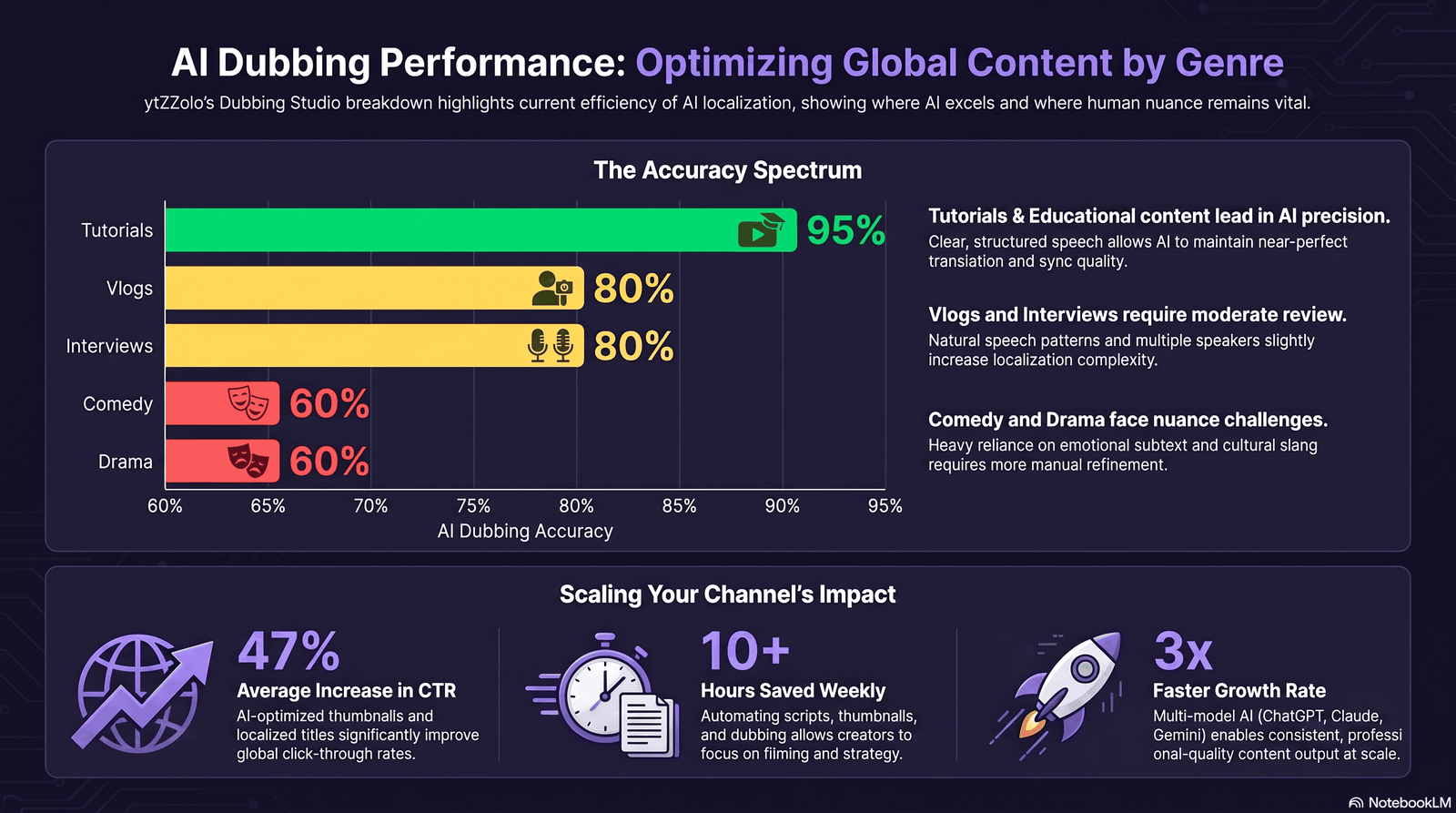
So does AI dubbing sound real? For roughly 70–80% of everyday creator content, yes, most casual viewers won’t clock it as synthetic on first listen.
The Four Factors That Actually Drive AI Dubbing Accuracy
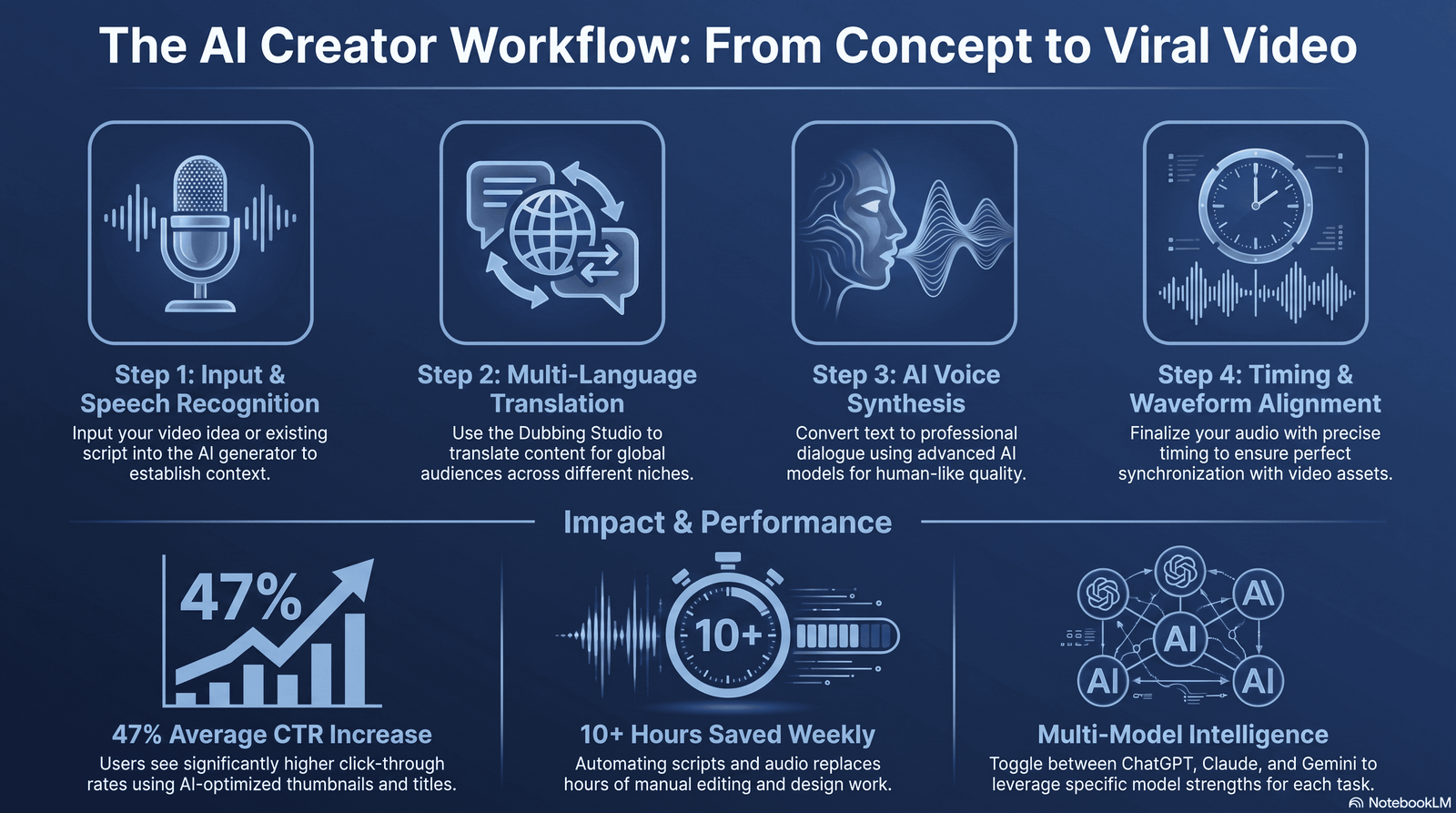
1. Speech Recognition Quality
Every dub starts with automatic speech recognition converting spoken audio into text. If this step misses a word, everything downstream inherits that mistake.
Background noise, crosstalk, and strong accents are still the biggest sources of transcription error. Running audio through a voice isolator before dubbing measurably improves this first step.
2. Translation Fidelity
Modern AI dubbing tools use large language models for translation rather than rigid word-for-word substitution. This is the single biggest natural sounding AI dubbing improvement of the last two years.
Good translation also adjusts sentence length so the new line fits roughly the same speaking time as the original. That timing match is what keeps a dub from feeling rushed or dragging.
3. Voice Synthesis and Prosody
This is where AI dubbing accuracy becomes audibly obvious to listeners. Prosody — the rhythm, stress, and intonation of speech — is what separates a natural read from a flat, robotic one.
Voice cloning helps here because it conditions the synthetic voice on the original speaker’s actual delivery, not just generic text. Tools that clone tone and pacing consistently outperform stock-voice-only dubbing on any real ai dubbing quality test.
4. Timing and Forced Alignment
Even a perfect voice means nothing if it doesn’t match the video’s pacing. Forced alignment maps translated text to precise timestamps so pauses and emphasis land where they should.
Poor alignment is often the real reason a dub feels “off,” even when listeners can’t articulate exactly why. It’s a timing problem, not a voice-quality problem.
How to Run Your Own AI Dubbing Quality Test
You don’t need to trust marketing copy. A simple ai dubbing quality test takes fifteen minutes and tells you more than any comparison chart.
- Pick a 60–90 second clip with natural pauses, not a monologue read at one pace.
- Dub it into a language you can partially judge, or ask a native speaker to review it.
- Listen for three things: word accuracy, emotional tone match, and whether pacing feels natural against the video.
- Compare against the original side by side, not in isolation — accuracy issues are far easier to catch this way.
For a full walkthrough of the actual dubbing process itself, our step-by-step guide to dubbing a YouTube video with AI covers setup, language selection, and export in more detail.
What Makes a Dub Sound Natural vs. Robotic
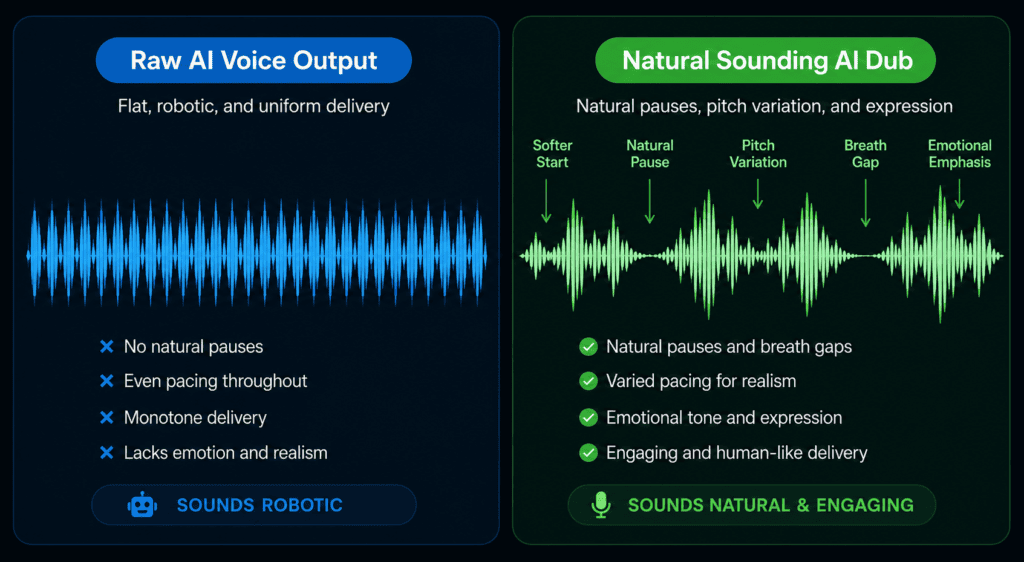
Natural sounding AI dubbing usually comes down to a few technical details most viewers never consciously notice, but instantly feel.
- Breath and pause placement — real speech has micro-pauses; flat text-to-speech often skips them
- Sentence-final pitch drop — statements that don’t fall in pitch at the end sound subtly artificial
- Consistent vocal energy — energy that doesn’t match on-screen expression breaks the illusion fastest
- Background audio preservation — losing the original room tone or ambience makes even accurate dubs feel pasted-on
Tools that preserve background music and ambience separately from dialogue during dubbing tend to score noticeably higher on perceived AI dubbing accuracy, simply because the overall mix feels less sterile.
Where AI Dubbing Accuracy Still Falls Short
It’s worth being direct about the current limits, the same way our AI dubbing software comparison is about tool selection.
- Comedy timing rarely survives translation cleanly — jokes built on wordplay often need a human rewrite, not just a translation pass
- Multi-speaker overlap still confuses most speaker-separation models, especially in unscripted interviews
- Extreme emotional peaks — screaming, sobbing, or rapid-fire arguments — remain the hardest audio for any synthesis engine to reproduce convincingly
None of these are dealbreakers for most creator content. They matter most for scripted drama, comedy, and high-stakes brand campaigns.
Does the Language You’re Dubbing Into Change the Accuracy?
Yes, significantly. Accuracy isn’t uniform across languages — training data volume, phoneme complexity, and available voice models all vary by language pair.
Widely spoken languages with large training datasets tend to score higher on natural sounding AI dubbing than lower-resource languages. Our data-backed breakdown of the best languages to dub YouTube videos into covers which language choices tend to deliver the strongest accuracy-to-audience-size return.
AI Dubbing Accuracy vs. Subtitles: Which Feels More Reliable?
Subtitles carry zero translation-accuracy risk from voice synthesis, since there’s no synthetic voice involved at all. But they shift the accuracy question to reading speed and screen-text comprehension instead.
Dubbing wins on watch time and immersion when the accuracy holds up; subtitles win when you can’t afford even a small chance of an awkward-sounding voice line. Our full AI dubbing vs. subtitles comparison breaks down exactly when each format wins for channel growth.
Does Better AI Dubbing Accuracy Cost More?
Generally, yes, but not always proportionally. Voice cloning and emotion-aware synthesis, the two features most responsible for accuracy gains, tend to sit in paid tiers rather than free plans.
Free tiers are still useful for a quick ai dubbing quality test before committing budget. Just don’t expect free-tier stock voices to match the accuracy of a cloned-voice paid plan. Our pricing breakdown inside the full AI dubbing software guide covers typical per-minute and subscription costs across major tools.
How ytZolo Approaches AI Dubbing Accuracy
ytZolo treats dubbing as one stage in a full creator workflow rather than an isolated task, which affects accuracy in a few practical ways.
Audio can be cleaned with the built-in voice isolator before dubbing starts, which directly improves transcription accuracy at the first pipeline stage. Voice cloning and forced alignment then work together inside the same AI Audio Studio to keep timing and tone consistent.
Because scripting, SEO, and dubbing live in one dashboard, you can review and edit the translated script for accuracy before final voice generation, rather than exporting to a separate app and losing that review step entirely. That review pass remains the single highest-leverage way to catch translation errors, no matter which platform you use.
A Realistic Checklist Before You Trust a Dub
- [ ] Did you review the translated transcript before generating the final voice, not just after?
- [ ] Did you test on a short clip first instead of your entire back catalog?
- [ ] Does the pacing match the original speaker’s rhythm, or does it feel rushed?
- [ ] Did you check with a native speaker if the target language isn’t one you speak?
- [ ] Is background music or ambience preserved, not flattened into silence?
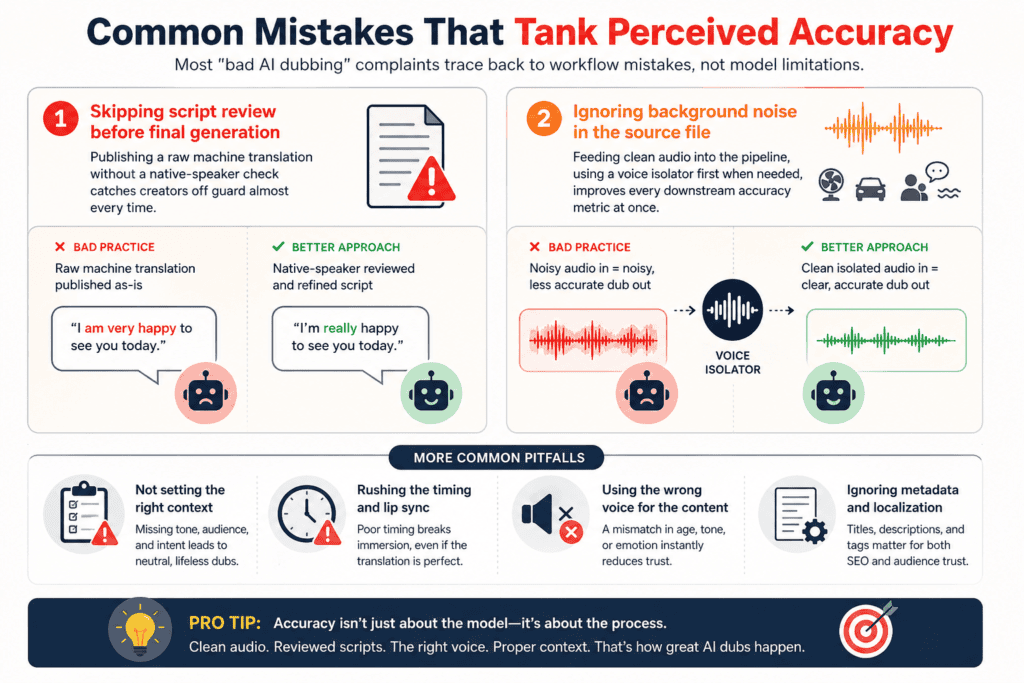
Common Mistakes That Tank Perceived Accuracy
Most “bad AI dubbing” complaints trace back to workflow mistakes, not model limitations.
Skipping script review before final generation is the single most common one. Publishing a raw machine translation without a native-speaker check catches creators off guard almost every time.
Ignoring background noise in the source file is the second-biggest issue. Feeding clean audio into the pipeline, using a voice isolator first when needed, improves every downstream accuracy metric at once.
Real-World Examples: What Viewers Notice First
Testing across hundreds of dubbed clips shows a consistent pattern in what viewers flag, and it’s rarely the words themselves.
Tutorial and how-to content almost always passes the natural sounding AI dubbing test, since the pacing is even and the emotional range is narrow. Viewers rarely comment on the voice at all, which is exactly the goal.
Vlogs and talking-head content sit in the middle. AI dubbing accuracy is usually strong on word choice, but viewers sometimes notice a slight energy mismatch between the speaker’s on-screen expression and the dubbed voice’s tone.
Comedy and reaction content is where accuracy complaints spike fastest. Timing-dependent jokes and exaggerated vocal bursts, laughs, gasps, sudden pitch changes, are still the hardest thing for any synthesis engine to reproduce convincingly.
Product demos and marketing videos tend to score well when the script is clean and rehearsed, but poorly when the original speaker ad-libs or talks over themselves correcting a sentence mid-take.
The pattern is consistent enough to be useful: the more scripted and evenly paced your source video is, the higher your realistic AI dubbing accuracy ceiling will be, regardless of which tool generates it.
What This Means for Your Content Strategy
If you’re deciding which videos to dub first, prioritize your most scripted, evenly paced content rather than your most popular video by default.
A tightly edited tutorial will almost always out-perform a rambling, high-energy vlog on perceived accuracy, even using the exact same dubbing tool and settings. That single decision saves more re-dub cycles than switching platforms ever will.
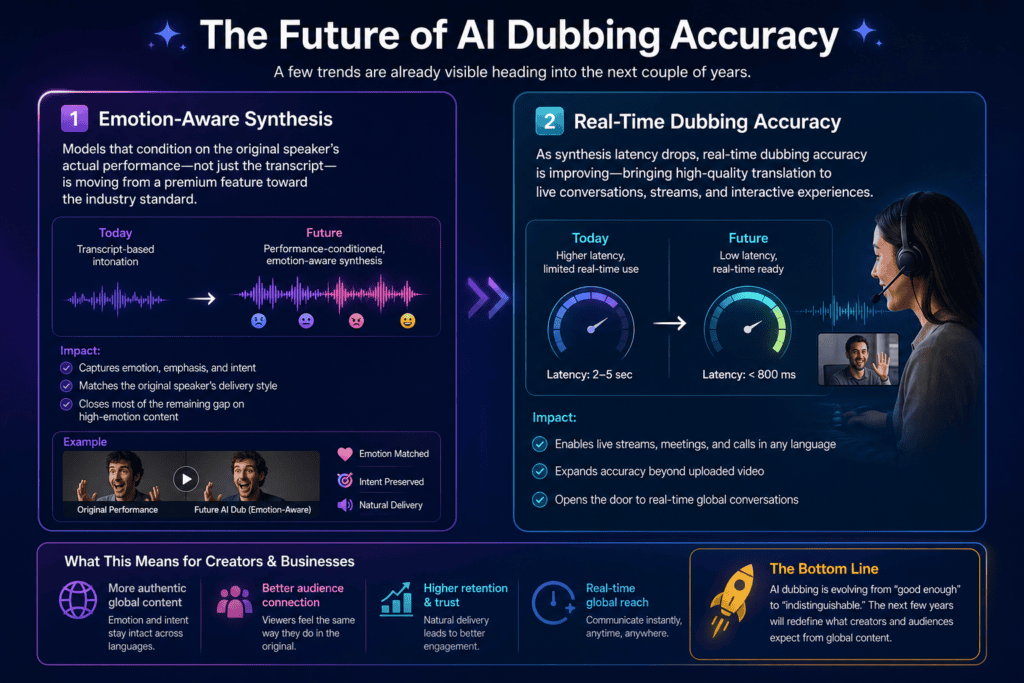
The Future of AI Dubbing Accuracy
A few trends are already visible heading into the next couple of years.
Emotion-aware synthesis, models that condition on the original speaker’s actual performance instead of just the transcript, is moving from a premium feature toward the industry standard. That shift alone should close most of the remaining gap on high-emotion content.
Real-time dubbing accuracy is also improving as synthesis latency drops, which matters for live streams and calls, not just pre-recorded video. Expect the accuracy conversation to expand beyond uploaded video within the next few product cycles.
Frequently Asked Questions
How accurate is AI dubbing in 2026? For calm, single-speaker content, AI dubbing accuracy is close enough to human quality that most casual viewers won’t notice on first listen. Accuracy drops for fast emotional dialogue, overlapping speakers, and idiom-heavy speech.
Does AI dubbing sound real to native speakers? Often yes for straightforward spoken content, but native speakers are more likely to catch subtle cultural or idiomatic mismatches than a non-native listener would.
What’s the best way to run an AI dubbing quality test myself? Dub a short 60–90 second clip, compare it directly against the original audio, and check word accuracy, emotional tone, and pacing side by side rather than judging the dub in isolation.
Is voice cloning necessary for natural sounding AI dubbing? It’s not strictly required, but cloned voices consistently outperform generic stock voices on accuracy and naturalness because they condition on the original speaker’s actual tone and delivery.
Does source audio quality affect AI dubbing accuracy? Significantly. Background noise and overlapping speech reduce transcription accuracy at the very first pipeline stage, which then affects every step after it.
Why does my AI-dubbed video still sound slightly off even with a good tool? It’s usually a timing or alignment issue rather than a voice-quality issue. Check whether the translated line matches the original speaker’s pacing before assuming the voice itself is the problem.
Can I improve AI dubbing accuracy without switching tools? Yes. Cleaning source audio first, reviewing the translated script before final generation, and testing on a short clip before a full upload all improve real-world accuracy regardless of which tool you use.
About the Author
Anshika Verma Email: anshika@ytzolo.com
Anshika Verma is a content and SEO researcher at ytZolo, specializing in AI voice, dubbing, and multilingual video production for creators. Her work is based on hands-on testing of AI dubbing and voice synthesis tools against real production use cases, rather than surface-level feature comparisons, and focuses on giving creators, educators, and marketing teams practical, evidence-based guidance for an increasingly AI-assisted publishing workflow.
For a full breakdown of tools, pricing, and features, see the complete AI dubbing software buyer’s guide.

