
Quick Summary: AI has compressed SEO content workflows from separate, week-long stages into fast, overlapping loops covering research, drafting, on-page optimization, and even thumbnails and voiceovers. Production got faster, but Google’s bar for helpful, original, people-first content hasn’t moved. Connected platforms like ytZolo show what this looks like in practice, generating scripts, SEO metadata, thumbnails, and voice from one brief instead of five separate tools. The workflows that hold up in 2026 use AI for speed and keep a human in charge of fact-checking, brand voice, and final judgment.
SEO content used to move in a straight line. You picked a keyword, wrote a draft, added some headers, and waited weeks to see if it ranked.
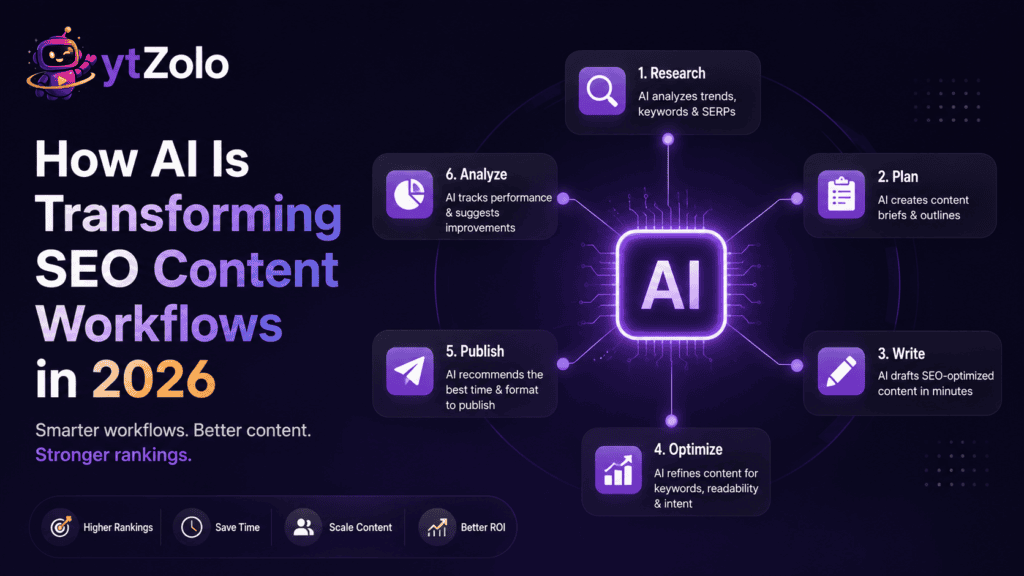
That line is gone. How AI is transforming SEO content workflows in 2026 is really a story about compression — research, writing, optimization, and publishing now happen in overlapping loops instead of separate stages.
This guide breaks down what actually changed, what still needs a human, and how to build a workflow that holds up under Google’s helpful content standards.
Table of Contents
1. What Changed in AI SEO Content Workflows
Three years ago, “AI content” mostly meant one thing: a chatbot drafting paragraphs.
In 2026, AI touches nearly every step of the workflow. Topic research, outline building, on-page structure, internal linking suggestions, meta tags, and even visual assets like thumbnails and cover images are now assisted by AI tools.
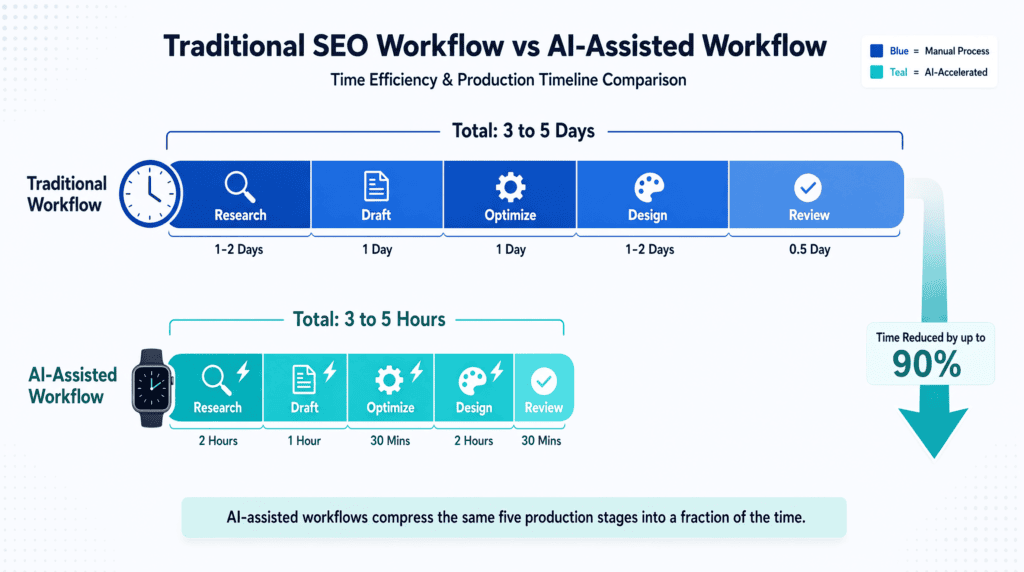
The bigger shift is speed of iteration. Teams no longer wait a full sprint to test a content idea. They can draft, structure, and publish a well-researched page in a single day, then revise it based on real performance data within a week.
This is the core of AI SEO content workflow thinking: less time spent on repetitive production tasks, more time spent on judgment calls — what to say, who it’s for, and whether it’s actually useful.
From Single Tools to Connected Systems
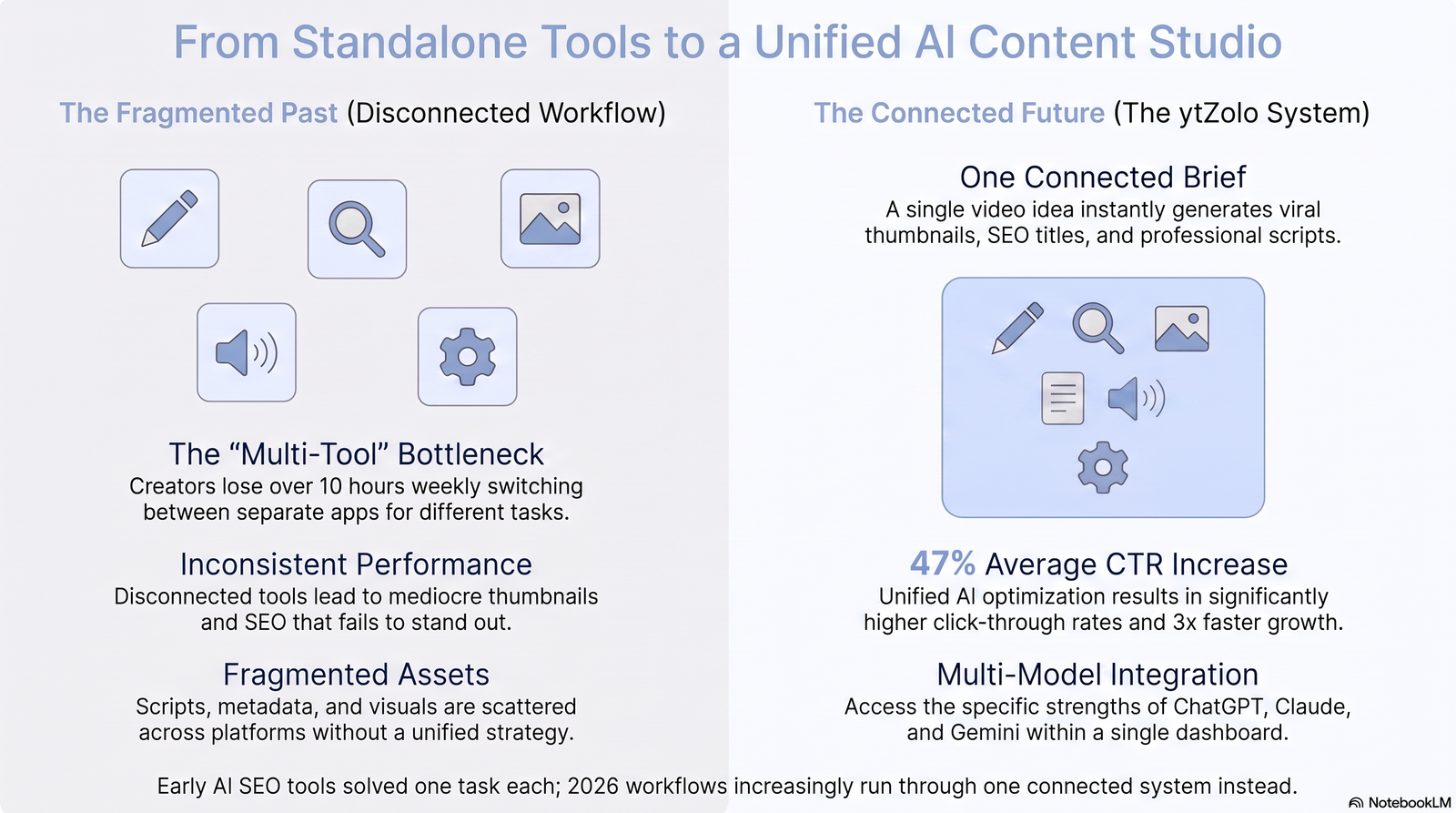
Early AI SEO tools solved one problem each: one for keyword research, one for drafting, one for grammar checks. Creators stitched five or six subscriptions together.
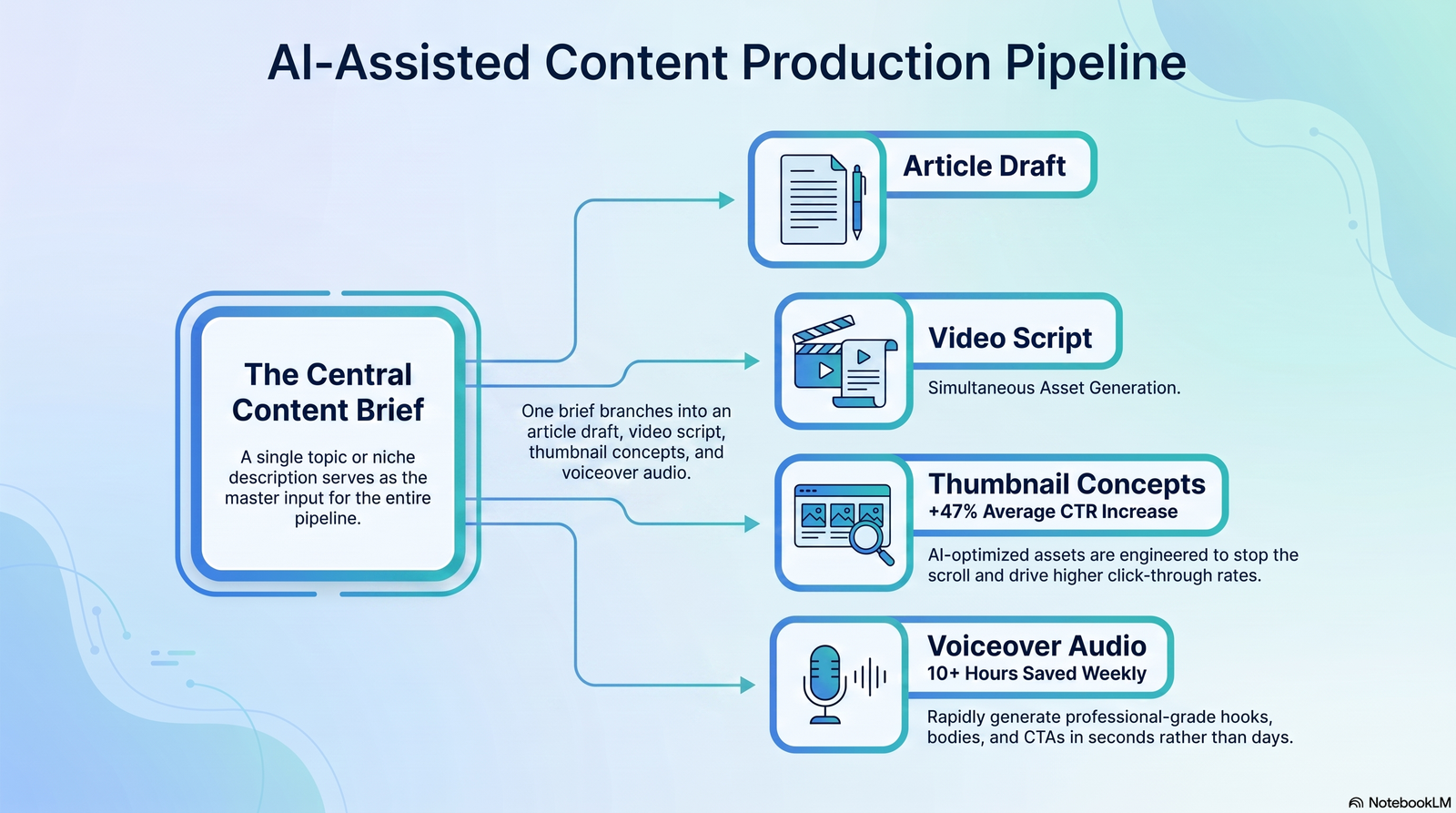
By 2026, the trend has moved toward connected systems where writing, SEO metadata, and supporting media are generated from the same content brief, so everything stays consistent instead of drifting apart.
2. Why This Shift Matters for Creators and Marketers
Speed alone doesn’t win rankings. Google has been consistent that content needs to be helpful, reliable, and people-first, regardless of how it was produced.
What AI actually changes is capacity. A solo blogger or a two-person marketing team can now cover a topic cluster that used to require a much larger team — as long as they still apply editorial judgment to every draft.
This matters for a wide range of people:
- SEO professionals managing dozens of client sites with limited hours
- Bloggers and freelancers who need to publish consistently without burning out
- Agencies balancing quality with client volume
- YouTube creators who need scripts, titles, descriptions, and thumbnails aligned for both YouTube search and Google
- Startups and SaaS teams building topical authority from a blank domain
The workflow shift isn’t about removing people from content. It’s about removing repetitive steps so people can spend more time on strategy, accuracy, and originality.
A Simple Before-and-After Example
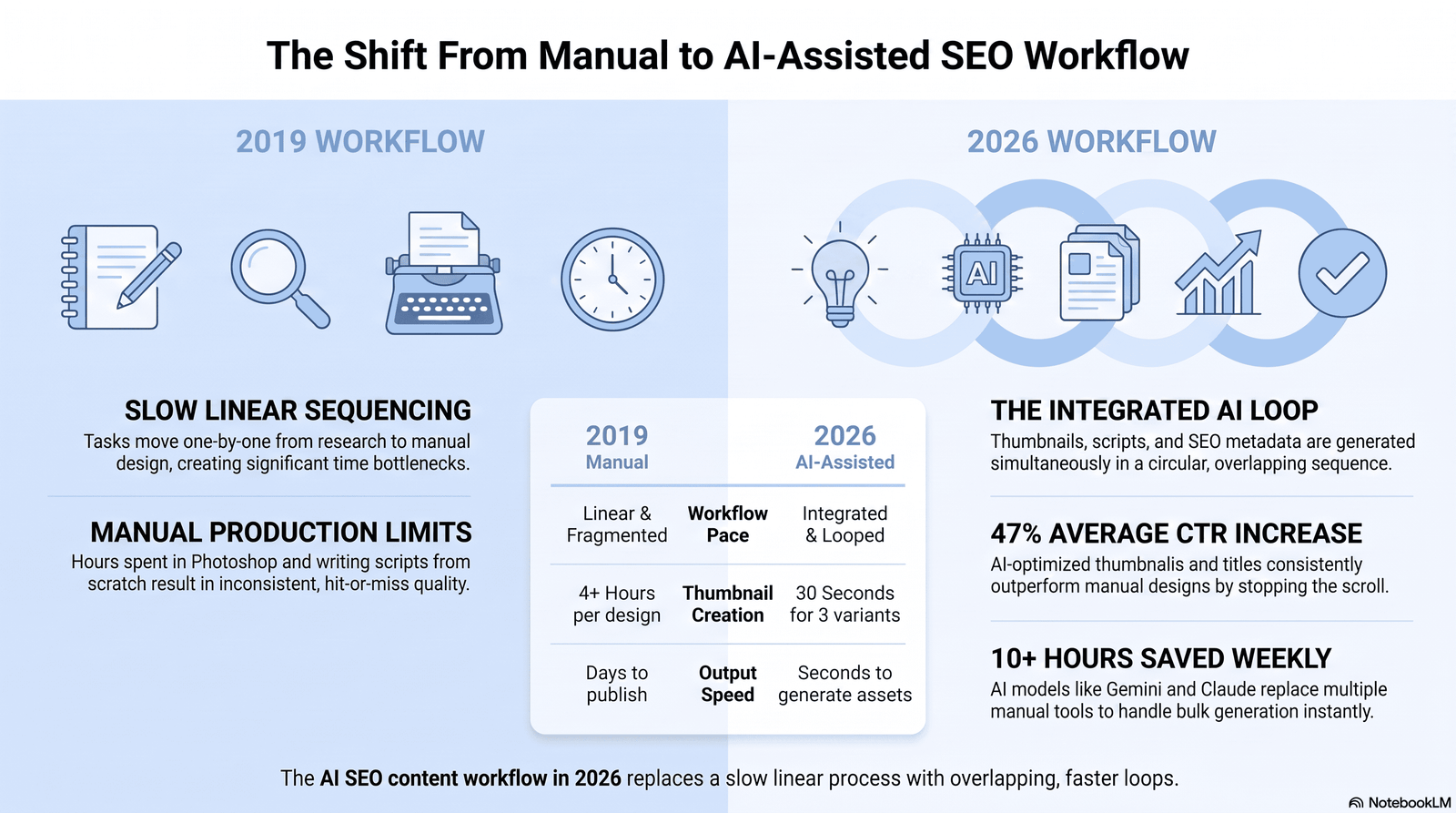
Picture a small YouTube channel covering personal finance. In 2019, publishing one well-optimized video meant writing a script, researching a title, designing a thumbnail in Photoshop, writing a description, and picking tags — often across four or five separate days.
In 2026, the same creator can draft the script, generate title options, produce thumbnail variants, and write the description and tags from one topic brief in a single afternoon. The research and strategy decisions — what angle to take, which claims need a source, what the audience actually wants — still take the same amount of thought. What disappeared is the manual production time in between.
This is the practical meaning of an AI-powered SEO content strategy: less time lost to production mechanics, more time available for the decisions that actually move rankings and retention.
3. Traditional SEO vs AI SEO Content workflow
| Task | Traditional Workflow | AI-Assisted Workflow (2026) |
|---|---|---|
| Keyword research | Manual tool exports, spreadsheets | AI clustering with intent grouping |
| Outline creation | Written from scratch | Draft outline generated, then edited |
| First draft | Fully manual, hours per article | AI-assisted draft, human rewrite pass |
| Meta title/description | Written manually per page | Generated in batches, human-approved |
| Internal linking | Manually searched | Suggested based on site content |
| Thumbnails/visuals | Designed in Canva or Photoshop | AI-generated variants, human selection |
| Localization | Hired translators per language | AI dubbing/translation, human review |
| Performance review | Monthly manual reports | Ongoing AI-assisted trend flags |
The table shows a pattern: AI removes the blank-page problem and the repetitive production work. Humans still make the final call at almost every row.
4. How AI Is Improving Each Stage of the Workflow
Ideation and Topic Research
AI tools can scan search intent signals, related questions, and competitor gaps faster than manual research allows. This doesn’t replace strategy — it gives strategists more raw material to choose from.
A practical approach: feed an AI tool your target keyword and ask it to map out subtopics, related searches, and People Also Ask–style questions. Then a human decides which ones actually fit the content plan.
Writing and Structuring Content
AI content creation for SEO has moved past generic paragraph generation. Modern tools can draft in a defined structure — H2s, H3s, short paragraphs, and even suggested tables — based on a content brief.
The catch is that AI drafts still need fact-checking, source verification, and a voice pass. Google’s own guidance on using generative AI content is clear that quality and originality matter more than how content was produced, not less.
SEO Optimization
This is where AI has matured the most. Tools can now suggest:
- Title tags within character limits
- Meta descriptions that match search intent
- Header structure aligned to semantic SEO
- Related entities and LSI keywords to include naturally
For platforms built around video, this extends to YouTube-specific SEO — titles, descriptions, and tags generated together so they reinforce the same keyword strategy instead of being written in isolation.
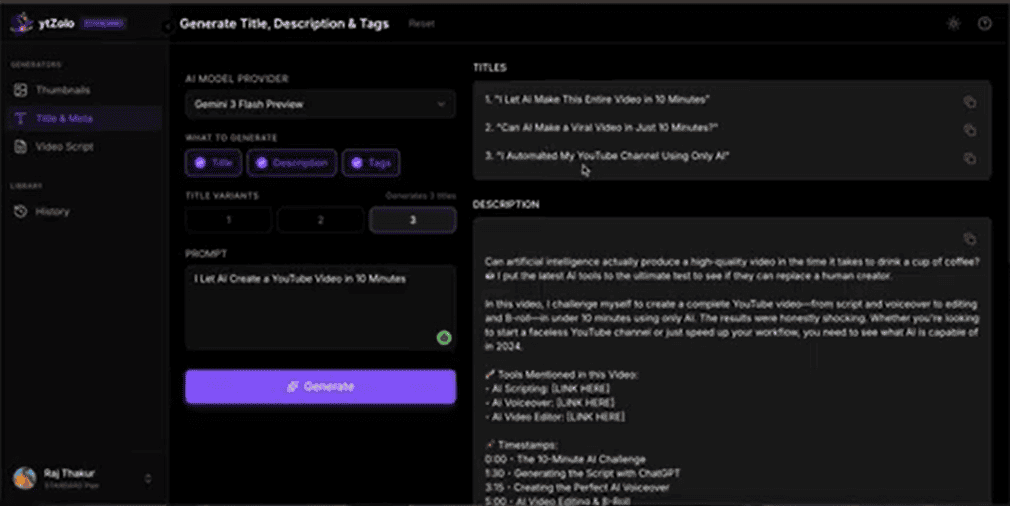
ytZolo’s SEO Optimizer, for example, generates titles, descriptions, and tags from the same video brief, which keeps the metadata consistent instead of guessing at each field separately. For a deeper look at how different description tools compare, see this breakdown of YouTube description generator tools.
Visual Content and Thumbnails
Visual assets are part of SEO too, especially click-through rate, which indirectly affects performance. AI thumbnail tools can now generate multiple CTR-focused variants from a single text description instead of requiring manual design work.
ytZolo’s AI Thumbnail Generator is one example of this, producing multiple thumbnail variations aligned with the video’s title and script rather than as a standalone design task. A closer comparison of how this compares to general design tools is covered in this guide to AI YouTube thumbnail generators.
Voice, Audio, and Multilingual Content
Audio and video content now sit inside the same SEO conversation as blog posts, because Google increasingly surfaces video and podcast content in search results.
AI voice generation, multi-voice dialogue, and dubbing tools let a single creator produce voiceovers and translated versions of a video without hiring a full production team.
ytZolo’s audio studio includes text-to-speech voice generation, a voice changer, voice isolation, AI music and sound effects, and AI dubbing for translating videos into other languages. For a wider view of how dubbing tools work across the market, this AI dubbing software guide covers the landscape in more depth.
Content Repurposing and Localization
SEO content automation with AI also shows up in repurposing: turning one long-form article into a script, a set of social captions, and a voiceover, without rewriting everything from scratch.
Localization used to be the most expensive part of scaling content internationally. AI dubbing and translation tools have lowered that cost significantly, though human review is still recommended for accuracy and cultural nuance.
The Widening Tool Landscape
Most SEO teams now use a mix of tools rather than one single platform. Research and rank tracking often still run through established platforms like Ahrefs, Semrush, or Moz, which have added AI features on top of their existing keyword and backlink data.
Writing and on-page optimization increasingly happen in dedicated AI content platforms, while video-specific work — scripts, thumbnails, SEO metadata, and audio — has started consolidating into single platforms built for creators, rather than staying spread across five separate subscriptions.
This is part of why all-in-one AI content platforms have grown quickly since 2025; managing fewer logins and fewer inconsistent outputs is a real time saving, not just a marketing point. A broader look at this shift toward consolidated tooling is covered in this guide to all-in-one AI platforms and this comparison of top AI tools in 2026.
For teams deciding whether to consolidate or keep specialized tools, a useful test is asking whether outputs need to stay consistent with each other.
A blog-only SEO team may not need this. A video-first creator whose title, thumbnail, script, and description all need to reinforce the same keyword strategy usually benefits from a connected workflow, as covered in this YTZolo, Descript, and VEED workflow comparison.
5. ytZolo in Practice: A Connected AI Workflow Example
Most of the individual capabilities described above — AI writing, thumbnail generation, SEO metadata, voice, and dubbing — exist as standalone tools somewhere. What’s changed in 2026 is that some platforms now run them from the same content brief instead of five separate logins.
ytZolo is one example of this consolidated approach, built specifically for YouTube creators rather than general blog SEO. It’s a useful case study of what a connected AI SEO content workflow looks like in practice.
Writing and SEO Layer
- AI Script Writer — generates hooks, body, and CTA sections for a video script from a topic input.
- AI Title Generator — produces multiple title options aimed at search and click-through performance.
- AI Description Generator — writes keyword-rich video descriptions intended to support YouTube search ranking.
- AI Tags Generator — suggests relevant tags aligned with the same topic and title.
Because these four outputs are generated from the same brief, the title, description, and tags reinforce a single keyword strategy instead of being written separately and drifting apart — the same consistency problem this article’s earlier sections describe as a core benefit of connected workflows.
Visual and Audio Layer
- AI Thumbnail Generator — produces multiple thumbnail variations from a text description, without requiring separate design software.
- Voice Generator (text-to-speech) and Multi-Voice Dialogue — for narration or multi-character voiceovers.
- Voice Changer and Voice Isolator — for adjusting or cleaning up recorded audio.
- AI Music Generator and AI Sound Effects — for background scoring and SFX without licensing separate stock audio.
- AI Dubbing — translates and re-voices videos into other languages for multilingual distribution.
Where This Fits the Broader Workflow
None of this replaces the editing and fact-checking steps covered earlier in this article. A generated script still needs a human pass for accuracy and voice, and generated titles or thumbnails still need a human to pick the strongest option before publishing.
What a connected platform like ytZolo changes is the number of separate tools a solo creator or small team has to manage to get from a topic idea to a fully packaged, SEO-optimized video — script, title, description, tags, thumbnail, and voice, from one input rather than several.
6. Where Human Expertise Still Wins
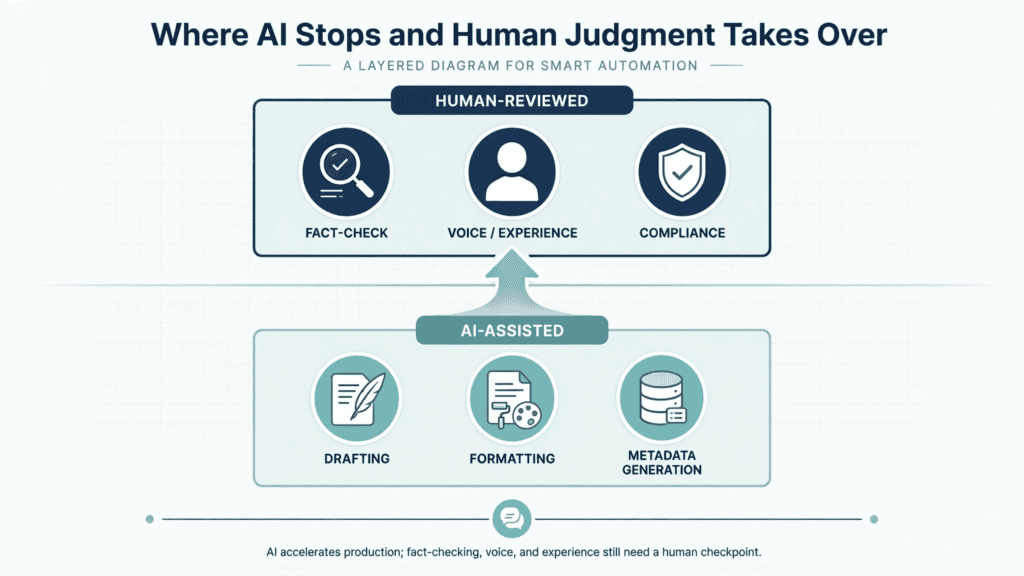
AI is fast at production. It is not reliable at judgment. A few areas where human review remains essential:
- Fact-checking and citations. AI models can generate confident but incorrect claims. Every statistic or factual claim needs a source check before publishing.
- Brand voice and nuance. AI drafts tend toward generic phrasing unless heavily edited.
- Legal, medical, and financial topics. These fall under Google’s higher scrutiny for expertise and trustworthiness, and mistakes carry real consequences.
- Strategic prioritization. AI can generate a hundred topic ideas. Deciding which ten actually serve the business takes human context.
- E-E-A-T signals. Author expertise, first-hand experience, and original insight can’t be manufactured by a model — they come from the person or team behind the content.
A helpful mental model: let AI handle the blank page and the repetitive formatting. Keep humans in charge of accuracy, originality, and final judgment.
Why “Experience” Is Hard to Fake
Google’s E-E-A-T framework starts with Experience — evidence that the content creator has actually done the thing they’re writing about. This is the hardest signal for AI to replace, because it requires a real event: a test that was run, a tool that was actually used, a mistake that was actually made and learned from.
Practically, this means the strongest AI-assisted content still includes things a model can’t invent: a screenshot from your own account, a specific number from your own results, or a detail that only shows up when someone has genuinely tried the process being described.
Teams that build this into their workflow — even as a mandatory checklist item — tend to hold up better through core updates than teams publishing purely AI-synthesized summaries of other articles.
7. A Practical AI SEO Content Workflow (Step by Step)
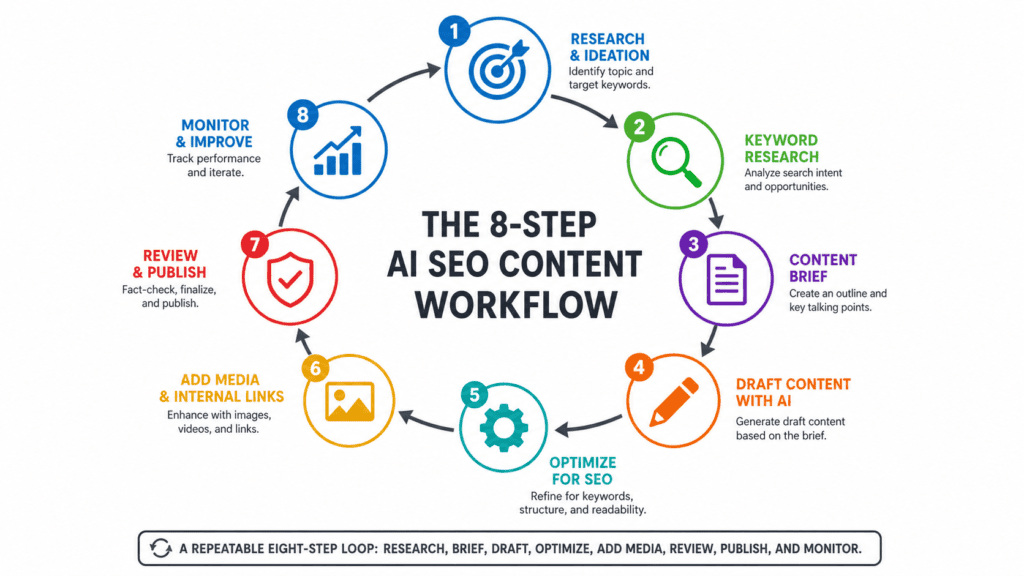
- Define the topic and intent. Confirm whether the search intent is informational, commercial, or transactional before writing anything.
- Research with AI assistance. Generate subtopic and question lists, then manually prune anything off-topic or low-value.
- Build a content brief. Include target keyword, secondary keywords, structure, and word count target.
- Draft with AI, edit as a human. Use AI for the first pass, then rewrite weak sections, add original examples, and verify facts.
- Optimize on-page elements. Titles, meta descriptions, headers, and internal links, checked against the on-page SEO checklist below.
- Add supporting media. Images, tables, and — for video content — thumbnails, scripts, and voiceovers generated from the same brief for consistency.
- Run a quality and compliance check. Review against Google’s helpful content guidance before publishing.
- Publish and monitor. Track rankings and engagement, and feed underperforming pages back into the research step.
Checklist: Before You Hit Publish
- [ ] Primary keyword appears in the title, H1, and first paragraph
- [ ] Meta description is 140–155 characters and matches intent
- [ ] All factual claims are checked against a source
- [ ] At least one internal link and one external authority link included
- [ ] Images have descriptive alt text
- [ ] Paragraphs are short and scannable
- [ ] FAQ section addresses real search queries
- [ ] Content adds something the top-ranking pages don’t already cover
Feeding Performance Data Back Into the Workflow
The step teams skip most often is the last one: using real performance data to inform the next round of content. A page that underperforms isn’t always a writing problem — sometimes the search intent was misjudged, or a competitor page simply covers the topic more thoroughly.
Checking Search Console data every few weeks, comparing top queries against what the page actually targets, and adjusting headers or sections accordingly closes the loop. This turns the workflow from a one-time production line into something closer to a feedback system, which tends to compound in results over time rather than plateauing after the first publish.
8. Common Mistakes vs Best Practices
| Common Mistake | Better Practice |
|---|---|
| Publishing AI drafts with no edits | Always run a human editing and fact-check pass |
| Keyword stuffing the primary term | Use natural variations and semantic terms |
| Ignoring search intent | Match content format to what’s already ranking |
| Skipping internal links | Link to related, genuinely relevant pages |
| Using AI for E-E-A-T claims without disclosure | Keep author bios accurate and specific |
| Treating AI tools as a replacement for strategy | Use AI for production, keep humans on strategy |
| One-size-fits-all content across languages | Localize tone and examples, not just words |
9. Google’s Guidance on AI Content and Quality
Google has repeatedly said that how content is produced — by a person, with AI assistance, or through automation — matters less than whether the content is original, accurate, and genuinely useful to the reader.
Two things are worth understanding here.
Core updates are broad ranking system changes, rolled out several times a year, aimed at better recognizing helpful and reliable content overall. They aren’t targeted at specific sites, and Google recommends against panic-driven “quick fixes” — instead, sites should focus on sustainable, people-first improvements. You can track when these happen on the Search Status Dashboard.
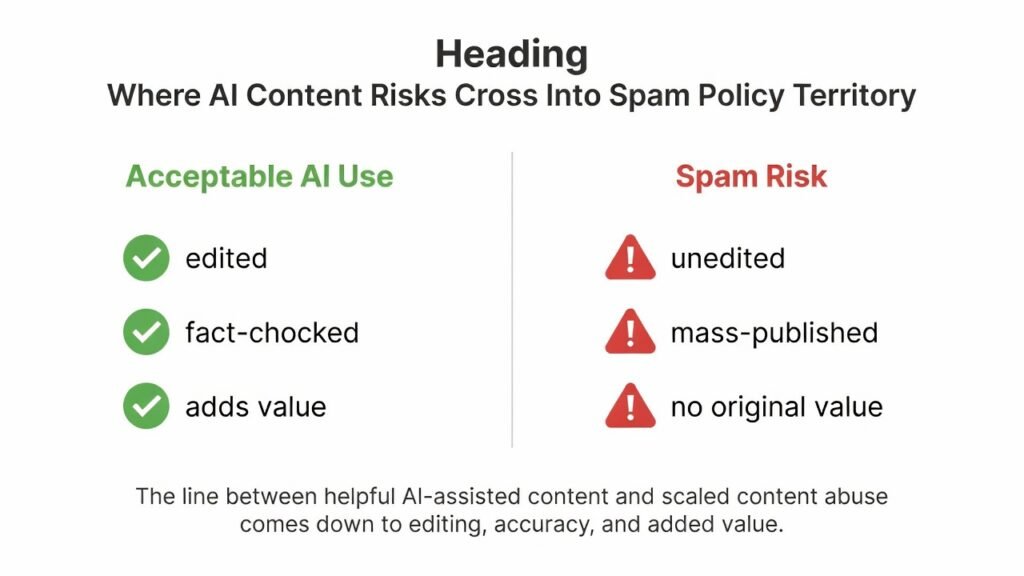
Spam policies exist separately from core updates and specifically address manipulative practices — including scaled content abuse, where large volumes of low-value pages (AI-generated or not) are published primarily to manipulate rankings rather than help users. The full policy details are available in Google’s spam policies documentation.
The practical takeaway: AI use itself is not a violation. Mass-producing unedited, low-value content at scale is what creates risk, regardless of whether a human or a model typed the words.
A Quick Self-Check
Before publishing AI-assisted content, ask:
- Does this page exist primarily to help a real reader, or primarily to rank?
- Would I be comfortable if a competitor read this and knew it represented my expertise?
- Does this add something not already covered by the top-ranking pages?
If any answer is uncertain, that’s a signal to add more original research, examples, or editing before publishing.
10. Future Trends Beyond 2026
- Tighter integration between content and multimedia. Expect more platforms to generate text, visuals, and audio from a single brief rather than separate tools for each.
- More emphasis on original data and experience. As AI-written text becomes common, content backed by real testing, screenshots, or first-hand results will stand out more, not less.
- Search results blending text, video, and audio. Optimizing for “SEO” increasingly means optimizing for how content performs across formats, not just blog rankings.
- Faster localization cycles. AI dubbing and translation will keep shrinking the time and cost gap between publishing in one language versus many.
- Stronger scrutiny on E-E-A-T. As more content gets AI assistance, demonstrating genuine expertise and experience becomes a bigger differentiator, not a smaller one.
- Growth of AI-generated audio content. Podcasts and audiobook-style content are becoming easier to produce from existing written content, which opens a new distribution channel for the same underlying research and ideas.
- Automated but reviewed workflows becoming the norm. The teams that perform best tend to combine automation for speed with a fixed human review checkpoint before anything publishes — rather than choosing one extreme or the other.
None of these trends remove the need for original thinking. If anything, they raise the bar, because the volume of average AI-assisted content on the web keeps increasing, which makes genuinely well-researched, well-edited work stand out more clearly.
For creators comparing the wider AI tool landscape as these trends develop, this side-by-side AI comparison guide and this overview of popular AI tools in 2026 are useful starting points.
11. FAQs
1. Does using AI to write content hurt my SEO rankings? No, not by itself. Google has said content produced with AI assistance is treated the same as human-written content, as long as it’s original, accurate, and helpful. Low-quality, unedited mass content is the actual risk factor.
2. What is an AI SEO content workflow? It’s a content production process where AI tools assist with research, drafting, on-page optimization, and supporting media like images or audio, while humans handle editing, fact-checking, and strategy.
3. Can AI replace SEO writers completely? Not reliably. AI speeds up production, but judgment calls around accuracy, brand voice, and originality still need human input to meet quality and trust standards.
4. How much should I edit AI-generated drafts? Enough to verify every factual claim, adjust tone to match your brand, and add original insight or examples the AI couldn’t have known. A full rewrite isn’t always necessary, but a thorough edit is.
5. What is keyword density and does it still matter in 2026? Keyword density refers to how often a keyword appears relative to total word count. It matters less than natural language and topical coverage now, but staying around 1–1.5% for a primary keyword still avoids both stuffing and under-optimization.
6. What is scaled content abuse? It’s a Google spam policy category covering large volumes of low-value pages published mainly to manipulate search rankings, regardless of whether they were written by a person or generated by AI.
7. How does AI help with YouTube SEO specifically? AI tools can generate titles, descriptions, and tags together from the same video brief, which keeps metadata consistent and saves the time of writing each element separately.
8. Are AI thumbnails as effective as designer-made ones? AI thumbnail tools generate multiple CTR-focused variants quickly, which is useful for testing. Designer input still adds value for brand consistency and unique visual style at scale.
9. What’s the difference between a core update and a spam update? Core updates are broad ranking system refreshes aimed at surfacing more helpful content overall. Spam updates specifically target manipulative practices like scaled content abuse or link spam.
10. Do I need separate tools for writing, thumbnails, and voiceovers? Not necessarily. Some platforms now combine these into one workflow so outputs stay aligned, though standalone specialized tools still exist for teams with very specific needs.
11. How often should I update AI-assisted content? Review high-traffic pages at least quarterly, and any time you notice a ranking drop that correlates with a core update, using Search Console data to guide changes.
12. What’s the biggest mistake teams make with AI content workflows? Treating AI output as a finished product instead of a first draft. Skipping the human review step is the most common cause of quality and trust issues.
12. Key Takeaways
- AI has compressed SEO content workflows from separate stages into overlapping, faster loops.
- Production speed increased, but Google’s quality standards for helpfulness and originality haven’t changed.
- Human review remains essential for fact-checking, brand voice, and E-E-A-T signals.
- Connected workflows — where writing, SEO metadata, and media come from one brief — reduce inconsistency compared to juggling separate tools.
- Scaled, unedited content is the real ranking risk, not AI use itself.
- Localization, audio, and video are now part of the same SEO conversation as written content.
13. Conclusion
AI hasn’t changed what makes content rank. It’s changed how fast a team can get from idea to a well-structured, properly optimized page.
The workflows that hold up in 2026 are the ones that use AI for research, drafting, and production, while keeping a human firmly in charge of accuracy, originality, and final judgment.
If you’re rebuilding your own workflow, start small: pick one stage — research, drafting, or metadata — and add AI assistance there first. Measure the time saved and the quality of the output before expanding it across your whole content process.
Author
Anshika Verma Researcher and AI content strategist with hands-on experience evaluating AI tools, SEO workflows, and creator productivity platforms. Focuses on practical testing, transparent analysis, and content aligned with Google’s E-E-A-T principles.
Email: anshika@ytzolo.com

