
By Anshika Verma · Content & SEO Researcher, ytZolo · Updated August 2026 · ~14 min read
Quick answer: In the montreal forced aligner vs gentle debate, both are free, Kaldi-based, open-source tools that time a known script against audio. MFA gives you more control — custom acoustic models, multiple languages, and phoneme-level TextGrids — but needs a Python setup. Gentle is lighter and Docker-friendly, but it’s built mainly for English and hasn’t seen active updates in years. If you don’t want to manage a local pipeline at all, an AI platform like ytZolo runs the same underlying alignment step inside a normal creator workflow, without any installation.
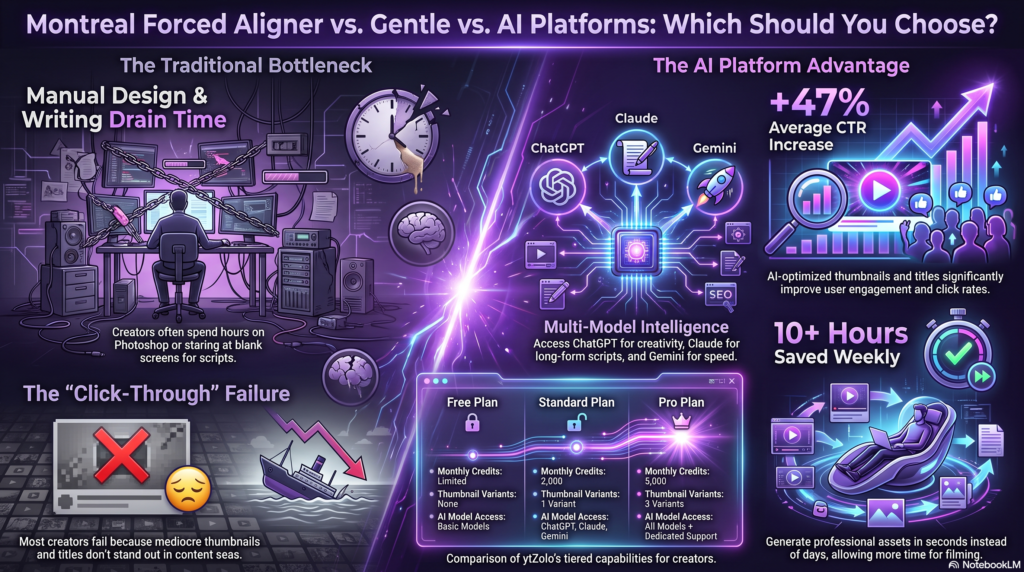
Table of Contents
Why This Comparison Matters
Most “best forced alignment tools” roundups treat every option as interchangeable. They aren’t.
Montreal Forced Aligner and Gentle solve the exact same problem in genuinely different ways, and an AI platform solves it differently again. Picking wrong means either wasted setup time or a tool that can’t do what you actually need.
This guide is a direct, branded head-to-head: Montreal Forced Aligner vs Gentle vs AI platforms, not a generic “best of” list. If you’re new to the underlying concept first, our forced alignment explainer covers what the process actually does.
What Is Forced Alignment, Briefly
Forced alignment maps a known transcript to its matching audio, timestamp by timestamp. The text is already correct — the model’s only job is figuring out when each word was spoken.
That’s different from transcription, which guesses at words it hears. Because the script is fixed, alignment tools tend to produce tighter timing than transcription-based captioning.
Every tool in this comparison — Montreal Forced Aligner, Gentle, and AI platforms — does this same core job. They differ in how you run them and how much control you get.
Montreal Forced Aligner: Overview
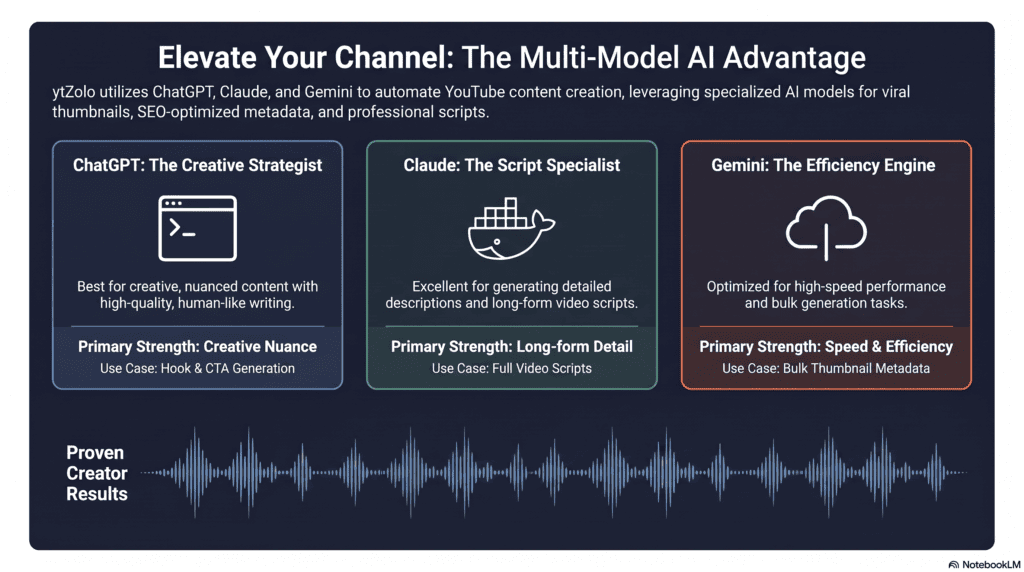
The Montreal Forced Aligner (MFA) is an open-source command-line tool built on the Kaldi ASR toolkit. It’s maintained by researchers at McGill University and widely used in linguistics and phonetics labs.
MFA works from a pronunciation dictionary that maps written words to their phonetic pronunciations, then trains acoustic models in stages — starting with simple monophone models, refining them into context-aware triphone models, and finishing with a speaker-adapted pass.
That staged training is what gives MFA an edge for custom or unusual language varieties: you can train it on your own corpus rather than relying only on a pretrained model.
MFA outputs Praat-style TextGrid files by default, which support both word-level and phoneme-level timing — useful if your project needs the deeper granularity our phoneme-level vs. word-level alignment guide walks through.
MFA Strengths
- Broad language support through community and pretrained acoustic models
- Phoneme-level TextGrid output alongside word-level timing
- Full control to train custom models on your own data
- Active development, with releases and documentation still maintained in 2026
MFA Limitations
- Requires a Python environment and command-line comfort
- No built-in publishing, captioning, or export workflow
- Steeper learning curve for anyone outside a research or engineering background
Gentle: Overview
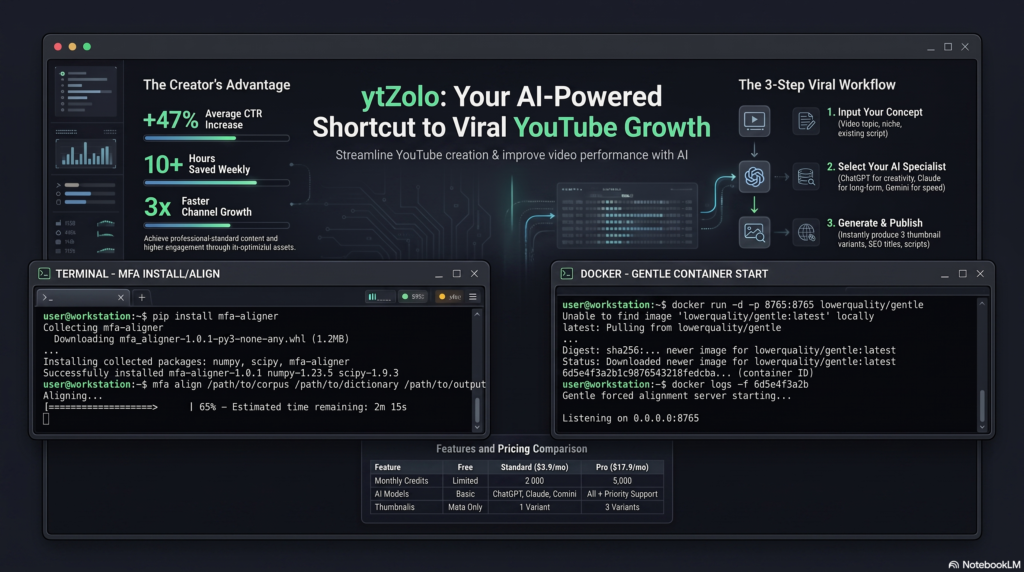
Gentle is a free, open-source forced aligner built on top of Kaldi as well, but stripped down specifically for English word-level alignment. It ships with a simple web interface and a Docker image, which makes local setup somewhat lighter than MFA’s Python dependency chain.
Where MFA leans toward linguistics research, Gentle was designed by developers building transcription and captioning pipelines who wanted something they could drop into a script without deep ASR expertise.
Gentle outputs word-level JSON with start and end timestamps for each word, plus confidence scores flagging words it wasn’t fully sure about — a handy signal for spotting sections worth a manual review.
The trade-off is scope. Gentle’s language coverage is narrow, its GitHub repository hasn’t seen frequent updates in recent years, and it doesn’t offer the phoneme-level TextGrid output that MFA does.
Gentle Strengths
- Simple Docker-based setup compared to MFA’s full Python stack
- Built-in confidence scores per word
- Straightforward JSON output that’s easy to parse in a script
Gentle Limitations
- Effectively English-only in practical use
- Development has slowed, so bug fixes and updates are infrequent
- No phoneme-level output or custom model training path
Montreal Forced Aligner vs. Gentle: Side-by-Side
| Montreal Forced Aligner | Gentle | |
|---|---|---|
| Underlying engine | Kaldi ASR toolkit | Kaldi ASR toolkit |
| Output granularity | Word-level and phoneme-level (TextGrid) | Word-level only (JSON) |
| Setup | Python environment, pronunciation dictionary | Docker or local install, lighter dependency chain |
| Language coverage | Broad, with trainable custom models | Primarily English |
| Custom model training | Yes | No |
| Maintenance status | Actively maintained in 2026 | Infrequent updates |
| Best for | Linguists, researchers, custom-dialect work | Developers who want quick English-only alignment |
Both tools are free and both run entirely on your own machine, which means neither one sends audio or scripts to a third-party server. That matters for teams with strict data-handling requirements.
The real fork in the montreal forced aligner vs gentle decision is scope versus simplicity: MFA does more, at the cost of a heavier setup; Gentle does less, faster to get running.
Where AI Platforms Fit Into This Comparison
Neither MFA nor Gentle was built as a publishing tool. Both output raw alignment data — a TextGrid or a JSON file — that still needs to become captions, a dubbed track, or an audiobook chapter file.
AI platforms handle the same underlying alignment step through an upload-and-generate interface, with no local install, and they typically bundle it alongside the rest of a content pipeline: scripting, voice generation, dubbing, and export.
That’s the structural difference worth understanding before comparing features line by line. Open-source aligners are a component you assemble into a pipeline yourself. A platform is the pipeline.
For a one-off academic project or a highly customized dialect model, that trade-off tilts toward MFA. For a creator or agency publishing captioned or dubbed content on a recurring schedule, it usually tilts the other way.
Full Comparison: Montreal Forced Aligner vs. Gentle vs. AI Platforms
| Montreal Forced Aligner | Gentle | AI Platform (e.g. ytZolo) | |
|---|---|---|---|
| Setup effort | Moderate–high (Python, dictionaries) | Moderate (Docker) | None (browser upload) |
| Cost | Free | Free | Included in a subscription |
| Output granularity | Word + phoneme | Word only | Word-level by default |
| Language coverage | Broad, trainable | Mostly English | Broad, covers major world languages |
| Publishing workflow | None built-in | None built-in | Built-in (captions, dubbing, export) |
| Data handling | Local, on your machine | Local, on your machine | Processed on the platform’s servers |
| Best for | Research, custom dialects | Simple English scripts, dev pipelines | Recurring creator/agency publishing |
| Learning curve | Steep | Moderate | Low |
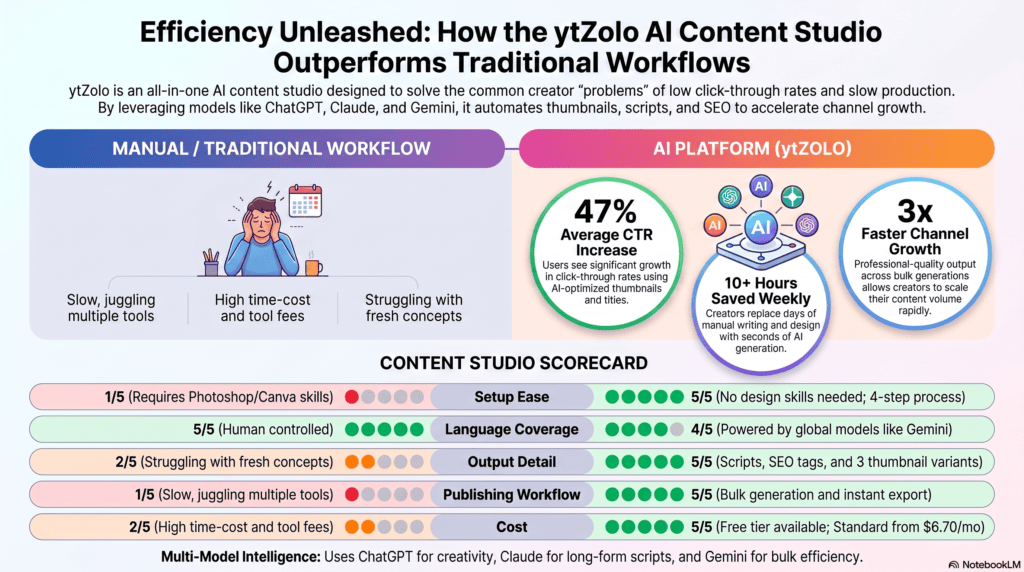
Reading this table, the honest takeaway is that “best” depends entirely on what you’re optimizing for — model control, simplicity, or workflow speed — not on any single tool being objectively superior.
Accuracy Compared
On clean, single-speaker audio, all three approaches land within a fraction of a second of true word timing, since they rely on similar acoustic modeling principles under the hood.
Where they diverge is on messy input. MFA’s speaker-adapted training pass can handle accent and recording variation slightly better once a custom model is trained on matching data.
Gentle’s confidence scores make it easy to spot low-certainty words quickly, even if the underlying accuracy on a given file is comparable to MFA’s default models.
AI platforms generally use modern acoustic models tuned across broad, general-purpose training data, which performs well out of the box but offers less room for deep customization on a niche dialect.
In every case, input quality still matters more than tool choice. Our guide on how to prepare audio for forced alignment covers the cleanup steps that move accuracy more than switching tools ever will.
Setup and Learning Curve
This is where the montreal forced aligner vs gentle decision usually gets made in practice, since most people evaluating both already know roughly what accuracy to expect.
MFA setup means installing Python, managing dependencies through Conda, downloading or building a pronunciation dictionary, and structuring your corpus into the format MFA expects.
Gentle’s Docker route is comparatively lighter — pull the image, run the container, hit its local web interface or API. Still a local install, but fewer moving pieces than MFA’s full stack.
AI platforms skip both. You upload a script and audio file through a browser, and alignment runs on the platform’s infrastructure, with output ready to export or feed straight into captioning and dubbing.
For a team without dedicated engineering support, that setup gap alone often decides which path makes sense, regardless of the underlying accuracy numbers.
Language Support
MFA supports a wide range of languages, and if yours isn’t already covered by a pretrained model, you can train a custom one from your own annotated corpus — a genuine advantage for regional dialects or under-resourced languages.
Gentle, by contrast, is effectively an English tool. Its acoustic model and pronunciation resources were built around English, and there’s no realistic path to retraining it for another language.
AI platforms typically cover major world languages out of the box — English, Spanish, French, German, Hindi, Portuguese, and more — without requiring any model training on your end. Our breakdown of the best languages to dub YouTube videos into has more detail on which languages currently perform strongest.
If your project needs a language neither Gentle nor a general-purpose platform supports well, MFA’s trainable models are genuinely the only realistic option among the three.
Cost Compared
Both Montreal Forced Aligner and Gentle are free, open-source software with no licensing fee attached to the alignment engine itself.
That “free” figure doesn’t include your own time, though — setup, dependency troubleshooting, and any custom model training all cost hours that have a real value, especially on a recurring production schedule.
AI platforms charge a subscription, but that price typically covers alignment as one feature alongside scripting, voice generation, SEO tooling, and dubbing rather than as a standalone line item.
For a single research project, MFA or Gentle’s zero licensing cost wins outright. For ongoing weekly production, the time saved by skipping setup and format-conversion work often outweighs a flat monthly fee.
Which Should You Choose?
Match the tool to the job rather than picking based on popularity. Here’s how the montreal forced aligner vs gentle vs AI platform decision typically shakes out in practice.
Choose Montreal Forced Aligner if you need phoneme-level output, you’re working in a language without strong pretrained coverage elsewhere, or you’re doing academic phonetics research that specifically requires model transparency.
Choose Gentle if you’re building a lightweight English-only pipeline, you want simple JSON output with confidence scores, and you’re comfortable running a Docker container without needing custom model training.
Choose an AI platform if alignment is one step in a larger, recurring publishing workflow — captions, dubbing, or audiobooks — and you’d rather not maintain a local install for something you run every week.
A useful gut-check: if your team already has ML engineering resources and needs deep model control, open-source wins. If the goal is publishing synced content on schedule without maintaining a codebase, a platform is almost always the more practical path.
Common Mistakes When Picking an Aligner
Choosing MFA for a quick one-off task. Its strength is custom model training and phoneme output — overkill if you just need word-level captions on a single English video.
Assuming Gentle covers your language. Its practical coverage is narrow, and forcing non-English audio through it produces unreliable timing.
Ignoring the publishing gap. Both open-source tools stop at raw TextGrid or JSON output. Someone still has to convert that into SRT, VTT, or a dubbing-ready format, which adds real time to the total workflow.
Skipping audio prep regardless of tool. Background noise degrades accuracy on MFA, Gentle, and platform-based aligners equally — cleaning your file first, through a voice isolator if needed, matters more than the tool choice itself.
Assuming sync tooling changes SEO outcomes. It doesn’t, directly. Our breakdown of whether caption sync affects SEO covers why timing accuracy influences rankings only indirectly, through watch time and retention.
How ytZolo Approaches Alignment
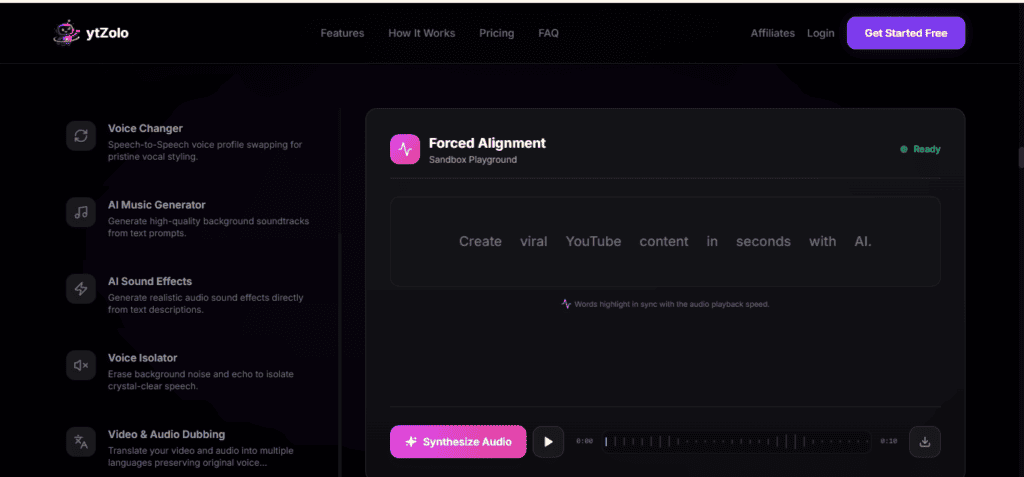
ytZolo runs forced alignment inside its Audio Studio as one connected step, not a separate tool you export files into and out of.
A typical flow looks like: clean a noisy recording with the Voice Isolator, generate or upload a script, produce a voice track with AI voice generation, run word-level alignment to sync captions or dubbed audio, then export directly.
That same Audio Studio also houses the Dubbing Studio for translating and localizing videos into new languages, AI music and sound effect generation, and a voice changer — so alignment sits next to the rest of the production stack rather than as an isolated step.
For teams weighing dubbing quality specifically, the AI dubbing accuracy guide covers what still benefits from a manual review pass even after alignment runs cleanly. You can see the full current feature set on the ytZolo features page.
Quick Decision Checklist
- Need phoneme-level timing or a custom-trained language model? → Montreal Forced Aligner
- Need a lightweight, self-hosted, English-only pipeline? → Gentle
- Need alignment as part of a recurring captioning or dubbing workflow? → An AI platform
- Working with noisy or overlapping audio? → Clean it first, regardless of which tool you pick
- Publishing in multiple languages? → MFA (with custom training) or a platform with broad language coverage; skip Gentle
- Short on engineering time? → A platform-based tool removes the setup step entirely
Frequently Asked Questions
Is Montreal Forced Aligner better than Gentle?
Neither is universally better — MFA offers phoneme-level output, custom model training, and broader language support, while Gentle is lighter to set up but effectively limited to English. The right pick depends on your project’s granularity and language needs.
Can I use Gentle for languages other than English?
Not reliably. Gentle’s acoustic model and pronunciation resources are built around English, and there’s no practical retraining path the way MFA supports for other languages.
Do I need Python experience to use Montreal Forced Aligner?
Some command-line comfort helps a lot. MFA installs through Conda and expects your corpus in a specific directory structure, so basic familiarity with Python environments makes setup considerably smoother.
Is an AI platform as accurate as Montreal Forced Aligner or Gentle?
On clean, single-speaker audio, accuracy across all three is comparable, since they rely on similar acoustic modeling principles. MFA pulls ahead only once you’re training a genuinely custom model on non-standard audio.
Which tool is best for YouTube captions specifically?
For a single creator publishing regularly, a platform-based tool is usually the more practical choice, since it skips local setup and produces export-ready caption files directly. Our caption generator guide covers that workflow in more depth.
Does Gentle still get updates in 2026?
Development has slowed considerably compared to Montreal Forced Aligner, which continues to see active releases. If you need ongoing support or bug fixes, that maintenance gap is worth factoring in.
Can I combine open-source tools with a platform workflow?
Yes. Some teams run MFA for a highly custom research pass and use a platform for day-to-day publishing — the two aren’t mutually exclusive, since they solve overlapping but not identical problems.
Does choosing MFA over Gentle affect my captions’ SEO?
No. Search engines crawl caption text, not which alignment tool produced the timing. Our detailed look at whether caption sync affects SEO breaks down where sync accuracy actually does and doesn’t factor into rankings.
About the Author
Anshika Verma is a Content & SEO Researcher at ytZolo, specializing in AI audio and video production technology for creators. She writes about voice AI, dubbing, localization, and alignment tooling, drawing on hands-on testing of forced alignment, transcription, and text-to-speech systems across the industry, including direct comparisons of open-source aligners like the Montreal Forced Aligner and Gentle. Reach her at anshika@ytzolo.com.

