
By Anshika Verma · Content & SEO Researcher, ytZolo · Updated August 2026 · ~14 min read
Quick answer: Captions themselves clearly affect YouTube SEO — search engines can crawl caption text, and creators have measured real ranking and view gains after adding them. But does caption sync specifically affect SEO? Not directly. YouTube’s crawler reads caption text, not the millisecond-level timing behind it. Sync accuracy affects SEO indirectly, through watch time, accessibility compliance, and viewer trust — all of which do feed ranking signals. Loosely synced captions still get indexed; badly synced captions lose the viewers whose behavior actually moves your video up the results page. Platforms like ytZolo build forced alignment directly into the caption and dubbing workflow, so sync accuracy is handled alongside scripting and SEO rather than as an afterthought bolted on at export.
Caption text gets indexed either way. Sync quality decides whether viewers stay long enough for that to matter.
Table of Contents
Does Caption Sync Affect SEO? The Short Version
Creators searching “does caption sync affect SEO” are usually really asking two different questions at once.
The first: do captions help SEO at all? Yes — that part is well documented.
The second: does the timing accuracy of those captions change anything? That’s where things get more nuanced, and where most articles gloss over the details.
This piece separates the two, using published data rather than assumptions, so you know exactly where to spend your effort.
How YouTube Actually Reads Your Captions
YouTube’s system can crawl the text inside your caption or transcript file, alongside your title, description, and tags. That text becomes additional searchable content tied to your video.
This matters because a caption file often contains far more spoken detail than a title or description ever could — names, numbers, niche terminology, and phrases a viewer might type into search.
Google’s own Search Essentials guidance is consistent with this: content that’s genuinely crawlable and matches what people search for has a better shot at surfacing, whether that content lives in a caption file or on a page.
None of this depends on frame-perfect timing. A caption block that’s a second late still contains the same words a crawler reads.
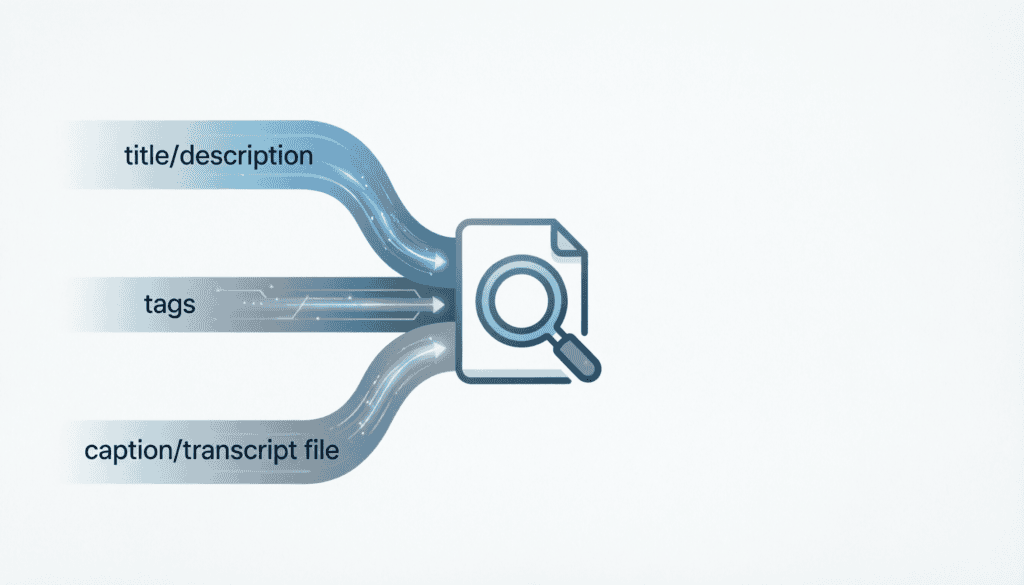
Caption text is one more indexable input alongside metadata — not a separate ranking track.
What the Data Shows About Captions and Rankings
This is where actual numbers exist, and they’re worth walking through in detail.
A widely cited experiment by Discovery Digital Networks tested whether caption text alone could influence ranking. The team searched for a phrase that appeared only in their video’s captions, not in the title, description, or tags.
The captioned video still surfaced for that phrase, and the channel reported a view increase in the two weeks after captions went live, with gains holding at a smaller but still positive rate afterward.
Facebook has separately reported that captioned videos saw a meaningful lift in view counts compared with uncaptioned ones, and an independent study by PLYMedia measured an even larger increase in views once captions were added.
None of these studies isolated sync quality as a variable. They tested captioned versus uncaptioned content — which tells us captions help, but doesn’t tell us whether tightly synced captions outperform loosely synced ones.
That gap is worth being honest about, since a lot of caption-and-SEO content blurs “captions help” with “perfect sync timing helps,” and the data only really supports the first claim directly.
What the Discovery Digital Networks Test Actually Isolated
It’s worth spending a moment on why that experiment is cited so often. The team deliberately chose a search phrase that appeared nowhere except inside the caption file — not the title, not the tags, not the description.
That design choice matters. It ruled out every other metadata explanation for a ranking change, leaving caption text as the only variable that could explain the video surfacing for that phrase.
What it didn’t test is whether the same video would have ranked differently with captions that were, say, three seconds delayed throughout. That’s a separate question the study wasn’t built to answer, and no widely cited public study has isolated sync timing the same rigorous way.
Why Engagement Metrics Matter More Than the Caption File Itself
Watch time and audience retention are consistently cited as strong signals in how YouTube’s algorithm surfaces content in search and recommendations.
Captions influence those metrics because a large share of video consumption happens with sound off — on mobile, in public spaces, or simply out of habit.
If sync accuracy affects whether a viewer keeps watching, it’s affecting a metric YouTube already weighs heavily, just not through the caption file’s crawl status.
Text vs. Timing: Where Sync Actually Enters the Picture
Think of it as two separate layers stacked on top of each other.
Layer one is the caption text. This is what gets crawled and indexed, and it’s where the studies above show a clear, direct SEO benefit.
Layer two is caption timing — when each line appears and disappears relative to the audio. This is where forced alignment and phoneme-level alignment vs. word-level decisions live.
Timing doesn’t change what gets crawled. It changes whether a human watching the video sticks around, understands what’s being said, and doesn’t bounce off in frustration.
That second layer feeds engagement metrics, and engagement metrics feed ranking. It’s an indirect path, but it’s a real one — and it’s the actual mechanism behind “does caption sync affect SEO,” rather than any direct crawl-time bonus for tight timing.
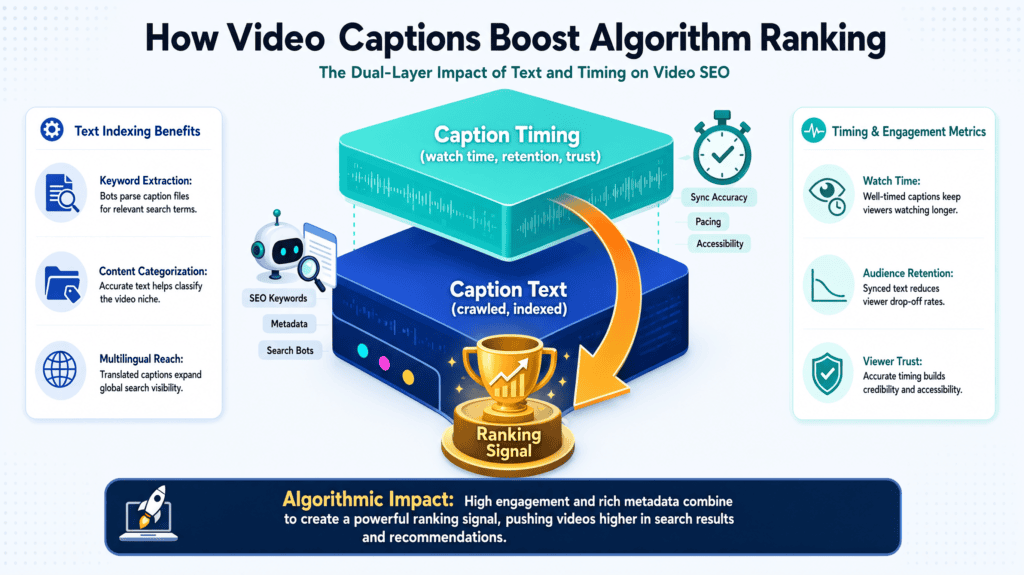
Text gets indexed directly. Timing influences ranking only through the viewer behavior it produces.
Does Alignment Granularity Change the SEO Outcome?
Short answer: no. Whether your captions were generated with word-level or phoneme-level forced alignment, the exported subtitle file still displays text at the word or line level, since that’s what SRT and VTT formats expect.
A search crawler has no way to detect which alignment granularity produced the file it’s reading. It sees the same word-timed output either way.
The only place granularity genuinely matters is downstream tasks like animated lip-sync, which is a production choice, not an SEO one. For nearly every captioning and dubbing workflow, word-level alignment is already the correct, sufficient default.
What Happens When Captions Drift Out of Sync
Drift is different from a caption file simply existing. A caption track can be technically present, fully crawlable, and still frustrating to watch if the timing has slipped.
The most common pattern is progressive drift — captions start on time but fall further behind as the video runs, usually because the video was trimmed, re-encoded, or had frames dropped after the caption file was generated.
A fixed offset across the whole file, by contrast, usually points to an export or frame-rate mismatch rather than an editing issue.
Either way, viewers notice fast. Research on muted video consumption consistently shows that most social video is watched without sound, so when captions and speech visibly disagree, viewers don’t read past it — they scroll past it.
That bounce shows up as lower average view duration, which is a signal YouTube’s ranking systems do weigh, even though the drift itself was never a direct penalty.
Fixing Captions That Have Drifted
The reliable fix isn’t nudging individual subtitle blocks by hand. It’s re-running alignment against the final, exported version of your audio, since even small edits shift every timestamp that follows them.
Our guide on how to prepare audio for forced alignment walks through the full drift-diagnosis and re-sync process step by step, including how to tell a one-time offset apart from ongoing drift.
How to Measure Caption Sync Impact on Your Own Channel
Published studies are useful as a baseline, but your own channel data will tell you more about your specific audience.
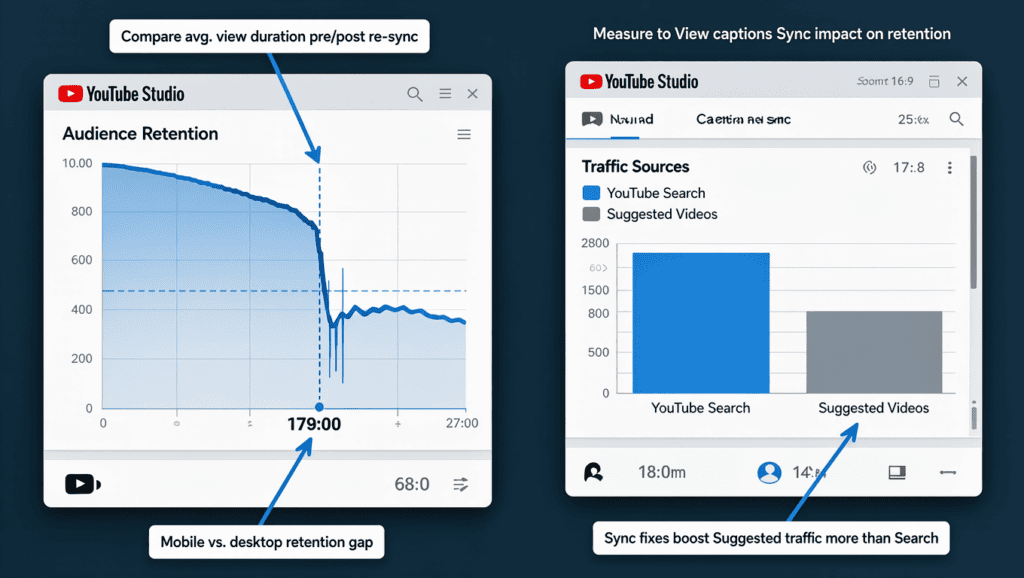
Check average view duration before and after a re-sync. If a video’s captions were visibly drifting and you fix them, compare retention graphs for the two weeks before and after the correction.
Watch the drop-off point, not just the average. In YouTube Studio’s Audience Retention report, a sharp dip at a specific timestamp often lines up with exactly where captions started lagging noticeably behind the audio.
Compare mobile versus desktop retention. Since a large share of mobile viewing happens with sound off, sync issues tend to show up as a bigger retention gap on mobile than on desktop.
Track search traffic separately from suggested traffic. Under Traffic Sources in YouTube Studio, YouTube Search performance reflects your caption and metadata text; Suggested Videos performance reflects engagement signals like watch time more heavily.
A sync fix should move the second number more than the first, which is itself a useful confirmation that the effect is engagement-driven rather than a crawl-based one.
None of this requires expensive tooling — it’s the same analytics panel most creators already have open weekly, just read with the text-versus-timing distinction in mind.
How to Keep Captions in Sync From the Start
Prevention is far less work than a mid-project fix, and it comes down to a handful of habits.
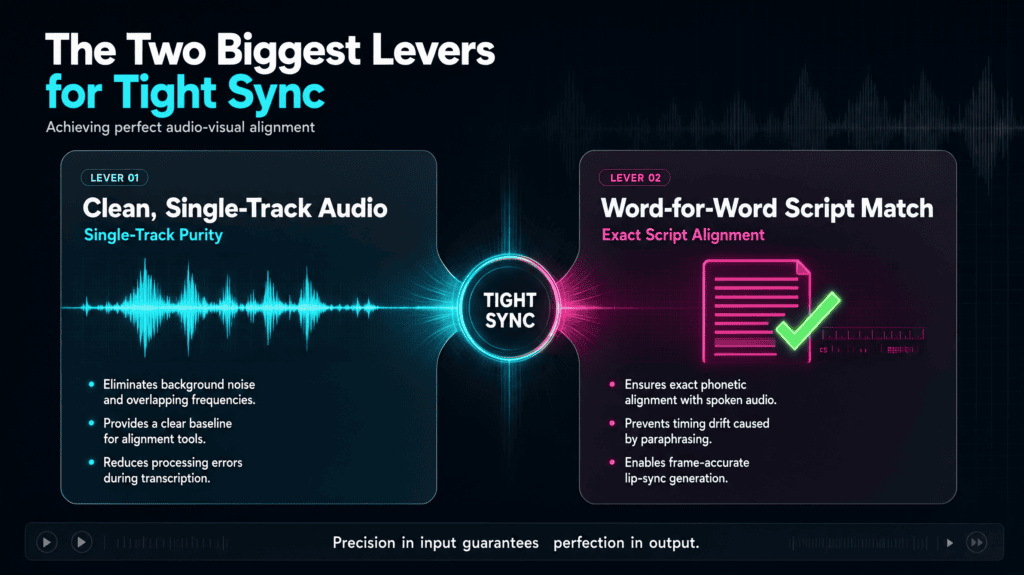
Clean your audio before syncing anything. Background noise and music under dialogue are the single biggest cause of alignment errors, so run noisy files through a voice isolator first.
Match your script to the audio exactly, including natural punctuation, since the aligner treats your script as ground truth and any mismatch becomes a timing error later.
Re-sync after every edit. A trimmed or re-encoded file needs a fresh alignment pass, not a manually patched timestamp.
Tool Choice: Montreal Forced Aligner, Gentle, or a Platform
If you’re weighing the Montreal Forced Aligner vs. Gentle vs. a platform-based tool, the SEO outcome is identical across all three, since none of them changes what search engines can crawl.
The Montreal Forced Aligner and Gentle are both solid open-source options for teams with Python or Docker experience who want direct control over the acoustic model. Setup is the trade-off — local environments, dependency management, and some audio-processing familiarity.
Platform tools run the same underlying alignment process through an upload-and-generate interface, which tends to suit creators who want captioning as one step inside a larger publishing workflow rather than a standalone technical project.
Pick based on your team’s setup and revision needs, not on any belief that one tool produces more “SEO-friendly” timestamps than another — that variable simply doesn’t exist.
Caption Sync and Accessibility Compliance
Accessibility requirements are a separate, non-negotiable reason to keep captions synced well, even setting SEO aside entirely.
The W3C’s Web Content Accessibility Guidelines require captions to be synchronized with the audio, not just present as text. A caption file that’s technically complete but consistently off by a second or two can fail an accessibility review.
There’s a knock-on SEO effect here too: accessible content tends to hold viewers longer, and longer, more comfortable viewing sessions feed the same watch-time signals discussed earlier.
Common Mistakes That Hurt SEO Indirectly
A handful of habits quietly undercut both viewer experience and the engagement metrics that follow from it.
Publishing auto-generated captions without a review pass. Automatic speech recognition can misread names, jargon, or accented speech, and those errors carry into your crawlable transcript too.
Skipping a re-sync after trimming. Even a small cut shifts every timestamp after it, and republishing without re-aligning guarantees drift.
Treating captions as an accessibility-only checkbox. Well-synced captions expand your searchable text and keep viewers watching — skipping the sync step leaves real engagement value on the table.
Over-optimizing the caption text itself. Google’s guidance on spam policies is clear that content stuffed with repeated keywords for search engines rather than people works against you, and that applies to caption text exactly the way it applies to a description field.
Ignoring caption sync on long-form content specifically. Drift compounds over time, so a five-minute video with a two-second lag looks very different from a forty-minute video with the same lag by the halfway mark. Longer uploads deserve a closer review pass.
Assuming one alignment pass covers every localized version. Each dubbed language needs its own alignment run against its own audio track. Reusing timestamps from the original language across a translated version is one of the fastest ways to introduce drift into an otherwise clean localization pipeline.
How ytZolo Fits Into This Workflow
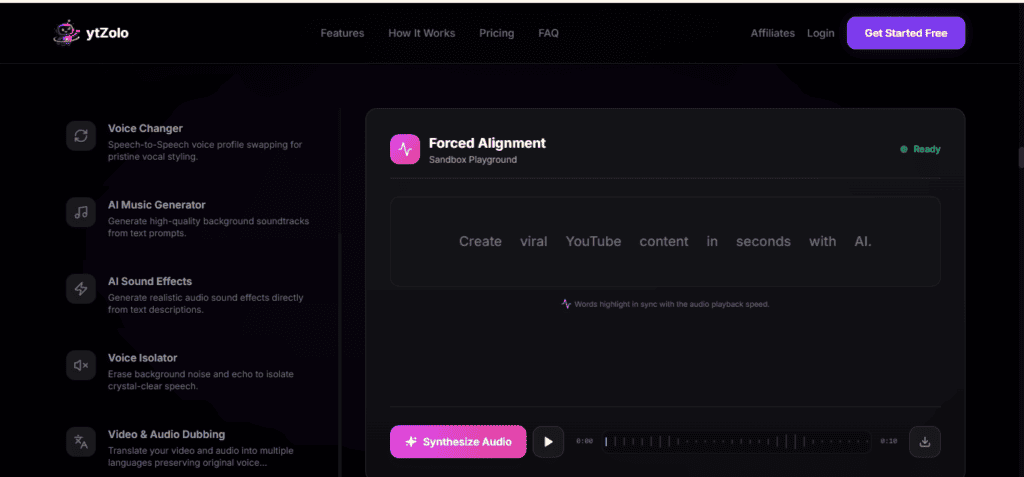
ytZolo brings caption alignment together with the rest of the audio production stack inside its Audio Studio, so sync isn’t a separate export-import step.
A typical flow looks like: clean the audio with the Voice Isolator, generate or upload your script, run word-level forced alignment to sync captions to the final track, and export — without switching between four different apps.
Because AI voice generation, the Dubbing Studio, and alignment sit in one platform, a re-sync after a script edit or translation change is a rerun, not a rebuild. The SEO tools built into the same platform handle the title, description, and tag side of the equation alongside it.
Quick Checklist
- Captions help SEO — this is backed by measured view and ranking gains, not just theory.
- Sync accuracy doesn’t change what’s indexed — the crawler reads text, not timestamps.
- Sync accuracy does change watch time — and watch time is a real ranking signal.
- Alignment granularity is a production choice, not an SEO lever.
- Drift is fixable by re-syncing against your final exported audio, not by patching timestamps by hand.
- Accessibility compliance requires sync regardless of any SEO consideration.
Frequently Asked Questions
Does caption sync affect SEO directly?
Not directly. Search engines index caption text, not timing data. Sync accuracy affects SEO indirectly, through watch time and viewer retention, which are ranking signals YouTube already weighs.
Will out-of-sync captions get my video removed from search results?
No. A caption file with drifted timing is still crawlable text. The risk isn’t removal — it’s viewers leaving early because the experience feels broken, which then affects engagement-based ranking signals.
Do I need phoneme-level alignment for better SEO?
No. Word-level alignment is the format search crawlers and subtitle standards already expect. Phoneme-level detail is useful for lip-sync animation, not for search visibility.
Should I use auto-generated captions or a scripted, aligned transcript?
A scripted transcript run through forced alignment is generally more accurate, especially for names and jargon, since the aligner treats your text as ground truth rather than guessing at unclear audio.
How do I fix captions that are already out of sync on a published video?
Re-export your final audio, re-run alignment against that exact file, and re-upload the corrected caption track. Manually nudging individual blocks rarely holds up across a full video.
Does adding captions in multiple languages change the SEO effect?
Each localized transcript is separately crawlable text in that language, which can extend a video’s reach to searches in other regions. Our YouTube video localization guide covers how that fits into a broader multilingual strategy.
How can I tell if my current captions are actually out of sync?
Watch the video at normal speed with sound on and compare speech to text in real time, rather than scanning timestamps on paper. Progressive drift usually becomes noticeable within the first two or three minutes if it’s present.
Is it worth paying for professional caption syncing, or is automated alignment good enough?
For most creator workflows, automated forced alignment paired with a short manual review pass covers standard content well. Professional syncing services tend to make more sense for overlapping dialogue, heavy accents, or client-facing deliverables where zero tolerance for error matters more than turnaround time.
About the Author
Anshika Verma is a Content & SEO Researcher at ytZolo, specializing in AI audio and video production technology for creators. She writes about voice AI, dubbing, localization, and caption tooling, drawing on hands-on testing of forced alignment, transcription, and text-to-speech systems across the industry. Reach her at anshika@ytzolo.com.
This article was researched and fact-checked against publicly available caption-and-SEO studies, Google’s Search Essentials and spam policy documentation, and W3C accessibility guidance as of August 2026. It will be updated as caption tooling and search guidance evolve.

